1935 Kirovsk
When we had managed to return to Khibinogorsk in the autumn of 1935, my schooling began. At first we could attend the national schools (if there were enough students for a class). I started by learning the Cyrillic letters. The Latin ones I already knew in part; mother had taught me to read from her Bible, an Estonian edition from 1895 and written in fraktur. (The only Russian text in it read: ”Approved by the censorship in Riga 1895” Actually it was forbidden to have Bibles, gold and precious stones in private possession, but….
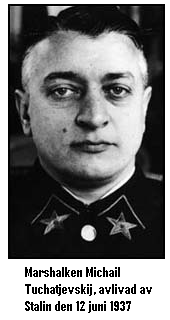
It was not only a lack of housing, the schools were also few and we had to do like the adults, study in two shifts: a morning shift from 8 a.m. to 1 p.m. and an afternoon shift from 1 p.m. to 6 p.m. The school building was somewhat better than the other houses, it was made of stone and I remember that on a wall up to the second floor hung a hero portrait of Marshal M. Tukhachevsky. The portrait disappeared from the wall a couple of years later, however, when the great purge of all higher officers began and none of the teachers could (wanted/dared) tell why. It was common in the late thirties for people to just disappear, without anyone wanting or being able to say anything. I heard (when the parents didn't think I was listening) that this and that person in a family had been taken away – always at night. Most disappeared without a trace. In a few rare cases the relatives could get in touch with the disappeared person, but that was more of an exception. I was involved in facilitating such a contact in Kirovsk sometime in 1937-40.
The son of an Estonian woman had been imprisoned and after a time the mother learned through a letter that he was held in the dreaded Solovetsky camp. The camp consisted of a number of desolate islands in the White Sea west of Arkhangelsk, the islands that had previously housed a monastery. Mother and son were allowed to correspond, at most one letter per month and only in Russian – a language which the poor mother did not master well either in writing or speech. She had never learned to write Russian and here began my career as an interpreter and translator. By then I had been in school for two or three years and knew the written Russian language quite well. Estonian I could read fairly well; my mother's Bible had been useful there, and we attended the first school year in Estonian. Until 1936 it was possible to attend school in one's mother tongue if there were teachers and enough students to form a whole class. Now, however, it was a matter of translating. She dictated in Estonian, I translated it into Russian and wrote down the letter - it worked. When she received a reply from her son, it was a matter of reading aloud what he had written in Russian, which she understood well enough. Neither the son's nor my writings were any literary masterpieces of the higher school; moreover, one had to formulate the text quite carefully so that the letter would not get stuck in the censorship. The slightest hint that the imprisonment (the sentence was never spoken of, the authorities acted by decree) was unjust or the least criticism regarding the state's actions led immediately to the letter either never reaching the addressee or arriving with large black strikethroughs. This correspondence continued for several years, right up until the Finnish Winter War 1939–40 had ended. As a reward I received a large glass of brew from her Volga mushroom, which she kept in a glass jar on the windowsill. The brew was sour and tasted very fresh and good.
In the spring of 1940 an order came to all inhabitants of foreign origin living on the Kola Peninsula, to gather within two weeks with all their belongings at the railway station in Kirovsk and Apatity and board the boxcars, which would be standing there ready for transport. Destination unknown - and no information about anything.
There has always been a shortage of premises in the Soviet state and the situation in Kirovsk was the same as in the whole Soviet Union. The school was a two-story building quite close to Stroitelnaya Street where the family was housed in a barrack for 15–20 families. The teaching, however, was nothing to complain about, except that geography and history were very one-sided and reflected only the Soviet society's view of existence. As the Stalin terror increased and Russification intensified, the foreign classes were abolished and the main language became Russian, which then continued throughout the entire school period.
At school I experienced something similar to what refugee and immigrant children experience today around the world. There were many nationalities mixed together; collectivization and confiscation were still ongoing in a quite tangible way. We still knew nothing of psychology and the popular terms and phrases like 'bullying', 'racism', etc., but took it for what it was. We fought with our surroundings in an old-fashioned, not to say good-natured way. No major injuries occurred, although I have a couple of scars from knife stabs. We 'foreigners' could of course fight among ourselves from time to time, but against the Russians we presented a very united front. They were like the main enemies, since they also formed the majority of the exiled, and it seemed entirely natural that great antagonisms arose between the 'foreign' and the Russian children. Through our parents we were unconsciously influenced to dislike Russians. As with all ethnic groups, one sees the large surrounding crowd as being much more stupid and simple-minded than the small ethnic group to which one oneself belongs. We 'foreigners' regarded all Russians as communists; that was not entirely correct, but because Russian was the language of the communists, even innocent Russians suffered. They were in as miserable a position as we were.
The rich Russian language has a lot of pejorative terms for non-Russians, but we were not slow to invent corresponding expressions about Russians. The Russian children called us Estonians, Finns and Ingrian Finns 'tjukhnas', people from the southern parts of Russia 'tjernomordnyje' (close to today's epithet like 'blackhead'), and we for our part were not slow to respond with various rhymes, of which the most popular went as follows:
-We are 'tjukhnas' since long, but you are just Russian sh...s. (Мы чухна уже давно а вы всё русское говно). Then we also used the bombastic Soviet abbreviations like RSFSR - the Russian Soviet Federative Socialist Republic (РСФСР – Россйская Советская Федеративная Социалистическая Ревпублика) which in our mouth meant anything but that, namely 'Русская Свинья Форсит Своим Рылом' interpreted as 'The Russian pig boasts with its snout', and CCCP – 'Совсем сумасшедший советский русский' – a completely crazy Soviet Russian. It wasn't only the Russians who teased us; everyone teased everyone and we, for example, pretended that we had forgotten what corn is called in Russian and always asked the Jewish children to say it in Russian.
How was it now? Kuku…. Kuu… If it was an inexperienced child, he/she pronounced the word "kukuruza", which as a rule led to a burst of laughter from the surroundings. Those who did not speak complete Russian (and there were plenty of such children) had difficulty pronouncing the word without it sounding guttural (influence from the Hamitic and Semitic languages) and when it did, we others laughed uncontrollably. The same applied to Ukrainians and southern Russians, with the popular name "khokhly". Mikhail Gorbachev, who is from southern Russia, would have fit in as an ideal target for teasing for us in Kirovsk. In the same group would be included both Khrushchev and Brezhnev. With the Muslim children there were additional forms to tease with. One folded a garment to resemble an ear and said: oink, oink, suggesting that they were pigs. Religion was certainly forbidden, but the parents surely held to Islam and the children were sensitive to such outbursts.
There were some children of Asian origin (from Kazakhstan, Turkmenistan and from the Caucasian regions). We would trick them into saying words that contained 'r' or the phoneme 'y' ('ы' as in the word 'пыль'). For many Asian 'Russians', especially of Mongol origin, 'r' and 'l' are the same sound, and again laughter echoed between the barrack walls when we had managed to trick some Asian boy or girl into pronouncing the word so that it sounded roughly like when Rune Moberg's manager in the series 'Lilla Fridolf', who also could not distinguish between these two phonemes.
The living spaces in the barracks were small; they consisted of just a single room of 10–12 square meters with a stove in it. There was no play space and most of the free time not taken up by homework or time with parents was spent outside on the street. Stroitelnaya Street was not a big street and we amused ourselves by guessing car brands, but traffic was sparse. We rolled hoop wheels and played with phosphorus. As a byproduct in apatite mines they obtained phosphorus, and during transport of the apatite from the mine further away to the factory for processing into fertilizer, rather large pieces could fall from the trucks' and railway cars' flatbeds. The trick was to find a good, clean piece of phosphorus, throw it up in the air and enjoy the glow that appeared when the phosphorus upon falling began to burn through friction with the air. The only thing was not to get in the way of the burning piece; it could cause quite nasty and hard-to-heal burns if one happened to come into contact with the heated phosphorus.
The Soviet school at that time, considered as an educational institution, was a very good establishment. Admittedly we had Marxism-Leninism to contend with, but most parents unconsciously laid down a certain counterfire against the propaganda and we did not take too much harm from it. The conditions were such that even relatively young people soon discovered the discrepancy between theory and reality. There was no corporal punishment, but there were other methods of maintaining discipline. The first reprimand was given to the student himself; upon repeated disobedience or lack of progress in school, he or she (mostly a he) got a note to the parents. They were to take note of the message and write their signature on it to indicate they had taken notice of the reprimand… If these two measures did not help, the parents were summoned to the school director, and he read them a lecture in which he impressed upon them the importance of ensuring that the child makes an effort to do homework and be orderly in school. If the student did not manage the homework, the student had a chance to repeat the grade, but if one was careless and rowdy, it led to expulsion and forced labor in some institution. In such cases, the game was usually over for that person. Practically no greater opportunity to resume studies at a later time was given. The tribulations for better grades I remember in the following song:
Отлично, отлично, заветная птица Excellent in grades is a dream
Ты так далеко от ребят which for us is distant (and unattainable)
Отлично и «хоры» во сне лишь нам снятся excellent and good we can only dream about
А двойки в журнале стоят while Fs stand in the class book
Я помню товарищ как ”физик” гонял нас Doyourememberbuddy,how ”the physics teacher” chasedus
Когда проходили мы «Ватт» When we were going through 'Watt'
Тогда нам обоим по двойкe досталось then we both got only a two
За то, что плели наугад. For that we bluffed with guesses
A certain collectivism (like the mandatory demonstrations on May 1st and November 7th) could not be avoided, despite our parents' clarifications of the system and its propaganda machinery. It was not a matter of voluntariness; everyone was ordered out on ceremonial occasions. An event from 1938 has left a lasting memory.
The Russians had had a polar expedition in the Arctic Ocean for 234 days. When the ice floes with the camp drifted too far south and the members of the expedition risked perishing, they were picked up by plane from their long stay in the Polar Sea. The rescue took place in April 1938 and in connection with the May Day celebrations, the four expedition members with Ivan Papanin at the head were to stop over in Kirovsk and be honored for their achievements, while at the same time they were to make propaganda for the Soviet Union's polar research. We were ordered out to the parade, where the gentlemen were to be guests of honor. Papanin was to give a speech and tell about his exploits. I was squeezed under a banner near one of the banner's poles, which was carried by a student from a higher grade. When we had stood there for a while listening to Papanin, he turns to me and says:
-Maltjik! (my boy) hold this for a moment, I'll be right back, and handed the banner pole to me. I took hold of the pole and then I had to stand there for a couple of hours. The man didn't come back. Sometimes politeness and friendliness literally become a burden. The members of the expedition were named Heroes of the Soviet Union, a rare distinction before the war, later there was inflation in hero nominations. (Brezhnev became a 5-time Hero of the Soviet Union).
I lived alone with my parents. My brother Karl worked in the mine and had moved to another apartment, and my sister Alida had moved to Montjegorsk to learn tailoring. The apartment was a single room along a corridor with about 20 other rooms. There was a common kitchen at one end of the house and a dry toilet at the other, each room also had a heating stove which was also used for cooking. For the most part, my parents worked in two shifts and I had to be quite alone when they had shift at the same time. For my parents, there were no other leisure interests than to work and stand in food lines to buy food. Both father and mother worked as guards at a cement factory and when mother was home from work she did handwork. Relatives and neighbors from the home district sent her wool, she carded and spun. I remember the spinning wheel humming almost constantly. The harsh times did not prevent fashion from taking its course. During these years, large white wool shawls were very popular. All party members' wives had to have such, it was the "dernier cri" of the time. Wool had become a scarce commodity. Mother bought wool from relatives who remained in the former home districts, processed the material into thread and turned the wool into these popular garments, which she sold with very good profit – preferably to the party bosses' wives – it was they who had money. When the weekly salary for an ordinary worker was around a few tens of rubles, mother could get up to 500 rubles for a white shawl. White was the most popular and commanded the highest prices, but other variants also sold, though not at the same high price.
For a lonely child with parents at work, there was a lot of reading: all of Jules Verne's books from 'Captain Grant's Children', 'The Mysterious Island' and ending with the book about the journey to the moon. Sven Hedin's 'From Pole to Pole' was almost standard reading in school. There were some exciting passages about how Sven Hedin and his men struggle in the Gobi Desert. The water was gone and they are about to die of thirst. Some remain behind, but one of them fights and eventually reaches a river, drinks his fill and returns with water in a boot, since he had no other vessel to carry water in. A couple of other books have also left a lasting memory from childhood. One was a Wild West story titled 'Rider Without a Head' (Всадник без головы) by Main Reed and the other was 'The Quest for Fire' (Борьба за огонь). The latter is about Stone Age people and the history of fire, about the tribe's difficulties in preserving fire during the migration and the struggle to reacquire it from other, hostile tribes upon loss.
The city library was located in the center on the main street Industrialnaya, and there was also the sauna, which I visited together with father every Saturday. In connection with the sauna visits, there was also a visit to the library. One exchanged books, but not just anyhow. Some books were part of school reading and often it happened that the librarian asked about the book's content. If you couldn't account for it, you got a reprimand for having worn out state property without reading them.
In winter there was skiing and ice skating. The Kirovsk area is quite hilly, it consists of the easternmost part of the Fenno-Scandinavian mountain range. There were plenty of slopes and in winter we skied eagerly. There were no children's skis, of course, but we used the adults' large, almost 2-meter skis from days of yore. The bindings consisted of a leather strap through the ski. To keep the binding from slipping off the felt boot, we stretched a piece of cut rubber strip from a car inner tube over the toe of the felt boot and to the heel. There could naturally be no steering in the true sense of the word, you stood on the skis and pushed off. For the most part there were ready-made tracks and you had to keep to them. Sometimes the skis slipped out of the track and when it seemed that a collision with some dwarf birch or dwarf pine would be inevitable if the journey continued in the same direction, the direction was changed by a sideways movement on the skis. Most of the time it went well.
One of the spring and autumn amusements for small children was when the Sami arrived in town. When the first snow fell sometime in September-October, the Sami came from the inland to the town to provision. It did not happen with one reindeer per sled, as is customary in the rest of the Nordics, but with 6 reindeer, some kind of double troika in reinforced model after collectivization had been carried out even among the Sami. The rig consisted of six reindeer in tandem harnessed to a fairly large sleigh with a big platform, and with a couple of reindeer behind to brake the sleigh. The terrain on the Kola Peninsula is not very hilly and allowed such means of transport. On the platform rode a black Lapland dog and when we boys tried to sneak a ride on the sleigh, the dog came rushing to chase us away. The platform was quite large and when one of the boys sat on one edge, he could ride a couple of meters before the dog came rushing. When the dog ran to one end of the platform to chase away the stowaway, some boys on the other side could ride a couple of meters before the dog got there. It happened that some child didn't get away in time and was lightly bitten, but the thick clothing meant that there were no serious injuries. Sometimes the dog itself slipped off the platform in its eagerness to chase away the free riders.
During a film shoot, where a dog sled was supposed to come driving into the town, the dog sled happened to collide with the reindeer team at a street corner and there was a great commotion. When the collision was cleared and the tangled traces from the different rigs sorted out, a couple of dogs had died from the kicks of the frightened reindeer during the turmoil.
There were some quite high peaks around Kirovsk, at least they seemed so seen with a child's eyes. There was one in particular that I wanted to climb, but it was too far away and from school there were no organized hikes, especially not for those who did not belong to the 'Pioneers', i.e. the communist youth organization scouts. At the risk of being pestered, my father did not want me to wear the red scarf that all children in school were given. I hid mine under the mattress and mother must have found it and thrown it away, I never saw it again.
Of course you got bullied, but I was not entirely alone in this. There were several of the ethnic minority children who were in the same predicament and no one took it very seriously. If the bullying does not go too far, it does not seem to cause any great harm, the bullied person becomes thoroughly hardened and can later in life withstand quite large stresses. For my part, I became somewhat of a 'curmudgeon against the stream'. Other boys started sneaking cigarettes, but since I was not in any gang but was a lonely 'tjukhna', it became completely natural for me not to act in the same spirit as the others. It has actually helped me a lot in later stages of my life.
Although Kirovsk is near the Gulf Stream, it could still get very cold in winter. During the time of the Finnish Winter War 1939-40, the temperature dropped far down and some days it was so cold that we did not have to go to school, even though the distance was not very far. We had no thermometer, but it was said to be minus 42-45 degrees. In the residential barracks there was no water, it had to be fetched from a water post at one of the street intersections, but at some times the cold was so severe that even the water pipe froze and the housewives had to melt snow for cooking.
Although the mountains around Kirovsk are not particularly high, avalanches occurred now and then. One winter, three of our neighboring barracks were swept away. Fortunately, our barracks was farthest from the slope and stayed completely intact. The avalanche occurred at night while everyone was sleeping and resulted in a hundred people reportedly dying on that occasion. The overcrowding was great and contributed to the large number of casualties.
Some of our relatives, who were not farmers or independent craftsmen, still lived in the Pustaperzha area, among them father's only sister Anna (married Toode). In 1939, the parents received an inquiry from the aunt in the collective in which she lived in the former home district, asking if they could send me down to Pustaperzha to herd the collective's cows, sheep and pigs during school vacation. It would be a health injection with plenty of food and fresh air as a change from the cold and lack of vegetables and fruit that prevailed up north. There was no one who could accompany me, so I was sent alone from Kirovsk to Leningrad, a journey of two days. In Leningrad, some relative was supposed to come and help me with the train change to Pskov. The conductor on the Murmansk-Leningrad train had told that during the journey I had fallen from the middle bunk, but apparently had not sustained any serious injury from the fall. For me, the summer of 1939 at Aunt Anna's passed under the sign of herding. The collective's red 'something' was a small collective, consisting of my father's and a couple of neighboring farmers' farms. The collective had 8 cows, some calves, a number of pigs and 72 sheep. From the parental farm I remember that the only thing left of everything was a large stone foundation after the cowshed and stable, and a somewhat dilapidated root cellar with a birch tree growing on the roof. The sauna, in which I was born, was no longer there.
Herding the collective's livestock was not a burdensome task, but the days were long and at the age of 10-12 one needs a lot of sleep. The livestock had to go out early in the morning and the cows were brought in for milking in the middle of the day. There was a couple of hours' break for the cows, meal time for me, and then departure to the barn, where I was to take a midday nap. The early rising was of course a bit problematic, but before the kind aunt woke me, she had already dressed me – even the shoes were put on when I had to get up. After breakfast it was just to let the animals out and make sure they didn't stray into the grain fields.
The Post family, with whom my aunt and I lived that summer, were old neighbors. In the autumn my father Jaan came from Kirovsk and Emely Post, accompanied us back to Kirovsk. The son had fallen in the war and the husband had been exiled to the Kola Peninsula and died there. After the war, she also moved to Estonia and lived for many years in Pôltsamaa. Aunt Anna rented a room from the Post's relatives.
When my father came to Novoselje in the autumn of 1938 to fetch me back to Kirovsk after the summer's events, the Russians had just 'liberated' Estonia (Mototov-Ribbentrop pact) and one could hear Estonian spoken and sung through the loudspeakers.
These loudspeakers in the Soviet Union were a chapter in themselves. There were always plenty of them, usually mounted on poles in residential areas and sometimes even inside barrack corridors. In Kirovsk, the loudspeaker in the corner of the corridor was almost always on. Sometimes, when someone became too tired of the propaganda and all those marches 'inspiring' socialist work and announcements of production figures and harvest results within the progress of the five-year plan, which poured out of the device, the wire was cut. However, it did not take long before the zealous party members had repaired the loudspeakers; other things that needed fixing did not go as quickly.