Borås spring 1947
Pictures48 j
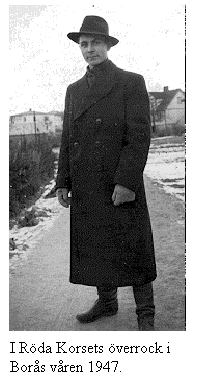
Efter having finished as a metalworker at Svensk Stålpressning in Olofström and traveled to Borås, I started working at Algots Syfabrik at the assembly line for trousers sewing. The sewing team produced between 800 and 900 pairs of trousers per shift. Algot Johanssons Konfektion was known under the slogan: "Say Algots, that is enough." The woman who was the supervisor was herself a refugee and spoke Russian, so I had no difficulties with the language. At first, she placed me somewhat aside with a sewing machine and told me to practice sewing straight seams. I had strained my sister's hand-cranked sewing machine in Far Karelia by sewing small leather bags and thought it was no difficulty to put together a pair of cloth patches. Here one could hold the fabric pieces with both hands, so that was no trick to sew then, I thought. The woman also thought so, and already in the afternoon she placed me at the line, where I was to sew the inner long straight seam in the trousers.
Professional sewing machines make quite a few stitches per second, and it did not take many seconds to finish that seam. You clamped the flap under the presser foot, stretched the fabric out behind your head, and stepped on the pedal. After about ten seconds, the seam was finished. Each worker on the line performed a single step, but for those who did not master the craft, it could become quite tough; the pile of unfinished garments used to grow beside the lines. After a while, I became a "reserve," i.e., I was placed as a helper in the spots where the seamstress (mostly women sat at the lines) could not keep up. We worked 45 hours a week with 10 minutes of break per hour. The wage was 45 kronor a week. In the mornings we had the radio on for one hour, it was the program "Music during Work" which ran between 10 and 11 and mostly ended with some march. There were many familiar tunes: "Alte Kameraden," "Entry of the Gladiators," "Florentine March," "Per aspera ad astra," etc.
The sewing work was done by the younger male and female workers, while pressing was usually done by somewhat older men. There were no canteens like those of today; we had to eat our sandwiches in the changing room or go out into town for lunch. The workforce consisted of many different nationalities (mostly foreigners), and at regular intervals certain situations arose (amusing to some and annoying to others). A large part of the refugees were from Southern and Central Europe, predominantly Jews, Poles, and the occasional Russian or Ukrainian, which immediately led to tensions. One of the most common and frequent jokes during lunch breaks was perpetrated by an older Ukrainian. Next to him in the changing room during lunch breaks he had a Jewish man, an older patriarch with orthodox ideas about dress and appearance, meticulously following Jewish rituals as far as possible. He cultivated his side curls, which had been cut off for a long time, and wore a large black overcoat with a matching black wide-brimmed hat. He had not had much opportunity during several years in the German concentration camps to study the Talmud and practice his religious rites. Now he was especially eager to follow all the rituals of the faith to make up for his religious karma for all the time that had been lost. He was subjected almost daily to the Ukrainian's attacks.
The Jew was faithful to his kosher ritual and did not eat pork; he mostly had vegetables and garlic on his sandwiches, while the Ukrainian's sandwich spread consisted mainly of fat, quivering pork. (Russians and Ukrainians – salo = pure fat)
- Do you hear, Moses! (David, Simon or something else depending on the mood) the Ukrainian used to say, shouldn't we swap sandwiches, my wife has only made pork sandwiches for me and you only have vegetables on yours, if we swap we will get a taste of each other's, it will be a bit of variety.
Between Ukrainians and Jews there has always been a certain racial aversion, and such jokes did not improve the situation. The Ukrainian was also a master at telling anti-Semitic stories; not a day went by without some intermezzo.
One of the Ukrainian's favorite stories was the following:
A member of the Mosaic congregation, old David, was on his deathbed and his entire large family stood by the bed to bid him farewell before his impending passing. David asks:
- Is Sara here?
- Yes, Sara is here.
- Is Rebecca here?
- Yes, Rebecca is here.
- Is the whole family here? David continues his questioning.
- Yeees, the whole family is here, dear father.
Then the old Jew sits up in bed, looks around and exclaims:
- Who the hell is minding the store then?
Although most had already heard the story several times, people laughed at the Ukrainian's joke; it seemed somehow entirely natural to laugh at the different national peculiarities. The Jews, and not only them, have always been targets of what is today called "bullying." At that time, none of us thought that way; it seemed entirely in order that a deep aversion existed between the different peoples, and people joked about each other's nationalities. The Russians joked about the Finno-Ugric peoples and called them "tchuchnas," about Ukrainians, who were called "khokhly," and everyone joked about the Jews and called them "zhidy" – a derogatory term.
No direct animosity seemed to exist, but there was bullying, of course. It is only later that one has begun to emphasize and pay attention to this "racial discrimination." The Swedes did not escape either; when a conflict arose between a Swede and a refugee, the refugee was always given the epithet "bloody foreigner." The terms "svartskalle" and "chokladtomte" and "kåldolme" (about Muslim women) had not yet been invented, and there was hardly any talk of racial discrimination. I myself never had a feeling of being more of an outsider than what refugee status led to. For our part, it did not show on the outside that we were strangers; racial discrimination came only when too many dark-skinned people arrived in Sweden. We: Estonians, Russians, Ingrian Finns and others, North and Central Europeans, did not differ too much from the Swedes either in appearance or mentality. Perhaps some of us were a bit darker in hair and skin color, but nothing that affected the public's thinking about races. The real racial discrimination came only when the Vietnam deserters began to arrive with the hippie and drug culture, which has since continued in a worrying way. Fundamentally, we are all more or less racists. The extent to which this happens depends on the economic situation, the number of "less desirable blackheads" and media influence, but most of all on unemployment. The Swedes are by no means exempt from this phenomenon, regardless of what party representatives say and claim (representatives who in some respects do not represent the opinion their voters hold). When reality catches up with them, they fall silent.
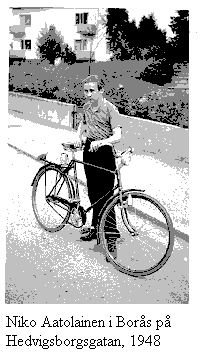
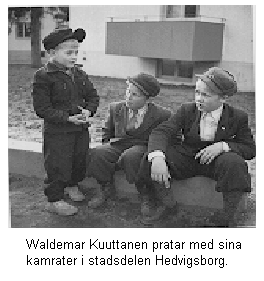
Where many people gather, controversies always arise; Algots in Borås was not free of such things either. Most of those who worked at Algots lived in the Hedvigsborg district, where newly built houses, immigrant ghettos, were located, inhabited almost exclusively by refugees. Transport (a distance of about 2 km from the center) was by bus, and along the way certain unpleasant, borderline (as one would say today) racist intermezzi could sometimes occur. With Southern Europeans came new eating habits, new dishes and exotic spices, including garlic, which the Northerners were not used to, and this led to certain rearrangements in bus traffic. Northerners do not use garlic to the same extent as people in Southern Europe, and one of my workmates at Studsvik, a Frenchman, said that he did not know garlic smelled bad until he came to Sweden. The breath in the bus where there were Southerners, and especially Jews, could sometimes be extremely strong. Gradually, a very irritated mood developed; the "white" people refused to ride the same bus, and Borås' bus company had to provide double transports – one bus for the garlic-eaters and one for the others. After a while, even the driver of the garlic-eaters' bus protested, and the company had to bring out some of the oldest buses, where the driver sits in his own little cage.
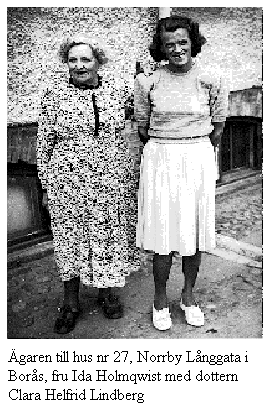
The first week after my arrival from Olofström and Svenska Stålpressning, I stayed with the Aatolainen family, then I got a shared room at Norrby Långgatan 27 with Mrs. Ida Holmquist. My roommate was Robert Felszegi – a Hungarian-Jewish youth, but I did not see much of him at first, literally.
He had been rescued from the concentration camp through the Bernadotte relief, weighed about 50 kg (height 183 cm) and had his head bandaged due to an ear infection. At first I only saw his eyes, and it was not until several weeks later that I could see what he really looked like.
Ida and her daughter Helfrid took very good care of me. With them, it was integration in the full sense of the word. There I learned Swedish, and it went relatively quickly. Robert was not as often at home with Ida and Helfrid; he lived a more traditional European lifestyle and was out a lot in social circles. When I moved from Ida Holmquist during the last days of May to begin working at the Länghem peat bog, I could manage on my own regarding the language (even though it was still quite halting).
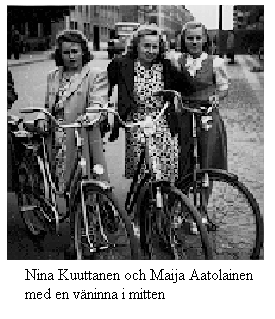
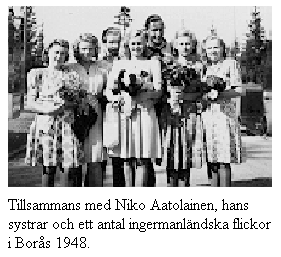
In every person's life there seem to be a number of "guardian angels" or "good fairies," and I have had quite a few such people who helped me on the bumpy path of life. In Far Karelia it was Olli Naukkarinen, in Finland in Joensuu the principal Paavo Ansas and his wife Aili, in Tampere Aune Laine and her sister Aili. In Sweden it became the Aatolainen family and Ida Holmquist with her daughter Helfrid, as well as Helge Johnson and later in Falkenberg Gertrud Damberg. While it is happening, one perhaps does not think so much about the debt of gratitude one is accumulating; unfortunately, one usually discovers it too late, and one does not have time to thank for the help; many are already gone from this life. Several more could be named. Old Mrs. Malmqvist in Köping, who let me stay in her basement (prepared as a shelter) when my money ran out and I had neither rent nor tuition. The landlady at the "Esplanad" boarding house and the tenants at Esplanaden 5, who could hardly have avoided knowing that they had an extra tenant living in the basement, but said nothing to the landlord or authorities in Köping; and all the nice waitresses at Café Odenryd in Köping, who supplied me with bread and the previous day's pastries during my studies there, among others. We all remain in debt to our surroundings in one way or another.
Mrs. Ida Holmqvist left a tangible memory; she is part of a fountain pen that I still have and use now and then. With it I have "written" my way through Katrineberg Folk High School and Köping Technical Institute. All my life I have had a certain fondness for writing instruments, especially fountain pens. All other variants have come and gone: steel nibs, ballpoints, etc., but fountain pens have remained. My first one I received as a gift from the Äänislinna (Petrozavodsk) City Orchestra on our tour through Finland in December 1942; it was of the brand "Kaweco" and did not last long—a wartime product as it was from Germany. I brought it with me to Sweden, but after a while it began to leak and I had to stop using it.
In late summer 1948 I again stayed for a while with Mrs. Ida Holmqvist and was about to turn 20. We talked with each other every evening, and it came up that my birthday was approaching and that I was going to buy myself a fountain pen to mark the great day. I had been looking at some fountain pens and fell in love with a Sheaffer from W.A. Sheaffer Pen Co., Fort Madison, USA. The nib was iridium with a part of gold on which it said "Lifetime," 14 K. However, it cost far too much given my somewhat meager finances, around 80 kronor, which was a large sum of money when my earnings at the Weaving Company's spinning mill were about 50 kronor per week. Mrs. Holmqvist knew that my birthday was coming and asked if I wanted to celebrate my birthday with them; she and her daughter Helfrid would treat me to coffee on the occasion of the festive day. We came to talk about what I would buy myself for my birthday, and I said it would be a fountain pen. She saw me at the desk now and then—I corresponded frequently with Mrs. Ansas in Finland. A few days before the birthday celebration, Mrs. Holmqvist handed me an envelope. When I opened the envelope, there were 40 kronor in it.
– It is a contribution to the fountain pen, said Mrs. Holmqvist.
When her daughter Helfrid found out about it, she exclaimed: – Goodness! We have never received more than ten kronor as a birthday present; you must be popular with Mother!
It was indeed a generous gift, especially considering that Mrs. Holmqvist did not have such a good economy after all—her husband had passed away and left her with the house and large debts. The pen was a lucky find; it still works, 50 years after acquisition—even after a regrinding of the nib. The pen happened to fall on the floor once and was damaged, but I managed to file a new tip. The reservoir is still tight and holds about 3–4 ml of ink, more than any other fountain pen. It is not often that a "Lifetime" guarantee (as it says on the pen) matches reality, but here it is true for once. A while ago I wrote to the company in America and thanked them for the guarantee, but the company had presumably ceased operations, as I never heard anything from them.
Recordings
- 1947B0råsVårenA.mp3
- 1947BoråsvårenB.mp3