Borås autumn 1947
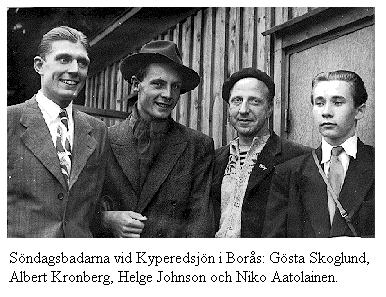
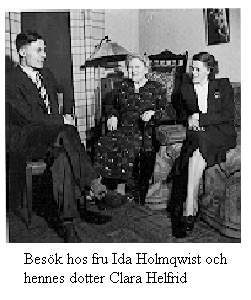
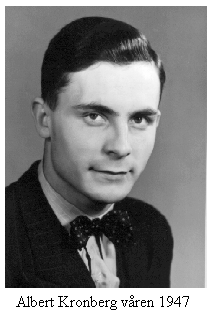
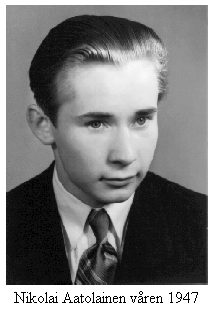
When autumn came and the work at the peat bog ended, I was offered a job at Borås Wäfveri AB. At that time it was a large firm with several branches both in Kinna and in Skene. I was allowed to choose whether I wanted to work in the spinning mill or in the weaving mill. I chose the spinning mill. Now I did not have any accommodation because Mrs. Ida Holmquist had in the meantime rented out the room to another Algots employee. Once again I lodged with the Aatolainen family in Hedvigsborg. It did not, however, take long before I became acquainted with a man from Dalarna from Mora - Helge Johnson - and he invited me to stay with him in his digs in the Wäfveribolagets residential building "Järnbäraren" at Norrby Långgata 39. "Järnbäraren" (a block name) was a horseshoe-shaped multi-story building in the same district as Wäfveribolaget and was inhabited mainly by those who worked at the company. A "dig" it truly was. Sometimes I wondered why Helge wanted to have such trouble with me, but he was good-hearted, sociable and we got along very well despite the somewhat cramped accommodation.
Something similar would be needed even today, but the attitude toward foreigners has changed since then. But today the foreign population is of an entirely different kind and the differences in both mentality and religion are so great that something similar seems to be impossible. The floor area of the digs could not have been much more than 20-22 square meters: a tiny room and a minimal kitchenette. Helge liked flowers and we had barely daylight through the small window for all the flowers. To make matters worse it was a top-floor apartment and the window niche was not excessively large. In fact there was no room for two, there was simply not enough space for an extra bed. The problem was solved, however, with a mattress in the wardrobe, which I brought out in the evening and it was no great bother. The company provided the bedding, there was a change of sheets, towels and pillowcases every other week. In this way I lived with Helge for several months, yes, even in several stretches when I, like a migratory bird, had nowhere else to go. With today's thinking I think we would have been labeled as homosexuals, but that was not at all the case. It was a normal comradely relationship.
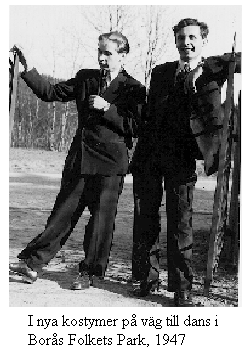
I do not remember that we ever quarreled. Helge was something of a clothes snob and it was with him that I went to a clothing store in Borås on Långgatan and bought my first suit for 185 kronor.
Helge was a "love martyr." He had been in love with a girl (and probably still was) but she married another man and Helge could not get over it. He had her portrait hanging on the wall the entire time I knew him, even after he had retired and moved from his digs.
At the time of his retirement the Järnbäraren block was demolished and Helge got a one-room apartment in the newly built Norrby district. The district was a typical 1970s construction and Helge's apartment was on the 5th floor of a high-rise.
After a while the room at Mrs. Ida Holmqvist became free and I was able to move in there again. Later, when her finances had stabilized after her husband's suicide, she no longer rented out the room to anyone else and I always had a refuge with her. She also began to grow old and had difficulties with her outdated apartment; I helped by carrying up coal, sawdust (for heating) and taking out the trash bucket.
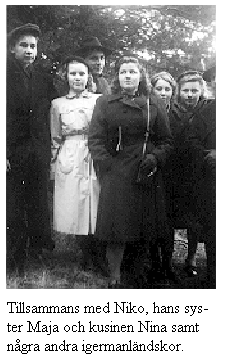
Now both Niko and I began to take part a bit more in nightlife and visited Borås Folkets Park almost every week to dance to Leif Kronlund's orchestra. Jitterbugging was in fashion and we practiced it diligently - mostly with Niko's sister Maija and their cousin Nina Kuuttanen. I remember having to buy an extra pair of shoes that summer.
Thanks to Helge's efforts, the workmates in the spinning mill and in conversations with Mrs. Holmqvist, by this time I mastered the local "native tongue" very fluently. The workmates in the spinning mill were mostly Swedes and the nature of the work was such that it provided ample opportunities for practice. The noise level was certainly very high, but that only contributed to the fact that one had to listen a bit more carefully to understand and oneself articulate clearly so that the others would understand what one meant.
The work consisted of changing bobbins on the spinning machines, at different time intervals depending on the nature of the work in progress at the time. Sheeting yarn took about 15 minutes between changes while on the night shift (we worked three shifts) mostly worsted yarn was spun and then the bobbin changes were not so frequent. If the shift was lucky the previous team had changed the bobbins before they went off shift and then the spinning machine ran for 8 hours without a bobbin change. The work team consisted of one spinner per 2-3 machines (1000 spindles per machine), a foreman and 4 bobbin changers. When the foreman Gösta Skogh, or later Lennart Dahl, considered that the bobbins were full, he blew his whistle, stopped the machine and 4 men rushed forward each with a box filled with about 250 empty bobbins. Now it was a matter of removing the full bobbins and replacing them with empty ones as quickly as possible. It went at a furious pace, most of the time it was a race and when one had practiced long enough, had aptitude and attained the highest degree of skill, it took a little less than a minute before all 250 bobbins
were in place.
Those who had long fingers and could grip 7-8 bobbins at a time had a certain advantage. When the bobbin change was not in progress we could pass the time as we pleased.
If worsted spinning was also going on, it could happen that one shift did not need to change bobbins on that machine at all. It took over 8 hours to spin thread of that quality. Sheeting yarn, on the other hand, filled the bobbins quickly; after a quarter of an hour or twenty minutes it was time to change and with 8 machines running with only sheeting yarn it could sometimes lead to a certain "shortage" of breaks. It even happened that some of the machines had to stand idle until the bobbins on another had been changed.
With Helge I had very friendly relations the whole time and was often invited to his place on Saturday evenings. Sometimes his friend the train driver Gösta was also there, he was around Helge's own age and they used to have a drink or two with the meal. I had no great inclination for alcohol and declined the drinks. The use of alcohol seemed to go in phases. At my parents' home I remember that when there was a party everyone was offered vodka. I had my own egg cup with a running-dog pattern and each year the level was raised by one line. By the end of my time living with my parents I was almost up to the rim of the egg cup.
Gösta lived in a stairwell next door and was known (at least in the neighboring stairwells) for having very sound sleep. Gösta was a train driver and his sound sleep could sometimes cause certain complications. He used to set a couple of alarm clocks to ring, one of them in a washbasin so that it would rattle really loudly. The result, however, was that most people in that stairwell woke up, but not Gösta. Someone had to go and shake him awake so that he would make it to the station and depart on time with the train. The Järnbäraren block was a somewhat closed community; all residents worked at Wäfveribolaget and knew each other and doors were almost never locked because no serious crime existed, and every new person who came to the building was subjected to a thorough scrutiny by the stay-at-home wives and pensioners.
When the transition to life in the Finnish army occurred, there was no alcohol at all. The parties were over, I had no one to celebrate anything with. Moreover, there was no alcohol to buy in Far Karelia; the war was going on and all drinking was strictly regulated. When the soldiers returned from home leave, the military police were especially careful to check the contents of the backpacks. If anything sloshed, it became extra troublesome and it was fortunate that only the military police were armed; the soldiers had to leave their weapons at the barracks, otherwise there would certainly have been some murders on the trains with returning soldiers when the military police deprived them of their "ration."
Upon moving to Borås there was once again an occasional party at Aatolainen's; there they would freely have a drink or two with the Sunday dinner, but the habit of mixed drinks did not exist and no larger amounts of alcohol were consumed there either. There were some older boys who were quite diligent with the glasses; Jussi Huli was often drunk at the dances, but neither Niko nor I could imagine having a drink before the dance - though sometimes it might have helped to become better acquainted with the girls in Folkparken.
The next stage in alcohol consumption occurred when I had become acquainted with Ann-Marie and her friend Gertrud Svensson. Gertrud often had parties and both snaps and wine were drunk with the meal. At Ann-Marie's home her father Algot also offered a drink with the meal now and then. When we got married and lived on our own, I don't recall that there was any consumption; besides, there was liquor rationing and I did not have a ration book. When we moved to Borås and Ann-Marie's workmates at the City Engineering Office found out that we were "freezing in" the liters, they pestered her and wanted me to obtain a ration book. Now it was the year 1953; there were a few liters, but already by 1955 the Bratt system ended and it became free for anyone to buy as much as needed and as the individual could afford financially.
For the most part, Nikolai Aatolainen, Nikolai Käppinen and I would go out on a Sunday, either on a bike ride or some other event, and wanted to get up quite early from bed. This annoyed Helge.
It is said that one should keep the Sabbath holy, not run around at the crack of dawn, he used to say. In Borås there were many foreigners and at least for Ingrian Finns the Aatolainen and Kuuttanen families were the natural meeting point. I didn't really belong to any of these nationalities, but through knowledge of their languages I blended into the Finnish- and Russian-speaking Ingrian group. I didn't know any Estonian boys of the same age or Estonian families, and it became most natural for me to turn to Ingrians, Finns and Russians. We were several young people in the same group: at the Aatolainens Lilian, Niko, Maija and at the Kuuttanens Nina. Her brother Waldemar was only 5-6 years old and wasn't part of our group, but many other Ingrian young people were. An occasional half-Russian was also with us - e.g. Nikolai Käppinen. He was a bit wild and occasionally had mishaps.
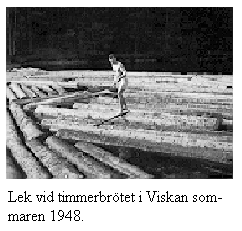
We were often out cycling on Saturdays and Sundays. The Viska River flows through Borås and Göteborgsvägen follows the river for long stretches. In some places the road ran right along the shore and during the cold season posed a certain threat as moisture settled on the road and made it very slippery. Many cars had driven off the road there. At the end of the 1940s timber was still being floated in the Viska and on one of our trips we came to a timber pile, half of which was still in the water. Here we were going to play log drivers, we had seen in films how you could jump from log to log. As long as you did it fast enough you would be able to reach the other shore without getting your feet wet. Niko and I made a couple of attempts, but realized that the logs were too small and that we weren't quick enough to change feet. The logs sank too much and we risked ending up in the river but managed to turn back and got almost dry onto land. Nikolai Käppinen thought (as usual) he was more skilled than us (he always had to be the toughest) and would in turn make an attempt and show us how it should be done. Right next to the shore the logs were slightly thicker and the first meters went reasonably well, but just a couple of meters further out the timber became less thick and he began to sink more and more. He turned and tried to reach the shore, but by then the pressure on the logs had become so great that he sank even more, to make matters worse he slipped when turning and fell in up to his waist - the river was not deeper right there. The Viska flows through both Borås - with all its textile factories and dye works, and Viskafors, where there was a rubber factory. In the 1940s there was no question of water purification from industry; they released everything directly into the waterways and the Viska's water appeared green already at the outlet from Borås and probably consisted more of chemicals than of water.
Nikolai Käppinen had gotten new, light summer trousers, but when he stepped out of the Viska these trousers had taken on an indefinable green-blue shade. His new, white gym shoes were no longer entirely fresh either. The weather was nice so he took off his trousers, took off his shoes and we wrung out the trousers to get rid of most of the water. The trousers took on a somewhat lighter color, but he never got the white color back, not even after washing. The finishing factories in Borås were known for their waterproof dyes.
Helge did not enjoy himself much at the Weaving Company; he was actually of somewhat finer stock than his surroundings, he never swore and never spoke ill of women, who in themselves did not have such a good reputation, and he suffered greatly from the extremely crude language spoken at the Weaving Company by both men (and sometimes also) women. Actually, he should have become an office slave, he would have thrived much better there. For Helge, every workday was a torment, and a day in the factory was a lost day. He was often ill, probably largely because he didn't like factory work. Today such illnesses are called psychosomatic. On Sundays he used to enjoy life, stay in bed and take care of his (and my) apartment. Besides flowers, he had many other small items on the shelves, including a number of Dala horses, a Dala man from Mora, which Helge was. At certain times there were so many flowers that we could barely see daylight through the small window.
As one of the larger industrial cities in Sweden in the 1950s, Borås naturally had football enthusiasts. These were divided into two supporter groups - Norrby in blue and white and Älvsborg in yellow and black. After a match between these two at home over the weekend, Monday mornings were devoted to discussing one team's advantages over the other and so on. There were supporters for both teams at the Weaving Mill and very loud discussions took place there; my suggestion that all Älvsborg supporters should quit Norrby Wäfveri to avoid the arguments was taken as a bad joke. If it wasn't the referee's fault that their own team didn't win, it always seemed possible to find some mitigating circumstances for why the favorite team lost. Sometimes the arguments went on so much that shift foreman Gösta Skoog at the spinning mill had to whistle a couple of times to get some to start the spool change.
"Sports pornography" was already well developed then, but still far from the heights that would come later. There was no TV yet and passive sports participation mainly took place through visits to Borås sports arena "Ryavallen" or by listening to sports broadcasts on the radio. Today a small bunch of hysterics practice jogging on roads and paths, while the majority of the male population stuff themselves with beer and chips in front of the TV to follow and "enjoy" others' achievements. A real shame is when there are big competitions on weekends resulting in fathers not wanting to go on Sunday outings with their children. "Sport does more harm than good," said Ivar-Lo Johansson already in the 1930s. Is he right? Probably. Especially when you see all the elite athletes who poison themselves with anabolic steroids to be able to participate in today's competitions and have a chance to place decently.
Borås Wäfveri was one of the larger workplaces in Borås at the end of the 1940s and had, among other things, its own music corps with a half-time employed conductor and music director. I had played clarinet for three years in Finland and now joined the music corps. Some of the rehearsals could take place during working hours and I remember that we played for the various political parties during election years.
The company was concerned about its workforce and the staff association had an old croft, Knektås, high up above the slopes of Lake Öresjön in Tosseryd southwest of the city. It was a frequently used excursion destination for Niko Aatolainen and me. Together with Nikolai Käppinen and some other Finnish youth we often went there, the uphill climb was strenuous, but the return trip was all the faster and without effort. During the summer months Knektås was open on weekends and for the bigger holidays the company was responsible for the arrangements. On a couple of occasions - during the Midsummer celebrations - the Weaving Company's orchestra played there dressed in the company's music corps uniform.
As in many other things, fashion has also affected sports, especially in equipment and behavior. When you see how expensive jogging suits and footwear the participants have, you ask yourself if it's advisable to go for a jog in the crown's blue training suit and similarly blue gym shoes. Now that the need for these blue training suits has decreased in the defense forces, the Prison and Probation Service has taken over the surplus and uses them for its clients, remand prisons, and prisons. If you go out in the terrain with such an "outfit," it can easily happen that someone calls the police and says that an "inmate" (you're not allowed to say arrested or detained) has gotten loose and is running.
We also took a break and stretched, but not as demonstratively as joggers do today. They stand by a tree and stretch their legs, groan, and give an image of a "real" athlete. You risk being ridiculed by the "clothes-joggers" you might meet on the jogging track. By today's standards our gym shoes were of course completely unusable, but we knew no better and were quite satisfied with our things. Shoe fashion also didn't change so often and you could run with the same shoes until they were worn out; that's not possible today if you want to appear as a "real" jogger. I was cleaning out the basement the other day and found my old blue gym shoes; they looked somewhat worn, but then they had also served for several years, with some success. Admiring individual achievements is normal, imagining oneself to be a participant in a team is just foolish. "Our team etc......who are they? Today with so many bought foreign players from different parts of the world in the "Swedish" teams, even the national feeling is almost completely gone. There are hardly any national teams in the true sense of the word left, possibly some of the "rural league teams" that still lag behind in "development" due to lack of funds.
Love and sport should be actively participated in – everything else is pornography.
Helge Johnson tells about the Borås period. Mora nursing home 199…
Recordings
- 98Morahel.mp3