Länghem 1947
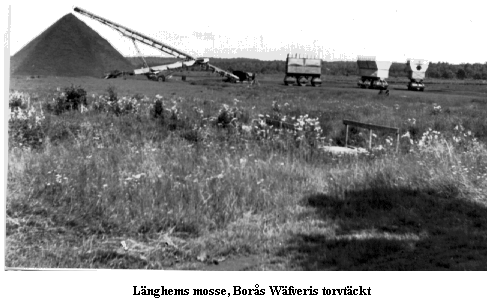
When spring came and the sun began to shine, it became a bit monotonous and confined at Algots, I wanted to get out into nature. At Aatolainen's I met a couple of Ingrian boys who worked on a peat bog and I went with them. It was Länghem Peat Bog, where young and fresh people were needed to load dried peat for further transport to Borås Wäfveri, which since wartime had been burning peat under its boilers. We were four foreign youths: Jussi Huli, P. Ihalainen, me, and a couple of "older" Swedes, had a barrack at our disposal and got our food cooked and served by sometimes a cook, sometimes a cook, and sometimes even a couple of married couples. It was about these wandering peoples who never stay for long in one place.
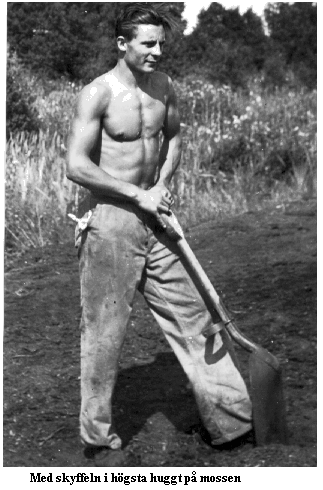
Länghem Bog was ditched to several meters' depth and the surface was milled up with a tractor miller to then dry in the sun. When the peat was sufficiently dry the bulldozer came, pushed the dry peat together up to a small narrow-gauge railway (Decauville track) and our task was to, as quickly as possible, shovel the peat into the wagons. We were young and strong, it took no more than 10 minutes and the wagons were full and the little train with its tractor engine chugged away to the loading ramp. There the peat was dumped into a truck for further transport to Borås and the factory or was placed in a pile for further drying. Then we had at least 10 minutes to sunbathe or read. With the engine driver and those who drove the tractor millers and bulldozers we didn't have much contact, they were local people and lived at home with their families and disappeared in the evenings. We loaders, on the other hand, were temporarily employed and had our dwelling in a barrack near the bog, in the middle of a farm landscape with cows and horses running around the yard of the barrack. In the evenings we could sit on the steps of the barrack and the cows would come up, let themselves be petted and got a few slices of crispbread each.
In the pauses between loadings I practiced diligently in the Swedish language, lying on the ground writing down vocabulary from the newspapers, reading and trying to interpret the anecdotes, the ground was warm and the pauses long enough. When gusts of wind swept across the bog, large clouds of dust swirled up and some of that landed on my books, at regular intervals I had to shake the peat out of both my notebook and the dictionary. When the direct studying began to get too boring and I had learned enough of the language that I started to understand a little more of the content, I moved on to lighter works. Newspapers like "Allers", and "Allas Veckotidning" and the like make for very good reading at the beginner stage. The content in these is roughly like in the Finnish "Seura" and "Apu" and pretty soon I had gotten into the Swedish vocabulary for love stories and didn't need to exert myself very much to understand what the stories were about. It was love, disappointments, fights and all the other ingredients, well known from the Finnish newspapers. The vocabulary is limited and the plot so banal that one doesn't need to have particularly much imagination to guess the content and the ending, the happy ending.
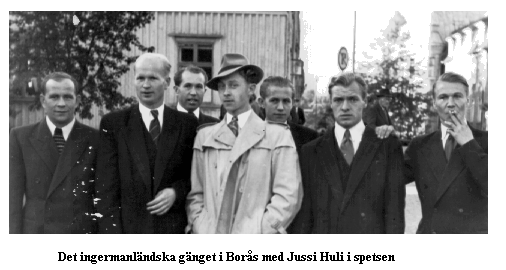
With help from the Swedish workmates, whom we met mostly in the evenings and at meal tables, I could after a couple of months swear quite well, the rest of my linguistic knowledge could perhaps be more questioned. The summer of 1947 was sunny and warm, on warm days we worked on piecework and when it rained we only got hourly wages. Then we stayed in the barrack, some played cards and some read. Since I never wanted to play cards, it was mostly reading and practicing Swedish. Every evening, when the weather was suitable, we went down to a nearby lake and swam.
My first Midsummer celebration took place in Länghem's Folkets Park. I had not stayed in Sweden long enough to get myself any new clothes and I had to make do with what I had received from the Red Cross. That suit was at least a couple of sizes too large for my then physique and I naturally did not make any great impression on the dance floor. With lacking language skills, lacking dancing skills and a certain shyness, it was impossible to get into any closer contact with the "native girls" and there were no others. At the tombola it was not much better, though the lottery could with a bit of optimism be seen as an improvement. I invested 50 öre, bought two tickets and won on one a nailbrush (which, in itself, was needed sometimes), the other was a blank, but they consoled the loser with:
"You don't seem to have luck in games but luck in love is just as good." The claim was a bit exaggerated, no girl was interested in my person, the other boys had no better luck either so we returned to our barrack at dawn and took our places on the sleeping bunks..
Life in the barrack was calm. Those who occasionally had a drink did so mostly on Saturday-Sunday, during the weekdays there was no question of taking any liberties in that regard. Most of us young ones were not traditional teetotalers either, but we drank quite moderately (with the exception of Jussi Huli who had picked up certain bad habits) and it mostly happened at family dinners and parties. One or another did fall outside the accepted frame, but they were youths of a somewhat older age than us (who were then 17-18 years old). Some of them had served in the Finnish or German army and had acquired certain habits. The schnapps that I consumed during the first years in Borås was mostly taken in the company of the Aatolainen family. Father Peter liked to have a nip with Sunday dinner and the rest of us followed along out of sheer momentum. My first half-liter I bought several years later in Borås, when Ann-Marie and I had been married for several years and were having guests for dinner.
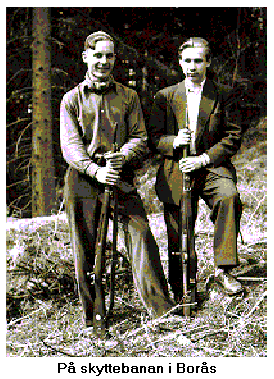
In Borås, Ingrians, Estonians and Finns had formed an association in which a congregation was also included. Religious life has always been a strong bond among the Ingrians. Sometimes priests came from Finland, both Lutheran and Orthodox, to preach to
the refugees in their own mother tongue.
The Russian-speaking refugees were always Orthodox, while the Ingrians and Estonians for the most part were Lutherans. All spoke both Russian and Finnish and could participate when the "pope" (priest) in Russian, Finnish and Church Slavonic (incomprehensible even for many Russians), intoned "Gospodi pomiluj i blagosloviiiiiii......". (Господипомилуйиблагослови…..)
Life for refugees began to take on more organized forms. The priest's son Sulo Korpelainen wrote in the association's newsletter and also acted a great deal in the Estonian-Ingrian society. The association started by organizing summer parties and many new acquaintances were made on these occasions. During these summer parties, athletics competitions were also held and I won a number of trophies: long jump, high jump, triple jump and orienteering. Overall, sports was a very popular pastime, we didn't have much money to spend on other entertainments, and most probably also lacked the interest. Those other interests usually come with age.
Recordings
- 1947Länghem.mp3