Falkenberg - 51
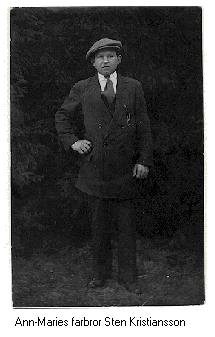
On March 26, 1951, I was back in Falkenberg and worked for a few months with Sten Christiansson (Ann-Marie's uncle). We dug and blasted wells in the Falkenberg area. I learned a lot about handling dynamite; it's certainly not a harmless task and accidents are always lurking. I remember one particular incident from that time.
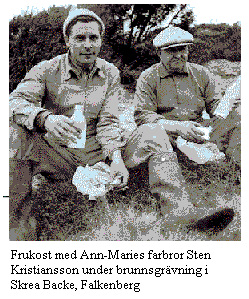
We were working on a well blasting up on Ugglarp hill. When the well was finished, the owner (attorney Mühl) came and said that since we were at it anyway, we should blast away a stone that lay somewhat awkwardly near the corner of the house. He thought it was far too big and bothersome. It was a timber house moved down from Dalarna, and only the walls had been erected. We drilled a horizontal hole with the Cobra (a motor-driven rock drill), loaded it, and let the shot fire off. Everything seemed fine and dandy. When we came up to the house, we couldn't find the blasted-away part of the stone; it was gone.
"Did you see where it flew?" Sten asked me.
"No," I answered, "I didn't see anything that would have flown away," I replied quite truthfully. There was only a smaller stone that I saw heading up the hill. We continued the work, removed the remaining stones, and did a couple more blasts. The next day the carpenter came, who was to install the window frames and fix the floor. As he walked in the house, we heard swearing and grumbling from inside.
"What the h... have you done?" he yelled at us. We had no idea what he meant until we came up to the house and looked inside. Then we saw the "missing" stone. It had flown so cleverly through the window and into the house that we hadn't noticed anything. There was not the slightest external damage to be seen, but the floor joist that the stone had landed on was not quite intact and had to be replaced with a new one. Since there was plenty of floor space under the joists, we didn't bother to haul away the stone; it's probably still lying there. Later we went down to Skrea plain and water-drilled a well for a farmer. He got water, but all other water sources in the vicinity dried up, and there was trouble with the neighbors. The work with Sten Christiansson didn't yield much in terms of money either; there was always a shortage of cash, and that naturally couldn't go on forever.
On July 7, 1952, I moved back to Borås and took a job at Borås Mjölkcentral, which was newly built and was said to be the most modern in the country at the time.
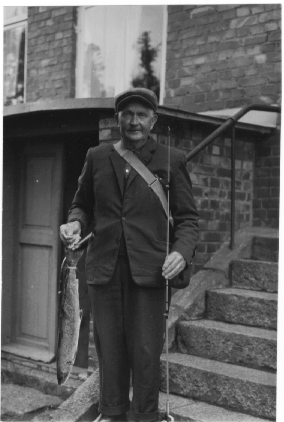
Ann-Marie's father Algot was an avid fisherman and spent a good deal of time – at least after his retirement – on the fishing pier over the Ätran River. It wasn't always that he got a bite, but when he did, he was a happy fisherman who proudly displayed his catch and willingly let himself be photographed. For a time, the Ätran was completely devoid of fish, like most Swedish waterways, but when industry began to purify its water, the fish returned to the delight of all amateur fishermen.
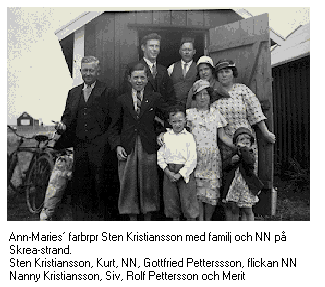
The beach cottages at Skrea strand have been popular; there are about 300 of them. There, people from Falkenberg and other vacationers have enjoyed fine summer days, some staying in the cottages for several weeks. In later times, the cottages have been modernized; quite a few have gotten electricity, and many have gotten summer water closer to the cottage. Ann-Marie's friend Gertrud had such a cottage, as did her brother Rune; later they bought a proper summer house at Sjövägen 20.
Recordings
- 1951FalkenbergX.mp3