Studsvik 1960 – 1991
Studsvik, as a workplace, has been a good investment. The salary increased by about 30% compared to Nordiska Instrument, and we would also get the first modern apartment when moving to Nyköping. By this time we had been married for 10 years and had lived mostly in sublets.
As long as the construction of Alfa-lab was ongoing in Stutsvik, we remained living in Hägersten and worked in a provisional laboratory at Framnäsbacken in the northern part of Stockholm. The Alfa laboratory was to deal with plutonium and my main task was to build glove boxes and equip them with the electrical and electronic equipment required.
In the autumn of 1960, the Alfa laboratory in Studsvik was ready for occupancy and we moved both our work and private household to Nyköping. We moved our boxes to Studsvik and continued working to make the boxes and laboratory ready for work with the highly active plutonium. Most things went according to plan for a couple of years, but we could never activate the boxes in the Alfa lab until new instructions came.
In 1963, ACL (Active Central Laboratory) was ready for occupancy and the company management decided that all active work would be concentrated in this building. The development plans were large and the laboratory was accordingly, 14,000 square meters of laboratory space distributed across rooms 13.15 – 13.21 with an area for decontamination and verification that employees did not come out "contaminated" and spread activity. Additionally, there was a large hall (15 x 25 x 30 m).
We moved in and since most of the glove boxes for initial work were ready, they were activated and primarily it was the thermobalance and dilatometer boxes. (Dilatometry = measurement of length change). The box constructions were mainly carried out by the design office and by Knut-Erik Jansson, but he was so afraid of the activities that he hardly dared to be near an active box, let alone work in them. Once, however, he had to transfer a certain amount of uranium powder from one container to another and then he "packaged" himself in a way none of us had seen before. The sleeves and legs of the coveralls were completely taped over, he wore a face mask. Most people, even the radiation protection officers, thought he went to violent extremes. His fear meant that someone else had to take over the boxes after completion, and that "someone" became me. I took over the work in both the thermobalance and the dilatometer box. The other colleagues Ulf Kyulenstjärna, Gunnar Berggren, Lennart Ström, Lennart Jakobsson, Alf Andersson, and others worked with pressing and development of pressing methods. It presented great difficulties in getting the "green", freshly pressed pellets to hold together on the way to the sintering furnace, many broke and we tried all possible additives, praseodymium (a substance in the rare earth group) and many other things.
In the early 1970s, the production of Pu fuel was relevant and we were tasked with building the necessary equipment in the "Great Hall" at ACL. It became a larger glove box, somewhat larger than a garden shed, with a lot of automation and remote-control equipment. The sintering furnace was several meters long and given that the plutonium was to be sintered at 1700 degrees C, a fair amount of peripheral equipment was required. The small fuel elements, the "pellets", were to be sintered in a nitrogen atmosphere and that complicated the entire equipment with a lot of automation.
We struggled on and were reasonably finished with the assignment, when word came that the project was to be shut down. Now we had to dismantle the entire box; the furnace was sold to ASEA (which in 1969 had started a fuel factory for nuclear fuel).
When the program for Pu fuel production did not happen, we had some problems with employment. I wandered between the activity control on HUGO, a whole-body monitor, where together with Birgit Biveryd I was measuring the activity in the entire body. The person in question was locked in a lead chamber and at first they had to sit there in a comfortable position for nearly 45 minutes. Later, more sensitive measuring equipment came and the time was shortened considerably. Some complained about the change and said that before they could calm down and sit for a longer while, now they barely had time to fall asleep before it was time to leave the chamber.
In the continuation, there were several workplaces: for a time I worked operating a reactor simulator in the Autoclave Building. It was a large facility for simulating the various possibilities for controlling a reactor. The "Reactor" itself contained only 20 liters of water, but with a pressure in the primary circuit of 170 bar and in the secondary circuit of 60 (simulating a pressurized water reactor), it was still a rather complicated device with a lot of automation and safety equipment. All pipes that were part of the pressure circuits had to be X-rayed by TRC (Technical X-ray Central) and their car with X-ray equipment was on site in front of the Central Workshop every Wednesday. The danger of incidents was always present, and on one occasion I got a minor shock. When the current run was finished and the system was again at room temperature, I was to replace a pipe and insert one with a measuring probe. I had only just touched the pipe when it came loose. It turned out that the tightening had not been sufficient, but no leakage was visible and I still cannot see how it could happen. Now this was on the 60-atmosphere part of the secondary circuit, but considering that the system during operation contained superheated steam of about 300 degrees Celsius and 60 kg pressure, it could have led to a serious accident if someone had been nearby at the pipe break and received a hot jet of superheated steam under great pressure.
In the same facility I worked with the Norwegian Rolf Hesböl, a chemist who was to experiment with getting absolutely pure water in the moderator. It was an autoclave of gold in the shape of a cylinder with a volume of about 1 liter, and we fiddled a lot with different ways to avoid getting impurities from the air into the water.
In 1980 there was an intensive expansion of nuclear power, Sweden had planned for 12 reactors: 3 in Forsmark, 3 in Oskarshamn, 2 in Barsebäck and 4 in Ringhals. Some of these projects were not completely finished, but under great agony the then bourgeois government nevertheless decided to complete the plan. Now (2007-05-15) the Social Democratic government has been forced, under pressure from the Green Party, to shut down both Barsebäck reactors while the other reactors live a healthy life, are renovated, improved and modernized to increase output and partly compensate for the loss of Barsebäck.
In the 1980s, I participated in a project for measuring radioactivity in the reactors. It was in the company of SOP (Sven Olof Pettersson), Maud Källströmer (Persson), as well as Janne Chyssler and Karen Godt. We roamed among the various Swedish blocks (and Finnish Olkiluoto) during the summer revisions and hauled 150 kg of lead to shield the Canberra measuring equipment from side radiation. During the revision at e.g. Ringhals, there were several hundred people, mainly contractors, to service valves, motors, etc. There was only a small elevator, and all personnel and equipment had to be transported to the reactor top in that elevator. Naturally there was some crowding, and it was important to get as much as possible with you on each trip. On one occasion we had taken a bit too much of our lead load into the elevator, which resulted in that when the elevator reached the entrance level, the automation could not stop the elevator car and we ended up sitting below the bottom floor level. Fortunately, there was a telephone in the elevator and we had to call for help to manually crank the elevator car up to floor level.
During such measurements, one sometimes had to work under truly "hot" conditions. When the reactor is running, the temperature in the containment is about 70 degrees Celsius and in a nitrogen atmosphere, and to avoid having to stop the reactor for too long, the inspection begins already when the temperature has dropped to about 30 degrees. To have to walk under the heat exchanger's "hot" legs wearing a face mask (sometimes even a gas mask), helmet, and often 3 coveralls, depending on having to pass both the yellow and blue radiation zones and enter the red zone, and at each "step over" (activity zone boundary) put on the prescribed protective equipment and carry the lead shields and the apparatus to the measurement point (usually in rather cramped spaces) makes one literally very dry. For the most part I liked to take a sauna after work, but not when it came to this type of work. Then you just wanted to drink water after work. Together with Janne Chyssler we struggled through a series of such measurements when Ringhals block 2 was to replace the heat exchanger.
During the 1980s, I was involved in a project to measure tritium spread in nature – a project led in Sweden by Ove Edlund. At first, the measurements were to take place in France because no other European country allowed such large emissions in such a short time. It was actually not allowed in France either, but there they sometimes do things that are not entirely within the limits of agreements. The project depended on weather and wind, so we drove a car filled with measuring equipment and placed our apparatus on a field about 70 km south of Paris (at a research station for plutonium). The meteorologists had predicted suitable weather with moderate wind in the right direction, but the weather changed and we had to fly back to Sweden and wait for a signal from our French colleagues. A week or so later the signal came, we went down and performed one measurement – several were to be done. However, the EU found out that the released amount of tritium was far too large (if I remember correctly = 7 Curie) and the project management had to try to find a new suitable place for samples. It was an international project with participants from 7 different countries and the Canadians proposed that the experiments should continue in Canada at the Chalk River laboratories in the province of Ontario, on the shore of the Ontario River about 300 km north of Toronto.
In early summer 1986, suitable parts of the equipment were sent to Canada and we began waiting to be able to fly there to complete our mission. When the signal came that fair weather was expected in the near future, we took the flight and were joined from Schengen by our French colleagues.
We stayed one day in Toronto, made an excursion to Niagara together with the Frenchmen, and then took the American Highway north. To Chalk River it is about 300 kilometers, and the road goes mostly through sparsely populated areas. The villages are roughly like in Russia, they lie along the main road, and behind the first row of houses there is usually nothing – the Canadian forest begins. Unlike European houses, the Canadian ones had no fences or the like at all, and the distance from the highway to the houses generally exceeded 10 meters. The reason is that some winters can bring very deep snow, and to avoid burying the houses under snow, they could not be too close to the road; there was plenty of space toward the forest. Around the houses there were large lawns, but hardly any flowerbeds or gardens, and on Fridays it seemed as if all the wives were busy sitting on their self-propelled lawnmowers, riding around on the grass.
We stayed in a community 14 km from Chalk River Laboratories. It was roughly like going to Studsvik, which lies 27 km from Nyköping. The road went through primeval forest, and on a couple of occasions we saw forest dwellers in the form of black bears. The Ontario River next to Chalk River is about 800 meters wide and rather shallow. Presumably, during drier periods one could have walked across the river on foot.
The test field was on sandy ground, well supplied with necessary service facilities: among other things, electric power at both 110 and 220 volts – both single-phase and three-phase – so that we did not need any transformers to adapt our instruments to the local voltage.
We had to wait several days for suitable weather; in the meantime we visited both Ottawa and Montreal, inspected the Parliament Building and some other sights. Ove and I were also supposed to have a sauna, but it turned out a bit wrong. We sat there naked and did not get warm. We thought it strange that no one else came in, and then we learned that in that room you were supposed to wear bathing trunks. It was just a warming room after bathing in the river.
When suitable weather came we were ready to work – and it turned into quite a long shift – almost 2 days. We started in the morning, tritium was released into the wind, and we began our measurements. Samples were to be taken twice an hour; temperature, humidity, etc., were to be measured. From a patch of grass about 1 square meter, samples were taken, quickly dried, and weighed. The sample cycle took about 20-25 minutes, and we had only about 5 minutes free after each round. It went well during the day, but the nights got somewhat cold. The sample area lay on a sandy ridge, and after the sun went down it became quite cold. We had only our summer clothes, and to keep warm we tried during the little free time to do some quick sprints. No extra clothes to warm ourselves were to be had, and we were forced to use garbage bags with holes cut in the bottom for our heads and in the sides for our arms. It did not help much, but we apparently got through without any injuries. The sunrise came as a relief and gave a realistic sense of how long certain nights can be. The participants from Canada were better equipped, and I remember an Asian lady who was very small; to drive the rented cars she had to sit on the very edge of the seat to reach the pedals. When the rest of us froze our feet, she could stuff hers into her rubber boots – with her own shoes still on.
When the measurements were finished we prepared for the return trip, packed our boxes, and I sneaked a bottle of whisky and a couple of bottles of brännvin into a printer with a spacious interior. It was a few days before Midsummer, and when we called KLM it turned out to be difficult to get seats. Well, if we could be in Toronto the next day we might be able to get on a plane to Schiphol in Holland. We had no car, no trains ran, and good advice was expensive – it seemed we might have to celebrate Midsummer in Canada. Calls to the Canadian airlines were free, however, and I called several to get advice on how we could get to Toronto. A possibility appeared in the form of a small local plane that made trips to Toronto, and we managed to get seats on it and arrived in Toronto in good time, got seats on the plane to Europe, and had to sit for about 8 hours in a rather cramped plane with boring commercials on the TV screen as the only entertainment.
We happened to sit next to a Polish man with pronounced Semitic features. During the conversation it emerged that he was a jeweler and, among other things, he showed us his Rolex watch. He was quite boastful, and I could not resist telling him a relevant anecdote about the mentality of Rolex watch owners.
A policeman came up to a Porsche that had broken down and was lying by the road. Next to the car lay a person. The policeman began to attend to the man, who woke to consciousness, and his first question was: - «What happened to my Porsche?» - «I think you should worry more about your left arm, which is almost torn off,» said the policeman. - «My God!» exclaimed the man. «What happened to my Rolex watch?»
To further reduce the weight and importance of owning an expensive watch, I said: «Rolex watches are quite accurate in their timekeeping, but they cannot compare with a cheapest-model electronic watch, for instance my friend's Chinese-made watch, which he bought for 2 Canadian dollars on Yang Street in Toronto.»
We made it back in time for Midsummer and could spend the holidays at the cottage.
The continuation of the work at Studsvik involved, together with the chemist Rune Lundquist, working on decontamination and assisting in Jan Arvesen's and Shankar Menon's project. Jan Arvesen had mixed together a blend of ceric acid and a number of other chemicals, and with the addition of ozone it was supposed to serve as a medium for decontaminating pipe systems so that they could perhaps be classified as less radioactive. Ceric acid is not a commercially widely sold product, and I recall that Jan had to buy it in small quantities from various European chemical companies.
When we had experimented long enough and achieved certain rather good results, it was time to take the equipment to Ringhals 2 and run a full-scale test. It was quite a large project, and both the nuclear power plants and ASEA were interested, so a lot of people had gathered when the test was to take place. We were to decontaminate a regenerative heat exchanger, and our equipment with pipe systems, pumps, and ozone generator was placed in the workshop area. I was in charge of the pumps and the ozone generator, and I wanted the system to be connected to the regular ventilation exhaust. The R2 people would not hear of that; instead, a plastic pipe was run with the exhaust on the roof.
The test run started, and after only a couple of minutes the monitoring equipment for the ozone generator alarmed that the ozone level inside the test room had exceeded the permitted level. The management jumped on me and claimed that the ozone generator was leaking, but I assured them that I had tested it thoroughly and swore it was not. The test was started again, and the same thing happened. Now we had to think to figure out the cause of the alarm. About twenty people were standing around the equipment, and the project money was ticking away. A closer examination was made, and it was determined that the exhaust pipe for the spent ozone was upwind of the reactor building's regular air intake. We had to splice on to the exhaust pipe and direct the airflow leeward of the air intake into the building. The test could be completed and turned out to mutual satisfaction. The radiation meters showed how the activity level in the filters increased as the surface layer eroded away.
Ringhals had overnight barracks popularly called the “Ringhals Hilton,” but Jan Arvesen and Shankar Menon wanted to stay in style, so we lodged at the Ekoxen in Göteborg, at a distance of 7 mil from Ringhals. The work went on for two or three days. Jan and Shankar handled the facility during the day while Rune and I watched it at night. At regular intervals samples had to be taken, and Rune did his titrations to see how the decontamination was progressing. When our shift ended, Jan and Shankar relieved us, and we took the car for the trip to Göteborg, where we ate our “evening meal” when others were eating breakfast and enjoyed Danish pastries, coffee, porridge, etc. Then we slept a few hours and, after waking up, went out into town.
Toward the end of the 80s, the Riksdag, egged on by the Green Party and the former Communists, who now called themselves the Left Party, made a decision that in Sweden there should be no research in nuclear technology or further development, and a number of engineers and researchers (about 30) were forced into retirement on 1991-12-31 with pay for the remaining time until pension from the Trygghetsrådet (the Job Security Council).
All of us could have continued, but at least for my part it did not pay off, because at the same time the Soviet Union collapsed and I got a great deal of work at SKI, SSI, and TRC, as well as a number of other institutions dealing with nuclear power. I was one of the few who had a reasonable command of English-Russian-Swedish nuclear terminology, and for three or four years I served as interpreter at all the seminars held by SKI, SSI, or Studsvik. Since I was virtually the only one in that position, I could set my own salary, and sometimes I earned more in a week than I had in a whole month at Studsvik. When the Russians and Lithuanians had learned some English, the need for my services decreased, and I had to settle for interpreting for the Immigration Board, the police, the courts, the hospitals, and social services.
Studsvik today (2007-08-04) is a shadow of its former self. Many institutions have moved: the Heat Laboratory (renamed Thermal Processes) has moved to Nyköping's old dairy, the instrumentation department was bought by Vattenfall, etc. When we were at our peak, there were over 1200 people at the various institutions; now they essentially have only an incinerator for low-level waste (clothing, paper, etc.) and a melting furnace for radioactively contaminated material. The Swedish Environmental Protection Agency appealed Studsvik's decision to expand the melting operation to 2500 tons but received no support in the Supreme Administrative Court. Many buildings have been demolished: the Van de Graaff generator, the Alpha Laboratory, the Active Central Laboratory (ACL). A couple of years ago the reactor R! was also shut down.
Many of the buildings have been demolished: Alfa-laboratorium, large parts of the ACL-laboratoriet, the Van de Graaf reactor, etc. The land (7 hectares) can probably soon be sold back to the counts von Plomgren. I have always claimed that one does not get rid of nuclear power in the foreseeable future and now my claims have come true. Finland is building its 5th reactor in Olkiluoto, they previously have two Russian-built pressurized water reactors in Loviisa and, according to media reports, Finland is planning for a 6th reactor.
Sweden is still resisting and the Greens are trying to get several Swedish reactors shut down, but a large part of the population is in favor of keeping nuclear power and it may not be long before Sweden also begins planning for further expansion. For Göran Persson and the Social Democrats, it is fine to speak with a forked tongue, but it seems somewhat audacious that Persson & Co are prepared to buy electricity from the Finnish reactors, but not build their own. People talk about the danger and difficulty of storing spent fuel – in 100,000 years there might be an earthquake and it could harm people. That they daily poison us with sulfur and other emissions from fossil fuels is something nobody seems to care about. The storage of spent fuel is technically solved in Sweden. They drive the fuel into an underground repository at a depth of 500 meters. The fuel is inside a stainless steel cylinder, surrounded by bitumen and inside an additional cylinder of copper. Examinations of old cannons that have lain on the seabed for a few hundred years show that copper is very resistant to corrosion in water after it has tarnished. According to information, those cannon barrels that have lain over 300 years in the water have not corroded more than a few tenths of a millimeter.
There is much talk about wind and solar power, but compared to nuclear power it is just like spitting in the ocean. Moreover, it is expensive and quite energy-intensive to build wind and solar energy installations. In the current situation, they barely pay for themselves over their lifetime.
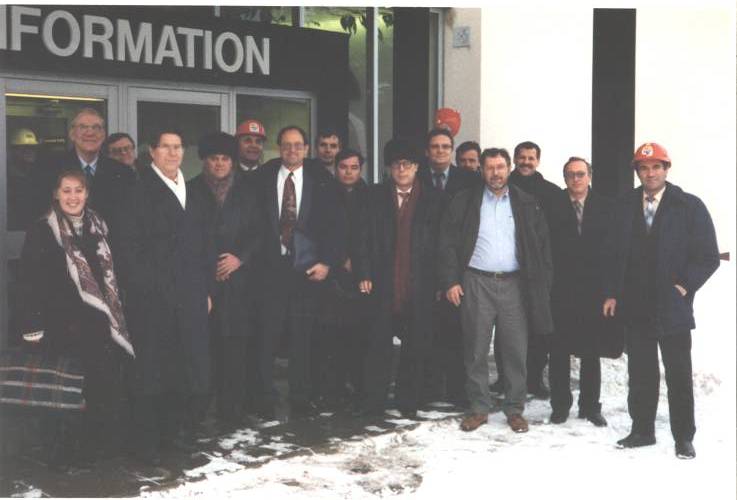
Russian-American-Finnish-German nuclear delegation on a study visit to Forsmark
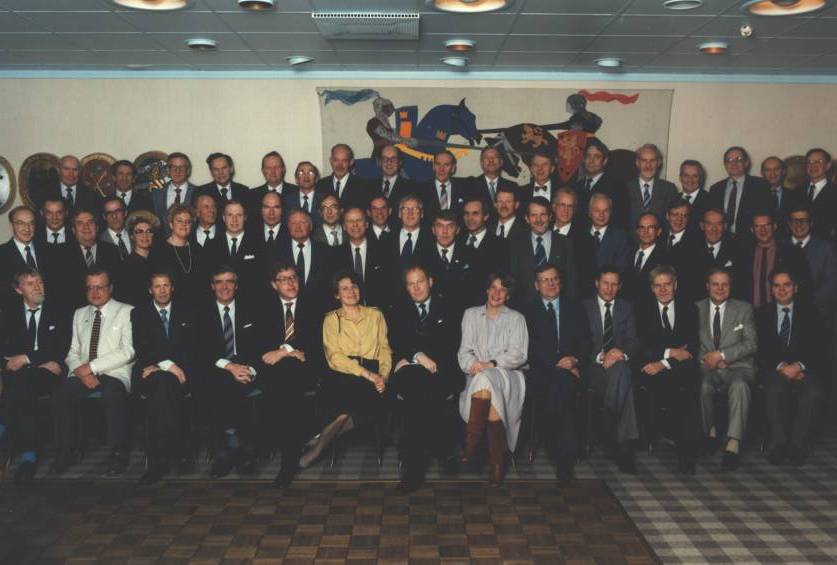
The farewell party for Studsvik's early retirees 1991-11 28 at Stadshotellet in Nyköping