Khibinogorsk
The Conversation - Mary Ekström - Tendens - sr_se.mht
Karl says:
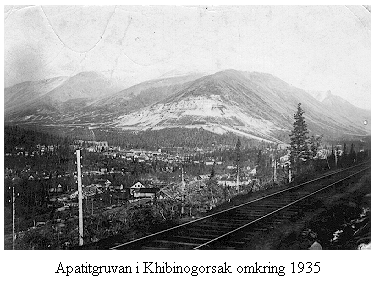
From Apatity station on the Leningrad-Murmansk railway it is 25 km to Hibinogorsk and we were unloaded from the cattle cars at "km 13". There were some barracks there, which had previously been inhabited by prisoners, now these had been moved and we were lodged in them.
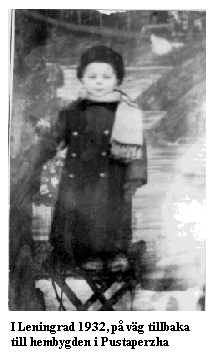
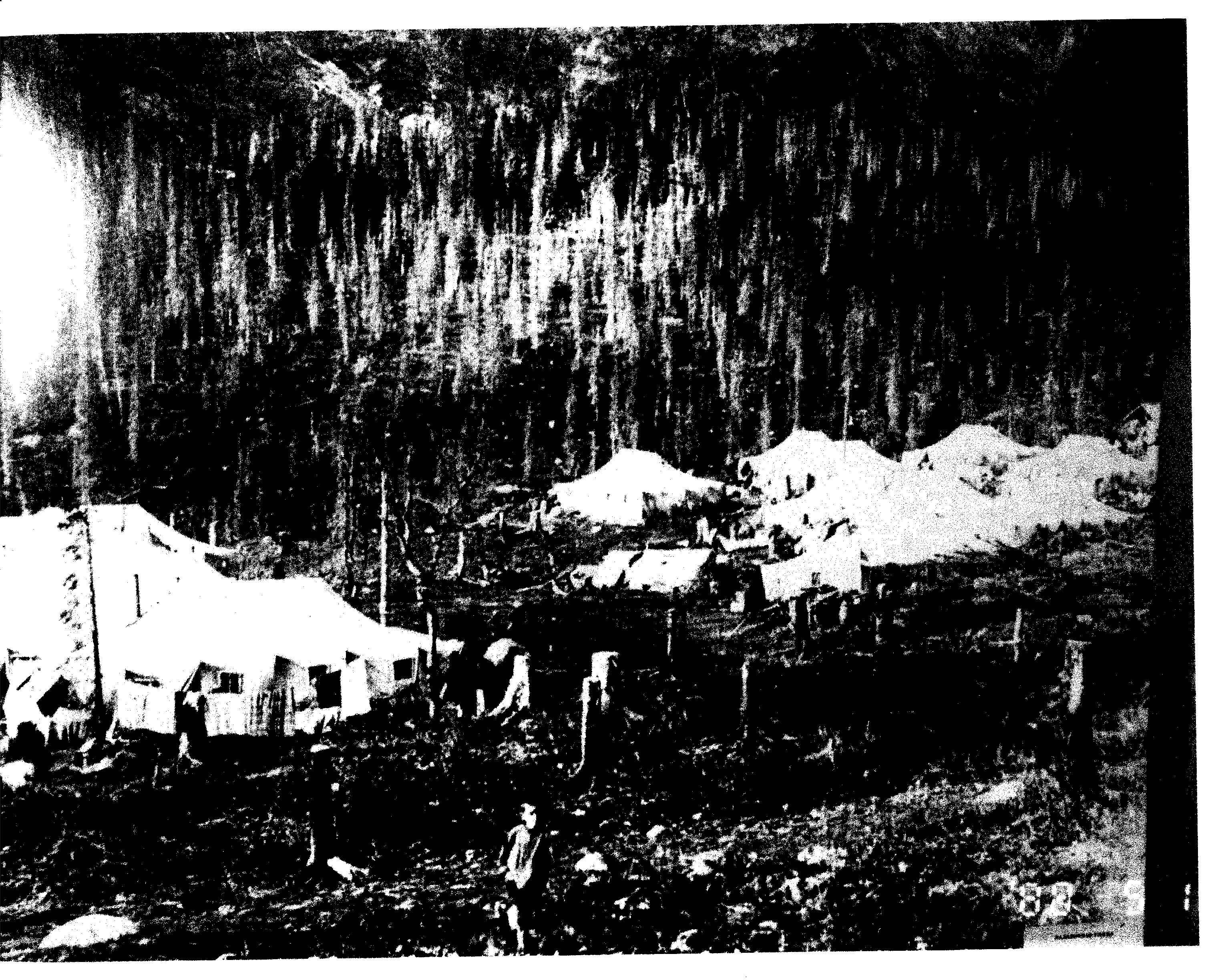
The conditions up in the north were very primitive. When the deportees arrived at their destination, there was basically only a set of military tents for the newcomers (temp. -20oC). Of the station town Apatity there was only a sign with the station name 'Apatity' stuck in the snow. My parents came from the relatively northern regions and had a lot of winter clothes with them, while Kyrgyz, Tatars, Uzbeks and other 'caftan people' walked in their long caftans and suffered greatly from the cold and snow. The only warm clothes available in the store were the Chinese-inspired 'fufajka's' - cotton-padded jackets and trousers. The fufajkas became a kind of national costume and symbol of the Soviet Union for many years to come. In themselves warm but not particularly beautiful, they saved the Soviet population from freezing to death in the northern regions. With a fufajka, felt boots and a fur cap with ear flaps, a person can withstand a lot of cold. Leather was a rare occurrence and therefore the clothes were mostly of the 'fufajka' model, i.e. a cotton-padded quilt sewn up into jackets and trousers.
Karl continues: My first job was to shovel snow and clear roads. From "km 13" to "km 25" we were transported by horses and tractors. There we worked on shoveling snow for a few weeks. Food was scarce and I couldn't manage much. Father took me to Chief Engineer Desterlo and I instead got to start on a construction site at "km 25". I began by, together with another boy of my age, a Russian from the Pskov region, carrying water and wood to the kitchen, which provided food for the builders, and help with building a barracks and a sauna. When the buildings were finished, I moved on to a job as a rod boy and ran with the leveling rod. The prisoners built roads under the leadership of Engineer Desterlo (a Swede?). He had three subordinate Russian engineers to assist him. No one really knew why Desterlo had been deported there, according to some accounts he had built a power station somewhere in southern Russia and been transferred to the Kola Peninsula after the power plant was finished. Desterlo was lodged somewhere else and used to ride to Apatity station, but when the roads became too bad he resorted to "apostles' horses" instead and then sometimes his "stable boy" of Gypsy origin took care of the horse.
When summer ended I continued working as a coachman at the construction site. The entire workforce was prisoners: from the foremen to the cooks and other staff. All of a sudden, without warning, all prisoners were moved from "km 13" to "km 20" and some barracks that had served as prison camps became vacant and we were to move in there. One of the barracks lay somewhat isolated from the others and had also served as a hospital, where prisoners spent their last hours of life. The wooded area behind the barracks had to receive the remains of those who died. Often several prisoners were buried at the same time - not one by one - but in larger groups of up to ten people at a time.
No one bothered with any large epitaphs for the buried. A piece of bark on the nearest standing pine tree was cut off and on the exposed surface they wrote:
- Sidorov, Petrov, Ivanov, etc.
For the most part, there was no other reason for the deportation than that the state needed labor somewhere else. Most accusations of "anti-state activity" have later been proven to be constructed solely for the purpose of justifying forced displacements. The White Sea Canal was built under the leadership of Nicholas II's son-in-law, a highly educated man who had studied abroad, including in France. He was born on the Crimean Peninsula, in Bakhchysarai. He had been chief engineer on the White Sea Canal construction together with Desterlo.
When I finished as a "rod boy" with the engineers and returned to my parents, my father was arrested for some reason (at night just a couple of KGB men came and took him), but he was released fairly soon and assigned work at a factory construction site. The work consisted of digging holes for the foundations of the future factories. I worked together with my father and dug for a whole week, but the work was heavy, he couldn't manage throwing up earth to a height of two meters for long, the food was so bad that his strength did not suffice. I went to the doctor and since I was only 18 years old, I was relieved from the heavy work.
- We knew a Menskij Pridu, Karl tells, I was at school with his children, Pridu said - Come to us! We need people skilled in carpentry. What carpentry was that? It turned out that we as municipal workers were to manufacture coffins. In 1930, when we started production, the really large contingents had not yet arrived, mortality was still relatively low and the demand for coffins was not that great. Some died now and then, but not more than that we managed to keep pace with mortality by manufacturing a coffin every other day.
The work was led by an Estonian, a former imperial regimental music sergeant major Jaan Niitt, he took me as an apprentice and throughout my first year of apprenticeship I was occupied with coffin manufacturing. He wanted us to make the coffins in the Estonian style, hexagonal, and it took two days per coffin. At first we planed the boards, but later, when many new prisoners had arrived and mortality rose rapidly, it became more of a quick production, 5-6 coffins per day and no talk of planing boards anymore. It was 1931-32. We lived then at "km 16", said Lida, in tents.
- Why in tents? I asked, you had built barracks.
- At certain "km" they built barracks, but not always in sufficient quantity, answered Alida, and when labor was needed somewhere they just set up a number of tents, in which the displaced had to live. We didn't exactly have any entertainment, now and then an accordion player appeared to lighten the mood.
I remember one morning, said Lida, when Jaan Niitt came and played a tune on the accordion, we all jumped up in just our underwear. There was also another musician, a native of Zapelka, 9 km from our home area.
- There was only 35 cm of space per person in the tents, said Lida. Due to overcrowding, poor food and lice, you, Albert, became ill. If someone went out at night, there was usually rarely a place to come back to, the spot was taken by others who spread out. The 35 cm of space was a curse, the old and young had to rotate around the tent stove because there weren't sleeping places for everyone at the same time. Anyone who wanted to turn over had to get up, there wasn't enough room to spread out either on their back or stomach.
- Alas, how many did not die in Kirovsk, sighed mother Emely. For many, life became too heavy. Living in a tent in the middle of winter is not something one does voluntarily and with a light heart. Not only was it cold, the plague of lice became severe due to the poor hygienic conditions. The adults could hastily splash their faces with snow and for children you could get water heated on the tent stove, but no real bath was possible during the entire first winter. It took quite a long time before a sauna was built.
In the autumn of 1932, 17 Estonian families joined together, received building materials from the state and began to erect a common dwelling - a barracks. From moving in until a new deportation in 1940 we lived in this barracks at the address Stroitelnaja 13.
Later, when we had moved into barracks again, typhus raged severely, among the Latvians in the neighboring barracks many died. In the tents the typhus problem was not as great due to the prevailing cold, but the stale air and lack of sleep caused you, Albert, to become so ill that you stopped speaking. The doctor came to the tent, examined you, and when mother Emely requested to go home, it was not granted.
- Later I worked underground in the apatite mines in Khibinogorsk, Karl tells, where clothes didn't matter that much, we could run to work without freezing too much. I worked in the mine, in "Lovcheridnyj Rudnik" at "km 23", distances were measured in km from Apatity station. First we lived at "km 13", then at "km 16", later at "km 18", at "km 21" and at Lovcheridnyj - "km 23".
Lida said that the first years she did not work, she was a "home daughter", 16 years old, and mostly occupied with cooking for the other family members. She started working only in 1934 and her first job was to be a stoker at an electric power station, where she had to transport wood and coal with a wheelbarrow. In total there were 4 or 5 boilers. After a while the power station was closed and together with some others she was transported to "km 23", to work at the phosphorus factory. In the mine they extracted lovchorite (mineral).
Lida says:
- I worked at the factory and the transport to and from work was troublesome. On Saturdays, after the workday ended, we had to clean up after ourselves and then we sat on a bench before the trip home. From the barracks where we lived, a man named Ljungberg drove, he drove a car with number 31, and when we saw the car coming on the bridge we often had to run. When the factory whistle blew at around 5 o'clock in the evening we ran again, and on one occasion I had a very modern, narrow skirt, I stumbled and ended up in the ditch with a sprained foot. I couldn't do my regular work, I couldn't get my boot on, and a man in management said:
- You will become a night watchman.
- But I didn't want to become a night watchman, I went to the doctor but was not exempted from night work, and only on a renewed visit to the doctor did I get papers that I did not need to work either at the power station or on any night shift.
Lida told that she had to start working as a builder at the phosphorus factory, it was winter with temperatures close to -300 C. She pushed wheelbarrows with cement and had to periodically go to the factory chimney to warm herself. On one occasion she burned a hole in her sheepskin coat. To keep the concrete fluid, they mixed in salt, which meant the concrete never dried; moisture ran from the house walls for several years afterwards.
Mother tells about 1930, 730903 (in Estonian)
- When we arrived there, were there any houses?
- Houses? No! There were no houses, but some barracks. First we were lodged in tents.
- How long did we live in tents?
- I don't really remember, however we lived there all summer. Karl was 17 years old and he was also there where they built barracks and worked there so that we too could move into a barrack. But we lived in tents all summer. There were no big houses there, maybe a single one, as far as I recall. The first year we lived there, an avalanche came from the mountain and buried a barrack with 84 people. What a commotion! The barrack was buried under snow and they had to dig out the dead. They took us to the "red corner" and conducted the burial ceremony. Karl worked underground for 10 years. They excavated apatite. Was there any use of it? Yes, there was use, but they ruined the river.
During the first months, as housing construction did not keep pace with industrial building, housing functioned according to the principle "Where you work, there you live". All miners had to lodge in mine buildings, medics in health centers, administrators in offices. Even specialists sent there with guaranteed responsibility and monthly salary had to sleep in their offices. People settled into houses before windows and doors were installed; in the daytime the people worked on construction and roads, and at night on their homes.
One of the first to describe conditions in Kirovsk in the book "The City on the Tundra" was B. Levites. He writes: It was crowded; people lodged not only on the floor in houses without roofs, not only on tables. Not only in the attics of the first three wooden buildings where as early as June 7, 1930 the "soviet" (council) lodged, not only in tents but also under the open sky.
According to the commission's notes from 1933, about 20,000 people were to live in the new city. As the main type of housing, communal houses of "non-combustible material" were proposed, but the main task for which geologists, miners and builders came to the polar region was fulfilled.
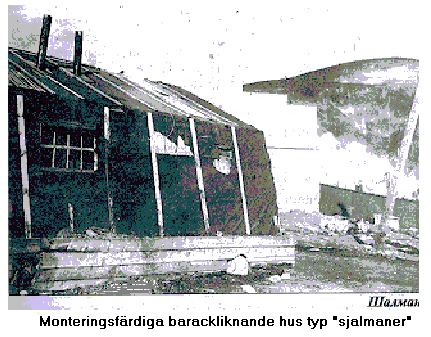
However, it took a long time before houses of "non-combustible material" appeared; only on Industrigatan there were concrete colossi for administration. When we were deported further to Far Karelia in 1940, the main part of housing still consisted of "shalmanes" and wooden barracks.
On page 237, the authors say: In 1972-1975, 280 dilapidated residential buildings of barrack type were dismantled, the residents moved to well-built houses.
ISBN 5-8216-0012-X, A.V. Barabanov & al.Ed. ”Ruda i metally” 1999. sid. 22-23
In November-December 1932 we were moved back to the tent dwellings at "km 16", Lida continues, and the following spring you Albert with mother could go to the Novoselje area. There was talk that mothers with small children would be allowed to travel back to their home regions, if they had someone to go to, but the decision did not seem to be coming and Albert was very sick. Now good advice was expensive; somehow a return to the home region had to be arranged.
According to the information I have managed to obtain, it happened in the following way. Mother's eldest sister Sofie remained in the home region and worked there at a factory. She managed to arrange a passport in mother's name and sent the passport to Khibinogorsk.
- They had not yet advanced so far in the building of communism that they opened packages and letters, said Karl. The year was 1932 and the total dictatorship had not yet managed to establish itself completely. Mother and I went back to Pustaperzha so that Albert would not die from the monotonous food.
Mother Emely says:
- When we came to Novoselje, my brother Karl with his wife Elvira met us and took us to their house. They lived next to a mill in a Russian village. Only Russians lived there and you, Albert, stayed with Elvira, while I myself lived in another place. We were not actually allowed to stay there officially and I lived there like a thief for two years. It was a wooded area and the government's long arms had not yet reached everywhere. My Estonian friend got along very well with the Russians and she had a two-room apartment; I occupied the back room, wove and did handiwork, and whenever a stranger appeared nearby, the door was shut. Sometimes we were out in the barn so as not to be seen too much. (from 1931 to 1932). Father returned in December 1932 to Puusta; at the same time our original home (in whose vicinity we lived) burned down and in connection with the investigations into the cause of the fire, it came to light that father Jaan was also present in the area - without permission.
After a time, the family (consisting of father, mother and me) was deported to Siberia, beyond the Ural Mountains, to a place called Nizhnije Tagili, north of Sverdlovsk (which has regained its original name - Ekaterineburg), today a city with half a million inhabitants and many heavy military industries, so-called "post box industries". These were not allowed to have an address that would show where they were located, but were provided with post box numbers and only the military and the local postal service knew the location. Many such industries were just beyond the Urals.
Karl says:
- In the autumn, Sass (dim. Alexander) Jürgenson returned to Khibinogorsk. We had managed to establish ourselves a bit, had built a new barrack and had somewhere to go; life became reasonably decent. Sass Jurgenson came to fetch us, and took quite a lot of our things with him: clothes, fabrics etc; the idea was that other family members might also be able to return to the home region.
- - 'You will come soon after,' he said to Lida and me, Karl told. Unfortunately he was fond of alcohol and sold most of our things; after he had left we had almost nothing left in terms of clothing.
After a time, Lida took a job as a cleaner at a scientific research station, Akademija Nauk, somewhere out on the tundra. She worked there for about a year, and realized that she might not be a cleaner her whole life. She wanted to learn a trade. She quit the research station and went to Monchegorsk to undergo training as a tailor. At first it was quite difficult, the monthly salary was small and for food there was mainly bread, potatoes and fish. Lida had nimble fingers and quickly learned the art of sewing, earned a whole ruble per day; at the same time she began to think how she could increase her earnings to 2 rubles. Her earnings steadily went up; after the apprenticeship she got work in a custom tailoring shop in Montjegorsk - right up until the subsequent deportation in 1940. Karl worked all the time in Kirovsk.
There were plenty of prisoners up in the north and these were largely former officers from the White Army (Tsar's army) and noticeably educated men. The factories were built by German engineers; one named Marienblatt was responsible for the construction in Apatity. He had as his assistant a Mucharovski, who was probably from Poland or Germany and had previously been a city engineer somewhere. He often talked about returning to his home region and settling there after the deportation, but he died up there and would never see either Poland or Germany again. There was feverish work going on to build the factory in Apatity and the mine 25 km from there.
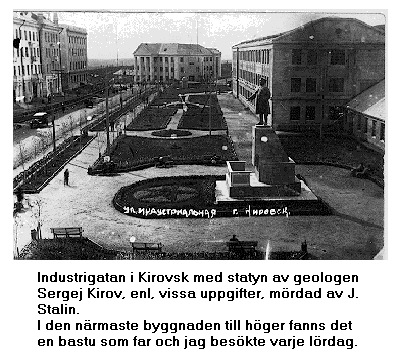
In the barrack at Stroitelnaja Street no. 13 I lived from 1932 to 1940, says Karl, except for the time when I worked in the mine in Kirovsk. My parents with Albert came back from Siberia in 1935 and we had to squeeze into one room with a stove all together for a while. Somewhat later I moved to the mine. The mine work was good; there the earnings as a driller were quite good and I lived with my godmother's son Eedu Rist at "km 25".
We were four people in a rather small room: there was Maali, she drank heavily (the rest of us did too, for that matter), and Eedi and Eedi's smith partner Roomed from Lake Peipus, and me. We had plenty of money; Eedi and Maali had no children then, they had a child a few years later, but it died due to lack of suitable baby food. They themselves did not survive their second deportation either, which was to the Komi area far up by the Arctic Ocean. There was not much leisure activity in Khibinogorsk and those who have not experienced deportation or prison can hardly imagine how depressing life can be. Alcohol became the "salvation" for many and there was a lot of partying. There was no shortage of vodka or fish and in the mine we were privileged; we got half a liter of milk daily after finishing our shift to wash down the dust. Vodka was available everywhere; father often sent Albert to buy a so-called "schkalik", a 2.5 dl disposable bottle of vodka. It was sold in small shops similar to today's hot dog and soft drink kiosks and the bottles looked roughly like the 2 deciliter cream bottles that existed before tetrapak. Admittedly, vodka was not supposed to be sold to children, but the understanding between the thirsty adults was so great that any "uncle" would agree to "collect it". 250 grams (in the Soviet Union vodka is measured in grams, not centiliters – 100 grams was some kind of standard measure) cost 3 rubles and 15 kopecks at that time.
When mother Emely had lived in the home regions for about a year, father Jaan also came to Puusta, in the month of December.
- There was talk of a fire in the house we previously owned; how did that happen?
Yes, the house burned down and we lived in a place not far from it. When Jaan came from Khibinogorsk, old Jaan Järve lured us to his place, near our old property. At first everything seemed to be in order.
- Move here with us, said Jaan Järve, who lived right next to his old property, here the people are better off, but I didn't want to, mother Emely told. Still, I didn't resist too hard when my husband decided we should move. But God, we could hardly live there more than one summer. I had to work in a large collective farm kitchen with big cauldrons, but had nowhere to cook my own food. Other people also lived in the same house. A few times I went into their communal kitchen, but the housewife began to complain and I stopped visiting. A former neighbor woman, whose son was imprisoned and became lonely, thought we should move back to a house near her, which we also did after a while. During the summer we had harvested quite a bit of hay, your aunt Anna Toode had given us a cow upon our return to the home region, and now we had at least a little milk. A remaining farmer nearby wanted Jaan (Kronberg) to start working for him, but he was not inclined to such heavy work as ditch digging at that age, but was mostly occupied with carpentry work. Instead we lived on what we could get from the kitchen garden. We had planted some vegetables in the spring and they seemed to be doing well. Father often visited Anna Toode's relative Manna Schoke. One Saturday evening Jaan went there and later told that he had seen a strange dream.
- "I dreamed that within a week I would be rid of all my worries". And so it happened. Before the week was over, on Sunday morning, the house burned down.
No one really knows how it happened when our house in the Novoselje area burned down, said Karl, the cause of the fire was never fully clarified. They had turned part of the premises into a cooperative store, but there were also people living there who had been assigned to the area and they had nothing to do with the store. According to what Lida had heard, the manager was a somewhat alcoholic woman, a trusted person of the new regime and a former member of the "poor man's committee". There was plenty of drinking by all accounts. It was said that the manageress had committed some irregularities and to conceal these she had set fire, but the most likely seems to be that the fire was caused by carelessness with fire. Drunkenness and confusion have caused much misery around the world, most of all in Russia. Besides the main building, a shed was also destroyed and a child burned to death in the shed. The doors of the shed were reportedly closed, the mother was out at work. There was no major trial, father was acquitted of the accusation. The general moral decay and informing became stronger over the years and just a few years later it would have brought father to a labor camp somewhere in Siberia. Now we got off with a deportation, a relatively mild punishment from a communist point of view, such a punishment at that time in the Soviet Union was rather seen as proof of honesty. Otherwise, moral dissolution was underway, with informing as the main thing. They "exposed" the enemies of the people and in the confiscation protocol they write about father that "he threatens the poor".
My father Jaan did not have permission to stay in the locality and as a result there were complications. Now he became a real "enemy of the people" and as punishment there was a new deportation, this time to the area beyond the Ural Mountains, to a place named Nizhnije Tagili on the Tjusovaja River, a tributary of the Kama. In hindsight, one thinks they settled far too close to their previous place of residence, said Lida. Other returnees went to the Novgorod area, where they were not known by the local population, they could stay there in relative peace and quiet because the administration often didn't care about the papers. The authorities needed manpower, the "depopulation" due to forced relocations had been noticeable, and then papers and permits took second place. Later, however, the paperwork exercise was tightened considerably and something like that would not have been possible.
At the end of January I listened to the radio program Tendens about the Kiruna Swedes who in the 1930s emigrated to the Soviet Union and to build up the Soviet state. It was a lady, Mary Ekström, who told how she as a 7-year-old came to the Kola Peninsula, to Hibinogorsk. When the program ended I called Mary and we agreed to meet and tell each other about life there. On Monday 090228 we took the car to Norrköping and had a pleasant time together about our dreary experiences up there in the north. It turned out that we lived not far from each other and in similar barracks with about ten families each with their own room.
Mary also left some pictures and from these it appears that the disorder is about as great now as then – untidy.
Mary's family returned to Sweden after a couple of years, but many stayed and returned to their homeland only after many years – as adults. In 1999 Mary together with a number of old Kiruna Swedes made a trip to Kirovsk. Now people have finally begun to pay attention to their fates, but when they returned in the mid-1930s and told in Kiruna how conditions really were in the Soviet Union, they were threatened by local communists to keep quiet.
One of these returnees, Alice Eriksson Kalla tells about her years in the Soviet Union:
”I was afraid for 48 years". It is a story about the dreariness, hunger, threats, informing and other difficulties during the stay in the great "workers' paradise".
The mountains around Hibinogorsk constitute the easternmost parts of the Fenno-Scandinavian Mountain range.
Recordings
- 1930HibinogorskA.mp3
- 1930HibinogorskB.mp3
- 1930HibinogorskC.mp3
- 1930HibinogorskD.mp3
- 821204 Karl-Lida berättar om Kirovsk band 2 grön A.mp3
- 821204 Karl-Lida berättar om Kirovsk band 2 grön B.mp3
- 821204 Karl-Lida berättar om Kirovsk band 2 grön C.mp3
- SR_p1_nya_tendens_090216110042.mp3