Confiscation 1930
Karl and Lida tell (Estonian)
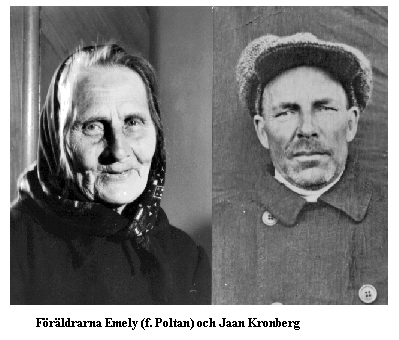
Inthe late 1920s, the communist ideologues began reshaping Russia and the ideas of collectivism began to take firmer shape. The result of all these ideological upheavals was that "committees of the poor peasants" were formed; at their meetings they would decide which large farmers were to be deprived of their property and deported from the area, unless they wanted to stay and become members of the collective. Often a possibility to stay was offered to the younger ones, but it seems very few took up the offer. The construction of the alleged communist paradise proceeded at full speed, and since the state could not attract people to the remote northern regions and Siberia by other means, forced assignments became the only way out. The new mines and sawmills needed labor, and it was just a matter of issuing decrees; whether these decrees were humane or just, no one dared to question. There was much talk about the "dictatorship of the people," but this had no counterpart in reality. People were driven to political meetings, and these are events where some say things they do not think, and others think things they do not say.
In these "poor peasants' committees," the members were mostly local Estonians, reportedly revolutionaries from the "Sorkseppä regiment," and in fact executioners of their countrymen and fellow travelers of the new government. Most had participated on the red side in the war and now had good benefits, about 500 rubles per month. One of these men was Eduard Hütt, his father had worked at the railway in Dorpat.
In 1924 he had been a farmhand for Jaan Kronberg, but in anger he had beaten a horse bloody on the muzzle and been fired. Jaan Kronberg did not tolerate violence, either against people or animals. He was a very peaceful nature, according to mother Emely he had never been involved in any fight or similar. After 1920 there were always a couple of farmhands employed by father, the farm had begun to give good yields and could afford hired staff now that grandfather Karl was getting so old that he could no longer participate in outdoor work. Moreover, he was somewhat disabled and had to use a harness to plow because one hand was deformed.
Eduard Hütt had left Russia for Estonia in 1918 and had brought with him a lot of gold, all that he had come across during his raids, which he called confiscation raids, but were in fact pure robberies, with the silent approval of the new authorities. In principle, all gold and precious stones in the form of jewelry and rings were to be handed over to the state, Lenin had said that urinals would be lined with gold that they would take from the "capitalists."
Already on December 27, 1929, Stalin had announced the transition from "a limitation of the kulaks' exploitation to liquidation of the kulaks as a class." A commission within the Politburo under Molotov's chairmanship was tasked with working out practical measures for this liquidation. It defined three categories of kulaks: those belonging to the first, "persons involved in counter-revolutionary activities," were to be arrested and transferred to the GPU's labor camps or executed if they resisted, their families deported and their possessions confiscated. The kulaks in the second category, who were defined as "less actively oppositional but nevertheless terrible exploiters, and thus naturally inclined to promote counter-revolution," were to be arrested and deported together with their families to remote regions of the country. The third category of kulaks finally, who were described as "loyal to the regime," were to be allowed by authority decision to settle on the outskirts of the districts where they lived, "outside the collectivized zones and on lands that needed improvement."
Instead of, in accordance with given instructions, drawing up an exact and detailed inventory of possessions and transferring them to the collective farm's inalienable capital, the de-kulakization brigades in fact acted according to the principle: "Let us eat and drink, everything is ours."
NA Ivnitskij. Kollektivizatsija i raskulatljivanie (kollektivisering av avkulakisering) Moskva 1994, sid.32.
At the time of the confiscation and deportation in 1930, the Kronberg family was in possession of the following: (according to the confiscation protocol of February 5, 1930)
33 hectares of land, 4 pigs, 5 dairy cows, 2 horses, a 2-year-old bull, 5-6 sheep, all of this had to be left behind. Despite all this wealth that was to be left, the family was (officially) allowed to take with them only:
1 sack of potatoes, 1 sack of flour, some smaller supplies - about 100 kg in total.
"Damn thieves!" exclaimed my brother Karl when he saw the list. They have
stolen most of it already at the start!
It goes without saying that such methods opened the way for all kinds of abuses as well as personal vendettas.
Instead of, in accordance with given instructions, drawing up an exact and detailed inventory of possessions and transferring them to the collective farm's inalienable capital, the de-kulakization brigades in fact acted according to the principle: "let us eat and drink, everything is ours." It was stated in a report from the GPU in the Smolensk governorate: "the de-kulakizers took from the rich peasants their winter clothes and their warm underwear and first of all seized their shoes. They left the kulaks in their underwear, took everything, including old rubber shoes, women's clothes, watering cans, etc. The brigades even confiscated the small pillows under the children's heads, as well as the porridge on the stove, which they poured over the icons that they had first smashed." Stephan Courtois, The Black Book of Communism.
The farm had lived by raising slaughter cattle, bulls and calves, and selling butter to the townspeople. It had been Karl's task to go to Novoselje once a week to deliver butter and other supplies.
Meat was quite cheap at that time. In 1928 a cow cost 20 rubles, a sheep 5 rubles, a bull 25 rubles. The bulls were usually used to pay for a farmhand and tax to the state. At the same time as our parents, the following people were deported:
Gustav Sack, Ossip Danilov, Jaan Repane, Rist.
August Post and Jaan Pae were commanded to transport us to the station, but they were not party members. The party members were Estonians who had been evicted to Russia after independence in 1918, they later worked for the police and administration that carried out the deportations. One of them was Paul Kruus. He lived together with Ojas, one of the former teacher's children, they were real rascals, they stole and robbed. During the war they stole Karl Kuuse's cow, but when it came out that they had stolen, it was also discovered that they had drowned some of the meat in a ditch. August Oja however, was later caught for theft, he worked as a day laborer and got 16 kg of flour per day, one ruble in money, and they stole the potatoes directly from the fields. August and another thief went to the glass factory, where Sass Jurgenson worked, they were going to steal honey. In the morning the beekeeper discovered fresh tracks and he summoned the workers at the glass factory who caught the thieves. At that time there were strict laws for theft and they were shot without trial and investigation.
The Paab family, father, mother and daughter were alsodeported to Kirovsk, they were somehow related to us.
Karl tells: The peasants had a free life, not like now that you have to start at a certain time and be dependent on someone else. The work would proceed as usual, the children would participate, and we also had Panja, a foster child, she was a bit older than me and herded our cattle before me. Then I started herding after her and also Sass Jürgensson was before me. He worked for our father about a year before me. In 1929 we had a girl from the Gommer family with us. It was as usual in the farmsteads, you worked in your own house, but then came the damned confiscation year 1930.
Some rumors had gone ahead, but the new ideas were too revolutionary for anyone to really believe them. But things were happening behind the scenes. It was sometime in the autumn of 1929 that Karl Ilm (as a child he had been a herding boy for father and mother) said to me in the club, where the young people met, that everything would be taken from us.
"Tell your father to sell everything," he said. I passed this on to father and he began to curse:
"May the devil take them, if they take everything from us there will be famine, it is we peasants who feed everyone else. No," he said, "it will have to be as it will be."
In the evening I was at Emely Tolsen's, she was intended as a wife for me. She said that tonight they will come after you, be prepared for it. She knew this because in their house there was the "red corner" (a Leninist altar with a portrait of Lenin, a couple of red flags, and some of Lenin's writings placed in a corner). I didn't have very many clothes, we had a cousin, my aunt's son Voldemar Naruspeck, he was a tailor and journeyman at Ann Todes' husband's, he was to sew some clothes for us. Ann Toode had two daughters, the younger sister lived near the Borski village, kept pigs and fed them with algae from the lake. Father, daughter, and son-in-law traveled to Outova, where they had relatives, they were going to a funeral but became ill and left Voldemar, the tailor, behind.
To my uncle it was about 7 km of good forest road and from there further to the tailor about 10 km. I went to my uncle, borrowed a horse from him and could continue to Voldermar in the evening. I put the horse in the stable and I stayed there with my godfather Karl Poltan, his granddaughter Frida is a lawyer in Riga. In the morning I harnessed the horse and around 4-5 o'clock it was time to depart to the Poltans. Everything seemed so peaceful and upon my arrival there Mrs. Poltan said:
- Stay a while longer and sleep! I had probably slept a little when the door was flung open and a neighbor stood in the door shouting:
- Let us go and take leave of Jaan Rist (married to mother's sister Anne) and their son Eedy! They were with us to Kirovsk in the 30s but were exiled in 1940 to Pudosj – east of Lake Onega, and at the beginning of the war they were moved to Siberia where they disappeared. We have not heard anything about them, says Karl. Rist, Hirv and Jesse were three Estonian families who were quite well off, and the Poltans who were slightly worse off. The Poltans had three children and lived on a hill nearby. They all ended up in Kirovsk. Eedi Hirv was in the army and when I visited Dorpat some years ago I met him. He was a butcher in a meat processing plant, he survived the war because he had such beautiful handwriting and was placed as a staff clerk. His childhood was difficult. It was Olga, Eedi. The parents tied the children with a string to a bed leg and went themselves to work in the fields. They ended up in Dorpat, but I have not visited them for a long time now.
Eedi Rist, the son of my godfather Jaan said:
- Don't go home! Osvald has left to accompany the family Korte to the station!
- No, I said, I will see if all my people have been sent off, if so I will come back. I had ominous feelings that at home it would not be very peaceful either, I set off homewards at top speed.
I came home quite early, it was maybe around 8 o'clock, and everyone still seemed to be sleeping, in March it is quite quiet in the countryside. I had a sawed-off shotgun, says Karl. I took it down from where it lay under the roof and went to the stream where I threw the gun in. Far away I heard the squeaking of sleigh runners, there was quite little snow that year and the runners sometimes scraped on bare ground. I waited and waited, the sound came closer and closer. I went to the kitchen window and saw that there were four or five sleighs coming, they were to pick up food supplies. The ground was almost bare and it wasn't possible to load much per horse-drawn sleigh, a few sacks and it is already heavy for the horse.
Those who had the task of sending us away were people from the area. It was Gustav Kunser chairman of the collective, his daughter was a herding girl with us in the summer of 1928, and Sass (Alexander) Topper, he who lives in St. Petersburg was 1929. I was busy all summer covering the roof of the barn. I did not go in but stayed outside first and then went to the sauna. Mother also came there and was to hide all the gold she had and chased me out. I received an offer from the confiscators to stay, but I had no money and what would I do. All the rooms of the house were sealed because we had a lot of meat in the pantry and flour and groats in a storeroom. The evening before we had hidden our better clothes: karakul hats, expensive shawls, silk blouses. All this we hid under the storeroom floor because father still did not believe we would be deported. I don't really remember how much we were allowed to take with us: a sack of flour, a sack of potatoes, pork.
- They were some measly confiscators, said Lida. I had managed to buy a dress when I went with father to Pskow to sell a cow, it was a floral one, in my opinion a beautiful dress, and I wanted to take it with me, but no. They took it from me. Talk about confiscation, it was outright robbery.
When "they" came we were given a few days to prepare for the journey (to an unknown destination) and take with us what we were allowed to take from the household. It became a couple of sacks of flour, a sack of potatoes and quite a lot of clothes, both work clothes and warm garments, because no one knew (or wouldn't say) where the journey would go.
We still got through the confiscation relatively unscathed. It was said that during the exile in the Pskow area, the exiles were robbed almost down to the skin. With us it was "our own people" – and they didn't feel good about it either.
Among those to be deported were our closest neighbors the Tensons and some others, but grandfather Karl Sr. was not allowed to come along, he stayed there because he was too old. When he became alone and had no one to support him, he had gone to the collective a couple of times to get some food. They had, however, deprived him of several barrels of salted meat from the two pigs slaughtered for Christmas and much else. The answer to his request was:
- You have already eaten enough!
He probably starved to death, (around 1930-31). The daughter Anna Toode (who was a widow and whom grandfather moved in with) didn't have much herself either and in the summer of 1939, when I was herding the collective's cattle in the home area, she told me how hard they had had it after we were deported. After the confiscation there wasn't much of a household anywhere, and due to lack of care the stores were not replenished. Karl Jurgenson had visited grandfather, he said that grandfather lay in bed and couldn't get up. Anna Toode had a cow. She was actually a city girl who had moved to the countryside only after her husband's death and left her only daughter in the city. She looked after grandfather as best she could, but you can't support several people with one cow. Maybe they had a little potato too, but that didn't go far when all other means of support were gone.
Konfiskeringen skedde den 8 mars, (Den sovjetiska/internationella kvinnodagen).
There was no snow to speak of that year. In the morning Karl came home from the visit to Emely Tenson, (his potential bride), in whose home there had been a gathering for the "poor peasants' committee". Emely Tenson had been to Jaan and Emely, her future in-laws, and warned them that the decision about exile and confiscation of property had already been made. In that way they got a certain chance to get away, but father did not believe that anything like that could be possible. Father Jaan had (according to Karl) been involved in some of Trotsky's committees as a peasant delegate and naturally found it hard to believe that such a thing could happen, but now Trotsky was gone and the new dictator, Stalin, had taken over and for him everything was possible.
The exiles were transported to Novoselje station on their own sleighs and had to leave both horses and sleighs there. To see well-cared-for animals handed over to the "barbarians" without any sense of justice felt hard, father Jaan had said. He probably sensed that not only the people would suffer but also the animals. The usual Soviet means of transport in the form of freight cars stood in a long line at the station and the people were loaded into these cattle cars. We stood there for a couple of days and father, who otherwise never smoked, now and then took a few puffs on a "Pushka" cigarette. We had probably bought a dozen packets. The chief of the contingent was a GPU officer of major or lieutenant colonel rank and he said to father:
- We see what is going on, it is not fair, but we must follow the protocol.
Even during those times there were people who were not completely depraved and who realized the injustice of the deportations, but they only obeyed orders, they were already enslaved by the new system, more than by the old one. The gathering took about 2 days, then the journey went from Novoselje in the direction of Novgorod and Tjudoshe.
In the evening came the departure and the leader walked along the train and said:
- Don't wave goodbye with red handkerchiefs.
In 1922 the government proposed that the GPU establish a large camp in the Solovetsky archipelago, five islands in the White Sea off Arkhangelsk, of which the largest housed one of the great monasteries of the Orthodox Church. After driving out the monks, the GPU organized a number of camps that were brought together under the acronym SLON (Solovetsky Islands Special Camp). The first camp inhabitants, who came from the camps at Kholmogory and Peramins, arrived at the Solovetsky Islands in early July 1923. By the end of the year, the camps already held 4,000 prisoners, in 1927 the number grew to 15,000, and by the end of 1928 to 38,000. (p. 149 of Stephan Courtois, The Black Book of Communism.)
The deportations of the second category of kulaks began already in the first week of February 1930. According to the plan approved by the Politburo, 60,000 families were to be deported during a first phase that was to be completed before the end of April. The Northern Region was intended to receive 45,000 families and the Urals 15,000.
The deportations were characterized by a total lack of coordination between the different links in the chain. The arrested peasants sat for weeks locked in improvised spaces – barracks, administrative buildings, railway stations – from which many managed to escape. For the first phase of the deportations, the GPU had counted on 249 train sets, each with 53 cars, because according to norms established by the GPU, each train set was to consist of 44 cattle cars, each intended for 40 deportees, 8 cars for transport of tools, food and some of the deportees' belongings up to 480 kg per family, and one car for transport of the guard personnel.
In these train sets, which while awaiting a place where the deportees could be “settled” had been left standing on a siding in the middle of winter, cold, lack of hygiene and epidemics led to a mortality rate, varying from convoy to convoy, about which we still have few numerical data for the years 1930-1931. (p. 165, Stephan Courtois, The Black Book of Communism.)
The journey went via Velikye Luki, Tikhvin, Leningrad and in a northerly direction, towards the Kola Peninsula. As the train continued its journey, more and more cars were coupled on from the various station towns. In Novgorod, the travelers in the respective freight cars were able to supply themselves with firewood. From Tjudoshe the journey continued to Va..... A fair amount of fuel was consumed; I remember that we stacked firewood in several places; including in Kemi, Karl relates. After about a week we arrived at Apatity on the Kola Peninsula, where we arrived on March 16, 1930. One car had gone off the track near Apatity, Karl relates, and the prisoners were trying to lever it back onto the track. The work was not done with any excessive frenzy and we had to spend another night in the freight cars before unloading could take place.
At the assembly point for the deportation in Novoselje the following families were present: Rist, Hirv, Adamsson, Keydorf, Koorte.
The collective chairman in Pustapersja was Gustav Gommer, he issued papers for the old and sick Karl Kronberg Sr to stay behind. Up in the North there was a need for young labor, no old people to have to take care of and support. These were to stay in their home communities and manage as best they could.
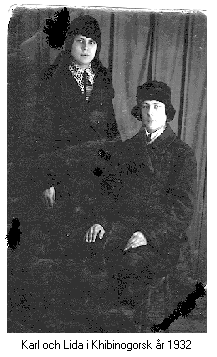
Besides a certain possibility that everyone would stay and work in the collective, there was a possibility for Karl and Lida to stay in their home district. Both were offered the opportunity and both refused; they were too young and did not want to be separated from the rest of the family.
The last stop was the station at Apatity, then the train went onto a track that led to Khibinogorsk, where it stopped and unloaded some people at "km 13". It was March 16, 1930. On one side of the railway the prisoners were housed in barracks and on the other side there were already some Cossacks from Ukraine, Rostov and many other parts of southern Russia. There they unloaded the deportees into the snow on a relatively large field cluttered with various building materials. The material could be assembled into some kind of barracks (commonly called shalmaner) in a day and could be put into use by night. My father Jaan started working as a carpenter on the railway and was given the task of assembling these huts.
Karl relates: My first job was to clear roads. We were transported with horses and tractors from "km 13" to "km 25" where we were shoveling snow. It was cold and there was little food and I couldn't manage very much. Father went to the chief engineer Desterlo (a prisoner himself); he got me released from the snow shoveling, and instead I started with my father as a helper. We began building a barracks and a sauna. When that building was finished, I got work as a rodman and ran with the leveling rod. Desterlo was head of the construction with three subordinate Russian engineers and a number of prisoners at his disposal. No one really knew why Desterlo had been deported there; according to some reports, he had built a power station somewhere in southern Russia. On the other hand, no particular reason (except lack of labor) was needed for someone or some people to be condemned to deportation. The White Sea Canal had for a time Nicholas II's son-in-law as chief and Desterlo had been there as second in command.
The Tsar's son-in-law was a very highly educated man; he had studied abroad but unfortunately happened to be in Russia during the revolution and had to stay. The prisoners were mainly former officers from the former White Army (White Guards from the Tsar's army) and as a rule very educated people, which could hardly be said about their guards. The factories were built by German engineers; one by the name of Marienblatt was responsible for the factory construction for us in Apatity. To assist him he had a certain Mucharovskij, who was from Poland or Germany and had previously been a city engineer somewhere in Russia. He dreamed of returning to his homeland, but the dream never came true. He died after a few years and lies buried in the permafrost up in the north.
In the years 1930-31 there was a feverish work to build the factory in Apatity and the mine 25 km away. In the spring of 1930 the whole family was moved on to "km 16". There typhus raged and later (in November 1930) the whole family was moved further to "km 18". The engineer there during this time was a certain Mikheev. In the autumn of 1931 there was another move, this time to "km 21", near a recently established cemetery. The mortality was high and it was not always that the bodies were placed deep enough in the ground; the permafrost is not so easy to work and it was hard labor to dig a grave. Moreover, the new regime considered digging too deep graves not to be productive work and the grave diggers were not to spend too long at it. Therefore the graves became quite shallow, the deceased were buried relatively close to the surface and sometimes in spring the frost pushed the bodies out of the ground.
Karl relates:
- I was on my way home to the barracks along the railway and met a man. Right in front of me stood a stone cairn and when the man passed it he bowed and made the sign of the cross. I could not restrain my curiosity and asked why he did that and received the reply:
- Under that cairn lies my father buried.
The food rations were small and strength accordingly; moreover, death was daily present and people became blunted and indifferent. On several occasions in the springs, playing children found corpses that had been poorly buried and came to light when the spring sun had thawed the ground.
The times were harsh; the food consisted mostly of black bread, cod, salted herring and vodka. Infant mortality was very high and even the authorities eventually realized this, which resulted in many mothers who had somewhere to go or had relatives remaining in their former home districts being allowed to return there with their small children.
Alexander Jurgenson (my cousin, the son of Aade and Aunt Sophie) came and fetched mother and me. We went back to Pustaperzha and were lodged with a neighboring family - Pae -Hellstin.(?)
Father Jaan grew tired of loneliness and sometime in December 1932 he set off on the journey home, assisted by Alexander Jurgenson, who had come to Khibinogorsk especially for this purpose. It was clearly illegal according to the rules then in force. Actually, Father was not allowed to return there and live there, but the surveillance was not yet as extensive as it later became and he could stay, but he had to keep a bit "underground" and do day labor for the remaining neighbors. He lived and worked near the store, with his sister Anne Toode, whose husband Gustav had died of typhus near Polttani Mägi.
Mother continues:
- I myself fell ill with typhus in 1937 and lay in the hospital in Kirovsk. I was annoyed with the hospital; we got no food and were not discharged either. When I had lain there about a week, I began to feel that it was becoming monotonous. I took my blanket and went out into the corridor, then the nurses got lively. Somewhat later I started to get a little more food; once I remember that jellied meat was served. One time I got two portions after a longer period of starvation, and it nearly went badly. Jellied meat is not exactly food for typhus patients. For the most part, I am told, I lay unconscious and without food, which in itself was the next best medicine given the circumstances. I must have gotten a little something in me, but sleep and rest did most of the work. During a period of unconsciousness, I must have suffered certain aftereffects from the cold; supervision was poor even then, and I did not have enough bedding. When I began to regain consciousness, I felt that my feet were very cold. When I was discharged, I was so weak that I could not get from the room to the car. After a while my feet swelled badly, and there was little medicine; I was advised to try to cure my feet with cold foot baths. There was a small lake near the barracks where we lived, and there I often sat on a stone with my feet in the cold water; this relieved the swelling, but the barracks were poor and there was a constant draft from the floor; that did not contribute to any great improvement in my health.
It was said that the new "peasants" fared even worse than under "the old times"; they were so poor, so poor. His family entirely lacked money and they had had to live on nothing but 1932 our homestead had been turned into a cooperative store, but the manager was said to have drunk and engaged in irregularities, and one day the entire homestead burned down. People in the village said that it did not matter whether there was a store or not, there was nothing in that store but brooms and rakes. As for food, it was empty, now that there were no peasants delivering goods and the collective farm did not function. Mother told that in Khibinogorsk (Kirovsk) she met a younger man, one of the inhabitants of the kolkhoz nearest our yard. He told that they fared even worse than under "the old times", they were so poor, so poor – cabbage, potatoes and turnips, there was no question of bread. The small and medium-sized farms were wiped out as food suppliers, and it was a hard time. Fortunately we still had some money. When we were to be sent away and the neighbor woman had baked bread and sent potatoes with us, so we were not as badly exposed during that first period. Up on the Kola Peninsula, getting supplies became much more complicated. The selection in the store was extremely limited and consisted of bread, potatoes, and some various fish products; sometimes, but quite rarely, vegetables came. When the provisions we had brought ran out and we had to live on what could be bought there, we had to queue and become aware of the great shortages in the Soviet system.
From the state's side, however, it was maintained that this was a soon passing stage and that the real "workers' paradise" was just waiting around the next bend on the road to the communist society. It was just one of those communist yarns that were constantly blared out from the government's side. The hindsight of history would gradually show something quite different.
The brother-in-law Gustav Toode had built himself a house in the same areas where the rest of the family lived; he had been an imperial tailor in St. Petersburg. Since their home was gone, neither Karl nor Alida wanted to move back to Puusta (Pustaperzha) but stayed on the Kola Peninsula.
After Gustav Toode's death, the house was sold and Anne moved to Tossus, very wealthy former refugees from Poland. He had a spring wagon with ball bearings, a truly luxurious ride for that time. They had about 60 hectares of land.
Karl Kronberg Sr died in a Leetlander's house, probably at a neighbor's, though not at the Gulbas family's, but at someone's on the other side of the river. The year of death was probably 1931. When Jaan Kronberg returned to his home district in 1932, Karl Kronberg Sr was already dead. It was not only age that laid him in the grave; it was mostly starvation. The communist extortion system had taken its first victim in our family; over the years many more followed when many of my cousins disappeared.
Крылатые выражения Александра Ивановича Лебедя
Александр Лебедь - видный политик. В 1988 году он руководил войсками в Сумгаите, в 1989 - в Тбилиси, в 1990 - в Баку. В 1991 году он был под Белым домом, а в 1992 году - в Бендерах. В 1993 году Лебедь ловил приднестровских ополченцев, замышлявших нехорошие дела в Москве. В 1994 году он пытался изменить власть в Приднестровье, а в 1995 - начал битву со своим бывшим сослуживцем генералом и министром обороны Грачевым. В 1996 году за кандидата в президенты Александра Лебедя проголосовало 15 миллионов россиян. В 1997 балотировался в губернаторы Красноярского края и выиграл выборы. Погиб в авиакатастрофе в Красноярском крае.
«Дурак не глуп, - это просто ум такой” A fool is not stupid, he just has such a mind”
Кто не жалеет о Союзе – не имеет души и сердца, но кто желает сейчас возродить его вновь – не имеет мозгов.
He who does not regret the Soviet Union has neither soul nor heart; he who wishes its rebirth has no brain. General Alexander Lebed.
Recordings
- 1930KonfiskationA.mp3
- 1930KonfiskationB.mp3
- 821201 Lida och Karl berättar om konfiskationen A.mp3
- 821201 Lida och Karl berättar om konfiskationen B.mp3