Karl Kronberg tells about Khibinogorsk 1932
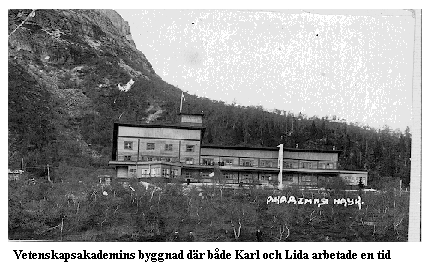
Died on 17 December 1994 1932 I worked a few months in Khibiny, 16 km from Apatity station towards Murmansk in a sovkhoz (in Russian selskoje hozyaistvo). It was an agricultural research station specializing in tomato cultivation. The professor had 4-5 laboratory assistants, a few cows and small fields where he grew different kinds of seeds. He researched cultivation and began developing agriculture and got quite a lot of milk from the cows. A driller in an apatite mine did not live long without milk; the lungs give out and he dies within a few years. Until 1936 I was a mechanic but in 1937 I moved to the mine and became a driller; they paid well for such work. The working day was only 4 hours.
In the beginning, when we had no milk available up there, we got a piece of butter, but the butter does not help against the locherite dust, and the dust hung thickly in the work areas. With a few glasses of milk after work you walk a few hundred meters and start coughing; you can't chew anything because pure sand comes up from the lungs; the milk cleans this away to some extent.
- Now I am 82 years old but it seems that my lungs are still healthy. If we had not had milk, the lifespan of a driller in the mine would have been limited to two or three years. Earlier, milk was transported there from Russia and was not available every day, but from 1937 we had abundant access to milk.
The professor had a small forest area overgrown with small pines cleared. It was a large "Tjeljäbinets" (a caterpillar tractor from the Tjeljabinsk factories) that did the work on the heavily mossy ground. Afterwards, oats were sown and they grew almost to man-height. The professor set up several such sovkhozes around, some with very large livestock herds - some up to 400 - 500 animals when we were again forcibly moved from the Kola Peninsula 1940. They did not harvest the oats but cut them green and used them as animal feed during the winter. They also had their own potatoes; they were not floury but became somewhat watery.
Those who had worked in the mine earlier were yellow in complexion; they had a small pension and had a rather difficult time financially. Once I met a bookkeeper; I knew nothing about the pensions; he had a small pension, was injured, and had difficulty moving.
Later, Professor Eiffert became president of the academy in Estonia; he was richly rewarded for his work on the Kola Peninsula and had been awarded several Orders of Lenin. It was told in an article about how he himself came to the Kola Peninsula very early, at a time when passengers themselves had to ensure that there was firewood for the locomotive and the journey from Leningrad to Murmansk took at least a week.
Eiffert was an extremely democratic person, a rarity in the Russia of that time. He was unmarried; he worked and ate together with his co-workers in the same canteen. We often had both semolina and rice porridge; I have never eaten better than during the two or three months I worked for him. When I worked as a carpenter the pay was about 70 rubles per month, rarely over 100 rubles, but with him I got 132 rubles and free food besides. I actually did not have permission to work in Khibiny, but I could not get registered either, because there was no commandant's office. It went well for a while. It was the only time I was treated as a human being; we were like a large family. The rest were leftover communist scum, human waste consisting of the dregs of society. They had robbed the working people over the past 10 years and wanted to continue doing so. They were bad as workers and even worse as administrators. However, I could not continue there "illegally" and before a renewed registration I returned to Kirovsk.
Before my parents were deported for the second time (when my father was also to leave Kirovsk), a cousin (Sass Jûrgenson) came and helped my father move the belongings that had been collected in Kirovsk to the home regions, and we siblings were left alone on the Kola Peninsula. In 1931 my mother went back to the home region east of Pskov and in 1932, just before New Year, Sass came and fetched my father. A long time passed; we received neither letters nor any other messages for a long while. We thought our parents were in the home region, but then a letter came from the area of the Chusovaya River, a western tributary to the Kama. Most others had been transported to a place about 50 km north of the city of Molotov (which Perm was called just then), but our family had been lucky. The Russians wanted to populate Siberia and therefore some of the deportees, the Waldemar Hiller family, had been allowed to bring a cow from home, from Puusta. The means of subsistence in Siberia were difficult; there was no shop to buy food from. Now and then a shipment of bread would come, but the boat had to stop below the rapids and most of the bread was gone when the shipment reached our selling point. (a shop – if one can call it that)
However it was, Hiller's cow became ill and was to be slaughtered. The meat, however, was to be delivered to the state further down the river at a receiving station. Here Hiller and my parents saw a chance to escape the deportation. They secretly built a raft (at night, of course) slaughtered the cow, placed both the meat and themselves on the raft and set off for the city of Sverdlovsk (which today has regained its original name and is called Ekaterinburg). The Hillers never returned to their homeland. They stayed in Sverdlovsk, where they were to sell the meat and thereafter we heard nothing from them. They were originally two brothers. From Sverdlovsk my parents somehow managed (by bribing officials with gold rubles, according to my mother) to get tickets back to Kirovsk and I remember that we had to wait a few days in Perm before we could take the train back to Moscow-Leningrad and Kirovsk. That I remember Perm so well is because I happened to break the glass on the stationmaster's red-green lantern, got a thrashing from my father, and he had to pay 3 rubles for the glass.
When we had returned to Kirovsk on the Kola Peninsula and found the barracks where the siblings were currently living, there was a terrible smell in the barracks where we were to live. They were fumigating against vermin.
- When I opened the door, Albert was standing there in the room, says Karl. It was the 16th of September 1935. In Kirovsk we then lived until the Finnish Winter War 1939-40. When it ended, there was a new deportation, this time to Far Karelia. When the Second World War began I went off to war on the Russian side, while Albert with my parents remained in Scheltozero.
When we returned from the war, Albert was gone, and we did not meet again until almost a quarter of a century later - in 1964.
Recordings
- 19941217 Karl om livet i Kirovsk XB.mp3
- 19941217 Karl om livet i Kirovsk XC.mp3
- 19941217 Karl om livet i Kirovsk XD.mp3
- 32apatda.mp3
- 32Karlber..mp3