Ural 1933
I
in connection with the fire investigation in the spring of 1933, my parents' "illegal" stay in their former home came to light and father was accused of having set fire to our former home. The neighbors who remained there testified, however, in his favor and he was acquitted, but since he had been staying illegally in the area, the sentence was a new deportation – this time to Nizhnie Tagili, a community in the making, beyond the Ural Mountains. The rest of the family's children, Karl and Alide worked on the Kola Peninsula and remained there.
Oh, oh, all that we have gone through, sighed Mother Emely, how many people did not perish in Khibinogorsk! At regular intervals we learned that this or that person had died. He was a man who once told me that the entire city was more or less built on human bones; he was certainly right. On the Kola Peninsula a large part of the Soviet Union's people had been buried, and now we were to be exiled again God knows where.
A neighbor Gustaf, one of the Pae brothers, moved to the kolkhoz after having previously lived in the city. Later he was said to have moved to Jamburg and gotten married, a male acquaintance told me, but Gustaf died shortly after the marriage. Later the male acquaintance also disappeared from the kolkhoz and no one knows where he went, just like my uncle Karl Poltan. The other of the Pae brothers stayed in the kolkhoz and was nearly one of the few grown men in the entire collective; he had to take care of practically all the plowing. When we returned from Kirovsk with you Albert and visited them, he said:
It would have been better to leave with the kulaks to Kirovsk than to stay with the “poor man’s committee” in the collective. When their father, who also lived in the collective, grew old and wanted tobacco, he got nothing from his sons. Then the daughter had to steal a little meat, which came to my husband Jaan, who often visited the city, and he arranged through some transaction a little tobacco for the old man. The old man died in his home region.
From mother’s account it appeared that we were not the only people who were to be exiled. There were many relatively well-to-do peasants on the Estonian and Latvian farms who were now to be deprived of their property and deported somewhere. “Raskulatjivanie” (confiscation of property and deportation of peasants) was still ongoing. There were whole trains of freight cars (meagerly equipped with bunks and a stove for heating) that were used for transport. Some Red Guards under the command of a “kommandir” (officer) accompanied the train and made sure that no one could escape during the train’s stops at stations. From Novoselje the train went via Leningrad, Moscow, Perm to Sverdlovsk beyond the Ural Mountains. The final stop was the station community of Tjusovaja, next to the river of the same name – a tributary of the Kama. (Perm was called Molotov for a time, and Sverdlovsk was formerly called Ekaterineburg; it was renamed Sverdlovsk after the Jewish tsar-murderer Yakov Sverdlov.) Perm already in the early Soviet years became notorious as a place of exile and has remained so even after the fall of the USSR. The Pentecostal friends in Vagnhärad carried out a certain relief work for prisoners in the Perm region. When the railway to Perm was completed, prisoners were shipped there in barred wagons; then they had to walk the remaining part to the place of exile Krasnoyarsk, Tomsk or Irkutsk. Leo Tolstoy, in his book “Resurrection,” described in great detail such deportations and how they were carried out. He describes the hardships, the intermediate stops, and the temporary prisons where prisoners were allowed to stay and rest for a few days. During Soviet times, transports went directly to the camp sites, even those far from Central Russia: Komi, Magadan, Vologda, etc.
From the Tjusovaja station the transport went by boat along the river of the same name (a 592 km long tributary of the Kama); then the journey was to continue on foot past the rapids upstream to a forest camp north of the site that today is the city of Nizhnie Tagili. My first memory from there is that father carried me under his arm and I could reach the water with one hand where he waded up to his knees in water in a couple of places. It must have been high water because the path now and then disappeared under the water.
The settlement in Siberia was somewhat better than the one when we arrived in Khibinogorsk. They had roughly cleared a clearing in the taiga and built a few small log houses in the middle of the Siberian primeval forest, which stood like a wall all around, relates Mother Emely. True, we had forests at home too, forests that we thought were quite majestic, but something like the taiga we had never experienced before, said Mother Emely. There was only a small opening toward the river; in all other directions the taiga stretched for hundreds of miles. The river constituted a landmark and it was not advisable to stray too far from it; it was easy to get lost and there were neither roads nor dwellings at a reasonable distance.
– We were out picking berries and mushrooms in the forest, for such things were plentiful, said Mother Emely. You Albert sat on a stump and clanged a pot lid to scare away the wild animals; there were plenty of both bear, wolf and elk, but no one had hunting weapons to shoot any. According to the small indigenous population that remained there, and a few who had survived the first period and stayed behind, we were supposed to be the third contingent that had been deported there. Most of the earlier forcibly relocated were dead, and in the light of the past our future looked quite dark.
The main occupation consisted of forest work, and logging was done mostly only near the shores. The transport routes were short, and then the timber was rafted to the sawmill that stood next to the river, and a bit away from it a small village had been built where we were quartered. There had been a small village there earlier; now they built a few more houses so that the exiled would have somewhere to live. The lodgings were typical Siberian houses, log houses with small windows and high thresholds; I remember I had some difficulty getting over the threshold. The houses were quite similar to those we later became acquainted with in Far Karelia, only with the difference that the Karelian houses were much more spacious, while being built together with stables and outbuildings. Here there were not so many livestock and therefore not as much additional space was needed. The original population had lived mostly on hunting and fishing; there were only small kitchen garden patches around the houses.
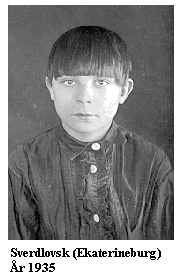
We came to the Urals early in the spring of 1933, and in the autumn of 1935 we were back in Khibinogorsk. Life in Siberia was hard and there were no opportunities to improve one's living conditions. My father Jaan was no longer young and not entirely healthy either. He could not manage to work in the forest, but fortunately the foreman Mozjaev, son of a former landowner and a prisoner like all the others, was a decent fellow. He did not make life harder for the exiled than he had to. Otherwise Soviet citizens were inclined to make existence worse for their fellow human beings to a greater degree than necessary. Many other accounts from the GULAG camps in Russia testify to this. The devout believers in the ideas of communism regarded all exiles as “enemies of the people,” in line with the propaganda blared out from the party headquarters in the Kremlin.
What father earned in the forest was not much; moreover, there was no food to buy; instead it was distributed by the camp administration. As usual – this has later been confirmed and described in many books – most of it was stolen already on the way to the camps, and what was not taken was sold by the camp administration at high prices.
– If we had not had any of our own money to draw on, we would probably have had to stay there forever, said Mother Emely. With a little capital one can get quite far regardless of how conditions are otherwise. Somehow we survived the winter anyway; Mother Emely did not want to go into any further circumstances and I myself do not remember much of it. A few episodes, however, have stuck in my memory.
Life went on in a kind of pioneer spirit and was quite disorganized. The few original villages lay along the river; those later built and intended for the forcibly relocated lay farther into the forest. There were not many children; I remember that I had no playmates of my own age during our entire time in Siberia, and during the days, when my parents were at work, I was mostly alone with some elderly people in the village. During the winter of 34–35 I mostly "served" as a stoker in the house that my parents had been assigned as a dwelling. I had strict instructions on how to tend the fire in the large stove so that the house would not cool down too much but neither burn up. Normally the Soviet government was careful to arrange nurseries and daycares for the children; here there must have been both a shortage of children and an organization for that purpose.
The forest camp lay far inland and the weather changes in summer could be very violent, with fierce rain and thunderstorms. One such thunderstorm I remember very well. It grew dark in the middle of the day and began to rain; I ran into the little house we were living in and hid in a corner behind the stove, where I felt safe. In Russian tradition, stoves are always so large that one can lie on top of them, no matter how small the house otherwise is. Behind the stove there was a nook; there I hid from the lightning, the driving rain and the strong wind. The lightning and wind grew stronger and stronger; when I dared to leave my nook and peek out through the window, I saw how some more isolated trees were blown over. When my parents came home they found a little frightened boy sitting in a corner behind the stove.
– Before we were deported to the Urals, I had in Pustaperzha (Puusta) managed to acquire a calf, says Mother Emely, which I had boarded with Ivans Lena. Officially the whole family did not live there. Before the deportation I had to sell the calf; I could not take it with me. Deported with us to the Urals were the Tenson family (husband and wife Alma), Valdemar Hiller and the Eedys brothers.
The River Tjusovaja had several rapids that had to be passed on the way up to the forest camp; this, along with the other usual Soviet distribution difficulties, made food a problem. Skill in distribution has never been a characteristic of dictatorships, and the Soviet Union is no exception. The majority of the male population was occupied with logging, while for the women most of the work was at the sawmill and lumberyard. The sawn timber was transported across the ice to a place below the rapids where boats could come and load the timber for further transport inland. In the name of equality, they generally do not distinguish between men's and women's work; women were often seen in jobs that in the West are usually considered traditionally male. Road workers and painters were seen as typical women's jobs in the Soviet Union.
With a bread ration of 400 grams and no other essential foodstuffs, naturally not much could be accomplished. It was a matter of using as little energy as possible, which mostly meant that the workers dawdled or let tools be destroyed (to get a rest break). Certain goods could be bought from the small group of indigenous people (and a few others who had managed to survive and settle in the area), but the earnings from work were not such as to leave much room for purchases. The selection was not worth mentioning either—fish from the river, a little bread and milk, potatoes could at best be bought from the people who had lived there for a longer time.
There was no real shop in Nizhnije Tagili. Food was distributed through the sawmill (the bread boat came once a week up the river, but stopped below the rapids); at the sawmill they did not always control the situation, since transport functioned sporadically and at certain times food became scarce. Bread and potatoes were to serve as staple foods. Siberia was a gloomy place for those used to somewhat open views; the taiga stood dense around the little village along the Tjusovaja River, and the wilderness stretched for hundreds of miles in all directions. The only opening faced the sawmill, which lay next to the river.
My siblings Alida and Karl were still on the Kola Peninsula. As the situation began to look serious with another winter and a lack of provisions, my parents wrote to them and asked them to arrange travel permits back to Khibinogorsk; the road home was by then completely closed. Another winter in Siberia we would not survive, and the only chance to stay alive was to somehow get away from there.
Lida and Karl went to the local NKVD leadership (Ministry of the Interior) in Khibinogorsk (after the murder of Sergey Kirov in 1934, likely on Stalin's orders, the town was renamed Kirovsk in 1935) and requested that the parents and the youngest brother be allowed to come to Khibinogorsk. At the NKVD they said:
- Let them come, we will register them here if they can make it, but unfortunately we cannot issue any official permission to come. It became a matter of fleeing Siberia, which, given the circumstances, was no simple undertaking. The food rations were meager, the forest work too heavy for old men—what could be done? An acquaintance of Jaan said that he was old enough to sit in the boat and make his way to the railway! Jaan, however, was not bold enough for that, but we were lucky.
Later mother told that besides the constant hunger, there was another threat to the family. Since there were not enough children to organize a daycare in the area, the authorities wanted to take me and place me in some boarding school far from my parents, because both parents were working. I was about to turn 7 and start school, but there was no school in the area, and for that reason I was to be sent away to a distant boarding school. Given the communications, we would likely not have been able to see each other very often—if ever.
Plans for an escape had been hatched earlier, but without much success—now, however, it seemed that escape might become possible. Together with the Hillers family, Jaan began building a raft; the river was the only link with civilization and the only way to reach more populated areas, from where a continued journey toward Khibinogorsk could be made. The first attempt was a failure—someone discovered their activities with the raft building, thought the raft was far too large, and reported it to the commandant's office; they were deprived of the chains that were to hold the logs of the raft together. However, improvisational ability and ingenuity are great when necessity is at hand; if there is no suitable material to use, one has to come up with something else. Both were experienced farmers and could handle both logs and withes. This time the logs were bound with spruce withes; they were not as reliable as chains, but the only conceivable option in the current situation. Sometimes one has to take risks that under normal circumstances would have been avoided.
I remember the night we were to start, it was in the middle of September and almost completely dark. I was strictly told not to speak loudly and not to rattle things. Since it was a complete move, we took everything we owned, which in itself was not much. I don't know if my parents had more than we could carry; it's possible that father had gone down to the riverbank with some of our belongings a few nights earlier.
During our journey down the river, the raft struck an underwater rock. The logs began to slide apart and a chest (which I thought was very large) was about to fall in. Father jumped into the water and held the logs together until the raft could come ashore and be repaired. The rafting could only take place at night; during the day it was too risky, as it could attract attention, and since all totalitarian systems rely on informing, we would be exposed to great danger of being discovered and reported during the day. That would likely have resulted in banishment even farther into Siberia.
Informing flourished under the Soviet regime; people were paid when they reported someone engaged in something that did not suit the state and its system. In earlier times, both political and criminal prisoners could flee Siberia; the indigenous population sympathized with the prisoners, helped them on their way, and hid them when the authorities' "dogs" were nearby. But the Soviet system had so depraved and corrupted the simplest ethical and humanitarian concepts among the population that for a few rubles they reported every unknown individual; in some cases they became local heroes in the fight against so-called "anti-state elements" and could boast with name and portrait on the "Honor Board" (Potjetnaja doska - Почетная доска).
After a few nights of rafting, the families returned to Tjusovaja station, where the meat was to be delivered, but they did not stay there at all; they continued the journey to what was then Sverdlovsk (today again renamed to Ekaterinburg). There the Hillers were to sell the cow. The families parted and never saw each other again. Later we learned that they had been taken by the militia for illegally crossing their area of residence and sent farther east.
Mother continues:
- We managed to take the train from Sverdlovsk to Molotov station (which, after Molotov fell into disfavor, regained its old name - Perm). There came a wait of several days before father managed to get train tickets. For lack of occupation, I ran around playing in the railway yard, accidentally kicked the stationmaster's red-and-green lantern to pieces, which earned me a minor spanking and my father an expense of three rubles. That the travelers had a ticket was by no means a guarantee of getting on the train. When the train arrived, there was a tremendous rush into the carriages. Father Jaan was a rather timid and peaceful person; he had difficulty pushing forward; mother Emely had to do it. She had a bit more grit and eventually managed to get into the carriage and find a seat on a bench. Then I was passed in through the window together with the belongings, and little by little father also managed to work his way through the crush and get on. We had to change trains both in Moscow and Leningrad, and the procedure of securing a seat was repeated in both places.
From Leningrad I remember that we arrived at the Moscow Station and were to move to the Finland Station, from which the journey toward Murmansk could begin—a considerable distance. There were no taxis, and as a rule the move had to be made with some truck that was heading in the right direction, and the trip cost (as usual in Russia) a half-liter (pollitrovka). At the station the things were unloaded, and then followed a procedure of moving the belongings (consisting of several parcels) to some place near a bench on the station. There were more parcels (a family's entire belongings with kitchen utensils and carpentry tools) than could be transported all at once. Consequently, someone (usually me) had to sit and watch the remaining parcels either at the place where they were unloaded or at the place to which they were to be moved. It is surprising how many things three adults and one child could still have with them. I remember that my parents had a rather large chest; I could stand next to it and look in when mother took out and put back things; I could reach up over the edge with my chin. Father was probably very strong and could carry it all by himself, since it was not possible for both parents to leave any of the "depots" unattended at the same time.
Among other things, there was also a pendulum wall clock of the classic tower-and-battlements model; on the pendulum were the letters R A printed in fraktur. When I had barely learned to decipher fraktur (my mother's Bible from 1895 is written in fraktur and in it I began to learn to read), I found it strange that the clock had my initials. In my inexperienced eyes, the R looked like a K. When our neighbor Dolly Axén passed away on March 28, 1986, we inherited a clock of the same make, in considerably better condition. It had hung in her childhood home in Vännäs. She had inherited it after her parents' death because none of the other relatives wanted it. At that time, it was supposed to have gilded pendulums (as Dolly put it), and later the clock lay for long periods in the attic of Stenbrosskolan just outside Nyköping, where she had spent her life's work as a teacher for over 40 years. When she retired and moved from the school to Erikslundsvägen 7, the clock was hung up again. According to her account, the clock was bought by her father. The father and a few other young locomotive drivers had each bought a clock from a fire-damaged shop after the great Sundsvall fire of 1879. It is a fairly large and good clock, but heavy to wind, and Dolly had difficulty mustering that much strength in her hands.
Most of the household goods from the return journey from the Urals came along, and after moving to Estonia in 1947, my sister Alida had the clock hanging in her and Waldemar's room. Now it hangs on the wall at Waldemar's in Tallinn. It looks quite battered; most of the turned figures are missing and some edges are worn off, but then again, it hasn't been allowed to enjoy peace and quiet on the wall of a stable house but has had to endure one bump or another over time.
After many difficulties and great effort, we returned to Kirovsk in the autumn of 1935. I remember the date. There was a calendar hanging on the wall, and by then I could laboriously spell my way through – September 16. A large part of the barrack town was finished being built and we could move in with Karl in his room with a stove on Stroitelnaya Street number 13. The barrack had been treated for vermin shortly before we arrived, and I remember it smelled quite bad. A few days later I was to start my schooling. It was to last
a few years, up to and including the spring term of 1940, when a new deportation – this time to Far Karelia – was to take place.
Today one can read in books published after the fall of the Soviet Union that the area around Nizhnie Tagili had, during the 1930s and 1940s, grown into a gigantic place of exile and a prison camp, where thousands of innocently sentenced and exiled people to forced labor had to spend a number of years; some never regained their "freedom" but were buried in the eternal permafrost of the taiga.
After the denunciation activity had been absent for a few years, it seems that President Vladimir Putin has again revived the possibility for people to denounce others completely anonymously. That anonymity, during the worst Soviet years, led to people being able to denounce their neighbor just to get hold of his apartment, workplace, or something else. (2002-01-04).
The Russian people have over centuries been instilled with the notion that the leaders work for the people's good. The 'popes', the priests, were tasked with reading out ukases and decrees about 'Little Father Tsar'. Now Putin & Co have taken over the priests' role, and the people continue to worship their idols – for better or for worse. The situation has improved somewhat, but given Russia's riches, not many crumbs fall from the rich oligarchs' table to the people. Putin's gang has surely moved a great deal of capital abroad; Russia has never been particularly safe to keep one's money in. At any moment a new 'ukase' can come and deprive citizens of their property and rights (2008-04-25).
The conditions and persecution of Estonians and Ingrian Finns in the Soviet Union did not abate after the war. This is attested to by an Ingrian boy's story:
Matti Mulkahainen was 14 years old when he, along with his family, was deported from Kelto together with some others in March 1942.
”We were moved to Siberia, to the Krasnoyarsk region. The father was still young, 40 years old, and we were assigned to the Turukhansk district, on the Yenisei River, 1200 km north. There was a small village with five or six houses. We were about 15 Ingrian families and a few Estonian ones. I remember that during the first winter two Ingrians died of starvation. One was Antti Toksonen and the other was Hynninen, who were from our village Kelto. They starved to death, as did an Estonian woman with her 15-year-old daughter. They died during a journey to a neighboring village to exchange some clothing for food. They froze to death on the journey, I remember that.
So we survived the winter and spring came. There were no roads; connections were along the water, on the Yenisei River. The local people had boats, but we had none. Father and mother thought that we too would face starvation and death if we stayed there. But how to get out? In spring, when the ice broke up, one could get timber from the river to build rafts. Together with my father, we made a raft at night, and at night we set off on the 200 kilometers north, to the district center.
We stopped after about 5 kilometers. There was tsheremisha grass there, which resembles ………… We collected a whole sack for food. There was also a broken boat that had been washed up by the spring flood. It was like a gift from God. From the boat, father got nails for the raft, which had been tied only with rope. Then we continued our journey. I remember how my little sister, then only seven years old, slept on the raft. Father said to me that we should go out to the middle of the river – the Yenisei is about 2 kilometers wide there – so it goes faster. When we got out to the middle of the river, the wind picked up and the wave height increased. We were to wake my little sister because there was a risk she would be washed off the raft. The raft began to split. Now the nails saved us. I remember how father started nailing and I held onto his coattails so he wouldn't fall in. Father hammered in all the nails, but despite that, the raft threatened to break apart, the storm was fierce. Then we made some kind of sail from a blanket and managed to get close to the shore. In the morning it was completely calm. We continued our journey and arrived at the district's administrative center.
Father went to the authorities and reported that the family had arrived. They told him that we had to return to where we had come from. Father said he would not do that, they could do whatever they wanted. With mother, father, and I wanted to go fishing, but mother had frostbitten feet. She went with little sister to the town of Turukhansk where she had her toes amputated. (Turukhansk – during tsarist times the place for exile of political prisoners. The participants of the 1905 uprising stayed there: Josef Sverdlov and Josef Stalin. Source: Soviet Encyclopedia 1987).
My father, I and my brother were transported 12 kilometers to a meadow to harvest hay, to the confluence of a small river into the Yenisei, even though it was not yet time for hay harvest. We received a five-day bread ration, no boat or anything else.
Two weeks passed without anything happening. We were dying of starvation. Then we found next to the shore of the smaller river a small old rowboat, and father began to repair it. Perhaps with it we could reach the fishing population on the small river. Father said he would rest a little and asked me to continue with the repair of the boat. He sat down – and died. He was a big man and had been without food for a week.
We, my brother and I, became frightened when father died. What were we to do? I took the rotten rowboat and a pole in an attempt to cross the river. Naturally, the boat broke, but luckily so close to the opposite bank that I could wade ashore on it. My brother stayed with our deceased father. I walked 12 kilometers along the shore and at night I came to a fishing family. I told them what had happened. They were kind people, they gave me fish to eat and took me to the authorities.
Two men from the administration made their way to the place where our deceased father and my brother were. My brother was still alive, but already swollen from starvation. Father was buried on the riverbank without a coffin and without any ceremonies. My brother and I were transported to the district center. The following day mother arrived with our little sister from Turukhansk. We told mother everything and cried together. From the district center we received nothing but bread rations. In Turukhansk there were some other goods on ration cards. Mother said we must move there. We said nothing to the authorities, we just moved there. Mother got work as a guard at a fish factory. I got work at a cooperage. That's how we survived.
(Mulkahainen, 13.6.1993). (From ”Inkerin kansan 60 kohtalovuotta”. ”The Ingrian people's 60 fateful years”, pages 106-107av Jouko Sihvo, Editon Tammi, 2000,.)
Matti Mulkahainen came back to Ingria from Karelia in 1954.
Mother Emely laments Albert's lonely childhood. In Estonian
Albert reads the same text. In Swedish abbreviated version
Transcript from a tape recorded by mother Emely in an archaic Estonian.
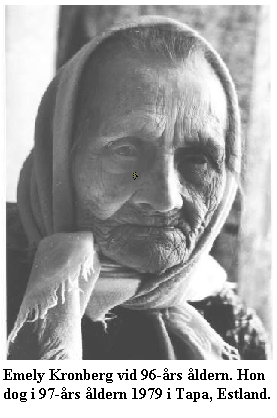
Vaada mis ma olen näinud omal elul. Olen ma kannata saanus……..Sinu pärast ma pagesin kaks korda. Vaada kuid siin lapset kasusid, aga kui sina kasvid….. Ku viidi sinne Uraali – kannu körval teid asja. Aga näes kas se es ollut Jumala hoidmine …………vot ku on ütte kopikad karmannis ja ku sa ni paljas oled. Kui minul es ole seta rahakopkad olnud et ma seal välja es oles joudnud, sis oles pidanud surema.a mis ma olen näinud omal elul. Olen ma kannata saanus……..Sinu pärast ma pagesin kaks korda.Vaada kuid siin lapset kasusid, aga kui sina kasvid….. Ku viidi sinne Uraali – kannu körval teid asja. Aga näes kas se es ollut Jumala hoidmine …………vot ku on ütte kopikad karmannis ja ku sa ni paljas oled. Kui minul es ole seta rahakopkad olnud et ma seal välja es oles joudnud, sis oles pidanud surema. Ja, seal ole kaks vanna – mees naisega molemad ja nendel oli kaks last, nigu sinagi. No süüa es anda, palkka ka ei saa, mötsa tööd tema ei jouatema es joua – mis tetta? Sis …………oles jumalast önn. Uks tuttva mees, kadunud Jaan teadas teda Pihkvas. Tema uetles ett vötta loodik ja söida sinne koski seal kusal sa rongi pääle istuda. Aga Jaanil nii palju pead es ole otsal, nii kaugele söitta. No sis tulevad önnes et ũhel perekonnal sai lehm otsa, ol kodumaalt lehm ũtte vöettu, tul sai lehm otsa ja tolle lupatti lihat linna viija, kos rongit käivad. Aga Jaanil temal oli käed …… ………..Ma sis läksi tolle mehe manu ja ũtli tälle. Nu nakkas tegema seda barschad kulla ta sais linna sõitta, ma ũtle et vot, ma tahassi väga et minu mees tule ka sulle appi, ku sa saad sinna nii vötta meid ka sinna. Aga ole ta väega valmis
Look what I have experienced in my life! Indeed I have had to endure…… For your sake I fled twice. See how the children grow up here, but what would it have been like? When we were deported to the Urals – there you had to sit by a stump and play. But everything is in God’s hands….. if you have a few kopecks in your pocket, you are not completely naked. If I had not had those kopecks, we would not have been able to get out of there, then we would have died there. There were two old people there – man and wife and they had two children, your age. But, there was no food, no pay, your father could not manage forest work – what was to be done? Thus – with God’s luck. A familiar man, the late Jaan met him in Pskow and said one should take a boat and set off to where one could get on a train. But Jaan did not have enough sense to go that far. Our luck came when the cow in one of the families became sick and was slaughtered. They had brought a cow from home, but she became sick and they got permission to bring the meat to the railway station, Jaan was not particularly … I went and talked to the man. He started to build a raft and to get to the town (today Yekaterinburg – then Sverdlovsk) and I said that, look here, we would very much like that my husband comes to help you. When you set off you can take us along. He was not particularly willing, however.
Recordings
- 1935UralA.mp3
- 1935UralB.mp3
- 1935Urall D.mp3
- 1935UrallC.mp3
- förkort.version av C60 2B.mp3
- Kass.Philips C60 2b Mor berrättar om Ural.mp3
- xx Maria I klagar över Kars roll i äktenskapet.mp3