Sheltozero 1940
After the return from the Siberian exile, life on the Kola Peninsula continued at a relatively calm pace for a few years. When the Finnish Winter War broke out, the "Soviets" apparently felt some unease and new population transfers were planned without the population's knowledge. We were inundated with propaganda in the form of both speeches and music. One of the most popular songs was the one that mocked the Finnish commander-in-chief Karl-Gustav Mannerheim, but the Swedes, who helped the Finns, also got their share: A song about Marshal Carl-Gustaf Mannerheim that was often played on Soviet radio during the Finnish-Russian Winter War 1939-40
Барон Маннергейм, белофинский подлец Baron Mannerheim, the White Guard scoundrel Два дня уж сидит без обеда Sits for two days without dinner Представился маршалу близкий конец He sees the end approaching and finally Барон Маннергейм белофинский подлец Baron Mannerheim, the White Guard scoundrel И помощи проситу шведа Begs he the Swede for help Зря точит заржавленный ножик Sharpens in vain his rusty blade Конец ему близок и тут уж ему He is near ----------------------the end, and Ничто все равно не поможет here he has no help to expect.
The Finnish Winter War 1939-40 ended in the spring, and after that the Soviet government apparently found it unsafe to have so many "foreigners" near Finland, and a new period of forced relocations began.
The war had gone extremely badly for the Russians. Despite their inferiority, the Finns managed to surround the Russian 18th Division and largely destroy it, capturing its war equipment. The same fate also befell the 44th Ukrainian Armored Division, which was supposed to split Finland in half and attacked in the direction of Suomussalmi. Without winter combat experience, the Russians had extremely slim chances of making any conquest; the snow, severe cold, and stubborn Finnish resistance put a stop to that.
A Russian company commander writes in his report: Our commanders have no idea how to wage war in forest terrain, why have we been sent here?….
The losses in personnel and material were enormous. According to official reports, the Russians lost 74,000 men, but there are assumptions that it could be as high as 131,000 men. The number of wounded was 186,129, frostbitten 13,213, wounded 240. According to data from the Finnish War Archives, the losses for the Finns were as follows: dead - 19,567, wounded – 43,557, missing - 4,101 and captured – 825. According to Finnish sources, 5,469 Soviet military personnel were taken prisoner. After returning from captivity in Finland, they participated together with Red Army units in the victory parade in Leningrad. Thereafter they were separated from "the victorious warriors", loaded onto special trains and disappeared somewhere – without a trace. It was punishable in the Red Army to surrender.
During the Finnish Winter War at Suomussalmi and Raatte, the Russian 163rd and 64th divisions were almost completely annihilated. As war booty, they got nearly 50 tanks, over a hundred different cannons, about 400 trucks, over 1000 horses, and significant amounts of ammunition and personal weapons. Since the Russians' attack objective before the battle had been to cut Finland along the line Kajaani-Björneborg, these victories had great strategic significance: the Russians made no renewed attempt during the war.(From Isänmaan vangit (Prisoners of the Fatherland) by Aarne Långfors, pub. Otava, 1997)
The Finns have documented horrible images on film: on a narrow road, large amounts of war material burn—tanks, cars, armored vehicles, field kitchens, equipment for field hospitals—and a large number of dead Red Army soldiers lie in the snowdrifts and on the road. A Finnish war correspondent writes in his newspaper: 'The entire division has turned to ice in our winter cold… Thousands upon thousands of soldiers have fallen without either glory or heroic burial.' Stalin could naturally not tolerate the disgrace; in front of the troops, the surviving commander of the 44th Division, General Vinogradov, the regimental commander Saratov, the regimental commissar Podchomutov, and the battalion commander Captain Tchaikovsky were executed. (p. 144).
The West, not least Sweden, supplied the Finns with weapons: 80,000 rifles, 85 anti-tank guns, 104 anti-aircraft guns, and 112 field howitzers. (Source: Valentina Kraskova, 'Crime Behind the Kremlin Walls', pp. 142-148, publishing house 'Litteratura', Minsk 1998.)
Karl tells:
- In June 1940, all foreigners were deported from Kirovsk to various places in the vast Russia—to Far Karelia, to the Altai Mountains, Siberia and other remote locations. We stood for several days loaded into cattle cars at Apatity station; I remember that I went several times to the Rist family, they had received a sofa from me and were housed in another car on the train. It was again time to renew acquaintance with "mass transport means," i.e., the boxcars, this time however without any stoves since it was summer.
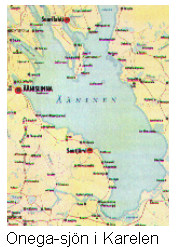
Karl and Alida had lived separately in various places on the Kola Peninsula during the years 1930-40, Karl mostly near the apatite mines at "km 25" in Kirovsk and Alida at the sewing factory somewhere in Monchegorsk. Now the family was reunited again in the town of Medvezhyegorsk (in the northwestern part of Lake Onega) at a collection point for loading onto boats for further transport to various locations along Lake Onega. We were herded aboard the "Karl Marx"—an aged paddle-wheel river steamer with shallow draft, able to dock at the gently sloping sandy beaches along the lake's western shore.
In all the disorder (as it appeared at first glance), there was a certain order regarding where the different nationalities were to be exiled: the Germans and Poles to the Altai Mountains; the Latvians, Swedes, Estonians, Finns, and Ingrian Finns to Karelia, to the collectives around Lake Onega. Dictatorship states have used population transfers as a means in their political agenda. From history we know that it was probably the Assyrian ruler Sargon II in the 7th century BC who practically carried out the deportation of the ten Israelite tribes.
Such relocations of population became a very distinctive feature of the political methods in the new Soviet state. Entire nations that were difficult to control in their homelands could be moved 'en masse' to unfamiliar regions and among foreign neighbors, where their only hope of survival lay in obedience to the ruling power. The Communists followed suit: the Kalmyks, Chechens, and Crimean Tatars were moved further into Siberia for alleged collaboration with the Germans; for the Jews, in 1934 an area was designated far in the Far East (Birobidzhan) near Khabarovsk. The Russians probably did not want a repetition of the situation that existed from 1917 to 1923 when the Jews, who numerically were about 1% of the population, constituted 83% of the leading stratum of 545 people = 447 people.
("The Rulers of Russia", New York 1967, by Rev. Denis Fahey, Regina Publications, 5 Cavendish Row, Dublin 1.)
After the fall of the Soviet Union, a number of anti-religious (anti-Semitic, anti-Islamic, and anti-Communist) books have been published; one of the most notable is V.A. Istrakhov's "Udar russkikh bogov" (Удар русских богов, В.А. Истрахов, Русская Правда, Ст Петербург). The book is a bloody execution of Christianity, Judaism and Islam - it will likely never be translated into Swedish.
Karl continues:
- The days at the beginning of June 1940 were sunny, the lake calm, and it did not take long before we arrived. The ship docked at a long wooden pier a bit from Sheltozero and we were unloaded. Sheltozero was a larger settlement with a few hundred remaining inhabitants, mostly women and children, on the western shore of Lake Onega, 50 km north of the mouth of the Svir River. The buildings were of typical Russian-Karelian construction - dwelling houses connected to stables and barns, and above them a hayloft. A stream ran through the village, and the buildings were grouped around the stream. There were also a few side streets, which is quite unusual for Russian villages, where the houses almost always lie on each side along the main street, sometimes causing the villages to stretch for several kilometers in length.
During the Russian era, the village was an administrative center for the southwestern section along Lake Onega and had a "raikom" (district committee), a grocery store, some kind of storage building, a tractor station, a relatively large library, and two schools. Here I continued my schooling in the sixth grade. The Communists did think of something, if they did indeed think, the relocation took place just before Midsummer and none of the children had to interrupt their schooling (at least that year). We would perhaps not miss the lessons in Marxism-Leninism, who knows. Sheltozero was one of the larger villages on the western shore of Lake Onega.
When we arrived in Sheltozero, we were received by the local population like kings. The people stood on the shore with horses and wagons, ready to help us with the transports to the various surrounding villages; a further distribution to different collectives would take place later. The reception festivities were not so much for our own sake, but rather for the collective's. Almost all able-bodied and enterprising people had managed to escape the collective and settle in larger communities: Voznesenye, Lodeynoye Pole (Latva in Finnish version) and Petrozavodsk (Äänislinna in Finnish).
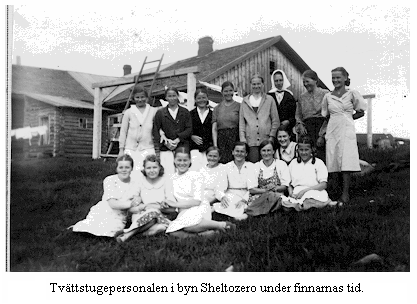
Remaining were the elderly, children, and women—widows and those who had no husband to rely on or were no longer capable of heavy labor due to age. The collective needed new, fresh labor, and here we came.
On one side along the village's main street, a sidewalk made of edge boards had been laid. It was from before the revolution, but maintenance had been neglected; now the boards were rotten and pedestrians had to watch their step carefully so as not to fall through a hole and break a leg. The main street, if one can call the dusty road a street, was like everywhere in Russia an old village road and lacked both pavement and ditches. In the summer, the fine dust would raise, and during spring and autumn the road turned into a mud pit. In that respect, time had stood still since the revolution; any asphalt or gravel for the road was out of the question, the region's economy being far too meager.
- Now we shall all become collective farmers, said Alida and cried a little. 'Kolchoznik' was the lowest stage on the Soviet rank scale, a Soviet state 'pariah' - biorobots - who existed only as labor. One could possibly become a 'brigadir' and lead the work, but the task was not particularly appealing since the 'brigadirs' simultaneously became a kind of whipping boys for unmet norms. Being a 'kolchoznik' was a genuine coolie existence without any great possibility to improve one's situation by one's own effort. The collective farm chairman had control of the internal passport. If the person in question, like us, belonged to the category 'pereselenzy' i.e., forcibly relocated, they did not even have an internal passport, only an 'udostoverenie lichnosti' i.e., identity document. Such a person belonged to a 'kulak' or other 'enemy of the people' class; they had been deprived of their property and citizenship during the collectivization years of the 1930s and were forcibly moved around the country as the state needed labor for one or another new construction. In adulthood, it was a matter of once a 'kolchoznik' – always a 'kolchoznik'. It was a Soviet form of serfdom, worse than both the old Russian feudal system or the crofter and statare system applied in Estonia and Sweden.
The collective farm chairman did not part with his subjects' passports unless absolutely forced to. The young people took advantage and in connection with studies or military service moved away and registered themselves in another locality, preferably in the cities where the livelihood opportunities were somewhat better. The depletion of labor in the countryside led to difficulties, to which also contributed a lack of initiative, general apathy, and the Slavic people's 'nichevo' mentality. Efficiency was very low. The work was also poorly paid. Cash payment almost never occurred; the system was based on the Soviet model of earned workdays (trudodni) and one had no freedom to move. The 'trudodni' (earned workdays) system meant that after the state-set norm of grain, vegetables, and milk had been delivered, the remaining products (if any surplus remained) were sold, and the income from this was distributed according to the earned workdays. More often than not, nothing was left to sell; the state's norms were set so high that there was no possibility whatsoever to achieve them with the work methods practiced in the collective, and the collectives were almost always behind in deliveries. These accumulated on the collective's minus account year after year.
In order to raise work morale to some extent and set certain ideals as examples to encourage higher work performance, the Soviet system was forced to invent some imaginary workhorses in the form of 'udarniki' (shock workers) and 'stakhanovites'.
A certain Aleksei Stakhanov, an 'udarnik' (ударник) was awarded several honors, was written about in newspapers and honored as an innovator in the coal mining sector. According to propaganda, he had achieved very high extraction results; he received the 'Order of the Red Banner of Labor' (Orden trudovovo znameni – Ордентрудовогознамени), was appointed 'Hero of Socialist Labor' (Geroj sozialisticheskovo truda - Геройсоциалистическоготруда) and was made a cult figure to encourage others to higher work achievements. Later it came to light that the whole affair was a usual Soviet falsification and that Aleksei Stakhanov had had several co-workers, whose work results were credited to him. The same thing happened with a cotton picker from Kazakhstan or Uzbekistan, as well as some milkmaids in the collective farms. At regular intervals, pictures were published in the newspapers where these 'udarniki' (shock workers) traveled to Moscow and were honored with orders at receptions in the Kremlin to serve as encouragement for all those who did not meet the norm..
No information was given to us before departure from Kirovsk; no one had told us what we would work with, but now most understood that it would be on a 'kolkhoz', in other words: despite the earlier refusal, we would nonetheless become collective farmers. Alida cried; she thought it was too bitter that after all the vocational training in Montsjegorsk she would again end up in the countryside, far out in the 'periphery', as they said in Russia about the villages. The indigenous population had moved into the larger cities – Petrozavodsk and Medvezhyegorsk – left in the villages were practically only the elderly, children, and an occasional adult woman. Very few of the male population had stayed – only a few tractor and machine operators. Some farming did go on there, but (as usual) under rather miserable conditions. The means of transport were worn out, to the extent that anything existed at all; most things were lacking. Often it was not possible to steer the horse from the cart; there were no reins in the collective. As a driver, a younger, lighter person, often a child, had to sit on the horse, even though the horse was already harnessed to the cart. There were not many children either; sometimes some sturdy matron had to sit on the horse for plowing to happen. One kolkhoz woman sat on the horse and steered while the other walked behind the horse and guided the plow.
For us, the first more 'permanent' stop became the village of Zalesje (behind the forests), 4 km from Sheltozero. There we lived for a few months and our parents worked in a collective farm with the proud name 'Krasnyi Komsomolets' (КрасныйКомсомолец - the red Komsomol member), for a while we were also assigned to the villages of Gornaja and Matveeva Selga, which belonged to the same organization. To Matveeva Selga, a forest village about 17 km from Sheltozero, there was hardly anything worth calling a road, only a miserable path, sometimes a corduroy road, and all transport was either on foot, riding, or with drays. In Matveeva Selga I became very sick; I don't remember if it was measles or chickenpox. What I still remember are the dizzy dreams from the illness. A number of small balls formed in a corner of the room, they grew quickly and filled the entire room; I had a feeling that they wanted to suffocate me. In Matveeva Selga, father was to work in the forest. The work was very heavy, the tools were inadequate, and father was no longer a young man. The forest work tools were of the type 'annodazumal' – a two-man timber saw and a meat axe.
When Alida managed to get work in the collective's sewing room and could use an abandoned house in the village of Verhovje, a couple of kilometers north of Sheltozero, the parents also moved there. Karl was to start as a mechanic at a logging site south of Voznesenje and moved. The village of Verhovje lay northwest of Sheltozero and consisted of about twenty timber houses. In the village of Verhovje, there were inhabitants in perhaps every 4-5 houses; the Veps (the indigenous people) had moved to the cities, and the villages in the countryside stood practically empty. In the village of Sheltozero there was a 7-year school, and I continued my schooling there until 1941. My playmates in the village were three boys, sons of a Canada-Finn who had fled Finland, lived a few years in Canada, and then fallen for the Soviet enticements to move to the 'workers' paradise'. The father was imprisoned sometime in the late 1930s, and now the widow lived with her mother and three minor sons in one of the houses in the village of Verchovje.
After the third deportation (to Far Karelia), together with father in the late autumn of 1939, I made a visit to my father's sister Ann Toode in Pustaperzha. After her husband's death, she had moved to the home regions and was living with a family in Posts' house. On the way back to Sheltozero, father wanted to visit Smolny, (the palace where Lenin had his headquarters after the revolution). Father had been there as a peasant delegate during the Trotsky period (but he did not speak very loudly about this; under the prevailing circumstances it was not quite 'comme il faut'). Now he wanted to go to the Smolny Palace to obtain permission in Sheltozero to acquire a cow, because the forcibly relocated did not without further ado have permission to keep any larger livestock. Ann Toode had a cow in Pustaperzha, near our old place, and the idea was that we would take over the cow and bring it with us to Far Karelia. Naturally, it did not work out. He was not even allowed to get near the Smolny Palace. The 'people's beloved leader' was so afraid of the people that they surrounded themselves with a large number of militiamen who prevented any contact with the people. How father would have transported the cow from Novoselje to Sheltozero he perhaps had not fully figured out at the time, but in Russia everything is possible, and I am sure that he would have succeeded in the feat eventually, if only he had gotten the permission.
The remote Karelian villages are built in a style reminiscent of the North Russian, all houses lie along the same street with their gables facing the road. The same house type occurs throughout Remote Karelia and also extends into northeastern Russia - all the way up to the White Sea. In Archangelsk there is an open-air museum (Starye Karely) of old houses, and many of them are very similar to those found further south in Karelia. Verhovje was in a certain respect the exception; here the houses were somewhat irregularly placed because the river curved around the village and ended just outside it; most of the houses were built along the riverbank to have easy access to the water. The plot, if one can call it that, extended down to the water, and right at the water's edge by the river each family had its own bathing facility in the form of a smoke sauna. For some reason we did not bathe in the nearest sauna but in one that lay by the bridge on the other side of the river on the way to Sheltozero.
A smoke sauna consists of a smaller log building almost always in two sections: a small anteroom for undressing and a somewhat larger room that constitutes the actual heating room of the sauna. In its center stands a sizeable pile of stones under which one fires. The 'luxury variants' had a cast iron cauldron built into the fireplace. The heating works as follows: one fires under the cauldron and stones; after a couple of hours these were heated to a suitable temperature and the embers and ashes were raked out. The sauna was aired to get rid of the carbon monoxide, then the first water was thrown to remove the soot from the stones, and the bathing could begin. There is no chimney; the smoke went directly into the sauna space and from there out through an openable smoke hatch in the wall, and soot settled everywhere. One can become somewhat 'blackened' at first.
In the even older variants of the smoke sauna, there was no hot water cauldron built into the stone pile. A few loose stones on top of the ordinary pile were used as water heaters. The stones were thrown into a tub of water and allowed to transfer heat to the water. That the water became a little sooty did not matter much; the final rinse (at least during the summer half) took place in the adjacent river.
Karelians are skilled at building log houses; sawn timber was used to a fairly small extent, and then mostly for decoration. The houses are of the traditional North Russian type, of round logs and quite spacious, with decorations on the gable boards and around windows and any balconies. From a distance it looks as if someone had hung crocheted lace on a dollhouse. In the Sheltozero area, the houses are also almost always two stories and equipped with something that could be said to function as 'central heating'. Through both stories runs a stove, which in the lower part consists of a baking oven with a cooktop on which all food is cooked. In the side rooms and on the second floor there are small doors for additional firing. In the first room after the entrance hall there is a 'lezhanka', a ledge of the stove where one can lie down when one comes in from outside on a cold winter day and is freezing. The threshold from the entrance hall to the room is high; one saves heat and prevents the cold from rushing from the cold entrance hall into the rooms. The entrance hall is cold and sufficiently spacious; there, during winter, barrels of mushrooms, cabbage and other provisions are stored. Ventilation, insofar as it occurs, is done by one of the panes in the larger windows being fitted with a small, openable hatch - a 'fortochka'. Part of the flue gases from the stove go through the 'lezhanka' and keep it warm; with heavier firing, very warm. Above the 'lezhanka' there is always a smoke outlet for the samovar, which, used in the original way, is one of the most efficient water boilers there is. The construction is very simple. Inside the samovar there is a fire tube surrounded by water. When burning charcoal, which was most common in the old days, the water heated up very quickly; after only a few minutes one had boiling water for tea, and tea was drunk copiously in Karelia; the rest of the culinary art was not particularly highly developed. Like in Finnish Karelia, they baked pirogi with all kinds of fillings from rice to fish and meat, when available.
The Karelian houses are built together with cowshed and stable; above these there is space for grain, hay and straw. There could be considerable amounts of snow, and then it was quite convenient in winter not to have to go out to feed the animals and for urgent needs. In a corner of the hayloft there was an opening down to the manure pile, where the outhouse lay. It felt quite spooky to go out and relieve oneself on a dark and cold winter evening, but necessity knows no law. In winter, the toilet pile rose like a stalactite column, and when my imagination ran wild in the dark, I had terrifying experiences of falling into the hole and being impaled with my rear on the pole. The risk of falling through the hole was actually not very great; the opening was not even large enough for a child to fall through, but fear and imagination do not reckon with realities. The shortage of kerosene meant that we mostly had no lighting either; it was strictly forbidden to take any open flame in the form of matches or a pitch torch; one had to grope one's way in the dark, and I remember that sometimes it felt very unpleasant. I was an avid book borrower, and some books were so exciting that in my imagination I built up various situations similar to those we lived in. When the Finns came and it became possible to beg flashlight batteries from the soldiers, it became somewhat easier, but it was not always successful in begging, and then it was just as bad again.
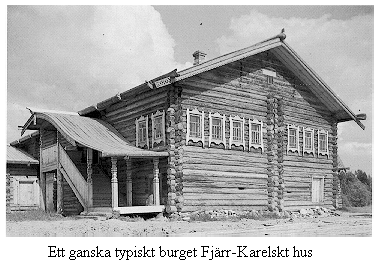
All cooking was done on the cooktop or in the baking oven; no stoves with rings in Northern European style were used here. Above the cooktop was attached a chain with a hook to hang the pots in, but most of the boiling was done inside the baking oven in iron pots. The Russian pots are of a special type; they taper downward and are handled with a fork-like grip - 'ukhvat' (ухват). There was no shortage of firewood; one just had to go out to the forest and cut down a number of birches, as much as one thought one needed for a winter. Some clear-cutting had occurred in the area a few decades earlier, but then the state was mostly after conifers and the birches had been left aside.
There was plenty of forest, and it was important not to get lost. The Murmansk railway was at a distance of about 70 km to the west; after that it was just forest for several hundred kilometers all the way to the shore of Lake Ladoga.
Sometime in late spring, it must have been 1941, I was to visit my brother Karl at the forest camp Nilo, where he worked as a mechanic, a few kilometers south of Voznesenje. Mother equipped me with a packed lunch and instructions on how to find the camp according to the directions in Karl's letter, and early one morning I started my hike.
It is 15 km between Scheltozero and the village Rybreka, from there to Voznesenje, where the river Svir flows out of Lake Onega, it was about another 10 km, and how far from Voznesenje to the forest camp Nilo I did not really know. It became a long hike. During the day I had managed to cover the stretch Scheltozero-Voznesenje, and the day was far advanced when I was to continue towards the logging camp Nilo. Following directions, I walked along a timber transport road of a type that was much used in Russia. To enable the horses to pull large loads, one watered the sleigh track. When the track had frozen, one could load the timber sleigh with a good load, push the load to start, and then it was up to the driver not to stop halfway, because the horse would not be able to start the load alone. The terrain for such an endeavor must be relatively even; there must not be any large hills.
I continued my walk along such an ice road and occasionally met timber sledges on their way to Voznesenje. When I asked the drivers how far it was to the camp, the answers were somewhat different. 'A couple of kilometers,' said one of them. I walked and walked. The next driver I asked about the way said: 'It's probably 7-8 kilometers there.' I became a little frightened because it was starting to get dark; night was approaching. The man had humor, however; when I had walked a while longer, I spotted a number of barracks – I had arrived at the camp, and my brother Karl offered plenty of food.
The logging camp consisted of a number of barracks, a mess hall and a 'culture barrack'. It was probably not a prison camp; the personnel consisted of voluntary loggers. Some were, however, old prison clients without being criminals; there were plenty of them in all contexts. After the meal there was music and song. Karl played the violin and there was a man with an accordion, so they sang a lot. Some of the songs were from the Russian prison camps and told about life there.
Гопца-смыка это буду я, граждане послушайте меня Ремеслом я выбрал кражу, из тюрмы я не вылажу Что-же будешь делать коли сел. От нарядчика мы прячемся под нары, не по одной а три-четыре пары Как нарядчик нас поймает, на работу посыдает,мы ему наводим тары-бары А если на робыту мы пойдем, мы от костра на шаг не отойдем Разобъем друг-другу лица, подожгем все рукавицы На костре все валенки сожгем Нарядчика мы кроем в рот и в нос, что ты за детенышь, недосос Ты-же знаешь что в субботу мы не ходим на работу А у нас субботеа каждый день
I was out with father one autumn helping with the felling; when the first snow came we drove out and fetched the trunks. I was to drive the sledge, and on the downhill slope from the forest towards the village it did not go ых well. The slope down towards the village was admittedly wide, but some hummocks here and there near the roadside caused me to hit such a hummock and the whole load tipped over. I was thrown off the load and escaped being crushed. Not only did the sledge overturn, the horse was also pulled down and lay there; there was a risk it would suffocate from the Russian harness 'khomut'.
The Scandinavian harness consists of two halves that are placed over the horse's withers and pulled together below with a strap. The Russian way of harnessing a horse is somewhat different. The harness is in the form of a tapering oval and is slipped over the horse's head with the lower part upward. Once around the neck, the harness is twisted half a turn and fastened with leather straps to the shafts against an arch - "dugá". When the load tips over, the harness will twist so that there is a risk of the horse being choked. It looked bad for our horse and father had to cut one of the leather straps to save the horse. A temporary strap was arranged from a piece of rein and afterward father had a lot of trouble finding a new leather strap. Leather was not something that was plentiful in the Soviet state.
The Soviet system had managed to take care of the citizens, but not all of them. As strange as it may sound, the wandering Gypsies still existed and I am probably one of the few who have seen Gypsies in their "natural" state in the Soviet Union. They kept to their traditional way of life and traveled with their skinny nags around Karelia as well. I remember how a Gypsy came to my father and wanted "some" hay. Father had already had such visits in Pustaperzha and knew how it worked. He said the Gypsy could go into the barn and take as much hay as he could carry out in one armful. The doors there were not very wide, and when the Gypsy had taken as much hay in his arms as he thought he could carry, a problem arose getting out. With the armful he had managed to take, he could not get through the door. No matter how he tried, he got stuck, and he almost cried when he had to give back part of the hay to get out through the door.
The Gypsies lived in their traditional way. The men dealt in horse trading, the women told fortunes by reading palms, and as strange as it may sound, they even survived the kolkhoz system. They had their "telegy" (four-wheeled horse-drawn carts), lived in tents, and entertained people in the evenings with song and music. Near the village of Verkhovye there was a large open space where they set up their tents, lit fires, and entertained us. People came to have their fortunes told, paid a few rubles to learn about the future. The fires burned, the Gypsies danced and played, and it all had a certain magical atmosphere. The men and women who came to the fires easily fell under the spell and willingly let themselves be told fortunes and treated to vodka (for a certain increased fee). After a few days they moved on, and we missed those evenings and nights when they camped near the village. To be sure, the villagers had to keep a closer eye on their belongings, chickens and such, but every pleasure has its price, and in the entertainment-starved village, any opportunity for amusement was welcome. There were few young people; most had moved to the cities, and dancing rarely occurred.
When the Gypsies had set up their camp, it wasn't just palm reading and other traditional Gypsy trades. There was always music and people danced in circles. In Russia there is a song tradition of "chastushki" (частушки) – short four-line verses with a witty content similar to limericks. There was also a rich variety of such verses with somewhat anti-Soviet content. A lead singer steps forward and sings his verse, and the others join in and sing the refrain: Right, right, absolutely right. Пишет Ленин из могилы Lenin writes from the grave дорогому Сталину To his dear Stalin Разоряй свои колхозы! Destroy your kolkhozes! Будем жить по старому And let us live as before
The chorus joins in:
./. Правильно, правильно, ./Rätt, rätt, cовершенно верно ./. ./.alldeles rätt./.
The folk could tell stories and make comparisons:
Мой миленок как теленок My sweetheart is like a calf Только разница одна With only one difference Мой миленок в баню ходит That my sweetheart goes to the bathhouse А теленок .- никогда But the calf never does There were naturally also a large number of crude and derogatory stanzas:
По деревне шла и пела Through the village walked and sang Баба здоровенная A hefty old woman За угол пи….ой задела She bumped her c…t against a corner Заревела бедная And burst into tears, the poor (creature)
In the village of Verkhovye perhaps ten families still lived, and you could freely choose any of the twenty or so houses that stood empty. Mother decided on a two-story house in the northwestern part of the village, near the stream that ran past the houses. The house stood on a slope, and below it was a kitchen garden. All the way down by the stream bank there was a smoke sauna belonging to the house. The kitchen garden had not been used for several years and was somewhat overgrown. Father dug up the ground and Mother planted vegetables on the resulting patch of soil. There were no orchards; Shetozero is not much farther north than central Sweden, and fruit trees would surely thrive there, but the custom of keeping fruit trees did not exist.
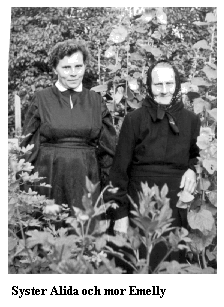
The kitchen garden was my torment. It had to be weeded and hoed all the time – not to mention watering. The stream was indeed in the immediate vicinity, but it was still hard work to fetch two buckets of water at a time with a yoke (koromyslo) over the shoulders. It took a long time (it seemed to me), and in the meantime the other children were playing; you could hear their voices from the village square where they were kicking a soccer ball and playing "lapta" – a baseball-like game. Worst of all was when the children passed the house on a warm summer day on their way up to the stream, where there was a deep spot where the village kids used to bathe. There was no chance of leaving before the day's chores were done; certain things Mother Emely was strict about. "First work, then pleasure."
Making a living was a problem here as well; we had to gather as much as possible for the winter, and toward the end of the summer came berry and mushroom picking. There were plenty of both kinds in the forests, and Mother used to salt down a fairly large barrel of mushrooms, and from the berries she made jam. Sugar was a problem, but after the Finns arrived, it became possible to exchange certain handicrafts for sugar, and Mother Emely had good experience with that already from the Kirovsk time, when she sold wool shawls to Russian women.
The Karelian soil is very fertile, and large harvests could have been brought in if there had not been an enormous shortage of both initiative and labor. Father used to say that if they had had soils as good as in Shetozero in the Novoselje area, they would have become millionaires in quite a short time. In the Novoselje area, the clay soils were very heavy and required a lot of work and fertilizer for anything to grow at all.
During the hay harvest and in the autumn during the potato harvest, all schoolchildren were commandeered for work in the fields. I was busy hauling both hay and potatoes from the fields to the storage in the village of Shetozero. Efficiency left much to be desired, but thanks to the inadequate potato and grain harvesting, we and many other villagers were able to survive the following war winter, when the Russians had left the area and the Finns had occupied it.
For the Finns, the Winter War had come somewhat unexpectedly; they had had to evacuate 400,000 people from the areas conquered by the Russians on the Karelian Isthmus, and now when they had their own refugee problems and at the beginning of the new war occupied parts of Far Karelia, resources were insufficient to support the increased population. In principle, the potatoes had been dug up during the Russian time, before the war had begun. We dug again and were lucky to get a couple of sacks and could sustain ourselves during the winter. The same was true of the grain. The harvesting machines were not in the best condition; the blades were mostly quite dull, and all sharpening had to be done on a hand-cranked grindstone (and no one bothered), meaning that part of the grain was not cut but only bent away from the blades and left lying in the fields. We went and picked up the remaining ears, threshed them on the threshing floor, and ground them into flour in a hand-driven mill.
There was indeed a mill down by the stream near the village of Nizhnije, but the custom of grinding by hand still persisted, partly as a result of the communist system and its lack of resources. People had a certain foresight. They did not always trust the state to provide for them. In almost every house there was a small hand mill, consisting of a lower fixed stone and an upper movable stone fitting into the hollowing of the lower stone. The upper stone was turned by hand with a stick, which at its upper end was fastened to an overhead beam and at the other end into a hole in the periphery of the upper stone. Hand mills of this type are ancient, and one can still see something similar used in some underdeveloped countries.
That the population had not gotten rid of all their mills had to do with the collective system and its shortcomings in almost everything. When everything is centrally regulated, one still tries as much as possible to become independent, at least to a certain degree, and keep some tools "in case of ..."
The kolkhoz peasants had kitchen gardens, but private cultivation of grain was not allowed; the laws did not permit any private ownership except to a very small extent, and then generally only in the form of vegetable gardens.
Consequently, there was no possibility of taking grain to the mill; on the other hand, it was not very difficult to appropriate some grain from the collective's stores and grind it in the house's own mill.
A small field of peas was not harvested when the war broke out, and this helped save the lives of many villagers. For lack of other foodstuffs, the Karelians practiced baking bread from pea flour, but pea bread tastes strange, almost disgusting, and was eaten only in the direst need.
We were always hungry, and then even pea bread went down – for lack of other bread. Pea soup of the Scandinavian type was not part of the Karelians' tradition, and now both fat and pork were lacking to make it taste like anything. When we did cook pea soup, it was not comparable to the "real" pea soup that I tasted for the first time on September 16, 1941, on the road between Verkhovye and Shetozero.
The first real pea soup and the first cup of real coffee have left their memories; I remember exactly where and when it happened. The Finnish army had been advancing for several days and reached Sheltozero late in the afternoon in mid-September 1941, where they took a break from the fighting. The population gathered around the soldiers, and the children mostly clustered around the horse-drawn field kitchens.
A contingent of soldiers had taken their night quarters in the lonely house between the villages of Verhovje and Sheltozero, from which Nikolaj Poletaev and I had "evacuated" some consumer goods. I now "happened" to be there, next to the field kitchen from which wonderful aromas came. When the soldiers had finished eating, the leftovers were offered to the surrounding children, and since the advance had been going on all day, the pea soup was truly superb, well-cooked and with large, fat cubes of pork in it. That pea soup tasted divine. Such a soup one certainly does not forget. Especially not if one had been hungry up until then.
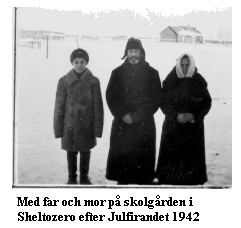
The premiere of coffee drinking took place during the tour through Finland with the Petrozavodsk City Orchestra in December 1942. I was the vocal soloist and performed Finnish and Karelian folk songs. In Helsinki we were to give a concert for the staff at SOK (the Finnish cooperative), and there they served real coffee. The Finns were overjoyed; they had not tasted any coffee since the outbreak of the war and delighted in the drink after all the surrogate drinking, but I myself thought the real coffee tasted awful and would have preferred a cup of "korviketta" (as the surrogate was called). To ask for the surrogate on that occasion, however, would have been sacrilege, so I refrained and suffered through the event with real coffee. A refill I did not want, however.
Even today, more than 50 years after my first coffee drinking, I cannot appreciate coffee very much; I just as gladly drink tea.
The Second World War had begun, and on September 12, 1941, Alida and Karl were taken to the defence battalions to build fortifications "Stroitelno-oboronnye raboty" and had to set off. As usual, there was a shortage of transport, and therefore part of the population had to be left behind. Later it turned out that some people had been left behind deliberately to keep an eye on the Finns. After the war it came to light that in the basement of Dmitrij Tuchin's house there was an intelligence centre with a telephone connection to the eastern shore of Lake Onega, which remained in Russian hands. When I met my mother after the war, she told me that a few months before the Finnish retreat began, she had spoken with a Veps woman, and this woman had said to my mother that if she had any Russian money left, she should not get rid of it. She would soon need it again, the woman had said.
I stayed with my parents, and on September 16 the Finns invaded the Sheltozero area in the war that was now to last a few years. After the Finnish advance had halted at the Svir River as a border, the trench warfare continued, and when the wind blew from the south, one could hear the rumble of cannon from the front zone. It lay only about 30 km from us.
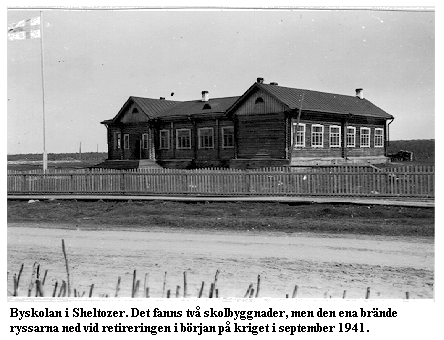
When the Russians left the area, they applied the ancient Russian "scorched earth" method, and many of the public buildings, such as schools and warehouses, were set on fire. The remaining population was not as keen on destruction; they were on the alert, and only one school, parts of the spare parts depot for agricultural machinery, and a few residential houses on both sides of the main street sustained any major damage.
The Russians' way of destroying everything stands in stark contrast to the Finns' endeavour to preserve things in the best condition. When I was enlisted in the Finnish Army in Petrozavodsk (Äänislinna), we were quartered at the Pedagogical Institute, and nearby there were large camps for Russian prisoners of war. Several of them had taken part in entering Karelia during the Winter War of 1939-40. Now they told how surprised they were when, upon marching into Finland, they found the houses in good order, cleaned and locked with the key either on a nail beside the door or under the doormat. When the Russians left the Porkkala area in 1955, nothing was intact. What the Russians could not take with them was smashed or otherwise destroyed, completely in line with the "scorched earth philosophy". The same thing has been repeated everywhere the Russians have been involved: in Estonia and the other Baltic countries. The Russians seem to suffer from some kind of destruction mania—they are not as inclined to build up.
These were great and serious events going on for the adults, but for us children it was a real playground; we did not have sufficient insight into the gravity of the situation but amused ourselves with both permitted and forbidden games. True, we had been frightened for several years with the "capitalists" and all the horrors they would commit after the conquest, but when one is met with pea soup, flashlights, and other small trinkets, children soon become friends with the conquerors.
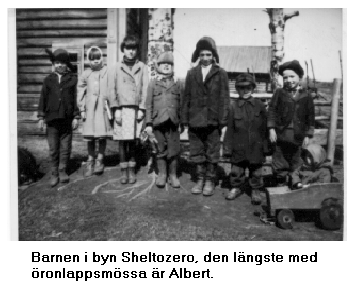
Together with a Ukrainian boy, Nikolai Poletaev, and some American-Finnish boys (who lived with their mother and grandmother in the house farthest up by the stream in Verhovje), we went to the village of Sheltozero and "amused ourselves" right in the midst of the fires after the Russian retreat. It was burning on both sides of the main street in Sheltozero, and we competed to see who could run farthest in between the burning houses. Nikolai, who was the most daring, won, but it almost went badly for him; in his overconfidence he ran too far, tripped on the muddy street, and almost could not get back. He managed, though, with burns on his arms and legs.
When the Russian administration had left, the "evacuation" (a euphemism for taking possession of temporarily unguarded property) of anything that might prove useful began. As I have already told, Nikolai and I were inside a house and "evacuated" our respective shares of the unguarded property: he took a sewing machine, and I took a hand-cranked gramophone and a stack of records, which later turned out to be a real lucky find. During the worst food shortage, my mother managed to trade the gramophone and records for two sacks of wheat flour from some army depot. It was a Finnish police sergeant who became fond of the gramophone and the few records that came with it. The sergeant used to ride over to us, carouse a bit with my father, and play the gramophone. One of my father's "hits" was "Dajte v ruki mne garmonj". (Oh give me an accordion in my hands. Дайтеврукимнегармонь…..). Whether the visits were welcome to my parents, they were very welcome to me as well. During the time the sergeant was with my father and mother, I would borrow his saddle horse and play Wild West. I had read some youth books: partly by Zane Grey and partly Main Reed's "The Headless Horseman". Now the horse came in handy. Unlike riding the collective's horses, this horse was equipped with a real saddle with stirrups, and it felt wonderful to set off along the cattle path up toward the stream. There were some loose livestock; the Russians had not managed to take all with them. Some were shot and eaten, but many were out grazing freely in the forests and remained after the Russian withdrawal.
- Mäletad näed kui sa tõid soomlaste kaks kotti? Peräst töi veel üks Soome üleemus mulle terve kotti otra, ai hobuse hoove ja võttis kotti päält maha et sis veneläse es näe. Ja mul siis seta leipä Soome aigu vaja es ole, se seisis niin kaua ku vene tagasi tuli, nendel oli nälga, aga mina vein veski manu, jahvati, ja mul olis süja.
- When we met later, after many years of separation, mother told me:
Do you remember that we got two sacks of flour from a Finnish sergeant? Afterwards, when you, Albert, had left for the Finnish army, a Finnish officer came and handed me a whole sack of barley; he drove up to the house with a horse cart, lifted off the sack, and carried it in to me without anyone seeing it. When the Russians came back, I went to the mill and had the barley ground. That is how we survived.
Before the Finns had fully established themselves, there were plenty of empty houses to lodge in and play in. The church and its associated buildings were also accessible, and we played with the few remaining church insignia we found in the house where the priest had lived before the revolution. There were some church vestments (which had not been sewn into anything "useful"); we put them on and played both priest and deacon. We also found a censer, filled it with moss, and lit it. This game, however, was rather short-lived. The smoke from the censer became suffocating, and we were forced to stop that part of the liturgy and cease swinging the somewhat foul-smelling censer and singing "Gospodi pomilyi i blagoslovi.i.i.i.i"… all while some of us made the sign of the cross and others threw themselves to their knees and bowed so that their foreheads hit the church floor in a seemingly holy fervour in our effort to appease the cruel gods. (Teach a fool to pray to God, and he will smash his forehead. Научи дурака Богу молится от лоб разобьет). There was no "iconostasis" left; instead there was a movie screen on the wall. For several years the church had been used as a cinema, and I was there together with my brother Karl and saw "Boule de Suif", based on a short story by Guy de Maupassant. As for the bows during our practice of the ritual, however, we did not manage more than one; the floor was so dirty and foul-smelling that we could not perform all the elements of the ritual.
When the Finns came, the church was cleaned, a bell tower was erected, and an altar was set up. Then the occupation forces held a proper Christmas service in that same church at Christmas 1942, and I sang "Heinillä härkien kaukaloon", an emotional Christmas carol considering the Finnish soldiers and Lottas who celebrated Christmas in Karelia under difficult war conditions, alone, far from relatives and friends.
In Sheltozero there was quite an extensive library, and one time on my way to the village of Verchovje with a horse and an empty "telega" - the four-wheeled Russian horse cart - just when the Russians had left and the Finns had not yet managed to occupy the village - I drove into the library yard and loaded the cart full of various books, both encyclopedias and travelogues. However, someone had seen my action, and in a normal order for a Soviet person, made a report to the new authorities. That they were no longer the same authorities did not matter, the power of habit was great. When the Finns had established themselves in the village, the commandant appeared with a couple of soldiers and wanted the books back at the library. I asked who would read them when they themselves could not speak Russian, but got no answer. I had unloaded the books in the hayloft, the soldiers took care of the books and brought them back to the library - the part they found. The Soviet upbringing had done its work, however, and I had guarded myself by hiding most of the books in other places in the outbuilding. The Finns, who were raised to honesty, never thought to question whether those were all the books I had taken with me. No questions, no answers. They couldn't get hold of the remaining books, but they could later be sold to some Russian-speaking Finnish soldiers from Karelia. The border population often mastered both languages, even though there had not been much interaction across the borders during the previous two decades. This applied especially to the Ingrian Finns.
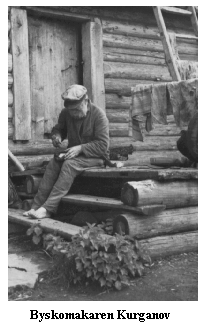
At the same time as the "evacuation" of a sewing machine and a hand-cranked gramophone, we also managed to seize a bicycle, a very great rarity in the Soviet Union of that time. I don't know what family had lived in the house, but they had quite a lot of things. Nothing is perfect, and so it was with the bicycle; it lacked tires. Now that didn't matter much; we made brave attempts to learn to ride, and after a few weeks we had actually learned quite a bit. That it lacked tires meant we had to move our practice to something soft and for this purpose the meadow just outside the village sufficed. The rolling resistance was 100% and we got nothing for free; we had to pedal like hell and we learned to keep our balance quite well.
The Finnish soldiers wanted to fraternize with the native population, and to that end they wanted to learn some important words and common greeting phrases in Russian or the Veps dialect. Children are always the easiest to make contact with, and it was the children who became the teachers. In most cases, the soldiers learned the correct phrases, but sometimes it didn't quite go as the soldiers had intended. In every society there are a number of little pranksters who cause trouble for those around them. The joke consisted of teaching the soldiers some coarse words, phrases with shameful suggestions, and similar expressions instead of the usual greetings. When the soldier then entered a cottage, bowed to a Karelian woman and thought he was saying "Good Day", or "How are you, my beauty" he instead uttered something like:
- Lie down, old woman, here it's going to be f...ed!
The woman screamed to high heaven and tried to run away, the soldier became confused, and eventually he found out what he had actually said or demanded. It didn't pay off for the boy who had taught him the phrases to come and ask for flashlight batteries or bread. After a while, however, most Karelians could make themselves understood in Finnish; Veps contains many Finnish words, and such incidents stopped on their own.
The Finns, for their part, tried (in the prevailing Greater Finnish spirit) to learn the Veps dialect, and the most diligent could after a relatively short time carry on simple conversations in this very mixed language. Some, however, regretted that they had not learned Russian instead. My singing teacher Olli Naukkarinen complained on one occasion about this fact; after three years they could have learned quite a bit of the Russian language, but the currently prevailing Greater Finnish nationalism blocked reason. It was even forbidden to speak Russian in lessons. The teachers Olli and Aune had to take several disobedient boys by the collar and impress upon them the necessity of using only Finnish. This did not prevent us from, in critical school situations (during exams, etc.), sending cheat notes written in Cyrillic letters. This was naturally obstruction and often resulted in the culprit being thrown out into the yard. Father said that during the First World War there were texts at the railway stations forbidding speaking German. Everything comes back.
In Far Karelia there is no grazing of livestock; instead, all cultivated land is fenced with kilometer-long "dala" fences, and the livestock are released into the forest to roam freely on their own. From the villages out to the pasturelands there were long fenced cattle lanes. The Karelian women are very skilled in fence building; it was quick to both build new fences and repair old ones. During the summer months, the men were mostly wage earners and stayed in other places. At least in older times, they went off to the big cities, where they worked mainly as stone pavers, and it is said that the streets of St. Petersburg are predominantly laid by Karelians. During the Soviet era, the rhythm had changed somewhat; now those who remained were collective farm peasants and were not allowed to leave the collective without the chairman's permission. That must have still been practiced, since most "native" children had their birthdays in late spring or early summer, which means the fathers came home sometime in the fall.
We used one of these cattle lanes to try to "tame" a left-behind young horse and ride him. We were all at an age where we had read some Wild West stories and now wanted to try "mustang riding" in practice. Some untrained three-year-olds that the Russians had not managed to catch during their hasty retreat were running free near the villages. We chased a black young stallion into a cattle lane, blocked the entrances and exits, and after some effort got both a bridle and a saddle on him. The saddle – or rather, the frame of a saddle – we found in one of the abandoned houses, and it consisted mainly of a wooden frame – a saddle tree with an attached girth. We put a couple of old cotton blankets on the young stallion ("put on" is far too insignificant an expression for the struggle we had with the unruly horse) and after a few futile attempts we also managed to tighten the girth. There were four or five of us boys, and we all had our hands full with the horse, as he was not used to having people so close and resisted as much as he could.
The oldest (and most enterprising) of the boys was to get into the saddle, but that was easier said than done. Anyone who has tried to ride a somewhat reluctant horse knows that if you place him next to a stump or some other elevation to mount, the horse will immediately move so that he stands with his head toward the would-be rider and his hindquarters far away. After a while of uneven struggle, we managed to get the rider into the saddle. To make things not too easy for the horse, we led the whole outfit to a clay field, where the horse sank up to his knees in the clay, and we figured that in this way the horse would tire faster and the rider would fall softer – if it should happen – and it happened immediately. As soon as we released the horse, he made some buckles, which resulted in the rider falling off, and the horse took off at a gallop. There was a shortage of everything, including reins and ropes, so we couldn't keep the horse. The rotten girth had broken, but not completely; the saddle had fallen under the horse's belly, where it hung and dangled between the horse's legs on just the girth remnants. The horse was neither broken to harness nor ridden at all, and this was too much for him. He tried to get rid of the saddle and kicked frenetically with his hind legs, causing the saddle to slide forward and scare him even more. Alternating between galloping and kicking, the horse took off into the forest, and we had no chance to catch him again. I can still see the black young stallion standing on his front legs with his hind legs high in the air in his futile attempt to get rid of the saddle. That ended our attempts at "mustang riding." After a while, the Finns caught all the loose horses, and it was the soldiers who had to deal with the breaking-in.
There were some dead animals out in the fields, and mother cut off a large piece of horse meat to give to the pig she had bought earlier in the spring. The horse had been an old collective farm nag, and it would have taken a pressure cooker to break down the muscle fibers and make it chewable even for the pig. We cut the meat into smaller pieces, and the pig swallowed them together with potatoes and peas. The pig ate anything, almost like humans (some claim that the pig is the animal that, after apes, most resembles humans).
They were not allowed to keep any larger livestock, such as cows or horses, only goats, sheep, and pigs. Mother had two of these stubborn and unruly creatures: the old goat Roza and the young goat Zorja. In addition, there were a few sheep and usually a pig. The goat Roza was docile, while Zorja, her daughter, was both lively and curious. We lived in a two-story timber house, and one summer morning we heard a bleating that sounded as if it came from the sky. When we looked up, we saw that it was Zorja standing on the roof ridge, bleating. The doors to the upper floor and from there to the attic happened to be open, and Zorja had not only gone up to the rooms on the upper floor but continued up to the attic and from there climbed onto the roof via an ordinary rung ladder. Goats are very skilled and fearless climbers. There she stood now, high up on the roof ridge, looking a bit frightened; she could not get down because the ladder was too steep. We went out onto the roof, placed a noose around her horns, and lowered her through the roof hatch to the attic, from where she could go down on her own.
For a while, mother also kept a billy goat. There were plenty of goats in the surrounding villages, but no one wanted to keep a buck; he was only trouble and couldn't be milked. However, mother kept one, but between the buck and the remaining women, controversies sometimes arose. Some houses in the middle of the village did not have their own strips of riverbank, and to fetch water from the stream they had to pass the house where we lived. When the women went down with their empty buckets on a yoke over their shoulders, the buck stood waiting behind the corner of the house, but without showing much interest in them at that moment. But he must have sniffed and sensed certain strong odors. When the women returned with the water buckets full, the buck ran forward and began to nuzzle under the women's skirts. There was a commotion every time, and the women complained about the buck's behavior, to which mother (who could sometimes be quite sarcastic) replied:
- The buck surely smells that you are in heat, so there's nothing to be done about it. In the absence of men, well .......
Billy goats are quite difficult to deal with and sometimes downright repulsive; they urinate in their own mouths, eat everything they can get hold of, and they like strong things best: tobacco and spices. You would think they would get nicotine poisoning, but no. Once, father was sitting on the porch steps chatting with a neighbor. The buck had sneaked up and in an unguarded moment snatched the neighbor's "makhorka" supply (coarse tobacco, mainly from the roots of tobacco plants) and ate it up before the deed was noticed, but he didn't seem to feel ill from it. He left no one completely alone and was quick to butt.
During the summer, I had to herd the goats, sheep, the buck, and the pig outside the village up toward the stream. The path through the cattle lane was several hundred meters long, and then I continued further along the stream to a place where I could bathe on sunny days, while the goats and sheep grazed and the pig rooted in the ground. Goats are easy to herd; in the forest, you don't need to watch them, they stay close to the human, and as soon as something rustles in the bushes, they rush to the herder and almost climb into his arms. Once, however, something happened that confused me greatly.
Zorja was already a bit restless on the way to the grazing spot, and I had to urge her on, which was unusual. Mostly she ran ahead of the others. When we had been out for a while, she suddenly set off homeward, and no matter how I tried to head her off, it didn't help. She didn't run out of our sight, but as soon as I tried to run after her, she took off again. It became an obstacle race; sometimes we had to rest for the pig's sake. His short legs couldn't carry him as fast as the goats' and sheep's; when the piglet had run as fast as he could but still couldn't keep pace with the others, he threw himself on his back and panted loudly, then we had to stop for a while and wait for him.
When we reached the outbuilding doors of the dwelling house, Zorja stopped right in front of the stable door and clearly indicated that she wanted to go in. I didn't know what was going on until Zorja lay down on her side and began to strain. I saw a pair of tiny, tiny hooves sticking out of her body. I had no great experience as a midwife, and since mother happened to be away, I had to run to a neighbor woman and ask her to assist. It turned out to be twins.
In the half-burned warehouse building in Sheltozero, some war materiel had also been stored, which the Russians hadn't had time to take with them. Among other things, we boys found a whole barrel of black powder and a box of hand grenades. The grenades were of the new, egg-shaped type and were neatly packed in a green box. We took charge of the box and began experimenting, which wasn't so difficult since very detailed instructions on handling the grenades were printed on the lid of the box. We took out a couple of grenades and hid the box in an empty house in the Verhovje village; later we would go fishing in one of the pools further up in the forest. A few days later, we were out in the forest, and after carefully reading through the instructions, one of the Finnish boys (the oldest of three brothers in the gang) took a hand grenade and threw it toward the pool. This was supposed to be fishing for "uha" — fish soup! The rest of us were already sitting behind a large stone, covering our ears. It exploded, we thought, horribly loudly; water and bottom sludge rained down on the ground because the pool was quite shallow, and we were not far enough away from it.
When most of the commotion had died down and all the mud and water had fallen back to the ground, we ran up to see if there was any fish. It was a sad sight! The pool was largely emptied of water; only a few small roach were lying near it. There was no fish soup that time. We had agreed not to take out grenades except to the forest, but some broke the rule, as we experienced some time later when there was an explosion in the village.
When we had located the explosion site, it turned out that the blast had come from Poletaev's house. All the windows were blown out, the door hung by only one hinge, and there were chicken feathers scattered all along the village street. After some time, the Finnish commandant arrived on a motorcycle; there was talk of sabotage and partisans, but we began to fear the worst. Nikolai was nowhere to be seen. Could it be that Nikolai had taken a hand grenade with him? To our relief, he appeared after a few minutes, and we began to question him about the grenades. After a while, he admitted that he had taken one into the house and put it under the stove, where they kept not kindling but their chickens.
The grenades were secured, but presumably the chickens had scratched the safety lever loose, and the explosion was a fact. The stove was of considerable size, so large that it was completely undamaged, and since the stove opening faced the door, the damage to the rest of the interior was not very extensive. There were not many fragile items in the house; Soviet citizens were not burdened with excessive amounts of property, and besides, in Ukraine, people mostly lived outdoors. The deportation had reduced the amount of household utensils to a minimum.
We other deportees (there were several families both in Verhovje and Sheltozero: among others, the Ingrian Kiiskis and Lemettis) lived in the abandoned houses, but Nikolai Poletaev's father was a blacksmith; they came from southern Russia, and he built his own house. It was built in a traditional South Russian style, from the Voronezh region, where people spend more time outdoors than indoors, and inside the single room, most of the space was taken up by a large stove. Admittedly, the Karelian houses also had quite voluminous stoves, but they heated several rooms and extended through two floors, whereas Poletaev's house was rather small in relation to the stove. Under the stove there was a large space, and there the family kept their chickens. After the blast, they had to get new ones.
We had also "evacuated" a barrel of black powder from one of the half-burned storehouses, and with this we had certain "exercises." One such exercise has etched itself into my memory because the exercise turned out to be longer than we had intended.
Over the stream that ran between the villages of Sheltozero and Verkhovje, there was a wooden bridge with a bridge pier in the middle of the channel. One day we decided to test the effects of black powder, and the bridge would be an excellent place to do it. We poured a considerable heap of powder onto the half of the bridge facing Sheltozero, drew a trail of powder from the heap to the bridge pier, climbed down into the pier, and sat in ambush waiting for a suitable victim. One soon appeared in the form of a woman on her way to the village of Verkhovje. When she was at a suitable distance from our powder heap, we lit the trail from the bridge pier. The flame rushed quickly away, but it turned out we had miscalculated the timing somewhat; the woman was almost over the flame when it flared up. A substantial burst of fire appeared right in front of her, and her clothes were nearly singed. She turned and ran screaming back toward Sheltozero. Her screams attracted great attention; people came running to the bridge, and we had to crouch deep in the pier to avoid being discovered. There we then sat for several hours, until nightfall, before we dared to come out of the pier and sneak home.
The stream that ran through the village had a few small tributaries from the ridge, and there we used to fish. They were not large fish, mostly roach and other small fry. The tributaries were no larger than that we could block the flow with some sewn-together pieces of cloth and then chase the fish into a sack that served as a catching device. It wasn't any real food to speak of, but we became popular with the village cats.
PS
In the spring of 2001, I wrote to the administration in Sheltozero and asked them to send some current information about the village. In early October of the same year, a letter arrived with a brochure about the village today and a few pages describing the history of the village Verchovje – mostly about the 19th century.
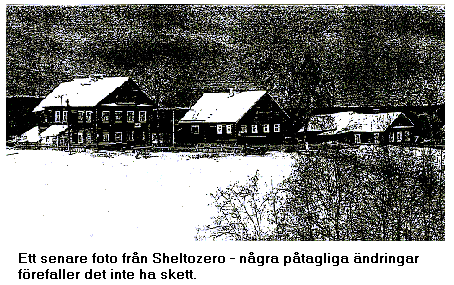
After having been a Soviet republic, the area has now been transformed into a part of the Karelian Republic, and Sheltozero, with the surrounding Vepsian population, has received its own "volostj" (the name for the administrations in old Russia – roughly parish), i.e., its own administrative area. Also included was a picture of some houses in the village of Verchovje.
A Finnish officer tells about the retreat through the village of Sheltozero:
- Of the guard units that were to secure the retreat along the Onega western shore was
some were under my command. For some reason, communications with the main force had been severed, resulting in us not having received any order from our own command center regarding the retreat that we were to follow. In this way, the left side became open and the enemy landed from three different ships over the village's landing pier.
The sergeant in the baggage train had already sent a patrol of fifteen men, who desperately tried to repel the landing. The liaison man I had sent returned and reported that from the boats enemies were pouring ashore like the sand of the sea and that the patrol was no longer able to prevent their formation behind us.
I sent off parts of the reserve, but the situation seemed hopeless and from the front we began to hear sounds of battle, which told us that the enemy's main force was also attacking us from that direction. It looked as if we were hopelessly in a "motti" (encirclement)..
I thought feverishly. The only free road was to the right of the main road, but it was insignificant and went through impassable primeval forest. Taking that road seemed impossible. I came to the conclusion that a swift annihilation of the landed enemy was our only possibility. I detached some men from the front lines and added the remaining part of the reserve, appointed the leader of my own unit, a reliable lieutenant, and gave him orders to try to annihilate the enemy behind us. He soon noticed that the situation was very difficult. The enemy had managed to establish themselves with a large number of men and heavy fire equipment.
Our situation became more and more difficult. A fierce battle was underway in both directions and our mortar crews had to shoot in two opposite directions. My unit diminished considerably, the other ambulance was filled with wounded, among them two officers. In the difficult situation, I thought of trying to call back to our forces behind via telephone. It was a huge surprise that the telephone worked and I got hold of Colonel Ikonen on the other end. The enemy, in their haste, had not noticed the telephone line along the main road.
I asked the regimental commander for quick instructions, the connection could be broken at any moment. After a little while, at the other end of the line appeared the division commander himself, General Isakson, who urged me to leave all heavy equipment and try to save ourselves from the encirclement through the primeval forest. The main thing was that we should save ourselves.
It felt sad. Regardless that the enemy had strong superiority, it was clear, but sisu would not concede the loss. It was hard to imagine that everything from cars to ambulances, the supply section and the heavy weapons would be left behind. Moreover, there were so many wounded that their transport and the possibility of keeping them alive while marching through an unknown primeval forest would be nearly impossible. I decided to consider all other possibilities.
I appointed my senior officer to lead the defensive battle against the enemy's main force and I myself went back rearward to gain some clarity on the situation. My battle lieutenant Martti Rautamies wanted to come along, but I ordered him to stay at the command post. During reconnaissance, I noted that the road was entirely dominated by just one, very favorably positioned, machine gun nest. If one could silence that, then perhaps…..
From the nearest man I took his machine gun and a couple of ammunition magazines. I began slowly and carefully crawling along the roadside ditch in the direction of the machine gun nest. Without having been observed, I came within a couple of meters of the machine gun nest, jumped up and emptied the entire magazine into the machine gun nest and jumped back into the ditch. The fire did its job, but at the same moment, new men nearby rushed over and sat behind the machine gun. My machine gun magazine was empty, there was no time to change, what would I do??
If I started to crawl back, death would be certain. In a fraction of a second, I instinctively came up with a solution, I made a tiger leap back to the machine gun nest and grabbed the barrel of the submachine gun. A weapon spat out a burst and I felt myself hit in the arm. Shortly after, I received a hard blow to the head and the world went dark, consciousness vanished.
Consciousness soon returned, however, and I began to understand what had happened. I realized that I was a prisoner, through cautious squinting I saw a large number of chattering enemies and heard agitated words: "An officer, he should be transported away, soon!"
Reason began to return and my brain to function regarding the continuation. Then I saw at my feet the lying submachine gun and made an instantaneous decision. I snatched the weapon from the ground, rushed up screaming and struck left and right with the submachine gun stock. The whole group was so surprised that I managed to dash about forty meters into the forest before the first bullets began to whistle around. I threw myself behind a tussock. The course of events was so varied that I did not notice the passage of time. I now realized that the entire event had lasted only 15 minutes. I understood that if ever, I must now act with utmost speed. The enemy's machine gun could not, at least for the moment, function and it takes a while before the enemy fully understands the situation. I gave the order to start: troops, the wounded and equipment were loaded into the cars, the machine guns and rapid-fire rifles were set up on both sides of the truck beds, and I gave the order to fire along the road edges as soon as possible. I jumped into the first car next to the driver and off we went. A new surprise paralyzed the enemy for the necessary moments to such a degree that we got through. (Jorma Karvinen: "Kaukopartiot" (Fjärrpatrullen). WSOY)
A Soviet song about the fallen soldiers.
Recordings
- 1940Sheltozero A.mp3
- 1940Sheltozero B.mp3
- 1940Sheltozero C.mp3
- 1940Sheltozero D.mp3
- 1940Sheltozero E.mp3
- 1940Sheltozero F.mp3
- 1940Sheltozero G.mp3
- 1940Sheltozero H.mp3
- 1940Sheltozero I.mp3
- De stupades sång.mp3
- Donsteppen förde Stalin bort från nöd......mp3