Kuopio 1945
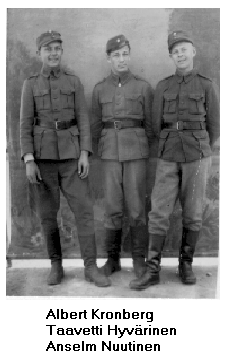
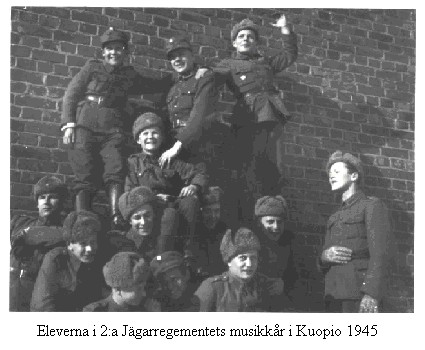
After having been stationed in Tammerfors for half a year, our contingent was transferred to the 2nd Jäger Regiment's regular garrison – the Niirala barracks in Kuopio, Savolax. Here life began to fall into the usual barrack routine. In the north, the war against the Germans was still going on, but we didn't feel it very much except that now and then we had to bury some fallen hero. We had started to adapt to peacetime conditions. We had music rehearsals, gave concerts, and during the summer, which was warm and relatively dry, we swam in the surrounding lakes. The city of Kuopio lies on a narrow isthmus between several different lake systems, and there was never far to the water.
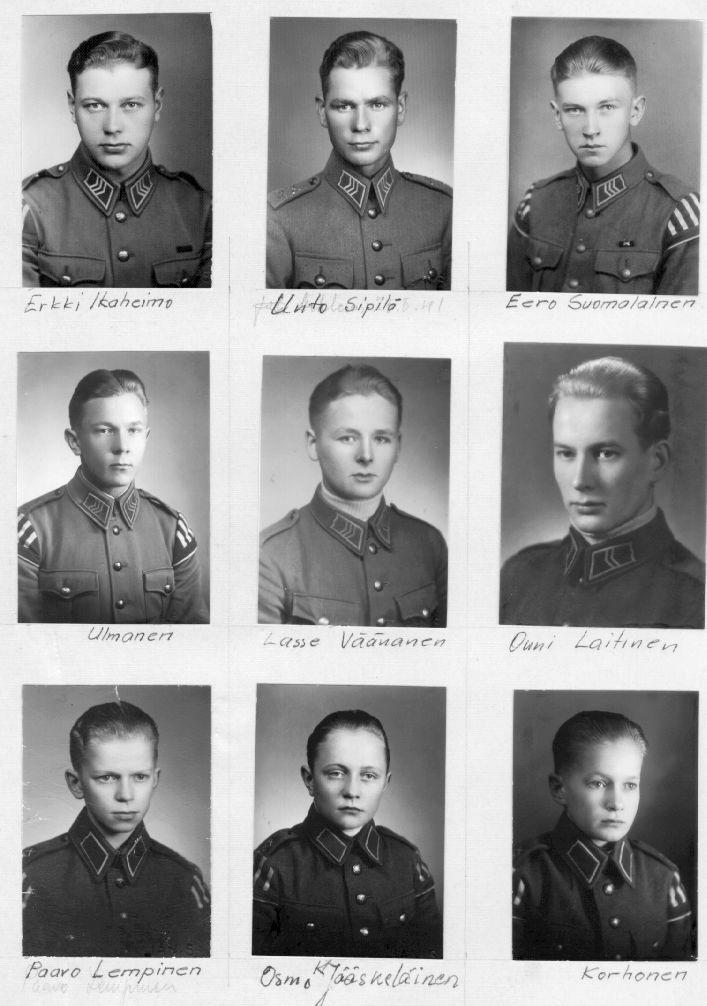
The cleanup operations against our former comrades in arms, the Germans, were going on in northern Finland, and here too we often had to attend funerals of soldiers killed at the front. Kuopio was a much smaller city than Tammerfors, and the distances were not so great; funerals proceeded more in the traditional style. From the church one marched together with the funeral procession; the bodies were transported on a horse-drawn cart by a somewhat mentally disabled man. He himself, his horse, and the hearse were old and worn. On the bumpy, cobblestone streets, it looked as if the cart could collapse at any moment, but it held together as long as I was with the regiment. After many funerals, the solemnity loses its character, and jokes were even made in serious situations. On one occasion, Eero Suomalainen wanted to make fun of the driver and his rig:
- Isn't it time for you to get a new rig, soon both the horse and the hearse will fall apart!
The somewhat laconic answer was:
- My customers don't complain.
When we didn't have drills or funerals going on, we swam in Valkealampi or Mustalampi, a couple of lakes near the barracks. My friend Keijo Puumalainen was a good swimmer; he had feet like bread paddles, and in breaststroke he always won the little competitions we had. Valkealampi was overgrown with water lilies, and we were warned about it, but we didn't think it was dangerous. Sometimes we made excursions to other swimming spots besides Valkea- and Mustalampi. A real long trip of a couple of kilometers we took when we swam out to an island in the Kallavesi Lake system. Kuopio lies on a narrow isthmus in the middle of a large water system, surrounded by lakes in every direction. We had bundled our clothes together and placed the bundle on our heads, in case there might be people on the island and we needed to put on clothes. The distance to the island was about a kilometer, and it took us a good while to get there. We didn't meet anyone, but there were plenty of blueberries.
These excursions were the bright spots in an otherwise rather gloomy existence. The days were relatively monotonous, the food could have been better, and the atmosphere in the quarters was not particularly uplifting. In Far Karelia I had the luck to be quartered with Toivo Iivarinen, and he was like a father to me. When he was off duty, he used to sit by the window and whittle. Unlike the others with their trinket boxes, Toivo carved his daughter's head.
Now all the war-time conscripts had been discharged, and only the regular officers, conscripts, and the younger members of the band remained. The regular staff of the band now again lived with their families, and the rest of us were quartered in a building assigned to the band. The younger men who had served more than three years became non-commissioned officers and received their own quarters at the far end of the enlisted men's barracks, where most of the time not used for drills or duties was spent playing cards on weekdays. Saturdays and Sundays were devoted to carousing around town. Being drunk now and then was part of the behavior pattern for regular officers, at least as long as they were bachelors.
Discipline in the Finnish Army was, in comparison with the Swedish, considerably stricter. We had to salute the officers and go to the mess hall in closed formation under the command of either one of the corporals or one of the oldest recruits as leader. The food was not something for a gourmet; mostly potatoes and brown sauce. If you came late to the mess hall, there was not a bit of meat in the sauce – no "sattumia" (roughly "happenings", "coincidental events") as the pieces of meat were characterized. Card games have a way of dragging on, and this often led to conflicts with the corporals Jääskeläinen, Kähäri, and Baldanius, the most prominent trio.
On one occasion, the card game went on far too long, and despite remarks from the younger, hungry boys, the corporals did not want to stop. I was among the oldest at the time and began to think it was time to go. I opened the door to the corporals' quarters and said:
- I take command and go with the boys to the mess hall, we are hungry and don't want to wait any longer for you. You'll have to explain to the kitchen sergeant why you are late.
- Shut up "monni"! (basse - derogatory term for the newly conscripted conscripts), shouted Jääskeläinen, jumped up from the chair and hit me with his fist in the face so that my nose started bleeding. I hit back and landed a blow on his mouth. One of his teeth cracked and a scuffle broke out between us. I was already quite large and relatively strong, I managed to get him on his back against a table that stood next to the window sill in the quarters, got hold of his head and banged it against the window sill. Jääskeläinen was one of those who often, together with Kähäri, would play Tarzan, hazing the smaller and weaker ones, and now my anger had boiled over completely. If his corporal buddies hadn't come, an accident could have happened; I had a good grip on his head as I lay over him, and the window sill was marble. Now, however, his buddies rushed at me to give me "a company beating," but I managed to twist out of their grasp, run out, and hold the door handle so they couldn't open the door. At that moment, Sergeant Unto Sipilä came by and started asking what we were doing. Now the corporals could not attack me, and I expected that one evening I'd get a blanket over my head and be beaten black and blue. To avoid that, I made an agreement with Jali Ahola that we would watch each other's backs. It was a common tactic that when the bullies couldn't handle us one by one, they would, in a sneaky and cowardly way, gather around the defiant one and, in an unguarded moment, throw a blanket over the antagonist's head and beat him up.
Jääskeläinen, who played the alto horn, had difficulty explaining how he had lost half a tooth. It was supposed to have happened in a fall down the stairs from the second floor of the band building, where he had been practicing, he told the bandmaster the next day. The officers naturally found out the true circumstances, but no further action was taken. When we had a reunion in 1982 (after 36 years), it turned out that Jääskeläinen had left the band after his five years, joined the police force, and was now police chief in a small community.
Hazing was a fairly widespread phenomenon, but for the most part not of any serious nature. The younger (and weaker) ones had to serve as some sort of errand boys for the corporals, fetching coffee substitute from the mess, polishing boots, etc. I stuck together with Jali Ahola, a big and strong man from Tavastland, and due to our combined strength, we henceforth avoided being servants to anyone.
Hazing took a temporary pause when one of the youngest and most hotheaded northerners stuck a knife in the belly of one of his tormentors. As usual, no police report was made; the matter was hushed up within the regiment, and the worst manifestations of hazing ceased for a while.
Veikko Tikkanen, one of the youngest, started strength training after having been subjected to peer pressure from the corporals. We had no training facility, so the cleaning room under the stairs to the second floor had to serve as one. There he stood in the evenings doing push-ups and lifting "scrap iron," in this case a crowbar. He reached 300 per hand and thought it took too long. So he decided to use two crowbars, lashed them together, and continued his exercises, sometimes long after taps. When the duty officer had made his rounds and made sure no one was on unauthorized leave, Veikko got up and stubbornly continued his exercises. Gradually, these exercises became like an addiction; he could go on late into the night. He became programmed (as one says today) and could not stop until he had completed the whole routine. He was a real whiz; over time he became very strong and looked almost triangular in the upper body; there were not many who wanted to arm-wrestle him.

Sergeant Unto Sipilä had been a very avid swimmer, Finnish army champion in certain distances before he developed back trouble. When, as officer of the day, he led the morning gymnastics for us younger ones during the warm season, he would usually finish by taking us to the gravel pit north of the Niirala barracks and, after a brief gymnastic exercise, let us swim across the Mustalampi pond. Anyone who didn't want to swim had to run around the lake, which took considerably longer.
The closest friends during military service were Erkki Inkinen. In Tammerfors, Jali Ahola joined, and in Kuopio, Keijo Puumalainen. Erkki Inkinen was a conscript and was demobilized shortly after the war ended. We three (Keijo, Jali and I) stuck together and spent quite a lot of time out in the forests and fields during that year. In the summer we swam in the numerous lakes around Kuopio and in winter we went skiing on Puijo hill (a height of a few hundred meters above sea level) and its surroundings. There we wore out several pairs of skis, partly military but also my own. During the autumn tour of 1942 with the Äänislinna City Orchestra, I had received a pair of really fine Finnish skis with Rottefälla bindings from a Finnish competitor, who in turn had received them as advertising from some ski company. It was something completely different to ski with these skis, especially considering how we had it during the Russians' time. Already in Kirovsk I had started with skiing, but there it was a matter of two-meter skis with simple straps. One put felt boots in the loops and to prevent the boots from falling off, one pulled a rubber strip cut from a tire inner tube over the loop. The skis were practically not steerable except by a direct sideways movement. For the most part, it was just a matter of throwing oneself down the slope and trying to stay upright as best one could until the slope ended.
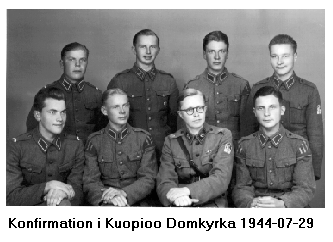
These excursions into nature, both in summer and winter, were bright spots while he tried to instill parts of Christian doctrine in us, with more or less successful results. The confirmation took place under solemn forms in Kuopio Cathedral on 1945-07-29. The entire regiment was ordered to the church to attend and participate in our confirmation. That the Christian spirit did not run very deep in some participants we received tangible proof of. One of the prospective confirmands sat during the confirmation period under arrest, sentenced to 14 days on bread and water for an attempted rape of a girl who happened to pass by at the same time as him across the cemetery bordering the barracks area. For the confirmation instruction he was accompanied by an armed military police officer.
On his control round, which the duty officer made to see if anyone was out on agricultural leave, he went from Niirala barracks to the cinema "Satu". On the way back through the cemetery he heard groans mixed with cries for help from a grave area a bit in from the main path. A closer inspection revealed that it was a conscript soldier who was raping a girl. It happened to be one of our confirmation classmates and the punishment for that was 14 days in the brig on bread and water.
The solemn confirmation, however, was already decided to take place and that a confirmand sat in jail accused of rape was not considered a sufficient obstacle to change the procedure. On confirmation day, the delinquent was fetched by a military police patrol of four men and placed at the end of the four-rank formation that the rest of us had to line up in, and was escorted to the cathedral. Then the police took up positions at each side door in case the convicted person tried to escape. The whole thing seemed greatly exaggerated, but probably it was prescribed in the protocol, and confirmed we were. The men in the regiment, however, had decided to sabotage the performance; the weather was nice and a two-hour church service was not particularly appealing. It became a service to remember, by no means due to the day's solemnity but because of a constant coughing. There couldn't have been so many truly cold people; the early summer had been warm and pleasant, but here in the church it seemed as if a patient group from a sanatorium had gathered in one place.
The coughing was amplified by the bare church walls and hardly any of the high mass and confirmation participants could tell what the day's text was about. Pastor Maasola looked troubled.
Article 5 of the peace treaty between Finland and the Soviet Union included a clause about the establishment of a control commission headed by one of the leading Finnish communists. The commission had been functioning for some time and many controversies arose in connection with it. The Russian prisoners of war were to be repatriated; the Russians also demanded the return of people from the "Brotherhood Battalion" ("Heimopataljoona", Ingrians, Estonians, Latvians, and others who had fought on the Finnish side) as well as some others with similar backgrounds. On one occasion, almost the entire regiment was ordered out for a cordon search for escaped prisoners of war. Many of these prisoners were placed with farmers, and in several places the classic situation described by several Russian authors arose. The farmer was out in the field and the farmer's wife had gotten a prisoner of war to help on the farm. Often mutual affection arose, sometimes due to entirely natural causes - two young, healthy people with normal feelings are drawn to each other, especially where the husband had fallen in the war and the prisoner had taken his place in one respect or another. Now the Finns, despite their great aversion to the Russians, were not particularly eager to search for individual hidden prisoners; quite a few stayed behind and lived secretly in Finland (in many cases aided by the surroundings) or fled to Sweden. When we were out on cordon searches in the Kuopio area, the men made such a noise that no one could remain unaware of what was going on in the area. Anyone who did not want to be discovered had good chances to escape. When the control commission's activity ceased after a few years, these former prisoners of war could come forward and have their papers arranged.
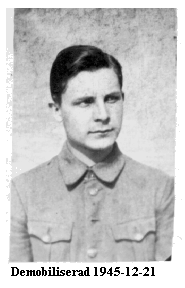
Those music students who had completed three years of service would enter the NCO school and become junior sergeants. I had by then served the Finnish state for the stipulated time and was to undergo training starting in 1946. I had a five-year contract with the Finnish army, but upon checking my citizenship, it turned out that I had no citizenship at all. Consequently, I could neither become a sergeant nor remain in the army at all after the peace had entered into force. So it was, if not outright dismissal, then a "layoff" through no fault of my own. As a consolation for a tiger's heart, I was appointed upon discharge (after 3 years of service) to corporal. One must see it as a joke. All "great" men have been corporals: both Napoleon and Hitler as well as one of the first Finnish presidents.
A few days before Christmas 1945 I stood there with my shoulder straps cut off, without a belt and without a cockade in my cap. The rest of the uniform I could keep like all other demobilized men; one could hardly send people out naked. I had no civilian clothes left; moreover, I had grown quite a bit and there was also some trouble with the uniform. It had become far too short in the sleeves. My supposed musician career had been cut short, I was homeless and had no influential acquaintances either. The Finns, however, felt a bit of their bad conscience and to suppress it, they collected a sum among the regimental personnel that came to almost 4000 Finnish marks. That turned into some half-banknotes with naked people on them. People joked about the Finnish banknotes that they were supposed to symbolize Finland's state after all the war reparations were paid.
A reformation of the currency system was underway and to bring out all the "black" money (for which the person had not paid tax) the government decided to split the banknotes. The left halves could be used now, the right halves would be paid out only in 1949 – if the person could show that the tax was paid. Some apparently had so much money that they got tired arms from cutting; at print shops that had large paper cutters, people stood in long queues with cash-filled sacks to get their money "halved".
Christmas and New Year 1945-46 I had to spend in the barracks; I had nowhere to go. After that, it was just to pack up my few belongings (the backpack didn't even get full) and move out into town. Then as now, there was a housing shortage, and I had to rent a sofa in the kitchen of a Salvation Army soldier and his family on Kauppa Street. Despite their supposed faith, they were not saved from human pettiness; between the spouses there were frequent quarrels, and it became quite trying in the long run. It was another tear in the already somewhat frayed belief in the blessing-bearing effect of religions on people. Later events would reinforce this further.
The world would be a considerably calmer and more pleasant place to be if the "black-robes" (or as my Swiss friend Werner calls them - Die Kohlensäcke) would.
cause so much "devilry". But, as the ancient Greeks already said: 'You cannot remove some old gods without putting new ones in their place.'
My Swiss friend Werner Müllis's annoyance is largely because his mother had to pay considerable sums to the Catholic church. The father is Lutheran while the mother was Catholic and for the sake of the marriage she wanted to convert to the Lutheran faith. Her Catholic relatives were naturally very much against the act, but she carried out her intention and converted. After some time she fell ill and then the relatives, with "der Kohlensack" - the Catholic priest at their head - were after her. They claimed that her illness was because she had betrayed "the true doctrine" and become a heretic. In the end they succeeded in persuading her to return to Catholicism, but it did not happen entirely without cost. Werner says he still does not know how much it cost, but he suspects that a good many Swiss francs disappeared into the papal treasury in the Vatican.
At a more mature age, I have sometimes thought about the clergy and their commandments. The question has arisen how long one can remain a believer given the circumstances. With priests, it is probably like with gymnastics teachers. In youth, a person can certainly be truly religious, with a natural striving to improve the world, but as the years go by, they must come to a clear understanding. Religion fades away and what remains is only a profession, which one has learned, and from which there are no major emergency exits. Most priests are merely actors in a ritual game. Unlike the real shamans, they lack the ability to conjure spirits. Toward the end, it all becomes just a spectacle: there is not much room for one's own thoughts. Most of what is said in church has been said many times before and there are sermon books in abundance. Superstition, however, lives on and has a strong hold on people. That reminds me of the teacher Dolly Axén's statement:
- Can't the religious do anything themselves, must they always call upon Jesus?
Dolly probably had very clear pictures of the religious practitioners. She was from a railway town in the north - Vännäs - where her father had been a train driver and could tell a great deal about religious life at the beginning of the century. She had a lot of humor and used to tell anecdotes from her visits to the 'salvation tents,' as she called the religious revival meetings. One of her stories went as follows:
During the great revival wave, it was customary for the congregation members to be urged by the priest to go forward to the altar and confess their sins and receive forgiveness for the misdeeds committed.
An older man goes up, stands before the congregation and begins:
- I have drunk, I have cheated, I have whored.........Two middle-aged ladies stand up and are on their way out of the church whereupon the man shouts:
Sit still, old women! I won't name any names!
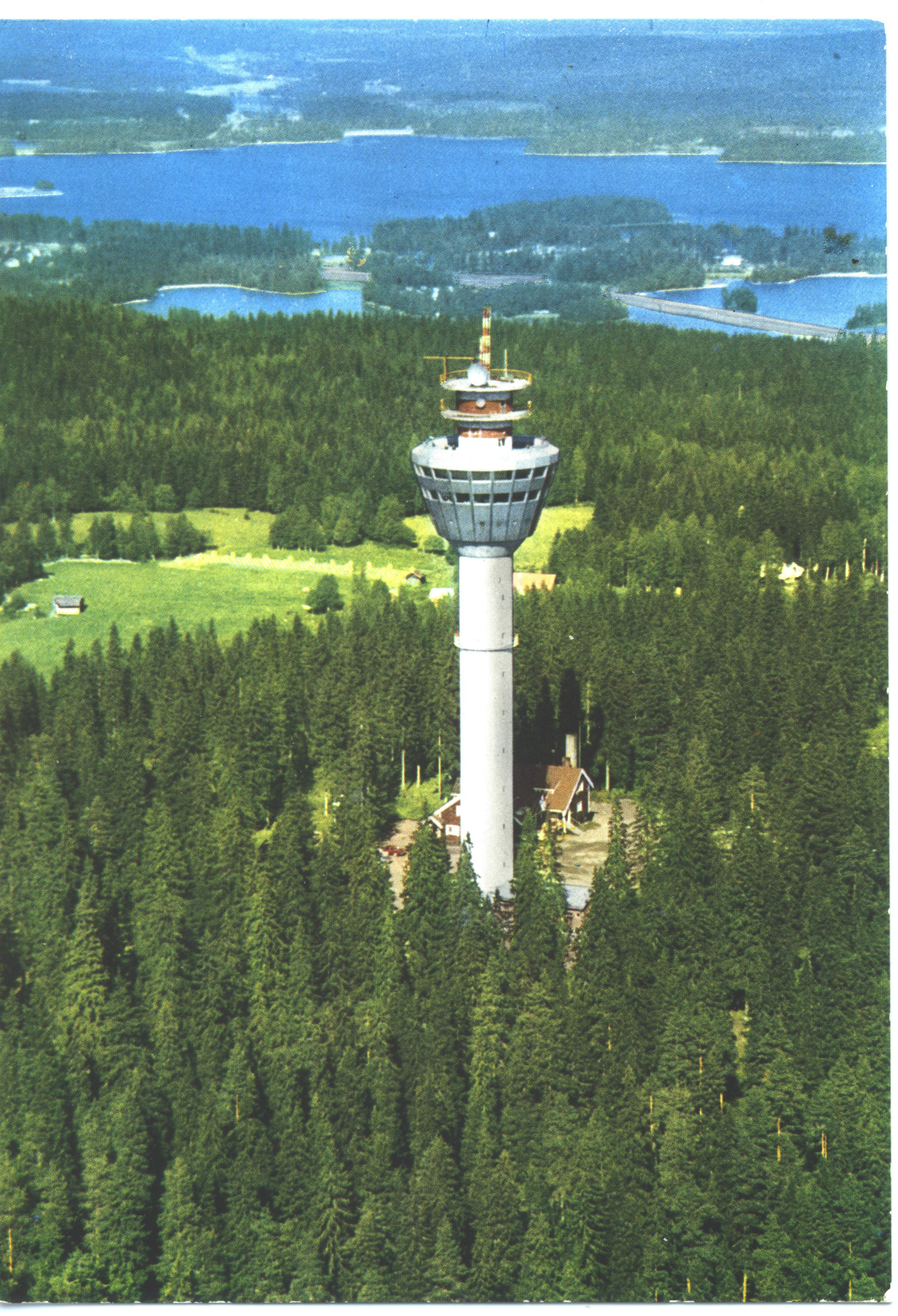
Puijo hill outside Kuopio was a popular excursion destination, both in winter and summer. In its ski slopes I have managed to break two pairs of skis. Together with Jali Ahola and sometimes Keijo Puumalainen, we were frequent visitors there. At that time, there was a brick tower about 20 meters high on the top, now there is a TV tower that is somewhat taller. Quite often we also set out on the ski trails in the evenings and it was quite thrilling to ski down the slopes when you couldn't see clearly where the bumps were. In moonlight it worked perfectly though, even if one occasionally took a dive into a snowdrift. But there was plenty of snow and no major injuries resulted.
Even in the summer, Puijo was an excursion destination; there were not many others like it in the vicinity of Kuopio. The city lies on a long strip of land, surrounded by the large Kallavesi lake system on both sides.
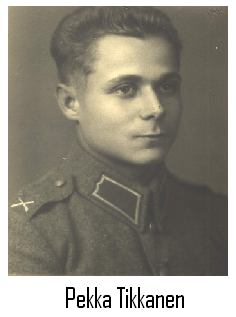
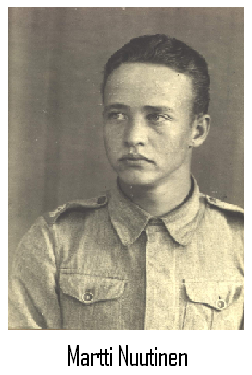
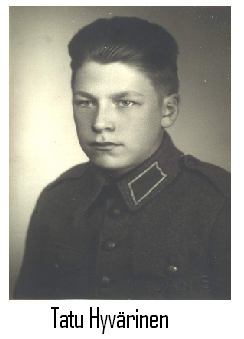
Music students and conscripts in the 2nd Jäger Regiment's music corps 1945
Recordings
- 1945KuopioA.mp3
- 1945KuopioB.mp3
- 1945KuopioC.mp3
- 1945KuopioD.mp3