Kausjärvi 1946.
The Finnish military life had come to an abrupt end, I was a "civilian louse" and would have to start supporting myself. There wasn't much to choose from in the way of work for an uneducated youth without parental support, and the employment outlook looked quite bleak. That my military life ended was not something I was particularly sorry about. It didn't suit me very well, especially the somewhat crude and overly militaristic spirit. I felt I was in some kind of opposition to my surroundings and often got into disputes with some of my comrades. It wasn't much better with the officers either. In some way, I sensed that I didn't really belong to the company and didn't want anything to do with it. The "discharge" in a certain sense was a liberation and had the good side that no matter what happened, it couldn't get much more dreary. The positive thing was that I later always had something to compare with and thereafter thought that most things were better. That I had to work hard at times and had a tight budget didn't matter much.
I got help with work through Captain Onni Palomäki, bandmaster of the Jaeger Regiment's music corps; he arranged an apprenticeship at Kuopio Gold Shop, where he had some influence. Through his marriage to Paasikivi's niece, he had become a partner in the company. Work at Kuopio Gold Ltd became quite monotonous and the pay meager. As an apprentice, I had to start by polishing spoons, forks, and knives. I didn't have any accommodation either; besides, my salary wouldn't have been enough to pay for my own room. I rented a place on a kitchen sofa in a Salvation Army family, but here there was no heavenly peace, but rather a certain discord between the spouses about who was the best Salvation Army soldier. In the long run, it became unbearable. Now I had to pay my rent and living expenses myself; it didn't add up, and there was nothing left over even for the most modest expenses. No amusements aside from an occasional movie visit were out of the question. As an apprentice, you ideally need parents to support you during the training period. Money was quite scarce and everything was expensive after the war – to the extent that anything was available to buy at all. Here it was necessary to come up with something better.
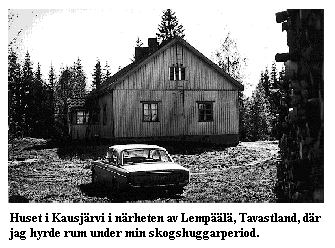
Since I didn't enjoy indoor work anyway when spring began, the only right thing was to take outdoor work – that became logging in the area of Lempäälä (south of Tammerfors). I took a job as a lumberjack and accommodation was arranged in a farmstead, a good distance from the logging site. The family considered themselves religious – in the Pentecostal direction – but neither was there any blessed peace in this house. There were constant battles about who was strongest in faith, and in time my faith in the beneficial effect of Christianity was further revised. The family had two children; the daughter had taken her matriculation exam and was going to become a missionary, while the son remained on the farm. The farm was small and did not provide sufficient income to support a family; the son wanted to move to Tammerfors and take paid work. He was about the same age as me, and I got along well with him. The farm was one of those smallholdings of about ten hectares that the returning soldiers got help with from the state.
The house was beautifully situated on a slope towards Tervajärvi, and all around the forest stood in all its glory. Sometimes I was out in the forest and by the lake after work, but most often I was far too tired to enjoy nature; besides, tool maintenance always provided enough occupation in the evenings and weekends.
All food was rationed and life became possibly even sparser than in Kuopio. Now I also had to perform heavy physical labor, and being inexperienced, the result was accordingly. The forest was nothing to write home about either; no experienced lumberjack would have agreed to work there on piecework as I did. I managed perhaps 3 – at best 4 cubic meters per day, and that brought in no money. Profitable work in the forest also requires that you are good at looking after the tools. I had no practice at all in filing a saw blade or sharpening an axe, and of course this affected the work result. It was very taxing; I had to ask someone at the farm to turn the grindstone, and that didn't happen for free; I had to help with certain other chores to compensate for the help.
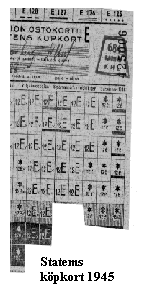
The smallholder family themselves had quite a sparse living, and I could not get any help with food from them. Every Saturday afternoon I walked the good mile to Lempäälä to fetch provisions; there were not always goods available that one had coupons for. I had a ration card of category "E", for heavy physical labor, but it didn't help much; most of the time I was quite hungry. Fishing in the nearby lake Tervajärvi became a certain contribution to my sustenance, but it had its risks, since the farmer did not have a rowboat that I could borrow; I experienced that quite clearly on one occasion. It nearly became my last fishing trip.
Since I had no boat, I consequently had to go as far out as possible on foot, jumping from tussock to tussock. The lake was silting up, and I broke through in one place, but managed to lean forward before I was completely submerged. There I lay, bent forward up to my waist in the lake with my upper body on a tussock. As soon as I moved, I felt a terrible suction pulling downward. At first my ability to think was completely blocked, but after a while the situation became clear, and I began to think about how I would get out of the swamp alive. I had instinctively kept hold of my spinning rod, and that (along with a small birch on a tussock a bit further away) became my salvation. I tied the line securely so that the sections wouldn't slide apart, grabbed the tip of the rod, and managed to hook the reel around the little birch. Then began the struggle to get away. Afterwards it is impossible to say how long it took to very slowly drag myself out of the swamp. Every time I made a sudden movement, I felt the downward suction increase. Those were minutes of terror, and they made me start thinking about my situation.
I began to feel like a backwoodsman and had difficulty talking to strangers. There wasn't much to discuss with the farm family; they were too immersed in their religious brooding, and I couldn't take part in it. With the daughter, I had a few conversations, and she taught me the very first basics of English. She intended to become a missionary. The only real acquaintances I had were the teacher from the Soutjärvi days: Aune Laine. She had returned to Tammerfors after the war and resumed her old work. Aune, her sister Aili, and their mother knew about my situation, and they became a great help to me. Aili was the matron at a hospital in Tammerfors, and every time I visited them, I got bread and buns to take with me. Some were a bit dry, but I never reflected on that. They tasted exceptionally good nonetheless.
There was plenty of game in the surrounding forests. Now and then I saw moose, and the smallholder's wife told a bittersweet story about the hunters in the area. A few kilometers into the forest there was a hunting lodge belonging to a large company in the Tammerfors area. When the moose hunt approached, a procession of carriers passed by Kausjärvi because the road ended here and there was no drivable road to the hunting lodge. The carriers carried both brännvin, beer, and much else that was needed for the hunt; sometimes there were also said to be some "ladies" with them.
– They didn't look like they were going to hunt moose, said the hostess.
One autumn day, she said, a few shots were heard not far from the house, and after a while a moose came out of the forest and threw itself into the lake to swim across the narrow strait to the other side. The moose was wounded and left blood trails; it got even worse when it tried to swim across, as autumn was far advanced and winter with frost and cold had already set in. There was a thin crust of ice on the lake, and the moose broke the ice with its snout, adding more blood. After a while, some hunters came running out of the forest. When the farmer's wife saw them, she forgot her Christian upbringing and gave them a proper scolding in plain common language, which reached its climax when she discovered that the gentlemen were far from sober.
– I've never heard mother scold like that, said the son; you wouldn't think she was religious. The hunters slunk away, quite crestfallen after that treatment, and were careful not to come near the farm again for a while.
Recordings
- 1946KausjärviA.mp3
- 1946KausjärviB.mp3