Raumo 1946
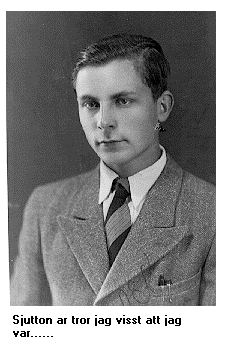
Iwas still in the forest work up until the autumn, but began more seriously to think about my situation and how I would manage in the future. Sometimes it felt like an anthill in my head. I clearly realized that I would not make it through the winter in the forest – both due to the insufficient food and the lack of work clothes for the winter. The uniform items that the army had provided me with were by now too small – and they were also starting to wear out. I was still growing, and the sleeves of the uniform jacket did not reach far below the elbow, the boots were tight, and I had little money for new ones. The forest was also so messy that any experienced forest worker would never have agreed to such conditions. I didn't know much more than forest work (barely even that), but there had to be something where I could have it a little easier and earn money. On one occasion, I also realized that my work was not entirely safe. I was about to end up under a falling tree when I was trying to get it down to the ground after the tree had snagged. It could easily have been my end. The clearing was far from the farm and the rest of the settlement; if I had accidentally cut myself with the axe or gotten crushed, I might not survive. When I had finished working, without finding any good way out, I took out my pay, shouldered my backpack, and traveled here and there – completely at random.
Among other things, I visited Erkki Inkinen and Toivo Iivarinen with their wives in Helsingfors. Both were worried about my situation; they were my closest comrades from military service and felt that the army had not taken the responsibility it should have done regarding the broken 5‑year contract, but had left me to the winds. However, they could do nothing. Everyone was aware that times for former soldiers would be tough, and for those who did not master any trade and on top of that were of foreign origin, it would be even worse. I traveled to Helsingfors, stayed in Erkki Inkinen's apartment for a few days and looked for suitable work, but nothing suitable existed and I had to continue my Ahasverus wandering. Housing was also scarce, and after a few days' stay with Erkki, I set out traveling again. I made an attempt to move to Åland and go to sea, but the mate on the boat in Åbo harbour (where I tried to board a ship) asked if I had any passport, and when I showed my military pass, he said that pass was not valid for going to Åland.
Our fates are guided by random whims. For some reason I took the train to Raumo (I can't remember why, probably just because it was a train that was about to depart from Åbo station) and got work and accommodation at a sawmill there. It was AB Raumo‑Raahe – a large company with a shipyard, sawmill and lumber yard. They were engaged in war damage deliveries to Russia. The Finns were forced by the peace treaty to compensate the Russians with $300 million for the damage they had caused, according to the Russians, and part of the compensation was delivered from here in the form of prefabricated houses, timber and ships. The shipyard in Raumo was to build 6 schooner ships as war reparations, and according to reports these ships were intended for the fishing industry, but we found that hard to believe; the masts were far too high for fishing vessels, and the comfort was likewise. The ships were built of oak, to a very high standard, and had such novelties as a sauna on board. The sauna had its own story. The Finnish shipyard workers said that all the walls and benches in the sauna were first to be paneled and then covered with stainless steel plates, but the plates were not to be fastened too tightly – only with one screw in each corner. The intention was quite obvious. When the ships were to be launched and taken over by the Russian control commission, the plates would immediately be removed and sold as dental material. All the gold had been used up for purchasing war materials from America, and people had nothing to fix their teeth with – so stainless steel had to suffice.
During a trip with Öl Jan‑Åke Bergh to Leningrad and Tallinn in 1978, we encountered such a stainless steel set of teeth on a lady in the dining room next to May Day Square in Viborg. The lady, who was serving soup, had her entire mouth full of stainless steel, and Jan‑Åke, who had never seen anything like it before, just stood there gaping in amazement.
The town of Raumo was a small hole with about 15,000 inhabitants, but a large industrial town with a leather factory and one of the best harbours on the Gulf of Bothnia. The town was almost entirely dominated by the Raumo‑Raahe company, a large industrial complex with wood and shipyard operations. No residential buildings had been built during the whole war, and the housing shortage was very severe. There were no rooms to rent in the town; they were already rented out to office workers and better‑paid skilled workers from the company. Now that the war was over, industry began to flourish.
I joined a team of 3 other talents of younger age, and we were stacking boards and loading timber and prefabricated houses for transport to both Russia and France. Sometimes the stacks grew to several metres in height, and one had to balance carefully so as not to fall down. With a couple of 1x4" boards on the shoulder, it was not entirely risk‑free to walk on a rather narrow gangway.
Quarters for workers (most did not have their families with them, to the extent they had any at all) were in a number of barracks up on a hill adjacent to the company – Martinmäki – some barracks for full drunks and some for half drunks. One of the barracks was intended for relatively sober people, mostly youths, as well as some older workers. The barracks were of a standardized Nordic model, divided into cubicles with four bunks placed around a small common room in the middle. The bunks had straw mattresses, but due to the lack of fabric, something resembling large garbage bags was used. The paper was of the smooth, hard kraft paper type, and when the mattresses were new and the straw had not yet settled properly, it was somewhat difficult to sleep on them. It was like trying to lie on a large pig. At first, I mostly woke up because I was lying outside the mattress, wedged between the mattress and the bunk board or the mattress and the wall. The older workers with somewhat lighter sleep had trouble sleeping due to all the noise from the mattresses. The hard paper rustled a lot, and among about twenty sleeping people, there is always someone turning over in the bunk, and it becomes practically constant rustling all night. Once the straw in the mattress had been compressed after a number of nights and the paper in the mattress had softened, it was somewhat better to sleep, but the turnover of people was great, and there was always some newcomer whose mattress caused rustling for a number of nights to come. The heavy work of carrying and stacking boards, balancing sometimes quite high in the air, made sleep deep, and occasionally falling between the mattress and the bunk board did not significantly disturb the sleep of the younger workers.
In the "sober" barracks, life was quite calm; after work, card playing was one of the most common pastimes, at least for the older workers. We younger ones went out into town and occasionally visited a cinema; there were just no other entertainments to engage in. For a while I tried to study. I enrolled at Raumo Kansanopisto (corresponding to the Swedish folk high school) as a student of the Finnish language, but with card playing and other noise in the evenings, my studies were not particularly successful; there was not enough peace in the barracks for homework, and after a few lessons I realized the hopelessness and quit my studies.
The dances – which were forbidden during the war – had started up, and I heard some younger talents talk about how much fun they had had. I myself was still completely uninterested in such entertainment. I had had no closer association with the female sex since the tour trip in the autumn of 1942 to the Rukajärvi front with the teacher Olli Naukkarinen and 4 far‑Karelian girls.
My entertainment became the town's cinema, and since I was only wearing my old uniform clothes and the ticket sellers at the cinemas were always middle‑aged ladies who could not tell the difference between a soldier and a civilian, I could often go in for half price, as a soldier. The civilians' shoulder straps had been cut off, and through the small "pigeon holes" to the ticket windows, they could not see any difference between a civilian and a military man.
There lived many demobilized older soldiers in the barracks. These had come back from the war; many had lost both their homes and some even their families, and had neither work nor housing left at the advent of peace. The saying "War is cruel, but peace is a hell" came true for many.
A few isolated older "civilians" also lived in that barrack, and almost every conceivable fate was represented there. I became acquainted with a man who had been sentenced to life for robbery murder while intoxicated and had served 15 years in the notorious Kakola penitentiary in Åbo. After the war, in connection with a general amnesty, he had been set free and now worked for the Raumo-Raahe company impregnating telephone poles. He was a rather taciturn type and never said anything about himself; it was through the others that I learned he was a former prisoner. During one of our conversations, it emerged that he needed a new helper because his current one was going to quit. When he had explained how things would be, it sounded fairly good, and I accepted the offer. It could be a change from stacking boards. It is not often that former prisoners command much respect, but no one looked down on this man. He was quite small in stature, but with a bearing and self-awareness that kings might have envied. As in all the world's prisons, there was also a certain hierarchy in Kakola, where murderers ranked quite high. He more or less set the price for his work himself. In the mornings, when we arrived at work, there were a number of logs dumped from a railway car, and when the foreman came to assign the work, my "buddy" would say that we wanted so-and-so many hours to impregnate them. I was inexperienced and thought he was being rather generous with the time, the foreman sometimes looked a bit puzzled but never objected, and compared to forest work I was having a real easy time with him. He had a "borsalino" hat. He was very proud of it, and on the few occasions when he mentioned something about his fate, he said one day with no little pride:
- It was stored in the Kakola prison warehouse in Åbo for 15 years.
Normally, my workmate was not particularly talkative; he sat mostly in silence during breaks, looking as if he was thinking about something. Sometimes, however, he felt a certain need to speak, and then he would tell, in a fragmentary way, about his life in Kakola, about the hierarchy among the prisoners, and a good deal more. It was a harsh life, but the robbery murderers stood high on the scale, and he got by reasonably well. Unfortunately, I was not interested enough to commit many details to memory, but it is a pity when one thinks about it now.
The food supply also improved considerably. Now I at least had money to buy food. Even though most things were still rationed, it was nonetheless possible to obtain supplies beyond the relatively meager offerings covered by the ration cards. The work was not as strenuous as in the forest either, and life began to look quite bright. In the dining halls, however, coupons were still required, and some people tried to outwit the system in one way or another.
One Sunday I was out in town and went into a dining hall to get some food. At the table next to me sat an "older" man (35-40) eating something that looked like a hash. He was nearly finished with his plate when he suddenly called the waitress:
- Miss! What is this? he said, pointing at something indefinable lying on his plate.
The girl looked at the plate and made an attempt to take it, but the man stopped her.
- No, no! I'm keeping this, he said, holding onto the plate.
The waitress became confused and did not know how to act. After a moment's hesitation, she said:
- I'll bring a new portion, and disappeared back into the kitchen.
The new portion arrived, and the man began eating it, but did not let go of the plate with the earlier portion. When he had finished the new portion as well, he started rooting through what was left on the previous plate, picked something up, and licked it clean. It turned out to be a pinned tooth. He put the tooth into its place in his mouth, licked his lips, and said:
- Well, so I've gotten an extra portion completely free and saved a few coupons to boot!
That was apparently his way of tricking the waitresses and getting food beyond what he was entitled to by the coupons, but in a small town like Raumo there were not many eating places; he must have traveled around quite a bit to obtain food in this way using the trick.
In our work impregnating the logs, we certainly did not overexert ourselves. When it was sunny and warm, we lay in the grass beside the impregnation basin and sunbathed for long stretches of time. Despite this, I earned almost twice as much as in forest work. If only there had been food or something else to spend the money on!
The autumn days grew shorter and shorter. The work of impregnating telephone poles had to be stopped when the water in the impregnation basin began to freeze, and one morning we found ice on the surface of the bath. We were given the choice of starting at the sawmill, the lumberyard, doing something else, or quitting at Raumo-Raahe. My "prison buddy" thought he was too old to stand in a drafty sawmill and quit. I, for my part, started again at the lumberyard, now once again as a stacker, stacking timber for drying in piles, loading railway cars, loading prefabricated houses, and everything intended for the war reparations deliveries to Russia. Everything Raumo-Raahe produced went to Russia.
Here too, the earnings were quite good, though not at all comparable to before. It was something more mobile; we were a four-man team and walked along the entire stacking area from Martinmäki up above all the way down to the docks.
The days were still warm, although autumn was far advanced; during lunch breaks we sat on the dock and observed our surroundings while eating our sandwiches. Environmental awareness had not yet set in, and the toilets consisted of the stream that flowed into the Gulf of Bothnia. Not far from us was a women's toilet, and there was constant joking when the door creaked and we knew someone was going into the outhouse to attend to one need or another. The entrance was on the other side, and we could not see the person because of the high fence, but we heard the door creak, and then the guessing began as to how old the lady in question was.
If one heard a hiss like when a water tap is opened under high pressure, we guessed it was a younger woman; if, on the other hand, it sounded as if someone had emptied a bucket into the sea, then we guessed it was an older lady (at that time, a woman of about 30) who had given birth to several children.
Politically, the times were rather troubled. The Russians had appointed the pro-communist Minister of the Interior, Eino Leino, and he began a certain reshuffling. All Estonians, Izhorians, and also some Russians who had fought on the Finnish side, especially members of the "Brotherhood Battalion," were all wanted, and the Minister of the Interior had promised 25,000 FMK to anyone whose information led to the capture and "repatriation" of a member of the battalion to the Soviet Union. One of the members (Vihtori Ikoinen) writes in his memoirs:
"I got married and had only lived a few months in Jämsä when I was arrested. After three days in the Jämsä lock-up, an order came that I was to be transferred to Helsinki and handed over to the Security Police. However, I was told that the police who were to escort me would see to it that I could escape. This promise relieved the pressure and the worries about my wife, who would otherwise be left alone."
"Fortunately, we had good and reliable friends among the authorities. One of the best was the police chief in Kuopio, then Police Master Simojoki. Toward the end of the third year, he sent word to me: 'The ground is starting to burn under your feet. You are on the wanted list, and I can no longer guarantee your safety. The wisest thing would be for you and your wife to seek refuge in Sweden.' Viktor and his family fled to safety in Sweden.
Many authorities acted unlawfully in relation to the new 'ukases.' They considered it improper to send their former comrades-in-arms back to Russia to be punished. An example of such an 'unlawful' act was, for instance, a transport of soldiers from the Brotherhood Battalion from Raahe to Naarasjärvi. Near Pieksämäki, the train suddenly slowed down, and 445 men rushed out into the darkness when the carriage doors were not locked. The guards did not even make any attempt to prevent a mass escape. Some, however, were recaptured, and by March 10th, 268 soldiers from the Brotherhood Battalion had been handed over to the Russians. (Nevalainen 1990, 305)
The Brotherhood Battalion, consisting mainly of Izhorians and Estonians, included 729 men. Most of them were discharged in October 1944 and did not fall under Article 10 of the peace treaty. The Finnish Defense Forces announced that these soldiers belonged to the regular troops.
According to the peace treaty, all non-Finns were to be repatriated to the Soviet Union, but under the old administration, the authorities had not exerted themselves overmuch in executing the decrees. In the autumn of 1946, the repatriation efforts gained momentum, and the stream of refugees heading west increased dramatically. Most set off for Sweden, from where they might possibly continue to America or Canada. There were also those who stayed in Finland, living underground, waiting for the situation to improve so they could begin to live legally. The native Finnish population was not overly eager to report remaining foreigners, whether they were Russians or others.
My oldest school acquaintances, the Ingrian family Kiiski – a mother with three sons and a daughter - (the father had disappeared in the great wave of arrests in 1937-38) with whose oldest sons I was a schoolmate already in 1935 in Kirovsk, belonged to this category. For several years they lived in obscurity at Anjala Manor near Inkeroinen, (where the Anjala League held its conspiracies against Gustav III). After a few years (when the Control Commission had finished its work) they could come out into the open and eventually become Finnish citizens. Toivo Kiiski moved to Sweden in the 1960s, became a Swedish citizen. After retirement, he rebuilt his summer cottage in the wilderness, near Nol, into a winterized house for himself and his wife Kirsti. Both Ann-Marie and I thought it was quite daring considering that Kirsti is severely disabled and has difficulty moving around. The house construction went quickly. The year before I visited them and then only the foundation was ready, when I visited them a bit later the house was practically finished, it had not taken many months. To my question how he could build so fast Toivo replied:
- I had over the years helped so many with their builds that now when it was time for me to get something done on my own plot, I called in some of the Finnish-Ingrian male colony for 'talko-työt' - a form of communal work often practiced in Finland (and partly also in Estonia). The Social Democratic government abolished this form of helpfulness between neighbors by taxing the work. There are about 300 people in the Finnish society in Gothenburg and at Bergsjö the Finns have a large clubhouse with a sauna (of course), dancing on Saturdays and sale of coffee etc. When I asked Toivo how they had been able to finance such a large clubhouse he replied:
- The Saturday dances.
- But you mostly have pensioners. They are not so mobile, many use a cane and walker I have seen here.
- Yes, that's true. But when they are going to dance, they throw away their canes and lean on each other, it seems to work perfectly and there is income for the club activities.
My thoughts of moving out of Finland took more concrete form when in the Raumo-Raahe canteen I became acquainted with an Ingrian lady - Maija Aatolainen. She stood at the food counter and we came into conversation with each other. She used to give me rather large portions of food, she probably thought I looked starving. Maija spoke Russian and it was through that she learned about my fate. She herself was from Kingisepp and also belonged to those families who had been forcibly moved to various parts of great Russia and finally moved by the Germans to Finland. She had two sisters with families in Raumo. The son in one family I knew a little, his name was Nikolai and he worked at the shipyard. He was my own age, had a younger and an older sister and two cousins: Nina, the same age as us, and Valdemar, 5 years old.
The Ingrians' transfer to Finland took place in two different stages. The first stage was based on voluntariness and lasted from March to October 1943. In this stage about 22,000 people were moved.
The second stage was a forced transfer on German orders and it became a rapid evacuation. At the end of October, thousands of Ingrians arrived at the ports of Kloga and Paldiski. The departure from Kloga and Paldiski took place in great haste. The camp, which was intended for about 6,000 people, had to accommodate up to 14,000 Ingrian refugees. The sea transports had increased capacity. This operation practically continued until February 1944, when the Red Army had advanced positions to the Narva – Lake Peipus – Pskow line. The main route was Paldiski – Hangö, but Hangö could not receive all and 17 transports went to Åbo and 3 to Raumo. It was to Raumo that the families Aatolainen and Kuuttanen had come with these transports.
During my continued conversations with Maija we came to discuss a possible move westward because the situation was becoming precarious for all former Soviet citizens and stateless persons. She herself was married to a Finn, but her sisters with their husbands and families were in danger of being repatriated. When I then showed some interest in heading westward, she said that perhaps it could be arranged from Raumo. There were not usually any longer discussions, but we returned to the topic now and then. One day she took me aside and told me that her relatives were preparing for such a journey, a fisherman undertook to transport the refugees by boat across the Kattegat and the price was 15,000 FMK. If I was interested, she would arrange the contacts, but it was urgent to decide, the journey would likely take place within a few weeks. What one wanted to bring could not be much more than what fit into a backpack or a small suitcase, the boat did not hold so much. I did not have that many possessions, but enough anyway that I had to get rid of some, partly for transport reasons and partly to scrape together the money for the trip. I sold a pair of extra boots and my Parabellum pistol.
The Control Commission proved to be quite effective, because despite the concluded war against Russia, there were quite a few communists in the country who now began to become very active. Now they took the opportunity to pay back old scores and take revenge on their ideological opponents, who had ensured that people with communist ideas, for as long as the war lasted, had either been imprisoned or interned in camps. Refugees in Finland got caught in the politics. Rumors began to circulate ever more frequently that the commission had taken this or that person. The Ingrian Sulo Korpelainen had to flee with his mother and grandmother and the ground began to burn under my feet as well. So far everything seemed quite calm in Raumo, after two years in the Finnish school and three years in military service my Finnish was as good as any native's, no one could hear any foreign accent. At the workplace I kept quiet about my Russian and no one took me for any 'foreigner'. With the identity papers it was not so strict either. The labor shortage was great and the management did not care where one came from or who one was, as long as one was a good worker. The problem was the home communists. There were, after all, quite many of them. Now when the war ended and their ideological comrades through the Control Commission had a say in Finland, these began to smell morning air and conducted intelligence service for the Russians' account over non-Finns, Ingrians, Estonians and defected Russians. Denunciation has always been an essential virtue in the communists', as in all other totalitarian governments' ideology. Now some had the opportunity to practice this 'virtue'.
Many of the Finnish communists had been interned during the war, but in connection with peace negotiations and the general amnesty they were now free and naturally harbored no warm feelings for those who had dissenting opinions. Many were also not so old that they did not remember the battles and injustices that had been committed by the 'Whites' during the 1920s, when the struggle for power in Finland was to be decided after the First World War. 'The Whites' won and the communists had not had much to say after that. Since 1918 Finland is 'democratic' and Western.
Recordings
- 1946RaumoA.mp3
- 1946RaumoB.mp3
- 1946RaumoC.mp3
- 1946RaumoD.mp3