Stockholm 1946.
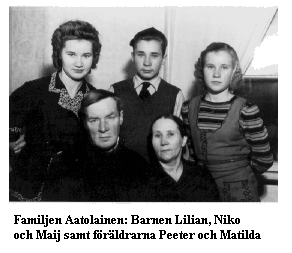
I n early December 1946, Maija Aatolainen said that now I should be ready to leave on short notice any of the very nearest days. For my part, departure was prepared; I paid the 15,000 FMK that the crossing would cost, disposed of unnecessary belongings, and had my backpack packed and ready. I had sold my Parabellum pistol to one of the younger men in the barracks for 5,000 FMK, as well as some other salable items, and now had only one set of underwear, 2 bottles of cognac, documents, and photographs left. I had some savings that would have been enough to pay for the passage, but I did not want to bring weapons to the new country; it could have caused complications if the action were discovered. Now I had so much money that I could hand over several thousand marks to Maija Aatolainen to keep for me (in case something should happen and I would have to come back).
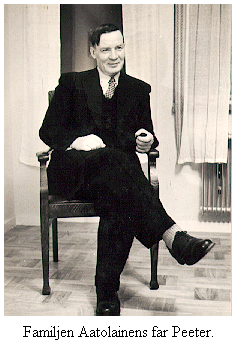
Maija's relatives Peter Aatolainen and the Kuuttanen family had the previous summer made an attempt to go to Sweden, but the attempt failed and they were returned to Finland. The attempt had taken place the same year, around midsummer, but fair weather, dishonest people, and bad luck with the boat motor, as well as the concern of communist-minded barracks neighbors, had thwarted the enterprise. They had sailed out with a fisherman in a larger boat and had all their belongings with them. In the same company was another man, a former clock dealer. The man had been somewhat loose-lipped and bragged far and wide about his good business and how much he had earned from it. Once out at sea, the fisherman wanted them to spend the night on an island. They were to unload the belongings and hide them, in case the coast guard should discover them, the fisherman said. Then they could claim that they were out on a normal Sunday excursion. The belongings were unloaded and hidden a bit from the shore; they themselves went into a sauna for the night, and the fisherman offered some liquor. Peter Aatolainen had brought a pistol and they shot at empty bottles for target practice. In the morning, when they were to load the belongings back into the boat, nothing was left. Someone or ones had stolen everything during the night. The reason was believed to be found in the dealer's supposed wealth, which he would bring to Sweden, and in the fisherman's dishonesty. It was quite clear that the theft was planned already before the departure. Now there was nothing to be done. Moreover (and this came out later), the pro-communist neighbors in the barracks had discovered that the rooms were empty in the morning and reported their observations to the police. The police sent a message to the coast guard, and when a boat went out to search between Raumo and Björneborg, they discovered the refugees. The coast guards threw a line to the refugee boat and they were towed to Björneborg.
At this point, the highest domestic leadership had indeed been replaced in accordance with the demands of the Soviet Control Commission, but the local police chiefs remained in their positions. They had by no means changed their opinion about what was right or wrong. Without the newspapers getting wind of the incident, the whole company was placed in the only available premises – the police arrest – and had to spend 3 days there. According to reports, an attempt was made to find a suitable residence for them in Björneborg, but when that failed, they were returned to Raumo. The barracks apartment there was still vacant. Before the fisherman was taken into custody by the police, he had time to inform the participants of the failed excursion that he would get a few months for human smuggling. He said he had money "under a stone", that they could repeat the attempt later in the fall, when the weather became more suitable for such excursions. Now the time for this renewed excursion had come.
On the morning of December 2, when I was about to eat breakfast in the Raumo-Raahe dining hall, Maija whispered to me that it was time. I was to report to the Aatolainen family at 9 o'clock in the evening and be ready for departure the same night.
On the evening of December 2, most of the barracks residents in the bachelor quarters at Martinmäki were home, and certain difficulties arose in getting the backpack out of the wardrobe and out of the barracks without attracting any attention. We lived in 4-man cubicles, and I had some time earlier moved my sleeping place so that it was now closest to the exit door. (The turnover of "tenants" was high, and it was not difficult to get the place one wanted.) I had to wait for the moment when the card game was most intense, and when I was alone in the cubicle, I opened the window and dropped the backpack to the ground. Apart from the light from the windows and a lamp at the entrance, there was no other lighting around the barracks, and the risk that someone would see my maneuver was quite small.
When I put on my outer clothes and told the company that I was going to town to drink coffee, one of the men asked me to buy some cookies for him. He would hand over some coupons for that purpose (most things were still rationed). I answered quite honestly that it might take too long; I didn't know when I would come back, so he had to ask someone else. In Aatolainen's barracks, everyone was ready for departure; we sneaked out and walked one by one a slightly different way to a meeting point south of the harbor. From there we walked, as it seemed, in total darkness to the coast, where the fisherman was waiting with his boat.
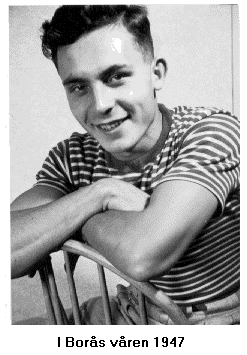
The boat seemed quite small for 11 people: (5 in the Aatolainen family, 4 in the Kuuttanen family, me, and the fisherman) given the rather long journey in open sea. The fisherman assured, however, that it would be fine and pointed to a couple of extra planks he had added to the boat's planking. When everyone was on board, the fisherman cast off, and we were on our way to the unknown Sweden. There was a kerosene engine in the boat, but to avoid attracting the coast guard's attention, we got away from the coast under sail. It was blowing quite briskly, and it didn't take long before we were a good distance off the Finnish coast. Only a faint diminishing glow astern still showed where Raumo and Finland lay. Finland, which I would not visit for the following 10 years. After a couple of hours of sailing, the fisherman started the engine; now we were far enough from the Finnish coast that the engine noise would not be heard there. It was blowing fresh, the waves were quite high, and we didn't feel particularly well. Maija Aatolainen and Nina Kuuttanen lay under the tarpaulin amidships, while Niko and I had to sit farthest out in the bow and receive cascades of foam when the wave broke under the boat. I only had an old worn military raincoat on me, and it resembled more a Swiss cheese, an Emmental with big holes; it had almost more holes than fabric. Every time the wave broke under the bow and the foam flew up, we got a cold shower. It felt unpleasant, but who would one complain to? The boat was quite small and very cramped. The girls lay under the tarpaulin and felt ill, not only from the sea sickness but more from the fumes from the kerosene engine that collected down there. Afterwards in Sweden, they refused for several years to even sit in a rowboat on Lake Öresjön in Borås.
By and large, the crossing went without major incidents. A couple of times we saw some smaller vessels in the distance, but since it was blowing hard and the waves were high, they could not see us. The boat and sail were gray, and in the December weather there is a half-twilight even during the day, especially if the weather is cloudy and gray. We sailed all day and most of the night; the crossing took quite exactly a day. Between Raumo and Söderhamn, the Gulf of Bothnia is at its widest, about 180 km as the crow flies.
After having sailed in semi-darkness, we now began to approach the Swedish coast, and a glow of light lit up the sky in the west. "Siellä on Ruotsi," (there is Sweden), said the fisherman.
The problem arose when we were to land. We were anxious that the landing should not take place on some uninhabited island from where we, during this season, would have difficulty getting to the mainland, while the fisherman, for his part, was afraid of running aground and did not want to go too far into the archipelago.
We touched bottom – three times. The archipelago off Söderhamn is quite shallow – and there were great difficulties in finding the mainland shore without running aground. The first two times we could get the boat loose fairly easily, but the third caused a lot of trouble. We were near land and had run aground firmly; no matter how we rocked and pushed with oars and boat hook, the boat was stuck – with the bow high up. The flatfish had dug in, and it seemed as if we could not get free by our own strength. We would make one last attempt, said the fisherman. If that didn't help, the two youngest male members (he looked at Niko and me) would have to undress, go down into the water, and try to lift the stern so that we could get free. We took out the oars and boat hook, gathered in the bow as far as possible, rocked and pushed with the oars to get the boat loose. After a few attempts, it finally slid off the bottom, but quite a bit of water had come into the boat; the extra nailed-on freeboards were not watertight.
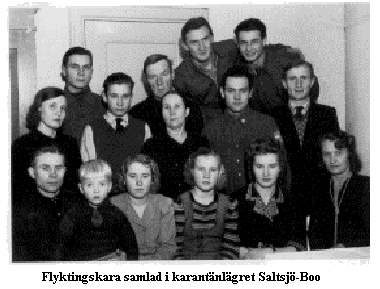
Now the fisherman no longer wanted to be involved, so he dropped us off on what in the dark seemed to be the mainland. The lights from the nearby city shone strongly against the clouds, and we had some visibility. As soon as we had left the boat, the fisherman headed back out to sea, and we began to think about how to make our way to the settlement.
When the morning of December 4, 1946 dawned, we found ourselves in the yard of a summer cottage. We had made an open fire in the middle of the yard; the summer cottage owner had plenty of firewood, and we had now managed to get warm and dry our clothes. The warmth was also contributed to by parts of the cognac, of which we had consumed a few drops, both during the night and after the landing in the morning. When we finally came ashore, we were swaying both from the unfamiliarity with the sea and from the alcohol. Peter Aatolainen with his brother-in-law and daughter Lilian, who spoke German, set off for 'civilization' to find some police authority, and it took four to five hours before they returned accompanied by a policeman and a fisherman in a boat. The fisherman had the same difficulties in landing as his Finnish colleague.
We boarded a somewhat larger, cabin-cruiser and did not feel as cramped as had been the case with the Finnish boat. We set off and after a relatively short trip we were in Söderhamn, where we were taken care of by Lottas and Red Cross nurses in a school below the Central Station and were fed. We stayed in Söderhamn for a few days, the police conducted a preliminary interrogation, we saw ourselves as the subject of a report in the Söderhamn newspaper, and after a couple of days we set off for Stockholm on an afternoon train.
A clipping from Söderhamns-Posten on December 4, 1946.
"Seven dead-tired and soaked refugees were found in Orsavik.
All the refugees who on Tuesday night landed with a small fishing boat at Sandö udde in the Normala archipelago have now been found. They are ten persons in total, both older and younger. As is known, three of the refugees were found around 10 o'clock on Tuesday morning after they had wandered about since their arrival at 12 o'clock on Tuesday night. The remaining seven got lost in the rugged terrain, and not until dusk yesterday afternoon did they manage to find them. It was district policeman Bertil Rehnström and district police officer F. Isberg who traced the refugees. They had made camp on Kroksandshällen outside Orsvik and built a fire around which they sat huddled to warm their soaked bodies.
A large force of policemen had then been active for many hours searching for the missing. A woman among the three first found could make herself understood in German, and district policeman Rehnström thus managed to obtain the information needed to direct the search in the right direction. The fisherman Bertil Wåglund took the policemen with him in his fishing boat, whereupon they set out to search for the missing by sea. Just as they were about to give up hope, they saw smoke rising from Kroksanshällen, and despite great difficulty in landing the boat there, Mr. Wåglund managed to get ashore. Only a few hundred meters from land they also found the missing, a total of seven people, who, dead-tired and soaked, had settled down around a fire. They were all in poor condition, which is not surprising, given that they had both a difficult 24-hour crossing and almost a day of wandering in the forest behind them. The policemen now took care of the poor refugees, who were given as good care as was at all possible. The refugees also recovered fairly quickly and were taken to Stugsund, from where they today are forwarded to the collection center in Stockholm.
During the journey it began to get dark, and we were greatly amazed at the amount of light, both in the form of outdoor lighting and neon signs, that flowed towards us from the cities and towns we passed. We knew nothing about Advent celebrations; I cannot remember if it was practiced much in Finland, in any case it was not possible during the war's blackout years or (even less so) in the bachelor barracks. We had indeed experienced an extremely 'dark' time during the war, with a shortage of almost everything – even light. It all seemed in some way very unreal and above all unfamiliar. I had never seen so much light in my entire life up to that point.
During the years we lived in Far Karelia, there was hardly any other light after nightfall than that which came from the open fireplace; when darkness fell, it became pitch dark. The village of Verkhovje, where we lived during the exile to Far Karelia, had no electricity laid on. I have read school homework by the light of an open fireplace (lezhanka) and therefore have little romantic feeling left for that kind of lighting.
Upon arrival in Stockholm, we were taken care of by Red Cross personnel, some of them also refugees, mostly Balts and Poles. Those who, like me, had outgrown their clothes received 'new' ones, admittedly somewhat used and in many cases somewhat too large garments. The ulster coat I got would easily have fit another person of my size. Upon arrival in Sweden, I weighed 72 kg with my clothes on.
Many of the Balts had already been assimilated by the Swedish bureaucracy, established themselves, and now served in the camp leadership. Several Estonians told us during our stay in the camp that the majority of Estonians and Latvians had moved on westward – mainly to America and Canada. They did not have much trust in the Undén government – the extradition of the Balts in January 1946 was a trauma for both Balts and Swedes – that is why Sweden in the 1990s has such a bad conscience regarding Estonia. This is all the more sad as later research has shown that the extradition was completely unjustified; the Russians had not at all requested any extradition, but the pro-Soviet Social Democratic government had jumped ahead in its devout worship of socialism.
From the recently released documents, it clearly appears that the Russians had possibly promised a trade agreement, but this was in no way linked to any extradition – and yet the Swedish Social Democrats rushed ahead and in practice sentenced 150 people to death. Later research has shown that very few of these forcibly extradited survived captivity. There may have been one or two among them who had voluntarily joined the Germans, but most were forcibly recruited into the Wehrmacht. The Germans, unlike the Russians, were extremely popular, and it was not a great difficulty to choose sides. During the Germans' time in the Baltics, there was no flight of population to other countries. From Karelia, several Estonian and Latvian families even traveled to Finland and from there further to the Baltics to return to their home regions after the Russians' forced deportations. The Baltics have old ties with Germany, and the Germans treated the Balts well; most Balts felt great sympathy for the Germans, who had liberated them from the communist yoke. The Russians constantly talk about 'liberation' when the Baltics are mentioned, but for most Estonians, Latvians, and Lithuanians, it was more an occupation than a liberation, and the struggle over the Russian 'Bronze Soldier' in Tallinn appears to most Balts as a justified act. That soldier did not represent liberation.
The Swedes' fawning over the communists, on the other hand, has been quite noticeable and has been the cause of much bitterness among those who defended Finland in word and deed. Filip Rytterås, a Swedish volunteer in the war, writes in the book 'Frivillig soldat':
"How many Swedes do you think appreciate what we did? Not the authorities, not the major newspapers, not the conformists, not the full and half Bolsheviks, who shouted insults at you when you walked on Stockholm's streets in Finnish uniform during your last leave. Do you think they think about such things as you have talked about? Do freedom, loyalty, honor and reputation exist for them? Fatherland? Do you remember how the men of 1918 were persecuted at their workplaces, those who voluntarily participated in Finland's War of Independence?"
That the Germans dealt harshly with Jews and communists is another story.
Furthermore, it is not only the Balts who are negatively disposed towards Jews and communists. The Jews are largely to blame themselves; their actions have all too often been reprehensible – and still are. The Jews have learned nothing from history. Now they treat Palestinians in an unworthy manner, and punishment will surely come to the Israeli-Jewish people in due time, when history catches up with them. As long as they want to be 'God's chosen people' and do not want to assimilate in the countries where they live, they will always be subject to a certain aversion. However, one is not allowed to say such things in 'sniveling social' Sweden; here only one opinion is allowed at a time, and today it is: The Jews suffered during the Holocaust. That masses of Slavs, Gypsies, and others also lost their lives is not talked about.
The Jews hunt old 90-year-old men who have had something to do with concentration camps, but the Simon Wiesenthal institutes in London and Vienna do not answer my letters with the question of why Israel does not convict the murderers of Folke Bernadotte. (SVT - documentary 1996-05-09, 20.00). Doctor Salomon Schulman in Lund said he knew nothing about Israel Eldad and Yehoshua Zetler murdering a Swede, and a professor of Eastern European Studies at Uppsala University, Christian Gerner, hung up when I asked him the same question.
Why the Russians hate the Jews is clearly documented in a doctoral dissertation: “The Rulers of Russia” by Rev. Denis Fahey, C.S.Sp., D.V.D.Phil. R.A. Regina Publication, Carendish Row, Dublin. From the dissertation, it appears that of the approximately 545 persons who ruled in Russia between the years 1917-1923, 447 (83%) were Jews or of Jewish descent. The Jews' ruling ability was inversely proportional to the population; they constituted only 1% of the total population in Russia.
One might possibly view the dissertation with some doubt, since it was written by a Catholic priest, but even with a certain discount taken into account, it is a frightening read.
History has also caught up with the Undén brothers in Sweden. Both Torsten and Östen have done considerable damage to Sweden's good reputation both in the Baltics and abroad. Torsten Undén was the last in the 1920s, as minister, to recognize the independence of the Baltic states, Östen Undén was the only one (apart from Nazi Germany) to recognize the Balts' "voluntary" incorporation into the Soviet Union in 1945 and hand over the Estonian state's gold reserve to the Soviet Union. Now it is the Swedish taxpayers who have to "scrape together" to repay the debt in the form of compensation. As recently as 1990, the Swedish foreign minister Sven Anderson claimed the "voluntariness" in a TV interview. However, he did not appear to be completely sober, so the statement can probably be attributed to a "drunk account." Now during perestroika and glasnost it was embarrassing for Sweden to have to handle Baltic issues via Moscow, while other countries could negotiate directly with Estonia, Latvia and Lithuania.
The Social Democrats, however, continue with their sympathies for the communist idea. A few years ago, a brochure about the Holocaust was published: "This we must talk about." In connection with the publication, the "patent democrat Patron Persson" and the socialists promised that a similar brochure and discussion material would be published regarding the misdeeds of the communists, but we are still waiting for it – and we do not have any great hopes that there will really be any deeper discussion and analysis of the "Gulag" camps or forced labor in general.
Life in the refugee camp Kymmelnäs was roughly like living in the bachelor barracks at Martinmäki in Rauma, the difference being that we got food without paying or presenting any coupons, and that the accommodation for the bachelors was in a common barracks without cubicles. The beds (50 of them) stood in long rows along the walls, and in the barracks there was everything from Jews to Poles. We could wander around freely and get to know the new country. The northern boat route to Stockholm passes by Kymmelnäs, and we had a good view of the ships passing on their way to and from Stockholm. On the cliff outside the camp we spent several hours a day just watching.
There wasn't much else to do, possibly take an occasional walk and try to talk to the other refugees at the camp. Russian was not popular and the Poles did not want to talk to us, so only Finns and the occasional Estonian remained. There was also the occasional German-speaking Jew, but I didn't know enough German and the "conversation" didn't last very long.
The refugee camp in Kymmelnäs consisted of a number of residential barracks, an administration building, a dining hall, and an old brewhouse converted into a washroom and sauna. Where there are Finns or Balts, there is almost invariably also a sauna in one form or another. The Kymmelnäs camp had a good sauna; it suited Finns and Estonians well, less well for Southern Europeans. Estonians and Ingrian Finns are as avid sauna bathers as any Finn; in Estonian it is almost the same - "saun" - but the Finns have managed to take over the advertising angle, and the rest of the world associates "sauna" as something originally entirely Finnish. That is by no means the case. The "sauna belt" is to some extent the same as part of the "vodka belt". It stretches from Scandinavia a bit down into the continent and continues through the northern part of Russia and across all of Siberia.
In the converted brewhouse we washed in the mornings and took sauna on Saturday afternoons together with people from different parts of Europe. The Southerners did not bathe as eagerly as Northerners and Balts, and never together with us after the bath they experienced when Peter Aatolainen, Nikolai Kuuttanen, Niko, I, and a number of Ingrian Finns and Estonians treated them to one Saturday afternoon.
The Southerners - Poles, Hungarians, and Jews - did not want it too hot in the sauna and complained about the Estonians and Ingrian Finns, who in turn thought it was much too cold. One Saturday, when the Ingrian Finns with Peter Aatolainen in charge were tending the sauna stove, the oven was heated up properly. It was sauna time and we sat up on the benches (and froze, according to some). A discussion arose again between Northerners and Southern Europeans regarding a suitable sauna temperature. The language of discussion was mostly Russian or broken German, but now Peter Aatolainen said to me and Niko in Finnish:
- Niko! Take a bucket of water and stand next to the sauna stove, and Albert! You stand by the exit door and open it in case someone doesn't like the heat and wants to get out quickly. Then Niko throws water properly and Albert opens the door so that those who won't enjoy it here can get out, and the rest of us can have a properly hot bath in peace and quiet instead of this lukewarm existence. Now I'm tired of just sitting here waiting for the heat to come sometime. There will be a change now. Get going!!!
We did as we were told, and a couple of seconds after Niko had thrown the water, there was, to say the least, a lively movement on the benches, as the majority of the bathers rushed towards the exit door with terrible screams. I yanked open the door, but there were so many who wanted to get out at once that it was close to not only the door but also the frame being torn away in the resulting crush.
The Southerners filed complaints with the camp administration; we were called in to the camp commander and received a reprimand, but it was worth it, said Papa Aatolainen afterwards. After that, no one disturbed us in the sauna and we were left in peace from chattering Southern Europeans.
Our duties included performing some routine daily chores, washing dishes and cleaning. The camp was partially self-sufficient and had two pigs that lived on leftovers from the camp kitchen. Based on the general mood towards the large neighboring country, the pigs had been aptly named "Molotov" and "Vorosjilov". They became Christmas food, and Nina's father Kuuttanen took care of the slaughter and preparations to preserve the meat.
The spaces were quite limited, but it was not considered a major problem, even though about 50 bachelors slept in a single barracks, like a monastery, in a dormitory without partitions. We were always looking forward to getting out to work. For my part, the camp stay lasted a little over a month; already in February I was in Olofström at Svenska Stålpressnings AB.
It was entirely different conditions for refugees than what is the case now. Those who came to Sweden right after the war were "real" refugees. Crime was almost an unknown phenomenon; a real refugee at that time had no thought of crime after having managed to get away from the Soviet "kingdom of happiness". Now it was a matter of pitching in and trying to create a new life in freedom. A life where parents' political or other dissenting opinions did not matter.
The authorities' attitude was also stricter and "human". They did not tolerate too great deviations. In the regulation appendix that we received with the "Alien's Passport", it was clearly stated (in several languages) that offenses against the country's laws could lead to expulsion. Even serving alcoholic beverages could be a reason for deportation back somewhere. Most also managed very well in Sweden, became capable citizens in the new state and were almost completely assimilated into Swedish society.
Today's crime among so-called "refugees" is nothing but great laxity and spinelessness on the part of the Swedish authorities. In some sort of humanitarian spirit, they let criminals take more and more liberties. Now the threat of deportation due to crime only applies after the delinquent has committed an offense punishable by at least one year's imprisonment. Ridiculous and extremely costly for the Swedish taxpayers. The latest gimmick is that serious criminals are allowed to stay in the country if they have managed to have children here.
I still work quite a lot as an interpreter and hear a lot of oddities that could not have taken place without proper consequences in "the good old days".
Recordings
- 1946StockholmA.mp3
- 1946StockholmB.mp3
- 1946StockholmC.mp3
- 1946StockholmE.mp3