Olofström 1947
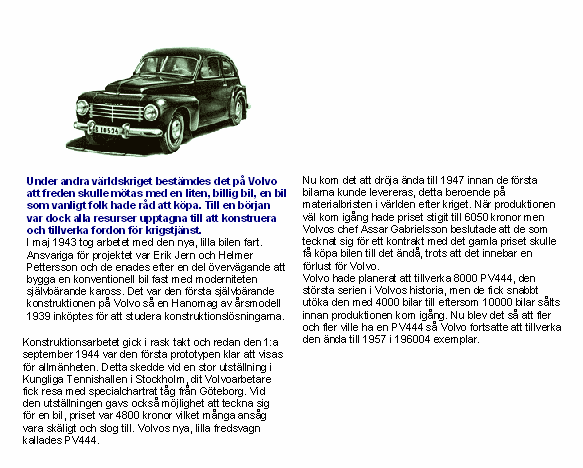
After a couple of months’ stay at the refugee camp in Kymmelnäs, it was time to enter working life and I was sent by the employment office in Stockholm out to my new job. The journey went to Olofström in Blekinge, to Svensk Stålpressning, where they had recently started manufacturing Volvo passenger cars and my work consisted of knocking out, grinding and smoothing any irregularities on the rear left mudguard of the Volvo passenger car model 1946.
The work was piecework but since I was still considered a minor, they deducted almost 30% with the result that the earnings became quite meager and I experienced that I again had very little money (while the range of goods seemed enormous in comparison with what I had received
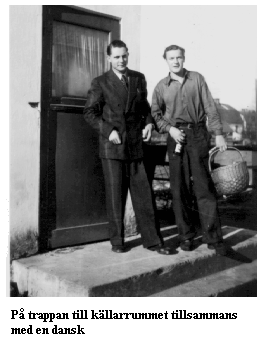
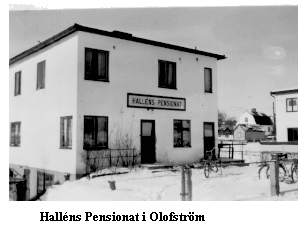
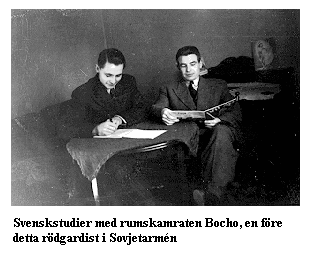
Bachelors and refugees who worked at Svenska Stålpressning lived at Halléns Pensionat, about one km from the workplace. A bachelor’s – and especially a refugee’s lot in a foreign country – is to always get the worst, leftover accommodations, most often a basement room or an attic. In this case I lived in the basement room together with an Estonian man – Tseno. In the attic, sharing the room with mice, a Russian named Bocko. Admittedly he claimed to be Polish, but his knowledge of Polish was no greater than my knowledge of Chinese and a Russian speaker cannot be fooled. He was likely a deserted Soviet officer, on the run like the rest of us. Otherwise, Brcko was an extremely educated and well-read man, we had some discussions about Russian literature and conditions in Russia. That he had served in the Soviet Army was beyond doubt. He could tell a lot about the army and had some pornographic “alphabet” verses in his head. Some of the stanzas I had heard earlier, but Bocko knew the entire alphabet.
At the pensionat there lived mostly bachelors, refugees like Bocko, Tseno and me. We received food and lodging for 29 SKR per week, for the remaining 7 kronor we were to obtain the other necessities of life. No nightlife existed for us, if indeed any such thing existed at all in Olofström, I never had time to investigate. My interest in the opposite sex had somehow not yet awakened. Bocko, who was about ten years older, was instead very interested in a maid at the pensionat, and he shared that interest with some of the other, older bachelors. The maid was (according to gossip) in turn interested in all men and that sometimes led to certain complications in social life and to interruptions in the daily (not to say nightly) existence.
One Sunday morning our attention was aroused by violent screams from the yard and when we looked out we saw two men beating each other. One of the brawlers had managed to pull his opponent’s blue blouse over his head, locked his arms in the blue blouse and while he held the blouse, the opponent was with his head and arms as in a sack and could do nothing to defend himself, the other spun his victim round and round, while constantly kicking the victim’s backside with his wooden clog. It was the Russian and the Dane who were fighting. The one wearing the blue blouse was the Dane and a rival for the maid’s favor. The Russian and the Dane had apparently arrived simultaneously at the beauty’s boudoir and disagreed over who had first dibs on her. Now the Dane was locked in his blue blouse, he screamed like a pig and it was only after the landlady (a strong and tart woman) went out and with a resolute grip on the brawlers put an end to the fight and it became quiet again. The beautiful sybarite of a maid was said to have had a whole album of photographs of her love victims, and the condition for access to her favor was that the suitor in question had a photograph with him. I had no photograph so I cannot verify the claim, besides I still had the Tammerfors incident in mind and this “common good” did not seem attractive.
The Dane was otherwise the second person (apart from the Finnish sailor I met at Martinmäki camp in Finland) who had no more possessions than what he stood up in. Now he was from Denmark and perhaps had all his belongings there. It was however a good distance from the pensionat to the Svenska Stålpressning foundry and the weather brought a lot of snow and cold that winter, but he ran to work in only blue blouse, blue trousers and wooden clogs. In the foundry he didn’t need other clothes, it was warm enough in what he stood up in.
In Olofström I felt that my situation had deteriorated catastrophically and for a while I considered despite everything returning to Finland, where I still had a fairly good income compared to my current salary. I just didn’t know how to carry out the retreat, I thought to wait a few more months, perhaps in the summer.
I was constantly in correspondence with Lilian Aatolainen in Borås, hers and Kuuttanen’s families had found work there, and when she learned of my situation in Olofström, she wrote that there was plenty of work in Borås, I could start at Algots sewing factory where their whole family worked, and that they had an apartment with 3 rooms and kitchen. I was welcome there, and for the first while I could lodge with them. Their whole family had found work at the sewing factory and they earned “considerably” more than I – a whole 45 – 50 kronor per week. I immediately took out my wages and traveled to Borås, now all the money had gone to the ticket and I received not only housing but also food at Aatolainens during the first weeks at my new place of stay.
VOLVO PV 144
Recordings
- 1947Olofström.mp3