Katrineberg – 49
A fool is a person who is in love,
But only a fool is truly happy
Katrinebergsvistelsena were pleasant, there were many young people there and we foreigners were well received, in fact I never heard anyone say "bloody foreigner" or the like about us and learning the new language went at a good pace. We socialized a bit here and there, but nothing serious. During the breaks between lessons it was like in all schools, the students chattered and joked with each other, worried about the upcoming exams and longed for spring, when the sun began to shine in full force and we could stay out in the school's large garden, sit on the veranda and sunbathe. During one of the breaks in the spring of 1949 I got to know a female student in the second year. She was named Ann-Marie Christiansson and was a quiet girl who didn't make much fuss. The acquaintance with her was perhaps mostly because she shared a room with Ulla Pettersson – a very outgoing girl, talkative and demanding attention – sometimes to excess. The writing of verses in poetry books was still flourishing and when she asked me to write in her poetry book, after a long deliberation, much effort and with somewhat lame rhyme, I could compose:
"You have one fault, it is your only one. With your charm you want to dazzle everyone."
Ulla apparently did not appreciate it much, I later learned from Ann-Marie. Could it be because the rhyme was so bad?
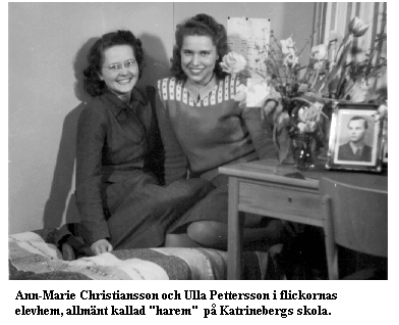
Just to tease Ulla Pettersson, who was interested in all the boys, I took her more quiet and calm roommate Ann-Marie on my lap out in the school assembly hall. Just like that, only for fun. It wasn't meant seriously from the start; Ann-Marie was not one to make a fuss or put on airs. If anyone had asked me a few weeks earlier who she was, I could hardly have answered. She and Ulla were in the second year and we didn't meet them very often, especially since Ann-Marie always went home to Falkenberg during the weekends. We mostly knew those who stayed at the school and attended the Saturday dances in the gymnasium.
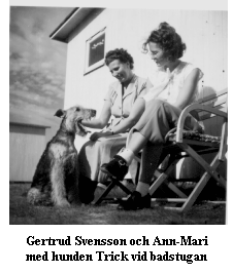
Now that I knew who she was, we spoke with each other now and then, a certain fondness arose, but nothing more came of it in the immediate time. I thought she was nice, had a good figure, beautiful hands, always very proper and with a calm and level-headed demeanor. She was also somewhat older than the other female students, that perhaps added to her charm. We got along well and began to go out. Dancing, walks, bicycle rides and everything that goes with youthful companionship. Ann-Marie was not among the most talkative, so sometimes quite long pauses could occur during our walks, but at the same time there was something that could be called "tacit communication". Our acquaintance developed quickly. Ann-Marie lived in Falkenberg and normally never stayed overnight at the school's boarding house. One Sunday afternoon Sulo Korpelainen came in to me and said that Ann-Marie Christiansson had returned from Falkenberg on the earlier train; we would have dancing even on Sunday evening. From then on there was no question of her traveling to Falkenberg on weekends and we met a lot both at the common Saturday and Sunday evenings in the gymnasium as well as during breaks and free time. During the remaining term she did not make many trips home on weekends and Gertrud Svensson, her friend with whom she stayed in Falkenberg, probably wondered what was going on. It also happened sometimes that I sneaked into her and Ulla Pettersson's room at the students' home, but Miss Hessling, teacher of German and English and the chief supervisor of the girls' morals in the students' home, kept a watchful eye on us and no major transgressions were possible to commit there.
Ann-Marie as company was rather taciturn, but she appealed to me very much. We took long evening walks and eventually I accompanied her to Falkenberg where I met her friend Gertrud Svensson. Gertrud was very well disposed towards me and sometimes even provided me with travel money – it cost 8 kronor round trip Vessigebro-Falkenberg on the narrow-gauge railway between Limmared-Falkenberg.
Now when I look back on that time, it seems as though we had already then found "our melody". Some people think that couples are not getting along if they are not constantly talking to each other, but that is certainly not the case; it works quite well to be silent together as well. After a number of years together, one does not need so many words – one knows each other's world of thought and one partner only needs a faint hint and the other knows where the train of thought is.
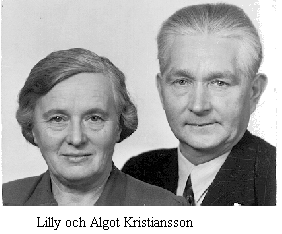
Then came the school closing ceremony and for the occasion the train Falkenberg-Limmared also stopped at Vessigebro, right in front of the folk high school, and all parents came to see their offspring at the school's closing ceremony – so also Ann-Marie's parents Lilly and Algot. They probably wondered why their daughter was so seldom at home in town during the weekends. Both looked very suspiciously at me when Ann-Marie introduced us – a foreigner, what good could that be? Uneducated and without either profession or home. It was evident that they were not too pleased. One can very well understand them as parents.
The parents said nothing however, and later I was, despite my supposed shortcomings as a companion for their daughter, very well received at both Möllegatan 12 in Falkenberg (where the parents lived) and at Ann-Marie's friend Gertrud Svensson's at Holgersgatan 16. Gertrud owned the finest flower shop in town, known for her tasteful bouquets and coffin decorations.
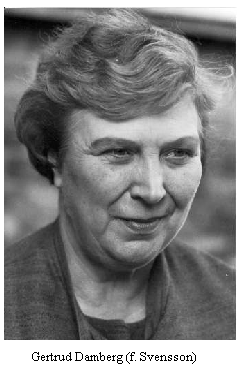
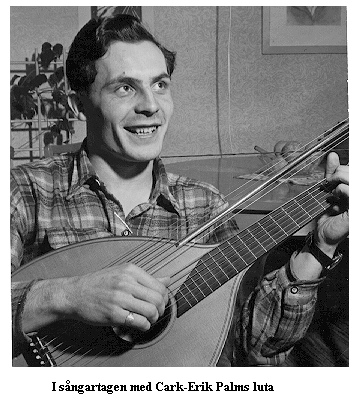
In Gertrud I always had a very strong defender against any suspicions of impropriety. She made sure I always had a ten-kronor note for the train ticket; I had no money of my own. Cylle Palm occasionally provided me with a film roll so I could take photos. In the autumn of 1947, at Johanssons Foto at Stortorget in Borås, I had traded my Kodak 6 x 9 bellows camera for a Voigtländer Brillant 6 x 6 reflex camera at a cost of 306 kronor (an enormous sum at that time). Then I took quite a lot of pictures at the folk high school, pictures that I could later copy at Cylle and Kerstin's and sell to fellow students, the more well-off farm boys and girls. In that way I managed to recoup most of the camera outlay. Cylle and Kerstin also had to supply a good deal of photo paper. Sometimes I also got to borrow Cylle's Rolleiflex with its accompanying flash unit, the kind that press photographers often used, and then one felt like a king in the realm of photography. During the summer I often cycled to Falkenberg. Sometimes Ann-Marie would come to meet me halfway, but for the most part this "halfway" for her extended no further than Tröinge hill – a couple of kilometers from Falkenberg, while I had to cycle a whole Swedish mile to the meeting place.
It took a long time before anything else happened; Ann-Marie held her ground for over half a year. The attitude towards more intimate togetherness was somewhat different in those days and girls were not as liberated as they seem to be today. Ann-Marie had a rather old-fashioned attitude, but it didn't disturb our relationship very much. When I didn't sleep at "the aunts" in Vessigebro, it often happened that I got to stay overnight at Gertrud's on the red sofa in the living room, while Ann-Marie slept in a maid's room, where visits were not entirely permitted. Ann-Marie used to come in quite early in the morning and also lie down on the sofa – but in all decency.
In the summer I stayed at Cylle-Foto in Vessigebro and we had ample opportunities for socializing with Ann-Marie's family. Gertrud Damberg (she was called Svensson at that time) had a bathing hut next to Strandbaden on Skrea Beach and there we spent Saturdays and Sundays. Eventually she bought a summer cottage and it further added to the comfort. Gertrud herself rarely had time to be at the beach; she had to run her flower shop, but now and then she arrived there by bicycle to "check the situation" and then we had coffee with buns and cookies. Actually, I did not particularly enjoy the beach and the sand. Just lying in the sun and occasionally taking a dip in the sea was too slow for me, but somehow I still put up with it and became more and more involved with both Gertrud's and Ann-Marie's family. In the autumn, Ann-Marie was to go to the cartographers' school in Gothenburg and I was to start my second year at Katrineberg Folk High School. Ann-Marie lived with her sister Sonja and her husband Bertil Sandqvist while I boarded at the school now that I was in the second year. We didn't meet very often, but now and then I went to Gothenburg or Ann-Marie came to Falkenberg.
Sometime at the end of October 1949, I went to Gothenburg. I was there early one morning and met her outside her residence. She seemed a bit upset, and after a while of talking it came out that she hadn’t had her period for a while and was probably “in the family way”, i.e., pregnant. It wasn’t really a big surprise, considering how often we had met; eventually it became more than just kisses and caresses, something significant had to happen sooner or later – she became my “prime amourette” – I had hardly looked at anyone else before. The problem was that neither of us had work or education. It was certainly a complication, but we just had to make the best of the situation – we became engaged on November 5, 1949, and exchanged rings (50 kronor each). Shortly after, we decided to have a wedding and went to the pastor’s office in Falkenberg to apply for the banns.
Here certain complications arose. I had no papers concerning my past conduct apart from my soldier’s pass, and the priest asked a number of questions about my marital status. That was easy to account for. I was barely 18 years old when I arrived in Sweden and had been here a little more than 3 years now – the priest decided to believe me and issued the banns during the first week of Advent. When the Christmas celebration was over, the festivities continued and the wedding took place in St. Laurentii Church in Falkenberg. Gertrud Damberg arranged most of that; she liked parties and organizing the wedding feast suited her perfectly. The wedding was, quite symbolically, on the day of the Holy Innocents, December 29, 1949. We composed our features, went to Almqvist’s Photo Studio to immortalize the celebratory event, and at around 2 in the afternoon we stood in front of St. Laurentii Church in Falkenberg, and I still remember the church caretaker asking me where I had the ring.
— Put it in the waistcoat pocket, then you’ll always know where to keep it, he said, and don’t walk too fast, otherwise you’ll have to stand at the altar for a long time before the music ends!
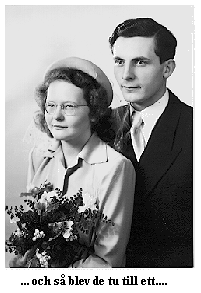
When the organ thundered into the wedding march, I had forgotten all wise advice and admonitions and set off at my usual marching pace. Ann-Marie had some difficulty keeping up with the rush to the altar, and if we didn’t set a record for the processional to the altar, we surely have an honorable top placement. We had to stand there for a good while before the organist finished playing the bridal march from Mendelssohn’s Midsummer Night’s Dream and we could kneel at the altar rail. Despite the looming difficulties ahead, it was a loud and clear “yes” that we both answered in turn – and so the two had become not just one but three. In the near future we could hope. At the following wedding dinner, only Ann-Marie’s closest relatives were present, along with a few of my classmates from Katrineberg. The dinner was lavish, Gertrud liked proper dinners and our wedding dinner was truly superb, with schnapps and several kinds of wine. We were tired after all the day’s events and naturally there was no traditional wedding night.
Ann-Marie was tired; I myself was perhaps too drunk with an excess of both food and drink. There was never any lack of “festivity” when Gertrud was involved, and Ann-Marie and I had experienced many pleasant gatherings at her place even before we were engaged.
When school ended in the spring of 1950, I started working as a farmhand at Björnhults Manor. The work consisted of thinning beets, and I must have crawled for several miles on my knees in the seemingly endless rows of beets. The statare system had indeed ended in 1945, but as unskilled labor I didn’t earn many kronor per hour, and making a living became a problem. Now I had not only myself to think of but also Ann-Marie and, a few months later, a child.
Borås, with its textile factories, tempted with somewhat better pay, and I took work at Kilsund’s Dress Fabric Factory, first as a weaver and later as an inspector. Now that I had Ann-Marie and Tomas—the boy was named after many name suggestions—life in Borås felt somewhat unsatisfactory. Ätranverken in Falkenberg advertised for a clerk in the invoicing and correspondence department, and I expressed my interest in the position, was accepted, and sat for half a year on an uncomfortable office chair writing out invoices and business letters. During my time at Katrineberg, I had trained hard at typing, and I had also taken a 70-hour course in Swedish business correspondence, and now these skills came in handy. The work was rather monotonous, and after half a year I grew tired of it.
My interest in photography persisted, and when I saw an advertisement that a photo company down in Skåne was looking for a copyist, I applied for the job. It was a combined photo and paper goods shop in Skurup, and one could rightly say it was a leap from the frying pan into the fire.
I initially moved to Skurup alone. There was an apartment to live in, but the kitchen was missing, and Ann-Mari would have to stay in Falkenberg until the housing situation was sorted. About the move to Skurup, I only remember that the stretch from Malmö Central Station to the Malmö-Ystad train was memorable. I had only two suitcases and a backpack, but the suitcases were packed to the brim and very heavy. The distance between the two trains was not particularly long, but my arms felt it. The Malmö-Ystad railway was operated by a chug-chug train with a steam locomotive, where the carriages were an old model with wooden benches—like on the Borås-Varberg railway.
“He who marries for love has wonderful nights but difficult days,” that became a truth for us to ponder.