Falkenberg 1950
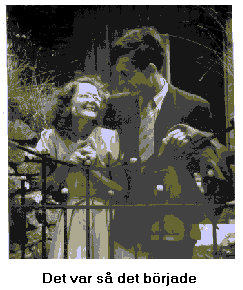
The Katrineberg stay came to an end. I had completed two 23-week courses, and Ann-Marie was expecting a child. Now I needed to find some work and support the family. For an unskilled person, there were not many options—most of what was available was manual labor. In the spring of 1950, I started working as a farmhand at Björnhults manor in Stafsinge, near Falkenberg. The work consisted mostly of thinning beets. I did that with a few others for a couple of months, but it was very monotonous work and didn't pay much either. True, we were living with Gertrud and didn't have high household expenses, but still, this couldn't go on in the long run. I realized that after a short time. Somewhat later we moved away from Gertrud and lived "almost" on our own at Vikingagatan 5 in Falkenberg. It wasn't entirely our own—we had to share the kitchen with a couple of young people, which naturally wasn't entirely satisfactory. The young people were fine; we got along well in their house, but two housewives in the same kitchen doesn't work for any extended period. I couldn't find any "better" work in Falkenberg, and on July 21, 1950, I moved to Borås, where I started working at Kilsunds dress fabric factory. Ann-Marie moved with Tomas to her parents at Möllegatan 12 in Falkenberg. A temporary solution for a short time, we thought.
At Kilsunds I started first as a weaver and after a time switched to fabric inspector. The weaving room was of the really old kind—about 300 looms in a single hall (24 per man to manage) and with a noise that was, to say the least, deafening. Today such a workplace would be shut down by the safety engineer, but in the early 1950s, demands on working conditions were not so great and no one spoke of the concept of "decibels", even though we surely had close to 100 decibels, if not more, in the weaving room. Most people hardly knew what the word meant. To signal that the weft thread (the filling) was running out, a lamp lit next to the loom, and since it was dress fabrics with many colors, there were many and frequent spool changes. When the warp thread broke, the loom stopped and the same lamp lit again. If the humidity wasn't right (over 90% RH), it became very arduous, often several looms stood still at the same time and the weaver didn't have a free second. Then it was crucial to tie the warp threads together quickly as a flash, otherwise the earnings would be poor—the work was piecework and it was important to keep the machines running. Because of the noise, it was impossible to speak in a normal voice—only if you screamed directly into your conversation partner's ear could there be a certain exchange of meaning, if not of thought, to the extent that you had time to talk at all. The 24 looms kept the weaver busy the entire shift, and there were never any longer breaks during the work.
After a few weeks, I moved to the inspection department. Why, I don't recall, probably I had resigned because of that noise, and instead of letting me go, the factory offered another job. Nothing was known about hearing protection, but I had an instinctive feeling that this was not good for me.
In the inspection department there were mostly older ladies, former weavers and spinners, and I got along well with them. Everyone wanted to give me good advice, and now it felt as if I had several mothers, without having had anyone previously to look after me.
The work consisted of inspecting the fabrics and marking any possible defects, both in the pattern and in the warp splices. There should be no long threads, twists, pattern errors, or similar flaws in the product. Apparently, I had quite a good aptitude for the work—there were no complaints about my work, and the piecework wage made the pay decent. The "search" for defects later helped me, during military exercises, usually win when it came to reconnaissance. I had an easy time spotting irregularities in the terrain.
It was, however, quite far to Falkenberg, and I longed for Ann-Marie and Tomas, so I wondered if I shouldn't find some work down in Halland, so that I could be closer to them.
During this period I again lived with Mrs. Ida Holmqwist at Norrby Långgata 27, in the same room that I had previously shared with Robert Felszegi in the spring of 1947 when I moved from Olofström to Borås and started working at Algots Syfabrik. "Say Algots, that's enough!" was the slogan from the advertisements in Borås newspaper. During its heyday, Algots rented quite a few rooms in Borås to house its workers. At that time I paid 9 kronor a week to Mrs. Holmqwist for the room.
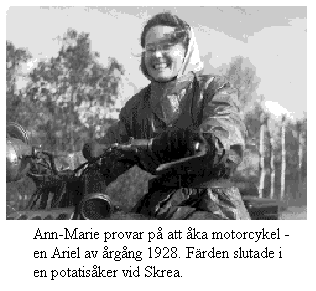
Helfrid's husband and Ida's son-in-law Uno Lindberg had an old 500 cc Ariel motorcycle with a side-valve engine that I took over. The year before, I had gotten my driver's license in Falkenberg at Karlsson's combined driving school and taxi business in Vessigebro, and I could now make the trip Borås-Falkenberg on my own. It was a very old Ariel, the same age as myself (1928), and the compression wasn't much. It consumed a little over one liter per mile, and since the tank only held 8 liters, there were certain difficulties with fuel. Nor did it have much speed—it took over two hours from Borås (128 km) to Falkenberg. In the 1950s, gas stations were not too frequent. To be sure of reaching Falkenberg, I usually carried a couple of liters of extra gasoline in a couple of bottles in the pockets of my Lotta coat. One time the motorcycle was stolen and was found after a couple of days in Varberg—I used to park it in the courtyard at Holgersgatan 16, and when I was about to go back to Borås, the bike was gone. It was found in Varberg, and I could continue my trips.
As careful as Ann-Marie was, she still wanted, in some kind of recklessness, to try riding the motorcycle. Of course she didn't have a license, so the practice would take place out in the countryside, somewhere toward Skrea. She sat at the handlebars, we started the motorcycle, and I sat on the pillion, with a quiet hope that it would go well. On the straightaway it was no problem, but when we came to a curve and needed to lean the bike, Ann-Marie didn't want to lean the same way. She was no lightweight and apparently had not sat on the pillion before; she had no practice in leaning into curves. Now she thought the motorcycle was leaning dangerously and tried to correct the balance, with the result that we soon found ourselves in a potato field. The motorcycle was no speed demon, and the potato field was soft, so we weren't hurt, but the farmer must have wondered if someone had tried to steal potatoes from his field. Since then, she hasn't been interested in motorcycle rides.
The motorcycling continued for a whole year, but living by myself in Borås became rather dreary, and I started looking for a job in Falkenberg.
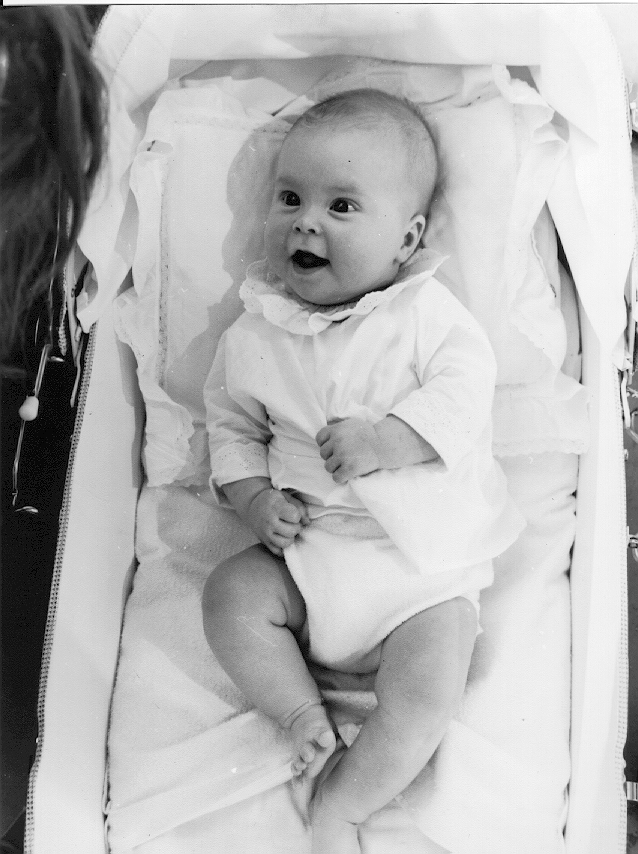
At Pentecost 1951, we were to celebrate in Gothenburg with Ann-Marie's siblings Sonja and Ruth. Tomas, who had been suffering from colds, became seriously ill during the visit. He was sensitive in his throat, and it didn't get any better by our traveling to the West Coast. Over the weekend he had trouble breathing, and we didn't know what to do with him.
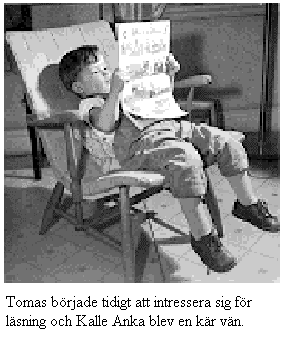
A visit to a privately practicing pediatrician was no help. The doctor was a society quack and apparently knew nothing about childhood diseases, as would later become clear. Streptomycin had just come out, and he said we could buy it—"if we thought so." Several relatives were to gather in Gothenburg; among others, Mother Lilly and Ann-Marie's friend Gertrud were coming up from Falkenberg, and that turned out to be Tomas's salvation. The ladies held a consultation, and Mother Lilly had great experience with children; they realized that something was not right—even if they couldn't define it directly. Gertrud called Sahlgrenska Hospital and asked to speak with a knowledgeable pediatrician. She was lucky and got the right person. After describing the symptoms, she was told to come up with the child immediately. The disease was likely croup, and the situation was serious.
"You cannot handle this yourselves," said the doctor, "if the condition worsens, you won't make it to the hospital in time before it's too late."
It was Saturday evening and there was quite a bit of traffic; everyone was a bit agitated, and Ann-Marie said that Gertrud, who a few months earlier had gotten a car, a Hillman, had driven very fast and broken several traffic rules—driving against one-way traffic, making improper overtakes, etc. By this time it was almost 11 PM.
Sonja worked at Sahlgrenska; she went to the children's ward in the morning and learned that already that same night (around 2 AM) they had had to operate on Tomas and insert a cannula in his throat. His airways had become so swollen that he was suffocating. When Ann-Marie and I went to visit Tomas the following day, we were met by a sad sight. He was breathing through the cannula, and when he cried, nothing was heard. You only saw the tears flowing without any other sound coming from him except the gurgling from the cannula tube. Ann-Marie was allowed to assist with suctioning the mucus, and I was supposed to be nearby as well, but that didn't go so well. I had no real task; I started to feel sick and had to sit on a chair at first. That didn't help—my nausea only increased, and I had to leave the room entirely so as not to be in the way of the other activities and cause more work for the staff, who already had enough to do.
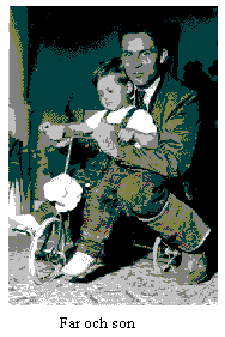
The croup would continue to cause us great worry, mostly for Ann-Marie since she was the one who was home and took care of Tomas. Every time it became windy, cold, and damp, the troubles returned and continued for many years. Only around the age of 10 did the troubles diminish, and we could sleep fairly peacefully at night. Otherwise, all the children have good health; none have had to be hospitalized for any serious illnesses.
Ann-Marie later told about her feelings during the time Tomas was in the hospital. It took two weeks before he could come out, and Ann-Marie had plenty of time to pass the time with walks in Slottsparken.
"I walked around looking at all the mothers who were there with their children and thought all the time about Tomas. Would we be able to keep him or not? Now it ended happily, thanks to Sahlgrenska's skilled and experienced pediatricians. The private-practice society doctors fell quite far down on the value scale."
During my time at Katrinebergs, I had practiced typing (touch typing) and now I wanted to try a real "white-collar job." (Become a white-collar proletarian, as the personnel manager Mrs. Hörstadius (that old bat!) at Borås Wäfveri put it somewhat condescendingly when I told her I planned to start at the folk high school in Vessigebro). I had completed a 70-hour course in business correspondence and typing, had a decent command of Swedish, and felt it was time to try something other than manual labor.
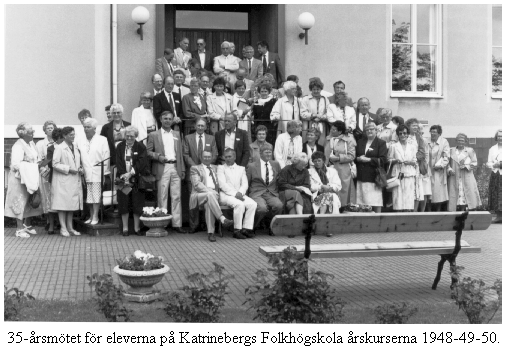
At the beginning of 1951, I started as an office clerk at AB Ätranverken, a metal factory in Falkenberg whose main business was manufacturing bicycle saddles and lawn water sprinklers. It went quite well for half a year, but the work soon became very monotonous; it consisted mostly of typing business letters, invoices, and dunning letters. Cars had not yet displaced all bicycles, and bicycle saddles were a big item. There weren't many competitors left in the country. The office manager, Mr. Thörn, was a rather dull person (and that wasn't just my opinion), he didn't brighten anyone's life, and the atmosphere in the office was not particularly bright; it was very boring and dreary. The foreman was an immigrant German - Hans Harms - a very skilled craftsman - from him we received a hammered bread plate as a wedding present. There was also a very pleasant female colleague in accounting, so it went fairly well anyway. The worst part was, as usual, the pay.
My interest in photography persisted, and when I saw an ad that a photo company in Skåne was looking for a copyist, I applied, got the position, and jumped out of the frying pan into the fire. On July 25, 1951, I was to start as a photo copyist at a paper and photo shop in Skurup, Skåne. I packed my bags with some books, clothes, and other necessities, said goodbye to Ann-Mari, took the train to Malmö and from there onward to Skurup. The Malmö - Ystad line was still not electrified, and I remember a locomotive standing there puffing as it waited for the train to depart. The distance from Central Station to the Ystad line station was not particularly long, but the bags were very heavy; I had to stop several times to rest on the way to the train to Ystad.
Recordings
- 1950-51FalkenbergA.mp3
- 1950-51FalkenbergB.mp3