Skurup 1951
Imoved to my new job as a photocopist in Skurup on August 1, 1951 and got an apartment in the attic of the owner's house at Kyrkogårdsgatan 46. The owner of the photo shop was a former non‑commissioned officer in the Skånska Dragoner. After the "regimental death" around 1925 he was discharged from the army and had since had various jobs before he married the daughter of a well‑to‑do shoemaker (who had several shops around Skåne). The current captain, Östen Lindelöw, was an exceptionally cocky upstart and we did not get along particularly well. On several points our opinions diverged and because he was a captain, he all too often liked to imply that he knew best how the military should work. True, I was considerably younger than him, had served three years in the Finnish army and advanced to corporal after three years of service (all great men have started as corporals: Napoleon, Hitler and the Finnish president Svinhufwud). Thus I had, if not great, then at least some experience of a "real" war. The village of Sheltozero was in the war zone and we had to listen to the rumble of cannon from the Svir front a few dozen miles away. Also a whole year in Petrozavodsk filled with Finnish soldiers, civil‑military personnel and Russian prisoners of war, but that he did not think worth mentioning. Now he was the home guard chief for the area and as a Swede he naturally knew everything best.
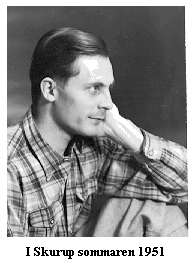
He suffered from a certain military mania, which sometimes took odd forms and at the same time ruined the reputation of real soldiers. In the house he owned (or perhaps it was his wife who owned it) on Kyrkogårdsgatan in Skurup, the inner walls on the lower floor had been torn down to make the apartment look like an officers' mess. The room resembled a barracks with some military insignia on the walls. Once Ann‑Mari and I were invited for coffee and there we drank alcohol from the smallest glasses I had ever seen. I first thought they were glasses from a toy cupboard. You could barely taste the alcohol; it ran down into a cavity in my tooth and had no effect.
When the Korean War began, Lindelöw came to the shop wearing a captain's uniform and boots. I just couldn't help saying:
- Oh, so Mr. Lindelöw is going off to war.
- No! What the hell would I do there?
- Surely Mr. Lindelöw can't stand in the stationery shop selling toilet paper and pencils wearing a smart uniform, I replied, and the captain muttered something inaudible, hardly military.
In the apartment where I lived, quite a few details were missing; among other things, there was no skylight in the kitchen so that Ann‑Marie could move there. The carpenter Nilsson had a lot of work and probably thought a single window was not that important. He had much trouble with his two children; they suffered from brittle bones and were rarely well at the same time; one of the children was always in a cast.
I lived alone in Skurup for more than half a year. It was dreary. In a town the size of Skurup there is not much to do after working hours. Money was also scarce, as usual, and I essentially ate only one meal a day, but at a very good boarding house. One did not live in Skåne for nothing. It was a real Skåne eatery with exceptionally good food, always several courses and with that several different desserts, but since it was usually only one meal a day, I felt a bit empty in the stomach in the mornings. I was improving my English and plowed through all of Somerseth Maugham's books; both those about the South Seas and those about England. I also did a lot of wood carving, among other things a lamp base and a bread bowl that are still in use. After the apartment became livable for the family in the spring of 1952, Ann‑Marie and Tomas also moved there; it became much nicer from a family perspective, but we still suffered from financial worries.
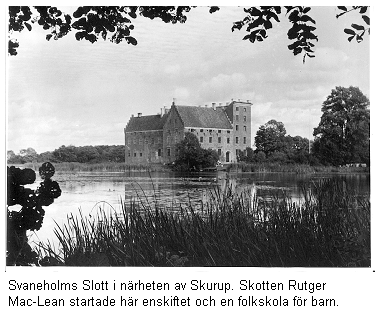
When the family had moved to Skurup and spring came, we made some excursions in the area, among others to Svaneholm Castle, an historic four‑winged Renaissance castle in brick built three storeys high at the beginning of the 1500s. According to the encyclopedia, the main wing was raised to five storeys at the end of the 1600s and has many interior stucco ceilings from the Renaissance and Baroque. At certain times the castle had been inhabited by far‑sighted and culturally interested people. The Scot Rutger Maclean was from 1782 owner of Svaneholm Castle and estate and carried out land reforms here that gave rise to the enclosure reform in Sweden. The castle was fairly well preserved and had been a kind of educational centre for the surrounding countryside. Up in the attic there had been a school for children of workers on the castle, long before the general compulsory schooling from 1842 came into effect. Some small desks were still standing there in a room under the sloping roof.
When Ann‑Marie finally moved down to Skurup we became acquainted through Tomas with a Mrs. Nilsson, an elderly lady who lived in the next stairwell. She was single and we socialised a great deal with her, also by correspondence as long as she lived.
We lived on the third floor overlooking Kyrkogatan and had our own balcony. One early spring day Ann‑Marie was going to wash the balcony window and went out with the wash basin and cloth. The door opened inward and Tomas was quick to close it. He was at an age when everything had to literally be pushed forward. All our books were pushed far back into the bookshelf and now he took the opportunity to push the door. It locked behind her and there stood Ann‑Marie without outer clothing and could do nothing. Tomas paced inside the room and at regular intervals came and looked at her. He was too small to understand what he had done and Ann‑Marie began to get cold. Fortunately the balcony faced Kyrkogatan; a neighbour across the street saw her predicament and came to help. He knew what the house looked like and could enter through another entrance. The rooms were in a row and had earlier been rented out, but now we shared the large apartment with Lindelöw's children; they lived in a couple of the rooms and the door was usually locked from their side. As it happened, the entrance door to their part of the apartment was unlocked and the neighbour could go into our rooms through a door in the children's room. In the future Ann‑Mari made sure the door could not lock behind her when Tomas was nearby.
Östen Lindelöw was an exceptionally unpleasant character and it was not only my opinion. Many mentioned him as a man with very strong Nazi sympathies (his father was of German descent) and several people claimed that he probably would not have stopped the Germans from landing on that stretch of the Skåne coast where he was called up as commander during the war, but would have stood on the beach showing where it was best to land. His father had been a music sergeant major and also lived in Skurup, but the grandchildren through the shoemaker's daughter were not considered fine enough to be allowed in the grandparents' house further down Kyrkogatan. On the other hand, it was fine for other grandchildren whose mother was married to a Dane. It was Mrs. Lindelöw who ran both the shop and the business. Lindelöw himself was a "fine" gentleman; he mostly handled the photo studio.
Series portraits were very popular in the 1950s; you could get everything from 4 to 46 pictures on a single plate and my main task (besides amateur photo copying) was to copy these series pictures. On one occasion, after we had exchanged opinions (and mine was naturally strongly divergent from his), I was to copy a number of series pictures.
- They're too damn light, said Lindelöw when the pictures were dry, this won't do! He made new copies himself and I didn't think the difference was anything to speak of. When the new pictures were dry I asked him to come in and pick out "his" copies. I had marked my copies and after drying I lined up all the portraits:
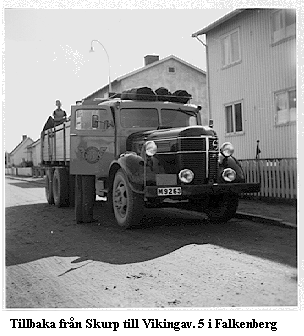
- Here you go, Mr. Lindelöw, choose, but choose right, I said to him. He had the misfortune to consider my copies as the best. Now the boiled pork was fried, this did not improve the relationship between us and after 3/4 year my career as a professional copyist was over, we moved back to Falkenberg. Skurup has not left any overly bright memories from the workplace, but in the future I had no difficulties whatsoever understanding Scanian, so some benefit there was with the stay "south of the road" after all.
From every situation there are opportunities to gain something useful for the future.
On one occasion he wanted to assert that I married a Swedish woman in order not to be deported from the country. Now, I did not belong to the Brodersapsbataljonen and the Baltic expulsion was a past stage, but Lindelöw's military cock‑brain could naturally not accommodate any thought that one could marry for love. He himself married a woman whose father owned several shoe stores in Skåne and naturally believed that everyone else was equally calculating.
Recordings
- 1951Skurup.mp3
- 1951SkurupA.mp3