Borås
During the time while I worked in Falkenberg blasting and digging wells with Ann-Marie's uncle Sten Kristiansson, I became acquainted with a younger printer at Hallands Nyheter – a certain Uno Svensson. He was an enterprising young man, interested in photography and owner of several cameras and a Monark motorcycle. He had recently been out at a public dance and seen that the new electronic flash units were being used to photograph people at dance halls. According to him, it seemed like a good idea. He said most people agreed to be photographed, provide their names and addresses, and (according to reports) almost always redeemed the photos, which were sent cash on delivery. Uno suggested that I help him with this. He was an avid amateur photographer and already owned a Super Color flash unit (a great novelty at the time), well suited for such an activity. I owned a Kodak 35mm camera, we joined forces and started the venture by going to Åkulla Folk Park in Halland.
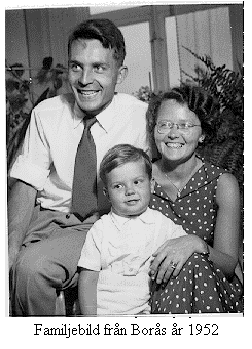
The photography went well. In the following weeks we had a lot to do driving around to the dance halls in Halland. On Sundays we developed, printed, and wrote out payment slips for cash on delivery. Money poured in steadily, and soon we felt almost rich. After a few months of regular work with Sten Kristiansson and extra work with flash photography, Uno and I realised that the market in Halland was not enough for two people, and I moved back to Borås.
The room at Norrby Långgatan 27 was vacant and I was able to move in. Mrs Holmqvist thought it would be nice to have me there; now she suffered even more from immobility and I would help with the usual chores – fetching firewood, taking out the slop bucket, etc. The business in Falkenberg had gone reasonably well, but since I was the "second man" my earnings were not that great after all. Now I intended to make a go of it on my own, but I did not have enough money to purchase a flash unit. The flash units were a brand new invention and cost a lot. I had a few hundred kronor and with that I went to Larsson's Photo on Östra Långgatan. I had known the manager there for a long time, a man named Larsson; he was a good fellow, and I for my part was a frequent customer in the shop. Larsson agreed to sell me a flash unit on an installment plan. I did not yet have a job, but I gave Stål's construction firm as a reference – that was not entirely true, but there was plenty of work available and no one doubted my statement. The price for the flash unit was 1064 kronor including a charger. It was a device powered by a 6-volt lead-acid battery, and when fully charged the flashes lasted the whole evening. The weight was about 3.5 kg, which at that time was not considered particularly heavy. I started photographing in the folk parks around Borås at first, and gradually extended my activities throughout all of Västergötland.
The business went well; I earned a good deal of money, but the work did not entirely fill my time and the future prospects for continuing the business were not certain either, so I decided to look for regular work as well. Since Ann-Marie and Tomas lived in Falkenberg, I could manage the photography in my spare time, on Saturdays and Sundays.
The darkroom was a bit of a problem; I had to set up in Ida Holmqvist's rented room, where there was a washbasin for rinsing pictures. I had bought myself an Opemus II enlarger with interchangeable lenses, and previously I had a Kodak Retina II camera with a viewfinder. I had no drying apparatus; the pictures were dried on a spread-out sheet, and since rinsing them in the small basin in the room was quite cumbersome, they left stains. Ann-Marie has scolded me several times for that, and a few years ago she dyed those sheets the same colour as the stains from the developer – a faint brown – and now, 40 years later, they have finally come into use after lying in the linen cupboard all those years. It was good fabric; I had woven it myself at Borås Wäfveri. The fabrics have their own story. When we got married, I bought all our sheets, towels and other textiles from the company store. They were sturdy sheets, unbleached and strong. Some of the sheets lasted almost thirty years. As a bachelor I had bought a few metres of fine cotton fabric for handkerchiefs; I did not get around to using them before Tomas was born, and then Ann-Marie used my fine handkerchief cloth as diapers for him.
In Borås I had an acquaintance, an Ingrian Finn from the time on the peat bog in Länghem; he worked at Borås Mejeri and through his recommendation I also got work there. On 7 July 1952 I took up my position at the milk filling line. At that time this dairy was one of the most modern in the country and processed slightly over 200,000 kg of milk per day. The main task (at first) was loading milk bottles into wooden crates for distribution to consumers. There were two men standing at the end of the filling machine filling a 16-bottle crate as bottles came from the filling machine. There were two filling lines, and every third half-hour we had to sit as checkers at the bottle washer behind the filling machine and make sure no old caps, dirt or anything else unsuitable passed with or in the bottle to the filling point.
There were quite a few foreigners working at the dairy, and for the most part the cooperation between Swedes and foreigners worked without controversy; I can recall only a few exceptions.
One of my former colleagues from Borås Wäfveri, where he still worked during his regular hours, used to come to the dairy on Sundays to earn some extra money. I remember him from my time as a spinner at Borås Wäfveri – a very combative man at union meetings, strongly left-wing communist in discussions with management, which resulted in management taking care of him, neutralising him, and making him a time-and-motion study man. He had a notorious reputation that women were not safe around him, and now as a time-and-motion study man he had certain leverage – in case the ladies were unreceptive to his charm. Many rumours went around about his doings in the spinning and weaving rooms, and how some spinners and weavers got good piece rates and others did not. Most were dissatisfied with him and often said he was unfair, favouring some and being hostile to others. His womanising, however, had the consequence that his wife did not want to go along with it, and it led to divorce. He probably earned a little more as a time-and-motion study man than as a weaver, but child support and the urge to go on a real bender now and then led to a certain shortage of funds.
To improve his finances he worked extra on Sundays, and very often there were lively discussions in the lunch and changing room. He naturally did not like foreigners, mostly because we disturbed his communist propaganda, and he was especially annoyed with me. I did not mince words; I knew what reality looked like, while he had only propaganda and theories in his head. By then I could speak Swedish quite well and was quick to retort, which led to increased aggression. The arguments went along much the same lines as they still do to some extent. We had substantial discussions, and I was not slow to explain the real state of affairs. After a lively discussion during a meal break, when I had finished my lunch and was just about to go out to the filling machines, he said:
- Damned foreigners! (A common address from some left-wing fluffers at that time, before 'svartskalle', 'chokladtomte' and 'blatte' became the terms later.) Are you going to come here and take the bread out of the mouths of us honest Swedes?
For once I came up with a good retort:
- That's rich coming from you! First you give poor piece rates at the weaving mill to the women who won't sleep with you, and take the bread out of the workers' mouths – just like the other communists have always done – and then you come here and try to do the same to us. People like you don't belong here, and you should stick with your current pals – the factory management at the weaving mill, with Mrs Hörstadius at the head of the personnel department!
There was general merriment among the others having lunch, and the man turned red in the face. He grabbed a stool and threw it at me where I stood by the door, but I managed to slip out and the stool hit the door with a bang. I opened the door again and added another volley:
- Typical communist behaviour! When arguments run out, you try to kill the opponent.
It got really cheerful in the lunchroom; even more bursts of laughter echoed and the workmates teased him thoroughly. He disappeared from the dairy and no one missed him. His reputation as a worker was not particularly high either; most people did not want to load milk bottles on the same team as him – he was not very popular, often quite lazy and sluggish in his work. In many cases this was because he had been partying the day before.
After I had worked a few months at the milk filling, I was transferred to the distribution of consumer milk. Together with a driver we drove around to the shops and delivered the number of crates and 25- or 50-litre cans that the shop owners had ordered. In the early 1950s milk was still sold in bulk, and many came with their small milk cans to the shop. That was easier than carrying bottles home. The work started very early in the morning, and it was important to get to bed in time, which was not always easy. Often my eyes felt very gritty, especially when I had accompanied Niko Aatolainen and his sister Maija to Borås Folkets Park until closing time. Then there would not be many hours of sleep, and the shift felt long. I wore out several pairs of shoe soles to Leif Kronlund's orchestra
The advantage of the job was that it was fairly free, we had long, pleasant afternoons and could go into town or go on bicycle and swimming trips. There was a steady group of Ingrian Finns and some Russians, and we stuck together as much as possible. We often swam in Kypered Lake. In the winters, Helge Johnson, my former roommate and workmate, would also join us when we had a sauna and took a dip in the ice hole.
Now I was again living with Mrs Ida Holmqvist. She had weathered the worst financial storms after her husband's suicide and only rented out rooms to acquaintances. She was getting old and felt that being a landlady brought little profit and much trouble. She had some foot problems, and I helped her by fetching coal and sawdust from the cellar for her stoves, as well as taking out the ashes and the slop bucket. We got along very well, and I was mostly invited to Sunday dinner at her house, together with her daughter Helfrid and son-in-law Uno Lindberg, who lived in the apartment upstairs.
Helfrid cooked the food, and Ida was supposed to put on the potatoes when Helfrid banged on the floor. Sometimes it was the other way around. Uno Lindberg had sailed before the mast and liked to have a schnapps with dinner, while Ida had been a temperance advocate all her life. Her husband had been a building contractor, gone bankrupt, taken to drink, and committed suicide, leaving her alone with all the children – 5 girls – and a house mortgaged up to the chimney. Ida had, however, managed to pay off the debts and now owned the house at Norrby Långgata 27, where we lived. Out of consideration for Uno's drinking habits, she had made a slight concession to her temperance ideology and usually kept a bottle of brännvin in the house. The bottle was stored high up in a cupboard; Uno had to climb up and fetch the bottle each time, and it had to be put back in the cupboard as soon as the drinks were taken. The house was old, and the ceiling was nearly 4 meters high.
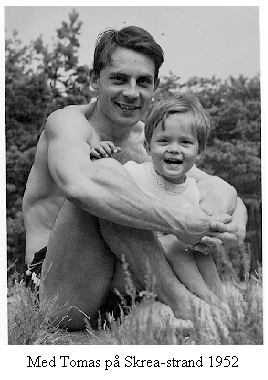
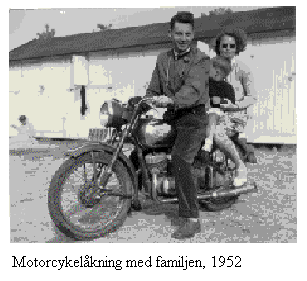
Ann-Marie and Tomas were still living in Falkenberg, and on weekends when I was off, I went there. From Uno Lindberg I had inherited a 1928 Ariel motorcycle, 500 cc, and with that I traveled to the west coast. The motorcycle was a side-valve and so worn in the cylinders that the 8-liter fuel tank wasn't enough to cover the distance between Borås and Falkenberg, a stretch of 128 km. Gas stations weren't as frequent as they are today, so I had to carry an extra couple of liters of gasoline in a couple of milk bottles, which I kept in the outer pockets of my winter coat. On the way to Falkenberg I also usually had quite a bit of whipped cream, and since the motorcycle had no luggage rack, I had to carry all that in both inner and outer pockets.
One rainy day I skidded on Allégatan and crashed on the cobblestones, smashing the cream bottles, and it looked as if my brains were spilled out, but it wasn't quite that bad. Most of the time it went well, but one morning when I was about to leave Falkenberg, Holgersgatan 16, where Ann-Marie and Tomas lived, the motorcycle was no longer in the yard. I had to take the train, and later that afternoon the police informed me that the motorcycle had been found in Varberg.
Uno Svensson in Falkenberg had earned good money from his photography, and when he upgraded, I bought his 150 cc Monark. After that I no longer needed to carry a gasoline reserve in milk bottles.
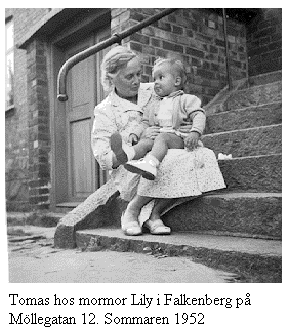
In the spring of 1953, Ann-Marie saw an ad saying that the Borås City Planning Office needed a map drawer. She replied to the ad and got the job, left Tomas with mother Lilly in Falkenberg, and came to Borås. Now we had to share the room in that narrow tourist bed, which was also quite saggy, and in which you couldn't sleep comfortably even when you were alone. We did manage to share the bed fairly well, but sometimes it got too warm because we couldn't lie apart; we really lay close together on the bed base.
We couldn't live like this for long, so I started looking for a place to live. The housing shortage was severe, and I didn't have very high hopes of getting an apartment so that we could bring Tomas to us and ease mother Lilly's worries about him.
He was doing well at his grandmother's – too well. When we had been there over the weekend and were about to leave, he would often burst out with barely concealed delight:
– Now I'll be alone with Grandma in the kitchen!
At the housing office, the director (a small, plump, rosy-cheeked man) couldn't promise very much; possibly there might be some apartments in a new building, but it seemed like rather vague promises. Since we anyway drove along Allégatan every day on our distribution route, where the housing office was located, I would drop in to see the little, somewhat stout director a couple of times a week. Most of the time during that period the answer was:
– No, no apartment is available yet.
After a couple of months I increased the frequency of my visits; toward the end of summer I was almost daily in to see him, and one day it paid off.
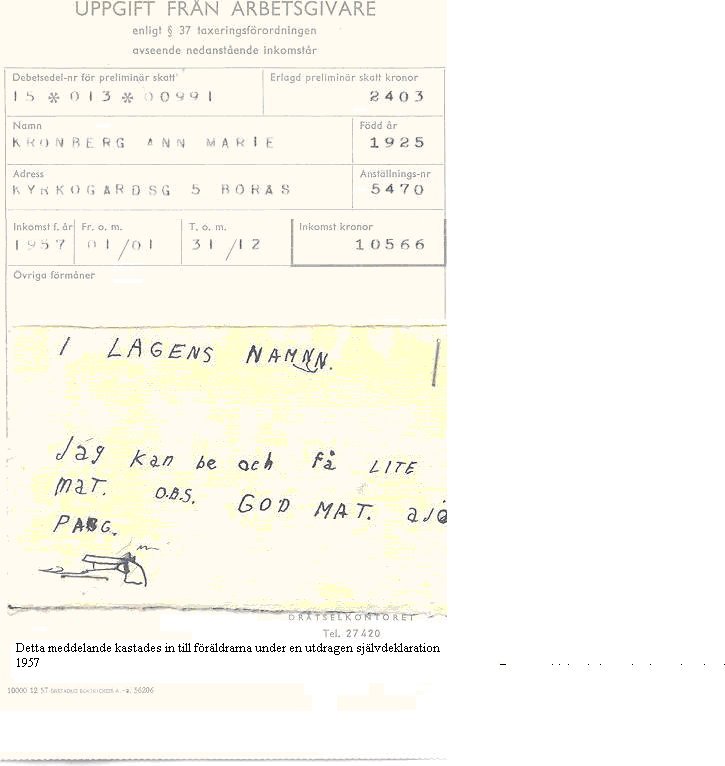
– There is a one-room apartment with kitchen; it's a cooperative, and the down payment is 800 kronor. The address is Kyrkogårdsgatan 5 in the Göta district, opposite the cemetery. It will be ready for occupancy on October 1.
There was nothing wrong with the work at the dairy, but now that Ann-Marie had both a job and a place to live, it was time for me to resume my studies, which I had always had in mind. It was of course a shame to have to leave again for another three years; there was no telecommunications line at the high school in Borås. Ann-Marie and Tomas were provided for, and it was best to get back to my studies. I had scouted Köping as a suitable town, and on August 30, 1953, I set off there on my newly acquired Monark motorcycle. I had made fairly good money from photography and traded in the old Ariel for a more modern bike. In a picture from this event, I see Jali Ahola and his brother were there to say goodbye. Jali would eventually move back to Finland, and for his brother it was just a short interlude of a few months.
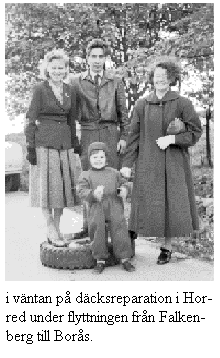
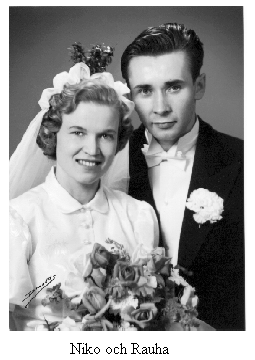
I began my engineering studies in telecommunications at the Köping Technical Institute under Principal Lilliehöök on 1 September 1953. After only three weeks, I had to return to Borås to help Ann-Marie with moving our few pieces of furniture from Falkenberg to Borås, where the new apartment was to be occupied. The Aatolainen family had established themselves in the textile business and ran a small sewing firm – as well as a larger panel van. Niko offered to help with the move; our few belongings would surely fit in the van. I had traveled directly down to Falkenberg, and on Saturday morning Niko and his fiancée Rauha arrived with the van. During the afternoon we loaded everything we had, had dinner, and were to start the move to Borås on Sunday morning. The van was a pre-war American model and not in its best condition; we had quite a few troubles before we reached Borås. Already on the way out of Möllegatan in Falkenberg, where Ann-Marie's parents lived, we got a flat tire, and the spare tire had to be used. After the tire was changed, we continued to Horred, where the next incident with the tires occurred just outside the town. Now there was no spare tire left, and things looked worrying. It was Sunday, and all the shops were closed, but we managed to get help at the Horred gas station. The man working there had good experience repairing old tires, and he helped us. Both the spare tire and the tire that had the puncture were very worn and could not be fixed in the usual way; moreover, for European conditions they were of an odd size and not easy to obtain. But the station attendant knew a trick: he ground down another old tire and put it inside the regular tire, and we could continue for a while. Such repairs are only emergency measures and have certain consequences due to friction between the different layers. The next puncture occurred just after Kinna, and now it became critical. Sunday was well advanced, and I had to be in Köping on Monday morning. There was now no possibility of repair; Niko hitched a ride into Borås and returned with the family's car.
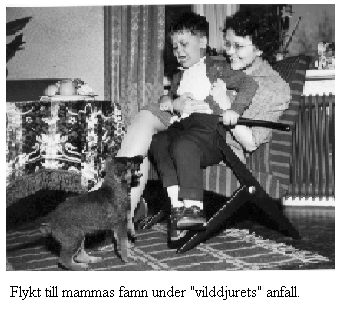
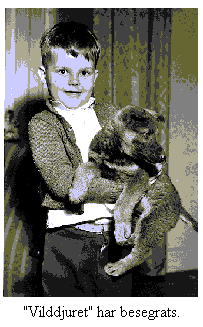
We stowed the most essential items in the car: Tomas's bed, a mattress, left the van on the roadside, and drove off. Niko was to pick up the van with the moving goods the next day. We barely made it to Borås, unloaded the things, in time for me to catch the night train at 10:50 p.m. to Köping. Ever since, that time has always stirred mixed feelings. The journey wasn't particularly comfortable, although there was usually quite a bit of space. We had to sleep on somewhat uncomfortable wooden benches, but on the other hand there weren't many people on the train, so it worked out fairly well anyway. We were visiting Niko Aatolainen, and suddenly their little puppy ran into the room. Tomas wasn't very used to animals and got very scared, rushing into his mother's arms for protection. After a few minutes, however, he became good friends with the puppy, and after that it was fine to play with him.
Tomas attended the Göta children's daycare, and the director there had good connections with the city's advertising agencies. They would often come to the daycare to get children to be photographed for clothing advertisements in the various garment companies' brochures. Borås in the 1950s was a significant textile city with many companies in the industry: linen, cotton, and wool weaving mills, as well as artificial silk.
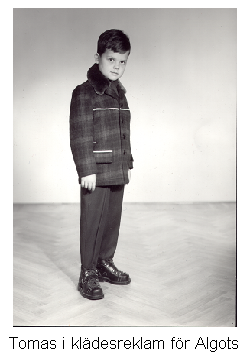
Tomas acted as a model several times, sometimes alone and sometimes together with other children from the daycare in Göta. Ostensibly (in the mornings) he would pretend he didn't want to be at daycare, but in reality he seemed to enjoy it quite a lot. He was quite an old head on young shoulders in his earliest years and usually got along well with older people.
Recordings
- 1952BoråsA.mp3
- 1952BoråsB.mp3
- 1952BoråsC.mp3