Köping 1953
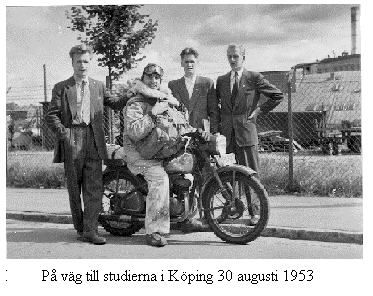
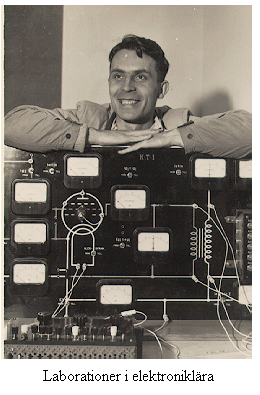
Now I was to study to become an engineer! I have always had an interest in electricity and already during my service in the Finnish army I managed to blow a number of fuses with my experiments. Even though I had known for a very long time what I wanted, the whole venture still seemed a bit uncertain regarding my livelihood, but relying on my good luck and a certain fatalism I believed I could manage it somehow. Ann-Marie had a beginner's salary at the Borås City Planning Office and besides had Tomas to support, so from her I could not expect any great financial help. I trusted that photography would provide enough for me to support myself, pay rent and term fees. Attending a private school always costs a bit more, but what was I to do? No secondary school with instruction in electrical theory and electronics existed in any other suitable place. I had to choose a location with certain specific conditions.
It should, first and foremost, be at a certain distance from the big cities, where the competition within my special photography field was too great for me; secondly, the place should not be too close to Borås, so that I would not be tempted to travel too often to Ann-Marie and Tomas. That would take up too much time; I was well aware that my school knowledge was somewhat lacking in certain areas and that it would be quite tough to manage both school and my livelihood. For these reasons, it became Köping in Västmanland.
The first term went fairly well on old knowledge, but I had some trouble with mathematics. My schooling had been very fragmented, and that now became apparent. It began in Kirovsk on the Kola Peninsula with my mother tongue Estonian in 1935, one academic year, and Russian as a second language; already the following year it became only Russian and nothing else. In 1940, my schooling continued in the village of Sheltozero, in Matveeva Selga, until the Finns conquered Far Karelia and all school-aged children of non-Russian origin were placed in the Finnish folk school. In 1948 came the Swedish folk high school – and yet another new language. Now I really had to work hard to keep up; getting ahead was out of the question. In the Soviet and Finnish schools I had been a fairly good student with good grades in most subjects. In the Russian school I was on a par with the other deportees from ethnic minorities; most of them were not particularly proficient in Russian. The student body in the Russian school in Kirovsk was very mixed; in many ways it resembled today's Swedish school, except regarding discipline and the teacher's authority. The number of students of non-Russian origin was striking, but the teachers were ethnic Russians and the teaching was nothing to complain about. Order in the schools was exceptionally good, and despite the somewhat authoritarian instruction, good progress was made in learning. I have always had good grades, at least from the Russian schools. In the 5th grade I was a top student, with "excellent" on the five-point scale; only arithmetic was a 3 – passing. Among those forcibly relocated there were many of non-Russian origin: Ukrainians, Belarusians, Tatars, and students of Asian origin. Many different languages were spoken during the breaks at school. The ethnic minorities stuck together, to some extent even beyond purely linguistic boundaries.
Estonians are a small fragment of a people; I had no more than a couple of purely Estonian schoolmates in the higher grades, and in Kirovsk I had to stick with the other "tjukhnas" – Finns and Ingrian Finns.
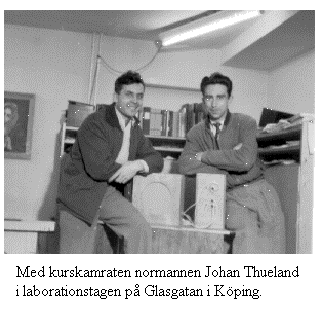
In Köping I rented a room from Mrs. Malmqvist at Esplanaden 5 together with the Norwegian Johan Thueland. He had been an officer, a second lieutenant in the Norwegian army, but had grown tired of it and wanted to study to become an engineer. Johan was very skilled not only in German but also in mathematics, and he helped me on several occasions when the problems began to pile up and time was short. With the other subjects I had no difficulties, at least not during the first academic year.
The house at Esplanaden 5 was a turn-of-the-century house, large and solid. The part of the basement that Mrs. Malmqvist had at her disposal turned out to have been prepared as an air-raid shelter, and I took it over at a modest cost to use as a darkroom; I was supposed to support myself by "flash photography" at the various dance venues around Västmanland. In the basement there were old packing crates and other junk (Mrs. Malmqvist was in her seventies and had lived in the house for quite some time). When I had cleared everything out, I had 80 square meters of floor space to move around in. The darkroom worked well; the only small window was easy to cover. Fortunately, the heating pipes from the boiler room ran through the shelter; in a couple of places there were even outlet stubs prepared, and I was quick to get a couple of radiators from the scrap heap and connect them into the heating system. The same went for the electricity. The fuse and meter cabinet was located just outside the shelter entrance, and it was not particularly difficult to tap into the mains. I had to work by the light of a flashlight, since there was no lighting in that part of the basement. After a substantial short circuit that blacked out the entire house, I was forced to hastily remove my temporary connections so that the service personnel from the Köping Electric Utility would not discover the tampering. I was not a major electricity consumer; there were only a couple of lamps, one above the table and the other a bit farther away above the darkroom equipment. The shade for the lamp above the table I also found on the scrap heap; it was a really nice, somewhat greenish "cobbler's shade"; unfortunately, I left it behind in Köping when the basement had to be emptied after finishing school.
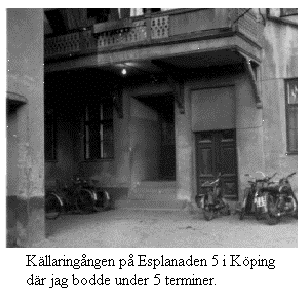
Now the darkroom worked really well; there was no water in the basement, to be sure, but the problem was solved by there being a demijohn in the basement, and I filled it with water as needed for developing and printing work. Now I could devote myself to my studies.
The first term went fairly well; the knowledge I had from the Russian and Finnish schools, as well as from the folk high school in Vessigebro, came in handy. As for my livelihood, the situation was naturally strained. Even though the rent was quite modest and the other expenses fairly small, the term fee was somewhat burdensome, and I had great difficulty keeping my finances balanced; my funds were beginning to run alarmingly low. During the following term I would have to undertake something radical, a rinse. During the holidays I would help with the laundry, but it was only once. After I had washed the clothes and all the garments had taken on the same somewhat fuzzy and indefinable color, Ann-Marie thought it best that she do the washing herself. It looks a bit odd and monotonous with all the clothes in the same color.
My basement in Köping worked really well, both as a dwelling and as a darkroom. There I could work whenever I wanted without disturbing anyone; quite often friends also came there when they had nowhere else to go. Down there it was truly disturbance-free in the fullest sense of the word. The retired principal who lived on the ground floor above was old, hard of hearing, and had no objection to my having the darkroom down there.
I was a bit anxious that my living situation would come to the attention of the social authorities, or to someone who would have objected to it. Those who lived in the houses around could hardly have failed to notice that they had an extra tenant in the basement. In affluent Sweden, one was not allowed to live just anywhere. However, nothing remarkable happened during the five terms, two and a half years, that my stay in the basement lasted, and I escaped becoming a case for social welfare. The people of Köping are, after all, quite decent.
either find a means of support or else quit school. The first year was, however, completed, and I could with dignity intact head off to the family in Borås for the summer holidays.
The academic year 54-55 was about to begin, and I returned to Köping to start the second year. During the summer I had done photography in the areas around Borås, but the earnings were not particularly large, and I was short of money for the second academic year. The holiday job at the Borås City Electric Utility did not yield much. After the term fee (400 kronor per term) and the rent for the third term had been paid, my study fund shrank alarmingly, and I was forced to start looking for how to support myself going forward. The idea was that I would do photography alongside my studies and thus obtain the necessary means for my livelihood, but now the "business" was not going as I had thought, and it began to look critical from a financial standpoint. The studies required serious effort, and I had to devote a great deal of time to them. Necessity, however, is the mother of invention, and providence sometimes lends a hand. "Audientes fortuna iuvat" (fortune favors the bold). In this case I can rightly claim that I was lucky. The darkroom became my salvation.
I went to Mrs. Malmqvist and told her plainly – that I did not have enough money to pay for the room, but if Mrs. Malmqvist had no objection, I would rent the darkroom basement and possibly live there.
- You have rented it as a darkroom, I don't know any more, replied Mrs. Malmqvist, and I don't want to know any more either, she added after a moment.
Now I gathered my few belongings and carried them down to the darkroom. Until then I had had no other "furniture" than a tabletop on two trestles, where I had the enlarger standing. Köping, however, seemed to have a good scrap yard and from there it was possible to get most things. Already the year before I had provided myself with heating elements and lighting, now followed a slightly better used table that I could use as a desk and something that with a little good will could be called a bed. In reality it was just a number of boards from a very large crate, it looked perhaps more like a coffin than a bed, but I had no rugs and did not want the blanket or bedding to fall onto the cement floor and nailed up a "freeboard" plank on each side.
With the toilet visits there was a small problem, but where there are problems, there are usually also solutions. I did not want to attract too much attention by running too often in and out through the cellar door, it became more of a sneaking. The problem resolved itself in a satisfactory manner. It turned out that in another stairway further to the left of my cellar entrance there was a toilet with a washbasin. Why the toilet was there I could not understand? The house was built at the beginning of the 1900s and there seemed to be no reason to have a toilet just there. It almost seemed as if the builders had anticipated that someone, many years later, would come to need it. With proper discipline regarding drink in the evening, it was easy to regulate the number of toilet visits.
Considering the limited opportunities to wash regularly, hygiene in the form of morning washing was perhaps sometimes neglected. I did not want to attract too much attention by running across the yard and into the toilet. I had a towel and soap in my school bag and washed in the school toilet before classes began. (The poet Nils Ferlin is said to have had his hygiene items scattered in various pubs in Klara). There was no great danger to hygiene overall, I was one of the most frequent visitors to Köping's Bathhouse - usually three times per week - so there was no great risk of becoming encrusted with dirt. The clothes were washed during visits to Ann-Marie. In the new HSB building in Borås, where she got an apartment, there was a laundry room with a washing machine. At that time it was a completely modern laundry facility, the machine was not fully automatic though, the washer had to add detergent and water themselves. Then it was a matter of draining the wash water and filling the machine again f The financial difficulties were ever-present. I had rented Herrljunga Sports Hall - a very large and popular dance venue - as well as Eskilstuna Folk Park. The annual subscriptions amounted to several hundred kronor per year, which was a fairly large sum given the circumstances (Findus meat soup in half-liter cans, which I mostly lived on, cost 1:50 per half liter, only when the cash allowed did I go to the bar) but then I had exclusive rights, behaved myself and was well received by the dance audience and could maintain my and the honest photographers' reputation. People began to appear who traveled around, pretended to photograph, took payment, but never sent any photographs. Sometimes I too got paid for photographs that I did not need to send, most often it was about someone - after a certain period of reflection - realizing that the subject in the photograph was not the right one and it was best to skip the photo.
- You get 10 kronor if you refrain from sending the photo!
Unfortunately, over time it became difficult to hold the market, interest in that type of photography began to decline, several competitors appeared, many of whom ruined the market, now it was a matter of looking for other livelihoods. I had a couple in reserve. I drove cakes for Odenryd's confectionery and photographed at Pensionat Esplanaden, located in the same building where I lived, two floors above.
Västmanland is a rich agricultural district and it was customary with very large farm parties. Many of the celebrations were held at Esplanaden's Pensionat and at weddings and birthdays it worked well to go upstairs, take pictures, run down to the cellar, develop the pictures and make some wet copies. Up again and take orders before the guests had time to sober up and start thinking about money again. The landlady knew that I lived in the house's cellar, but she too did not betray me. Sometimes I helped with certain small things there and one could say we lived in some kind of symbiosis.
For being a small town (10,000 inhabitants) Köping had a very modern bathhouse (it is said to have been a donation from one of the town's sons) with a 16 m swimming pool and a very good sauna. There I spent much of my free time, insofar as one can say I had any. One of the editors of Köpings-Posten was also a frequent sauna bather and we had long and thorough discussions up on the sauna benches. It was, in the full sense of the word, a good sauna, the temperature could be well over 100o C, which is rare in Swedish saunas. The Finns generally complain that Swedes have "toasters and car heaters" as sauna stoves. The real Finns find no modern sauna acceptable, it must be a smoke sauna. I became good friends with the ticket seller and her daughter – the girl was 15 years old and I would meet her again later in life. Her name was Marianne Erlandsson and I had the pleasure of meeting her as an intelligence assistant when I was transferred to the Air Force, she participated in some maneuvers at the same time as me, Viktor Eriksson and Andrej Daragan – among others in Barkarby. She had a friend Anita and I together with Viktor Eriksson got to borrow Anita's apartment in Hägersten during the maneuver, while she herself would lodge at her mother's. We were given a strict order not to rummage in either cupboards or closets. I could refrain, but Viktor could not curb his curiosity and opened a closet with the result that a large pile of clothes fell out. Viktor had plenty of occupation picking back the clothes and asking me to quickly close the door while he held out against several garments that did not want to stay put. Anita was fun, but somewhat messy and disorderly. At least privately.
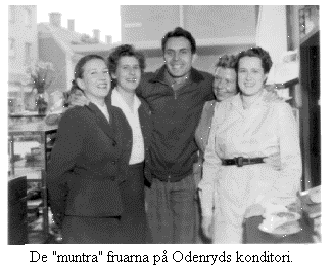
Of the second year at Köping Technical Institute I do not remember many particularities, I was occupied around the clock with studies and sustenance. Most other students used to gather at Widell's café, but some "over-aged" like me had our regular watering hole at Odenryd's. On Saturdays it was about studying the newspaper ads and seeing where there was dancing, go there and photograph. For the rest, my life in Köping mainly moved between three or four points. The most important stop after school on Glasgatan was my cellar dwelling, then came the bathhouse and café Odenryd. There I soon became acquainted with all the waitresses and when they heard how I had it, they showed some mercy for my situation. I on my part tried to help with what I could. One of the ladies at Odenryd was named Vivian and had two children with her husband. When they wanted to go out and have fun, I sometimes babysat the kids. One Walpurgis Night I offered to go out with the children (a girl and a boy) and watch the Walpurgis bonfire while the parents were at a party. With me I got 20 kronor, that was a fairly large sum of money when sausages cost no more than 50 öre each. With this money I was to provide myself and the children with sausages and ice cream during the evening. All the money was indeed spent without me eating more than a couple of sausages - sometimes one wonders how much small children's stomachs can take, it was alternating sausages, cotton candy and ice cream.
When the fourth term ended in the spring of 1955, I returned to the family in Borås, where I had registered my interest in again doing an internship at Borås City Electric Works, its electric meter workshop. Half of the summer holiday I worked with meters, then it became field work - service cabinets and cable work. The summer was very dry and the ground's conductivity very poor. This led to unexpected consequences. After several weeks of such drought, the older fitters became somewhat careless, as did my workmate.
Attention slackens somewhat and then an accident is near. The work was often done with the power on. The live busbars in a service cabinet at street level lie at a distance of 5-6 cm from the back wall and when the new cables are to be attached to the busbars, one drills with a shortened quarter-inch drill so as not to cause a short circuit to ground when the drill goes through the busbar. My workmate's shortened drill had broken off and without thinking of the consequences he took a standard drill (which is slightly longer). When the drill then went through the copper busbar it reached the bottom plate, resulting in a short circuit. There was a substantial flame, some amperage goes through a 6.3 mm drill before it melts and a powerful spark, similar to a small lightning bolt, is the result. He came flying out of the work tent backwards, black in the face like a negro and was transported to the hospital. After being smeared with a white ointment on his face, he looked even funnier, still like a negro, but now disguised as a clown - sunburned as he was otherwise. Nowadays one is not allowed to work with power on at all, but back then it wasn't that strict, or else he ignored it, I don't know which.
During the weekends we were out, cycling around the Borås area, swimming in Viaredsjön and visiting acquaintances. We socialized frequently with the Aatolainen family and Helge Johnson. At her workplace in Borås City Engineering Office, Ann-Marie had become acquainted with Elin Rånge; she and her husband had a beautiful villa in the Hedvigsborg district, right next to the house at Hedvigsborgsgatan 36, where the Aatolainens had their first home in Borås and where I stayed overnight for a few nights when I first came to Borås. We had from time to time admired the villa from the window and wondered what kind of millionaires could live so finely.
The villa was neatly situated in the rocky terrain and was built in a Southern European, Austrian style. Now we got to go inside to Elin and Kalle Rånge and discover that the interior was as interesting and well-planned as the exterior was beautiful. Elin's husband Kalle owned a yarn and bedding store next to Stora Torget in Borås and business had apparently gone very well. (Kalle was also a rather frugal man). We often visited them; Kalle was an avid sauna bather and had a sauna in his basement, where we spent many pleasant hours. Later, when I was an intern at the State Railways Telegraph Engineering Office, I sang together with Kalle in the KFUM choir.
Elin had taken a liking to Tomas and offered to babysit the few times we were going out in the evening. For the most part, it was about singing in the KFUM choir. When there was no choir practice, Tomas still wanted us to go out sometimes:
- Don't you want to go to the cinema? he would sometimes ask, all with the intention that then Aunt Elin would come and babysit him.
Tomas was very sociable, liked older people and had no difficulties getting along with them. In the summer of 1955, I was interning at Borås Electric Works and had a Belgian intern, Edmond van Meenen, as a colleague. When I was home between school terms and we were going somewhere, he also babysat Tomas. Edmond spoke some English, but Tomas could not, despite that they apparently got along quite well. When I asked Edmond what they had been doing, he told me that Tomas had read fairy tales to him. He didn't understand anything, but remembered that one of the tales began with:
- Once upon a time there was an old fox... Tomas had recently learned to read from Kalle Anka and was now practicing his newfound knowledge on anyone who wanted to listen. After the fairy tale reading, he went out to the kitchen and they helped each other make coffee.
- The Belgian had become acquainted with a woman in Borås and after a while moved in with her. It went well for a while, but then he happened to answer her phone when the woman was not home and then he heard:
- Who the hell are you?
It turned out that the woman was married, her husband was a sailor and came home only occasionally. van Meenen had to quickly and willingly find a new place to live.
The summer of 1954 was over and a new school year with hard work awaited me in Köping. It was just a matter of again taking leave of the family and buckling down. Already in 1951 I had applied to become a Swedish citizen; it would possibly go through under certain conditions, I was married to a Swedish woman, but the answer that time was:
” His Royal Majesty finds no reason to grant the application, ran the somewhat laconic reply from the Ministry of Justice. Now, in 1954, when I had resided for seven years in the country, I made a renewed request and was met with somewhat greater understanding from the authorities. On July 23, 1954, came a fancy paper with the large State Coat of Arms on it and signed by the then Minister of Justice Herman Zetterberg, on which it read:
HIS ROYAL MAJESTY has by decision this day admitted the applicant to Swedish citizenship. Not only I myself, but Tomas was also granted Swedish citizenship. Stamp fee - 40:--. Today the new citizens only get a copied A4 sheet.
With the application I had to attach a list of all my workplaces and residential addresses. I had moved quite frequently and it took almost a whole year before the check of the list was completed and I could receive the coveted document.
| Start - end date | Type of work | Employer's name and address |
| 1947-02-08 – 1947-03-14 | Filer | Sv. Stålpressning, Olofström |
| 1947-03-15 – 1947-05-27 | Garment worker | Algot Johansson, Borås |
| 1947-08-28 – 1947-08-27 | Peat worker | Borås Wäfveri AB, Borås |
| 1947-08-28 –1948-10-17 | Textile worker | Borås Wäfveri AB, Borås |
| 1948-10-18 – 1959-03-31 | Student | Katrinebergs Folkhögskola |
| 1949-03-30 –1949-10-18 | Photography student | Cylles Foto, Vessigebro |
| 1949-10-18 – 1950-03-30 | Student | Katrinebergs Folkhögskola |
| 1950-04-01 – 1950-08-03 | Agricultural worker | Björnhults gods, Steener |
| 1950-08-04 – 1950-12-31 | Textile worker | Kilsunds AB, Borås |
| 1951-01-01 – 1951-07-31 | Office clerk | Ätranverken AB, Falkenberg |
| 1951-08-01 – 1952-03-31 | Copyist | Lindelöws Foto, Skurup |
| 1952-04-01 – 1952-07-06 | Stone worker | Hos Sten Kristiansson, F-berg |
| 1952-07-07 – 1953-08-29 | Dairy worker | Borås Mjölkcentral, Borås |
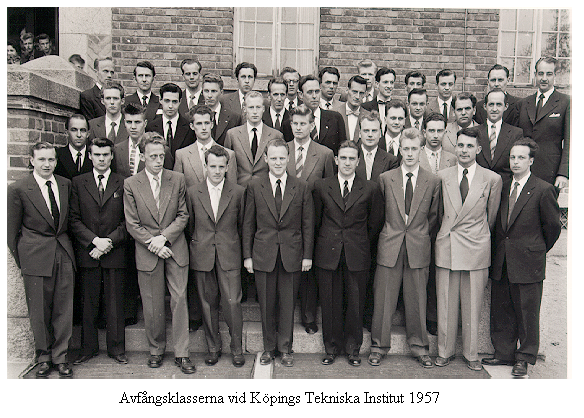
| 1953-09-01 – 1954-05-31 | Technical student, 1st year | Köpings Tekniska Institut |
| 1954-09-01 – 1955-05-31 | Technical student, 2nd year | - ” - |
| 1955-09-01 – 1956-05-31 | Technical student, 3rd year | - ” - |
| 1956-06-01 – 1957-01-06 | Telegraph worker | SJ, Borås |
| 1957-01-07 – 1957-10-30 | Conscript | KA4, Käringberget, Göteborg |
| In- and out-migration | Location | Gatuadr./Motsvarande |
| 1947-02-08 –1947-03-14 | Olofström | Halléns Pensionat |
| 1947-03-15 –1947-05-27 | Borås | Norrby Långgata 27 |
| 1947-05-28 – 1947-08-27 | Länghem | Ringmosse |
| 1947-08-28 – 1948-10-17 | Borås | N. Långgata 39, ing. 9 |
| 1948-10-18 –1949-03-15 | Vessigebro | Katrinebergs Folkhögskola |
| 1949-0315 - 1949-10-17 | Vessigebro | Fam. Carl-Erik Palm |
| 1949-10-18 – 1950-03-15 | Vessigebro | Katrinebergs Folkhögskola |
| 1950-04-01 – 1950-08-03 | Falkenberg | Holgersg. 16, Falkenberg |
| 1950-04-03 – 1950-12-31 | Borås | Norrby Långg. 27 |
| 1951-01-01 – 1950-12-31 | Falkenberg | Vikingag.16, Falkenberg |
| 1951-08-01 – 1952-03-31 | Skurup | Kkyrkogårdsg.49, Box 51 |
| 1952-04-01 – 1953-08-23 | Borås | Norrby Långg. 27 |
| 1953-09-01 – 1953-08-30 | Borås | Kyrkogårdsgatan 5 |
| 1953-09-01 - 1956ö5030 | Köping | Esplanaden 5 samt dess källare |
The application also included a certificate of language skills and Magister Berndth Bergling at Köping Technical Institute issued the following:
Hereby certified that Mr. Albert Kronberg, born in August 1928, possesses good ability to speak and read the Swedish language and also has very good proficiency in the written treatment of the language.
The summer of 1955 went much along the same lines as the previous one. Also during the past summer vacation I worked at Borås City Electric Works, this time with cable laying and at substations. The summer was extremely dry and rainless, much of the vegetation had withered away and the farmers had difficulties with water for the livestock. For all those on summer vacation, however, it was an ideal summer with warm winds and pleasant swimming weather. We took advantage of the weather quite a bit, cycled around the surroundings and swam in Viaredsjön. There were also often trips to Falkenberg; Gertrud Damberg had acquired a somewhat larger bathhouse where it was possible to stay overnight and we frequently used this opportunity. Ann-Marie did not like Viaredsjön very much; she is a west coast girl and must have clear water, and Tomas still could not swim, despite our persistent efforts to teach him the noble art.
The two previous school years had gone reasonably well, now the final efforts were to be made. So far I had not had any major difficulties except with math, where I had a rather poor foundation and it began to show at the end of the second year. With livelihood, there had not been too great concerns either; so far photography was working quite well, but too many dishonest photographers began to appear and that ruined the market. I had my anchor points in Herrljunga and Eskilstuna, where people knew me and knew that if I took some pictures, they could be sure that these would also arrive in due time - against cash on delivery.
It became a laborious year both regarding studies and livelihood. I had to devote much time to my deficient mathematical knowledge, but luckily Johan Thueland was very skilled and helped me over the greatest difficulties. He had completed the Norwegian army's officer school and knew a lot of mathematics. At the end of the school year I did get a passing grade. The other subjects I thought did not present any major difficulties; physics and chemistry consisted largely of practical calculations and I managed them with common sense as well as tables and the slide rule. The linguistic part did not pose any major obstacle; by now I mastered Swedish if not completely then relatively well and had good grades on essay writing. But there were financial worries. Ann-Marie had Tomas to support; she was fairly new at the drawing office and could not spare any large sums from her entry-level salary. Added to that came another concern.
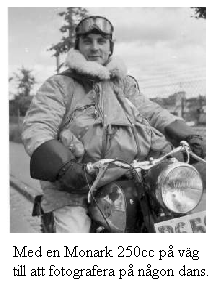
It was cold to ride around on the motorcycle in winter. After a few miles I was mostly forced to jump off the bike and run alongside it for a few hundred meters to avoid freezing to death. One becomes quite drowsy from the cold and on a couple of occasions it nearly ended in disaster.
I had been on a photography round at Herrljunga Sportpalats and since there were only 5 miles left to Borås, I thought it would be appropriate to visit Ann-Marie and Tomas. I had driven from Köping, photographed for about 5 hours in Herrljunga and was quite tired, but the longing for the family took over. The road between Borås and Herrljunga did not have many straight stretches; it was snowy and cold. Suddenly there is a bang, I sort of wake up and see trees rushing towards me, where had the road disappeared? The motorcycle jerked and then it stopped. I had apparently fallen asleep and driven off the road but had a guardian angel with me. The motorcycle had gone off the road and into a birch forest, passed between two birch trees that stood so close together that the handlebars did not go completely free through, and it was this jolt that woke me. Completely unharmed, but quite shaken, I led the motorcycle back onto the road and had no problems staying awake for the remaining driving distance.
A similar episode occurred on the bridge over the railway at Dingle in Västmanland. The bridge decking consisted of planks and it was quite slippery. I skidded off the road and tumbled down a slope. The slope was such that I landed roughly like a jumper in a ski slope, got the backpack with photo equipment and the motorcycle over me, but managed even this adventure without anything more than minor injuries and bruises. The Lotta coat, Finnish army cap and a pair of Finnish boots protect quite well against injuries.
Sometimes other accidents also occurred with the motorcycle, like when one dark autumn night, on my way back from a visit to a dance hall somewhere in the vicinity of Vingåker, I got a puncture in the rear wheel. There were still quite a few horses in the area, and when I stopped the motorcycle and started looking for the problem, there was a piece of a horseshoe nail stuck in the rear tire. I had left the built-up areas and there were no houses nearby; for a while I was quite uncertain what to do. When I had studied the map by flashlight for a while, I found that there was a small village a couple of kilometers away. I took off the wheel and began my walk in the direction of the village. When I got there, I saw that a light was still on in one of the houses and I knocked, despite the late hour. The man who opened the door was very understanding; he took me to another house and I got help patching the inner tube of the wheel.
Finding my way back to the motorcycle turned out to be a problem. The village lay at a crossroads with several roads heading in different directions, and after walking in the dark I could not say for certain which road I had come from. The kind man offered me a place to sleep for the night until dawn, but I had to be in Köping in time to produce the pictures and didn't feel like staying. I could roughly tell where I came from, but we still had to make a couple of detours in his Model T on the different roads before we found the motorcycle, which I had left at a parking lot.
All that riding on the motorcycle during the cold season took its toll; I began to feel it in my left hip. Motorcycle riding in winter is a dubious pleasure. Even on relatively short trips, you freeze like a dog after a few miles, and here it was usually a matter of considerable distances on icy winter roads. The Lotta coat and high boots didn't provide much warmth; after a few kilometers the cold penetrated to the marrow of my bones. I started looking for a car. An opportunity arose to make a trade with the motorcycle and pay 1000 kronor in between.
The car was a pre-war Opel Rekord and naturally didn't look like much, even to my untrained automotive eye, but I decided to go through with the deal and one day in late autumn 1955 I was suddenly a car owner. Some troubles ended and new ones began. Together with Johan Thueland, we were going to make a trip to a dance hall, but we hadn't gotten farther than Köping's western exit when it broke down. The difficulties started with the cooling. The hoses were bad; we managed to fix the problem, but as is the case with old cars – as soon as one fault is repaired, one or more new ones appear. The result was that I couldn't use the car as much as I had planned, and that led to difficulties in making a living. Again, good advice was hard to come by.
I managed to get by somehow until the turn of the year, but then I had to take measures to sort out my finances, and quickly at that.
The semester fee had to be paid, and I didn't have many kronor left. Emergency help came in the form of a loan from Skandinaviska Enskilda Banken, but back then it wasn't as easy to borrow money as it became later. On the other hand, the interest wasn't as ruinous as it is now. Gertrud Damberg had to sign a promissory note for me to get the money. The banks were very stingy, and I had great difficulty, using Gertrud and her flower shop in Falkenberg as well as Gertrud's sister Gerda as security, to get 3,000 kronor from Skandinaviska Banken. It took a long time to pay it back.
Now everything was fine and dandy for the time being; I no longer had to drive around but could devote myself entirely to my studies during the last semester. I left the car standing in the yard and worked hard on my school assignments. When finally the spring term was over and I had received papers certifying that I had passed the engineering technical examination in the telecommunications line, we celebrated this at the Stadshotellet together with wives, fiancées, and other concerned family members. Ann-Marie had come up to Köping to join the party; I said goodbye to my fellow students and prepared to return to Borås. The cellar was cleaned up, all evidence that someone had lived there for more than two and a half years was erased, the jumper cables from the electrical cabinets were removed and the radiators returned to the scrap heap; it was just a matter of getting into the car with my newly acquired knowledge, leftover belongings, and starting the journey home.
Up to Mariestad it went fairly well, then the engine started knocking alarmingly, and after consulting a know-it-all at a gas station, it was determined that the crank bearing had gone. Slowly we crept through all of Västergötland and reached Borås, but it took a considerable time. After so much trouble with the car, my interest in it cooled considerably, and I sold it for 600 kronor to a car dealer from Stockholm. Now I no longer had any direct use for the car either, and selling it seemed the only straightforward course. Then it wasn't until 1965 that buying a new car became relevant.
PS. Today (2005-12-16) I listen to the radio and watch TV, and the only programs are about how stressful everything is. Among other things, they showed students who needed relaxation rooms to de-stress, and I start to wonder. I worked almost around the clock during my time in Köping, but stress hadn't been invented yet, and I never thought about such a thing. Sure, it was sometimes rushed, but nothing worse than that you got things done when you kept at it. One wonders how these students, who receive grants from the state for their studies, get to borrow money without any security, are wired. Has the genetic material become so much worse and weaker that their mental strength can't withstand the slightest setback? They have, after all, attended regular schools, had plenty of time to improve in school subjects, yet they seem unable to cope with their commitments.
The studies haven't become more difficult; we wrote our essays by hand or on a rickety typewriter without correction possibilities; now they have computers that fetch the information easily. We didn't have any advanced calculators; the equations had to be worked out by hand using a slide rule. It doesn't seem that education is aimed at training the strength of the mental state; if something goes wrong, they blame stress and call for counselors. How would these people react if they were subjected to a truly stressful situation? Probably most of them would lie flat on the ground, or else wake up to the awareness that you can and do get more done, just by pulling yourself together a bit. Society is like a mother hen, "coddling" individuals in cotton wool, and they call for a counselor or a priest as soon as they get a splinter in their finger. Many "curling parents" sweep the path for their children so that they can't handle the smallest snowdrift that might appear on the road ahead. These children become mental invalids in their ability to withstand adversity. A person is like a certain type of engine; they burn up if they don't have negative feedback to keep them at a certain RPM.
2007-07-18
Two weeks ago we made a little "nostalgia trip" to the West Coast. We visited the FBU camp Källviken and took part in the "induction party" of the current cohort. Much has changed and the atmosphere is completely different. It seems quite commercial. When I entered the dining hall together with Ann-Marie to celebrate and eat shrimp, it turned out that you were not allowed to bring your own drinks, and that felt a bit strange. Here we had been eating shrimp and drinking for 25 years; now we were supposed to buy restaurant liquor at sky-high prices. We (like some others) went out onto the rock and experienced old memories and feelings "the old way," even though the weather wasn't the best for it.
From Källviken we headed to Norway, to Kongsvinger, to meet my classmate from Köpings Tekniska institut – Johan Thueland. I had spoken to him on the phone and he told me he had been ill and had spent several weeks in the hospital. We hadn't met since AB Atomenergi moved its operations down to Nyköping – Studsvik in 1960, and I was curious to hear how he had been doing over the years.
Norway is supposed to be beautiful, but we had to drive 160 km along a road construction site; they're building furiously and soon the E6 from Malmö to Oslo will be a motorway, but before then we had to weave between concrete barriers, road signs, and on potholed roads. After a couple of hours and some wandering in Oslo, we arrived at Smørbukkeveien 19 in Kongsvinger. It was a house among many others on a slope, and we got up to the 3rd floor. Johan had difficulty walking; outdoors he had to use a walker.
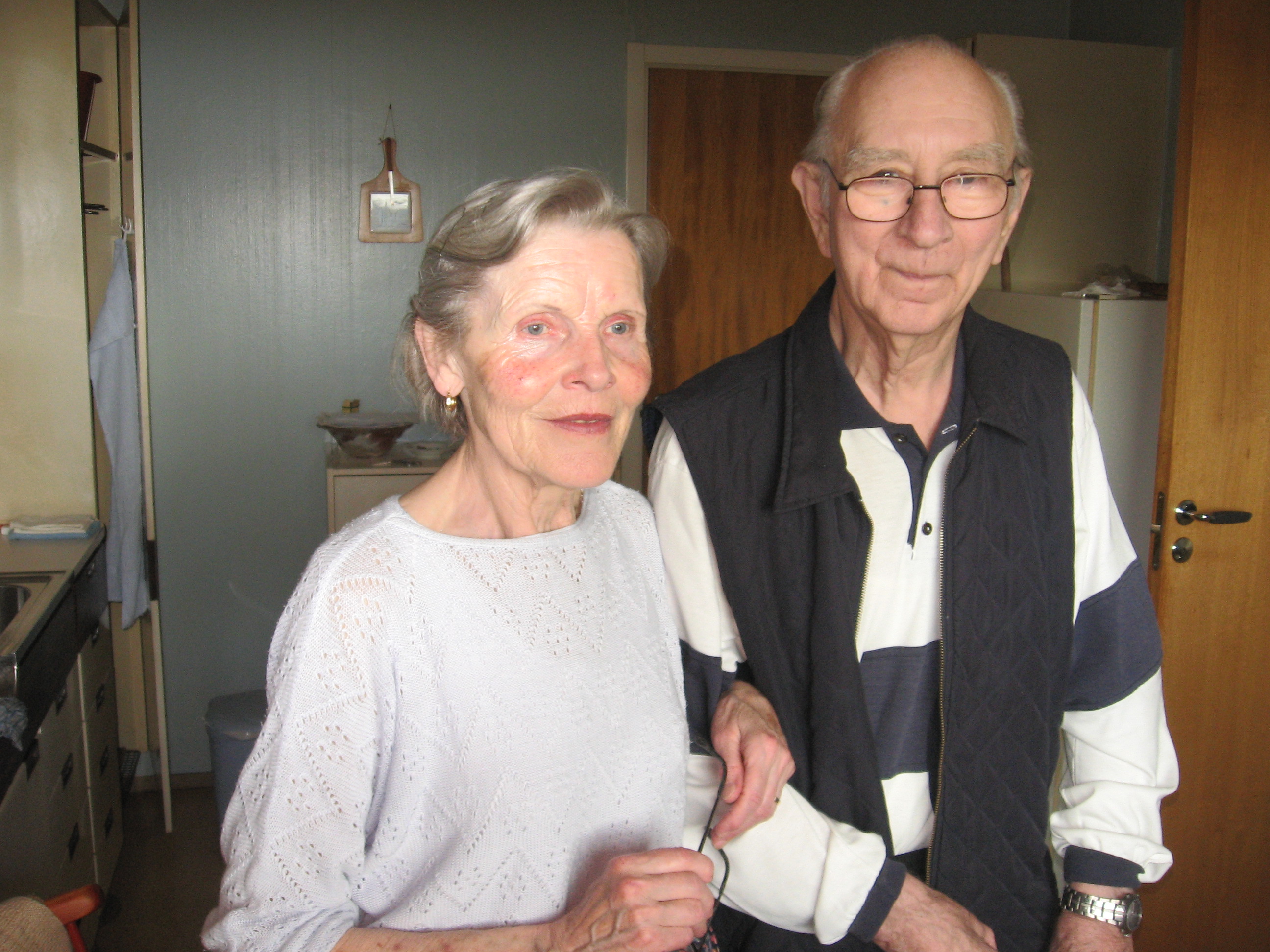
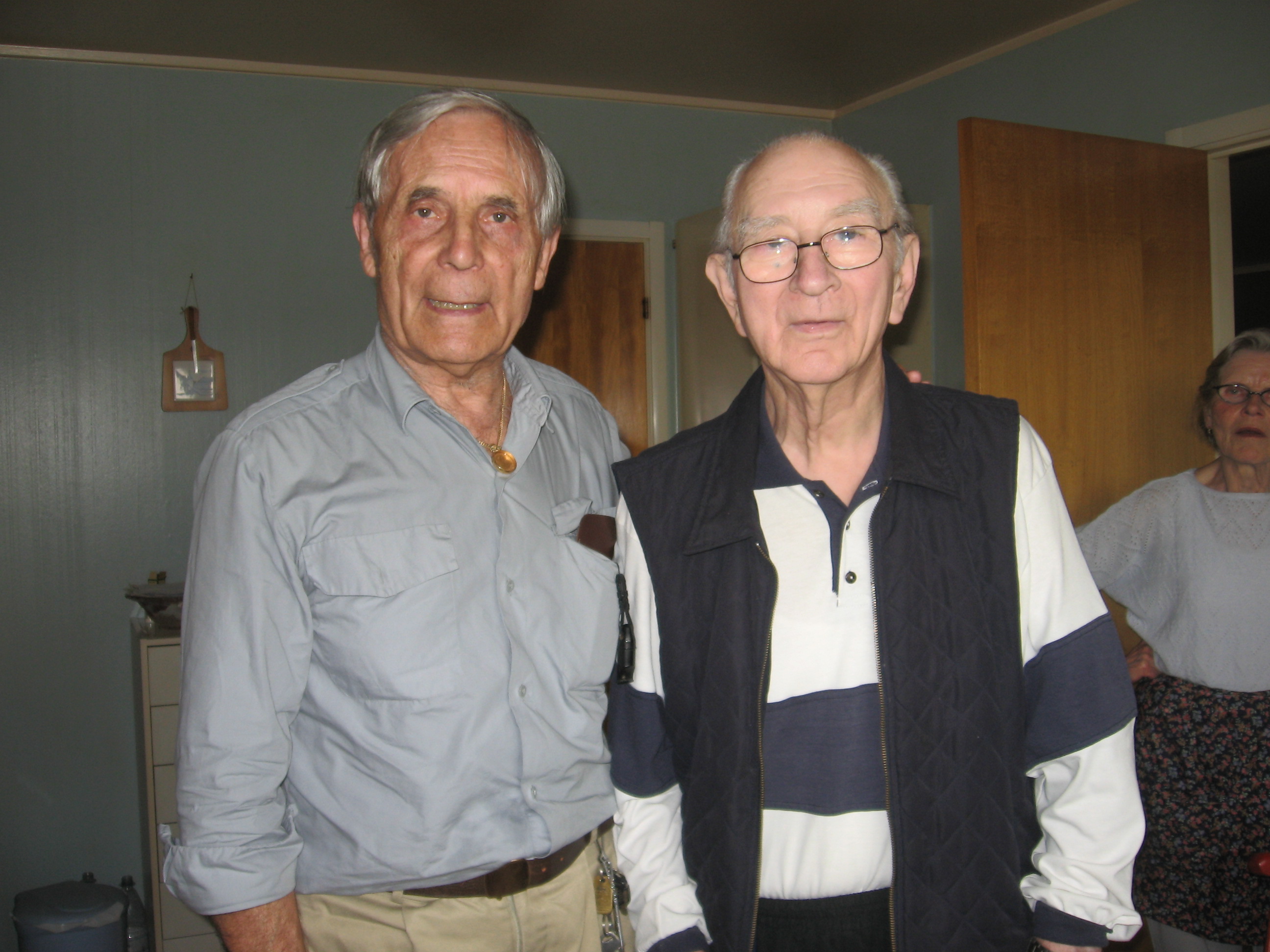
There was something wrong with Johan. He had always been a highly “technical” person with an interest in electronics, but now he didn’t even own a computer. He was divorced from Ursula, his first wife, and the new one seemed somehow a bit odd. Johan kept pointing out that they couldn’t offer anything. Already in Källviken, when I called him, he said they had no possibility of letting us stay overnight at his place, and I said we could sleep at a hotel. The wife offered us coffee and a couple of small sandwiches, which we ate in the living room, while they themselves went into the kitchen and drank tea. The situation became rather untenable and dreary; after a couple of hours of suffering we said goodbye and set off toward Karlstad – to possibly meet Lennart and Liljan Pettersson. On the way I called them, but it turned out that Lilian had left to visit one of the children, and so we decided to continue directly to Nyköping.
We stopped at a pizzeria in Åmotsfors and drank coffee at Pålsboda.
Recordings
- 1953KöpingA.mp3
- 1953KöpingB.mp3
- 1953KöpingC.mp3
- 1953KöpingD.mp3
- 1953KöpingE.mp3