Hägersten 1959
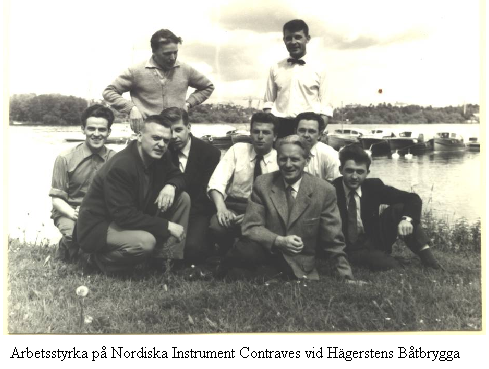
Afterfinishing my engineering education and completing my military service with the Navy Coastal Artillery in Gothenburg, I thought my contact with the military and all that that entailed was over, but in reality it was just about to begin – and on several levels. I looked for work on the West Coast, but there were not many options to choose from, only at LM Eriksson. After my grades and résumés had circulated among different companies, I settled on a company in Stockholm, at Nordiska Instrument (a branch of Bührli-Örlikon in Zurich, mainly focused on manufacturing control devices for 40 and 57 mm anti-aircraft guns)
There was another option, also in Stockholm, at Vattenfall's laboratory. The reason I chose Nordiska Instrument I don't remember. Perhaps the surroundings influenced me — Nordiska Instrument lies next to Lake Mälaren and has Hägersten's boat club as a neighbor. In hindsight, one wonders what it would have been like if I had taken employment at Vattenfall, but one can only wonder... I rented a room in a villa at the Sigge family's house at Båtsmanskroken 10 in Mälarhöjden, while Ann-Marie and Tomas, for lack of a family apartment, would stay in Borås for the time being. The rental rooms could be characterized by Nils Ferlin's poem: I am a lodger, I rent a furnished room...
The work consisted of trimming anti-aircraft sights for delivery to KATF (Royal Army Ordnance Administration). Since it was originally a Swiss firm, it consisted of nearly 40% Swiss, and we ended up being employed precisely with what I was not allowed to do in the KA, including the mounting of P12 radar systems on the anti-aircraft sights.
When I had worked and lived a few weeks in Stockholm and become a little settled, I thought of my first roommate in Borås, Robert Felszegi. I knew he had moved to Stockholm; during his visits to the Eklund family in Borås we sometimes met quite by chance. He was a refugee, like me, and getting hold of him was not exactly easy. I called what was then the equivalent of the Immigration Authority and was told that they did not know if he was still in the country. It is still the case that the Immigration Authority does not give any direct information. However, they promised to check if Robert was still in the country and then they would give him my address and he could possibly contact me.
After a few days Robert called and we met at a café on Herkulesgatan. It was a place where many foreigners gathered; Robert was outgoing and spent a lot of time out in the city. During the evening it turned out that he had a two-room apartment with a kitchen, and if I wanted I could rent one of the rooms from him, since he was hardly ever at home anyway. Here I had it much nicer, my own room with access to kitchen and bathroom. Now I had at least someone to socialize with, even if it was not very often. Robert was out a lot.
While I was living at Båtsmanskroken 10, I wrote to a photo company in England and wanted more details about a flash unit. Several weeks passed without hearing anything from the company, but one day a lady called and said they had received a letter addressed to me. They also lived in Mälarhöjden and there had been a mix-up of addresses. The lady lived at Båtsmansklevet 10. She said that the name Afanesjeff should be on the door.
When I got there it turned out that the family was of mixed origin: The man was Russian and the wife Swedish – born in Borås. Since I had lived in Borås, we naturally came to discuss the town and I stayed there for a long while. Eventually her husband also came; he had a "Sound Shop" at Gröna Lund – in the shop you could record your own voice onto a disc. At the end of the 50s, tape recorders were still not so common, and it was popular with personal recordings. The business had apparently done very well; they had their own house and (according to the wife) also a number of plots in Mälarhöjden.
The man's name was Georg, and later, when I joined the Military Interpreters, I got to know him a bit more. He was a good friend of Andrej Daragan and a great car enthusiast. He owned a Horsche, an open car of German manufacture, (Hitler's and the party bigwigs' favorite) on which he spent a lot of money renovating. His wife Inger was not at all as interested; she mostly thought it was cold and uncomfortable to ride in the car (especially in the summer when the top was down) and would have liked her husband to get the family a "proper" car. Now one can draw a parallel with Viktor Eriksson; he also spends so much on his Dyna Panhards, most of which are not drivable, but has no car to drive and is forced to rent one when needed. Currently (2004-11-17) Viktor is ill; he suffered a stroke and is staying at a rehabilitation home in Hammarby Hamnstad.
Georg fell ill with cancer and died a few years after we had become acquainted. His wife Inger, who was tired of her husband's car interest, got rid of the car as quickly as possible. The buyer surely made a good deal, for Inger was anything but a businessperson. The car brand is rare and highly valued among enthusiasts for vintage cars.
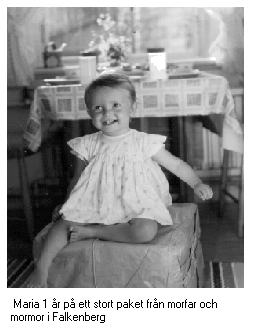
Regardless of my somewhat improved situation regarding housing, it was still rather dreary to be in Stockholm all alone; I longed for Ann-Marie and the children. By this time the family had been expanded with another child – a girl who at baptism received the name Maria Helena. Because of my work in Stockholm, I could not be present at the birth; that was not so common yet either. The first meeting with her was somewhat shocking; the birth had been quite difficult and the girl had a rather deformed, pear-shaped head. She did not look much, black-haired, dark-skinned, with very thin and delicate arms and fingers. Ann-Marie was quite affected by the birth and spent the whole summer with her parents in Falkenberg.
Getting a home in Stockholm was probably even harder than in Borås, and I began to despair. I had no acquaintances of rank either, and buying a home with money was out of the question.
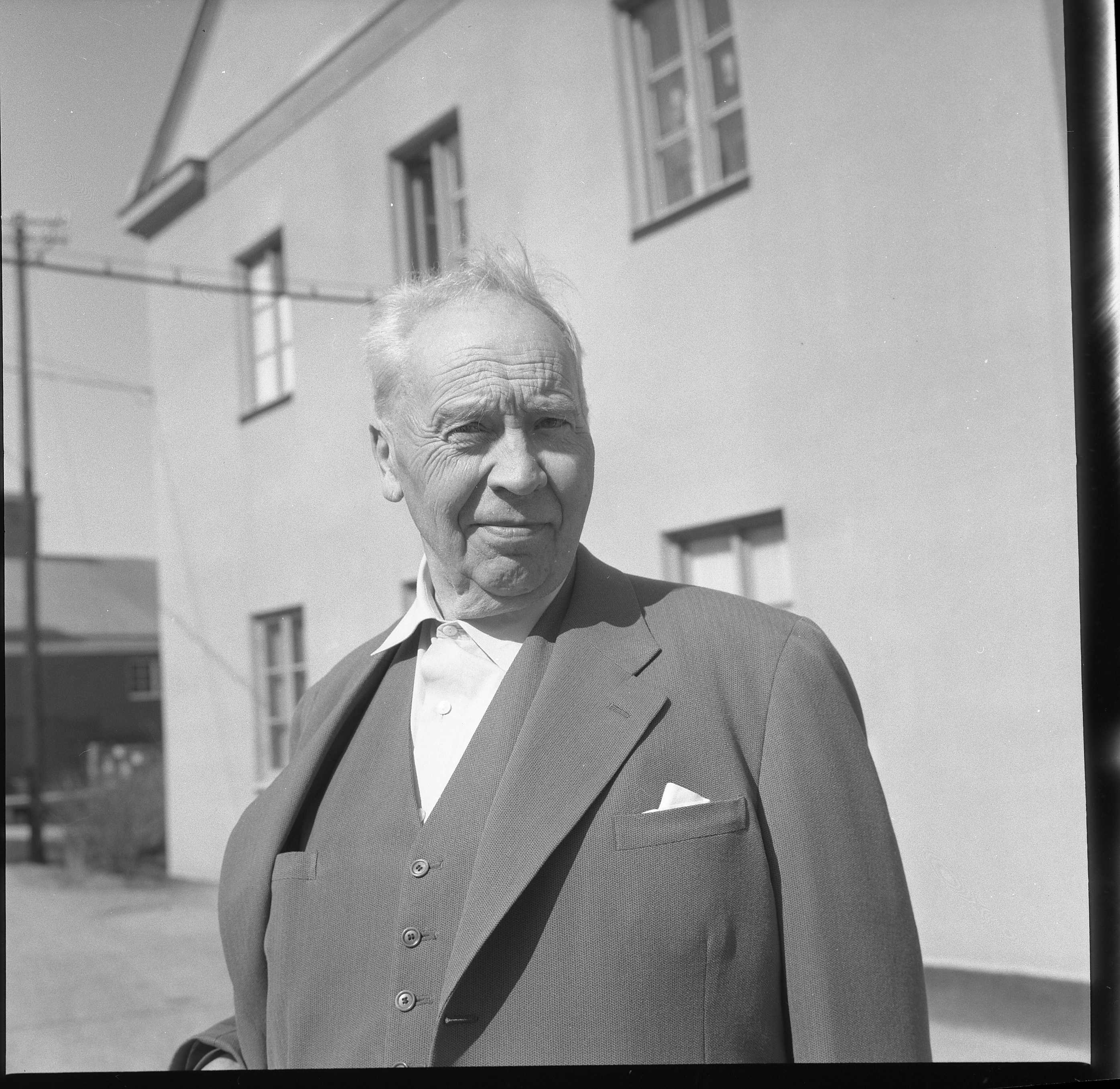
A little luck one must have, however, and in this case the luck turned out to come from quite close by. After having worked for a time at Nordiska Instrument, I became acquainted with Mr. Ulfward, the owner of both the factory site and the building. He was an older, jovial widower who lived with his only daughter in a two-storey villa next to the factory area.
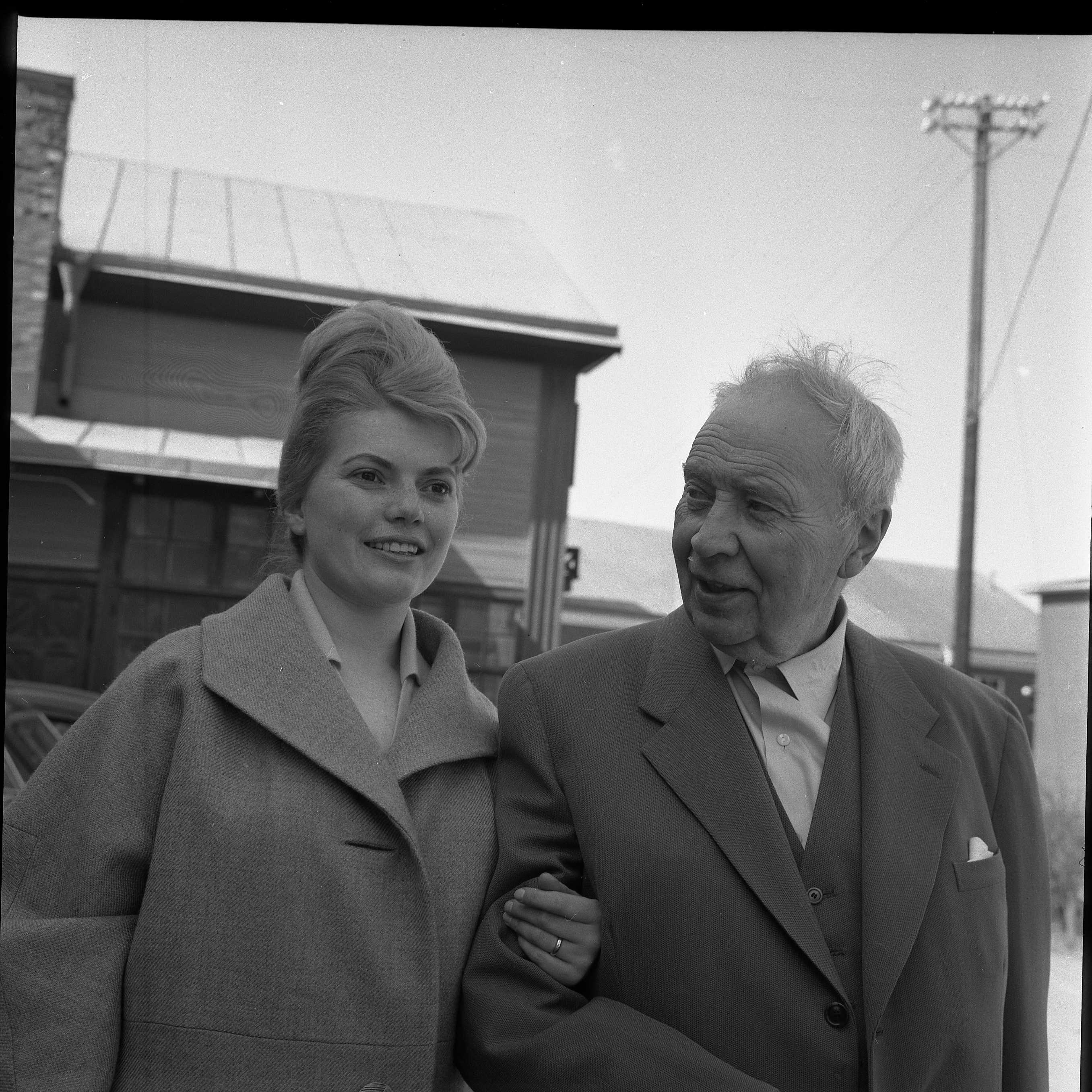
It was said that he had been quite a tough businessman during his active time; now, however, he had mellowed considerably and towards me and my family he showed his very best side. He had been a widower for several years and had certain worries about his daughter Inga. She was an only child and as such a rich heiress. The daughter was considered quite spoiled (not surprising since she was an only child) and Ulfward was worried about her future. Once he had to send her all the way to America to get rid of an overly eager but apparently unsuitable suitor. As a former businessman, Ulfward naturally found out what kind of person the suitor was and thus saved Inga from becoming a financial prey. It worked out for her, though; she married a policeman and had two children. A couple of years ago I found some pictures from the Hägersten time; one of them was of Inga and her newborn son; I sent the picture to her and got a sad message back. The son had died in a traffic accident – 20 years old.
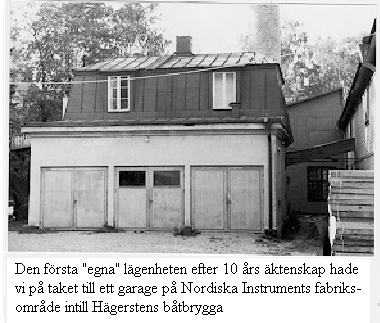
In further conversation with Ulfward, it emerged that he needed someone to look after his oil heating boiler and perform some minor tasks, possibly drive him sometimes to Södersjukhuset – a sort of caretaker and private chauffeur. An apartment could also be arranged, a very small one located on the factory grounds but still... Now Ann-Marie and the children could move to Hägersten and we could finally live together. By this time we had been married for about ten years without having lived together for any longer period.
In early February 1959, the moving van went from Borås to Hägersten with the things we had managed to acquire by then. When the moving bus from Borås Express stopped in front of Kyrkogårdsgatan 5 in Borås and the rear doors opened, it did not look as if our few possessions would fit; the bus already seemed fully loaded. Whatever the case, our few belongings went into the moving bus and the next day we were in Stockholm. Ann-Marie was annoyed with the moving crew because during unloading in Hägersten they happened to drop her brand-new Husqvarna sewing machine. The machine survived, and although I have sewn backpacks on it, it still works today (though not as quietly as before). On an old receipt I see that it cost 850 kronor – that was a lot of money then.
Now I had the family living practically at the workplace in Hägersten and could go home to Ann-Marie and the children for a coffee break at 11. With the apartment came certain obligations; I would occasionally drive the owner, Director Ulfward, to the hospital. He owned the land, the apartment, a Ford car from 1954 (with large fins at the back) and the factory building itself, which was rented out to Nordiska Instrument. The task was not too burdensome; he was an older, benevolent gentleman, and sometimes we could borrow his car in exchange for me occasionally looking after his oil heating. The oil heating unit was of a very old model; it was said to have been one of the first equipment imported from America after the war.
The apartment was not large, but we were not more than 4 family members at that time, of which two still quite small. Tomas was 10 years old and Maria barely two. In the apartment there was a toilet, also in miniature format. The toilet dimensions were truly minimal, large persons (like Gertrud Damberg) had to back into it and then the door could not be closed and we were not allowed during that time to come out into the hallway where the toilet was located. If the apartment was small, the rent was not exactly burdensome either. It was to be paid at 100 kronor/month – one year in arrears. We lived there about one and a half years before the move to Nyköping took place and when I went in to director Ulfward to pay the rent, he took the one thousand-kronor bill and said:
- Keep the rest, you will need the money for curtains and such things now that you are moving to Nyköping. Daughter Inga was perhaps not entirely on the same page, but Ulfward had the final word. I have the lease agreement left as a memory of a pleasant period in life.
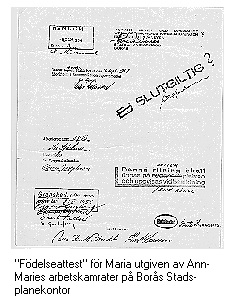
The time in Hägersten has left only pleasant memories. Admittedly, the salary was small and the dwelling could not be said to be entirely modern, but there was really nothing wrong with the comfort. Especially in spring and summer it was a very good home. In winter we had to stoke the stove boiler, which provided both heat and hot water. During my time at Nordiska Instrument, the company expanded with an inspection hall and to make room for the building, a number of large oaks were felled on the adjacent plot. I got to take care of the firewood and it truly warmed us several times. There were 3-4 centuries-old oaks with an impressive girth and I had great difficulty in cutting them down to a size that could fit into the stove boiler. The trunks were thicker than I could saw through with an ordinary bow saw; I had to turn the trunk and saw from several directions. Not even that helped, there was always a piece left inside the trunk that was not sawed off, and I had to split the trunk before I could saw all the way through.
That became firewood for the whole winter, and some we had to leave behind when we moved to Nyköping in the autumn of 1960. Norstedts publishing house had its premises right next to Nordiska Instrument and from there we also got some timber, packing crates and other packaging materials.
Telephone call with grandmother Lilly on Mother's Day 1959
Autumn 1959 I was called up for refresher training in the Dalaskogarna forests, at the same time a murder occurred on a taxi driver in Huddinge and Ann-Marie had some reservations when she was to live in Hägersten alone with Tomas and Maria during that time. Then Tomas was allowed to stay up as long as he wanted, Ann-Marie is a city girl and not used to the darkness.
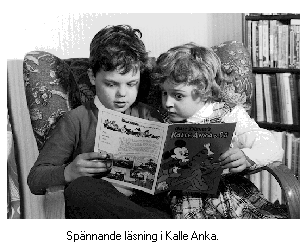
It became dark and quiet around the dwelling during the winter half-year. The factory buildings lay in darkness and the few street lamps that lit up the road towards Hägerstens Allé stood some way from the dwelling and contributed little to the lighting. Tomas could read and worked himself up sometimes by reading ghost stories about tomtar and troll, but not worse than that for a krona in reward he could walk around the factory building and Nordsteds publishing house after nightfall.
Director Ulfward owned the entire area all the way up to Klubbacken and for Tomas it was an excellent place to start cultivating his recently awakened interest in nature. For Maria's part it was a bit worse. She was only two years old and since the dwelling was above a garage, the long staircase down to ground level posed a certain danger. Ann-Marie had to watch her so she wouldn't tumble down the stairs in the practice of her newfound walking skills. Maria was good at climbing and has fallen out of her crib twice. The first time we didn't have the crib bottom fully lowered, she managed to crawl over the edge and fall down. When we lowered the bottom to the lowest position she used her teddy bear as a step, and in that way she got a little higher and could climb onto the edge. That time she got a proper bump on her forehead.
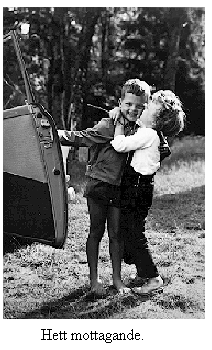
Those parts of the factory building that were not rented by Nordiska Instrument or by the small-beer brewer were used by Nordstedts Förlag. The former garage (which was under our apartment) now served as a painting workshop for school boards. The painter was not one to stay sober all working days and sometimes he would come up to the apartment and complain about his wife. On one occasion, when he was very unsteady on his feet, it happened that he fell down the stairs. The stairs were steep and the height about four meters. When we heard the commotion we thought he had hurt himself badly, but God is with fools and drunkards, he just shook his head and got up as if nothing had happened.
Tomas was in third grade at Mälarhöjdens school. One day he came rushing home and said that now they could start playing a instrument. The music teacher had been there and three children in the teacher's class had been accepted.
- But she knew the music teacher, after all, he added.
A couple of days later he came home with a box containing a half-size violin. The boys who were not going to play naturally made fun of the music students.
- Does it take a long time to saw through? they teased Tomas.
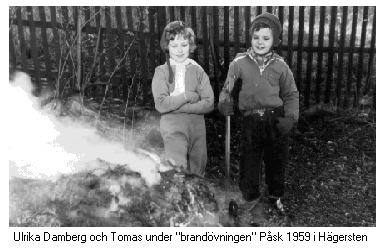
A gang of small boys from Mälarhöjden harassed him sometimes when he was on his way through the villa neighborhood and I decided to put an end to it. We agreed on a time and place. I positioned myself behind a hedge and when Tomas came walking, both the boys and I were waiting. The boys did not know, however, that I was part of the plan. When they surrounded Tomas and started teasing him, I stepped forward and took a couple of the rascals by the collar and threatened to go to their parents if they continued to harass Tomas. They promised to stop it and after that Tomas was left alone.
The dwelling in Hägersten was located just below a home for wayward boys - Eolshäll. There things sometimes happened that were written about in the newspaper, but we were not greatly troubled by them. They never harassed Tomas on the way to school. Only on one occasion had they been inside Ulfward's villa and stolen a wallet. Ann-Marie had met a very polite boy on his way up our stairs, he had bowed and greeted her, then he continued running through the wooded copse towards the boys' home.
Now and then the boys naturally came up with unlawful things. One day the grocer Jordan, owner of the grocery store on Hägerstensvägen, called the small-beer brewer who had a brewery on the factory premises and asked if he was going to cease operations. When the brewer acted completely baffled by the question, the grocer explained that some boys were in his shop and wanted to sell a number of 5 and 10 liter small-beer bottles. According to the boys, the brewery was closing down and they were allowed to take the bottles and sell them. They were very "helpful" kids. A leader at the home had complained that his Volkswagen had a very poor battery. A few days later, he had a new battery; it was just standing next to the car and no owner claimed it. The leader took the battery and pretended to be unaware of how it had gotten there. Later, however, the matter came to the attention of the management, at the same time as other irregularities from the same youth leader were also revealed, which resulted in his being fired from his job.
The plot in the direction of Klubbacken was rather scrubby, overgrown with brushwood and tall grass. Director Ulfward asked me in the spring of 1960 to clear the brush and burn it. That would suit well for Easter. I worked a few evenings chopping down the brush and pulling it together into a pile a bit above the stairs. After a few days the pile had become quite large, now it was just to wait for Easter, it would be a good Easter bonfire this year.
We prepared the burning quite well, we thought, but circumstances would play an unexpected trick. On Easter Eve afternoon all preparations were ready, I had filled Maria's bath tub and a number of other larger containers with water, in case the fire became too intense and needed to be dampened. To help I had Tomas and Ulrika Damberg (her parents had sent her by plane to Arlanda, where we had picked her up) she was going to be with us for a couple of weeks around the Easter holiday.
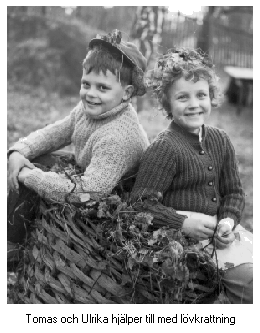
The expectations of Tomas and Ulrika were high. Like all children, they thought it would be fun to set a fire. The big moment had arrived and we lit it. At first the fire did not want to catch, the brushwood was still somewhat damp, but when it caught, it did so with a vengeance. When the fire had spread around the entire brushwood pile, there was a strong draft and the fire flared up like a torch several meters high and the surrounding spruce trees were at risk of being scorched. I emptied the water buckets on the fire and sent Ann-Marie with the empty containers to fill more water in the kitchen, for the fire was not dampened much. She came running back and reported that no water came from the tap.
There was quite a commotion around the fire because now it had caught really well and the flames up to the sky reached considerable height. No major risk of the fire spreading existed in itself, but too intense burning always creates a certain feeling of unease - it can go wrong and the fire can spread. A couple of spruce trees stood quite close and the needles began to crackle. It was now a matter of limiting the fire's spread and I had a rather sweaty job in my attempts to pull out some of the brushwood from the fire. We kept watch on the fire so that it could not spread in the ground layer. Tomas and Ulrika did not really grasp the seriousness of the situation, they ran around playing fire brigade with all the sounds of horns and sirens that a fire brigade can produce, and that certainly did not reduce the effect. Ann-Marie became very worried, she had in her childhood experienced a big fire and thought that what was going on now was quite unpleasant.
There was still no water coming, so it was just to wait until the pile had burned down. I could achieve some reduction by pulling out some brushwood from the pile, but the heat was great and I could not get close enough. So gradually the fire died down, but a couple of nearby spruce trees had gotten clear marks on the branches facing the fire.
Explanation of the missing water came a bit later. The factory area consisted of several buildings and one of them was rented out to the soft drink brewer. On Easter Eve he was going to clean the tanks and had shut off the main valve to the others in the area. The Nordiska Instrument factory was not running due to the Easter holiday and he thought it was a good time to shut off the water to the rest of us so he would have proper pressure on his line and be able to rinse his brewing vessels.
When Easter was over, the fire had certainly not died out. The ground under the bonfire was somewhat mossy and a small fire smoldered there for several weeks. When it got dark in the evening we could see it glimmering and smoldering under the stump, and every evening for a couple of weeks we poured a few buckets of water into the stump where the fire had been, but it still took considerable time before the fire was completely extinguished.
Tomas and Ulrika enjoyed themselves in Hägersten, the problem was getting them to bed at a reasonable hour so that we could also have some free time. Simply asking them to go to bed wasn't very popular, commanding didn't work either, as excited as they were in the evenings they couldn't fall asleep and there was constant nagging about one thing or another. Sometimes they wanted water, sometimes milk, and there was no limit to their imagination when it came to staying up.
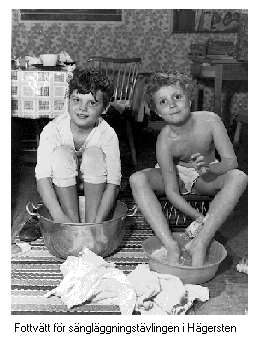
After a while I came up with a trick. There would be contests for going to bed. The contest elements were of varying kinds but involved performing certain tasks against the clock. We set up a number of stools and other obstacles to be overcome, they had to climb through the chair with an orange on a spoon, or perform some other task, but first they had to undress - also against the clock.
Ulrika was always quick and resourceful, quick to find shortcuts while Tomas was honesty itself and usually came last. When the starting signal for the evening's contest went, Ulrika had already secretly loosened all the buttons on both socks and bodice and was on her way to the next task while Tomas was still fumbling with his trouser buttons.
It was the same when they had to climb through the stool with an orange on a spoon. Ulrika usually squeezed the orange with her thumb so it stayed on the spoon, but Tomas had constant difficulties when the orange fell off in the heat of the battle and he had to start over from the beginning.
Naturally Ulrika almost always won, but since there were only first prizes (as in all children's contests I led both in Hägersten and later at Källviken) everyone was satisfied and instead of nagging about bedtime, the children now started asking in the evening when the contests would begin. The last week of Ulrika's stay with us, Ann-Marie and I had it really quiet in the evenings. It was almost as if they sometimes went to bed far too early. Maria was still so small that she caused no major trouble at bedtime. She liked water and it worked perfectly to wash her in the kitchen sink, where she sat and splashed to her heart's content when left alone for a while. She was not difficult to put to bed.
Maria was a very kind and patient child. When Tomas was little he whined quite a bit, it didn't stop until he was nearly 10, but from Maria we almost never heard anything like that. Yet she knew quite firmly what she wanted. Tomas had learned to read quite early and also tried to write, so on one occasion we got a note that said:
New Year's resolution. I promise not to whine.
Once we went to Sätra Recreation Area, which is within reasonable walking distance from Mälarhöjden, and I had her in a backpack for convenience, she sat with her legs crossed and only her head sticking out of the pack. There was no carrier of the type we had for Katarina (which Björn Grönroos welded together at Studsvik) and we used the backpack for the purpose. It worked well for short distances, but sitting with legs crossed probably became tiring in the long run, and on the way home Maria refused to get into the pack. It didn't help that we promised to walk fast so she wouldn't get tired from sitting, I had to carry her on my shoulders at intervals, the distance was probably a few kilometers. She was a patient child and put up with most things and tolerated most things, but only up to a certain point.
Work at Nordiska Instrument sometimes required us to test our sights and calculating instruments in both heat and cold, in addition to going to the anti-aircraft firing range on Värmdö and shooting at a "sausage" hanging behind an airplane. Accuracy was around 30% under favorable conditions. The sight had to follow the target for 5-7 seconds, the time needed to calculate lead, then the Bofors cannons fired.
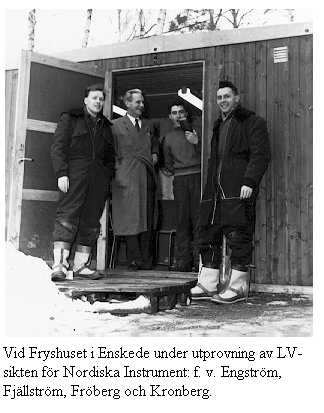
The heat and humidity were produced in a tent, but for the cold we had to rent a corner in Enskede cold storage.. Outside it was about 25 degrees warm and inside the cold storage held -30 degrees. When the fans were on for freezing, it could get down to -40 degrees inside the building.
As a rule, we drove the devices into the cold storage on Friday afternoon and worked on them during the following week. The instruments had to stay within certain tolerances both in heat and cold. When some values were off, you had to put on plenty of clothes, warm shoes, and suitable mittens. When adjusting knobs and fiddling with a screwdriver on certain adjustment points, you had to take off your mittens and the adjustment had to be done very quickly.
The instrument construction was in the form of pull-out drawers, somewhat like in a chest of drawers, and the electrical connections consisted of a wide rubber cable with embedded wires running along one side of the pull-out drawer. During an attempt to rationalize and cheapen the equipment, someone had come up with replacing the expensive rubber with a corresponding plastic cable, but it turned out to be a complete fiasco.
It was a Monday, and the cooled calculating instrument for the sight was started up. As usual, certain adjustments were needed and it was my turn to go in and turn potentiometers and capacitors. I unscrewed the drawer's mechanical safety brackets, grabbed the handles, and pulled out the drawer.
Several flashes shot out of the cable at the same time as a certain rattling was heard when the frozen-hard pieces of plastic cable fell onto the concrete floor as the drawer was pulled out and the cable bundle bent. That was a quick end to the testing that day and we had to transport the instrument back to the company for repair. There were no more experiments with the plastic.
When everything worked, it was a pleasant change to get out of the factory premises to Enskede. We had our own generator and its cables were run into the cold storage through a small hatch in the wall. The cold storage was filled with animal carcasses and ice cream. The cable hatch was wide enough to take out some ice cream through it, and we consumed a lot of ice cream on site, but there was also some left over to take home to the children.
The instructions for field conditions were quite brief, but apparently sufficient for the equipment to function. However, the service manager Nilheim got the idea that the instructions were far too short and wrote a new field instruction several pages long – then error reports started coming in. Nobody in the field has the energy to read more than half a page; if the instruction is longer, they set the instruments "by feel" and it goes wrong. Nilheim had to revert to the earlier instructions.
After the transfer to the Military Interpreters and the autumn maneuver in the Dalarna forests, a few months passed without me thinking much about any changes in the work situation. During my first interpreter course at the Källvik camp in 1959, I became acquainted with Gunnar Berggren, an Estonia-Swede, whose father before World War II had been the director of AGA in the Baltics. Gunnar worked in Stockholm and we kept in touch. He mentioned that he worked at AB Atomenergi, and asked if I was interested in starting there as well. We parted after the course and for a while I heard nothing from Gunnar, but shortly after New Year 1960 a phone call came. Gunnar had made inquiries with the group leader Ulf Kuylenstjärna regarding my possible employment. After about a week he called again and said that if I wanted, I could start at Atomenergi's Plutonium Laboratory in Stockholm, with later transfer to Studsvik. Atomenergi would arrange housing in Nyköping, Trosa, or Tystberga. The salary would be 1300 kronor – a considerable increase compared to the current 1000. Shortly after, I received a phone call from his group leader Ulf Kyulenstierna and Ulf repeated Gunnar's question. I answered yes, and on March 1, 1960, I started my life in the service of nuclear power. The company had started in 1957 and lived a somewhat secluded life, but with a constant growth of staff and premises around Stockholm and with an embryo in Studsvik, on a peninsula between Nyköping and Trosa. The workplace was at that time in Huvudsta, about 10 km from Hägersten where we lived, and I got there on an old bicycle converted into a moped of a model that was driven by a carborundum disc on the front wheel. During the relatively few months that I worked in Huvudsta, I wore out more bicycle tires than I had done in all my previous cycling..
I resigned from Nordiska Instrument and began my new life with nuclear power. The workplace was located on Framnäsbacken, in the northern part of Stockholm, and whereas I previously could walk to work without outerwear, I now had a rather long commute. It was time-consuming to take public transportation from Hägersten to Framnäsbacken, and to make it more comfortable I got a moped. Moped might be an exaggeration; it was an ordinary bicycle with an auxiliary motor over the front wheel, and it consumed a fair number of tires during the three-quarters of a year that I commuted between Hägersten and Framnäsbacken.
With Ulf Kuylenstjärna as boss and coworkers Gunnar Berggren, Stig Henriksson, Lennart Ström, Lennart Jakobsson, it went well to get started and begin manufacturing glove boxes for Pu experiments. The workplace was located in the basement of an ordinary apartment building.
The move to Nyköping was announced to take place during the same year, and we borrowed Ulfward's car to go to Nyköping and look at the apartments. On the list was an apartment on Järnvägsgatan, opposite the TGOJ railway – 4 rooms and kitchen. Ann-Marie thought, however, that the apartment was a bit too exposed considering the children and told Bo Håkansson (who acted as an intermediary) that we wanted to see something else. He took us to Jupitervägen 12, where on the 4th floor in a newly built house there was an apartment with 4 rooms and kitchen on 80 square meters. Some of the future tenants had already moved in. Once we had decided on the apartment, it was time to get some food, and for that purpose we went to a restaurant, which I believe was on Bagargatan. At the table next to us sat a person with peculiar behavior. When he had finished eating, he continued scraping his plate so persistently that we thought the decoration would come off. When he finally finished, he went out, stopped in front of the mirror next to the entrance door, and made faces at himself for a while. At that moment we certainly thought Nyköping was a bit strange, but hoped that not all the residents would be like that.
That the residents turned out to be somewhat sour on “atomare” we experienced several times. They did not understand that it was through these that the city got new housing and also a certain new life. The inhabitants of Nyköping (and Södermanlanders in general) suffer from an inferiority complex. This complex stems from the fact that they have for too long had to stand as tenant farmers with hat in hand and bow to counts and barons. Södermanland is littered with large castles and estates, and there are many lords before whom the Sörmlänningarna have had to bow. Wachtmeistrarna, Trolle-Löven, Bonde, von Post, von Rosen, etc. None of the independent farmers north of the Dalälven would stoop to such subservient behavior. The Sörmlänningarna still, after many years, have not been able to overcome their complex; the situation has not changed very much in all these years, as it appears.
After a couple more reconnaissances in Nyköping, we decided on the apartment at Jupitervägen and began preparing the move. It was to take place at the end of November 1960. The house was on the eastern outskirts of the city, on the way to Studsvik, but no direct road existed yet; it would come only a few years later.
Now I would become a coworker in nuclear power and help with cooking recipes and working with plutonium fuel for nuclear power plants.
Apartment inspection in Nyköping
Tomas plays the violin
Tom Thumb
Phone call with grandmother
In autumn 2009 we made a visit to Henriksberg in Hägersten. I had a number of pictures and was to hand these over to Inga and Pål. We went up the stairs to “Holken,” as the building above the garage was called and where we lived during the time I worked at Nordiska Instrument Contraves. The residence was rebuilt, but no one lived there. We met a man from Hanson’s construction firm, who had apparently taken over both the brewery and the factory property, and he told us that both Inga and Pål were gone. Pål had (as the man hinted) died from smoking too much, and Inga had followed a few years later.
Since “Holken” was empty and we had been looking for a new home for a few months, it occurred to me that we might be able to rent “Holken” once more, but on closer reflection I realized it would probably be difficult to live there. The stairs up to “Holken” were about 20 steps and the road up to Hägerstens Allé is very steep. We would not be able to live there long before becoming prisoners of circumstances – old age and the difficulty of moving. But the thought was tempting. There was much nostalgia with that residence; it was our first shared apartment where we could live family life..
Recordings
- 1959Hägerste D.mp3
- 1959Hägersten A.mp3
- 1959Hägersten B.mp3
- 1959Hägersten C.mp3
- 1959Hägersten E.mp3
- 591221 Mormor och Morfar på besök G.mp3
- 59HÄGER.mp3
- 60 1130 Läg besiktning i Nyköping.mp3
- 600821Tfiol.mp3
- 60Tummeliten.mp3