Källviken and the journeys eastward
The Military Interpreters' Association's march by Björn Collinder with music by dir. mus. dir. Janosc Sandor
”Military Interpreter Poetry”
Life at the Tolk School may not always be so cheerful, and the SFÖ and voluntary courses can also have their gloomy sides. Despite that, there is something called UTRYCKNING, the melancholy lifts and releases a not infrequently witty sense of humor, which also reveals an occasional poetic vein. The works that thus emerge are then gladly presented e.g. at the graduation party. There are naturally also other occasions, for example anniversaries or jubilees, when poetry is allowed to flow. Yes, sometimes even a teacher tires of everything and sits down to write a poem instead of thinking up tricky sentences for next Friday's translation test. Here a selection.
The Military Interpreters' March
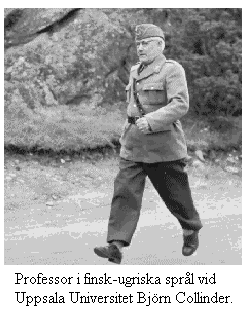
This is to the best of our knowledge the oldest work in the genre. The word "ädelpekoral" is surely lurking. But one should perhaps still recall that the text, written by none other than Bjorn Collinder, at the time a prominent professor of Finno-Ugric languages at Uppsala University and an engaged "old interpreter", was surely intended to be taken in full earnest – and it probably was at the beginning of the 1950s, when the world political situation was not particularly stable and the "old interpreters" knew what patriotic fulfillment of duty meant. It should be added that there was an original melody for the march, written by fellow old interpreter Georg Sandor. That we cannot reproduce here.
We interpret with all our living faith, Each in our flock may like the men of Pentecost
who populate the camp's barracks be crowned with a burning tongue
You shall never see that any of us Perhaps you become the tongue on the scale, my friend
gives up or fails and plays truant Like lightning may the interpreters flash
We are not counted by dozens and gross Your tongue becomes eye and ear to the one
and no one is a henchman and no one is boss who guards our kingdom with bow drawn
We are all soldiers and interpreters May we therefore in unity sing
If it is required of us we are ready to fight We will soon be here again, one still needs probably
With swords but not with daggers Us all, old and young
We interpret with all our living faith Each in our flock may like the men of Pentecost
who populate the camp's barracks Be crowned with a burning tongue
Efter having completed his military service in the year 1957 and moved to Stockholm, on 1959-02-19 a letter came from the Foreign Department of the Defense Staff, where they stated that they had observed that I had "for the country valuable knowledge of foreign languages", i.e. in Russian, Estonian and Finnish. The letter was signed by Kn Christer Westin at Attachébyrån, under which the interpreters were organized at that time. It seemed interesting and I answered in the affirmative, one could always see what it might lead to in the extension.
Maria was only a couple of years old and Ann-Marie preferred to spend the summers with her parents in Falkenberg. I myself, on the other hand, did not enjoy the inactivity there very much, I did not have the peace of mind to just lie on the beach and keep Ann-Marie company, so we decided that I would go to Bohuslän and try out the military camp life. K1 in Stockholm would assist with the uniform, and if I passed the tests, it would lead to a transfer to a different service than the one I had been trained for during my military service. The train between Gothenburg and Strömstad set no speed records, it was a real "milk stool train" – it stopped at every station, and it was quite late in the evening when I arrived in Strömstad.


A military bus was waiting for us, at the wheel sat Astrid Holm, a motor corps woman from Stockholm, a crackerjack at driving a car (especially large, heavy vehicles) and one of Sweden's few female vehicle inspectors. There were a few other people also along, and the journey went north towards the FBU camp Källviken, which turned out to consist of four or five barracks, a mess hall, a classroom, and hygiene facilities with a row of stainless steel washbasins in a smaller building and an outhouse. The camp was beautifully situated on the coast; as neighbors we had a recreation area with the romantic name Capri, but its inhabitants sometimes behaved quite unromantically; however, there were never any more serious disturbances, but minor incidents occurred all the more often. The camp was classified as a military area and unauthorized persons were ruthlessly turned away. Embedded among the rock knolls down by the camp's beach was a very good sauna; at first glance, the stay seemed like it could be quite pleasant.
Professor Björn Collinder sings a self-written and composed song at the Military Interpreters' Association's 25th anniversary in 1975 at the FBU camp in Källviken, Strömstad.
Ur MT-cirkuläret nr 4/1959.
"1st summer course in Kjellviken" was carried out according to plan during two lovely summer weeks in connection with the year's early midsummer. When we finished last year's course, we told each other that such a course would never come again; pleasant comrades, good training, fine atmosphere "in and out of service" and wonderful weather all the time. After this course, we don't know what to think. We had the same good luck with the weather. The first week was so fine that Sandor thought he was on vacation and lay bathing every free moment. Not until Monday of the 2nd week, when all the papers for the war game came over him like a small flood, did he discover his mistake.."
The camp stay lasted two weeks and consisted largely of two parts. During the first week we practiced our Russian, since for many of us it had become quite rusty; during the second week there was to be a war game in the form of interrogation exercises. The WACs served breakfast at 7:00 AM and formation with flag raising took place at 8:00 AM. After breakfast, some of the older interpreters used to gather on the "liar's bench" under the pines in the yard and stories were told. It was a chosen group of odd characters from all corners of Eastern Europe, and supported by their rich experience and adventures, there was much to tell: anecdotes, tall tales, and real-life events. The wives sometimes complained that they couldn't keep up. Almost always the stories began in Swedish; when the Swedish-speaking wives came near and the stories became somewhat unsuitable for female ears, they switched to Finnish. When even the Finnish-speaking wives arrived, it could happen that the language became Russian. There were not many wives (only the Ingrian ones) who mastered that language. Ida Nordberg used to be the last of the wives to remain on the bench.
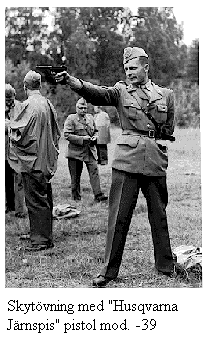
Inserted into the second week's program we had a military field competition. Some of the regular events were exchanged with regard to the nature of the training and we had a couple of competition events of a more intellectual character. It was naturally about Russia, its language and about Russian conditions. Since I mastered Russian relatively well (despite many years of fallow) I could in many cases bring home good placements. The visible proofs of this are the challenge prizes in the form of a silver vase and a fascine knife. In the silver vase, which has been donated by CFST/Sekt 2, some of my military interpreter colleagues also have shares (A. Potocki 1967 and 1971, Antti Nordberg 1969 and 1970, I Rodhe 1968 and A. Hedlund 1972). I won three victories in a row (1973, 1974 and 1975) and became the owner of the silver vase. In the vase that ended up at Antti Nordberg's home I also have two inscriptions and the fascine knife from Ch för Armén was won in field competitions in the years 1980, 1981 and 1983. Shooting, orienteering and Russian have probably been the strongest subjects. Of the four challenge prizes since 1959 I have taken home 2 pieces: a silver vase and a fascine knife, as well as a number of prizes for decent placements.
It has naturally not been entirely free of charge. At the competition in 1968, it happened that I suffered a minor incident in the form of pain in my right knee. The source of the pain was that year's competition. The injury occurred during the orienteering and the reason was a lack of mental activity, which unfortunately sometimes happens during the heat of competition. The Bohuslän terrain is sometimes quite rocky; here there was a deep ravine with a width of 3-4 meters in the way that I had to cross. I did not want to climb down and lose height, so I took a running start and jumped over, but landed somewhat carelessly on practically just one leg, resulting in a sprain in the knee joint. After that, I had difficulties on the guided tour that I was to undertake with French-Swiss teachers from Reisebüro Kuoni in Zurich..
When I was to do my military service, the enlistment major wanted me to do my military service at the Tolk School, but that time it did not suit me.
I did not escape the Tolk School, however, but it became a mixture of student and teacher. I became a military interpreter and was to a fairly large extent out on various interpreting assignments. This resulted in Commander Erik Stenberg calling during the summer of 1973 and asking if I could take one day a week and act as a teacher for the Navy line; they had no one who mastered Russian naval terminology to a sufficient extent. Neither did I, but among the blind the one-eyed is king, and in the absence of bread, one takes a loaf. I had been on every naval visit to the Soviet Union from 1960 and knew a good deal of specialized Russian, but the step from a good interpreter to a good teacher seemed a bit daunting. Admittedly, I had taught at TBV in 'Swedish for You' for foreigners, Russian for the technicians at Studsvik, and Finnish for the foremen at Volvo-Bolinder in Eskilstuna, but with a bit of self-criticism one quickly realizes that there is a difference between teaching and teaching. Two hours a day is all well and good, but a full day of teaching?
AB Atomenergi and Hans Hindbeck (my then boss) agreed to spare me after a couple of letters from the Naval Staff that Commander Erik Stenberg had sent to the company. In the winter of 1973-74, I was in Uppsala one day a week – on Wednesdays. It was a strenuous time; the students at the Tolk School were usually the cream of the class, none had less than an 'A' in average grade, and they had brains like sponges – everything said stuck with them. For the teacher, it really was important to remember what he had said a week earlier, otherwise it would come:
- Last week the captain said thus and so .......
For me the situation was sometimes a bit precarious; I was afraid that some advanced student would ask me about page 32 when I myself had only reached page 28 in the textbook. I had to prepare very carefully so as not to embarrass myself. However, it seemed that most things had gone well, and I did not hear any particular criticism regarding my teaching.
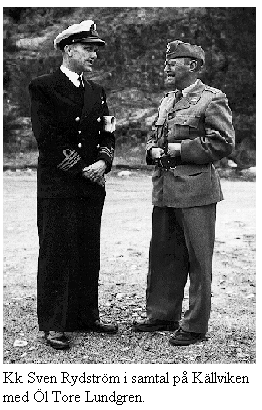
Commander Sven Rydström was sometimes there and supervised the teaching. One time we went together into the officers' mess at AUS (Army Intelligence and Staff School). The mess in Uppsala is a venerable establishment with all military insignia on the walls, and from the ceiling hung a chandelier consisting of bayonets from m96 rifles. The furniture consisted of large leather armchairs with high backs that completely hid those sitting and dampened sound. When we came in, we therefore saw no one and thought the mess was empty. Most premises where many people gather get a completely characteristic own smell; guard rooms smell the most. The mess here was no exception. Sven Rydström was a navy man and accustomed to fresh air and sea winds; he stopped on the threshold of the mess and said loudly:
- Damn it, what a smell of soldiers here!
The scraping of boots against the floor was heard, and from one of the sofa groups a couple of lieutenant colonels rose and looked at us with cruel eyes. We chose not to sit near them but formed our own group as far as possible from the "soldiers".
The Association of Military Interpreters had been formed sometime in the early 1950s, was under the Attaché Office, and had Lieutenant Colonel Tore Lundberg as its chief.
In the early 1960s there were many interesting and fascinating "crackpots" in this association, as it comprised people from many different places of the great Russia, Finland, the Baltics, etc. – some names deserve to be mentioned. Among the oldest and most loudmouthed was Boris Palasoff, a former Cossack cornet from the southern part of the old Tsarist Russia. To the annoyance of many, he always stressed the importance of nationalities during interrogations and believed that a Russian should be interrogated in a completely different way than a mountain dweller from e.g. the Caucasus. Many had difficulty with his theories that a mutual aversion exists between these peoples. The Soviet propaganda machine had succeeded in instilling in the outside world the perception that everything was peaceful and that no conflicts occurred between the different peoples, but time and again rather heated discussions arose on this topic, and later events would more than confirm Boris's theories about the aversion of the various nationalities toward each other. He who laughs last laughs best. With hindsight, one sees that Boris Palasoff was right. I myself held certain opinions diverging from Boris's theories, and Jan-Åke Bergh often recalls his first encounter with the military interpreters in the basement of the Air Force Staff, where Boris and I are said to have stood for a rather animated discussion.
After an interpretation at the Frunze Academy in Leningrad on 730612, I received a gift in the form of a book titled Акмия Советская – The Soviet Army, and on page 434 one can read the following passage:
Благодаря ленинской национальной политики Советская страна предстваляет собой настоящее братское сотрудничество народов в системе единого государства. Советский строй навсегда уничтоживший наациональную вражду, соединил узами братской дружбы все нации и народности нашей страны.
Фашистские захватчики стремились расколоть дружую семью советских народов. Но они плохо знали советских людей, и все их коварные планы были спрокинуты самой жизнью, всей советской действительностью
Советская Армия всегда олицетворила собой великую дружбу всех национальностей страны
Thanks to the Leninist national Soviet policy, there is now a truly fraternal cooperation between the peoples in the united state system.
The fascist conquerors sought to drive a wedge into the fraternal Soviet family of peoples. But they knew the Soviet man poorly, and all their treacherous plans were overturned by life itself, by the entire Soviet reality.
The Soviet Army has personified the grand friendship between the nationalities throughout the country.
”"Sic transit gloria mundi", say the Latins. Thus passes worldly glory.
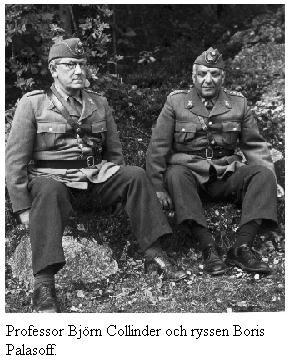
Boris was boisterous and extremely dominant, but had a lot of humor and admitted on one occasion that he bore a certain resemblance to the TV character Fred Flintstone (one of the first TV series in the 60s). He rumbled outwardly but at home he was as meek as a lamb, and it was Mrs. Helvi who called the shots.
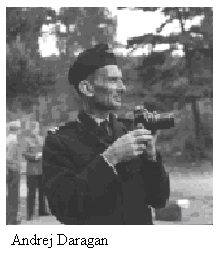
The always correct and knowledgeable Andrej Daragan was, to a certain extent, a counterpoint to Boris. A rather pedantic and meticulous person, who said to Jan-Åke Bergh that he was far too lazy to be sloppy. Andrej had, together with Bill Belaeff, experienced World War II as an interrogator in the Finnish Army on the Svir and Rukajärvi fronts. He was generally considered the authority who could rely on the greatest experience and who best knew how a successful prisoner interrogation should be conducted. He was a civilian economist, but made his living in Sweden through translation work in his D-bureau in Nockeby. In Finland, he was among those whom the Russians demanded back after the war, and he would have been repatriated to the Soviet Union along with many others. His brother was kidnapped during the Soviet-backed communist period in Finland (completely illegally under Finnish law) together with 19 other people; these had to spend several years in Soviet prisons before the day of liberation came. However, not for all; some had already left this world due to the harsh conditions in Soviet prison camps. Andrej had met his brother, who after liberation worked for a company that traded with the Russians. The brother then told him that in prison they practiced multiplying multi-digit numbers from memory and solving equations in their heads. All to not lose intellectual strength.
Andrej was of Baltic landed gentry descent, and there is said to have been a railway stop between St. Petersburg and Warsaw named "Daragan", where the train stopped when the landowner needed to take the train.
Bill Belaeff, a brother-in-arms of Andrej, belonged to the Vyborg Russians. His father had been the owner of a timber industry in Suojärvi, the borderland between Finland and Russia, and in the years 1943-44, when passing Suojärvi station on the road between Petrozavodsk and Finland, one could still see the somewhat faded name on one of the factory buildings. Bill was a fine man, always proper, primly and somewhat snobbishly dressed, but his wives (he was married three times) complained that he was dressed that way even when repairing cars or copying color pictures in the photo lab - in a white shirt and tie. Bill wasn't much for sports and "sweaty" exercises.
Running is for horses, dogs, and farmhands, Bill used to say.
And Bill, a heaven-sent poseur, but also a true enigma,
among aviation terms, an elegant flâneur, on free time pottering with golf balls.
For the women, a charming charmer
which is said to make them (it should rhyme with enigma) cry bitterly
You come in the mist and disappear in stealth. (From "With Words as Weapons")
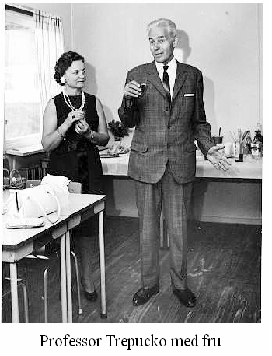
- JTR800817 Prof. Trepucko sings about the "Mad Organ Grinder" (an emigrant song)
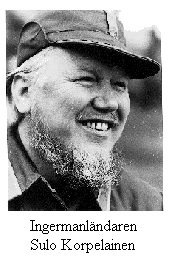
During one of Professor Josef Trepucko's many interesting lectures regarding population movements within the Soviet Union, Sulo Korpelainen came in just when Josef had uttered something like the "demographic" distribution of the Soviet population. Sulo had only heard half and now raised his voice in protest. He had understood that Josef had spoken about "folk democratic" etc. in the Soviet Union and that did not compute with Sulo. Sulo was a pastor's son; his father had been imprisoned already at the end of the 1930s 1 (in August 1937) and met an unknown fate; the family never heard anything from him. Sulo came to Finland (and later to Sweden) together with his mother and grandmother. For a time in Borås we lived as neighbors with them; my wife Ann-Marie had an apartment on Kyrkogårdsgatan and the Korpelainens lived facing Åkerigatan. There was a courtyard between the houses, and Sulo Korpelainen's wife Terttu would occasionally run up to Ann-Mari for a chat.
Josef Trepucko was a very timid and knowledgeable man, professor at the Slavic Institution at Uppsala University, but in the family his wife Helena ruled, a Polish noblewoman with a voice that could cut glass - high and piercing. Only when she spoke to the family's cocker spaniel (or Alex Potocki, who was the head of the Polish nobility in Sweden) did she lower both volume and pitch. She still retained old aristocratic manners and at Källviken they called her "Princess". She drove the car and the dog sat next to her in the front seat while Josef contented himself with the back seat, where he could be alone with his books.
Jim Beláew, my brother-in-arms from the 2nd Jaeger Regiment's music corps in Finland and brother of Bill Belaeff, also ended up with the Military Interpreters. Jim was Russian and spoke Russian better than most of us. Before the war he had studied music at the Vyborg Conservatory and over time became a very skilled violinist, but somewhere along the way a discrepancy arose between him and music, whereupon the latter was abandoned in favor of banking. He moved to Sweden about a year before me, and it probably would not have been difficult for him to become a professional musician, but certain circumstances evidently caused him to change his life path.
Towards the end of the war, when we were stationed in Kuopio, Jim played together with Erkki Inkinen at the Kuopio Hotel, and there were many ladies who got something strange in their eyes when Jim struck up "Hungaria" on his violin. Jim was always very careful in his choice of clothing, well-combed, well-groomed, and tidy – a true Adonis. Women had difficulty tearing their eyes away from him. Jim was in good company; Erkki Inkinen was of the same ilk, except that he did not look like an Adonis, as Jim did in his youth. When we were stationed in Tampere for funerals in Messukyla, Iris (later his first wife) was a constant guest from her photo studio in St. Michel. When we didn't have a funeral, where we were to play in the afternoon, we were free and could bathe in Lake Pyhäjärvi, which lay just below the city.
As a banker, Jim was not so well versed in technical matters, but he still managed to become an air interpreter (the uniform was much nicer), even if it could have its downsides at times.
At one of the parties, Harriet (his third wife) happened to knock over a wine bottle, and Jim scolded her. I couldn't help but take Harriet's side (Harriet is quite tall, and some movements become a bit clumsy). This was highly disapproved of by Jim – such interference in family affairs! He became very cross with me and did not speak to me for several days.
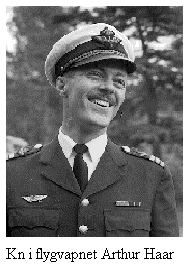
Arthur Haar was the course director at the time and thought it was bad that two old friends should be at odds with each other. Both Jim and I were part of the air group, and Arthur said he would see to it that we became friends again.
"On the next training exercise, Jim will become group leader of the group you will be part of. The task will be too difficult for a non-technician, and then he will be forced to turn to you," said Arthur. It went as Arthur had intended, and since then we have not had any major controversies. My relationship with Jim is probably the closest one can come without being blood brothers.
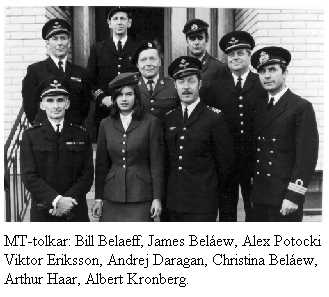
Arthur Haar, belonging to the Viborg Russians, was a model of the true gentleman: correct, polite, and accommodating – loved by both women and men – a rare combination. He was of "mixed descent", if I remember correctly – English-Swiss. Unfortunately, he passed away far too early.
On April 19, 1980, we celebrated his 50th birthday, and in September of the same year we were at his funeral. He had a brain tumor. At first, they planned to operate on the tumor through one eye, but the growth progressed so rapidly that the operation never took place. His normally very correct and stringent manner disappeared during the illness; according to his wife Gunvor, he became mean, foul-mouthed, and unmanageable in the final stage of the disease.
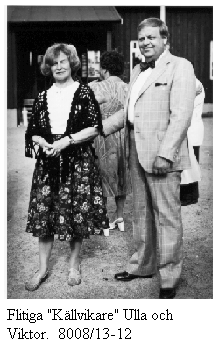
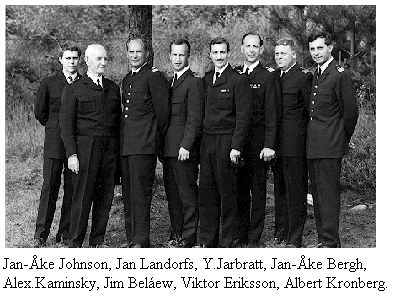
My long-time colleague at Studsvik, Viktor Eriksson, also has a reputation as a great car enthusiast, but rarely or never has a vehicle worth the name to drive. He is a big Dyna-Panhard admirer (aluminum body – it's like an infatuation that only looks at the legs), but most of these French cars are in such miserable condition that they couldn't have been fixed. Not with the energy that Viktor possesses (or rather lacks). Before Hans-Uno Eng, one of the colleagues at Studsvik, bought his Volvo Amazon, he was once going to Stockholm in one of Viktor's "coffins", a Fiat 600. One cold autumn day, they were to make the trip in one of these temporarily functioning cars (which naturally lacked any heating system, or else it didn't work). To keep his feet warm, Hans-Uno had wrapped several copies of Svenska Dagbladet around his legs. In Vagnhärad, Viktor was going out to buy hot dogs at the kiosk. Hans-Uno followed and naturally attracted some justified attention with his original foot covering, which greatly annoyed Viktor. Like most "prim people" (whether male or female), Viktor is also very touchy. He took offense and felt that Hans-Uno's expressions of humor could stay within somewhat narrower bounds.
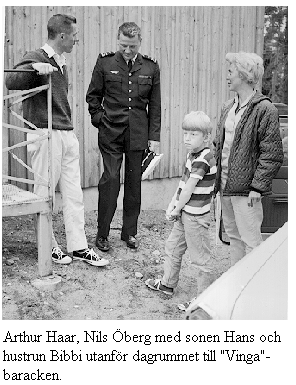
During most of my service with the Military Interpreters, we had Nils Öberg as the interpreter officer. There are different opinions about him as an interpreter officer; for example, Nils did not speak any Russian, but that was not necessarily an obstacle to holding the position. Nisse could organize – and more than most. Apparently, he had good contacts at the top, and under his leadership, the Military Interpreter Association likely had its best days. Nils was an enthusiast and always knew where money for exercises could be obtained; there was no shortage of training opportunities for those who wanted to improve their Russian or participate in some maneuver. Sometimes I had a feeling that I was a favorite of Nils's. It was probably not only thanks to my knowledge of Russian and the fact that I could usually free myself from work that I attended all the naval and air force visits both here in the country and partly also in the Soviet Union. Moreover, I was in high favor with his wife Bibbi; she liked my Russian songs. Bibbi herself plays the accordion, but reportedly was not allowed to do so except in the garage. Nils is a trained organist, but ended up in the Air Force. That's how it is with our fates; you never know where you'll end up.
I thought Nisse Öberg was a playing card manufacturer
but the flight captain came in a Capri quite gallantly
And you have done everything so clearly clever.
A man who steps up,
a man who wants what he has promised
and promises where he wants (From "With Words as Weapons")
Among the camp commanders, many will remember "Kipp Salamander" – Sven Hallgren from I17 and his little Stina with her two small "lamp brush" dogs. With them, she had to go out very early in the mornings because dogs were forbidden in the camp. (Some others also broke the ban, including Helena Trepucko).
Stina kept an eye on Sven, except once when she wasn't there. There were too many sips of wine and beer. We had had a prawn party as usual, sat on the hill and danced afterwards in the Lecture Barracks.
- Around 11 PM, the canteen keepers usually opened the shop, and all the dancers gathered there to drink beer and socialize. Now that Sven was the sole master on the deck, many wanted to buy him a beer; normally Stina would gently steer away any offers she felt exceeded moderate consumption. Sven was accommodating; he didn't want to hurt anyone by declining the offer, so he drank and became quite tipsy. I happened to be sitting next to him at the end of the table. From the heat, the beer, and the general noise with music and song, Sven became so drowsy that he began to look unsteady. Kerstin Lång, the female motor corps member, happened to be sitting opposite me on the other side of Sven, and we both exchanged glances and to some extent realized the seriousness of the situation. Something had to be done to save Sven from the disgrace of being seen drunk, so I said to Sven:
- Come take a walk with Kerstin and me; we could use some fresh air!
Sven did not protest. We took Sven by each arm and went out into the fresh air as if nothing had happened. It didn't seem like anyone had noticed anything special. From the canteen we continued to the Operations Barracks where Sven had his room. He didn't object when we tried to help him into the room but let himself be willingly led all the way to the bed, though he didn't want any help undressing. The situation was under control, and we could return to the canteen and later to the dance n.
On courses with so many different people, there are always a number of talents who can amuse the rest of us with their performances. One of these was Hans Kimberg, originally from the Baltics and working as a secondary school teacher in Visby. He had German ancestry and often performed by reading "Sov du lilla videung...." as the various nationalities would have done in their respective languages. No one remained unmoved by Kim's recitations; he was skilled in phonetics and hit the different speech sounds spot on. No one was left in doubt that a Russian, a Frenchman, a German, or a Finn would have read it exactly that way.
Now and then he replaced "Lilla videung" with an imitation of Hitler; that was no worse.
We had Vjatjeslav Netjaeff, a Russian who played not only balalaika excellently but also theater. He was a skilled actor and gave real theater performances when he was to act as a prisoner of war. In civilian life, Vjatjeslav worked as a skin buyer; he was from Siberia and knowledgeable about fur animals. It was almost always the case that the oldest and most linguistically proficient got to act as prisoners in these war games.
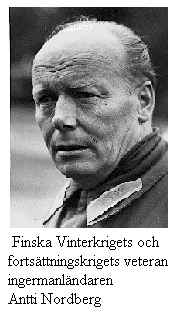
A long-time fighter on the barricades was Fred Oddner; he used to be down at the beach early in the morning; he and Antti Nordberg were the real bathers, both in the sauna and out in the sea. Fred was a good marksman and usually had the luck to win the shooting competitions, to the annoyance of the others.
The know-it-all Mordarsky was a skilled electrician but otherwise a character unto himself. Being of Polish origin, he could even take on discussing linguistic matters with Professor Trepucko, but naturally came up short in the argument. He could explain everything (and did so). If you asked him what time it was, he would start with the history of clocks, and only after a few prompts could he get to the requested matter.
Lars Arvidsson, the lawyer and rent councilor, was politically dark blue and had a very strictly marked boundary against the left. One of the somewhat left-leaning military interpreters (such existed too, even if they were not many and usually disappeared from our rolls fairly quickly) invited his wife Barbro to dance. Lars went up to the couple, pulled Barbro away, and said that she should not stoop to dancing with the "Bolsheviks".
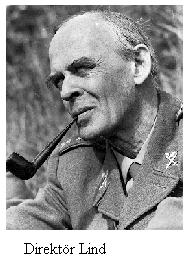
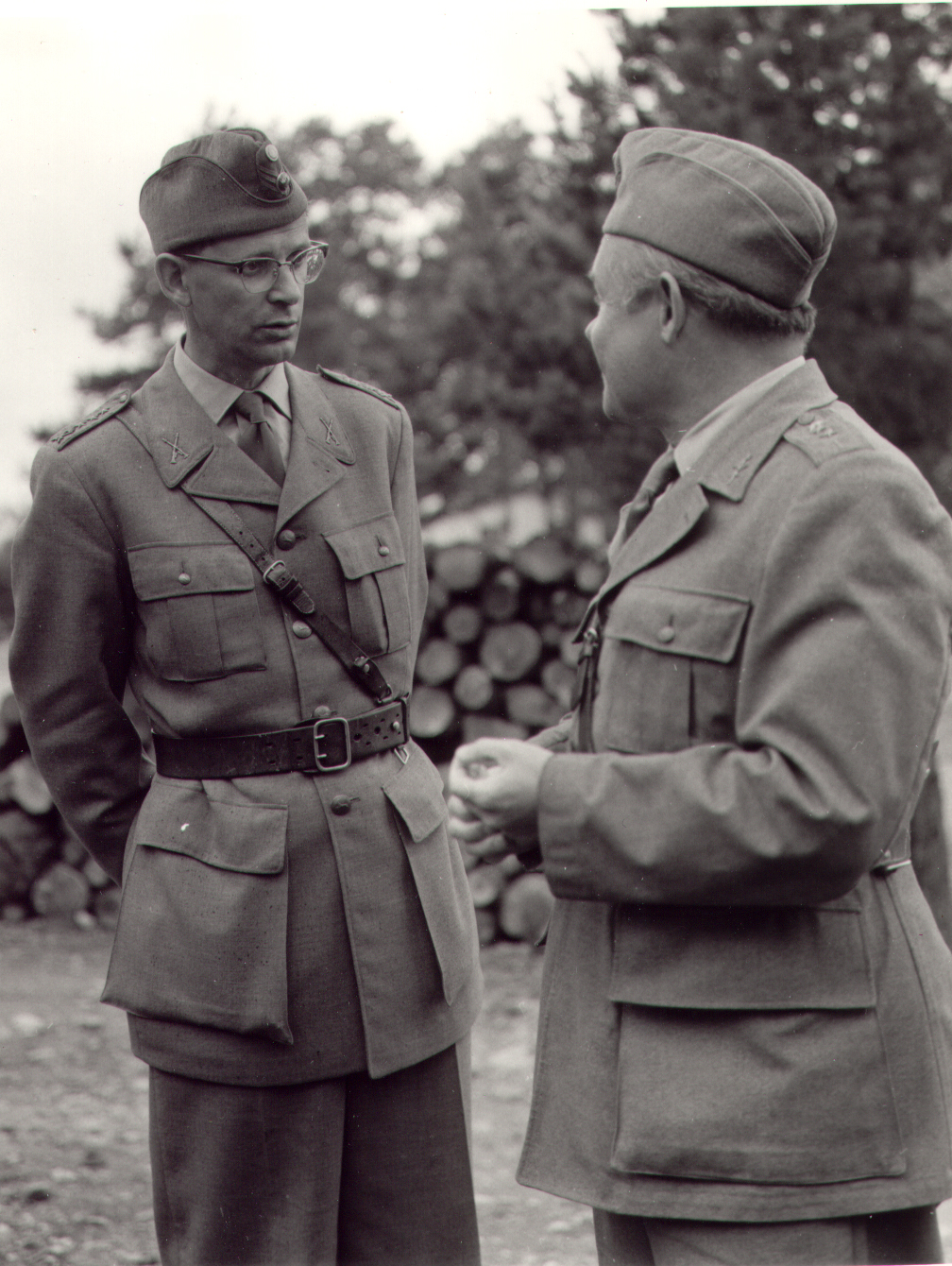
Alex Potocki, count and reserve officer, was one of my great competitors in field competitions and spoke excellent Russian. How it is that he is the head of the Polish noble family, I do not know? His first wife Irja, who had been a flight attendant on Finnair, met Alex on a flight from Helsinki to Stockholm. She once said that he was the handsomest man she had seen up to then and had decided on the spot to take care of him. Alex was apparently not slow to catch on, and they got married, though not for all time. After a few years of marriage and four children, when the children were half-grown, they divorced, and nowadays they are cohabiting or remarried separately. Love is constant; it is only the object that changes.
One of the earlier camp quartermasters, Ingvar Olsson, was not quite used to people not always obeying him. He was a real "soldier" and naturally came up short in this illustrious collection of extremely independent, experienced, and strong-willed types. It was not the same as commanding conscripts. He had probably harbored a certain aversion to the interpreter course, which he had not managed to combat in the usual soldierly manner. The opportunity to deal with us came when Captain Berndt Eriksson from I17 came to Källviken to serve as camp commander. Olsson had succeeded in convincing Berndt Eriksson how badly things stood at Källviken, and Eriksson, who was apparently too naive and gullible, set out to rectify the situation.
At first, we noticed nothing; everything seemed as usual. We had our prawn parties and other amusements – just like all previous years. The "bomb" exploded at the final briefing on the Saturday before we were to leave the course and go home. Then Berndt pulled out a notebook with black covers and listed all our sins that he had recorded there. We had behaved badly, not helped with table setting for the parties (which were not handled by the Lotta girls), etc. There was no end to all the transgressions we had committed.
That was not quite true. I was the club master and asked for the floor. I pointed out that we had indeed offered both him and his wife help with this and that in preparation for the party, just as we had done in previous years, but that the offers were declined. Eriksson, however, interrupted the meeting, left the premises, and there we stood, if not thunderstruck, then at least greatly surprised.
I had a feeling that there was a real "fox" buried here and ran out to find Olsson, whom we considered to be the instigator of the disagreements. We did not consider Eriksson to blame for this; he had only been too naive and compliant and happened to become a henchman to the camp intendant Olsson, but Olsson was nowhere to be found.
The course directors, with Nis Öberg, brought in "higher powers" and Olsson disappeared forever from Källviken's horizon. I later had a good relationship with Berndt Eriksson; the girls (our Maria and his Eva) enjoyed each other's company in the summers. They wrote to each other and I also exchanged a few letters with Berndt; he acted as a kind of correspondent for "Bohuslänningen" and used to send me articles about the Källviken events.
In such a disparate collection of people, there are always some who become more prominent, especially if they can handle some instrument. In the 60s we had the northerner Välivaara from Umeå and the Hungarian-born director musices at Bromma Secondary School, Janosc Sandor. Välivaara played the accordion and Sandor could play several instruments, but the accordion was common to both, so we could dance to live music in the lesson barrack. Sandor also played the violin, and I still remember how he performed a very virtuosic piece called "The Violin Maker from Cremona" to an accompaniment previously recorded on a tape recorder. I have never heard that piece before or since. Could it have been his own composition?
Stig-Åby Eriksson, one of the teachers at the Intelligence School in Skövde, lodged for several years in the "veranda room" of the Operations barrack. The veranda became a real "hangout" for cheerful types, where people gathered for a drink both before and after meals. Stig came from S3 and was a "horse man". At some lectures that I gave in Skövde at Öl Hammarberg's request for conscripted intelligence officers, we once had a party in the former stables, where Stig-Åby's horse stall now served as a bar. There we drank "The Horse's Toast", standing with one foot on a chair and the other on the table, together with him and Major Uno Boman. Before the lecture, Uno treated all the intelligence officers to a "cultural event"; we drove around Västergötland and looked at both churches and poor quarters. Kungslena Church has a remarkable painting: one sees the Evil One stirring a pot in which five men are located. The fire burns under the pot and the men's faces are somewhat distorted, but very recognizable.
Uno told the story of the painting:
A church painter during one of the previous centuries had been commissioned to do certain painting work in the church. When the work was completed, however, the church council refused to pay the requested price, and as revenge the artist painted the aforementioned picture. The people served by the Evil One were members of the church council. The painting had been painted over and was uncovered during restoration a few years ago. Västergötland and the area around Ekorrne Tå have been the site of many battles in bygone days, and Major Uno spoke of these "übermensch" men from Västergötland who had taken part in the battles. In Ekorrne Tå one could also see the last remnants of former times' (up to the 40s) poor relief. There stood some small hut-like houses that had housed tenants long after World War II. It was before the "folkhem" (people's home) began to take shape and conditions improved. In 1970 a new star rose on the musical horizon, when Jan-Åke Bergh came as course director for the Air Interpreters. Together with Arthur Haar, he had studied Russian for Andrej Daragan at the Försvarets Läroverk (Defence School) in Uppsala and thought that now it was time to try the language in practice. Jåke (as he was commonly called) was a person gifted in several respects. Not only did he bring an accordion and handle it with great skill, he was also good at drawing, and the lessons in aircraft recognition never became tedious. Some of the formalism disappeared because Jåke had as his motto:
- Rules are for idiots and to some extent a support for the rest.
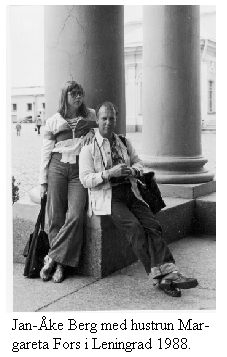
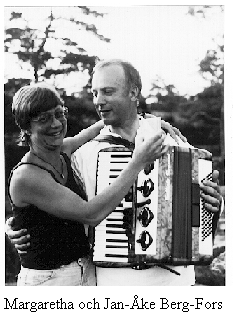
Now there was a real injection into the entertainment life; we spent many pleasant hours on the veranda of the Operations barrack (later renamed Rossö). The room behind the veranda, where Stig Åby-Eriksson had lodged for several years, was taken over by Jåke and his wife Margareta, and life continued at the same cheerful and relaxed pace.
Both Jåke and Arthur were eventually placed at the staff in Stockholm, but as former F11 division chiefs they carried out their obligatory flights in Nyköping. Often they were at Ann-Marie's and my place in the evening, and we had a few drinks and something else good that Ann-Marie had prepared.
The leadership of the Interpreter School mostly participated in the camp, and in later years they also brought some practical teaching material (a language laboratory) where the students could practice their Russian. At the end of the 1960s, when the idea of acquiring a language laboratory became current, Sigurd "Sigge" Lindqvist was (according to reports) very much against it. Sigge was a skilled linguist (a real language giant with about 10 languages in his repertoire) and began studying Farsi at a mature age. He was, however, a proponent of the outdated teaching method, where much effort was put into learning the written language, but less attention was paid to pronunciation. They emphasized palatalization too much, and that could create somewhat peculiar effects in the pronunciation of some difficult words. For the rest, Sigge is one of the most linguistically gifted and interested persons. He was quick-witted and knowledgeable as few; over the years, the students at the Interpreter School have collected a number of "siggisms", expressions that were perceived as something out of the ordinary. During the review of language tests in the summer course, no one wanted to miss the dissection of the students' handling of Russian that Sigge used to undertake, where one often had great difficulty keeping from laughing. Sometimes it happened that he told about his travels, and whoever has heard how it went on a trip from Belgrade to Munich where Sigge was to act as babysitter for a Yugoslavian guest worker's wife with child and belongings on her way to her "Gastarbeiter" husband, will not forget it. Another of Sigge's stories was "The Plank"; he told it in a Finland-Swedish dialect and no one needed to fall asleep during that performance.
From their inferior position, there were surely some who hated and feared Sigge Lindqvist and saw in him a sarcastic slave driver. Those who felt more secure in the saddle could perhaps better appreciate Sigge's superb knowledge of human nature, wonderful mood, sparkling storytelling ability, and excellent social talents. Certainly these qualities came to best light in private life, at the mess, and in the staff room, but they were by no means filtered out by the classroom door. The classroom was otherwise primarily the place for developing the special Sgge-pedagogy, for the practice of which all other technical aids than the blackboard and chalk were superfluous. Sigge seemed to harbor a sublime contempt for exaggerated audio-visual methods and refused to understand that "to learn that cow is korova, you not only need to see a picture of a cow but also hear it moo!" Surely Sigge today has accepted the existence of the language lab at the Interpreter School, but it would surprise me greatly if he himself dealt with it. Chalk should still be delivered to the Interpreter School.
When the question of acquiring a language laboratory for the Interpreter School became current, Öl Berg (head of Air Force Intelligence) and Nils Öberg came down to me in Nyköping and got to see the TBV language laboratory. Nils Öberg was always interested in everything new and wanted to see how a language laboratory works. I was teaching "Swedish for You" for the refugees and could demonstrate the equipment and the approach to language learning. The language laboratory was acquired, and since then no one is known to have protested against it. The language laboratory is an excellent tool both for speeding up learning and improving pronunciation. After the students at the Interpreter School had had a rather miserable pronunciation of Russian, this improved considerably already during the immediately following courses, and today there are many graduated students who speak excellent Russian, within the framework of the instruction they have received.
But, Sigge, you live, among words and learned, stern you stand with furrowed brow.
You lead through the human world, Yes, the interpreter is eternal: he speaks as if anointed
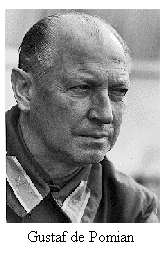
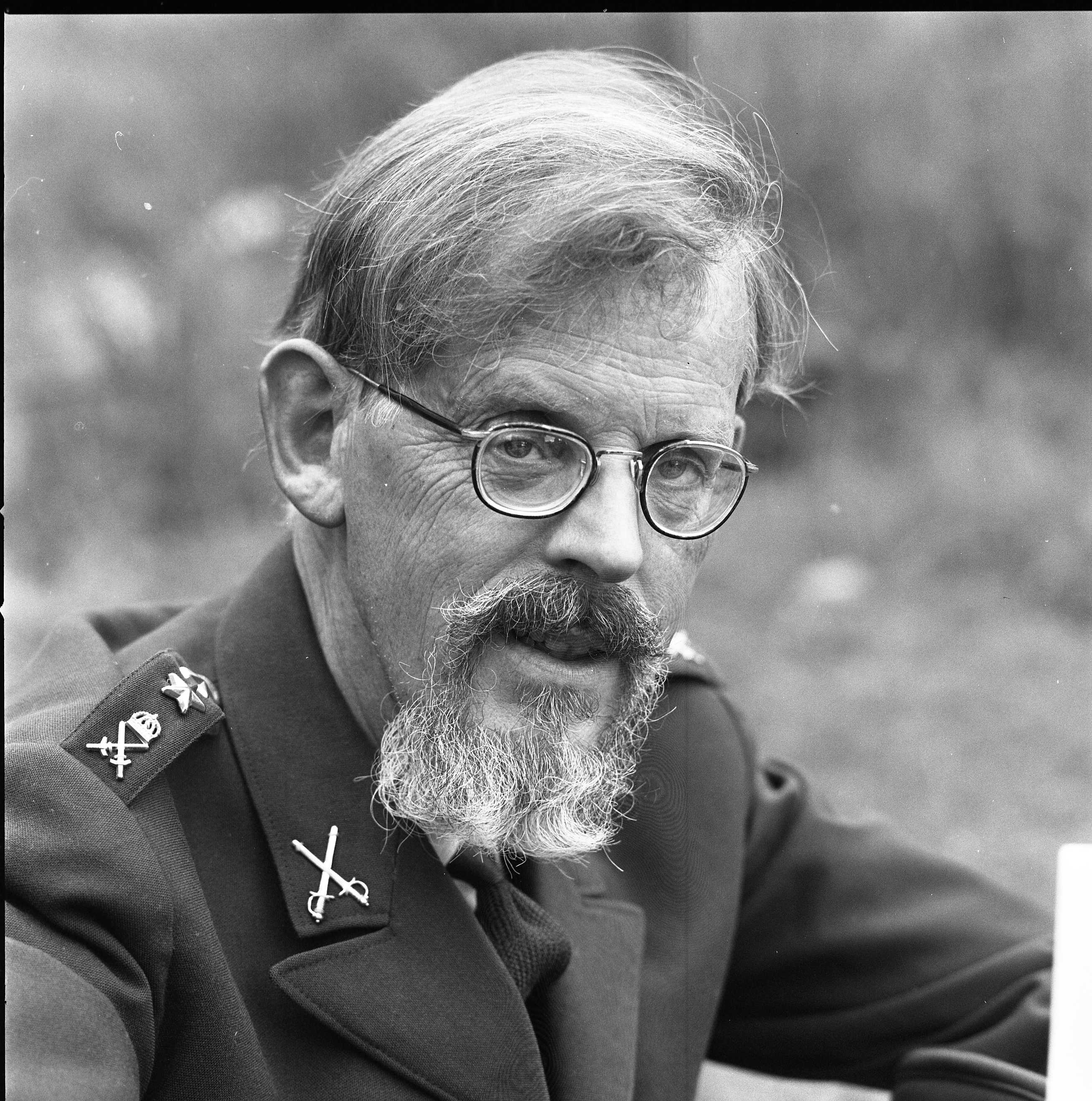
The other truly great linguist was the professor of Finno-Ugric languages at Uppsala University – Björn Collinder. He was the first chairman of the Military Interpreters' Association and, like Sigge Lindquist, very interested in languages. When he retired, he also started a new language – Chinese. During the breaks at the FBU camp in Källviken in the early 1960s, one could see him walking along the road towards Seläter with a small tablet and an ink container and a brush in front of him; there he drew Chinese characters while walking. Björn Collinder translated the Finnish folk epic Kalevala and mastered not only some European languages but also Russian. In his youth he had been on study trips to the Siberian peoples of Finno-Ugric origin: Nenets, Oleners, etc. A very learned man and a great humorist; his lectures were extraordinarily interesting and well-formulated.
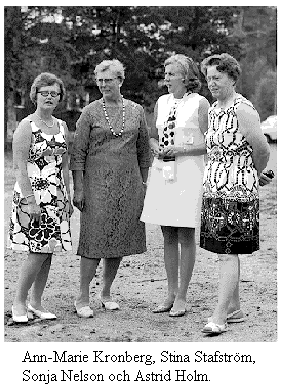
Of the female staff during the first years in Källviken two ladies stand out in a clear light: Astrid Holm – car corps member and Stina Stafström – Nils Öberg's long-time secretary at Fst/und. Stina got a worthy successor in Gulli Jacobsson while Astrid Holm was replaced by several car corps members from Fo 34 in Vänersborg. There they thought it was not entirely right that when the rest of the supply of the camp came from Vänersborg they had car corps members from Stockholm. From Vänersborg also came two other, very loyal girls to the interpreter course: Kerstin Lång and Gun-Britt Karlsson. Pure family scenes played out in front of the expedition barracks when the course was to start and the participants were to greet each other. The reunion was to say the least heartfelt. The farewells were no less dramatic –
Partir - c'est mourir un peu....
С´est mourir à ce qu´on aime.
On laisse un peu de soi-méme
En toute heure et dans tout lieu.
Kerstin Lång was a great exercise enthusiast. I also engaged in certain athletic exercises; I ran daily, once or usually twice, the 2.5 km "mountain track". The first round was usually at 6 in the morning and very often I had company with Kerstin, though not on the "mountain track", then we took more normal roads towards the shooting range. The other course participants were not as morning-active, except for the Lund resident Holmqvist, but he was of a younger age and ran a bit too fast for me. As I have already mentioned, the "warrior band" was of extremely varied composition; it was some kind of semi-military association with intellectual elements, but without any greater understanding of military discipline and behavior.
There was no morning formation that could be described as standardized; anything could happen - and usually did.
Many of the older interpreters surely remember the Hungarian and music director Sandor's report. He was something of a bohemian and often appeared in mixed clothing and with only sandals, without socks, on his feet. He was to report the interpreter course to Lieutenant Colonel Tore Lundberg:
Lieutenant Colonel! The interpreter course …
Then he got no further; there was a general pause. He stood there before the troops with his hand to his cap visor and had forgotten how the rest of the report phraseology went. When the silence after a long wait became too noticeable, he did an about-face and commanded:
- All men! At ease!
Most leaders realized the lack of 'military matters' at a fairly early stage and made no major efforts to change the situation, but exceptions occurred.
Lieutenant Colonel Hammarberg from the Intelligence School in Skövde once did a rash act in the form of commanding a march from the weapons depot to the shooting range in closed formation. None of the officers had done that in living memory. We were to shoot with submachine guns and he challenged us to a competition. That would go well, if we got to decide the prize, because no one had any illusion of having a reasonable chance against him. He was one of the officers who (according to rumor) had gone through St. Cyr in France and had been one of the few Swedish officers in the Foreign Legion; there are not many of those. A real 'warrior' in other words, not to use a term from military jargon – 'fighting c...'.
Of course he won, with a good margin, and after the shooting we sat down on the ground to think of a suitable prize. We knew that through many years' stay in France he had become a connoisseur of noble drinks, but a reward in the form of something like a bottle of fine wine could not be considered here; he had 'insulted' the group by commanding closed formation.
- No! Here something else had to be thought up.
In the evening a crayfish party was to take place up on the mountain and then the prize would be handed over. The student David Ivarsson was tasked with handing over the victory prize. After a somewhat forced speech with solemn phrases about the noble art of shooting, the prize was presented. It was a bottle of pilsner, class I, warmed to a suitable body temperature in David's inner pocket. We knew of his disapproval of too weak drinks; he grimaced properly, but here it was a matter of putting a good face on a bad game and he drank the whole bottle amid general cheers.
To the question of whether he wanted another bottle, the answer was no.
Inserted into the second week's program we had a military field competition. Some of the regular events were exchanged with regard to the nature of the training and we had a couple of competition events of a more intellectual character. It was naturally about Russia, its language and about Russian conditions. Since I mastered Russian relatively well (despite many years of fallow) and was good in certain competition events, I could in many cases bring home good placements. The visible proofs of this are the challenge prizes in the form of a silver vase and a fascine knife. In the silver vase, which has been donated by CFST/Sekt 2, some of my military interpreter colleagues also have shares (A. Potocki 1967 and 1971, Antti Nordberg 1969 and 1970, I. Rodhe 1968 and A. Hedlund 1972). I won three victories in a row (1973, 1974 and 1975) and became the owner of the silver vase. In the vase that ended up at Antti Nordberg's home I also have two inscriptions and the fascine knife from Ch för Armén was won in field competitions in the years 1980, 1981 and 1983. Shooting, orienteering and Russian have probably been the strongest subjects. Of the four challenge prizes since 1959 I have taken home 2 pieces: a silver vase and a fascine knife.
As a banker, Jim Belaéw was not so well versed in technical matters, but he still managed to become an air interpreter (the uniform was much nicer), even if it could have its sides sometimes.
At one of the parties, Harriet (his third wife) happened to knock over a wine bottle and Jim scolded her in the presence of the other guests. Harriet is quite tall and some movements become somewhat 'awkward'. I could not help taking Harriet's side. This was highly disapproved of by Jim. He became extremely sulky with me and neither spoke nor greeted me for several days.
Arthur Haar was course director at the time and thought it was bad that two old friends should be at odds with each other. Both Jim and I were in the air group and Arthur said he would see to it that we become friends again.
- On the next exercise task, Jim will be group leader in the group that you will be part of. The task will be too difficult for a non-technician and then he will be forced to turn to you, said Arthur. It went as Arthur had thought and since then we have had no major controversies. My relationship with Jim is probably the closest one can come without being blood brothers.
Most course participants were relatively normal people, but one or another fell outside the established norms and put themselves on public display. A couple of cases can be described in more detail.
In Ånn I once was in charge of a ski group that was to go up to Blåhammaren. It was free to ski to Blåhammaren at one's own pace and since Percy was extremely strong, he disappeared from us on the first slope and we did not see him again until we arrived at the station. By then he had already had time to drink coffee and was about to write postcards. Percy's behavior pattern mostly deviated from ours; he never acted like the rest of us. He had already written his manuscripts at the encampment in Ånn and was now copying these works onto postcards. They were not postcards with texts like 'here we are....'
No, he wrote regular letters, but with such small handwriting that the whole letter fit on the small space available on the postcard. He had seized the large table in the middle of the room entirely for his own use; there he had spread out his papers and manuscripts so that no one else could even come near. We were to be back in Storulvån around 17:00 to make it to dinner and I gave the order to start at 16:00; one hour would be enough to reach Storulvån Tourist Station, I figured. The distance is 12 km and Storulvån lies several hundred meters lower in altitude so there would be no time shortage.
Percy was to start somewhat later; he was not yet finished with all his 'novels' on postcards. We thought that was perfectly fine; he was strong and would surely catch up with us after a while and arrive on time, but no one had reckoned with his peculiar behavior. When the rest of us had gathered down at Storulvån, however, we saw no sign of Percy and prepared to wait a while. Time passed but no Percy appeared and we began to get impatient. For a moment I felt like leaving with the rest of the contingent and leaving Percy without transport; he would have to fight his way 17 km to Ånn, but considering it was winter with cold and other dangers, I dared not do it. His sense of direction was not as good as his memory; he would surely get the idea to cut straight across Lake Ånn and then no one knew where he would end up. If a storm were to blow up on the mountain, there was a risk he would get lost and I did not want to be responsible for his life. At long last he came; it did not seem as if he had thought at all about the rest of us waiting for him. Sometimes he was somehow absent from the sensory world - and it got worse over the years.
There were many stories about him, not least about his love affairs. Because when Percy courted a lady, it was truly a courtship, perhaps sometimes in the hardest manner. One summer he cycled 60 km daily to visit a sweetheart who had her summer camp further south of Strömstad; a few years later he brought a lady with him to Källviken. The lady had a half-grown child and that meant Percy was not allowed to sleep in the same room. That summer he spent the nights in the camp's laundry room, in the dayroom, and in various other common areas. Gradually the madness took on increasingly tangible forms; for a while he appeared in the newspaper 'Vår bostad' as one of the worst landlords on Karlavägen. He had inherited a house with 14 apartments and the tenants complained that the landlord listened to the foreign station on the radio at high volume at night and chased his complaining tenants with a saber during the day.
The other strange figure was 'the war-crazy priest', a Finland-Swedish priest from Brännkyrka parish outside Stockholm. Whatever one thinks of priests in general might be left unsaid in this context; this one had probably over-read 'Fänrik Ståls Sägner' or some other similar war epic and instead of sticking to the Bible and its Christian message, he was a worse warrior than all the others. Nils Öberg could apparently not prevent him from coming to the summer course. There were some strange discussions with him. First he claimed that he had been in the Finnish war, but that did not match his age; overall we did not understand his behavior. He was no angel of peace (how many priests are, by the way?). Since he mastered nothing but Finnish, and Finnish became rather obsolete over time, he disappeared after a couple of summers of 'guest appearances' from our horizon.
The students' guest appearances during their free time often extended to Långön on the other side of the sound. In the 60s, a Swedish-American lady ruled there. She had a boarding house and spent her free time building out the stone structures around the house. There were many cemented cobblestone paths and piers. On the way back, certain intermezzos occurred: among other things, it was told that the current head teacher at the Interpreter School, Jan-Erik Walter, fell into the water and came up to the encampment wet as a cat - in a white riding suit and boots with spurs on.
For the children, parties and events are also organized at regular intervals. For a while in the 70s, I was club master and in charge of the children's parties. Children don't need much to be amused, a little sack race, ball games and various similar entertainment. Our then camp leader Berndt Eriksson sometimes gave demonstrations in lifesaving for us. He was chairman of the Swimming and Lifesaving Society and had several times been in charge of Olympic swimmers. One summer we had a bit of such antics. We rowed out with an overloaded rowboat, capsized it in the lake to the great delight of the children while Berndt told how to behave if you involuntarily ended up in the water and what you absolutely should not do. Later we provided Jim Beláew with a life vest and pushed him off the pier to the great cheers of the children. At the children's parties I organized, all children got first prize in competitions, unfortunately it turned out that some mothers considered even their almost adult teenagers as children, and there were some discussions about how far up in age a child should be considered a legitimate participant.
The ever-present Red Cross sisters (and brothers) were at service with medical exercises, and the most diligent among them was "sister Tore". During several summer courses he had "doll Anne" with him and we learned the mouth-to-mouth method. Often, medically trained women from the motor corps also served as Red Cross sisters.
Through Nils Öberg's efforts, I was transferred to the Air Force in 1961 and was frequently employed by the Navy during the "friendship visits" to Soviet port cities: Leningrad, Tallin and Riga. For some strange reason, the Navy has had very few interpreters from its own ranks; it was mostly Antti Nordberg (army interpreter), myself, and Bill Belaieff from the Air Force who had to make most of the trips in connection with the naval visits. On a later occasion, I pointed out this situation to Admiral Rudberg, but no major change seems to have occurred. From 1962 and up to the submarine incident, I participated in all naval visits to the Soviet Union. In 1980 we had acquired a cottage and couldn't afford a telephone, and Gulli (Nils Öberg's secretary) could not call me to interpret for the submarine incident. It began with the destroyer "Öland". Actually, it would have been the destroyers "Halland", "Södermanland" and "Hälsingland", but "Hälsingland" ran aground just before the visit, got its propeller shaft bent and was out of action for a while. Its commander Kk Reutersvärd came along nonetheless. He had been naval attaché in Moscow and told in the gunroom about the game of "hide-and-seek" he had played with Russian surveillance during his attaché period. There was a certain surveillance of the higher military officers until the end of the 70s.
During my first visit to Leningrad, we were not to dock at the quay but hung at the buoys between the Palace Bridge and Lieutenant Schmidt Bridge opposite the Winter Palace and the Wedding Palace. Transport to and from the ships was by a large tugboat, and it was naturally for the purpose of keeping an eye on the foreign power. At first, there was no question of any night liberty; "all hands" had to be on board before midnight. The first naval visits were quite stiff and formal affairs. The mistrust of the other party was very great from both sides, and a warmer atmosphere rarely arose. When the intoxication was over, so was the friendship. I cannot confirm it, but it was claimed from some quarters that when the Swedish Navy had left, all the people who had stood on the quay waving goodbye to us were taken into custody. Night liberty came only during the subsequent trip, two years later. Then we also got out of hanging at the buoys, but it did not happen without complications. Through diplomatic channels it had been agreed that this time the ships would lie at the quay, but when we sailed in between the by then well-known bridges, it seemed the same as the previous visit. For two hours we had the engines running and no one really knew why. With a certain delay we finally came to the quay, moored and began the visits. Later we learned that the local Russians had not wanted to let us come to the quay, but then Admiral Blidberg got angry and said that in that case we would turn the bow downstream and sail back to Sweden.
Now certain other relaxations had also come into effect. The officers had night liberty and did not need to feel like recruits during the first weeks of conscription. Nightlife flourished and some incidents occurred, but none of a serious nature.
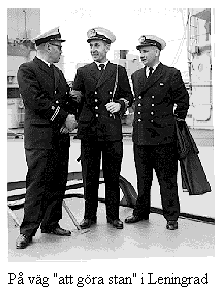
An official visit follows a very detailed procedure. When the ships arrive at a certain city, the contingent commander makes at least three visits: to the highest naval commander in the area, to the person responsible for the military district, and also to the city's mayor. The ceremonies are very strictly regulated and are usually 20 minutes in length. The local commandant provides a vehicle, and the admiral, the flag adjutant, and the interpreter are driven to the various reception points. One is welcomed, then the Swedish admiral proposes a toast to the formal Soviet leader - during my time mostly to the party leader and General Secretary of the Communist Party – Leonid Iljich Brezhnev. The Russians in turn proposed a toast to His Majesty the Swedish king. After a couple of visits, I felt that just translating Brezhnev's name seemed somewhat meager. His official title was approximately: the General Secretary and leader of the Communist Party of the Soviet Union, comrade Leonid Iljich Brezhnev. Sometimes one of the military officers also added: Hero of the Soviet Union. It became quite a lengthy harangue to translate, but I took the trouble to recite the entire title. When a toast was proposed for the king, it was only: for His Majesty Karl XVI Gustav. The adjutant's task was (as he himself put it) to ensure that the admiral appeared at the right place, at the right time, and was provided with the correct documents and speeches. A couple of minutes before the stipulated time expired, the adjutant whispered in the admiral's ear that it was time to prepare the farewell phrases and depart.
The same procedure was repeated two more times: at the highest army commander on site and at the city's mayor (municipal chairman). A couple of hours later, the same procedure was repeated with return visits by the Russians to the ship. Then the sightseeing and museum visits began for officers and crew. We made small provocations, such as getting to speak with a survivor from the cruiser "Aurora", well aware of the historical events that had taken place in 1922. The sailors made a new uprising, but were mostly shot down on the ice of the Gulf of Finland in their attempts to escape.
My first naval visit in 1962 became very memorable for "Öland"s part. On the return trip, an incident occurred that could have ended badly, but thanks to the crew being well-trained and the weather good, the event had a happy ending.
I was in my cabin and the ship was off Helsinki when shouting and noise were heard from the deck. I went up on deck and saw a sailor from the engine room, he stood with a stanchion in his hand and seemed somewhat undecided. The deck watch was in a ready position and a bit further away I saw the second-in-command. On all military units, there is an armed deck watch and he is usually stationed mostly on the afterdeck, where there is the most space. Now his presence would possibly be called upon by the second-in-command. Suddenly the latter calls out:
- Drop the stanchion and give yourself up, or I'll command fire!
By this time several people had heard the commotion and many had come up on deck. The man looked alternately at the gathered crowd and at the sea, and it was clearly visible that he was very hesitant about what to do. Suddenly he swung his arm and we saw the stanchion fly off and land in the water, after which he himself took a good run-up, ran in the direction of the starboard quarter and with an elegant swan dive jumped off the ship. When he came back up to the surface after the dive, he waved to us.
- Man overboard! shouted the deck watch, all in accordance with his instructions, rushed to the lifebuoy and threw down both it and the buoy with the flag, which is attached to the buoy.
After the cry of man overboard fades, a lot happens on the ship - and to the ship. Everyone not involved in the direct action searches for the lifebuoy with the flag buoy. A human head disappears very quickly from sight even at a moderate wave height and would in most cases be impossible to spot without the nearby floating lifebuoy, which the distressed person should try to grab. The ship's course is changed for a full turn and the lifeboat crew in the watch rushes to the lifeboat and begins to make it ready for launching. In wartime, one launches the lifeboat at a certain speed, but in peacetime one does not want to take such risks; the lifeboat and its crew can easily be damaged. They wait until the speed is practically zero before the davit machinery is started to lower the boat. The helmsman put the destroyer's rudder hard to starboard, which meant that the ship heeled considerably. Since the ship was not prepared for such a sharp turn, not all hatches were closed. At the far aft on the port side, the mine and artillery officers were quartered; their cabins filled with water up to the raised thresholds, and a lot of paper and other buoyant objects were washed into the water and from there out into the passage, as the doors were also open due to the heat.
In the meantime, we had gone around and were near the lifebuoy. The launch was manned and launched; we saw the sailor, he had put the lifebuoy ring on himself and waved cheerfully at the crew in the rescue boat. After a while they reached him and took him into the boat. When the rescue boat returned to the ship's side, the torpedo recovery hook was lowered, a harness was put around the man and he was pulled up. When the crane was swung in, the ship's doctor was opportunely nearby and gave him an injection in the backside. By that time the sailor was quite chilled; the water temperature was around 10-12 degrees C and the rescue operation had taken about a quarter of an hour.
- Now he'll be calm until we reach Hårsfjärden, said the ship's doctor. The sailor was put under arrest in the sickbay and was not allowed out anymore; we had about 12 hours of steaming time left to the harbor.
When most of the commotion had subsided, we heard the backstory of the event.
The seaman came from the engine room and was an overager in his late twenties. He had sailed abroad and not done his military service. When he then came to Sweden, the conscription authorities took charge of him and, like others, he had to do military service and was placed in the Navy. Being overage and having sailed abroad, he had acquired certain (bad) habits. The crew is forbidden to have alcohol on board, but despite the duty officer's "search", he had managed to smuggle a couple of liters. This had been consumed in the crew's quarters, and in an intoxicated state, some grudges against the officers had come to light. Encouraged by his comrades, he had grabbed a Mora knife and was going to settle things with Boatswain's Mate NN, who had insulted him on some occasion.
Once up on deck, he had encountered the Boatswain himself, a person with a certain authority and apparently used to handling his men; he had managed to persuade the seaman not to bother about the Boatswain's Mate but to leave him alone. The story could have ended there, but back in the crew's mess, the comrades had begun to taunt the seaman and he had become angry again. He had gone up on deck once more, and since he no longer had a knife, he grabbed the first available tool, which happened to be a gangway support. These were stored under the torpedo tubes on the main deck of a ship of the "Öland" type.
This time, the second-in-command happened to be on deck, and the story turned out differently than the seaman had intended.
Something always happened – even if it could not always be described as unforeseen. The visits to these, to say the least, "schnapps-drenched" places Leningrad, Tallinn and Riga often entailed extra work for interpreters and the military police. Alcohol was free and very cheap by Swedish standards, and it was also heavily consumed, but at the same time the norms were fairly liberal – temporarily.
When Admiral Blidberg gathered his men in the Berga schools' auditorium before departure, he used to say:
- We should not be too petty. Any man who can make his way to the ship and come aboard under his own power shall be considered sober.
The abundant supply of cheap liquor brought with it a number of problems, not only on board but perhaps mostly ashore. An interpreter on duty was always to be on board; he could then assist in the most varied assignments.
Once in Tallinn, the interpreter was summoned from the Russian command post. Someone had called there and reported a seaman with blood on his arm – presumably Swedish. The man had no cap and did not speak any comprehensible language (according to the Russians), and he was somewhere on the outskirts of the city. The command post always had a car standing on the quay, and now the interpreter drove with a couple of Russian military police to the given address – and sure enough! It was a Swedish sailor and he looked strange. His right arm was completely bloodied and he also had blood on his face. Upon closer inspection, it turned out that the face was not so bad; he had wiped his face with the bloody hand and smeared himself thoroughly. The hand, however, was worse; there were long cuts and the skin was hanging off in several places.
At first they thought he had been in a fight, but during bandaging in the sick bay it came out that he had caused all these injuries himself. After drinking a bit too much vodka, he had gotten lost and happened to pass a greenhouse at a suitable distance from the sidewalk. He was angry at not finding the harbor, and in passing he smashed some glass panes with his bare hand. When the blood started to flow, he got even angrier and smashed several more.
In Riga, I myself experienced an interlude after a fight. When we went to pick up the brawler, it turned out that he had come off rather badly; his jaw was hanging wide open and he gaped like a cod on dry land. In the fight he had taken a blow and dislocated his jaw. It looked quite comical and we could not help laughing at the misery. We took him to the military hospital in Julgava; the military doctor looked at him for a while and then aimed a blow at his jaw. It snapped back into its joints and the man was restored. The operation succeeded and the man regained his speech, only saying that his jaw ached a bit. It was, in its own way, a refined operation, without too much sophisticated technology involved. The military doctor laughed:
- We have to do that all the time; there is quite a lot of fighting in the Soviet Navy. The Soviet Navy's liberty uniform for enlisted men includes a fairly wide belt with a large brass buckle. In roughhousing, the belt is used as a weapon with quite devastating effect.
The Baltic Fleet Hospital in Julgava was a large facility. According to reports, it could house about 400 patients and had 315 staff – everything from dentists to physiotherapists. When I asked if the hospital was also used as an alcohol clinic, the answer was no. For that purpose, there were other institutions. The hospital had a large dietetics department, and it was certainly needed. The average Russian is a rather short and stocky person; as a soldier, he has a monotonous and boring life, often far out in the periphery of the country. This is compensated for by proper parties when the opportunity arises. The traditional Russian feasts, with lots of food and even more drink, lead to considerable obesity; the officer corps "swells" noticeably after a few years in service. To Julgava they were sent to get rid of their extra kilos and improve their physical condition.
During our stay in Riga, we were to attend a jazz concert by the Baltic Fleet Band, and also watch a football match between the Soviet and Swedish Navies.
The concert was a painful affair. As guests of honor, we sat right at the front under giant loudspeakers. Both the volume and the distortion of the sound system were uncomfortably high; I could not stand the misery and quite rudely tore my handkerchief apart and stuffed some of it in my ears, after which it was easier to endure the event. Jazz is not my favorite music, and in a Russian Navy arrangement with a brass band, it becomes no more enjoyable.
After the concert, we were to watch the football match, and the officers were transported there in the Russian Navy's cars. I sat in the front seat of the Russian commander's large limousine together with Admiral Blidberg, the commander and his wife with their 7-year-old son, the family's status child (caboose child). The admiral was a bit over 50 and the wife a few years younger. It emerged from the conversation that the couple had a couple more children; one of the sons was at a cadet school somewhere in the vast Russia and was to become an officer. The Russian soldier's humor is not of a very sophisticated kind, and the admiral followed the usual pattern. He told one rather crude anecdote after another, and the wife, who held her hands over the son's ears, tried to interrupt him now and then with remarks that the son should not yet hear such stories.
- He might as well get used to it from the start; he is going to be a soldier, said the Russian admiral. Both Admiral Blidberg and I would have liked to cover our ears as well; the stories were very coarse.
The head of the Leningrad Naval District in the year 1978, Admiral Mikhailovsky, was a typical example of an overfed sailor. He was square, literally. If you had cut off his arms and legs, turned his body 90 degrees and then reattached the extremities, you would hardly notice any change. During the visit, I stood together with the Russian liaison officer and my colleague, the Russian interpreter Kk Lanzev, as well as some other Swedish officers on the deck of the Visborg and followed the reception ceremonies down on the quay. Lanzev himself was a very plump person for his age. Suddenly the Russian liaison officer turns to me and asks:
- How is it that your sailors are tall, well-built and have proper proportions? Just look down there, he said, pointing to a group of higher-ranking Russian officers standing on the quay; ours look like a bunch of frogs!
- What shall we say to him, I asked in turn the Swedish escort officer, who happened to be standing next to me.
- Say that the King does not pay us enough for us to eat as much as the Russians. We are, after all, a capitalist country.
Kk Lanzev was the Russians' interpreter and had two or three rows of ribbons on his uniform jacket. I could not curb my curiosity, and in an attempt to be funny, I asked him:
- Tell me, Kk Lanzev, how is it that you, who are much younger and probably have not had the opportunity to take part in the war, have managed to get so many medals? I am 10 years older, have served in the Finnish army (I never hid that) and have only two paltry commemorative medals from the Finns and one single from the Swedes? What have you done to deserve, for example, this medal, I said, pointing to one of the countless ribbons on his uniform jacket.
- That is the 30-year medal for the liberation of Prague, answered Lanzev.
- But you were never in Prague, were you?
- No, but I was in the vicinity when the medals were awarded.
Brezhnev and Göring are said to have been the most decorated medal bearers of all time, but the other Russian officers were not far behind. There was a joke about Brezhnev that I was told on a later occasion, when we had taken a few drinks and lowered our visor flaps:
One Russian asks another.
- Tell me Ivan, where has Comrade Brezhnev been? He hasn't been seen on TV for weeks.
- But Pjotr? Don't you know? He is in the hospital and they are lengthening his ribs to make room for another "Hero of the Soviet Union" medal. These are considered equivalent and must be worn in a row. Brezhnev already had 4 of them, and it was clear that there were difficulties, even given the relatively favorable circumstances of his body width, to fit another one alongside the others.
Admiral of the Soviet Union S. Gorsjkov, who visited Sweden in 1978, had a splendid array of trinkets on the left side of his chest. Only because he was a rather stout person with a large chest and an even larger continuation in the form of an exceptionally large stomach did he have room for all that finery. The ribbons took up an area the size of A4 and covered the entire left chest and half of the abdominal side. During his visit to Sweden, they were housed at the Hotel Stockholm, in its best and most expensive suite, and yet his adjutant, Captain-Lieutenant Kotikov, came one morning wanting hot water – in a thermos.
I conveyed the request to Admiral Bengt Rasin, who was the Swedish host, and he asked me to inquire whether they were not satisfied with the service at the hotel; if so, they should tell him and he would pass it on to the hotel management.
- No, no, replied Kotikov when I had delivered the message, and I could see that he did not want to enter into further discussions. However, I pressed on and after a while it emerged that the water was needed to clean the admiral's uniform coat.
Admiral Gorsjkov had a generously sized waist. His arms, however, had not kept up with the growth; they had become too short in relation to his stomach, and he had certain difficulties in getting his food in without spilling too much. When the "spills" landed on the left side of his chest, where all the ribbons were, it did not matter much. There was already so much colour there that one or another splash of colourful sauce made neither here nor there on the colour scale. The problem was mostly on the right side, which looked a bit bare compared to the left side, and anything that landed there discoloured the fabric of the uniform coat. Well, Kotikov got his water; it was not the service that was at fault.
Russian admirals can be quite amusing. Some of the prominent gentlemen can be mentioned here. In October 1972, Sweden was visited by a delegation from the Baltic Diving and Submarine Rescue Service, headed by Rear Admiral P.P. Eromenko. He was a great storyteller, and we laughed a lot and heartily during that visit. The stories were not exclusively about the area between the navel and the knees, even if most were of that sort. We made a trip to the Karlskrona Diving Centre and took a ride on the submarine rescue ship "Belos". The visit took place in October, and during the "Belos" excursion we thought a sauna would be appropriate. There is one on board – and the heat was turned on. Not many could fit in the sauna at the same time – about 5-6 people – and I was there as interpreter for Commander Jan Sundlöf, then the ship's captain. In the nudity, a very jovial atmosphere arises, and people start telling somewhat daring stories. The Russian officers' repertoire of anecdotes can certainly be quite extensive, but monotonous. For the most part, the plot is set between the navel and the knees – "about that and such", as Ola in school used to say. One of the admiral's stories that I remember was as follows:
The admiral had come into a cadet barracks where the men were competing to see who was strongest in the cock. The winner boasted that he could carry a bucket of water up to the second floor on his cock.
- That's nothing to boast about, said the admiral, even I can do that, despite my age.
The men were about to burst out laughing, but I showed them it was true, said the admiral.
- How did the admiral do it?
- Very simple. I tied my foreskin around the handle of the bucket and went up with the bucket to the second floor, after that no one dared to laugh.
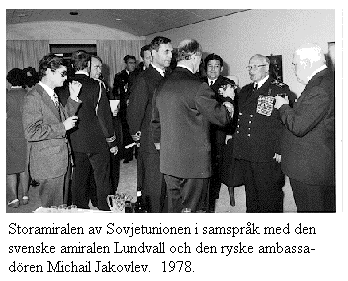
Speaking of admirals, I remember a trip to Tallinn with three destroyers: "Halland", "Södermanland" and "Uppland". Bill Belaeff was along as interpreter on the destroyer Södermanland, and at a reception on the deck of the destroyer Halland, Admiral Smirnova (the wife of the Admiral of the Intendance Troops) took a fancy to Bill. Bill was elegance itself – reservedly charming, polite, and a skilled conversationalist in Russian, being Russian-born. The admiral's wife felt a whiff of the high society, and under the favourable contribution of the party and alcohol to the merriment, she wanted to drink "du-skål" with Bill. In Russia, people address each other with the formal "vy"; informal "ty" was still almost entirely unthinkable in dealings with strangers. They filled their glasses, linked arms, and drank up, after which Bill, according to old Russian custom, threw his glass overboard, and the admiral's wife followed suit with hers. Bill should not have done that. Among those who had witnessed the event was the ship's purser, and he was soon beside Bill. I was standing quite close to the toast-drinkers and heard what the purser had to convey to Bill.
- I just want to point out to Captain Belaeff that the loss of the glasses will be charged to your mess bill at kronor ....
They were not ordinary plain shot glasses; the Navy's anchor and some other insignia were engraved on the glass.
Russian hospitality is well known; among certain visitors it became notorious – it happened that the hosts would try to serve participants from bottles of different alcoholic strengths. This diminished over time and ceased entirely when even the Russians began to have difficulties with their representation funds. As a rule, it was bottoms up, and it was considered impolite to "bite off" the snaps, which could become both many and large over the course of the day and evening. Toasts were frequently made for good neighbourliness, peace in the world, and once during our visit to Riga, when the current Latvian Foreign Minister Neiland (who was then the chief propagandist and editor of the Swedish-language broadcasts on Riga Radio) had been extra "red" in his zeal to emphasise the communist superiority in all areas, Captain NN. Nilsson (the intelligence officer from the Naval Staff) proposed a toast to the Soviet Fleet with the somewhat ambiguous addition "Bottoms Up!".
I pondered for a brief second how to handle it; the toast seemed somewhat controversial, but an interpreter is under oath and must interpret everything "to the best of my ability, change nothing, add nothing, omit nothing, etc.", as when one takes the interpreter's oath in, for example, courtroom interpretation. I translated the phrase and waited for the reaction.
Nyköping AD 2010
Albert Kronberg
1Jouko Sihvo, "Inkerin kansan 60 kohtalon vuotta" page 49.
Recordings
- 1959 Källviken I.mp3
- 1959 Källviken J.mp3
- 1959 Källviken K.mp3
- 1959 Källviken L.mp3
- 1959 Källviken M.mp3
- 1959 Källviken N.mp3
- 1959Källviken A.mp3
- 1959Källviken AJ.mp3
- 1959Källviken B.mp3
- 1959Källviken C.mp3
- 1959Källviken D.mp3
- 1959Källviken F.mp3
- 1959Källviken G.mp3
- 1959Källviken H.mp3
- 197x Militärtolkarnas Paradmarsch.mp3
- 19800708 Professor Trepycko sjunger och berättar.mp3
- 64 Förhörsspel med Daragan Kronberg B.mp3
- 64 Förhörsspel med Daragan Kronberg C.mp3
- 64 Förhörsspel med Daragan Wikland A.mp3
- 800704 Sång på berget L Pettersson polackerna.mp3
- De stupades sång.mp3