Källviken and the journeys eastward. (Continuation)
A slight unease arose among the assembled officers; usually one accepts the toast and hastens to empty the glass, but now there was quite a long pause after the "good wishes" once I had translated it. It all resolved itself, however, in a burst of laughter; Nejland looked rather grim but had to swallow the bitter pill and play along in the mean game.
Captain Nilsson and Nejland did not become good friends. No!, really not! The next day there was a cultural event for officers in Riga's newly renovated Cathedral, which also included a demonstration of the newly renovated organ. Later in the evening there would be an organ concert and Admiral Blidberg was looking forward to visiting the concert together with a Swedish-speaking lady and enjoying the music. Now we listened to Nejland; he told about the cathedral, its history and pointed out that Riga was built around the same time as Stockholm, Tallinn and Visby for (as he said), since the Baltics had been occupied by the Swedes.
- Oh really, said Captain Nilsson loudly and clearly, by us as well!
Nejland was too slick a speaker to be thrown off, but part of his presentation was lost in the snickering that arose after Nilsson's remark. Now, however, the opportunist and political fox has turned his coat with the wind and appears as the new Latvia's foreign minister. A few years after the Baltics' liberation, he wanted to visit Sweden, but was denied a visa. A rather unusual action from the Swedish Ministry for Foreign Affairs.
Admiral E. Blidberg was going to the concert and I was to be free for the evening. At the reception in Riga's Officers' House, I helped myself to an extra shot and felt 'in form', as they say. Together with some other officers we were going out dancing. But nothing came of it. Just before the reception ended, Admiral Aistov's adjutant came and said joyfully that now we were going out 'just the four of us' — the admirals, him, and me.
- We're going to a very nice restaurant, he said. Admiral Blidberg was not particularly pleased, but he had no choice. We got into a car and set off. The drive took about twenty minutes and during that time the alcohol I had consumed began to take effect. The intention was, of course, not for me to get into a car; from inactivity I only become sleepy and nauseous. The road was also very bad, with deep potholes – a sort of roller coaster. When we passed one of these potholes, the admiral lost his cap and had to hold it in his hand the rest of the way. When we arrived, it turned out to be a fine restaurant indeed, "Zhemchuzhina", (pearl) built by the Finns in the shape of a mussel, anchored to the rock by its root and extending over the bathing beach Julgava - the windows symbolize the opening of the mussel. Now I felt terrible; the road had not been the best and my insides were in disorder. When we sat down at the table, it was the first and only time I was unable to act as interpreter. I had all the phrases in my head, translated and ready, but could not get them out, and the Russian admiral's interpreter spoke no foreign language. The situation was becoming critical; the admirals wanted to discuss but had no intermediary. I apologized, went to the toilet, stuck my fingers down my throat, threw up everything in my stomach and drank water afterwards. I immediately felt much better and was able to return to duty. The alcohol had not yet fully taken effect. Back at the table, I ate chocolate and fruit; the Russians must have thought I had never seen such things in my entire previous life. After a while I began to feel better and was able to fulfill my duties.
During my first trip with the destroyer "Öland", an intermezzo had occurred 'higher up' in the chain of command. The destroyer "Halland" was the flagship and there all solemn receptions were held. After one such reception, we saw from "Öland"'s deck a Russian colonel's cap floating past us with the current. It turned out that one of the notorious drunkards, the head of the Leningrad shipyard, Colonel Baikov, had fallen out of the launch when he was about to leave "Halland" and taken a dip in the Neva's chocolate-brown water. Leningrad had practically no sewage treatment plant and all sewage emptied into the river. The Neva River has periodically caused trouble for the city's inhabitants. When certain parameters coincide, the city of Leningrad is subjected to flooding. This occurs about every hundred years and the most recent event was in 1924. The city lies in a former swamp area, is low-lying and the water level can rise to considerable heights. Next to the officers' house on Stenön (Каменный Остров) there was a mark at a height of about 2.4 meters above the current level. With westerly wind, low pressure and heavy rain over Lake Onega and Lake Ladoga, there is a risk of flooding.
A few years ago the Russians started building a dam in the Gulf of Finland. The idea was to thereby prevent the flooding from affecting Leningrad. Now it turned out that the Gulf of Finland is far too shallow, the water throughput insignificant, and all wastewater remains more or less in the Neva delta. It is said to have started smelling quite strongly and the dam construction has ceased.
On the first trips, when the ships were moored at the buoys, all transport of prominent persons to and from was done with a launch; it was all very ceremonial. At the bow stands a sailor with a boat hook and directs, the motor man steers and gives gas. The launches are representation boats and mostly have twin engines with a large number of horsepower. At the same time, they have a fairly low gunwale aft, and when the sailor forward had given the signal to set off, the motor man opened up properly with the result that Baikov lost his balance and tumbled into the Neva over the low railing. The motor man sits a bit forward, the landing man stands on the foredeck and parades with the boat hook; neither of them looks back until shouts from "Halland" catch their attention and they realize what has happened.
In the evening we were to continue our socializing and the entire crew received strict orders not to mention the intermezzo by a single word. Baikov appeared in full-dress uniform; it looked as if he had stepped out of an operetta performance. The male ostentation of the higher Russian command was striking. This was especially noticeable on occasions when the Swedish and Russian officers met at 'cultural events' or at the officers' messes. When Swedish naval officers have rank insignia only either on the sleeves (when a blazer is worn) or in the form of shoulder boards on the shoulder straps, the Russian officers have insignia on sleeves, shoulders, and certain marks also on the collar tabs.
At the next visit, a couple of years later, certain changes took place, but not without intermezzos from the Russians' side and protests from the Swedes. We arrived as usual and were moored at the buoys between the bridges, but they did not stop the engines; they just idled for a couple of hours. Everyone wondered what was going on, and the explanation came eventually, when we were allowed to dock at the quay, also now between the aforementioned bridges.
Through diplomatic channels it had been agreed that this time we would lie at the quay. When we finally arrived, the Russians began to claim that the quay edges were not strong enough and that we would again have to remain at the buoys. Admiral Blidberg had eventually become angry and said that in that case we would cast off and sail back to Sweden, whereupon the Russians gave in and we were able to moor at the quay.
As time went on, there were relaxations in the 'traffic'. After a while, the officers were granted night leave, then it became permitted for regular officers and officers to wear civilian clothes, etc. In the mid-70s, the new passenger port on Vasiljevskij Ostrov was completed and the visits took on a somewhat different character. But the surveillance still functioned, not least regarding the relatives, whom I always had meetings with during the visits. On one occasion, I had some brochures from the radio and TV store for my cousin's son's husband Slava and handed them over to my cousin and Slava's mother-in-law Elvira Petrovna for forwarding. Elvira told me the next day that a militia officer had stopped her around a street corner and demanded to see what she had received from me.
Another time, when we were visiting Riga with the "Belos", something similar happened. Three Swedish divers had hit it off with as many waitresses from the Officers' House and were carrying on a discussion in sign language with them on the quay, with the intention of accompanying the ladies to some restaurant. The language difficulties made themselves felt and when they saw me, they asked for help. As we stood there and the divers tried to come to an agreement with the girls about the visit, a militia lieutenant appeared and began to warn the girls against the foreign sailors. He had not heard me speaking to the girls. The warning was that the sailors might not be entirely healthy, etc. Now I could not remain silent and turned to the lieutenant and said:
- These are the king's men and divers at that; their health is checked meticulously and there is no risk of any serious diseases.
Then the militia turned the tables and hinted that the girls might not be healthy. I replied that it would be interesting for Admiral Aistov (naval commander of Riga's naval district) to find out that the girls who serve in Riga's Officers' House are not as healthy as they should be.
During our discussion, a small Moskvich drove up and stopped right in front of the militiaman; it almost looked as if it had intended to run him over. The passenger appeared to be asleep, but it turned out he was dead drunk. The driver was not sober either, and a somewhat bittersweet situation arose. The driver did not want to get out of the car, and when the militiaman started pulling at him, he held on tight to both the steering wheel and the gearshift; the militiaman got nowhere with him. Then he turned to us and asked for help, whereupon I replied that if he can harass innocent people with moral sermons, then he can also handle his own dirty work.
The second floor of the Riga port building is equipped with mirrored windows behind which several other militiamen sat; they must have seen what was going on up on the quay and came to the rescue. They took care of the intoxicated individuals and their car, but the driver fought honorably to the very end; the militiamen never found any car key—the driver had managed to smuggle it away somewhere.
On such trips, various interludes occur, usually in connection with the free and cheap alcohol. There is always an interpreter on duty on board, and he regularly receives calls from the Russian commandantura to come and assist in taking charge of intoxicated sailors. Temperance was naturally a problem, although the rules were fairly liberal. I recall how Admiral Blidberg admonished the sailors in Berga's large assembly hall before departure for Leningrad:
- I will not preach any temperance, said the admiral. Every man who can get on board and across the gangway under his own power will be considered sober.
It went reasonably well on ships whose deck was higher than the quay. Slightly bent forward, the intoxicated sailors could pause, salute the flag, and with a certain forced dignity, despite the situation, come on board. It was worse on those occasions when the water was low or when the quay was higher than the ship's deck. The deceleration moment to salute the flag did not always occur, and it often happened that the sailor came rushing down the gangway, landing in the arms of the OD (officer of the deck), who was certainly well prepared for his task, saved the delinquent from falling down, and dragged him behind the gun turrets, away from the sight of the populace standing on the quay watching the antics of the "depraved" Westerners.
In true Soviet spirit, they often tried to find critical remarks. I was standing on the quay when an older Russian came up to me, pointed at a compressed air cylinder on board, and said the equipment was poorly maintained—there was rust on the cylinder. I asked him to get new glasses so that in the future he could distinguish between rust and grease. The cylinder was properly greased on the polished parts. The grease was somewhat dark, and that was the reason the Russian mistook it for rust.
Another time, a Russian officer asked how often we held religious services in the navy and whether we had a priest on board.
- No, I replied. In Sweden, there is freedom of religion, and everyone may believe as they wish. You in the Soviet Union, on the other hand, are religious—by compulsion.
He was completely baffled by my assertion, and I had to explain to him that communism was nothing other than a blind faith.
- Is it not the case that you must attend political meetings for a couple of hours every week? I asked.
He could not deny that.
In 1970, I was traveling with my family to Estonia, and when we passed Gatchina on the way to Tallinn, we could see a long row of placards along the walls with pictures of Lenin. The texts informed us that one hundred years ago, Vladimir Ilyich Lenin was born. The captions glowed in red letters:
Lenin lives forever!
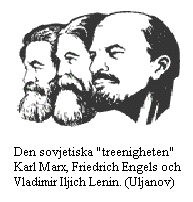
- If the Soviet state had not fallen apart, communism would surely have developed into a new religion. All the prerequisites were there: the old prophet Karl Marx, the apostle Friedrich Engels, even Judas in the form of Leo Trotsky. There was a "Bible" in the form of Marx's "Das Kapital" (the Old Testament) and Lenin's collected works (the New Testament), as well as some preparation for saint worship in the form of a modern "icon" in a "red corner" in every official Soviet building. In the corner stood a portrait of Lenin surrounded by a couple of red flags and parts of his collected works. It was nothing other than a new form of the old Orthodox custom of having a holy image on the wall. In all Russian homes before the revolution, there was a holy image, an icon. When a believing Russian entered the cottage, his first action was to find which corner the icon was in, make the sign of the cross, and bow to it. Only then could he attend to the visit. At the Soviet embassy, there was a "red corner" with a bust of Lenin and a somewhat dusty (in later years) collection of Lenin's works. .
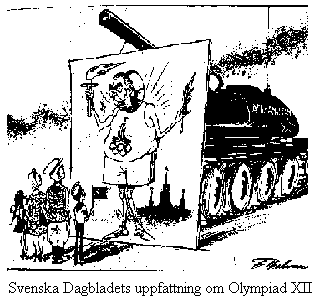
In 1980, I served on the Olympic regatta as a crew member for Jan-Erik Jonsson on his Flipper 820. The Russians did not have any boats of their own, so about twenty small pleasure boats were borrowed from Sweden and Finland to take dignitaries out to the sailing arenas. We had both Fidel's brother Raoul and the French communist party leader on board with us. The customs formalities and controls were strict, but one can always annoy the authorities a bit—when the opportunity arises. Just before the customs formalities were to be completed, I had placed the editorial page of "Svenska Dagbladet" with Brezhnev as the angel of peace on the salon table, and the customs officer immediately wanted to confiscate it. However, I pointed out to him that it was an official Swedish newspaper and that he had no right to confiscate it, and the customs officer had to back down. Naturally, it was a provocation on my part, but one has to have some fun. After only a couple of hours, we were ready to sail into the "VIP quay", which was to be our "home port" for the next two weeks.
The Russians' tendency to idolize their leaders has not disappeared, but it has become permissible to lampoon them. In the independent newspapers, there are often very interesting caricatures of the leaders. Some time ago, a Finnish reportage about Vladimir Putin was shown. There, one could see how an old Russian woman, standing in front of a painted portrait of Putin, made the sign of the cross and bowed several times, just as before a holy image, an icon, or a picture of Christ. (2003-12-21).
The Russians are not particularly fond of the Jews after what happened during the years 1917-21, when the Jews ruled in the Soviet Union. Lenin's maternal grandfather was a Jewish merchant Moische Block, his mother a Jewess, and his father a Kalmyk. Stalin is also of Jewish descent. The name Djugashvili is said to mean "son of a Jew" in Georgian. The sons Block fell out with their father and converted to Orthodox faith, changed their names, and became Russians. Lenin's grandfather, Nikolai Ulianov, married his own daughter, who was 24 years younger, and had 4 children with her in the marriage.(Source: V.A. Istarkho, 'A blow of the Russian gods' - »Удар руссклх богов” ed. 'Russian Truth' Moscow. 2004)
A number of Jews have also infiltrated the Russian administration: Chubais, Khodorkovsky, and others. The latter, however, made an attempt to compete with Putin and nominate himself as a presidential candidate, but that did not go so well. He was convicted of economic crimes and probably won't be out for a good while.
The Russians have gone back to the dictatorship stage. No one can claim with any pretense of truth that Putin was elected. In the usual manner, a leader was appointed in Russia, but a leader who is a former police officer is not accustomed to commanding, only to obeying. Previously, propaganda to the youth could go through the pioneers and the communist youth leagues, but those can no longer be used, and so something new has been formed. To strengthen Putin's "image", a new youth organization has been created, "Putintsy", a fairly clear parallel to the Hitler Youth in Russian variant. They have also started another youth organization – Nashi (Наши – our ones). These youths participated in harassment of foreigners (including the Swedish ambassador) when Estonia moved the Soviet soldier statue, and popular humor has dubbed the organization "Naschists". Putin has become the new dictator. D. Medvedev, who comes after him, is not elected. He is (naznatjen - appointed) Putin and his clique have managed to close almost all independent TV channels, exercise harsh censorship over the free press, and the situation is increasingly reminiscent of Soviet times. Journalists with dissenting opinions live dangerously. Previously, they were locked up in the GULAG camps, now they are killed. The latest case of A. Politkovskaya will probably never be resolved. Stalin is said to have had a nominal salary of 200 rubles during his time as dictator; Putin has surely appropriated a number of oil millions and is building (according to the Swiss opinion) an extravagantly luxurious house in the Swiss Alps, in Vevey, near Lake Geneva.
During the naval visits, I often had the opportunity to meet my relatives. We agreed on a time and place, and when I was not on watch, we could meet. In itself, it is a sad chapter regarding the family gatherings. For 20 years, I lived separated from my mother and my siblings, but all's well that ends well. There have been a few more meetings now that Estonia is free. No other papers are needed anymore except a passport and money. Now I only have Karl left from my family; the nieces and nephews belong to another generation, and if one has not had the chance to socialize with them as children, the risk is great that they will remain partly strangers. It is thanks to Aunt Minna (mother's niece and mother of Sveta, Bella, and Anatoli) that we met at all. Admittedly, I had some thoughts about trying to reach my relatives in the Soviet Union, but during Stalin's time it was not particularly suitable; the situation improved somewhat during Khrushchev's time. Those who have relatives abroad will for a long time to come appear as potentially suspicious individuals in the Soviet Union and run the risk of being subjected to unpleasant interrogations.
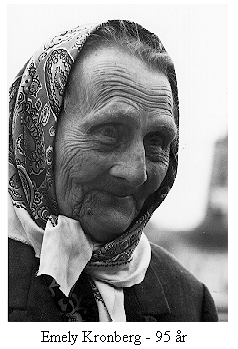
Aunt Minna had from time to time urged my mother to write to the International Red Cross to make inquiries, and at the end of 1962 she had sent a letter. It was around the same time that I began to think about doing something similar regarding Lida and Karl. Mother was so old that I did not believe she was still among the living. I had hardly sent off my letter when an RC letter arrived from Geneva. The message read:
From the International Red Cross Committee's Tracing Bureau in Geneva, we have recently received a request for a trace of you, made by your mother, Emely Kronberg, Uus tn. 18-1, TAPA, Estonia, Soviet Union. We had begun a trace of you based on your previous address in Borås, when your letter with a request for a trace of your sister reached us today. Stockholm, 20 June 1963.
A few months later, I had all the paperwork ready for a trip to Leningrad; trips to Estonia were not yet relevant at that time. The borders were closed to foreigners. It took some time to work on the Russian embassy, but gradually it yielded results and I took a charter flight from Helsinki to Leningrad. It became the first private trip to Leningrad, where I also met one of my last living cousins, Elvira (Vera) Petrovna Bakhlanova. However, I did not get to meet her husband; he had passed away a few months earlier.
We met in front of Hotel Leningradskaya; there stood Mother, Karl, Lida, and Lida's son Waldemar. They had not been in Leningrad for a long time and had nowhere to stay, but I managed to arrange a room for them as well, at the easy price of 5 rubles per night. As tourists, we had to pay much more – and that in Western currency.
There were no heartrending scenes; one does not create such things in our family. To an outsider, it would have appeared more or less like a meeting arranged a couple of weeks earlier – no fervent hugging or kissing. No onlooker could have guessed that here, in all quietness, a part of a family drama was unfolding – a reunion after 20 years.
Over the years, there were quite many meetings; as long as Mother Emely lived, she used to come along, even to Leningrad. With the Navy, it was only the cities Leningrad, Tallinn, and Riga that we visited.
Karl had lived for several years in the Caucasus, but now he was back and had a woman with him. She was a lady from an Estonian fruit collective located on the slopes of the Caucasus. Her name was Leida and she mostly supported herself by moonshining. At the beginning of the century, some German landowners had planted large apricot groves; these had now largely run wild and – as Leida said – there was no shortage of raw materials. When I asked if she wasn't afraid of getting caught for moonshining, she replied that there was no danger at all. The local police chief and his entire entourage were among her steadiest customers. Leida was a very enterprising woman, good at distilling vodka, cooking, as well as playing guitar and singing. Raised as she was in a mixed company that largely consisted of Crimean Tatars, she mastered that language and could sing Tatar songs, which Karl described as sheep-bleating. The East begins where the women sing like that, he used to say. Unfortunately, Leida fell victim to her own craft. After a certain number of years in Estonia, she returned to the Caucasus and, according to Karl, drank herself to death.
Despite the often somewhat overambitious programs during the Soviet visits, there were still many occasions for me to visit relatives in both Leningrad and Tallinn. Cousin Elvira Petrovna Bakhlanova and her daughters Margarita and Tatiana lived quite close to the harbor; the street was called Gavanskaya (Harbor Street) and at least during later visits, when we were docked in the passenger harbor, it was just a stone's throw to Vera's apartment at Gavanskaya 24. When I learned the visiting hours, I wrote to the family and then we gathered at least one evening and had a family reunion with food, drink, music, and song. When Waldemar (my nephew) was along and could play a tune on the accordion, sometimes Alida played a few waltzes and Karl accompanied on the violin. Sometimes I also invited someone from the ship to come along, and Boatswain Möller probably won't soon forget such a visit. The visit was when Karl was together with Leida, an Estonian woman he had become acquainted with down in the Caucasus region, and they had come up to Leningrad with a few bottles of moonshine.
Leida was no lightweight; she was big and sturdy, and Boatswain Möller was no slouch either. Livened up by food and drink, they were now going to dance in Vera's small apartment – two small elephants in a – if not china shop – then a cramped little Soviet apartment. It so happened that they tripped and fell into Vera's sofa. It creaked ominously, but held, fortunately. Russian furniture is quite sturdy; to some extent, people still live in the old, bourgeois furniture style; on the other hand, overcrowding is great and the furniture that exists is used much more frequently than in the West. Considering that, it is also much sturdier. Moreover, furniture is difficult to obtain in the Soviet Union.
Leida had brought a couple of 5-liter bottles and it was hard to tell which was the state-produced spirits and which she had distilled herself. The somewhat late hour, the festive mood, and some previous consumption may have contributed to the difficulties in assessment.
With a bit of skill, the rest of the company managed to save the food, plates, and everything on the table. As luck would have it, no one was sitting in the sofa at that moment; together, this dancing couple weighed nearly 200 kg and if they had fallen on someone, the consequences could have been fatal. The sofa creaked ominously but held. That was also fortunate. Furniture in the Soviet Union is both expensive and hard to obtain, so with a bit of bad luck, we could have caused something akin to a disaster for Vera. Now everything went well and we had a good time far into the morning.
I had become quite intoxicated, lying on the sofa and not feeling particularly well. My mother Emely sat at the other end of the bed, shaking her head sympathetically. Oh, oh, oh, those were the times!
Despite her forbidden occupation and penchant for her own alcohol production, Leida was a stroke of luck for Karl. The first time I met my family in the 1960s, after about 20 years of separation, Karl was in rather poor condition, worn down both by lack of food and excess of spirits. Soon after, he went to the Estonian collective near Krasnodar and Gulkevichi, and the next time I met him, he was a completely different person. Leida could not only distill spirits, she was also an excellent cook – it was evident both on her and on Karl. On one occasion, Karl and Leida had brought a 5-liter keg of home-distilled spirits from the Caucasus; certain comparisons were made between the home-brewed and state-produced varieties, but no difference could be detected.
Considering the circumstances, I still managed to be with my family quite a bit. Mother lived another 17 years after we had met (she died 1979-12-13), Lida for 25 years (she died 1989-12-13), and Karl, now nearly 86, is still alive and quite spry for his age, given how much he has had to endure during his earthly journey. He has told me of his tribulations during the war, and it is not pleasant reading; it is full of hunger and suffering.
In 1978, we had a visit from Admiral of the Fleet Sergei G. Gorshkov and during an animated evening in Karlskrona at the home of Governor Camilla Odnoff. She suggested, in light of the upcoming Olympics and the 300th anniversary of the founding of the city of Karlskrona, that the visits should be extended to both naval cities – Karlskrona in Sweden (during the Olympics) and Kaliningrad (Königsberg) in the Soviet Union. At first, Admiral Gorshkov looked somewhat gloomy. Now all his secrets about the old "scrap heaps" (cruisers of the Suvorov and Kashin classes, etc.) in Kaliningrad would be revealed to the West. No, he did not seem keen on that visit; one could clearly see that enthusiasm was lacking. However it was, he softened after a while and the gentlemen admirals agreed on a further extension of "friendly relations." They shook hands and promised to work towards realizing these new goals, but unfortunately neither visit came to pass, at least not officially. Admiral Gorshkov had written a book "Sea Power"; according to informed readers, a very comprehensive book, with bottom charts etc. (though no map of the Murmansk area), and many officers had bought it and wanted the admiral's autograph. I occasionally had to step forward with a request and present the book to him. The "unofficial" visit of the Russian submarine U-137 in the fall of 1981 effectively put an end to all further association on the military side. The few Russian visits by official persons that have occurred since then have generally gone to the Foreign Ministry. Among these was the Soviet Supreme Commander Yazov, who participated in the failed military coup in August 1991.
It is surprising how poorly even persons at such a high level as the admirals were oriented about the rules of democracy. When we were in Karlskrona and Svängsta, there were some demonstrations, and Admiral Putintsev, who was one of the members of the delegation, revealed his monumental ignorance.
The Svängsta visit was a so-called "cultural visit"; the gentlemen were to fish for salmon in the Mörrum River. The evening before, the Navy had hosted a party in Karlskrona, and there were quite a few demonstrations on our way into the party venue, with placards like "No ball for the admiral of war" and similar. In Svängsta, the police had taken strict measures to prevent the demonstrators from getting near the fishing spot, and all roads to it were cordoned off. However, that did not prevent two persons from rushing out onto the road just before arrival at the shore with a burning Soviet flag. The demonstrators had to take a long detour through the woods to bypass the police cordons.
I was sitting in the front car together with Admiral Gorshkov, his accompanying Admiral Putintsev, and the Swedish escort officer Admiral B. Rasin.
"How can one be allowed to demonstrate against us; we have been officially invited here by the Swedish Navy?" came a question from the Russian accompanying admiral.
Gorshkov was more versed in democracy and began, somewhat embarrassed, to explain to his closest man how things stood and that an official invitation did not prevent demonstrations in capitalist countries.
The admiral had received a "Diplomat" fishing reel as a gift from the Navy the previous evening, and wore his sport suit during the fishing trip, but there was no great fishing luck; the Soviet consul general caught a small salmon, the others went empty-handed.
The return trip to Stockholm was to be made by Vertol helicopter, and we arrived at Sturup to begin our journey from there. There were more than Mrs. Gorshkova who were afraid to fly. The then Soviet ambassador Mikhail Yakovlev said he would drive back.
"We are flying, all of us!" was Gorshkov's reply, and the ambassador had to comply with the decision.
Mrs. Gorshkova was worried about the flight, and to make it easier for her, I told the joke about the lady who was also afraid to fly but had to do it.
- I don’t want to sit next to the wings, she said, it flutters too much, I want a seat far in the back instead.
When we had stepped into the helicopter and put on the hearing protectors (the Vertol makes quite a lot of noise), Mrs. Gorshkova looked quite exhausted. I called her attention and since we couldn’t speak, I just waved my arms, simulating wing movement, and she soon looked somewhat relieved.
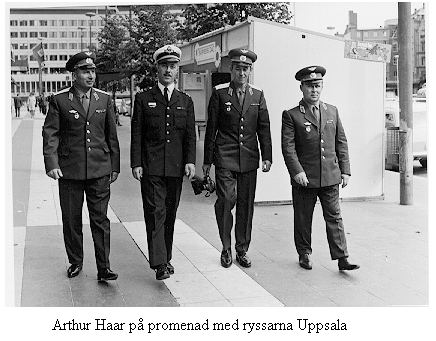
In 1974, I took part in a relief shipment to Pakistan. The journey was made with the Air Force Hercules "Swedish Air Force No. 7". As cargo, we had about 22 tons of supplies: the Finns had donated an ambulance, the Swedes medicines, and the Norwegians had bought a large number of blankets from the Russians. The route went via Moscow, Tashkent, Kabul.
We made a stopover in Moscow, and as soon as the plane had stopped and the mechanic opened the door, a Russian major stood there demanding to see the passport. I was in charge of certain papers necessary in Russia – including the visa documents, where it was noted that on the return trip we would land in Tashkent. The major immediately wanted to take care of the visa and tear off the first third, but since the return trip would also go through Russia, I could not agree to that. He persisted to the very end. He had no idea how we would explain that we had no visa on the return trip; he wanted his share and that was that!
When no other sensible arguments helped, I resorted to an "ultima ratio", which almost always worked with the Soviet people.
- OK, I said to the major. You may take the visa, but before that, you will sign a paper stating that you have done so. We must have something to show your colleagues in Tashkent on the return trip, how would we prove our permission to pass through the Soviet Union?
It had its effect. If there was anything the Soviet officials dreaded, it was signing any papers. After having been extremely eager, he suddenly became almost completely disinterested in our previous discussion and shuffled away without bothering us further.
In Moscow, they foisted a Russian air force officer on us as an extra, extra co-pilot. My presence on the plane was justified by the fact that we would be able to talk to the Soviet air surveillance stations on the ground, but that wasn't enough; the Russians wanted additional monitoring. Even if one knew Russian, in most cases it was almost impossible to have any conversation with the ground stations. The equipment was very poor, and the transition from one surveillance area to another could go something like this.
Navigator Lasse Metsatalo announces that we are now entering another area and the Russian station on the ground should be called. I take the microphone and call the Russians:
- Tjernaja Grjäz, Tjernaja Grjäz.! This is Swedish Air Force transport plane F7 Hercules en route to Karachi. We request permission to pass over your surveillance area.
Through the speakers came something that with good imagination could be perceived as a human voice, but most often it was impossible to tell whether permission was granted or not. Nor was it anything to worry about – the main thing was that the formalities were observed.
- Tjernaja Grjäz! Tjernaja Grjäz! we perceive that we have permission. Spasibo! Do svidanja! Thank you! Goodbye.
A transport plane of the Hercules type is quite noisy and only the cockpit is reasonably soundproofed. The Russian was a nice fellow and we had quite long conversations during the hours the flight lasted. After leaving Moscow and crossing the Volga, we came out to the Russian steppe southeast of Central Russia. For several hours we flew over virtually uninhabited areas; one saw only a number of small villages and car tracks on the ground – mile after mile.
During the conversations with the Russian, we touched upon the Russians' relationship with the African countries. I asked him how he views it. At first he didn't answer, but after some reflection he told the following anecdote, considering that we were out on a flight.
- There was a Russian transport plane that crashed in darkest Africa, but the crew consisting of four men survived the crash. After some time, the local chief appeared dressed in only a loincloth and had a couple of his warriors with him. After taking a closer look at the Russians, the chief and his party had the following conversation:
- How shall we dispose of them, asked one of the lesser chiefs?
- The fat one we grill, said the chief. The second we can make soup from and the third we can freeze and keep as a reserve.
- What shall we do with the fourth?
- The fourth, said the chief, he shall live, we are study mates from Lumumba University in Moscow.
During the flight eastward, the day disappears very quickly, and it was late in the evening when we arrived in Tashkent. Before it became completely dark, we wanted to see the city and managed to arrange a minibus and a guide. We asked the guide to drive us to the oldest part of the city, but despite several nudges, we didn't get there.
After showing us a lot of ugly concrete colossi and various other completely uninteresting buildings, we asked her for the third time if we couldn't go to the old city. Finally, she had to admit that she did not have permission to show it to foreigners. She blamed it on having been badly damaged by an earthquake that had occurred a few years earlier. Off the record, she told me that there were still women there who, after marriage, had never been outside their house. Islam had strong roots in the border states.
The overnight stay was to be at Hotel Tashkent, a rather run-down hotel, but the food was good. At the neighboring table in the dining room sat a number of Uzbeks, looking like an illustration of the Mongol chief Genghis Khan – with long, somewhat sparse drooping mustaches and narrow slits for eyes. Lars Metsätalo, who was an eager photographer, asked me if he dared take a picture of the group. I started a conversation with the Uzbeks and expressed Lars's wish. Yes indeed, that would be perfectly fine. By the way, wouldn't we like to move to their table, and we would celebrate together with the board of the kolkhoz "The Red Uzbek" that the rice harvest had been successfully brought in and exceeded by 25%.
We didn't need to be urged twice; after a while everyone had squeezed around the table and the rest of the evening vanished in a very friendly atmosphere with large quantities of the local wine. No vodka here, no! But all the more wine.
- It's only Russians who drink vodka here!, said the Genghis Khan copy.
The next day we were to cover the stretch Tashkent-Karachi. The route went over the Himalayas' foothills – the Pamir Mountains.
- Hope nothing happens, said navigator Lasse Mäkitalo, the nearest landing site is about two hours away. Hercules has four engines and can stay in the air with two, but here we flew at an altitude of 5,500 meters and had the nearest jagged peaks at barely a few hundred meters' distance below us. The revolution in Afghanistan had been going on for a while and we were not allowed to land there. To step out of the plane on Karachi's airfield was like opening an oven door, humid and hot. The field also looked completely burnt and nowhere could we see anything green. Our unaccustomed bodies reacted instantly and we felt how the sweat began to stream out of all pores in the skin. After having unloaded the plane, locked it and gone through the passport formalities we put on our "going-out uniforms" (dark Air Force uniforms m/41) and headed to "Luxury Beach Hotel" somewhere in the city. It was a swarm of people on the streets, it smelled of frying oil, dust and the Orient. "Luxory Beach Hotel" perhaps did not live up to its name, but that depends of course on what one compares with. For Karachi's many beggars with a bamboo bed in one hand and the rest of the property in a bundle in the other hand, the hotel would surely feel like the highest luxury. On the other hand they did not need to go to any hotel, when they felt it was time to take a midday nap they set down the bed with two legs on the curb and propped up the other two with a couple of stones so that the bed would lie flat, lay down and forgot their worries.
The air conditioning worked reasonably well, which could not be said about the bath. Some rusty brown water came from the shower tap, and you might get wet but not clean. The day was far advanced and darkness fell like a curtain; in just a few minutes it became completely dark. Since there weren't very many streetlights, you couldn't walk just anywhere. The Red Cross representative invited the entire plane crew to a welcome supper; he claimed it cost no more than about 7 kronor per person, but the lager (in disposable bottles made in Lidköping) cost the same, which we would have to pay ourselves. The menu choice was free and consisted to a very large extent of shellfish. The lobsters were swimming in a large tank, and each participant was to choose their victim, point out their lobster that the staff would grill.
Breakfast became a solemn ceremony. We sat at tables for four and practically had a waiter each. The head waiter – a small man with great dignity – directed the wait staff with a few, very measured hand gestures. He came to the table, took out the order pad, and it seemed as if he would graciously do us a favor. After writing down our wishes, he slowly turned toward the kitchen door (where the waiters stood), and soon a man ran to our table. The order was executed about 30 seconds later. There is always a risk in eating vegetables (especially in southern countries), but we couldn't resist all the good salads. To a certain extent prevent stomach illnesses, we had for safety's sake taken a few shots from the vodka supply purchased in Moscow, with the result that the entire crew managed without any major problems.
During the two free days in Karachi, we were to see the city. Together with navigator Lasse Mäkitalo, I went to the city's market hall. It was a large building with substantial openings under the eaves for air exchange. That it was needed we realized as we approached the hall. None of us dared to go all the way into the hall; the smells of half-rotten meat were so strong that we only came near the hall. Outside the market hall, there were also a row of stalls, standing there in the sunshine, and the vendors offered their wares: fruit and meat. We were going to buy dates and approached a stall. The vendor was quick to come forward and began praising his products. To show how good these were, he waved his hand over a dark pile, and an armada of flies lifted from the "date field"; our desire to purchase disappeared quite quickly, and since then I haven't been very fond of dates and figs in Sweden either.
We made an attempt to enter the market hall, but when we approached the stall with sheep heads, it was a stop; the smells were far too strong for our unaccustomed olfactory organs. Our understanding of why southerners spice their dishes took on another dimension.
Lasse Mäkitalo and I were the most diligent sightseeing tourists; we would see more of the city and its attractions, and for this purpose we had acquired some brochures. When we came out of the hotel, there was a snake charmer with a snake sitting in front of the hotel entrance, blowing on his double-piped flute. The snake was not willing to sway to the musician's rhythm, and he had to occasionally give the snake a slap to make it move.
Taxi prices varied enormously, depending partly on how close they were to the hotel and partly on what kind of taxi it was. There was a wide selection – from the ordinary London taxi, into which one could step wearing a top hat, to three-wheeled scooter taxis and rickshaws. We took a three-wheeled scooter (for the experience, as the prices were negligible even for the real taxis), showed the driver our brochure, and wanted to be driven there. He stepped on the gas so we nearly fell off (one doesn't sit particularly comfortably, with one's knees almost at eye level) and sped off. According to the navigator Lars, we were driving far too much to the northeast, but since the driver didn't know any English, there was little to do but hang on and bide our time. After about fifteen minutes we came to something that looked like a mosque. A couple of younger men in Western suits came forward and offered us their services. It became a real exercise in pidgin English; we agreed to their suggestion to be guided through the mosque. It was situated high on a hill, and at the bottom of the steps we had to leave our shoes (against a receipt – here they didn't trust entirely in Allah's watchful eye). In just our stockinged feet we walked up the stairs, which were covered with fine dust and flower petals. Once inside the mosque it was crowded; we were each given a little straw cap to put on our heads, some white, sticky sweets (I didn't try the taste; they seemed similar to "chewy toffees"), and when they began to feel sticky from the heat I let them fall to the ground. In the prevailing crush there was no danger of discovery; otherwise it might have been considered an insult to the prophets. We stood for a while in the throng, and when we made it clear to our guides that we wanted to get out, we had to back out – one does not turn one's back on the prophets (who were buried there). Our eager guides dragged us through several rooms, and afterwards it felt as if we had walked the entire way backwards. In one of the rooms they showed us their holy book – the Koran – and when I wanted to touch it, one of the guides quickly snatched the book away. A Christian dog (he didn't say that directly, though) was not allowed to touch the holy scripture with his hands; it would take about seven days and a lot of prayers and bows toward Mecca to cleanse the Koran of this "contamination" (to use nuclear language) due to the touch of the unbelievers.
On the way back we drove past something that perhaps had a distant resemblance to a funfair. In the shadow of the structures lay several beggars, skinny creatures with ribs visible under their skin.
We happened to be in Pakistan on National Day, but due to the flood and a national disaster there was no parade. The prominent Pakistanis instead walked to a mausoleum of Italian marble, built in honor of the first president. The building had the shape of a cloth, with four corners resting on the ground and the dome arching toward the sky. We visited the place, took off both shoes and socks, but put our socks back on quite quickly because the marble was scorching hot where the sun beat down. Under the dome itself, however, it was cool and pleasant; there a Pakistani honor guard was performing British drill "No. 1" (according to Lasse). It sounded amusing when he stamped his bare feet on the marble floor – it sounded like applause.
The city was not entirely without a holiday atmosphere, however. People from the upper social classes took walks to the monument, which constituted a kind of park area, if one does not have too high expectations. The mausoleum is on a rise, and from it leads a water feature with a number of thresholds over which the water flows down. Along the water feature stood a number of dusty palm trees; it had not rained for a while after the flood. On the way up to the mausoleum there was a stream of holiday-clad Pakistanis. There it is still permitted to have several wives, and here we could observe the hierarchy in the family. First came the family father with his favorite son at his side, followed by the favorite wife and her relatives, then the other children and the remaining wives in rank and order with their respective children and relatives. Both the male and female participants in this procession were well-fed, not to say fat. In these countries, fatness is a sign of prosperity, and some were probably more than prosperous. The beggars, on the other hand, were so thin that one dared not sneeze near them. As soon as they saw a foreigner, they threw themselves at him and held out their hands. Some female beggars sat on street corners with deformed children (could the deformity have been deliberate abuse?) – the deformities generally consisted of crooked arms and legs, inability to walk, and so on.
Pakistan is a Muslim country, and no alcohol is served. In theory. Muhammad forbade Muslims to drink wine (he must have discovered the harmful effects of alcohol), but whiskey could be taken as medicine, and many did so quite heavily in the hotel bars. The effect was exactly the same as on the rest of us – they became loud and opinionated.
On the return trip we landed in Tashkent, stayed overnight there, and went out to the market square to make some purchases of southern fruits. There was no sign of the fruit and vegetable shortage one could usually experience in other Soviet cities. The square was strewn with all kinds of fruits and vegetables; mountains of watermelons, figs, dates, and tomatoes of all sorts, many of which were completely unknown to us. I bought two kilos of large, juicy tomatoes, put them in a plastic bag (as one does), and by the time we arrived in Nyköping the tomatoes had turned into tomato puree. The children still talk about how good those ripe tomatoes were.
On the return trip we had no cargo. A Red Cross nurse accompanied us back to Sweden. She had worked hard and slept almost the entire way back. We began the return journey from Karachi at 2:00 AM (Swedish time), and after about 12–14 hours we were happily back in Sweden again, landing at Bromma airfield.
For the most part the interpreting went well, sometimes very well according to some opinions, but a couple of times it failed. It was still not so bad that I didn't manage it with a certain preserved dignity, but hardly with honor.
In 1981, Sweden and the Royal Kallinge Air Wing were visited by six Russian MiG-23 aircraft, and I was assigned as interpreter for Colonel Sven-Olof Olsson, later Chief of the Air Force, but at that time commander of the Southern Military District. While waiting for the Russians to land, the colonel called me in and we went through his welcome speech to the Russian guests. The colonel read his relatively short speech sentence by sentence, and I interpreted into Russian, memorized a few important points, and we parted to meet again on the tarmac when the Russians had arrived.
I still remember the formation quite clearly today. Out on the tarmac we stood in a square: the Russian An-12 crew to the left, the Russian pilots straight ahead, and the Swedish participants to the right. I stood together with Colonel Sven-Olof Olsson up at the microphones, and the welcome ceremony began. Colonel Olsson gave his speech and I interpreted; everything seemed to be in order.
Suddenly I became aware that the colonel was looking at me, and I noticed that I had been distracted, unfocused. I had no idea what he had actually said when he realized that I was not following up, and I just stood there and we looked at each other. The microphone for the loudspeaker system was on, and if I were to start asking the colonel what he had said, it would have gone out over the entire airfield. Now good advice was scarce. I had a vague sense that he had gone through almost the entire speech, but only a vague sense – what was I to do? Asking him to repeat the phrase was out of the question; on the right wing stood ten other military interpreters, and they had surely followed my actions with great interest. There was a somewhat too long pause, and when the delay began to feel embarrassing, I made my decision. I still thought he had said most of what we had rehearsed, and I constructed a closing phrase myself:
- And so I finally ask, on behalf of the Swedish Air Force, to warmly welcome our Russian friends and colleagues to Sweden and the Royal Blekinge Air Wing, F 17!
Now it was a matter of whether I had guessed correctly; how would I behave if this was not the final phrase? I was lucky; it was the final phrase, but the comrades later asked what was really going on with me, because the phrase did not exactly match the one the colonel had spoken. One must have luck. For the rest of the visit I stayed more alert, and everything went well for the interpreters; for the Russians, on the other hand, it was somewhat more troublesome.
We had said goodbye to our newly acquired friends, with Colonel Andreenko at the head; the MiGs had taken off and headed for Ventspils. We were about to disperse when the order came over the loudspeakers that all Swedish participants were to remain on the field. The Russians were coming back.
One of the aircraft had developed a fault; one of the fuel valves was not working, and then the aircraft cannot fly normally – the tanks must be drained in a balanced order to maintain stability. The Russians landed, and since the An-12 was still on the ground, all the service personnel were still there and they began their work. They knew which valve was the problem, but instead of opening the hatch and repairing the valve, they took a large hammer and began hammering on the port side, quite far back. We suggested some more civilized methods to remove the valve, whereupon the Russians replied that it was not possible – the valve was sealed, factory warranty. Tableau! The Swedes shook their heads as the interpreters translated. After a while of hammering on the metal, everything seemed to be in order; the planes took off and this time it went well. When even the An-12 had taken off and disappeared eastward, we could finally, after a couple of hours' delay, leave the airfield and consider the visit concluded.
???? "Mixed" unison song about Stenka Razin. Popularly called "The Stone Garage"
The summers at Källviken are like a string of pearls; you can't really distinguish one from another until you look more closely at a particular one. For the most part, the summers have left a sunny memory, but 1963 was somewhat rainy in a horsey way. It rained for two weeks and many wives swore never to return to Källviken. The spaces were small, and the common rooms were taken over as classrooms by the students, so the mothers largely had to sit in their small cubbyholes with the children. We had no heating in the barracks and after a few rainy days it became quite damp. When the situation began to become untenable and several wives threatened to go home with the children, the camp leadership, with quartermaster Olsson at the helm, managed to procure a number of heaters for those with small children. (The summer guests in Bohuslän had bought up most of the heaters). I remember that we lived in the Koster barracks, entrance facing the dining hall. Ann-Marie had to sit in the window and look at the puddles in the yard most of the time and try to think of something for Maria to do. The following year I had some difficulty persuading her to come along.
Most summers were however perfectly fine. It was a real holiday home for the wives, without any major worries about either food or housekeeping. The Lottas cooked the meals; you just had to come up from the beach and sit down at the table. The children had so many playmates that with them it was also no concern. They were busy with their beach games and the mothers could devote themselves entirely to sunbathing, coffee drinking, and general social life.
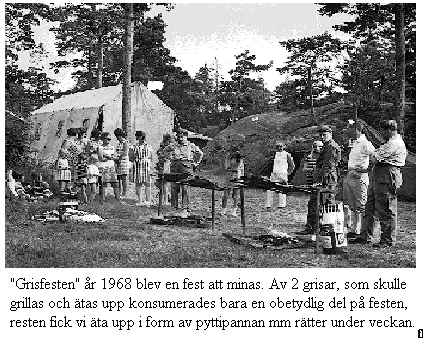
Sometimes, of course, some children could be naughtier than others. Some worries for Harriet Beláew were caused by her son Mikael; he could come up with all sorts of things. Together with Stellan Arningen's Peter, they went sledding on the workshop tent's roof in 1968 and caused quite a ruckus. That I remember the exact year is because that summer left a lasting impression in the memory of most. The thing was that trips to Mallorca had begun and those who had been to the hasada (the pig roast) down there were inspired to continue with this also in Sweden. Normally we were content with shrimp and wine up on the hill, but now someone came up with a proposal that we should throw a barbecue party, just like in Spain.
Harriet Beláew works at the weekly newspaper Land and she knows some people out in the countryside, especially some who would provide us with both pigs and barbecue equipment.
After many and long discussions we decided that a number of pigs, pre-prepared, should be procured. There was much discussion about the number but finally they agreed on 3, no one really knew anything about grilling on a larger scale.
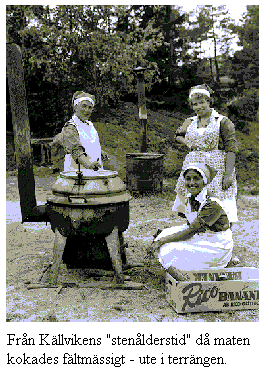
One Thursday afternoon the operation was started and a "grill station" was set up between the Koster and dining hall barracks. From the slaughterhouse we had received barbecue equipment and a whole bucket of grill oil, this was going to be a party! Nisse Öberg was to take care of the grilling with the willing help of Viktor Eriksson and Mordarsky, the man who knew everything. Pig roasting went on all afternoon and the smell of both burnt and grilled pork settled like a blanket over the camp area and over at our neighbors at Capri camping.
Many know-it-alls came forward with good advice; everyone knows how someone else should do it. Most knew, as usual, Mordarsky. He could explain everything, and if you asked him what time it was, he would start with the explanation that a mechanical clock has so many moving parts.
After dinner the party was to begin. Now it was a bit unlucky that we had already had peas and pork; it was like having more of the same, and no one was particularly hungry when the dish was to be consumed. First we urged the grilled meat onto course participants with children and wives; when they had not eaten more than barely one pig, we announced on Capri and people came from there who got to buy a generous portion for 7 crowns, but the pigs were real Särimnars.
No matter how we tried to get rid of the meat, there were still almost two whole pigs left. These were taken to the dining hall and handed over to the Lottas; then we had to eat pork morning, noon, and night until the end of the course. It was not particularly popular, especially considering that at a summer camp with minimal clothing, our physical flaws are revealed in a very tangible way and there is a constant dieting hysteria. You are supposed to look nice and slim in your swimsuit; the beach reveals too much of the pleasures that the person has enjoyed at the table. We have not had any more hasada since then.
Towards the end of the 70s, the younger talents, as they became men in the state, began to return to the camp. It became a bit more lively even on the hill. For a few years Källviken had been practically "childless", but now it began to teem with small children. One year we had a children's party down on the field, with competitions and handout of candy bags; afterwards the party was to continue together with the children up on the hill.
I lived above the old dining hall and was on my way up to the party site along the path behind the hygiene building. Little Natalie Egli (4 years old) toddled over the pine roots on her short, wobbly legs and waved happily with her candy bag, where she, alone without parents, was struggling on the fairly steep slope just above the outbuildings. I thought to joke with her and shouted:
- Oh, Natalie, you have candy! Then I'm going to rob you because I like candy so much!
The poor child got frightened, threw herself into the bushes and started shouting as loud as she could. I rushed to help, but it only made the situation worse; she had already been scared and taken my threat about the robbery seriously. Her mother was sitting up on the hill and heard the noise; she came down and saw her daughter's predicament and rescued her from the supposed robber's violence. Little Natalie had wet her pants in fright, and as punishment I had to bribe both her and her three siblings with ice cream the next day.
When breakfast was eaten, we went to the canteen and I fulfilled my promise. After the ice cream was eaten, I played with them before the morning assembly, and then my happiness was complete. Thereafter, Natalie would not even get up the hill before she ran to the dining hall. There she would look me up and stand by my table (without saying a word) with the intention that I, as soon as I finished breakfast, would come out and play with her. The parents thought Natalie was too pushy and tried to stop her, but she would not be swayed. We had a really nice time together, but the risk is always that people might misinterpret it if you play too much with little girls. Playing with big girls is perceived as perfectly normal. Children like lively and somewhat rough games, but most fathers don't seem to be aware of it or else can't be bothered with it. A sort of vacuum arises that then needs to be filled all at once when the child gets hold of a suitable person. I have always played both with my own and often with other people's children in that way, and the children like it.
When mine were small, I would take them and hurl them up into the air so that they shrieked - with a mix of fear and thrill. The important thing was to always have a firm grip either on an arm or a leg, never let go completely. The other variant was to spin the kid around while holding either the arms, legs, or one arm and one leg. It worked really well when they were small; when they grew in size and especially in weight, it became quite tiresome to keep up such games. Of my own children, Maria was the most daring; she claims to have had complete trust in me during such games. Probably it's true; I sometimes held her over a high ledge by just one leg, to her mother's great horror.
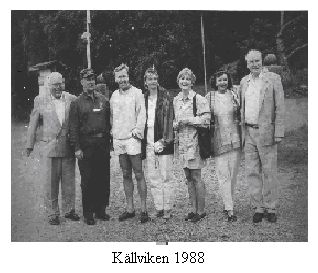
For my part, the camp stay ended in 1988; by then only Antti Nordberg, Viktor Eriksson, and I were left of the "old ones". It began to feel a bit empty and I identified a little with "the last of the Mohicans" (I was the youngest in the group of old interpreters) and didn't think it was fun anymore. Jan-Åke Berg had become military attaché in Poland, and with him a very large part of the pleasantness disappeared.
With Jåke (as he was mostly called) it never had to be boring. He is a skilled folk musician and always has the accordion ready; on the porch of the Driftsvärn barracks we have spent many pleasant moments in the company of both Stig Åby and the others in the merry group.
During the generational shift between the "old" and "young" interpreters, the camp became somewhat empty. The children of the old ones had grown up and the young ones had not yet had any; it was too quiet at times, but in the mid-80s the young people began to come back, after having climbed a few steps on the career ladder, and it became quite lively again in the yard.
The young interpreters are surely both more intelligent and know the organization better, but still they are so similar to each other! They have all gone roughly the same path: through elementary school, high school, college, and the Interpreter School; they have almost nothing to tell yet, therefore the liar's bench is empty. But their time will come too eventually.
Certainly some of them have "become men in the state" (the former boys), mostly perhaps in the journalistic field: Malcolm Dixelius, Olle Stenberg, Harald Hamrin and Stig Fredriksson, Anders Åslund. The latter has during the upheaval been an advisor to Boris Yeltsin in Russia. Through Russian they have had the opportunity to go to Moscow and be at the "center of events" in a quite tangible way. When they reach a certain age they will have a lot to tell and will perhaps in due time sit on the "liar's bench" in Källviken and complain about the younger generation (if anything of the Interpreter School will remain; it doesn't look that way with all the cutbacks in the Army, Navy, and Air Force).
As the years went by, the conditions in the camp improved, and towards the end of the 80s the camp was almost comparable to a better hotel. During the somewhat primitive "Stone Age" period, the Lottas had been in charge of the catering, but after a number of years the hotel unions began to protest, and it became ordinary civilian staff who managed the dining hall; the union had gotten its demands met. Shortly after the takeover, the conditions deteriorated significantly, but gradually changes were introduced, new barracks, lecture halls, a new dining hall were built, and thus the standard rose quickly. Today the Källvik camp s
as accommodation for the refugees during the winter, and AMS has invested a lot of money in the facility.
Of the "old interpreters", only a few people remain, that is Viktor Eriksson and Antti Nordberg besides me, who have been loyal to the camp all these years. I myself struggled for quite a few years and managed about 25 summers at Källviken, but after buying the summer cottage in 1980, my vacations and free time didn't really stretch. Now that I have retired, I would in fact do some summer course again, but Ann-Marie thinks there aren't enough "old ladies" of her age left and she would feel quite lonely at the camp.
For my part, translation and interpretation work has shifted more to the technical and agricultural level. Now and then I interpret for the nuclear power plants, Studsvik, SKI and KSU. Last autumn, there was a delegation from the Rostov nuclear power plant to Ringhals where Viktor Eriksson and I acted as interpreters. Later, I accompanied a combined delegation from RLF-Halland and the Ringhals plant on a return visit to Volgodonsk, and a while ago I interpreted for a full week for RLF-Halland.
It was a rather interesting week during which I acquired some knowledge in the agricultural field. Right now (1991) when a restructuring of agriculture is underway in Sweden, the farmers are extra active. Within 5 years they are to reach competitive prices and the other taxpayers should not have to contribute subsidies to agriculture, as has been done to a very large extent so far.
After the interpretation was finished, the Russians received a lot of presents - and I as well - I wonder if RLF considers me a Russian too? It was a very nice bag with a detachable pocket, a cowbell, a jumpsuit from Arla with the inscription "Milk is Life" and some cheese, sausage and pork, and two bath towels with "HALLANDS LANTMÄN" on them. I brought one of them to Finland during the Finnish interpretation course at Kouvola Summer University, and during a swimming trip I managed to fool a Finnish farmer for almost half an hour, then he discovered that I wasn't actually a real farmer.
The situation in Russia is precarious and many Russians, Ukrainians and Jews are seeking asylum in Sweden. I have had quite a lot of work as an interpreter at SIV (the Swedish Immigration Board), every other week I go to Flen to interpret. Not only Russians come; among the asylum seekers there are quite a few young Balts, from Estonia, Latvia and Lithuania. They are usually allowed to stay while the situation for Russians is worse; now in the autumn of 1993 over 60% are sent straight back to Russia. Many are no longer considered political refugees in the true sense of the word, but quite a few are allowed to stay for humanitarian reasons. Sometimes there can be some doubt as to whether the person should have been granted asylum; too many make unreasonably high demands on Swedish society, and unfortunately the Swedes give in far too often. An Armenian woman did not want a used baby stroller on loan, because someone else had already lain in it. There was nothing wrong with the stroller; the assistant was on the verge of writing out a requisition for a new one, but here I violated my interpreter's ethics and managed to prevent that. Some guests have their pretensions.
Russian has become popular, especially in nuclear power technology. Since I finished my work at Studsvik, I have been very involved in the activities of both SKI and SSI. These institutions have been visited by Lithuanian, Latvian and Estonian delegations. Lithuania had Ignalina on the agenda, Latvia has problems with very large radar stations, and Estonia has a waste facility in Sillamäe - 5 times as large as Ranstad and with 100 times higher radiation level. For Ignalina, a project 'Barselina' has been formed, with participants from both the institutions and the Barsebäck nuclear power plant.
The interpreting has gone well; Jan-Olof Snihs has thanked me for 'professional work', but sometimes it's quite sweaty. The working language of nuclear power is to a very large extent English, and I don't master it well enough. Three years with Allan Brown at Studsvik and work with X-ray examinations have however provided me with so much knowledge that I manage - perhaps not with honor but with retained dignity. Now even the Russians are starting to know some English, at least those who live in the west; with people from Siberia it's still the same problem. Anita Nilsson and Paul Ek at SKI have had to distribute learning materials in the form of study packages with TV and CDs to both the Kazakhstan people and the Ukrainians. For once, I have been able to set the price myself because there aren't so many competitors. Part of the money has been invested in a newer computer, a 486 with 50 MHz clock frequency. Real 'multilingual' programs are starting to appear, and that has facilitated my work. The difficulty lies in switching from one alphabet to the other. The finger positioning is completely different, but after some practice I have achieved quite good results in typing 'touch' even in the Cyrillic alphabet. Now it's not as 'tricky' to write mixed text with Latin and Cyrillic letters, although typos still occur. So far (1996-04-13) I haven't gotten hold of any Russian spell-check program, but otherwise it's going quite well. It's just a matter of pressing a couple of buttons and both the keyboard and alphabet are switched. With a scanner you can even insert images into the text, and a laser printer can print everything with fairly good quality.
In the autumn of 1993, a letter arrived from Finland with the 'Home Front Memorial Medal' and a paper on which it said approximately the following:
"As a memory and as an external mark of participation in the home front, etc.
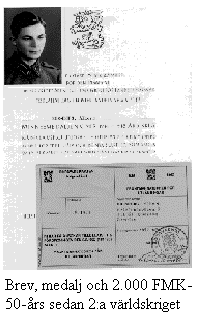
During my meetings in Oxelösund with Finnish veterans from World War II, many of them told me that they had received a 'war pension' and urged me to apply for it as well. Admittedly, I had not been a front-line soldier, as I was too young for that, but the designation 'home front' (as it said in the message) did not fit either. Petrozavodsk (Äänislinna in Finnish) was not any home front; most of the time we were actually stationed there and the front ran along the Syväri River and across Lake Onega, and no major military actions occurred in or near the city. I had served Finland for three years, played at heroes' funerals, sounded the morning reveille, and acted as an interpreter in the prisoner camp in Petrozavodsk, Far Karelia. Moreover, the Finns broke my musician contract, and I should have some compensation for that. I sent in some papers and for a long time I heard nothing from the Finns. Somewhat later, I wrote to the Finnish Military and sent in my 'statement of merits and complaint' about the injustice committed, and the other day a paper came from the Defense Forces' War Archive granting the 'Front Fighter Badge for Foreigners'. In the letter there was a memorial medal with an oak leaf insignia and an accompanying paper stating
Honored veteran
As holder of the front fighter badge for foreigners, you are, as of 1.1.1993, entitled to apply for selectable benefits as follows:
1) A rehabilitation period of 2 weeks at a rehabilitation center in Finland and front payment of 100 Finnish marks, or
2) front payment of 2000 Finnish marks
Letter from the Finnish Defense Forces
I don't feel I need any physical rehabilitation yet, but a front fighter payment will do. Shortly after New Year's, a money order arrived from Finland with the above-mentioned sum. As a memento of the Finnish time, I bought on my last visit to Helsinki with HSB and SIAB a 'dog-tag', an ID tag (death tag) of Finnish army model in gold (the real one was made of aluminium and several times larger in size).
I have had my Finnish soldier number engraved on the tag, I still remember it - 619 782. The Finns have in recent years assisted the former Estonian and Ingrian former front soldiers in the Finnish army with help for physical rehabilitation at some Finnish institutions. It has been about reconditioning at a good health institution under medical supervision. During my interpretations at Nyköping Hospital, I have met some old war veterans who have been subject to rehabilitation. In Oxelösund there is an association for old Finnish front soldiers, I intend to visit them one day. So from now on, I will date all my documents based on before and after 'The year I got the medal'. (2007-02 I sent a letter to the Finns about possibly getting rehabilitation, but the program had ended in 1997 and there was no trip for me.)
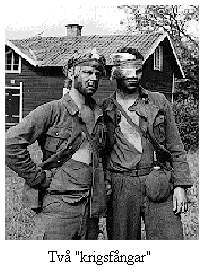
In 1969, the defense forces were to shoot a film about prisoner interrogation, and some members of MT and the Interpreter School were taken to an old, rather dilapidated building on P10's training area in Strängnäs. We dressed in fantasy uniforms and I acted as interrogator for the Air Force, which was to interrogate prisoners from the enemy's air force. Among the other participants, I remember Leo Petrov, Alex Potocki, Antti Nordberg, and Andrej Daragan. The students at the Interpreter School, who played the prisoners, thought that the rest of us were okay to be interrogated by, but the 'little black devil' we would rather not deal with. That 'little black devil' was Andrej Daragan. He was quite small in stature and had narrow, Caucasian features. When he assumed the role of interrogator, he could be a real s... bastard, as skilled as he was from the Second World War exercises on the Svir front in Finland. He had been part of an interrogation group together with Jim Beláew's brother Bill. They had had ample opportunities to practice on 'real' interrogations of prisoners of war.
Some time ago, one of the former teachers at the courses in Källviken (Bertil Nelson) called and wanted to get some pictures from our summer camps. He was going to write something and needed pictures for his book. I selected numerous photographs from my rich "photo production" and had one of the pictures published in the book "Regementen och vapenbröder".
During the years from 1969 to the end of the 80s, 30,000 conscripts were plagued with this film during their compulsory military service.
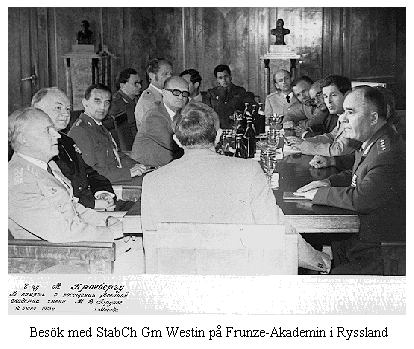
During this interpreting assignment at the Frunze Academy in Leningrad on 12 June 1973, I received a gift in the form of a book titled Sovjetarment (Армия советская) and on page 434 one can read the following bombastic passage:
Благодаря ленинской национальной политики Сщветская страна представляет собой настоящее братское сотрудничество народов в системе единного государства. Сщветский строй навсегда уничтоживший национальную вражду, соеднил узами братсой дружбы все нации и народности нашей страны.
Фашистские захватчики стремились расколоть дружную семью советских народов. Но они плохо знали советских людей, и все их коварныые планы были спрокинуты самой жизьню, всей советской действительностью.
Советскпя Армия всегда олицетворила собой великую дружбу всех национальностей страны.
Thanks to the Leninist national Soviet policy, a truly brotherly cooperation between the peoples in the unified state system is now taking place.
The fascist conquerors strove to drive a wedge into the brotherly Soviet family of peoples. But they knew the Soviet man poorly, and all their treacherous plans were overturned by life itself, by the entire Soviet reality.
The Soviet Army personifies the grandiose friendship between the nations of the entire country.
”Sic transit gloria mundi”, So passes worldly glory
The photo from the visit I used during my later, private visits to Russia. I used to put it on top of my suitcase, and when the customs officers opened it, they immediately became somewhat more polite and asked a little about the picture. A "sesame open up". On the same occasion, I had also received a "rank badge" from the Inspector of Armoured Units in the Soviet Union, Colonel General Tankaev. I mounted it on my shoulder bag, and in that way it attracted immediate attention from the customs officers.
- You are not allowed to have that, said a customs officer with an arrogant look, and indicated that
he would confiscate it. I replied that in that case I wanted his name and service number so I could call Colonel General Tankaev, inspector of the armoured corps, and ask for his opinion. If there was anything the Soviet officials were afraid of, it was giving their name, and even worse if one requested a written document about their action.
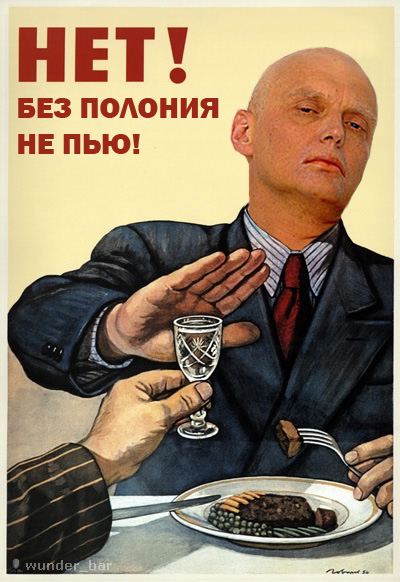
Njet! Without polonium I don't drink
Interrogation of an airman: Interrogator Albert Kronberg
prisoner: Andrej Daragan
Songs and "poems" that deal with bosses and teachers are probably among the most popular. Here the "poets" can scoff in the knowledge that the atmosphere at the moment of presentation does not allow for any angry reactions. Everything breathes nothing but goodwill and sympathy. Here is an example of "Vandalizing verses from the literary arts" by Jan Olof Lönnquist, performed for the first time at TolkS's ceremonial gathering (presumably a graduation party) on 28 May 1969.
Captain, our tough hero, with olive oil in hand,
made our weak spleen sick when interpretation was done on tape.
"How the Svea Guard bites, you shall get to try!
Out of the way, interpreter-schoolites, how can you interpret like that?"
I thought Nisse Öberg was a playing card manufacturer
But the flight captain arrived in a Capri, quite elegant
And you did everything so clearly clever.
A man who makes an effort,
a man who wants what he has promised
and promises where he will
But, Sigge, you live, among glossaries and learning, stiff you stand with wrinkled brow.
You lead through the world of the human, Yes, the interpreter is eternal: he speaks as if anointed
And Bill, a god-sent poseur, but also a real riddle,
among aviation terms an elegant flâneur, on leisure learns to fiddle with golf balls.
For the women a charming charmer
who will make them (it must rhyme with riddle) bitterly weep
You come in the fog and disappear in secret
Stand to, stand to, for Sweden's god of war approaches. See the man ready to stand for battle and storm!
I think the wise brain never calcifies and the body thrives in a well-filled uniform.
He has inspected his hair and beard-sharp cheek, and pockets and buttons from top to toe,
his lungs roar like the resounding wind. We all grew up under mighty Lindhen
How he manages the task no one can understand!
Ed.: The tough captain was Ingvar Nilsson (Svea Life Guards), who was a teacher and CTolkS on various occasions
Nisse Öberg was, as shown by other entries, an interpreting officer at the Army Staff. He was, however, an airman and during the course referred to above he was head of the school's flight line, as far as is known the first flight line at the school.
Bill was named Beljaew in surname. He was of Russian descent, but partly grew up in England (hence the English-sounding Bill). Bill was a teacher of aviation terminology. Bill has unfortunately left us, but his brother Jim is still a member of MT. (2003-03-10).
Film shooting 1968
To further underline MT's and its members' versatility and usefulness in various contexts, film shooting can be mentioned in conclusion. True, the film was made with Swedish speech, but it touched on MT's field of activity.
The Army's Film Detail commissioned from AB Suecia-Film an instructional film named "Om du blir krigsfånge" (If You Become a Prisoner of War), intended to be shown to conscripts in all branches of the armed forces. The manuscript was authored by the head of AB Suecia-Film in consultation with representatives of the defence. The director engaged was film director Torgny Anderberg and the photographer was Gunnar Westfeldt.
However, it was more difficult to get hold of "prisoners" and "interrogators". It was considered unsuitable to use professional actors, because their faces known from film, stage and TV screen could distract the audience. However, the production management, via interpreting officer Nils Öberg, who incidentally had been a driving force behind the creation of the film, got in touch with MT, and thus the actor issue was solved. Through many and long interrogation exercises at camp courses and during field service exercises, MT's members have acquired a not insignificant routine in "acting". For the prisoner roles, younger, Swedish-born MT:ers were chosen; for the enemy's interrogators, older MT members with a certain accent in their speech.
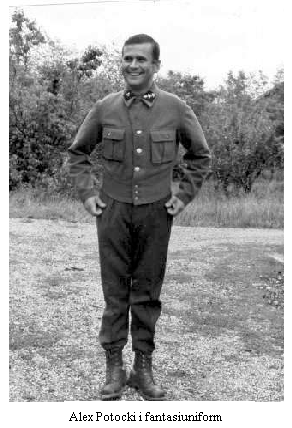
The shooting took place during the summer and autumn of 1969 in a "prisoner camp" in the barn of Husby Östra gård on P10's training area outside Strängnäs. The result was an instructional film in three parts, each 20 minutes long. The parts are named: "Tillfångatagandet" (The Capture), "Flykten" (The Escape), "Fångförhöret" (The Prisoner Interrogation) and "Fånglägret" (The Prisoner Camp).
Director Torgny Anderberg said after the completion of the shooting.
"The contact with the MT gang was an enormously positive surprise, which I am very happy about. There was certainty in the acting scenes – they were fine actors. A strong category – easy to cooperate with, playful but disciplined. It became a fun shoot."
The films are considered to be of high class, both instructionally and artistically. Besides giving Swedish conscripts, for the first time seriously, clear information that they too, in the event of war, can become prisoners of war, the films provide some guidance on how prisoners of war should and ought to act and behave. The films also contribute to spreading much-needed knowledge about the activity for which there is now a developed organisation within the Swedish armed forces, and for whose further development and improvement we, among others, work in the Befälsföreningen Militrtolkar (Officers' Association of Military Interpreters).
Recordings
- 1959 Källviken I.mp3
- 1959 Källviken J.mp3
- 1959 Källviken K.mp3
- 1959 Källviken L.mp3
- 1959 Källviken M.mp3
- 1959 Källviken N.mp3
- 1959Källviken A.mp3
- 1959Källviken AJ.mp3
- 1959Källviken B.mp3
- 1959Källviken C.mp3
- 1959Källviken D.mp3
- 1959Källviken F.mp3
- 1959Källviken G.mp3
- 1959Källviken H.mp3
- 197x Militärtolkarnas Paradmarsch.mp3
- 19800708 Professor Trepycko sjunger och berättar.mp3
- 64 Förhörsspel med Daragan Kronberg B.mp3
- 64 Förhörsspel med Daragan Kronberg C.mp3
- 64 Förhörsspel med Daragan Wikland A.mp3
- 800704 Sång på berget L Pettersson polackerna.mp3
- De stupades sång.mp3