Nyköping 1960
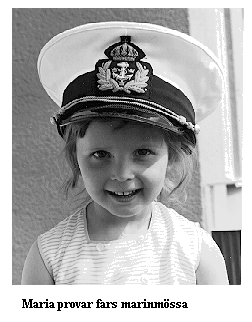
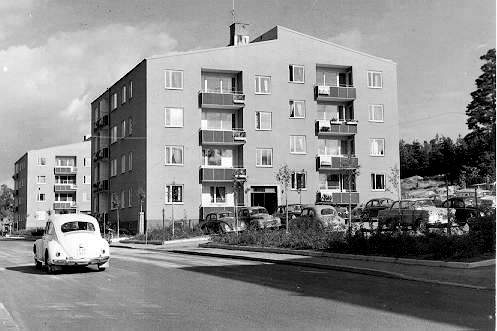
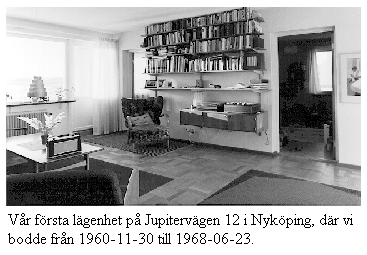
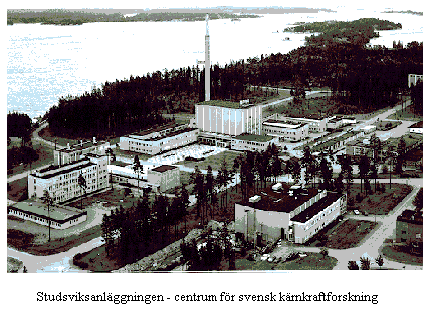
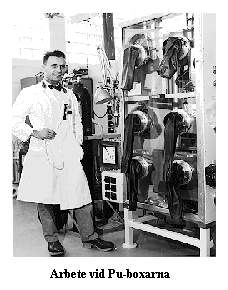
Itwas with a certain melancholy that we moved from Hägersten, but the move was already decided upon when I took the job at AB Atomenergi and in Nyköping we got a completely modern apartment consisting of 4 rooms and a kitchen at Jupitervägen 12, where we then lived from November 30, 1960 to June 23, 1968. The number of rooms did not increase, but the apartment was almost twice as large as our previous one and it felt extremely luxurious, especially since we were the first tenants in that apartment. Now we finally had a completely own apartment. The deposit was 8,000 SEK and half of this would be paid by Atomenergi if I stayed with the company for the next 5 years. Likewise, the company paid for the move and one day Ryds Express stood in the yard. I said goodbye to Nordiska Instrument, my years there and all my colleagues, Friberg, Österman, Hans Wehrli and service manager Eisenberg. It was also saying goodbye to Mr. Ulfward and his daughter Inga. The move went well except that a small Chinese bowl, which we had received as a gift from Gertrud, disappeared. It must have disappeared during the move and when we realized it, half a year had passed and it was not worth contacting Ryds Express office and demanding compensation.
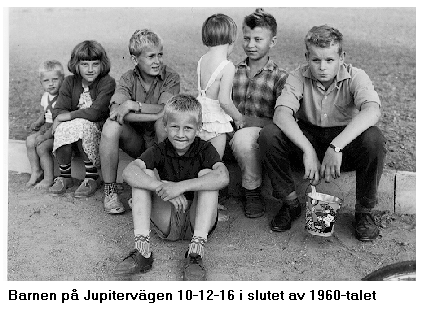
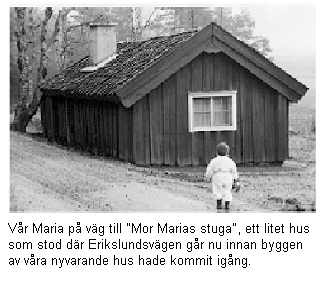
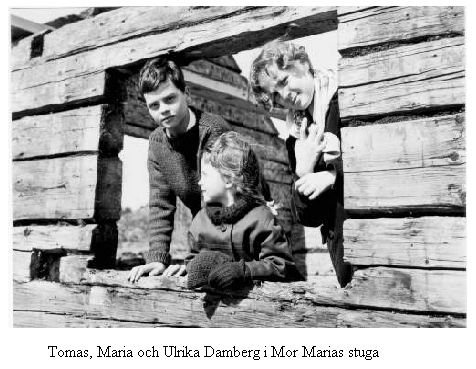
The district of Stenkulla in Nyköping, which we moved to, was a newly built area and when we had settled in we enjoyed it very much. The area was not yet fully built up and the current Trosa-vägen road was not even considered, so Tomas and the other children in the houses had quite a lot of space around in the forest.
Our start in Nyköping was a bit messy. We had barely settled in when Ann-Marie became violently ill and had to be admitted to the hospital. At first the doctors suspected an ulcer and gave her blood transfusions, because she looked somewhat pale (she has never looked so rosy as after that blood infusion), but after a few days the doctors realized that it was actually her gallbladder that was acting up. Earlier, the gallbladder had already made itself known; for example, she could not eat shrimp (but could eat more expensive shellfish like lobster and crab). In the autumn of 1960, the Stenkulla area was still partially undeveloped, there were only the houses at Jupitervägen 10, 12 and 14 and the villas at the end of the street. The snow came early and when Ann-Marie ended up in the hospital, I was left with the children. Tomas went to Östra school and was no concern, but Maria was only just over 2 years old and had to be taken care of somehow. At that time, parents did not have any "child sick days" and I consequently could not stay home to care for a sick child, as one can do now.
Considering my somewhat precarious situation, the then group leader Ulf Kuylenstjärna granted me a day off and I tried to sort out my temporary troubles, called the Social Office and asked if I could leave the child for a couple of days until mother-in-law Lilly could come and take care of the child during the mother's illness. At the office they were completely uncomprehending when I suggested that I could leave Maria at the daycare center on Hospitalsgatan for a couple of days.
- No! That won't work. We only accept children who are registered here and right now we don't have any available places, replied the social assistant.
I got angry. It cannot be possible that one cannot house a child for a couple of days, so I answered the social lady:
- Now it's just that tomorrow morning I will come with my daughter and if the door to the daycare is not opened, I will leave her on the steps and then you will be responsible if she comes to harm.
During the night it had snowed heavily, the roads were not plowed and the snow reached the ankles, there were no buses either, so on the morning of December 11 I took Maria in my arms and set off for the city's daycare center. It was a rather arduous walk, even if a two-year-old doesn't weigh that much. Arriving at the daycare on Hospitalsgatan, I stepped in, the door was open and no one protested, it almost seemed as if Maria had been there before. Everything went calmly, I explained my situation to the daycare director and she had no objections to me leaving the child. Maria didn't protest very much either, when I left her.
The second day she was not as willing to stay, she held on to my trouser leg and it was with gentle force that I pulled her off, but brave as she was she didn't scream, just looked sad. The third day, Lucia Day, it was not as easy to leave her. Then she held on to my trouser leg with both hands and it was no longer a matter of gentle force, I had to pull hard to get her off. The cook, Mrs. Lundström, lived next door to us and she helped comfort Maria, they knew each other a little and it was possible to leave her, but with loud protests. On the evening of Lucia Day, the situation had reached a critical level. When I came to pick up Maria, I did not see her among the playing children. The director then pointed to a corner and there sat Maria.
- She has sat like that all day. She has neither eaten nor drunk, nor has she been to the toilet, the director informed me somewhat regretfully...
When Maria caught sight of me, she rushed up and grabbed me. The director offered saffron buns but Maria did not take one. When I was also offered and took a bun, Maria snatched it from me and started chewing on it. The director wanted to give her her own bun, but Maria did not accept it.
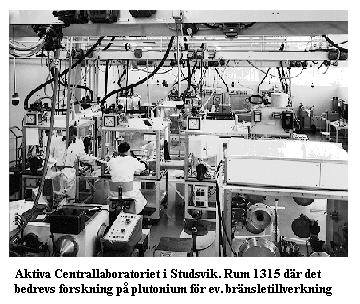
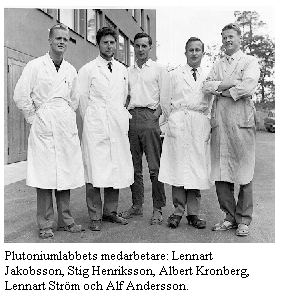
Now I felt it was becoming difficult to leave her. Studsvik was under construction and I could not get any more days off, so I had to find a solution. I told Stig Henriksson, one of my colleagues at Studsvik, about my predicament and asked him if he knew anyone who could take care of the girl for a couple of days. Mother Lilly could come shortly.
- Well, said Stig, try to find the Espings, they have a girl the same age and the wife is home with her. They live near Stenkulla. I got the Espings' address (they lived on Pilos väg), went there and spoke with Mrs. Esping. That would be fine, she said, and the next day I could leave Maria with her. They had a girl the same age to play with and the three days until Mother Lilly's arrival passed without difficulties.
Lucia Day 1960 was very cold and after all the day's hardships I thought a hot bath would be in order. Tomas was at the scouts' torchlight procession and would come home a bit later. I filled the bathtub and crawled into the bath together with Maria, but did not get to enjoy the warmth for many minutes before sounds and moans began to be heard from the front door, as if someone was trying to get a key into the lock.
- Who is it? I called.
At first I heard nothing, but then it came with a pitiful voice that I recognized as Tomas':
- It's me, I can't get the door lock open because I'm terribly cold in my hands.
There was nothing to do but get up, open the door, take off some of his clothes and dip his hands in the warm bath. There was some screaming and shouting when the chilled blood began to pulse again in his fingers, but necessity has no law, he had to get warm.
After a few days, Mother Lilly arrived, Ann-Marie returned home from her hospital stay and I had to carry her up four flights of stairs to the apartment, she couldn't manage it herself. Life began to run its normal course. Maria got a different dress on; apparently I had had the same clothes on her for almost a week, well, I had obviously changed her underwear, but the dress had to do for several days. Ann-Marie's wound was not healed and she could not fully participate in our activities. When Maria was being funny, Ann-Marie had to turn away because the wound did not allow for any big laughter.
In 1958, during the Stockholm stay, I had bought a Tandberg tape recorder and recorded a lot of the family's and children's activities. During the Christmas holiday 1960 we were going to practice "Silent Night, Holy Night" and Maria helped with joyful shouts, there was a bit of disturbance in the harmonies.
"Silent Night, Holy Night" sung by Albert, Ann-Marie and Tomas with contributions from Maria.
The houses on Jupitervägen had been built by Erikssons Byggnadsfirma in Eskilstuna, they had formed a housing cooperative on their own but now the residents were to take over the houses. The warranty inspection was to be done by the construction company, but we discovered that it was probably best if we ourselves took over the association and did the warranty inspection on our own. None of us had much experience with housing cooperatives. Admittedly, Ann-Marie had lived in one at Kyrkogårdsgatan 5 in Borås, but she was in no way involved in board work and I was rarely home. The neighbors on Kyrkogårdsgatan thought she was unmarried and called her "Miss Kronberg".
We put together an interim board where I was elected vice warden and there was a lot of work to get some order into the intended transfer. The construction company had formed a formal housing cooperative where the company's boss was chairman, his wife vice chairman, and so on. If they had been allowed to hand over the housing to us on their own terms, the warranty inspection (2 years after the completion of the association's apartments) would have been done in a very cavalier and costly way from the members' perspective, but now the newly elected board put a stop to that.
It turned into quite a lot of work for me as deputy superintendent. Almost daily I had conversations with the construction company and tried to assert the association's rights, but they were more experienced and sometimes it was difficult to come up with strong enough arguments. At one point I discovered that there were no toilets in the buildings Jupiter Road 10 and 14, only in building no. 12. Instead, there were two cleaning rooms: no. 1 and no. 2. The toilets in the basements are intended for housewives with small children; here, however, they had cheated and omitted these. I looked at the building plans and there were no changes compared to the middle building. I pointed this out to the construction company and said that either they should submit plans approved by the County Housing Board where these toilets were not drawn in, or else they should install them.
The construction company tried to come up with various excuses, but I stood my ground and said we would not approve the buildings if the issue with the toilets was not resolved. It took a couple of weeks, then a work crew arrived and they had quite a lot of trouble chiseling out the drain stacks in the poured-over floors. It turned into rather costly renovations.
After such incidents we encountered difficulties in cooperation; we could not agree on an inspector, so we each chose one, and they in turn had to agree on a third, who would then be as neutral as possible. Our efforts were crowned with success and we got quite a few post-repairs carried out both indoors and outdoors. The profit was on the order of 50-75 thousand kronor, and for a newly started association that means a great deal.
The family finances were still rather meager, however. Ann-Marie was at home with the children, and my salary, although somewhat better than before, did not allow for any major extravagances in spending. I did, however, have some extra income from translations for the Studsvik library, interpreting, and being a driver on the Nyköping-Studsvik route.
In the boom of the 1960s there was a labor shortage, and the Thor company, which handled the bus transports between Nyköping and Studsvik, needed a few extra drivers. Through the traffic controllers "Erik" and "Gustaf" I got the opportunity to practice bus driving, and after a few trips with them I was allowed to "borrow" the bus myself and drive around Nyköping to improve my driving skills. Actually, I had relatively little car driving experience; most came from the motorcycle during the Borås and Köping periods, and my first driving test failed on the climb from Kvarnbron to Östra Kvarngatan. The right turn towards Allhelgonakyrkan is both steep and sharp; I couldn't manage both the steering (there were no power steering on the buses yet) and the gearshift, stalled the engine, and the inspector said I should come back after some more practice. A week or so later I took the driving test again and this time I passed. Then I drove the bus for nearly seven years between Nyköping and Studsvik, until the bus station was moved to Harg and it became far too long and inconvenient in the mornings and evenings. At first it was very convenient, especially during summer. For several summers I parked the bus either on Jupiter Road or later in a construction pit roughly where the Nyköp store is now. We were a few engineers and mechanics from Studsvik: Stig Henriksson, Ruben Eriksson, Sjöblom, etc., who earned 4 extra hours per day and were part-time members of LO.
Before Road 219 along the coast towards Trosa was built in the mid-1960s, transport went along the old Route 1, then to Sjösa Farm and from there onward to Studsvik. The avenue at Sjösa Farm was troublesome even after one row of trees had been cut down. Several bus mirrors were lost there when inexperienced drivers drove too close to each other between the railway crossing and the farm. The buses were heavy to drive, and the extra drivers always got the oldest and worst buses. D336 didn't always want to start, and several times I had to chase the passengers out at departure from the end of Ängstugevägen near the current Nyköp store. The bus was so old that it didn't take much effort—just a slight push from the passengers and the diesel would start, and we could begin our journey to Studsvik.
Viking Line had started ferry traffic between Sweden and Finland, with daily trips from Kappelskär to Åland and onward to Åbo. The routes became popular and traffic increased rapidly. The ferries went into international waters and could sell alcoholic beverages duty-free. This boosted the lines' popularity enormously, and the trips were always crowded. Not only Stockholmers could use the service; the countryside also participated eagerly with trips, and for this buses were needed. Thor-bus was quick to jump on the bandwagon, and I was asked if I wanted to drive the bus on Saturdays and Sundays – Nyköping (sometimes Norrköping) round trip. The family economy had certainly improved somewhat, but money was always needed, and I started my "booze bus operation" in late summer 1961.
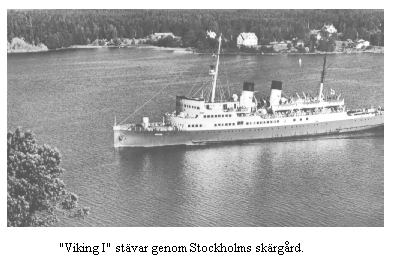
The Viking Line company was in its infancy and had only a single ferry, an old former American hospital ship "Viking I," a steam-driven boat that had been part of the invasion of Sicily.This was evident from the plaque on the main deck. It did not make as many knots as the current ferries, but the motion was smooth; the ship glided on the waves instead of being shaken along. When the company acquired new ferries, it was not always so successful. "Viking I" was a conventional ship with a single ramp at the stern; cars drove in on the starboard side, reached a turntable at the bow where four strong seamen turned the car, and it then continued back on the port side. Loading took a little longer, but people weren't in such a hurry yet. Business went so well that after only a year the company acquired a more modern ferry with ramps both fore and aft, the diesel-driven "Diana II," which had a very harsh ride – the plates in the dining room and the liquor bottles in the shop vibrated strongly and maintained a fairly high noise level. However, it soon disappeared from service and was replaced with ferries where the vibrations from the machinery were considerably lower and less disturbing.
When the ferry "Vellamo" arrived, the Swedish Maritime Administration wanted to practice life-saving, and on the maiden voyage I was called in as interpreter to maintain radio contact with Sweden, Finland, and Russia. The drill began; we in the radio room were to call for help, but nothing happened. Neither Finland nor Russia answered, and had it been a real situation, 400 crew and nearly 800 passengers would have perished. Now it was, fortunately, only an exercise.
Now we had really established ourselves properly: a good job and a home of our own. Tomas attended Östra elementary school and had Mrs. Zetterberg as his teacher, a lady from the older generation of female teachers. There was a shortage of everything, including teachers. Mrs. Zetterberg was a pensioner, but like Dolly Axén she worked several school terms after her retirement. To avoid shouting at the children when she wanted to get their attention, she used a whistle; the class was almost like a football team.
Marianne Cederbom, a former teacher, colleague of Mrs. Zetterberg and neighbor of ours on Erikslundsvägen, told us about Mrs. Zetterberg that she had, with the exception of her time at teacher training college, spent her entire life at Östra Elementary School – in one and the same classroom. She had started in first grade in that classroom, and upon returning to Nyköping she had been given the same classroom as a teacher. At one point the school's operations were reorganized and certain changes were to be made, including a change of classroom so that Mrs. Zetterberg would have a different one, but it didn't work; she wanted to continue as before.
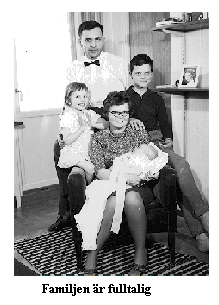
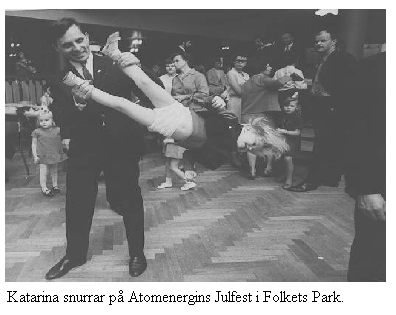
The Stenkulla area had been built up gradually; besides the houses along Jupiter Road, after a few years there was an entire block of three-story buildings and a few high-rises in the same area. Ann-Marie managed the household chores and now there was plenty to do. In the winter of 1963, the family had an addition, this time a girl who was christened Katarina. She was a bit reluctant to be born and Ann-Marie was overdue. The winter was snowy, but we didn't get far because we didn't have our own vehicle. One Sunday, Stig Henriksson, who had a car but no children yet, called and said that he and his wife were going to Ryssbergen to try out skis and if we wanted we could come along.
Today, Ryssbergen is a well-developed recreational area, but the mild and snow-poor winters have made the visit frequency, despite all the amenities, much lower than in the 1960s. The parking lot in Ryssbergen was a distance from the NBK clubhouse, and we had to tramp through fairly deep snow to reach the lodge. It was a bit troublesome for Ann-Marie, but she struggled bravely onward. Skiing was out of the question for us – besides, we didn't own any skis.
The next day – on Monday evening – Ann-Marie began to feel the contractions, and around 9 PM it was time to head to the maternity ward. The snow-tramping had probably upset the baby, and it likely thought that now things were going too far – time to appear in the world. I went to the hospital with her. For the next few hours hardly anything happened, and I was urged to go home and be ready to be called when the situation changed.
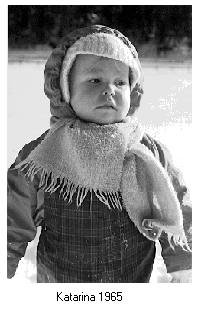
Shortly before midnight the midwife called and said that now it was time for the father to come and assist. The delivery process had begun, and Katarina was born (according to the health card) at 11:47 PM on Monday, February 4, 1963. During the delivery I didn't feel very well due to the rush and the smells, and the midwife told me to sit by the window in the corridor and breathe some fresh air. When the moment came, I was called in and saw a head beginning to appear. When the head was out, we heard the midwife say:
- Oh, what a shame!
Ann-Marie was startled and was about to jump up to see what was the matter, but was prevented by the midwives, and the one who had spoken realized she had frightened the expectant parents:
- It's no danger, she only got the umbilical cord around her shoulder and might become a little pale at first, there's nothing to be afraid of! It was a well-formed girl and she had not a hair on her head, only at age one did some light fuzz begin to appear on her head
Both at Studsvik and in the rest of the Nyköping area there were plenty of immigrants and I was engaged in teaching "Swedish for You". There were many different nationalities in the study circle: Yugoslavs, Germans and Finns. In one course I had 11 participants and 9 nationalities in my "class" - including some Japanese women, wives of guest researchers at Studsvik,
The little "cherry blossoms" had difficulties with certain speech sounds - the Asian languages do not seem to contain the vowels "ö", "ä", "u", and in some cases not even the letter "r". The pronunciation exercises with them brought back certain memories from the Kirovsk period on the Kola Peninsula. There were also a lot of Asian children who could not distinguish between "r" and "l" and we laughed heartily at them.
Ann-Marie was at home with the children and the finances were tight, I took on all sorts of extra jobs to improve the cash flow for the family's livelihood. Besides teaching foreigners, I had courses in Russian for the researchers at Studsvik and Finnish for the foremen at Bolinder-Munktell in Eskilstuna, in addition I drove bus between Nyköping and Studsvik during workdays and bus tours with tourists to Åland on weekends. The trips to Åland with cheap liquor had started in the early 60s and it was at first a very lively traffic. There was only a single boat to begin with - a converted hospital ship from World War II and renamed to fit in the Nordics - Viking I. It could carry about a hundred cars, two rows on each deck and had only one ramp at the stern. The motorists drove along the starboard side up onto a turntable at the bow, four strong sailors grabbed the car, turned it towards the stern and continued to a parking space on the port side in order to upon arrival drive off over the same ramp at the stern.
The Finnish instruction for foremen at Bolinder-Munktell in Eskilstuna was a bit special. During the large labor immigration from Finland to Sweden, communication difficulties arose at some companies between the supervisors and the Finnish employees. My good friend Heikki Räty, who was operations manager for TBV during those years, managed to persuade Volvo-Bolinder's personnel manager and study leader Lennart Eriksson about the necessity that the supervisors in the departments where there were many Finns should be given some knowledge of the Finnish language and Finnish culture, a culture that comprises 0.037 per thousand of the earth's inhabitants..
It became a two-week intensive course. During the first week all teaching took place in Eskilstuna. A Finnish teacher went through the grammatical subtleties of the Finnish language and I handled the practical pronunciation training. When the week was over and the participants went home, they took with them some cassette tapes I had recorded so that they could practice pronunciation at home for two weeks. After two weeks we gathered again and went to Turku for practical training with the students from the top high school class at Turku's Swedish-language lyceum for girls. It was a very pleasant form of teaching. Finnish is like a multiplication table, you have to learn certain case endings instead of pronouns, then you just pour it on. A couple of participants actually learned so much that they could manage on their own in Finland in very simple errands. Towards the end of the second week at home, I had a work assignment at Chalmers in Gothenburg and was going to visit one of the course participants, the foreman at the truck factory Lars Gustafsson. I called his home number and a woman answered:
- Good day! My name is so-and-so, I'm wondering if Gustafsson is home.
- You didn't need to introduce yourself, the woman replied, I who you are. I have listened to your voice from my husband's cassette player for the past two weeks. My husband has practiced diligently.
- Welcome to visit us!
During the stay in Turku we would naturally visit a real Finnish sauna and the choice fell on Forum - a sauna near the Market Square. The Finnish sauna is not just a cleansing procedure, rather it is a ritual almost akin to a religious cult. Forum bath was a real Finnish establishment, with washerwomen and everything that went with it.
- Now we'll have fun with Lennart, said Heikki. We'll take him with us to the bath woman and let her scrub him down properly. Said and done. We ourselves were to be scrubbed first, then it was Lennart Eriksson's turn.
- This man likes to be scrubbed properly, said Heikki to the bath woman in Finnish - a language that Lennart did not understand - take a really coarse brush!
Poor Lennart suspected nothing of the treacherous intent, but lay down nicely and willingly on the bench while we quickly disappeared from the room and went out into the shower.
When Lennart came out from the bath woman he was, to put it bluntly, f.....d. The bath woman had evidently followed our advice and used a piassava brush, Lennart was glowing red on his back, almost skinned and did not want to bathe again several times with either Heikki or me.
Besides Finnish for the Swedes, Swedish for the Finns and other foreigners, I taught Russian to the researchers at Studsvik. Russia began to become interesting from a scientific point of view and many began to take an interest in the language, especially as more and more research visits came from the east to Sweden.
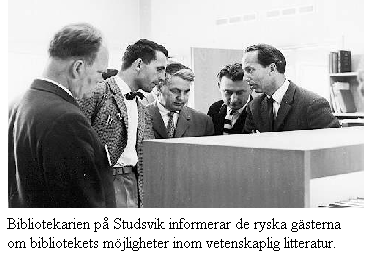
At Studsvik there have always been many foreign visitors and researchers, both from east and from west. The eastern contacts were to a large extent mediated through me.
The very first visit where Viktor Eriksson and I were employed as interpreters took place in 1962, when the professor and member of the Soviet Academy of Sciences, N.N. Millionchikov arrived at Arlanda together with his colleagues. All participants looked very grim and serious, most of all the professor himself, as he came into the reception hall. He held his right hand pressed with the palm against his breast pocket and it looked a little funny. When he was to greet us he had to move his hand and then it turned out that he had a large black stain at the level of his breast pocket. We wondered what was the matter and then he told that his fountain pen had leaked, the Russian planes did not have pressurized cabins and when the plane got high enough in the air, the negative pressure sucked the ink out of the pen and spread it on his jacket. On arrival at Studsvik, his jacket was sent to dry cleaning and he received a temporary loan from director Harry Brynielsson.
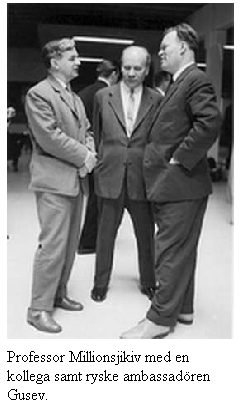
The delegation consisted of 5 men, besides Millionsjikov (the little environmentalist), 4 scientists + "a corpse in the cargo" - the politruk. The surveillance of delegations was still strict and they trusted no one, therefore each delegation included a political overseer. Leonid Leibov, owner of Sparreholms Snickerifabrik AB for some years in the 9+-talet where I worked for two years after retirement, told that when he for the first time in 1974 was to visit Czechoslovakia (a socialist country), he was so frightened that he dared not speak to anyone. He had been indoctrinated by the authorities that all foreigners were spies and saboteurs. In addition, his union, party leadership etc. authorities had to give their approval (and his wife) in order for him to travel abroad.
The politruk in Millinosjikov's delegation had a lot to say, we soon discovered. He had no other task besides the surveillance, for the most part he sat completely silent, probably understood nothing of what was discussed and had difficulty staying awake. It actually happened that some of these politruks fell asleep during the lectures.
During one of the days, the delegation made a trip out to sea with a boat that Atomenergi rented from a fisherman. The intention was that the guests would see how to take samples out at sea, just outside the mouth of the cooling water discharge from the research reactor R2 in Studsvik. The visit took place in the autumn and the weather was somewhat chilly. It was windy out on Tvären and everyone felt a bit chilly. I then suggested that we should have a sauna upon return and the proposal was met with general approval. It was only the politruk who did not react. The fisherman called the guard at Studsvik and they were to turn on the sauna heater. Everything seemed peaceful and pleasant, but it was soon disturbed by the politruk as soon as we came into the Studsvik mess and he got access to communication with the embassy. He threw himself on the phone and came back after a while with the message that his group had to have an urgent meeting and could not participate in the sauna bathing. The Russians, who are as avid sauna bathers as the Finns, looked disappointed, but could not do anything, it was the politruk who had the highest command.
Similar cases in the surveillance activity occurred a few years later. A delegation of reactor engineers was to be split into two parts: one was to go to Västerås and the other to Degerfors to see the manufacturing of reactor vessels. The then second secretary at the Soviet legation, "comrade" Popov, the same man who later assisted during the flight visits, was "the top dog" for the moment. Late in the evening it had been decided that my colleague Viktor Eriksson would go to Västerås with the main part of the delegation and I would take care of two men and with my own car go with them to Degerfors. Popov found out about this at 23.00 and threw himself on the phone. He was to arrange a supervisor for my group, he himself would go with Viktor Eriksson and the other delegates to Västerås. He went on for quite a long time, finally it seemed that everything would work out for him.
The next morning I set off for Degerfors. According to the instructions from Popov, we were to pick up "his man" at the train station there. When we arrived in Degerfors and at the station, there was a man lying on a bench in the waiting room. He had traveled on a night train without a sleeper and was by then quite tired. He fell asleep several times during the day's lecture on reactor vessels. When he started snoring too loudly, we woke him up and offered him coffee to perk him up.
Often one of the delegation members was (usually the most skilled) of Jewish descent and then the political commissar was extra attentive. During a visit by a delegation specializing in reactor vessels, we had a small Jewish man as an expert. The R2 at Ringhals was just being completed and the Jewish man wanted to see the condensation chambers in the reactor. The safety engineer did not want too many people coming down into the reactor and said that only the expert and the interpreter could come along. The political commissar became very worried as we stood on the roof of the building and asked if there were other exits from the reactor. The safety engineer assured him that was not the case, which had a calming effect on the political commissar. Too bad there were no other doors, then we could have let the commissar stand there waiting and sweating. When we had returned to Stockholm and the members of the delegation were invited to supper by Director Harry Brynielsson, the Jewish man was fetched to the embassy for "consultations." As the years passed and the number of visits increased, the surveillance became somewhat less until it ceased entirely in the early 1980s.
At around age 10, Tomas was very interested in birds and nature. On summer mornings he could go out at dawn to "wake the little birds" and in the evenings he would stand on the balcony looking at the stars; he was also interested in astronomy and learned quite a bit about stars and planets.
Ann-Marie was a housewife and took care of us and the household. Tomas sometimes had to relieve her by taking Maria to the playground, and kind as he was, he did it without too strong protests. However, it has come out later that it was not just a pleasure. Tomas has kept a diary since childhood and a while ago we read roughly the following:
- "Today I went with Maria to the playground. It's not fun, especially with Maria."
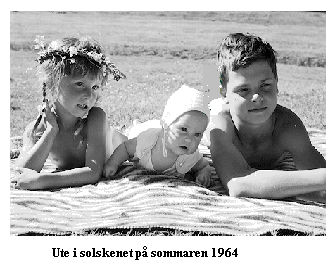
Tomas was nonetheless a kind and ideal big brother; he went out with his younger siblings: Maria by the hand and Katarina in a baby carrier on his back. We feared he might have some difficulties passing by the other youths who stood at the entrance to Jupitervägen 12, but our fears proved unfounded.
- "Don't the children tease you when you go out with your little siblings?" we asked him on one occasion.
- "No, they don't because I'm the strongest in the class."
Such affection towards one's younger siblings is not very common, and this did not go unnoticed by those around. One day a lady came up to Ann-Marie and said:
- "What a big brother! I have seen how patient and kind he is with his little siblings! There were plenty of children on Jupitervägen in Stenkulla and some little girls wanted to take Katarina out in the stroller. Ann-Marie was careful and never let any child take sole care of Katarina. Her fears proved justified. One day she discovered a group of little girls remaking the bed in a stroller they were out with, while the child itself lay squirming on the sidewalk during the re-bedding."
Maria had a small birthmark just behind her left ear and we had taken her to St. Göran's Children's Hospital on Fleminggatan in Stockholm when we lived there. We were to return somewhat later, the doctors at the hospital said. One day we decided it was time; we called the hospital and were given an appointment. As a change in parental roles, I would go with her to the hospital. It was winter and well bundled up we took the train to the capital. Maria was two years old going on three and was beginning to develop a will of her own after having been a fairly compliant child so far. I talked to her a little during the journey and tried to prepare her for a possible grinding, and she just nodded without saying much more. When we got to the hospital it was a different story. It was winter and she had an ear-flap hat on. When I wanted to take it off so the doctor could see the spot, she wouldn't let go and furthermore started screaming. Both I and the nurses present made several attempts to get the hat off her, but our efforts were in vain and no promises that it wouldn't hurt helped. She held onto the hat with both hands. We returned to Nyköping with our mission unaccomplished. Only many years later did she get the mark ground off, but then I was not present.
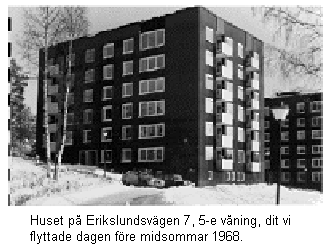
After eight years and three children, the apartment at Jupitervägen 12 began to feel small; it consisted of four rather small rooms and the layout was not the best, so we started looking for something larger. I was also quite tired of being the building superintendent and receiving all complaints and ensuring that operations ran reasonably well. The new janitor Öberg (whom we got after Reutermo) was not overly interested in property maintenance and had probably taken this job just to get hold of housing. He had been at sea and there acquired certain (bad) habits with alcohol, which also contributed to the relationship between us not functioning as it should. At Studsvik, research had gotten properly underway and I didn't have as much time to manage my superintendency. The Ringbergs had moved to Erikslundsvägen 7 and when Viola called and said there was another apartment that would become vacant, we also decided to move. It was quite a good increase in living space - from 90 square meters to 115.
The move from Jupitervägen to Erikslundsvägen took place on the hottest day of the year - the day before Midsummer 1968. Neither before nor since have I come anywhere near my record for beer drinking - 12 bottles in one day!
- "That reminds me of the two bums in the Åbo urinal at Salutorget."
- "You know," said one bum to the other as they watched the liquid trickle into the drain:
- "Beer, you don't buy it, you just rent it."
Once all the moving goods were transported to Erikslundsvägen 7, we packed the car, stuffed in the children, and drove to Finland to spend a couple of quiet weeks with the teacher and music director Olga Naukkarinen in her cabin in Joutsa.
Olga served in Sheltozero (Far Karelia) during the Finns' time and has always been one of my supports. I maintained contact with her throughout my stay in Finland, (similarly with Aune Laine and her sister Aili) corresponded with them from Sweden and on one occasion, when Olga had been to the continent on a holiday trip and passed through Stockholm on her way home, we agreed that we would visit her in Finland.
For several years we spent a week at Olli's summer place. We ourselves were still quite tight on finances, the children were small and Ann-Marie stayed home with them. We weren't in any dire need; I did all sorts of extra work and it worked out more or less financially.
Upon returning from the Finland vacation in 1968, it was time to start arranging the new apartment. Such things take time, but now there was a bit more space; Tomas now lodged in a room off the kitchen - with its own entrance directly from the entry level. Maria and Katarina had to share a room. There was some squabbling now and then, but that is only healthy. There would be less cliquishness if women also had to perform some kind of national service or social duty and learn to get along with 10-16 people in the same room.
Single people all too often become too independent. Marriage or cohabitation is something that can be compared to a gear. The gear module is intended to be the same, but the grinding can be very different. If the gears are new and not fully hardened, there will be some squeaking at first, but after a while the gears will have ground into each other and the gear will function almost silently. If the gears lie too long on their own and become hardened by the environment and prolonged living alone, two such gears will not function - or will function with constant squeaking because the surfaces are hardened and there is nothing that can give way. It is the same with people. If they live too long as independent individuals, adaptation to cohabitation becomes nearly impossible.
In the early 1970s, there was a lively discussion about housewives and Ann-Marie was also affected by it. The youngest child Katarina was over 10 years old and Ann-Marie didn't have much to do at home. She began to feel the pressure from the "red stockings"' (red-asses') propaganda about housewives "drowning in the dishpan" and was unhappy at home. My duties had included washing the children when I got home from work as long as they were small, but now they could do it themselves and I got more time for myself. Ann-Marie started looking for work and sent an application to K-konsult, but didn't get a job there. Somewhat later, she saw an ad in Södermanland Nyheter where the City Architect's Office in Nyköping was looking for a temporary map drafter. She sent in her papers and the very next day the then city architect Karl-Otto Hellman called and asked her to come up to the city hall. It turned out that the city architect's office had two map drafters, who soon after that they had become permanent also became pregnant, and took parental leave. Ann-Marie came in at the right phase; Karl-Otto presumably thought that our family had gotten the children we wanted and nothing more was on the way.
After a while Ann-Marie became permanent and continued her work until the municipality of Nyköping was to be divided into its original parts: Trosa-Vagnhärad, Gnesta-Daga. Ann-Marie had begun her work by collecting and sorting the maps from these municipalities, when they were to be merged into Nyköping Municipality, and ended by once again separating them and distributing the maps back to their respective localities..
She continued for two years after the regular retirement and stopped when the municipality was divided. It fit really well in time. I was going to take early retirement with 80% of the salary and left my work at Studsvik Radwaste at the turn of the year 1991-92. She did not get any full ATP, but nowadays we manage quite well: our health is nothing to complain about and income is not lacking either. Now, when we don't spend any large sums, now we have money. When we really needed it, during the children's upbringing, then there weren't many extra pennies left from the salary and other earnings.
We still live (1995-04-15) on Erikslundsvägen and are quite comfortable. Already in 1972 I became chairman of the housing cooperative Morkullan, which comprises two properties on Erikslundsvägen (the other is Stormfågeln) and since no one else has wanted to take over the office, I carry on. The task is not particularly burdensome if there is a good deputy caretaker who handles most things. We buy our service services from HSB and it has worked excellently so far.
The housing cooperative's 6 tower blocks of 6 floors cost about 10 million kronor to build in 1963. During my chairmanship we have restored for an equal amount: new facades, new roof, new windows and new elevators. Now (1995‑09‑24) we are about to make additional investments in the form of replacing the water and sewage pipes for about 12 million kronor. It is perhaps a bit early, but construction costs are very low at present and furthermore the government gives a 15% discount on all such renovations. A couple of days ago we had an extra general meeting regarding the matter and made a preliminary decision about the renovation. During the winter of 1999 the cooperative renovated the laundry rooms for 500,000:- and purchased new, completely modern washing machines. The floor in the laundry room has been given tiles and the walls ceramic tiles. Looks really clean and luxurious.
Now (2000-01-24) the cooperative is in negotiations to improve the balconies and the next step will be to replace the lock system. We still have a master key system and have been lucky that no irregularities have occurred. Besides HSB, only I have a master key and every now and then I have to help my neighbors get into their apartments when they have locked themselves out. Nyköpingshem had the misfortune that the master key went astray and there were several burglaries before the man was caught and got 3.5 years for his deeds and possession of ”a small” amount of narcotics.
During the summer we have replaced the lock system, the old one was becoming too unreliable: when reordering cylinders and locks, the old keys often did not work with the new cylinders. It cost 360,000:- for the cooperative. The inspection is still (2002-09-14) not done, I have called NUV several times and asked the responsible person to set a date, but it has not worked. There are some deficiencies in the common areas.
In the spring we sorted out our dealings with the municipality regarding waste sorting. It has worked really well, no major complaints either from the municipality or the members.
At the annual meeting it was decided that some trees should be removed, there were about 20 people who participated when we went through which trunks should be removed. I was still weak after the pneumonia when the felling was to begin and ordered Mannis Trädfällningsfirma from Flen to do the felling. Then I put up advertisements that we needed help removing the branches. On the appointed day, four or five people came. The end result was that I myself, vice-chairman Lennart Andersson and a couple of other people helped. There were 18 trunks and I trimmed, sawed into suitable lengths and portioned them out to various people (including myself). Rune Lundqvist's and my former workmate Lars Öberg had retired and moved completely to Gotland, he was on a temporary visit and they drove 6 trailer loads to Peter Tarkpea. His villa plot in Petersberg became a bit cramped and he had some difficulty getting into the house. I drove 4 loads to Lilla Fredrikslund and the rest were taken care of by relatives of Porjebäck in exchange for the promise to help with the removal of the brushwood. It became almost 10 filled containers. Lasse Öberg suggested to Peter that he should come with his hydraulic splitter from Gotland and make sure the wood was split. It took two days for Rune and Lars to process Peter's 6 loads, then they moved to Lilla Fredrikslund and we worked for a day and a half at our place. Now we have wood for the rest of our days and even longer, at least as long as we keep the cottage Ann-Marie does not need to think about saving fuel.
During my illness I had an inspector from Föreningsbanken's real estate agents look at the cottage and suggest a sale price. We were there for a couple of hours and he valued the entire property at about 450,000:- at auction maybe up to half a million. He didn't understand much about our work, but was greatly impressed when he came down to the sauna cellar and saw Ann-Marie's jam jars - they occupy the entire one gable wall and also extend along the long sides.
Today (2003-05-11) we still have the cottage, but are starting more and more to think about getting rid of it.
Now (2003-08-29) that I have had a heart attack (2003-08-29), the thoughts of selling the cottage have become stronger and when autumn comes and I get the Internet sorted out, I will place an ad. Björn Grönroos has promised to come and take a number of photos with his digital camera as a basis for the advertising.
At the beginning of 2004 I resigned from the chairmanship of Brf Morkullan. No one wanted to become chairman, but after some persuasion, vice chairman Lennart Andersson took on the task. At the conclusion of the annual meeting I received as thanks a nice watch and at a later gathering with the Södermanland HSB association I was awarded a fine crystal bowl and a very beautiful bouquet of flowers.
33 years as chairman of a cooperative is a long time. The properties Morkullan and Stormfågeln cost about 10 million kronor when they were built in 1963-64. After all the renovations, repairs and other things, it turns out we have invested 20 million in improvements and modernizations. By then most things have been renewed: new roofs, new elevators, additional insulation of the houses, new windows with aluminum cladding around the frames, renewal of the pipe mains, improvement of the area and new locks. The cooperative has good finances and a couple of million kronor in the bank for unforeseen expenses. Apart from some minor incidents, the chairmanship has been fairly calm. The cooperative is now inhabited mostly by pensioners and most of them no longer have the energy to quarrel. Today the cooperative resembles more of a retirement home, the young people are very few. The cooperative apartments have risen to astronomical values, a couple of years ago the Petterssons moved in two floors below us and they paid 700,000 kronor for their five-room apartment similar to ours. The four-room apartments have sold for 500,000 thousand and even for one-room apartments some have paid nearly 50,000 kronor.
The cooperative has a maintenance plan that was drawn up in 1998, revised in 2006 and extends to 2025.
During my chairmanship the following periodic maintenance has been carried out:
1984 Roof reconstruction and facade renovation
1992 Window replacement
1996 Pipe replacement and renovation of bathrooms
2000 Balcony renovation
2001 Replacement of locks in the property
2002 Improvement of the outdoor environment
Our life is slowly drifting towards the home port, the final destination and the journey goes quite well, we are traveling in first class basically, have enough money and hardly any worries except for failing health. We have had the joy of being relatively healthy: I have admittedly suffered from both pneumonia and a heart attack, but at the moment (2005-08-14) I do not feel any discomfort from either one. Ann-Marie also seems to be completely healthy, her memory is beginning to fail a little and sometimes she asks about the same things at short intervals, but who escapes the troubles of old age? The latest variation is that I fell at Kvarnbron, hurt myself so badly that I got 5 cracks in my ribs and shoulder blade, but even that I have survived and don't have much aftereffect.
We socialize with our friend Rune Lundquist, we don't have any others – you don't make friends when you get old. At best you can get some acquaintances to occasionally spend time with. With Rune we became acquainted in adulthood and we don't have any major shared experiences except for the years at AB Atomenergi in Studsvik. Real friends you only get in childhood, those with whom you have very early experiences, about which one can later in old age talk and remember. Since May 10, 2006, Rune has not wanted to see us and we don't know why, to my knowledge I have not in any way hurt him or been unpleasant. Bachelors sometimes get such strange ideas, you never know what they then do with them.
The language skills have in some cases led to rather unusual tasks. For several years I was an interpreter for elderly Finns, Estonians, and for the refugees from the former Soviet Union. The Finns came to Sweden in the 1960s and never became linguistically integrated into Swedish society. I was often called upon as a linguistic aid for Mr. and Mrs. Aulis and Hilja Knopp. They came to Sweden in 1969 and Aulis had been a forest worker for many years at Mälarskog, but fell ill, which resulted in him gradually becoming almost completely paralyzed on one side of his body. His hand had curled up and had to lie against his body. His wife Hilja struggled long and hard; she took care of him and herself even when, in the early 2000s, she broke her right wrist on the way to the store. After a while, Hilja could no longer cope and Aulis was admitted to Mariebergsgården. When Aulis died, certain problems arose. He was Greek Orthodox and could not be buried according to the Swedish ritual. Moreover, he was Finnish-speaking and that was especially troublesome. There is an Orthodox congregation in Stockholm where he was registered, but Hilja wanted a Finnish-speaking "pop" (priest) at the funeral, and I had a great deal of trouble finding one. It became a priest from Finland
Aulis' relatives lived far up in Northern Finland; they were old and could not attend. A number of people from the Finnish colony were present, but no one who wanted to say anything at the coffin, so I was given the task of holding a eulogy for the deceased. Hilja was in fairly poor condition and informed me that she did not intend (did not have the strength) to attend the funeral. I insisted, however, and said that I would call before the funeral and come to pick her up to take her to the hospital's prayer room, where the funeral would take place. When I called, she told me she still did not want to attend, and I went alone to the hospital to meet the priest and ensure that the funeral would take place.
There were about ten people—old acquaintances and workmates of Aulis—gathered in the prayer room, where Aulis' coffin stood under a Finnish flag (which I had borrowed from the Finnish Society) along with a number of flowers and wreaths. Actually, there should be two officiants at an Orthodox funeral: a priest and a deacon, but the deacon could not come and the priest himself had a cold. Now he had to struggle with both the text and the singing (which the deacon would have handled), and I myself had to step in as a kind of "assistant priest." That meant I had to handle the censer and wave it from time to time. The smoke was somewhat troublesome for the poor priest; he had a sore throat, and the smoke from a censer is quite pungent.
The funeral ritual took nearly an hour, and afterward we gathered at Mariebergsgården, where a coffee table was arranged for the closest mourners. When the coffee was finished, I took the priest with me and we went to Hilja. She scolded me for not having picked her up, but now it was too late. She sat on the sofa in a black dress.
Hilja struggled alone for a couple of years, but she got worse and worse. I tried to get her into a nursing home, but at first she protested strongly. She survived the first stroke; a couple of days later she was back in her apartment and continued going into town to play bingo. Now she had little money, and I received almost nothing for my efforts. Previously, she would occasionally slip me a few hundred kronor for my trouble. She did not survive the second stroke; she remained in the hospital, and on the same day she died, I received a notice from the municipality that she was to be admitted for elderly care, and from the district court that I had been appointed as her "guardian." Hilja died in March a couple of years ago, and I once again had to act as funeral director. I called the daughter Tuula Nuutinen in St. Mickel and informed her of the death. She came a couple of days later with her son and partner, cleaned up the apartment, and the question arose of when and how the funeral would take place and whether they planned to return for the ceremony or not.
"How quickly can we arrange it?" asked the daughter.
"I don't know," I replied, "I'll find out."
I called the Östra parish in Nyköping and made inquiries about the funeral, but from there I was informed that Hilja was not registered in the parish, nor anywhere else. To consult about the funeral, I contacted Susanna Engberg at Arfwidssons Funeral Home and made the situation clear to her. We would not get any help from the church. It was a Thursday, and the daughter and her company apparently wanted to get the matter over with as quickly as possible. When I called Susanna at the funeral home again about how quickly it could be arranged, she replied that she could arrange it for the following day at 11:00 AM.
"You can bury her yourself; you held a good eulogy at her husband's
funeral. No one else is needed."
We gathered in the prayer room, I held the eulogy, and only the funeral director Susanna, myself, and the daughter with her son and partner were present, so it didn't take long to complete the ceremony. There was no gathering afterward; the daughter was in a hurry to get to the ferry, which was to depart at 5:00 PM from Stockholm. They had taken the few things of any value; the rest was piled on the floor, and I was to try to get rid of it. However, most of it was so worn and worthless that not even the Salvation Army wanted anything except a bookcase. With the help of Peeter Tarkpea and Rune Lundquist, we drove the remaining furniture to the recycling center.
The daughter and her company left for Finland, and I was left with the apartment. Summer was approaching, and the prospects of selling the two-room apartment did not look very promising. Moreover, Hilja owed the municipality a fair amount of money; she had not paid for Aulis' stay at the hospital and nursing home. It was not until August that a buyer appeared. He was in need of an apartment after a separation from his partner and bought the two-roomer for 125,000 kronor, a fairly good price even though the apartment is on Brandkärrsvägen, an area that does not have the highest status.
When I had completed the inventory of the estate and all the debts, I took 10,000 kronor for my trouble, and the daughter received nearly 70,000 SEK as inheritance. With Hilja and Aulis, my commitments with that part of the Finns who did not master Swedish in official contexts came to an end, and now I have no worries at all, except for my own and Ann-Marie's. It feels quite liberating.
Inventory of the estate By Ivar Röstlund

Father and mother are gone. Now the estate is to be divided,
the estate they labored to build over more than fifty years.
Hands, perhaps strangers', see that nothing is missing.
Everything is counted, everything undergoes a short-sighted scrutiny.
Simple, dear old ornaments and memories,
Furniture that has served its purpose is brought out.
The minds of more or less tender relatives
count and watch, dressed in black, solemn.
Yet here every object has its everyday story
from the toil, struggle, and faith of times past.
The tale of how two people could laboriously draw
each in their best way to a common home.
If only objects could tell all they have seen,
could tell these people what they once meant.
Perhaps they would then place them respectfully
But, where is the sense of modesty
Before things that have money's power and value?
Family and blood ties disappear mercilessly,
If it is noticed that one takes more than the other.
Rather crush, tear and destroy
than it becomes another's advantage or gain.
No matter what they say, no matter how they act,
only that they themselves do not get the least of the inheritance.
If only those who labored to build it all,
had foreseen what seeds of strife they left behind,
sown among those who are to divide the inheritance,
the memories saved after mother and father.
Do we then find it so hard to tolerate each other
That we sacrifice everything for worldly goods?
Do not wonder if strangers judge one another!
Do not wonder if it blows cold in the world!
Katarina sings Christmas 1978 "Pappa kom hem". On guitar Albert Kronberg
Katarina plays.
Summary
Ann-Marie and I are beginning to get old. It shows more and more. Ann-Marie is starting to have difficulties with her memory; it began to be noticed by those around her at the beginning of this year.(2006-05-29). For my own part, I have begun to feel a certain stiffness, and my body cannot handle much physical exertion anymore. Last Saturday we went to the cottage to mow the grass; it had become far too long because we hadn't been there in a while. I borrowed the neighbor's motorized and self-propelled machine, but it is quite heavy, and I felt it on Sunday. I had a real ache in my back, and today, a few days later, it is still noticeable. Not just muscle soreness but also a substantial feeling of stiffness in my back. It is most noticeable when I get up from the TV sofa; then it really resists.
However, we don't have much to complain about. Age takes its toll, and there is nothing to be done about it; just keep struggling so that the change does not become too abrupt. We take our walks, and there are no difficulties at all – yet. We stick to our Saturday walks to the city center, which amounts to a distance of about half a mile.
Our lives have passed in a fairly calm pace; hospital visits have been few, and the minor ailments I have described are nothing to speak of when you think how some other people are with their illnesses. Apart from the heart attack, I have only been in the hospital twice: once during military service in Distant Karelia (1943-09-16) at field hospital no. 36 behind the Finnish communist Viljo Kuusinen's palace in Petrozavodsk. The second time was a stay due to the Asian flu, during Swedish conscription in autumn 1957 at KA4 in Gothenburg. The Asian flu was raging, and when we came ashore after four days of isolation on Måvholmen near Vinga, the military doctor thought he should keep us under observation for a few days at Nya Varvet Infirmary.
2008-02-12
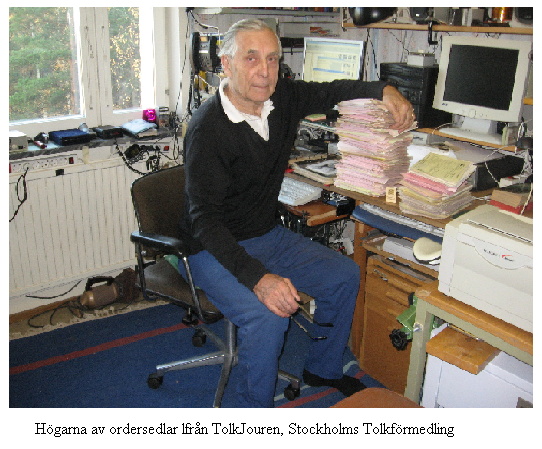
The interpreting assignments are really starting to taper off. It has been a couple of weeks since I had an assignment, and for my part, the work is winding down. I haven't even bought a diary to record the assignments. A few days ago, I went up to the storage room where I have kept all the order slips, took them down, and we counted them. There were nearly 4,800 assignments from the time I retired on 1990-11-30. Most of the interpretations were Russian-Swedish, but quite a few Finnish and more recently also Estonian. When it was most intense, about four or five years ago, there could be 8-9 assignments per day. In addition to these assignments, I have done some interpretations for SSI, SKI, and TRC, the Prison and Probation Service, and a few other institutions. The duration has varied from a few days to a week.
Today (2008-05-03) the number of assignments has suddenly increased because Södermanland County Council has accepted TolkJouren as a provider of interpreting services. For my part, it means that I occasionally have to take a trip to Eskilstuna to interpret at Mälarsjukhuset. It is not particularly profitable to go there for an hour, but I get paid for travel and idle time, so there is always something left over – while I also harbor the hope that in this way I can keep the 'upper floor' in decent shape and possibly depart this life 'with my boots on'.
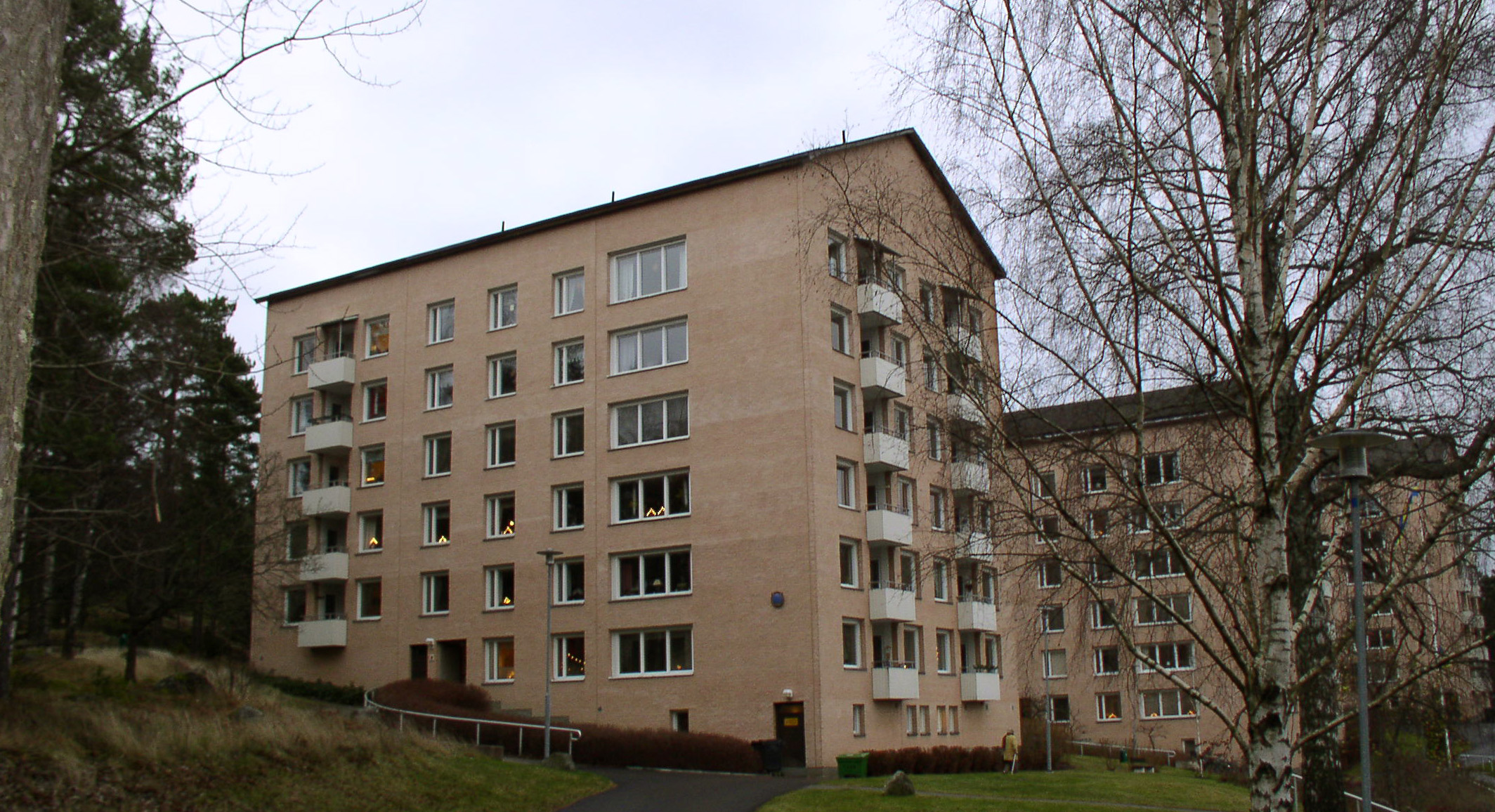
At the end of 2009, the apartment on Erikslundsvägen began to feel somewhat too large and desolate. Ann-Marie sat in the living room and I was working on my documentation in the room behind the kitchen, and sometimes several hours passed without us seeing each other. We had talked about moving on and off and had registered with Nyköpingshem, Slottsbostäder, and HSB. The opportunity came in November when Madeleine Franzon, a manager at HSB (which manages some rental properties), called and said there was a vacant apartment in the St. Anna area in central Nyköping. We were quick to decide, and during December the contract was signed for the new apartment. It was already vacant, and I became a frequent customer of the grocery stores that sold bananas. Banana cartons are excellent moving boxes. I had about 30 of them and during December transported most things to the new apartment at Forsgränd 5 – right next to St. Anna's restaurant. The Ford Mondeo Helcombi came in handy; it holds about 8-10 cartons. Moving from a 5-room to a 2-room apartment naturally has its challenges, but we had lived on Erikslundsvägen for 43 years and many of the things were old and worn, without being antiques. With Ann-Marie's willing help, we got most things to the new apartment; only the bed and the leather sofa I needed help with from Rolf Lindh and HSB's trailer for the move. The piano was taken by the moving company Foria; it cost 2000 kronor, but I couldn't dishonor Georg Bohlin by sending it off to 'something' yet. Now it's a bit cramped at our place, but I hope someone takes the sales ad for a 'reddish leather sofa with 2 armchairs'.
The condominium apartment was advertised at the beginning of the year, and after quite a number of people had come to look at it, the family Stefan and Eva Carman (with the willing help of Stefan's father) decided to buy it. We agreed on 880,000 kronor (purchased in 1948 for 12,000 kr) and on the 17th of March was written undertecknades the purchase contract. The sale perhaps didn't go so quickly because there is not much demand for 5-room apartments; the apartment was also worn down after 43 years. I had papered and painted the ceilings in some of the rooms during the second Advent week of 1972, and after that not much was done. When the ad came out, several real estate agents wanted to sell the apartment for me, but I felt there was no reason to lose 4-4.5% on the deal; besides, I had sold both Oscar Margus' and Hilja Knopp's apartment myself without needing to hire an agent.
Condominium apartment: 115 sqm, 5 rooms and kitchen with south-west exposure on the 5th floor with view over Stadsfjärden, in a quiet neighborhood close to nature. 1 room with its own entrance. 1 bathroom, 1 laundry room, pipe replacement, roof, insulation, new elevators, etc. Pipe replacement and additional insulation done. New elevators, new lock system, triple-glazed windows, new laundry room. Monthly fee 4986:--, covered parking space.
Asking price 1,000,000:--, 30.00 in the repair fund. Available 2010-01-01
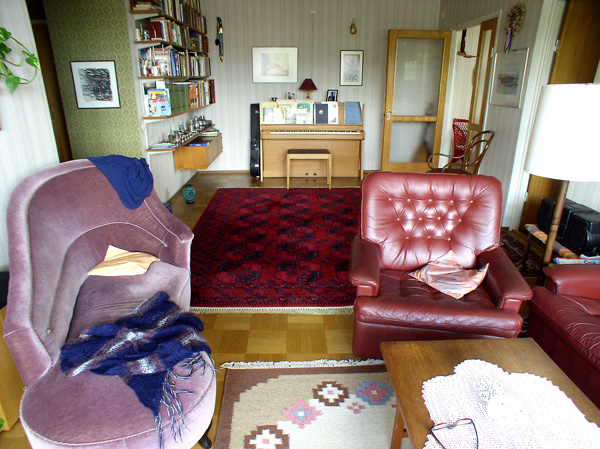
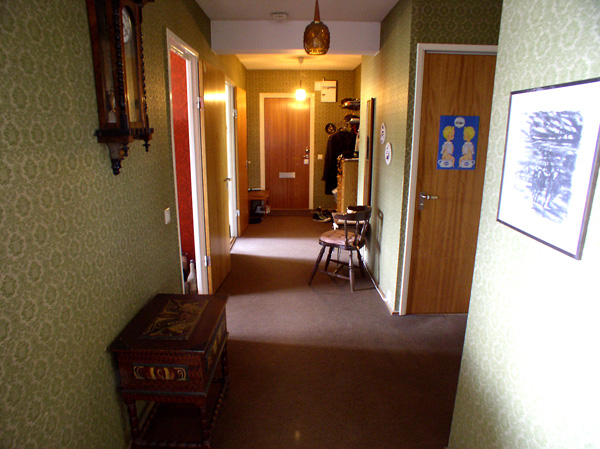
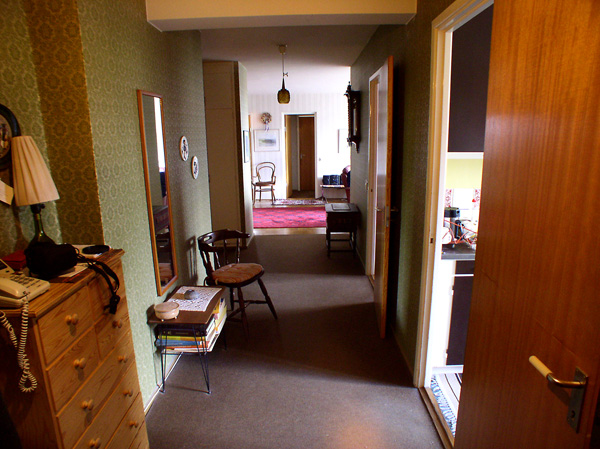
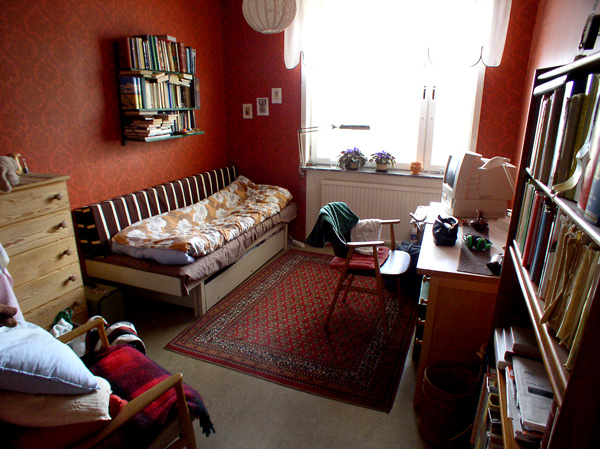
. Right now (2010-03-25) there are a bit too many things in the attic, but when the warmth returns, to the recycling, partly our old things and partly also what I have collected there over the years.
Nyköping's history in Russian.
Нючепинг остается в истории Швеции как место проведения злополучного Нючёпингского банкета, на который король Биргер пригласил двух своих братьев, Вальдемара и Эрика. После трапезы братья отправились отдохнуть, но были разбужены слугами короля и брошены в темницу замка. Ключ от каземата король выбросил в реку, обрекая братьев на голодную смерть, однако его коварство вызвало народное восстание, и в итоге Биргер был изгнан. Новая жизнь замка началсь в XV в. когда король Карл IX перестроил его в замечательном ренессанском стиле. В 1665 г. Значительная часть сооружения была уничтожена огнем. Годовщина знаменательного банкета ежегодно отмечается парадом, а на берегу реки появляется цветочное изображение судьбоносного ключа. Внутри замка располагаются две экспозиции, расскаывающие о двух наиболее заметных периодах в истории замка.
Recordings
- 63Lillymormor.mp3
- 641107 Katarina jollrar D.mp3
- 78 Jul Katarina sjunger.mp3
- 800704 Källviken Albert Kronberg och Lennart Pettersson sjunger.mp3
- 800704 Sång på berget L Pettersson polackerna.mp3
- 810113 Annandag Jul Gertrud och Sonja på besök B.mp3
- xx Anders pratar och sjunger A.mp3
- xx Anders pratar och sjunger B.mp3
- xx Anders pratar och sjunger C.mp3