NAVAL VISITS 1962-1979
GeThrough the efforts of the interpreter officer at the Defence Staff, Commander Nils Öberg, I was transferred to the Air Force in 1961, appointed as lieutenant, and was frequently employed by the Navy during the "friendship visits" to Soviet port cities: Leningrad, Tallinn and Riga. For some reason, the Navy has had rather few interpreters from its own ranks; for the most part it was Antti Nordberg (army interpreter), myself, and Bill Belaieff from the Air Force, and I myself who have made most of the trips in connection with the naval visits. On one occasion I pointed this out to Admiral Rudberg, but no major change seems to have occurred. From 1962 and up to the submarine incident, I participated in all the naval visits to the Soviet Union. In 1980 we had acquired a small cottage and the money was not enough for a telephone, and Gulli (Nils Öberg's secretary) could not reach me.
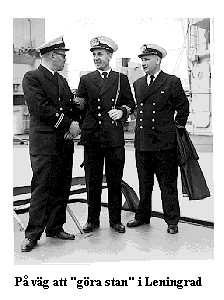
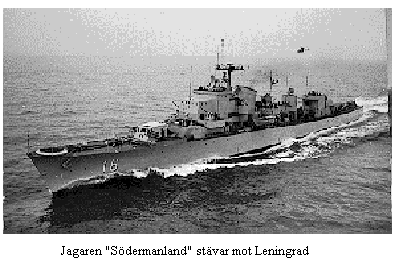
The naval visits began in 1962 with the destroyer "Öland's" visit to Leningrad. Actually, it was supposed to be the destroyers "Halland", "Södermanland" and "Hälsingland", but "Hälsingland" ran aground shortly before the visit, got its propeller shaft bent and was out of action for a while, and "Öland" had to go as its replacement. The commanding officer of "Hälsingland", Commander Reutersvärd, came along nevertheless. He had been naval attaché in Moscow and told in the wardroom about the game of "hide-and-seek" he had played with Russian surveillance officers during his time as attaché. There was a certain degree of surveillance of the higher-ranking military personnel up until the end of the 1970s. During my first visit to Leningrad, we were not to dock at the quay but instead moored at the buoys between the Palace Bridge and Lieutenant Schmidt Bridge, opposite the Winter Palace and the Wedding Palace. Transport to and from the ships was by a large tugboat, and this was naturally for the purpose of keeping track of the foreign power. At first, there were no night leaves; "all hands" were to be on board before midnight.
The first naval visits were rather stiff and formal occasions. The distrust of the other party was very great on both sides and a more cordial atmosphere rarely arose. When the intoxication was over, the friendship was also over. I cannot confirm it, but it was claimed from some quarters that when the Swedish Navy had departed, all the people who had stood on the quay waving goodbye to us were taken into custody.
Night leave was only granted during the subsequent trip, two years later. Then we also got to avoid mooring at the buoys, but this did not happen without complications. Through diplomatic channels, it had been agreed that this time the ships would lie at the quay, but when we sailed in between the by then well-known bridges, it seemed to be the same as during the previous visit. For two hours we had the engines running and no one really knew why. After some delay, we finally reached the quay, moored, and began with the visits. Later we learned that the local Russians had not wanted to let us get to the quay, but then Admiral Blidberg had gotten angry and said that in that case we would turn the bow downstream and sail back to Sweden.
Now certain other easements had also been introduced. The officers had night leave and did not have to feel like the recruits during the first weeks of conscription. Nightlife flourished and certain incidents occurred, but none of a serious nature.
The first naval visit in 1962 became, for "Öland's" part, very memorable. On the return trip, an incident occurred that could have ended badly, but thanks to the crew being well-trained and the weather good, the event had a happy ending.
I was in my cabin and the ship was abeam of Helsinki on our return from Leningrad, when I heard shouting and commotion from the deck. I went up and saw a seaman from the engine room, he was standing with a guardrail stanchion in his hand and seemed somewhat indecisive. The deck watch had his sub-machine gun at the ready and a little further away I saw the executive officer. Suddenly the executive officer shouts:
- Drop the stanchion and give yourself up, or I will order fire!
On naval units, one of the deck watch is always armed and is usually stationed mostly on the afterdeck where there is the most space. Now his presence would potentially be put into service by the executive officer.
By this time several people had heard the commotion and many had managed to come up on deck. The man looked now at the gathered crowd, now at the sea, and it was clearly evident that he was very uncertain about what to do. Suddenly he swung his arm and we saw the guardrail stanchion fly away and land in the water, after which he himself took a good run-up, ran in the direction of the starboard quarter and with an elegant swan dive jumped off the ship. When he came to the surface again after the dive, he waved at us.
- Man overboard! shouted the deck watch, all in accordance with his instructions, rushed to the lifebuoy and threw down both it and the buoy with the flag, which is attached to the ring.
After the cry of man overboard fades away, a great deal happens on the ship - and with the ship. Everyone not involved in the direct action searches for the lifebuoy with the flag buoy. A human head disappears from sight very quickly even at a moderate wave height and would in most cases be impossible to spot without the nearby floating lifebuoy, which the person in distress is supposed to try to reach. The ship's course is changed for a full turn and the lifeboat crew in the watch rushes to the lifeboat and begins to ready it for launching. In wartime, one launches the lifeboat while under some way, but in peacetime one does not want to take such risks; the lifeboat and its crew can easily be damaged. One waits until the speed is practically zero before the davit machinery is started for lowering the boat.
The helmsman put the destroyer's rudder hard to starboard, which caused the ship to heel considerably. Since the ship was not prepared for such a sharp turn, not all hatches were closed. At the far aft on the port side, the mine and artillery officers were quartered; their cabins filled with water up to the raised sills and a great deal of paper and other buoyant objects were washed into the water and from there out into the passageway, since the doors were also open due to the heat.
In the meantime, we had gone around and were now near the lifebuoy. The cutter was manned and launched; we saw the seaman, he had put the lifebuoy on himself and was waving cheerfully at the crew in the rescue boat. After a while they had reached him and took him into the boat. When the rescue boat returned to the ship's side, the torpedo recovery hook was lowered, a sling was put around the man and he was hauled up. When the crane was swung in, the ship's surgeon was opportunely nearby and stuck a syringe into his backside. By then the seaman was quite chilled; the water temperature was around 10 - 12 degrees Celsius and the rescue operation had taken about a quarter of an hour.
- Now he'll be calm until we reach Hårsfjärden, said the ship's surgeon. The seaman was placed under arrest in the sickbay and was not allowed out anymore; we had about 12 hours of steaming time left to port.
When most of the excitement had subsided, we learned the background to the event.
The seaman came from the engine room and was a conscript over age, around 28-30 years old. He had sailed abroad and had not done his military service. When he then came to Sweden, the conscription authorities took charge of him and he, like others, had to do military service and was placed in the Navy. Over age as he was, and having also sailed abroad, he had acquired certain (bad) habits. The crew is forbidden to have spirits on board, but he had managed, despite the duty officer's "search", to smuggle a couple of litres. This had been consumed in the crew's quarters and, in an intoxicated state, some grudges against the officers had come to light. Encouraged by his comrades, he had grabbed a Mora knife and was going to settle accounts with Boatswain's Mate NN, who on some occasion had insulted him.
Once up on deck, he had met the boatswain himself; he was a person with a certain authority and apparently accustomed to handling his men, and he had managed to persuade the seaman not to bother with the boatswain's mate but to leave him alone. The story could have ended here, but back in the crew's mess, his comrades had started to taunt the seaman and he had become angry again. He had again gone up on deck and, since he no longer had a knife, he grabbed the first available tool, which happened to be a gangway stanchion. On a ship of the "Öland" type, these are stored under the torpedo tubes on the main deck.
This time the executive officer happened to be on deck and the story turned out differently than the seaman had intended.
Something always happened - even if it could not always be described as unforeseen. The visits to these, to say the least, "aquavit-soaked" places Leningrad, Tallinn and Riga often brought extra work for interpreters and military police. Alcohol was freely available and very cheap by Swedish standards; there was also heavy drinking, but at the same time the norms were quite liberal - temporarily.
When Admiral Blidberg gathered his men in the auditorium at the Berga schools before departure, he used to say:
- We shall not be too petty. Every man who can make it to the ship under his own power and come on board shall be regarded as sober.
The abundant supply of cheap liquor brought with it some problems, not only on board but perhaps mostly ashore. An interpreter on duty was always to be on board; he could then assist with the most varied assignments.
Once in Tallinn, the interpreter was summoned from the Russian commandant's office. Someone had called there and reported that a seaman, bleeding down his arm - probably Swedish, he had no cap and did not speak intelligibly - was somewhere on the outskirts of the city. The commandant's office always had a car standing at the quay, and now the interpreter rode with a couple of Russian military police to the given address - and sure enough! It was a Swedish seaman and he looked strange. His right arm was completely covered in blood and he also had blood on his face. Upon closer inspection, it turned out that with the face it was not so bad; he had wiped his face with his bloody hand and smeared himself thoroughly. The hand, however, was worse; there were long slash wounds and the skin was hanging cut in several places.
At first, people thought he had been in a fight, but during the bandaging in the sickbay it emerged that he had caused all these injuries himself. After drinking a bit too much vodka, he had gotten lost and happened to pass a greenhouse at a suitable distance from the sidewalk. He was angry for not finding the harbor and in passing, he smashed in some glass panes with his bare hand. When the blood began to flow, he became enraged and smashed in several more.
In Riga, I myself experienced an intermezzo after a fight. When we went to fetch the brawler, it turned out that he had fared rather badly; his jaw was wide open and he gaped like a cod on dry land. In the fight, he had been struck and his jaw had been dislocated. It looked quite comical and we couldn't help laughing at the misery. We took him to the military hospital in Julgava, the military doctor looked at him for a while and then aimed a blow at his jaw. It snapped back into its sockets and the man was restored. The operation succeeded and the man regained his ability to speak, only saying that his jaw was a bit sore. It was, in its way, a refined operation, without too much sophisticated technology involved. The military doctor laughed.
- That we have to do all too often; they fight quite a bit in the Soviet Navy. It's some kind of tradition from old times. Russian sailors have a broad belt; previously the buckle had a double eagle embossed on it, now they have a star and an anchor. The buckles are used in fights and can cause rather nasty wounds; the buckle is made of metal and is quite heavy.
Sometimes, as an interpreter, one had to be an intermediary in some intended affair between a Swedish sailor and a "native girl". During a visit to Riga, we were on a tour of the city and were also to visit a place where the Germans had had a concentration camp. While we walked around looking at the various objects—the eternal flame on a cracked marble slab—a Swedish lieutenant had made contact with a girl who was among the local visitors. They had language difficulties, and I helped so that they could agree on where in the city to meet after duty hours. However, Soviet officers in our party must have observed the action, or else the girl changed her mind. When I asked the lieutenant about the meeting the next day, he told me that no one came to the agreed place.
The Baltic Fleet Hospital in Julgava was a large facility. According to reports, it could house about 400 patients and had 315 personnel—everything from dentists to physiotherapists. I asked if the hospital was also used as an alcohol clinic; the answer was no. For that purpose, there were other institutions. The hospital had a large dietetics department, and it was certainly needed. The average Russian is a rather short and stocky person; as a military man, he has a rather monotonous and boring life, which is compensated for with proper parties when the opportunity arises. The traditional Russian festivities, with lots of food and even more drink, cause significant overnourishment; the personnel "swell" considerably after a few years of service. They were sent here to Julgava to get rid of their extra kilos and improve their physical condition.
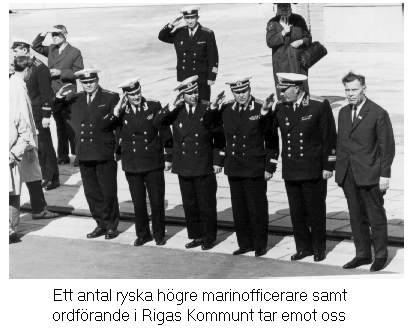
The commander of the Leningrad Naval District in 1978, Admiral Michailovskij, was a textbook example of an excessively overfed, desk-sailing sailor. He was square, literally speaking. If you had cut off his arms and legs, turned the body 90 degrees, and then reattached the extremities, you would hardly notice the change. During that visit, I stood together with the Russian liaison officer and my colleague, the Russian interpreter kk Lanzev, as well as a few other Swedish officers on the deck of Visborg, watching the reception ceremonies down on the quay. Lanzev himself was a very rotund person for his age. Suddenly, the Russian liaison officer turned to me and asked:
- How is it that your sailors are tall, well-built, and have proper proportions? Just look down there, he said, pointing at a group of senior Russian officers standing on the quay, ours look like a bunch of frogs!
- What shall we say to him? I asked the Swedish officer in turn.
- Say that the King doesn't pay us enough for us to eat as much as the Russians. After all, we are a capitalist country.
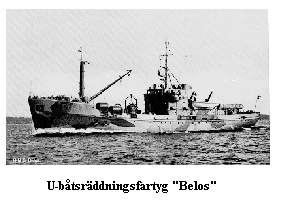
Kk Lanzev was the Russians' interpreter; he was like the other Russian sailors in appearance and body shape. I had known him from an earlier visit by the Baltic Fleet's Submarine Rescue Service under the command of Admiral Eremenko. Together with the delegation and Viktor Eriksson, we visited the diving pool in Karlskrona. Lanzev was a cheerful fellow and had a few rows of decoration ribbons on his uniform coat. I couldn't curb my curiosity and, in an attempt to sound amusing, I asked him:
- Tell me, kk Lanzev, how is it that you, who are much younger and presumably haven't had the opportunity to participate in the war, have managed to get so many medals? I am 10 years older, have served in the Finnish Army (I never concealed that) and have only two measly commemorative medals from the Finns and one from the Swedes. What have you done to deserve, for example, this medal? I said, pointing at one of the countless ribbons on his coat.
- That is the 30-year medal for the liberation of Prague, Lanzev replied.
- But you were never in Prague, were you?
- No, but I was nearby when the medals were distributed.
Brezhnev and Göring are said to have been the most decorated medal bearers of all time, but the other Russian officers were not far behind. There was a joke about Brezhnev that I was told at a later occasion, after we had had a few drinks and raised the visors.
One Russian asks another:
Tell me, comrade Ivanov, where is comrade Brezhnev staying, we haven't seen
him for a while?
- But comrade Petrov! Don't you know that he is in the hospital to get some
ribbons extended.
- Extended? Why?
- Yes, so that he can have room for another "Hero of the Soviet Union" medal.
This medal was considered so important that it should be worn in a row after each other. During our stay in Riga, we were to attend a jazz concert with the Baltic Fleet Band, and also watch a football match between the Soviet and Swedish Navies. The concert was a painful experience. As guests of honor, we sat at the very front under enormous loudspeakers, and since both the volume and the distortion of the system were uncomfortably high, I couldn't stand the misery and, quite rudely, tore my handkerchief apart and stuffed part of it in my ears; after that, it was easier to endure the event. Jazz is not my favorite music, and in Russian naval style with a brass band, it becomes no more enjoyable.
After the concert, we were to watch the football match, and the officers were transported there in the Russian Navy's cars. I sat in the front seat of the Russian commander's large limousine together with Admiral Blidberg, the commander and his wife with their 7-year-old son, the family's status child (late-born child). The admiral was a bit over 50 and the wife a few years younger. It emerged from the conversation that the couple had a couple more children; one of the sons was attending cadet school somewhere in the vast Russia and was to become an officer. The Russian soldier's humor is not of any more sophisticated kind, and the admiral followed the usual pattern. He told one less-than-piquant anecdote after another, and his wife, who held her hands over the son's ears, tried to interrupt him now and then with remarks that the son should not yet hear such stories.
- Just as well he gets used to it from the start; he is going to be a soldier, said the Russian admiral. Both Admiral Blidberg and I would have wanted to cover our ears as well; the stories were very crude.
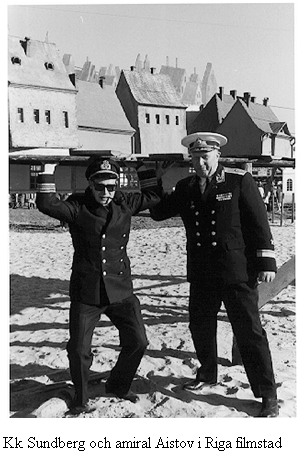
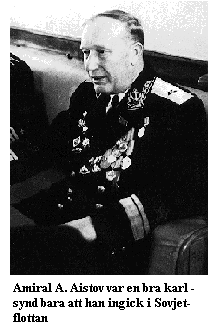
The commander of the Riga Naval District, Admiral Aistov, was a pleasant man, a real sailor, and had come up the long way. When he came on board to say goodbye to us, he handed over a number of gifts (I received a crystal vase) and said:
- When you have cast off from the quay in Riga, I am a former admiral. He retired in 1975.
The Russians are quick to make jokes both about their leaders and about the prevailing conditions. During the Soviet era, one could to some extent read the state of the country. Already in the 1970s, one could hear booing in movie theaters when Brezhnev's image appeared on the white screen, and stories about him were legion. Most were unflattering. One could gauge the leaders' popularity by listening to what was said about them. About Mikhail Gorbachev there were not so many malicious jokes, but Raisa was not always very popular. She was, after all, the first Russian woman (except for milkmaids on collective farms and cotton pickers in the Uzbek cotton fields) to be officially shown alongside a Soviet leader. The following anecdote can illustrate the situation:
The Gorbachevs were in America on an official visit, and during the visit, word came from the CIA that their plane was bomb-threatened.
- We'll swap planes, said Reagan. We have a transport on its way to the Moscow Zoo with a rare ape; a colored man will fly with the ape. You can take their plane, and we'll send your plane with the keeper and the ape.
However, they had forgotten to inform Moscow about the swap, so when the plane with the keeper and the ape landed in Moscow, the entire Soviet nomenklatura was lined up along the red carpet to meet their leader. The keeper stepped out of the plane leading the ape by the hand, walked down the airplane stairs, and looked somewhat surprised at the reception. The foremost of the Russians present in the reception committee stepped forward to the keeper and said:
- Welcome back, dear Mikhail Sergeevich! You look healthy and tanned, and if you didn't have Raisa with you, we would simply not have recognized you!
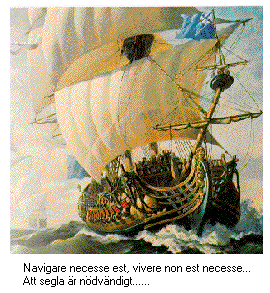
Ladoga.......To sail is necessary
The Russians watched us, but the surveillance cannot have been all that effective, since we were able to make certain detours outside the set schedule. The following mission was undertaken by three men, including myself, to find out the situation on Lake Ladoga. In principle, it was a forbidden area for foreigners; we were not allowed to go beyond the stipulated 30 kilometers, but we nevertheless made a few brave visits. I started by trying to buy tickets from the saleswoman in the kiosk next to the Winter Palace. I did this quite openly, in uniform with a long coat with many stripes on the sleeve. Generally, women are not particularly well versed in military ranks, but here the saleswoman reacted very quickly.
- You are not one of ours, she said, and climbed with her eyes along my rank insignia stripes on the uniform coat.
- You must go to Herzengatan and get a permit to go to 'Schlüsselburg' (the fortress 'Nöteborg' built by the Swedes in the 17th century) at the river Neva's outlet from Lake Ladoga!
We did not give up and took the next step. The wife of Naval Attaché Odin spoke passable Russian, and in a second attempt we sent her to the kiosk to buy three tickets. This time as well, it was refused. Now we had to think of another way.
The boats to Nöteborg departed from the square below the Winter Palace, in front of the statue of Peter the Great. After a little reconnaissance at the boat, there seemed to be no major surveillance or control of those boarding, and we decided to pull off a coup.
We timed our arrival at the gangway a few seconds before the boat was to depart, for safety wearing our raincoats; the weather was somewhat cloudy but it wasn't raining. The Swedish Navy's raincoats have no rank insignia; only on the cap could a trained eye spot that we did not belong to the country's own armed forces.
- Schlüsselburg? I asked for formality's sake the female deckhand who was just about to pull in the gangway.
- Da, da, she said, come quickly on board, we are about to cast off immediately.
Once on board, still in our raincoats, we paid for our tickets and then continued into the saloon. We'll probably be picked up at the next pier a few kilometers up the river, we thought, and sat in tense anticipation. The boat docked at a few more piers, but no one disturbed us, and after the third docking we began to feel safe and relaxed.
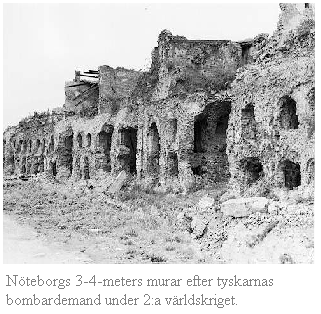
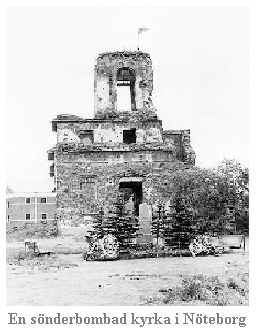
After a couple of hours' sailing we reached the small rapids formed where Ladoga empties into the Neva. The boat docked and we went ashore to look at the surroundings. Naturally we wanted to be real tourists and see the fortress 'Nöteborg', founded by the people of Novgorod in the 15th century and in Swedish possession until 1702. Not much was left of the fortress; in some places the almost four-meter-thick brick walls had been shot to pieces by the Germans during the Second World War, when they were only a few kilometers away and could shell the fortress with their artillery. Most of it was in ruins and only the prison had been restored. In all the other debris next to the prison, there was a sign on the wall stating that here one of the members of 'The People's Will', Alexander Ulyanov, Lenin's elder brother, was executed.
He was involved in the preparation of a terrorist attack against Tsar Alexander III in March 1887 and was hanged in this prison.
The Peter and Paul Fortress in St. Petersburg has also served as a prison, and during a guided tour there we could see on the cell doors plaques with the names of revolutionaries who had been held there during Tsarist times. Once I asked an official guide where those who were in opposition to the Soviet Union were held, but I got no answer to that. Sometimes it was easy to silence the Soviet guides. During one of the visits to Leningrad we drove around the city on a sightseeing tour and eventually came to the square where Peter the Great stands on a statue sitting on a horse. The guide, a Swedish-speaking Soviet officer, pointed at the statue and said:
- The statue depicts Peter the Great, he who built Leningrad!
He was so full of enthusiasm and Soviet spirit that I couldn't resist taking the microphone and adding.
- And the snake that the horse is trying to trample to death represents Sweden.
The guide lost his train of thought and couldn't get out anything sensible until we arrived at the Winter Palace; only then could he run his propaganda record again..
Something similar also happened during a visit to Riga in Latvia. We visited Riga Cathedral, the easternmost Protestant cathedral in the Baltics, and had as our guide the speaker of Riga Radio's Swedish-language broadcasts, N. Nejland. He turned his coat according to the wind and became after liberation Latvia's foreign minister, but did not get a visa to Sweden due to old sins. During this visit, however, he was like a fish in water, a true communist and fellow traveler; he embroidered at length about the virtues of the Soviet empire and about the past Swedish times in the Baltics and Livonia.
- As you know, the Baltics have been occupied by the Swedes for a number of years, he reportedly said on one occasion when he served as guide and was to show us the newly renovated Riga Cathedral. Captain Nilsson, one of the intelligence officers in the Navy, could not listen to this in silence and exclaimed loudly and clearly so that the whole company could hear:
- Oh, by us as well! Nejland was silent for a good while before he could continue.
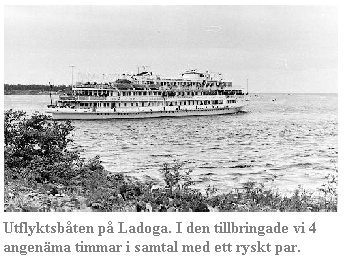
While we were walking in the small town on Orekhovo Island (Nöteborg) and looked like real tourists, a 'babushka' came up and said that an excursion boat was leaving in a few minutes, with the aim of sailing on Ladoga for about four hours. If we wanted to join, we'd have to hurry. The Ladoga pier lay behind a small hill and we hadn't seen it. The kind babushka set off at a trot and we trotted after. When she reached the top of the hill, she called out to the crew of the vessel, an excursion boat of a somewhat larger Waxholm model, to wait before casting off because there were more passengers coming. We hurried on board, took off our raincoats, and immediately attracted some attention with our uniforms. A couple of men came up and asked us in broken English if we wanted to follow them to their cabin. Now our trip would be over, we thought, but.....
The men introduced themselves as a doctor and an engineer, two brothers on an outing with their wives. We were indeed questioned a bit; they had seen the Swedish destroyers on the Neva and knew of the visit.
Now they were just curious in general and wanted to keep us company. Getting close to foreigners was not always easy in the Soviet Union; there were obstacles both in terms of language and restrictions. We were generously treated to their brought goods, both food and drink. I handled most of the conversation while my shipmates took the opportunity to go out on deck and look at the 'surroundings' and into the saloon to dance.
The four hours passed very quickly; then we had company back to Leningrad and waited to be picked up by the militsiya, but nothing of the sort happened. To be safe, we got off together with our new acquaintances a few stops before the final docking place opposite the Hermitage, in front of the statue of Peter the Great, and parted with mutual wishes for a good continuation of the visit.
CM secretary 1978-09-07
Preliminary plan for car transport during the visit of the Soviet Union's naval chief in Sweden 12 - 16 september 1978
Fleet Admiral Gorsjkov Mrs. Gorsjkova Rear Admiral Putintsev Captain Fedunkin Colonel Malygin Commander Kosjkin. Captain Konovalov Mrs. Konovalova
Captain AstakhoN,
Gor Mrs. G Pu
Fe ,
Mal
Adj Kon
Mrs. Kon Ast
V
CM
Mrs. L Rhe Hell Åk Kron CM adj iceamiral Lundvall
Mrs. Lundvall
Rear Admiral-Rheborg
Captain-Hellström Commander Åkerhielm
Commander Kronberg Mrs. Ginsburg
Captain Fischerström
Vehicles used
1
ur Fo 44/KörC vpl Sjöstedt
ur Fo 44/KörC ur Fo 44/KörC vpl Spång
ur Fo 44/KörC ur Fo 44/Körc ur Fo 44/KörC
Mercedes (7-seater)
2 Mercedes no. 17600
3 Mercedes(7-seater)
4
5 Volvo no. 40330
6 x)
7
8 Bus (10 pers)

D Directive to drivers
Car shall be ready at the latest 10 minutes before the planned departure time.
In case of doubt, incident, difficulty keeping time etc - take contact with
)
CM secretary (Mrs. Nelson)
CM adjutant (Capt. Fischerström)
Escort officer (Capt. Rheborg)
tel 67 95 60home 62 72 96
tel 6795 60 home 773 31 18
tel 2210 20 (Grand Hotel)
During all these naval and air visits, the communist propaganda worked against information exchange and regularly published some articles that caused a certain amusement and also annoyance. Too many were outright lies and shameless attempts to discredit the West.
PROPAGANDA STORM AGAINST BALTS.
Official Swedish circles attacked in the Soviet press
The Soviet naval visit to Stockholm in mid-June has formed the background to a new strange attack in the Russian press against the Baltic refugees in Sweden. In an extremely sharp article in the government organ Izvestija, headlined '50 minutes in the snake pit', 'official Swedish circles' are accused of 'assistance to this scum'. The article is signed by the newspaper's 'special correspondent' in Stockholm, V. Golijtsev.
At the Swedish Foreign Ministry, they tell Dagens Nyheter that the man is completely unknown there. Izvestija has a permanent Stockholm correspondent, but his name does not appear in the context.
The account begins in the Blue Hall of Stockholm City Hall, where the Russian Baltic Fleet's song and dance ensemble performed during the naval visit at a gathering organized by the Sweden-Soviet Union Association. Golijtsev states that the performance was disturbed by a 'brazen Baltic provocateur', who urged Soviet sailors of Latvian origin to 'defect'. They would get all the help they needed for that if they visited the house at Västmannagatan 27, where 'their Latvian brothers' stood ready to take care of them.
The 'provocation attempt' was quickly thwarted, according to the Izvestija writer, by some 'furious Swedes' in the audience, one of whom is presented as 'construction worker Sven Lind'. The Swedes became indignant at the Baltic man's behavior and were ready to take physical action against him. He found it best in this situation to flee the field, it says.
'Sven Lind' is said to have expressed his state of mind with the words: 'These dirty types abuse our country's hospitality. It stinks of them even during this wonderful concert.'
'Evil emigrants'.
Stockholm, with the assistance of Sweden's bourgeois right-wing parties, has entrenched itself with a small but exceedingly evil emigrant organization, Goljtsev continues. They consist of defectors and traitors who have fled from Soviet Baltics. These political corpses, who have lost all connection with their homeland, have the audacity to claim to be "authorized representatives" of the Estonian, Latvian and Lithuanian peoples. They are busy forming their own "governments", "parliaments", various committees, they organize elections, send around notes, issue protests and demands, make noise in the press, create an impression of active activity and thereby raise their value for the Scandinavian reaction, which easily bites on anti-communism.
At the end of 1950, these anti-Soviet organizations formed the "Baltic Cooperation Committee" to "consolidate" the forces and "coordinate" their subversive activities. The tone there is set by Latvian representatives, writes the Izvestia correspondent.
Visit at Västmannagatan
Guided by my desire to get clarity on what kind of rabble this is that calls itself the "Baltic Cooperation Committee", I decided to pay a visit to *"Västmannagatan 27", where the defectors have set up their "snake nest", declares Goljtsev.
Goljtsev recounts the "visit" in the following manner:
- "I set off to Västmannagatan 27 in the company of one of my Swedish friends. After entering through the gate, we found ourselves in a wide corridor. To the left of the gate was a list of tenants. At the end of this stood: 'Latvian Central Council in Sweden', 'Latvian National Fund'. Next to it was a small map of Stockholm posted. No doubt, we had come to the right address.
After looking around, we went to the floor occupied by the fund. On its door were two patent locks – one small of the usual type, looking the same as on all the other doors, and one of unusual dimensions, specially mounted.
We pressed the doorbell button. A deafening ring, of the same strength otherwise used for fire alarms, was the result. It sounded and died out. We pressed the button once more. Inside the door, footsteps were heard and a "woman's voice asked:
- The police?
”This is a Swedish"
- No, said my friend in Swedish. This is a Swede. The door opened. A
middle-aged lady bade us enter. We found ourselves inside an apartment that had been converted into an office.
Through a dark corridor we were led by the woman, who introduced herself as the manager of the fund's bureau, to a large room whose windows faced the street. The blinds were, however, completely drawn. In the room stood a few small tables. They were littered with
printed matter published by the emigrants – newspapers, magazines, a few pitiful little books.
While my friend conversed with the lady, I took in the room. The aesthetic part of the wall to the right of the entrance was taken up by a large map of the Soviet Union, painted with red color. On it, from Stockholm, ran a bundle of white arrows that ended somewhere beyond the Urals.
We asked what the arrows meant.
They are the direction for our propaganda in the enslaved homeland, answered
the manager, not without boastfulness in her voice.
In the room there was a chart of reporting figures for the so-called "Christmas aid" with a list of contributions received. Throughout the winter, the leaders had, without any qualms, fished kronor out of the pockets of the common man among the emigrants. But the collection only yielded 2,968 kronor.
On one of the walls hung a banner. On it was this appeal to young Latvians:
- "Do not believe communist propaganda, do not return to the Soviet Union."
The lady also showed us another room, where there lay packages of some kind.
This is propaganda literature. We send it to the Baltics with
sailors and tourists. Unfortunately, not many want it.
Gentlemen, you have come on an unsuitable day, the lady apologized.
The weekend is near, our leaders have gone away to relax.
And how is it that you yourself remain in Stockholm?
”Luxury to go out to the countryside"
The luxury of resting in the archipelago or out in the countryside can only be afforded by wealthy people
LThe leaders of the emigrant gang are rich people. They took
with them masses of valuables from Soviet Baltics, in Sweden they have bought themselves houses, villas, luxury yachts and cars. Without placing too much hope that their
"liberation plans" will be realized, they continue to hoard money
up. As for the common man among the emigrants, they are forced to support themselves through the heaviest kind of work. Some of them, despite the emigrant leaders' scare tactics and provocations, try to break free from the bourgeois "paradise" and return to their homeland. Others have distanced themselves from participation in the emigrant organizations' shady activities, the Lithuanian cells, for example, have fallen apart and ceased to exist.
”Professional spies"
Yet another part of them, the third, the most embittered,
raging police, penal commando members, Nazi henchmen continue with their accustomed "work". They are professional spies and gangsters who carry out the dirtiest assignments from foreign intelligence services.
We spent 50 minutes in their nest. During that time no one came to visit, no one called. It was clear that the Baltic so-called center is simply a criminal den for politicians who have long since gone bankrupt and are losing their foothold even in the emigrant environment. It raises the question why official Swedish circles give this scum their support, Goljtsev concludes his story.
During a visit that a Dagens Nyheter correspondent made on Monday evening to the property at Västmannagatan 27, it was noted, among other things:
The nameplate in the entrance does not list the Latvian Central Council as a tenant.
The "Stockholm map" is a fire evacuation plan for the building.
The locks on the door to the fund's apartment are both of ordinary type without conspicuous dimensions.
The doorbell emits a signal at a normal sound level – as a "fire alarm", it is completely useless.
None of the fund's rooms have any "small tables".
The map of the Soviet Union shows no "routes for emigrant propaganda originating from Stockholm". However, it illustrates, starting from Riga, locations in Russian Central Asia to which Latvian youth were deported.
The windows in the apartment lack blinds, which consequently could not have been "completely drawn", etc.
From a conversation with the secretary general of the Latvian National Fund in Scandinavia, it appears that the fund, during the 15 years it has existed, has not had a single female employee, with the exception of a cleaner.
No "charts of collection results" have been put up in the premises, and the figure of 2,948 kronor was completely unknown. Nor have they had any banner hung on the walls.
Within the fund, an investigation has been conducted, and the result of this was that no visit of the kind described in Izvestia ever took place in the fund's premises, it added. L.S. (Dagens Nyheter, July 3, 1967)
The Russian's conception of Swedish democracy is diffuse.
Former Borås resident in Russia: (Sten. Damberg Hallands Nyheter 620728)
Russians in general have a very vague idea of Sweden and Swedish democracy. Related by engineer Albert Kronberg, a former Borås resident, now working at the Atomenergi facilities in Studsvik. He was recently with the Swedish naval visit to Leningrad and, as he served as an interpreter, came into close contact with Russians of both sexes. They are friendly, cheerful and helpful, relates Mr. Kronberg, and at least in Leningrad they seemed to be doing well. They were well-dressed and, actually, there was not much that distinguishes them from Westerners in general. The Swedish naval visit aroused great attention and I believe it served a positive purpose in creating good will on the other side of the Baltic.
Right now, engineer Kronberg, together with his family, is enjoying a well-deserved vacation at Skrea beach in Falkenberg. But the becoming suntan he displays is not a memory from Leningrad, but a genuine "Skrea product", if one can speak of a "product" in this context.
Engineer Kronberg, who came to Sweden
in 1946, primarily from Finland, has worked in both Falkenberg and Borås before taking his engineering degree. After employment at an instrument factory in Hägersten, he moved a few years ago to AB Atomenergi in Stockholm and then followed along to the company's facility in Studsvik and is now resident in Nyköping. After obtaining citizenship, he did his military service in the coastal artillery, was later selected as an interpreter and as such is a lieutenant and placed at the Defense Staff. During the visit to Russia, he held the rank of captain.
It was the three destroyers Halland, Öland and Östergötland that paid a visit to Leningrad. The commander was Admiral C.E. Blidberg and the flagship was Halland, relates Mr. Kronberg.
After a very pleasant journey across the Baltic, we arrived in Leningrad, where we anchored in the city center between the Palace Bridge and Lieutenant Schmidt Bridge, recounts engineer Kronberg. From the very beginning we received a very cordial welcome from the people of Leningrad.
In total we were 650 Swedes on the three destroyers, and during shore leave the crew were allowed to roam wherever they wanted. There were never any restrictions mentioned, and one could photograph as much as one wanted and wherever one wanted. The boys naturally also took the opportunity to fraternize with the pretty girls in Leningrad. The language difficulties were of course apparent, but on the whole everything worked out well.
We were also offered a tour of the great city. Among other things, we got to study the excellent metro, a real sight, which in some places lies as deep as 40 meters below ground level. The stations along the metro were designed in a completely different way than what we are used to; among other things, one could not help noticing that the stations were equipped with a good deal of what we call "carpenter's delight".
The cleanliness on streets and public places is known as typical for cities in Russia. Leningrad was no exception in this regard. People put paper and rubbish where it should be, and we actually have a lot to learn in that respect. They also have quite a lot of green areas in Leningrad, and it is striking how people seek out these areas for rest and relaxation.
During the tour we also visited the Hermitage and the Russian Museum, both sights that one gladly keeps in memory. Some of the personnel also had the opportunity to see football at Kirov Stadium, which holds nearly 100,000 people.
For two days, the people of Leningrad had the opportunity to visit the Swedish destroyers, and they took advantage of this opportunity. Surely one to two thousand sea-interested Russians crowded aboard the destroyers, which apparently impressed them slightly.
The Russians are very outgoing, something one experienced thoroughly during the question-and-answer sessions arranged on board. They were particularly interested in the Swedish standard of living, the wage level for Swedish workers, and food costs. One could not help noticing that they had very vague concepts about Swedish democracy.
Time and again one was asked whether the Communist Party was not banned in Sweden. It also caused surprise when one spoke about how few communists there actually are in our country.
Another thing that surprised the Leningraders greatly was that we only have 12 months of military service. And that, perhaps is not so strange if one takes into consideration that the Russians right now have 3 1/5 – 4 years. In the name of fairness, however, it should be pointed out that this training also includes a certain vocational training.
The visit to Leningrad was successful in every respect. The program was very well arranged; receptions, tours, and visits followed one another. And for many, it was simply to note that the Russians differ very little from us Westerners.
That alone was a valuable discovery to remember.
With the fleet eastward
(Karlskrona newspaper, July 1967)
Flag Steward Möller tells about the Coastal Fleet's visit to Leningrad and about an evening at my cousin Vera Petrovna Bakhlanova's on Gavanskajagatan in her one-room apartment.
The Swedish destroyers Södermanland and Uppland have been on a five-day naval visit to Leningrad. The crews then had the opportunity to study more closely the Soviet metropolis at the mouth of the Neva River. Flag Steward Sture Möller on Södermanland tells here his impressions from the visit.
The lilacs were blooming in all of Leningrad's parks. On the main street Nevskij Prospekt, people were dressed in summer clothes. At the beaches, bikinis were in the majority. The Swedish Coastal Fleet usually visits one of the nearest foreign cities once during the summer half-year, and this year the course was set eastward, with some units to Finland and the destroyers Södermanland and Uppland toward the Soviet Union and Leningrad.
The departure took place on June 14, and across a completely mirror-calm Baltic Sea, the final touch-ups could be made. The weather was so fine that the ship's commander, Commander Stig Strömbäck, could stop the engines, after which the crew gathered on the forecastle for a pleasant shipboard evening. It was the ship's own talents who entertained their comrades with song, music, and sea stories.
Salutes and parades.
Friday arrived with splendid weather, and out at sea, liaison officers, pilots, and the Swedish naval attaché came aboard. At the Kronstadt fortress, a salute was fired for the Soviet nation. Inside Kronstadt harbor lay, among others, the Soviet cruiser Kirov, which will soon visit Stockholm. On all ships, the crew paraded, and on the quay stood a parade guard with a band. The journey then went into the not-so-clear waters of the Neva River, and gradually Leningrad appeared with the large distinctive silhouette of St. Isaac's Cathedral. At the docking place, another honor guard with a band was waiting. As soon as the gangway was laid out, the flotilla commander, Commander Gunnar Grandin, disappeared accompanied by an interpreter and a liaison officer to pay visits, which were then returned with return visits.
After this, the crew was free to go on outings and liberty. I myself had the pleasure in the evening of being invited to dinner at the senior naval commander's in Leningrad. One has previously heard descriptions of the extravagance of food and drink that usually occurs at Russian parties, but it is greatly exaggerated. Admittedly, Russian caviar is a sensation, but otherwise it was an ordinary Swedish smorgasbord that was served, with a subsequent hot dish. The coffee was the best I have had so far. The dinner lasted exactly two hours, and after that I had the pleasure of accompanying one of the interpreters when he visited childhood acquaintances. The house they lived in was of ordinary Swedish 1890s type, with high ceilings and a good deal of stucco at the top of the walls. The apartments were in relatively good condition, with parquet floors, gas stove, and toilet, but each family had only one room and kitchen; the other spaces were shared.
The furniture was somewhat mixed, but there was some of modern design, as well as both radio and TV.
Historical buildings remained.
Saturday came with equally splendid weather as the day before. The crew had been assigned to a multitude of outings to different parts of the city. Unfortunately, I did not have the luck to join any of them, but had to explore Leningrad on my own with a map in hand. One has heard many stories about what happened during the revolution, but the Russians have preserved the great palaces and other historical buildings with considerable piety. Admittedly, some may be used as storage buildings, but in most cases they have housed museums, schools, and state and municipal administrations. At the time of our visit, several of these buildings were about to receive an external facelift to appear in their true glory for the 50th anniversary of the revolution, which will be celebrated this autumn. I visited, together with some comrades, first and foremost St. Isaac's Cathedral, which is the most magnificent church I have seen during all my visits abroad. It cannot be described but must be seen, and it would take days to study it in detail. If one then adds the Winter Palace and the Summer Palace—the first with its enormous collections of art, the second with its park, fountains, and statues—then a visit of one and a half days is the bare minimum for those who are culturally interested.
The onion-shaped domes so characteristic of the rest of Russia are very little represented in Leningrad. When one studies these great buildings, one understands why the Russians rebelled both in 1905 and 1947. In the delta of the Neva there is no stone; it had to be brought from other parts of Russia. Certain columns, for example at St. Isaac's Cathedral, are whole granite columns that are polished and weigh about 110 tons.
When one then sees all the riverbanks lined with granite blocks, as well as fortifications of stone, and knows that those who did the work were forced into labor—admittedly sometimes with euphemistic descriptions, but in practice slaves—then one understands that they wanted to throw off the yoke.
For today's observer, the beauty value remains, but when one then considers the cost, one understands that the rulers of that time did not have much regard for the common man.
Nordic style.
The city is built in a Nordic style, and when one knows that the city was founded as a bulwark against the warlike Swedes in 1803, then many similarities with Karlskrona can be traced. The fortress at Kronstadt has much in common with Kungshomsfort, and there is almost a copy of the God natt lighthouse. The streets are very wide and often have tree plantings in the middle or along the sides. Since the presence of cars is minimal by Swedish standards, the streets seem very wide. We usually say that Stortorget in Karlskrona is large, but the palace square outside the Winter Palace could certainly hold five of our squares. There were few cars, but instead a richly branched network of buses, trolleybuses, and trams. I understand that one never gets as close to the Russian people as in one of these modes of transport. Swedish honesty is sometimes spoken of, but in the Russian buses and trams there were no conductors, only a cash box where each person dropped the fare. I saw on several occasions that someone at the back sent the fare forward through the passengers, and eventually a ticket came back. Another example is that one of my comrades forgot his camera on a park bench. When he had gone a couple of hundred meters, a boy came running with it.
Subdued entertainment
On Saturday evening we were to look at the nightlife. It was only at two hotels, intended for tourists with duty-free shops—Europa and Astoria—that I saw dancing and dining. However, in all the parks, small political discussion clubs or chess clubs were active. At a park on Nevskij Prospekt there was an entry fee of 20 kopecks (about 1 krona). Inside, there were theater and music, and we sat there for three hours. It was an experience to see the interest shown in all the events that were available. In Russia, it is considered an insult not to be culturally interested. Almost everyone sitting in the public transport had a book and read. People walking around had a book under their arm or in their bag, and in the homes there were plenty of books. The only author I could spell out was Tolstoy, but there were of course several authors represented. This evening we took the subway, and its artistic decoration is worth a chapter in itself. On Sunday I had duty, which meant I could stay aboard and receive the flotilla commander's party guests and otherwise watch my comrades go ashore. Several of them attended a ballet evening at the theater, and they said afterwards that it was a memory for life. They believed that such a troupe could not be put together in Sweden even if one combined all our ballet companies.
Factory visit.
Monday came with equally fine weather, and the Russians said that it was apparently the Swedes who brought the fine weather as compensation for old wrongs. This day I took part in a visit to an electrical factory that made turbines and generators. The factory was called Elektrosila and was founded in 1898 as an assembly plant for the German firm Siemens & Halske. We were received by the district party secretary and the Komsomol secretary. They were both employed by the firm but were now elected officials and released with pay from the company to take care of party work among the workers and youth respectively. They informed us about the company's history, such as production. We also had the opportunity to ask questions about various things. It emerged that the company had about 10,000 employees, with special daycare centers and schools for both young people and older ones who wanted to further their education in the trade or generally. In the trade union, almost everyone was a member, but they emphasized that membership was completely voluntary. However, union membership entailed certain economic advantages. In the youth movement, only the best were allowed to join, so there was a certain selection. At this factory, about 1,800 were members of Komsomol. The youth movement included those aged 18-28. How many were members of the party was not possible to ascertain.
The average wage at this factory was around 225 rubles per month (1 ruble: 5.75). I heard in other contexts that a skilled worker could reach 150 rubles in the metal industry and in rare cases 160 rubles. Those who earned under 80 rubles per month were exempt from tax, while above that amount there was a progressive scale from 7 to 12%. With a certain increase for bachelors and some relief for families with children. Pensions were about 50-60 percent depending on length of employment. I also heard that a pensioner who continued to work lost half the pension but kept the salary. The retirement age was 50 years for women and 60 years for men. In certain heavy occupations, the age could go down to 40 and 50 years respectively. The equal pay principle was fully implemented. Sick pay for accidents at work was 100%. For ordinary illness there was a qualifying period that one had to have worked three years within the company. Then they received 50% of the salary. Thereafter it increased depending on length of employment, so the maximum paid was 90%. Vacation was 22 working days but then increased slightly with years of service. The company had its own holiday home. According to the party secretary, half had time wages and half had piecework. There were six different wage classes where the apprentice started in class (and the most skilled in class 6.
The factory itself did not differ much from a similar Swedish one, except perhaps that some safety devices were missing. The turbines that were being manufactured when we walked around were of 350,000-500,000 kilowatts, but they were planning turbines of 800,000 - 1,000,000 kilowatts. In addition to the domestic market, production was for export to 28 different countries. They even try to enter the American market.
Family party.
On Monday evening I was invited to a family party. It had a bit of a Småland-style feast about it. One was urged endlessly, and the hostess wanted one to eat oneself stuffed with each dish. The atmosphere was cheerful and informal, and there can never be too many guests. At night when we wandered home to our ship, we had our heads full of Russian folk songs, because when there's a party there must be playing and singing. Otherwise, one might say that people are passionately interested in developments in the Middle East, though sympathies seem to lie with the Arab countries. Developments in China have also left their mark. One is, to put it mildly, very disappointed with the Chinese. The Russian side has pumped large sums into China, and for a time there were so many Chinese students that Russian youth had no opportunity to study because the schools were filled with Chinese. The thanks they have now received from China seems to be experienced very bitterly by the common man. Furthermore, at the higher schools there are certain racial problems, since as a rule it is the children of better-off men who come to Russia from the developing countries. They have experienced demonstrations in Russia against Russia, and that certainly does not improve the situation. It has gone so far that some time ago a Negro was stabbed to death.
The Russian lives, from our perspective, a hard life with severe housing shortage, low wages, and in many cases costs as high as ours. For example, meat costs about 2 rubles (11.50), a suit about 400 kronor. On the other hand, rents are cheap and bread, which by the way is excellent. Our Swedish bread manufacturers are recommended a study visit.
On Tuesday it was time to take leave of the Soviet Union and Leningrad. It had been an interesting visit, at least for me, who saw the great country in the east for the first time. Shortly before 12 o'clock the honor guard marched up with music and the commanding admiral made a final visit on board. On the Swedish ships, parade stations were ordered and as scheduled at 12 o'clock, Södermanland and Uppland cast off while the quay was full of waving people. A few hours later we again manned parade stations when we passed the Kronstadt fortress, and when we dismissed from the stations it began to rain, and now we are lying in Karlskrona again, and so on Wednesday evening many will go home with balalaikas and other foreign souvenirs.
Recordings
- 1962MaarinbesökenB.mp3
- 1962MarinbesökenC.mp3
- 1963MarinbesökA.mp3