Mountain hiking with Tomas and Ann-Marie Katterjokk – Singi – Alesjaure – Vistasjokk - Tarfala – Kaskasavagge – Kebnekajse. 1964 Photos
First day Katterjokk-Jerbele.
After buying a bag of oatmeal and some postcards, we started our hike, whose first goal was the wind shelter in Jerbele. The trail wound upward, accompanied by the rushing Katterjokk, and after just a couple hundred meters we began to feel the backpack a bit here and there.
The first obstacle we encountered just before Katterjaure, where we had to cross Katterjokk. With Dad's help, Mom and I got across dry-shod; otherwise we would probably have had to undress quite high up. We were unaccustomed like this at the start of the hike, and it took quite a long time to get across. When we were finally over the stream, we were at Lake Katterjaure, where we cooked some food and made some attempts to fish, but without catching anything on the hook.
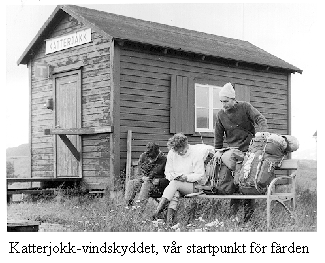
The journey continued through the magnificent nature, even though the cloudiness and a light haze prevented us from seeing nature in all its grandeur. In a small lake we spotted a reindeer swimming around in the water, and since reindeer are reluctant to go into the water, we became a bit puzzled and wanted to look closer at why the reindeer was staying in the water. We also discovered tracks of some predator, probably a lynx, because the tracks were completely round, but it could just as well have been some other predator. We were not so good at tracks. Since we could not let the poor reindeer remain in the ice-cold water, we managed, after some shouting and running, to get the reindeer up out of the water. It turned out to be a reindeer calf. It had probably gotten separated from the reindeer herd and then been frightened by the predators.
Our journey continued through a rather desolate area; the foggy and hazy weather also contributed to making the journey somewhat gloomy. When no wind shelter was in sight, only large stones and block fields, Mom began to look as if she regretted the whole outing, but there was no turning back. According to the map, the hut could not be far away. Reaching the wind shelter took longer than we had thought, but eventually we arrived and, tired and happy to have reached the first day's stage goal, we cooked our evening meal and crawled into our sleeping bags.
Second day. Sunday, August 2, 1964
Jerbele – Unna Alakats.
When we woke up in the morning and looked out through the small window of the wind shelter, we saw how fog banks rolled in along the ground. It did not look very pleasant, but we bravely plunged out into the rainy weather to eventually go to Unna Alakats. The first stretch was not very remarkable. It rained a little and we saw almost nothing of the nature. If we saw anything, it was mostly stone and here and there some soil in between, but where there was soil, there was also glacier buttercup. Along the trail we saw some very beautiful, blue-green glacial lakes, and we also walked a lot on the snow. Once we even walked on a snow bridge over a rushing stream; it was quite exciting for a while, we only calmed down after everyone had safely crossed. To be safe, we had a wading line between us.
The last part was quite tiring to walk, and we tried our glucose tablets for the first time. It at least felt like it would help; psychological factors also have some effect. A suggestion was made that we should camp, but since rain showers were in the air and the hut was so close (as we thought), we felt it was best to walk all the way to it. It soon turned out that our eyes deceived us – as usual when one is tired – and in reality there was quite a long way left to the hut. On the way down we encountered another stream, where we had to lower our backpacks across with a rope. It actually went quite well, and then it was not long before we were at the Unna Alakats hut (Unna Alakats means most beautiful among the mountains). In the hut we ate rice with meat sauce; it tasted wonderful after the day's exertions.
Third day
Unna Alakats – Alesjaure
We were woken in the morning by a radiant sun; it at least seemed radiant after the first days' light rain and hiking in mist and fog. We hurried to get ready to leave as fast as possible.
The journey first went up a blooming mountain heath. It was the actual Unna Alakats mountain. Up on the mountain we were lucky to see some reindeer herding. One must probably have quite a lot of stamina to be a reindeer herder; not just anyone could manage it, at least if one started it all of a sudden.
We had not had much trouble with mosquitoes so far, but when we had come down into Snarpavagge, across Snarpajokk and started climbing the gentle ascent towards Allespuolta, the little critters began singing in our ears, but we thought small jet engines had gotten stuck in our ears. It did not help that we sought out snow patches; the mosquitoes followed along anyway. True, many were left behind in the snow, but what did that matter when there were at least a hundred left. 'No point in killing a mosquito, then his relatives will just come and take revenge on us,' say the Lapps themselves.
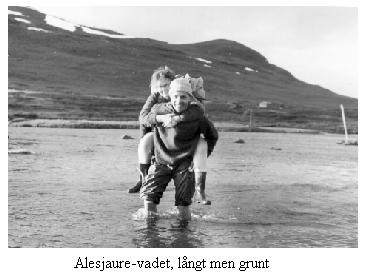
The terrain was easy to walk, and it wasn't long before we had come up to Allelspuolta and in radiant sunshine could look towards Alesjaure and the Alesjaure hut. The journey went steeply down towards Alesjaure, and our knees got quite a workout during the descent. The mosquitoes bravely followed along, and why would they give up now when they got reinforcements from the valley. Once down at the Alesjaure hut we did not stop there, but continued and passed a small ford. Nothing at all compared to what we would experience later. In most places we could walk with rubber boots, and where that wasn't possible, Dad carried me and Mom across on his shoulders. On the other side of the 'ford' we set up camp by a very small mountain lake.
To keep the mosquitoes at a distance with the help of the wind. We ate dinner in peace and quiet, then hurried to lie down and inaugurate our new tent.
Fourth day. Tuesday, August 4, 1964.
Alesjaure – Vistasstugan.
We woke up very early in the morning to rain lashing against the tent fabric. It had been raining almost continuously all night. Dad had started to get a little leak, so he got up first and got ready. It was not very pleasant to crawl out of the warm, cozy sleeping bag into the cold rain, but there was nothing else to do. We ate some porridge, which was served without milk; we didn't want to start messing with powdered milk in the heavy rain – besides, we got so much water on our plates that it worked fine anyway. The rain hurried us along, and soon we were on our way towards the Nallo hut – at least we thought so. Eventually we spotted some lakes that were not in the valley we thought we were in. We therefore thought we had gone wrong (which we indeed had) and turned back to take a compass bearing towards the Alesjaure hut and thus check where we were. It turned out that according to the compass we should be in the right valley, so we turned once more and continued into the valley. As we walked, we nevertheless became more and more convinced that we had gone wrong, and when we had gone quite a way and come up on a hill, where we cooked food, I at least had no doubt that we had gone wrong. Oh well, it didn't matter; in Vistasvagge there was birch forest, and it could be fun to see some of that.
Tomas says:
- We continued through a difficult-to-pass block field area, where Mom sometimes sat down and looked desperate, but when we got out of it and rounded Unna vistasjokk, we were rewarded for our efforts. Before us spread Vistasvagge like a panorama. On both sides of the valley rose the mountain peaks, and in the middle Vistasjokk wound in meandering serpentines. We were to cross that stream, and when we had looked through the binoculars and found what we thought looked good for wading, we decided to cross there instead of crossing at a marked spot further down the stream. But first we ate our dinner and admired the beautiful view.
When we got down to Vistasjokk, some difficulties immediately arose. The water came up to Dad's waist, and the very last meter even higher. As usual with winding streams, the current is strongest where the water is deepest. It would not be easy to get both me, Mom, and the backpacks across. However, we could not find any better spot within a reasonable distance and decided to try to cross here.
- First Dad took me on his shoulders and unloaded me onto a birch that was dragging in the water. When I stood on the trunk, it sank quite a bit into the current, where I stood trembling, but somehow I managed to balance my way ashore to the other side. Then I stood and caught the backpacks when Dad threw them over to me. Last he took Mom across, by then we had found a relatively good spot and Mom didn't have to balance on the birch trunk. When we were all safely across, we continued and soon (Soon? I walked and walked and walked, Mom's remark) arrived at Vistasstugan.
Fifth day. Wednesday, August 5, 1964.
Vistasstugan – Kaskasavagge
The weather was fine when we woke up in the morning. We were in no particular hurry to get going; we were not going so far today. The worst part was that we would have to start the day with a ford. This time Dad did not carry me across, but I had to go myself with my backpack. However, there was a wading line at one spot, so it was not so difficult to cross. On the other side of the stream we realized that we had crossed a bit too early. That meant we had to cross another stream. If we had gone that high up the stream, we would have come below the outflow of the other stream and avoided having to wade two streams, as we now had to. At the second ford over Staureitajokk (the big stream was Vistasjokk) the wading line had broken, so it immediately became more difficult to cross. We managed that too. The journey now continued towards Kaskasavagge.
At first we didn't get onto the path right away, so we had to force our way through both willows and marshland before we found the path again and could slowly make our way to Unna Räitajokk. There we also had to wade, or rather we had to both hop on stones and wade. Only dad changed into gym shoes, then he helped us across to the other side. Once across, we ate and then rested for a while.
The journey continued steeply up the mountain wall. By the time we reached the crest, it was three o'clock. So it had taken a very long time to cover the short distance from Vistasstugan to here, but then we had also had three fords and a very steep climb on that stretch. We also saw some reindeer, and dad found a shovel (military model) which he dragged along all the way to the Kaskasavagge wind shelter.
The view from the crest was overwhelming. The sun shone a little on a mountain, which I think was Tubmartjokko. If the sun had shone over the entire area, we could have stayed here for a long time. When we passed the highest point, the beautiful Vistasvagge soon disappeared and we came onto a small mountain heath. To our left lay two mirror-smooth mountain lakes, and in the same direction one could see the mountains blue in the distance.
So far the path had been easy, but now the rugged boulder terrain began, which would follow us all the way to Kebnekajse.
When we came down to Kaskasavagge, we saw that instead of the hut, which had collapsed, the Swedish Tourist Association had built a double wind shelter. When we got there, there were already three Germans, and eventually a nice Danish couple also came, so it became completely full in the wind shelter. I was, however, allowed to borrow a reindeer hide to sleep on, and that worked out well too.
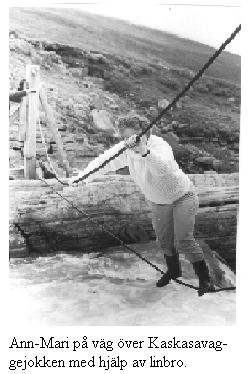
The Danish couple came from the Kebnekajse direction and had to cross Kaskasajokk using two steel cables lying 1½ meters apart, one above the other. This nearly cost the good Dane his life. Such crossings can be quite treacherous if you don't master the proper technique: i.e., you must keep walking so that your body weight leans forward and adopt a strongly leaning position. The Dane, for some reason, had not maintained this position, perhaps because his backpack had just been filled – he had provisioned in Kebnekajse – and soon his feet slipped out from under him and he hung there by his arms alone, with the backpack as an extra weight over his shoulders. He had good lungs and he used them to call for help (and quickly – you don't hang by your arms for very long with a 20-kilo pack). Kaskasajokk is a raging, deep-channeled stream; if he had fallen in, there would not have been much chance of saving his life. However, he was lucky: two of the Germans were nearby, trying their luck fishing. They ran to help him and pulled him ashore, otherwise he would have become a 'Lappland victim'. Every year one or two hikers perish.
Sixth day. Thursday, August 6, 1964.
Kaskasavagge – Kebnekajse.
Fog, snow, ice.... Yesterday we had learned from the Danes that the path to Kebnekajse was very difficult. Full of stones the whole way. They themselves had come from the Kebnekajse direction and said that one should preferably go somewhere else. Therefore we got up early and ate no breakfast in the wind shelter so as not to disturb the others. Just below the wind shelter we had to cross the 'bridge' that the Dane had nearly fallen from. Mom was quite scared when she had to cross, but we supported on the cable and everything went well; we all got across safely. When we had gotten a bit higher, the wind shelter was out of our sight and we sat down to eat breakfast.
The rest of the way there isn't much to say about. It was fog, snow, and ice – we saw almost nothing and had to walk the entire way by compass all the way down to Tarfalajokk. The path consisted entirely of boulder fields. Long stretches we had to walk on snow and ice. To avoid losing our way, we kept a straight southerly course. Eventually, tired and hungry, we came down to Tarfalajokk. There we ate mushroom soup and oatmeal mix. The path continued along Tarfalajokk until we came to a bridge where we crossed the stream. From there it is only one kilometer left to Kebnekajse Tourist Station. We had a bit of bad luck when we arrived at the station. The last places in the turf huts were taken, and we had to sleep in a construction tent because a renovation of the station was underway. For me and dad it didn't matter much, but mom froze all night and needed several blankets to keep herself – as she put it – alive.
It was cold in the tent, and mom complained afterwards that her face had frozen so that she couldn't open her jaw for some time.
Eighth day. Saturday, August 8.
Kebnekajse – Kaitumjaure.
We started quite early in the morning. It was 27 km to Kaitumjaure, where we would try to get to today. The weather was absolutely glorious; we couldn't see a single cloud in the sky, and for a while we considered going up to the Kebnekajse summit, but mom wanted to continue, and since not everyone agreed to the proposal, we continued our hike to Kebnekajse. After the ford at Signetjokko, where dad and mom got their feet wet, we dried our shoes and ate breakfast. The journey now went through Ladjovagge. At Liddopakte – a majestic mountain with very steep sides and a knife-sharp ridge – we left the trail and climbed up onto a spur of Liddopakte. For we planned to stop there and sunbathe and enjoy ourselves. However, there was no water on the hills, so we had to go down to Järtajaure, where we bathed and rested. While we sat there, a mountain flyer came and made a sweep over the lake. He waved to us.
The journey continued down to Tjaktjajokk, which we then followed all the time. We passed a Sami hut along the way. It was really nice and considerably better than some tourist huts one might see. Right after the Sami hut, Kaukasvagge opened up, a beautiful little valley.
When we came down to the tree line, dad went ahead and looked for a campsite. He also found an absolutely excellent spot down by the shore of Tjäkttjajokk. After setting up the tent and eating, we had a calm and pleasant time. We fished and admired the rapids that roared below us. When the fire had died out and the air began to get a bit chilly, we crawled into the tent and lay down. As tired as we were, it wasn't long before everyone fell into the sleep of the weary – to the accompaniment of the roar of the rapids.
Ninth day Sunday, August 9, 1964.
Kaitumjaure – Teusajaure
This time we had more luck with our camping than last time. When we woke up, it was completely cloudless and it seemed as if it had been that way all night. It was really nice to crawl out of the sleeping bag and stick one's nose into the fresh air before getting up and dressing. Breakfast tasted fine and everything was as it should be. When we had packed up the tent (it had gotten a bit damp during the night from the water droplets from the rapids) and gotten ready, we set off again. The journey went high above the roaring stream until we came to a bridge where we crossed it. From there it wasn't far to the Kaitumjaure cabins. We stopped there to rest and to look for suitable birch burls for making kåsor to drink from. However, we didn't find any, so after chatting a bit with the cabin keeper, we set off again towards Teusajaure.
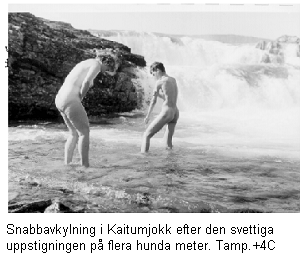
The trail went along Kaitumjokk. (Tjäktjajokk and Kaitumjokk have their outflows at almost the same place). We stopped now and then to admire the blue-green water and to try to catch some fish. Our attempts were perhaps not really wholehearted, so there was nothing to fry. When we had crossed another bridge and continued along the mountain heath, we spotted a waterfall in Kaitumjokk, and since it was quite scorching hot, we decided to go to the waterfall to eat and bathe (in reverse order). We had gotten quite sweaty in the heat and took a bath right away. The water was ice-cold, but it was only pleasant, even if it was hard to stay in the water for any length of time. Dad wanted a picture of us when we were standing out in the rapids bathing, but before he had focused the camera properly, our feet had almost gone numb.
When we had eaten and rested, we continued the journey over an easy mountain heath. We trotted along quite briskly because we wanted to get ahead of some Germans down to the boats at Teusajaure. Just before the difficult descent to the Teusajaure cabins began, we had a magnificent view over Teusajaure and the Stora Sjöfallet National Park on the other side. When we came down to the lake, it turned out that there was only one boat on our side. We had to row across three times back and forth; it was, however, quite easy because the lake was dead calm. It was different when dad and I rowed here last time: then it was quite windy, hard to row, but that time we only needed to row once. We had put mom ashore on the other side of the lake on the first trip; she was going to start preparing the cooking.
Dad and I had no shoes on when we walked from the mooring place to the campsite, which meant that we got to feel how cold the water in a mountain lake is, even if it, as now, was only shallow puddles that we walked through. When we stepped on solid ground now and then, we thought the ground was really warm.
After we pitched the tent, we took a little nap in our sleeping bags. It was very pleasant to lie in the bag and look up at the snow-clad mountains, which rose against the clear blue sky. It was so quiet that a bumblebee buzzing past sounded like an airplane overhead. I happened to fall asleep, because when I woke up, Mom and Dad were gone. They soon came back; Dad was looking, as usual, for wood to make drinking cups and had found some, but they were so large that our bow saw wasn't enough to cut them loose. We consoled ourselves that next time we would borrow a saw so we could get the burls off.
During the cooking, we made a small fire, as protection against the mosquitoes and to dry some wet clothes by. When we were about to eat, the butter was so soft from the heat that we had to put it out in the water, where it became almost too hard in the icy water.
The evening was so beautiful that we had no desire to go to bed; we sat warming ourselves by the fire and it was pleasant, until it became so chilly that we thought it best to turn in. When we lay down, we knew that it was the last night in the mountains – for this time.
Tenth day. Monday, 10 August
Teusajaure – Vakkottavaare
Already yesterday we agreed that we would start early the next morning and continue to Vakkottavaare to take the boat directly the same day. We therefore got up already at half past four and set off without eating any breakfast.
The trail now went through Stora Sjöfallet National Park. It was quite strenuous before we got up from the lake to the tree line. But then it went along quickly. In front of us stretched a very easy-to-walk mountain heath. To the left it sloped gently upwards, and to the right there was a small valley with a stream at the bottom. The stream was called Kautpajokk and beyond the valley rose some small mountains.
Straight ahead, however, rose Sarek's snow-clad magnificent mountains in the distance. A little to the right of them lay Akka in solitary majesty. Akka is famous as one of Sweden's most beautiful mountains, and one readily agrees when seeing it from here. The snow on the top sparkled in the sunlight and Akka looked very fine against the blue sky.
We had not eaten any breakfast when we left Teusajaure because it was intended that we would eat along the way. It turned out, however, that due to the recent heat and sunshine, all the small streams and watercourses had dried up, so we had to go all the way to the so-called "first ford" before we could get any water for our dried and powdered food. At the "ford", which we could cross with dry feet, we prepared a proper portion of porridge. We were quite hungry waiting for the food, so the porridge was soon gone.
The rest of the mountain heath is not much to say about. The so-called "fords", which were marked on the map, contained no more water than that one could barely quench one's thirst in them.
Eventually we reached the birch forest and there began the descent towards Lulejaure and the Vakkottavaare cabins. It was so steep that it hurt in the knees with every step we took. We were also in a hurry, as we had to catch the boat, which came at 0950. Just as we came down to the huts, the boat was coming in. The worst part was that there was about a 5-minute walk to the mooring place. Mom had not yet come down to the huts, so Dad became a bit worried. I had to go ahead and make sure the boat wouldn't leave without us. When almost all the people had boarded, Mom and Dad came running.
We were lucky with the boat even though the boarding was at the last moment. As soon as we had stepped into the boat, our hike for this time was over. I hope it won't be the last.