Norway trip 1964
Wanderings went on during the rest of the 60s and a bit into the 70s. Ann-Marie was at home with the children and our economy was still meager. We supplemented it partly by my working as a tour leader for French-Swiss teacher groups for Reisebüro Kuoni in Zurich, partly by driving a bus as an extra driver to Studsvik (it was Thor-buss at that time), and also occasionally doing some translations from Russian to Swedish. By and large, it worked out, but not much more. Strangely enough, we were still able to make a number of trips both to the west coast and somewhat later also to Switzerland and Czechoslovakia. In 1964 I also bought a Hasselblad camera (C500 with 150 mm lens at a price of 1800:--. The Studsvik photographer Olle Eriksson could arrange it through his father-in-law, who was a camera dealer) and looking back now, I sometimes wonder how it really worked financially. Ann-Marie has been a good financial manager and we managed quite well despite everything, even if there was no abundance. It was never a question of welfare; the only time we received a grant from the state was when I did my military service in 1957. Then Ann-Marie got 50 öre per day as support for Tomas. However, the state realized that she had a decent salary and wanted the money back – but not after the letter they got from me in which I pointed out certain things. It was close to libel, but it went through and we didn't have to pay anything back. The sum itself was ridiculously small, I don't remember it, but it was a matter of principle.
One of the Thor-bus drivers, Glenn Pettersson, had become manager of the bus company when the previous manager Rolf Frej bought into another bus company, and Glenn offered me a trip as a driver on a Norway tour. Little did I know then what I was getting into. It was a group of Stockholmers who were going to travel around Norway with me as driver and with a Jewish girl, Eva Falk from Solna, as guide. Eva was to lead us through all the difficulties on the way. On the way to Oslo we took too much time and on arrival at the hotel we got a reprimand: they had had to wait far too long for the food. We got over that shock, but it got worse as the trip went on.
As soon as we entered Norway, the road standard changed markedly, the landscape became more mountainous, the valleys deeper and the mountains higher. The roads narrowed considerably. Norway is a difficult country from a traffic perspective and the roads were not very well developed. Several times, when the road narrowed and looked more like a cow path, we wondered if we had taken a wrong turn somewhere. The views were magnificent, but as a driver I didn’t have much time to enjoy them; it was quite laborious keeping the bus on the road and scraping past other vehicles at passing places. We passed Rjukan, where during the war the Germans had a factory for producing heavy water when Norway was occupied. Norway has plenty of waterfalls, not very big but all the more numerous. In Rjukan we could see 7 pipelines on the mountain slope from which the water was led down to turbines for electricity production. A lot of energy is used in producing heavy water.
We had brought lunch food from Stockholm with us, and on the first day we stopped at a parking lot, set up the kerosene stove and fetched water for coffee from a nearby stream. It was up on the mountain and there was not much shelter for the kerosene stove, so boiling the coffee took considerably longer than we had planned. Moreover, most had never been in Norway and were fascinated by all the views. All the gazing took time, with the result that we did not arrive in Oslo until late in the evening – to the great annoyance of the hotel staff and some wonder as to where we had been. The following days we tried to keep as close to the schedule as possible so as not to cause too much trouble for our night hosts.
Sometimes the roads were like goat paths, narrow and winding, and there were also quite a few goats by the roadsides. The Norwegians love their mesost, the sweeter the better, and goat husbandry is a well-developed sideline in certain parts of the country. There are many different kinds of mesost, the Norwegians claim, but to us uninitiated it seemed to be one and the same kind, only in different packages and somewhat varying colours. At several rest stops it was impossible to sit down and eat the lunch sent along from the hotel. The goats are quite aggressive and eat everything they can reach or butt their way to. The passengers couldn’t sit and eat their sandwiches; they had to stand holding the sandwiches on outstretched arms, and even that didn’t help completely. The goats are skilled at balancing on their hind legs, and short passengers had a hard time at times. Some saved themselves by getting into the bus, closing the doors, and only then could they have their lunch in peace and quiet.
At one such rest stop we nearly became livestock thieves. We had taken a break and the bus doors had been left open. When I started the bus I looked in the rearview mirror to see that everything was in order and thought I glimpsed something unfamiliar at the very back of the bus. I stopped, walked back in the bus to see more closely what it was, and discovered that a kid had sneaked into the bus unnoticed. There it lay under one of the rear seats (some were empty) and only its horns were sticking out. I didn’t recognise those as belonging to any passenger. It was a one-year-old kid and it wasn’t very willing to leave the bus; it lay on the floor above the exhaust pipe and was quite comfortable. We had to pull hard on the horns before we managed to get rid of our "stowaway".
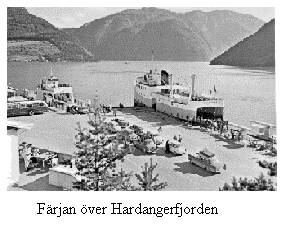
It was a laborious and somewhat adventurous trip. When we were to cross the Hardangerfjord, the bus barely fit on the ferry. We managed to squeeze onto the boat, but the rear wheels were just barely on the deck, the overhang was quite long and part of it hung over the stern. The sea inside the fjord was calm and we got across without great difficulty; the fjord is long and inside it there is usually considerable calm. Our destination was Hotel Leirvangen, which was a few miles from the bottom of the fjord. We came up onto the mountain, where it had rained and the ground was sodden, the road as well. In one place I got a bit off the narrow mountain road and the bus’s left wheel went too far out. The ground was mossy and the wheel got poor traction; it just spun when I stepped on the gas trying to get up. I asked the passengers to move over to the side where the wheel had traction, and somehow I managed to get some gravel under the wheel and we got free. It was certainly no pleasure drive; every evening I felt a certain relief and also some surprise that I had made it to the overnight stop.
Especially near Odda-Stalheim and Trollstigen the journey was difficult. Swedish buses are 250 cm wide and have four seats in a row, while Norwegian roads are mostly adapted to the Norwegian bus types with only 3 seats and boat-shaped fronts and rounded rears. The roads hung as it were on the mountain slope, and on the valley side you saw only precipices.
I managed to scrape the bus in a tunnel; the road curve was almost 90 degrees and I didn’t dare keep far enough out (where there was a deep ravine). Trollstigen is a serpentine road and the curves were so sharp that in many cases I had to maneuver forward and back six or seven times to get around the hairpin. One really had to practice steering, and moreover it was important to engage the right gear from the start, whether going up or down.
On the way down toward Odda, which from above the mountain looked like a toy village, we had to make an extra stop on the road. When we were almost down in the valley, suddenly a young black-haired woman stood in one of the last curves, waving frantically with her hands, signalling us to stop. The slope was so steep that the handbrake didn’t hold, and I had to park the bus with the bumper against the guardrail. In a mix of Italian and French she explained that their car with a caravan was around the next hairpin and that they were waiting for help. We walked to the next curve and sure enough – there stood a Ford Anglia of the "half-finished" model (with the rear window sloping outward) hitched in front of a caravan bearing the proud inscription "Roma - Cercle Polare". The road, like almost all Norwegian roads at that time, was gravel, and presumably the whole rig had started in too low a gear; when they then tried to shift to a higher gear, the speed dropped so quickly on the very steep hill that they had no speed left. From down in the valley we heard engine noise; a farmer with a tractor was on his way to help the Italians up the steep slope. It was a typical Italian family with many children, and we wondered how they all fit in the relatively small car.
A heavily loaded Swedish bus with all the passengers' suitcases sits rather low, and the cat's eyes were the first things shaved off in such a curve. For the passengers it wasn't particularly uplifting either; a couple of the ladies lay down on the floor in fright. They couldn't see any ground on the side facing the valley, and during the reversing half the bus hung over the precipice.
The trip went without too great mishaps, however; the return route went on the Swedish side via Härjedalen-Jämtland, and back in Stockholm everyone was happy and satisfied, with many new experiences and something to tell their friends.
A week or so later we gathered at the tour leader Eva Falk's place and went through the trip once more, with pictures and stories.
”Der eine Reise gemacht hat, hat etwas zu ersählen”, as the Germans say.