About the family's cars.
Every family has a car history, with one or more variants. When Ann-Marie and I were just a small family consisting of the two of us and Tomas, I studied at Köping Technical Institute and made a living by driving around in Västmanland photographing people at dance parties.
The first own motor-driven vehicle was an ”Ariel” motorcycle of the 1928 model. I got it from Mrs. Holmquist's son-in-law Uno Lindberg, a retired sailor who worked as a foreman at Svenskt Konstsilke in Borås. With it I made quite a few trips between Borås and Falkenberg when I worked at the Borås dairy and Ann-Mari was still in Falkenberg.
Later, when the typographer Uno Svensson and I started with "flash photography" at various dance venues, initially in Halland and later in Närke and Västmanland, I became the owner of a Monark motorcycle and rode it from 1951 to the autumn of 1955. The winters were still quite cold and snowy in Köping and I thought it was time to buy a car. I didn't have much money, but I had scraped together one kronor here and there with my summer work and through photography that I thought I could manage a car purchase. It all started because I knew a man who had a pre-war Opel Kadett for sale and he was willing to transfer the car to me in exchange for my Monark and 1000 kronor.
The same day, John Thueland, my former roommate at Mrs. Malmqvist's, and I were going to take a ride in the car. Already at the exit from the city strange noises began to be heard and after a few minutes it looked as if we were riding in a steam-powered carriage. A column of steam shot out of the engine and we had to stop and start repairing the car. It was a coolant hose that had burst and we had to muster all our ingenuity to be able to fix the hose and get back to the parking space in the yard of the house Esplanden 5. After a couple of similar trips with faults here and there, I did drive a number of trips during the autumn of 1955, but the journey was usually far too uncertain, now and then I got stranded with the result that my cash decreased catastrophically. Since the photography always took place on Saturdays and Sundays, it became very expensive to chase down a repairman to get the car going for a trip back to the parking space, I usually didn't manage to do any photography. The studies were also becoming very laborious and thus both the car driving and the photography had to be more or less set aside, neither time nor money sufficed.
The studies ended in the last days of May 1956 and it was time to pack up the few things I owned in Köping, including the car, and head off to Borås. I had cleaned the basement, returned all the "scrap" (heating batteries, fan and various pipes and wires) to the scrap pile and was together with Ann-Marie (who had come to Köping to participate in our farewell dinner at the hotel) ready to leave and leave Köping as a troublesome and laborious parenthesis in life.
The engine made a lot of noise, more than it really should even considering its high age, and as we began to approach Mariestad the noise level increased to an alarming level. It seemed as if someone was sitting inside the engine rhythmically hammering on a metal part. We stopped at a gas station and sought expert advice.
"It's the crankshaft bearing that has failed," the man said and asked us if we were going far. When I said I was going all the way to Borås, he shook his head and said it won't be easy but if we drove at a somewhat leisurely pace we might be able to make it all the way there.
The continued journey went at 30-40 km/h, which wasn't too slow considering that the regular speed had been about 60 km/h earlier. It took several hours to get to Borås, but we got there. Now I no longer needed the car and managed to sell it to a buyer from Stockholm for 600 kronor so that the loss after all wasn't too great.
It was a long time before there was time and money for the next car. We lived in Stockholm for a couple of three years and in the last days of November 1960 we moved to Nyköping to start working at AB Atomenergi in Studsvik. The move also meant a certain salary increase and after a few years we considered ourselves able to afford to try to get car number 2. The family had also grown and it became too troublesome to travel to Falkenberg with three children. The year was 1965.
The choice fell on a dark blue Ford Taunus 17 at Kindvalls Bil AB in Stockholm at a price of 7.000:--. We had the car for a couple of years before it was time to change.
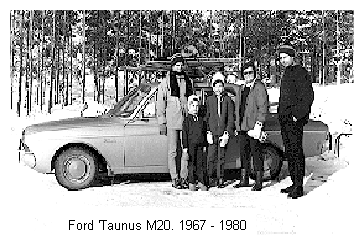
To improve the family's finances I drove a bus between Nyköping and Studsvik, also took trips abroad such as Norway and Denmark, did translations and for once had a fairly decent income. Thor Buss, which was the largest bus company in Södermanland, also had a car sales and the salesman Rylander suggested that I should trade up. He had a Ford Taunus 20M, with registration number D67891, a six-cylinder car in very good condition. Later the license plates were changed and then the car was called GB 741. I was to pay 11,000:-- for it and he would take my old Ford in exchange for 6,000:--. It was a good trade, even though its 6-volt electrical system caused me starting problems now and then. This happened especially when temperatures were around 0°C. Otherwise it was a good and fast car, we drove about 270,000 km with it both in Europe, Finland, the Soviet Union and Estonia. Katarina was a little sad that the cars were two-door, she didn't have her own door to handle, but they were child-safe.
During the M20's time Tomas turned 18 and we practiced diligently so that he could get his driver's license without having to attend any driving school. When it was time for the driving test, I came along and sat in the back seat. The weather was rainy and visibility very poor, the defroster couldn't keep the windows clear of condensation and I couldn't see much of where we were driving. From the back seat the speed always seems much higher than when sitting in front and I didn't have much hope that Tomas would have passed on the first test, but actually he did. The only remark from the inspector was that he changed lanes somewhat too slowly. However, it reportedly went pretty fast when Tomas and his schoolmate Göran Holte were going to set a speed record for the car on the newly completed Nyköping-Oxelösund motorway. The only time I've had to drive fast was when we had a traffic jam in Germany on the way home from Switzerland. To make the ferry, I had to maintain a speed of 150-160 km/h and it didn't feel safe at all. We made it to the ferry in Travemünde with very little margin and ended up on the wrong ferry, but that one also went to Trelleborg.
A few years later I also wanted Maria to get her driver's license, but after we lightly collided with a power pole at Odal's facility on Hamnvägen in slippery road conditions, she refused to continue. On one of his "independent" car outings, Tomas had girls with him in the car and asked them to check if there was anything in the way when he was backing up. The result was a collision with the only tree in the yard of Östra folkskolan and 300 kronor in repairs. It was a somewhat sad young man who came home and had to tell about the incident. In a way, a minor crash without physical injury to the driver early in a driving career is good; it provides a useful reminder of the dangers that lurk on the roads.
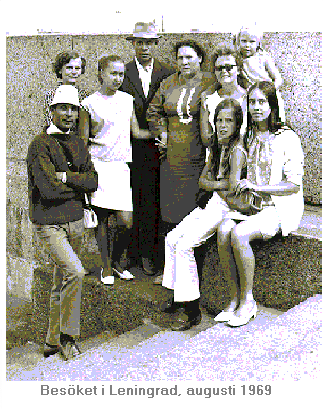
In 1964 I had regained contact with my mother and my siblings, they lived in Estonia and there were numerous trips there during the summers, with more or less difficulty. It has never been easy to travel in the Soviet Union. There were many obstacles along the way, not only physical but rather of an administrative nature. Every 50 kilometers there was a checkpoint (GAJ = State Vehicle Inspection) that would ensure that state surveillance functioned. On a trip between Leningrad and Tallinn we stopped a bit longer for lunch and drove the car away behind some bushes. When we did not reach the next checkpoint within the stipulated time, they apparently became worried and sent out a motorcycle patrol. They did not see us until we made ourselves known to them. When tourist traffic by car to Estonia developed further, they tightened surveillance at the first checkpoints lying on the outskirts of Leningrad.
We were stopped at one such station just outside Pulkovo and the militiaman, who was apparently quite new, could not read the Western alphabet. I spoke English with him and heard how he tried to explain the license plate number D67891 by saying that the letter looked like an "O" with its belly bulging mostly to the right. While he was speaking, I secretly read in his logbook and discovered that an inspector had been there the day before and written that "special attention should be paid to foreign tourist cars".
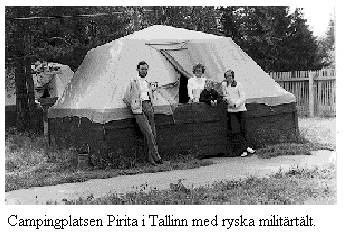
In the mid-60s, when our traveling became more regular, there were 13 checkpoints on the Leningrad-Tallinn route - a distance of 375 km - in practice every 30 kilometers. With two militiamen per three shifts, Saturdays-Sundays and holidays, that amounts to a considerable amount of unemployment that could be tied up, about 4000 man-days. Zealous militiamen forced us to stop at every station and we had difficulty covering the distance in a reasonably decent time. Later I figured out a trick. When we had been stopped at the first checkpoint, I told the militiamen that now they should call ahead to the next, and the next, etc. According to the rules, foreign cars were not allowed to travel in darkness, and if we did not get through before dark we would blame the militiamen. It actually worked quite well; for the most part we avoided stops between stations. The prohibition that foreign cars could not travel at night had its reasons. The roads were in terrible condition and with the Soviet (and Russian) "nitshevo" attitude, it could very well happen that the road was impassable - without any warning signs posted. On one of the trips we nearly drove into a sand pile. It lay there without any warnings and it was only because the evening was light that we did not drive into the pile. Deep ditches beyond the shoulder could sometimes be marked with tar torches - in the 20th century. It was far from Lenin's words: "Communism is electrification...". As with most things in the Soviet Union, the proud phrases had little connection with reality.
The Russian general Alexander Lebed says:
- If anyone doubts that Russia has its own path, let him drive on our roads.
Without being particularly "status-minded", I have had two cars with metallic paint. Some car owners seem more than normally attached to the external attributes: metallic, lots of extra gadgets, etc. It is a bit difficult to understand that a motorist can thereby raise his status; it does not sit in the car but in the person himself and his relationship to the surroundings. The M20 was a silver metallic and gave a certain prestige. This came in handy in Russia a couple of times. We were driving through Leningrad towards Pushkino to get out to the Tallinn road and saw a long line of large black cars passing.
- Now we must take advantage of that, I thought, and latched onto the end of the procession since it was going in the same direction. We tagged along and got through Leningrad at about 100 km/h where normally only 50-60 is allowed. There was no chance for the militia to stop us; besides, they would never dare stop any car with foreign plates in such a situation. We have never gone so fast through a Russian city. One of the few times that the metallic with its status and sporty appearance came in handy in such a context. With a Lada or Volkswagen one would hardly have had the same chance.
That car got to see a lot of both Russia and Europe. A couple of times we went to Switzerland and from there to Italy - to Livigno. The whole family remembers a trip to Czechoslovakia and Switzerland during an Easter weekend. That year Easter came early, and on the Småland highlands and halfway through Skåne we had great difficulty staying on the road; it was slushy snow almost all the way down to Trelleborg. Upon arrival at Sassnitz we were met by a whole platoon of rifle-armed guards in the harbor, and at the customs declaration the customs officer saw that I had papers with AB Atomenergi's logo on them. He became very interested and asked if he could take a closer look at them.
- What happens if you don't get to? I asked, and the customs officer looked a bit embarrassed. It was no controversial papers, just an order for hydraulic valves that I would fetch in Tuttlingen in West Germany on the border with Czechoslovakia. The road over Rügen and through Greifswald was an East German misery. No plowing had been done and due to some snowmelt the road surface had taken on a V-shape with a meltwater channel in the middle. First you drove on one side of the road, and when the pressure against the door started to hurt your ribs, you moved over to the other lane. Traffic was quite sparse and it was no problem to use the entire road width. In Greifswald the streets (if you can use such a term for a surface that looked like a field) were full of holes and the M20, even with normal load, had a ground clearance of barely 10 cm. Now we were loaded and to avoid damaging the undercarriage I drove both right-hand and left-hand traffic. A Volkspolizei stopped us and pointed out this fact, to which I replied that he should not bother peaceful motorists but should see to it that the roads could come up to Western standard so that one did not need to drive with tanks and off-road vehicles within the city. He was silent and we drove on.
We kept the car until 1980. Ann-Marie brought up the subject of changing cars now and then, but it didn't become relevant until my nephew Waldemar from Tallinn was going to visit us for the first time in Sweden. He had strayed to Jan-Åke and Margaretha Berg-Fors; instead of taking Viking Line from Helsinki, he had met an acquaintance and came with Silja Line. We lived in the countryside and he couldn't reach Ann-Marie by phone; the only contact he had was Jåke, and eventually I managed to track him down there. The gas was starting to run out on the way to Stockholm and I was going to refuel on Huddingevägen. I inserted my three ten-kronor bills into the fuel pump and was about to take out the hose when I noticed a note on the hose:
- Out of order.
Someone had tried to refuel before me and had hung up this note. I had no more ten-kronor bills and the era of hundred-kronor bills had not yet arrived. There I stood, and the gas station on Huddingevägen was quite isolated. What could I do? I decided to continue to Jåke and Margareta at the risk of being stranded on the road. It went well, but the last bit to Akvarievägen, where they lived, I had to let the car coast. I almost made it; I was about fifty meters short. Margaretha had an extra 20-liter gas can and I got to borrow that to manage the trip home.
On the return trip, Waldemar wanted to drive to try how Western cars performed. He had only driven Ladas and Volgas. Near Vagnhärad something happened; the foot brake didn't work, but we continued the journey and arrived in Nyköping for an overnight stay because Ann-Marie didn't want to be alone at the cottage. When we examined the car, it turned out that the vacuum booster had a "puncture"; every time you used the foot brake, the engine died. The problem was quickly fixed; from the scrapyard at Björshult we bought a used part and could drive as usual again.
Waldemar was interested in cars and wondered if you could really just walk into a store and buy a car. Just like that. I mentioned his wonderings to Ann-Marie, and she thought that now we should take the opportunity to show him that this was indeed the case. A couple of days before Midsummer 1980, we went to Källander's car dealership in the Hemgårdsområdet area in Nyköping and were going to look at a Ford Taunus that they had advertised. Källander's was an Opel dealer and this Ford they had taken in as a "divorce car"; it had reportedly been parked in their tent for almost a year. We looked at the car with license plate JET 990 and could not see anything wrong; there were no external damages on it. The price was 23,000 SEK, which could not be considered too expensive. During the test drive we could not detect any peculiarities either and decided to buy it. Källander's would however fix certain things and we could pick up the car the next day - the day before Midsummer.
Regarding the M20, I had thought of eventually putting it into good condition, but there was never time for anything other than improving the cottage, and so in 1988 I sold it to a farmer, Lennart Nestor in Lästringe. (tel. 0156-30025) The life of GPB 741 ended after a journey of 280,000 kilometers.
At the beginning of the year, we had acquired a cottage near Sparreholm and were now about to head there for a Midsummer celebration. We picked up the "new" car, packed everything for the Midsummer celebration, and set off. I suggested to Ann-Marie that we should take two cars, as we had a lot to transport to the cottage, but she refused—she didn't think it was necessary.
We set off quite late with Waldemar at the wheel, and everything seemed fine until about Skälby farm, a few kilometers before Oxbron. Suddenly a cloud of steam burst from the hood, and when we looked at the instruments, the needle was almost bent above the red, not-allowed part of the temperature scale. We had been engaged in discussions and didn't observe the instruments—the car was new, after all, and you don't expect it to break down after just 20 km of travel.
When most of the water had boiled away and we could open the hood, it turned out that the fan belt had broken, but not completely—it was still held together by a few threads. On closer inspection, it turned out that the V-belt was incorrectly mounted. Instead of lying in its groove on the water pump shaft, it lay directly on the shaft and rotated thousands of times per minute until the V-belt was worn out. We didn't have a spare belt and had to figure something out. Usually, you can make an emergency belt from a lady's stocking, but it was Midsummer and Ann-Marie wasn't wearing any stockings. The solution became the tow rope. We cut off a piece, spliced the ends together, and tried to start the car, but it was completely dead. We managed to stop a younger couple, and despite being in a hurry, they towed us to the cottage. I promised them 100 kronor for the trouble—I would take that money out of the Källanders' account; it was the least they could do.
On Saturday morning we made a closer inspection of the car and found the fault. The cable lug on the battery was poorly tightened and didn't make good enough contact—the car had been standing unused for quite a while. We tightened the cable lug and headed to Flen to get new V-belts. Now, an ordinary rope isn't very good as a fan belt; after a few kilometers it gave way, and we had to stop and tighten the rope with the alternator. Once we had arrived and changed the V-belt, the car worked again and continued with minor incidents until Midsummer 1986.
The Taunus 20M was put away in the barn in the countryside, in the hope that I might eventually become interested in renovating it once the other shortcomings with water, etc., had been fixed at the cottage. But that never happened. My interest never awakened, and a few years later, when we were going to build an extension for a kitchen in the outbuilding, the Ford was moved out into the yard and sold after a few months to a cowherd from Lästringe. He needed a car to drive between home and the barn so that his regular car wouldn't smell like a cow barn when he was out among people. The M20 had been a real faithful servant, driven for over 10 years and 280,000 kilometers. It was relatively new when we bought it, and I fitted it with a stainless steel exhaust system; it never needed to be replaced, but because the car was very low, we had trouble with the entrances and exits from the ferries. Sometimes it happened that the helmsman had to maneuver the landing ramp, and then we were the last ones off the ferry.
In the summer of 1978, the car was stolen. We had just returned from the holiday in Joutsa, Finland, where we spent two wonderful weeks with the teacher Olga Naukkarinen. Upon our return, there was a postcard in the mail from my cousin's child Rita and her husband Slava, saying that they would be coming on the ship "Michail Kalinin" – one day before our arrival in Sweden!!!! I knew that Soviet citizens didn't have any significant amounts of money with them and was worried about them. Where would they spend the night?
Now it turned out that the ship had run aground and hadn't arrived at all; it was to call at Stockholm only the next day. I parked the car on Dalagatan and spent the night at an acquaintance's place. In the morning the car was gone. Stolen. Since the departure from Nyköping was somewhat rushed, I hadn't completely emptied the trunk; there were still the children's tent, sleeping bags, and some half-finished woodcarvings to pass the time in Finland, including a knife with a very good sharp edge.
In the afternoon, the car was found in Tensta with a broken steering lock, damaged trunk lid, and all equipment gone. It pained me that my best carving knife was also missing. I had been carving some knife handles – with a bear's head – and they disappeared along with a couple of bowls made of birch burl. Now began a long correspondence with the insurance company Folks(k)am. The Linköping office offered me a "comparable car of the same model year" and I countered that it should be fine as long as the car had no remarks from the vehicle inspection, was rust-proofed, and had a stainless steel exhaust system. "No, you can't reason like that," thought Folksam. After a couple of months of correspondence, I got angry and went to Folksam's head office in Stockholm and said that I wanted to speak with the CEO, Director Bark - "Unfortunately, he is not in," was the answer.. - I can wait for him, I replied, or arrange a meeting for the next day. The public servant tried to explain that the director might not be able to see me for several days, but I did not give up. I said that I wanted to ask the director what I had paid full insurance for during the 10 years the car was in my possession and why they wouldn't agree to my legitimate demands. When I did not back down, the official promised that one of the department directors would come out and speak with me. A small, crooked-nosed person with clear Semitic features came and tried to persuade me to accept their terms. When we could not reach an agreement, the person promised to speak with the CEO. They would take up my case immediately the next day. I returned to Nyköping, and when the mail came, there was a letter from the insurance company asking if I could settle for 3,000 kronor, keep the car, and repair it myself. That turned out to be a better deal for me; after the repair we drove the car for another two years, until it was time to switch to an orange Taunus – JET990.
Now Katarina was of "driving age" and we began the lessons. There were many rounds in the outskirts of Nyköping, and we most frequently visited the streets around the water tower and the villa neighborhoods there. Katarina got very comprehensive training: hill starts both forward and backward, turning on the street, backing around a corner, but despite this, the inspector did not want to let her pass. He claimed that she did not look enough in the rearview mirror. That was not quite true; she did not turn her head all the time like they are taught to do in driving school, but followed with just her eyes—I had thoroughly impressed upon her the importance of monitoring the traffic behind. During the next driving test, I accompanied her, and it was a long drive. She drove for about 40 minutes in the city, and only toward the end did she take a turn onto the old E4 up to Kungsladugården. The only more sophisticated maneuver occurred at Åkarnas Hus, where the journey ended. She had to reverse park, and when that was done, the inspector handed her the driver's license. She did not need to perform any of the other maneuvers, but it can be useful to have practiced them in case it becomes necessary.
JET 990 ended its journey at the scrapyard. Katarina was to attend Susanne Johansson's wedding the day before Midsummer 1986 and set off from the cottage to Tuna Church, where the wedding was to be held. In the evening we were sitting in the cottage and there was a knock at the door. There stood Katarina together with Anna Billings' parents, and they looked somewhat puzzled. It turned out that the wedding was by no means to be in Tuna but in Tunaberg Church, a couple of miles further away. When Katarina had realized this, it became a bit rushed and the accident was a fact. From Katarina's account it appears that she probably got too far out on the gravel shoulder, made too quick a steering movement to bring the car back onto the road, and overturned from the speed. She rolled one complete turn with the car but fortunately there were no obstacles in the way or beside it; she ended up on an even keel and suffered no major injury apart from the fright and some bruises on her back. I had always impressed upon her the importance of wearing the seatbelt, and this saved her. The car's roof had been thoroughly pressed in and it was not worth repairing. It was fully insured and we received 13,000 kronor from the insurance company.
Now we were temporarily without a car. When the Midsummer holidays were over we borrowed Tony and Gunilla's old Volvo 245 and set off for Nyköping to visit the car dealerships. The trip became somewhat complicated. We visited Björn and Aili Grönroos, who then lived at the cottage Stensborg on the road toward Nävekvarn. When we were about to leave, the Volvo would not start and Björn had to help with jumper cables. We got a little way, but the next stop came just after the turnoff toward Tista Slott. There the Swedish Road Administration was building a new road toward Eskilstuna, and I again got help to start the car. After another half mile it stopped again, and now there was no one to help us; moreover, we were quite tired of having to start the car with cables. We pushed the car aside onto a side road and called Tony; he had to come and tow us to Fredrikslund. On Monday the old Volvo was towed to Sparreholm's gas station, where it was determined that the voltage regulator was not working. The ignition worked as long as the battery gave a little power.
At Nyköpings Bilfirma, which sold Fords, there were a couple of Taunuses but the price (19,000 kronor) was in my opinion far too high given the car's condition. No car was bought in Nyköping that time. Upon returning to the cottage I spoke with Tony and he said that Eskilstuna had a good reputation regarding cars. We went there and visited Motorkompaniet, where there were several Fords and Opels to choose from. After careful consideration we settled on an olive-green Ford Taunus dark green metallic of the 1983 model – with a tow bar, for a cottager must have one. EMR061 Price 30,000 kronor. It had gone about 3,000 miles; we drove it until April 1994 and the odometer then read 24,000 miles.
It turned out to be a good purchase, but even it had a typical Ford problem. When the temperature was around freezing, ice apparently formed somewhere in the carburetor, causing the engine to lose power and stall – if one continued pressing the accelerator. It was not a serious fault. If one stopped for a couple of minutes with the engine off, the ice plug melted and then there were no further difficulties.
The cars up to the mid-80s were of relatively conventional and somewhat old-fashioned construction, and it was still possible to keep them running if one had a little knowledge, skill and the will to maintain the car. With the green Taunus we got stranded only once, but then even the Ford workshop could not solve the problem – at least not right away. When something goes wrong, it often has knock-on effects – just as happened to us.
Katarina had taken a job as a cosmetologist on the cruise ship "Funchal" and was to be in Göteborg on a Friday evening at 6 PM. The day before, I had been at the countryside and had some trouble with the car on the way home. After changing spark plugs and making a few adjustments to the ignition timing, I took the car for a spin around the block and everything seemed to be in order.
In the morning we put on the roof rack (Katarina had a lot of creams and perfumes with her), got into the car and started the journey. It went well until Nyköping Castle, but then it stopped. The engine coughed and growled, made some attempts to run but could not keep going, and now good advice was scarce. Opposite the castle there was a car workshop and I went in to get help, but no help was to be had. The mechanic was (as he himself said) a specialist on Saabs. I called the Rescue Service and we were towed to the Ford workshop at Idbacken industrial area. It was Friday morning now and the workshop was not particularly willing to help; they pleaded that they had many cars to get ready for the weekend, but eventually agreed to help when they heard our predicament. For about three hours, two foremen and a couple of mechanics kept changing parts, but nothing helped. The hours passed and we realized the car could not be fixed. It became a matter of renting a Japanese "rice cooker", a "Bluebird" for the tidy sum of 900 kronor plus petrol, reload everything we had both in the boot and on the roof into the Japanese car, and finally set off toward Göteborg. Maria was also with us, and it was a bit cramped in the car as it lacked a roof rack, but it worked and we arrived in Göteborg just in time for the boat's departure.
When I went to the Ford workshop on Monday and asked how the repair had gone and what the fault was, the answers were somewhat vague. It turned out that the workshop had to call in an old, retired mechanic and that there had been several faults, but the foreman did not even know exactly which. The repair cost 1,800 kronor, but afterwards the car worked without any interruptions.
After retirement I got a number of assignments from the police, SKI, SSI and the Immigration Board, and I needed a fairly reliable car. In the spring of 1994 it was starting to look a bit neglected, and when Ann-Marie's sister Sonja visited us in March, she began to talk about the car. Ann-Marie and the girls had been to Göteborg while I had a week of interpreting in Stockholm, and I suppose the car had not been particularly well received by the well-off relatives. They did not say outright that the car should be parked a couple of blocks from their home, but......
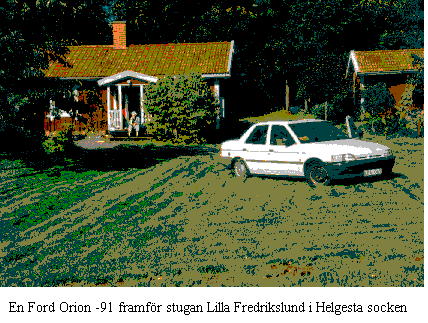
We drove out to Bilforum, which sells Fords, and looked at the offered used cars. There were a couple that we looked at more closely: a Ford Taunus 1989 with automatic transmission and a Ford Orion 1991 JET 190 with sunroof and tow bar. The Taunus cost 60,000 kronor and the Orion 85,000 kronor. We decided on the Orion and a price of 80,000. It had gone just over 3,000 miles and had no blemishes. The engine is 1.6 litres and from this small engine Ford squeezes 105 horsepower, which means the car is somewhat noisier than the old Taunuses were. The quietest of them was the 20 M; when its engine was warm you could barely hear it running at idle. The Orion continues to growl quite strongly even after it has been running for a good while.
The Orion has worked well. After about a year the battery showed signs of weakness and it was time to get a new one – nothing lasts forever. Our second trouble with the Orion occurred a few weeks (1995‑09‑17) ago.
We had been to celebrate my friend Robert Felszegi's 65th birthday on Sunday, stayed overnight at Maria's and were supposed to be back in Nyköping on Monday. I had an interpretation assignment at BOP (Child and Adolescent Psychiatry) at Tullportsgatan 8. On Monday morning I had been to SKI and gotten some computer programs, there was some discussion there and we were somewhat delayed. About ten kilometers from Nyköping the car stopped - and seemingly without any reason at all. It had indeed been jerking a bit for a few weeks, but now it came to a complete halt. Since we were late, I stopped a car with a radiotelephone and called in to Mrs. György at the Interpretation Service and asked her to forward a message about my delay. I couldn't say how long it would be before I could be in Nyköping. Somewhere one must begin and I started as usual by opening the hood and seeing if anything could be seen that could be directly attributed to the fault. Under the hood everything seemed to be in order and I made a renewed start. The engine coughed a little and it seemed as if it wanted to start, but no.......The car remained silent.
When nothing else helped, I had to start looking in the instruction manual and came to page 91, which dealt with the fuel system. It turned out that on this type of fuel-injected engine there is a small mechanical inertia switch, which is supposed to be triggered in a collision to prevent the electric fuel pump from continuing to pump fuel from a possibly damaged fuel line. All I had to do was press a button in the left side pillar near the floor and we could continue our journey with about a 20 minute delay. We drove directly to Tullportsgatan and Ann-Marie had to walk home.
The old Taunus was deregistered and a month after the acquisition of the Orion, it was loaded full of tires and other equipment both inside and on the roof for further transport to my nephew Albert in Tapa. When I visited my brother at the end of the year, he met me together with his son Albert and daughter-in-law Faina, we were driven in the old Taunus which was now completely overhauled, repainted and the engine purred like a contented cat in the sunshine.
The intention was that Albert, my brother Karl's youngest son, would fix up the car and sell it, but apparently nothing came of that.
- He doesn't want to part with it, said Faina, he thinks it's the best car he has had so far. I can understand him, so far he had only had Ladas and even though a Ford Taunus is not much of a status car, it is a notch sharper than any Lada.
At a later visit, however, it came out that the Taunus was sold - for 14,000 Estonian kronor. (10,000 SEK).
The Orion has had certain peculiarities, among other things the electronics seem somewhat weak, at least the contacts. The first time it started to sputter was in 1996, then it ran fairly well, now on 1999-10-15 we had to replace the clutch and front brake discs. Shortly after it started sputtering again and Åke Karlsson's Ford workshop in Sparreholm could not find the fault. I was there a couple of times and towards the end it seems that it was again the contacts, primarily between the ignition module and the high-voltage coil. I bent the small pins and Åke Karlsson gave them a cleaning spray, now it seems that everything should be fine and dandy again.
Now we write the year 2000-11-16 and Maria has decided to get her driver's license. She had the same offer as the other children to receive an 18th birthday present from father and mother in the form of a driver's license, but nothing came of that that time.
We were out practicing for a while, but then we accidentally made a small dent in the grille at the vehicle inspection station, where we were practicing, and somehow Maria's interest in driving disappeared.
Now she has become independent in the translation business and probably realizes that she may eventually need to be able to drive. The regulations for the driver's license have however become somewhat stricter (and "flummier" according to some), the last I heard about the statistics, over 60% of candidates fail and a private person is not allowed to practice drive with just anyone simply (as was the case before) but now you must obtain a practice permit from the County Administrative Board. Maria has arranged this and, but we have already been out a number of times, last summer when I was to pick her up in Sparreholm on the way to the cottage we took the opportunity to do practice at Sparreholms Snickerifabrik.
During the year 2000 we had to replace both the clutch and the fuel tank. I had checked that everything was in order before the inspection in November, but the inspector discovered a certain leak under the car and it turned out that the tank was so rusty that it couldn't be welded. Sparreholms Bilverkstad was to replace the tank, but that was easier said than done. The model turned out to be a transitional model and it was only on the third attempt that succeeded. The previous two tanks did not fit.
Today (2001-10-24) the Orion has passed 220,000 km and we began to consider replacing it. During a visit to Ford at the Hemgårdsområdet area, we however realized that it would be a bad deal, even the salesman Kogner said so, he who sold us the car in April 1994. That time my sister-in-law Sonja Sandqvist was with and egged us on. The old, green Taunus had started to rust quite badly and since I wouldn't get anything for it anyway, I had thought to take it to Estonia and give it to my nephew Albert. The year was 1994.
Kogner said he was ashamed to give me any price for the Orion: possibly 5-6 thousand kronor and thought himself that we should keep the car. It still runs under 0.8 liters per kilometer in mixed driving, I have undercoated it even this year and am going to buy new winter tires.
The intention was that I would go to Estonia, let Albert put the car in shape, get rid of the rust and keep it for a few more years. I have no status thinking and owning an old car does not bother me in any way, as long as it functions reasonably. After some consideration I however found it best to let Albert take over the car, we could get something newer.
20030724 Ford Mondeo GLX
The trip to Russia and Estonia had certain consequences. The visit to Vera went well, even though it took several hours at the border between Estonia and Russia. I spent a couple of days at Vera's, her daughter Tanja and cousins Sveta and Bella and Tanja's son Alexej. Most of the time was spent eating and drinking, I also went to Strugi Krasnye in a vain attempt to get my 8450 rubles, but of course that was not possible so now I will again start corresponding with the Prosecutor's Office of the Russian Federation. According to the "Commission for the Rehabilitation of Victims of Collectivization" the sum has risen to 10,000 rubles. I am working to get the sum paid to my cousin (who has been mistakenly recorded as my sister) Elvira Petrovna. She lives in St. Petersburg.
On the return journey from Russia I had the sisters/cousin-children Bella, Sveta and Sveta’s daughter-daughter Christina with me. Unlike on the journey there, the weather was now completely dry and sunny. In the afternoon of July 15 we arrived at Albert and Faina’s in Tapa, Albert had the sauna warm, but the ladies were not sure that they wanted to bathe. On arrival Bella called her husband Rein and he would immediately start the journey from Tallinn to Tapa to fetch home Bella, Sveta and Christina. I bathed with Albert, it was nice to rinse off the Russia-dust, then we sat down at table in Albert’s and Faina’s fine sauna, in its anteroom. Rein arrived and took part in the feasting, then they set off back to Tallinn.
The next day we set about transferring the Ford Orion to Albert. We went to the county capital Rakvere and re-registered the car. We visited customs and the vehicle inspection, got the car deregistered and transferred to Estonia. I asked for 5,000 Estonian kronor from him for the car and when he was to pay he got back 1000:--, I thought he might need that to buy repair materials. Albert had to pay an additional approx. 4,000 Estonian kronor for customs and registration.
In the afternoon Albert and Faina drove me to Tallinn. The traffic inside Tallinn was intense and the average speed only a few kilometers per hour. On the way in to the ferry terminal, a cloud of steam puffed out of Albert's Saab, a closer inspection showed that the temperature sensor for the cooling fan had corroded and when the wind from driving no longer swept through the radiator, the engine got too hot. Despite me having the tools from the Orion with me, there was no wire to connect the fan directly to the battery. After a while of searching we found a couple of ropes that just barely reached from the battery to the fan and Albert could head back to Tapa.
I took my suitcase and a cart, the suitcase felt very heavy and afterwards I realized that I had packed the things wrong. The weather was still warm and humid. Halfway through the terminal corridors to the ferry, my strength gave out. With every ounce of effort I dragged myself to the ferry, but by then I was drenched in sweat and upon arriving at the seating lounge I lay down in a corner on the floor. My left arm began to ache and I went to the ship's doctor to get a couple of painkillers. I got them and returned to my resting place, but the pain did not subside and I returned to the sick bay. I pointed out to him that I thought I recognized the symptoms of a heart attack. He listened to my heart and lungs, gave me a nitroglycerin tablet to place under my tongue as well as some other tablets. I went back to my place and lay down, but could not sleep all night, it ached strongly in my left arm down to the elbow and upon arriving in Stockholm I had great difficulty getting ashore.
Björn Grönroos was going to Göteborg in the afternoon and he promised to meet me at the ferry and give me a ride to Nyköping. We first went to Alby, I took a shower and rested for a while, then we set off for Nyköping. After a quick coffee break at our place, Grönroos left and drove me to the Emergency Room at Nyköping Hospital. There they determined that I had a major heart attack and I had to stay in the hospital for 8 days.
When after three days I was moved to ward 12, I started the business of getting a new car. The idea was that I would take over Jon Hellberg's Mercedes 250, which had been in the garage for several years. His wife Ingegerd is seriously ill with cancer and had deregistered her 1994 Ford Mondeo. Now I was to inquire whether, after being discharged, I could come and take a closer look at the Mercedes.
"You can buy my car instead, I have deregistered it," said Ingegerd.
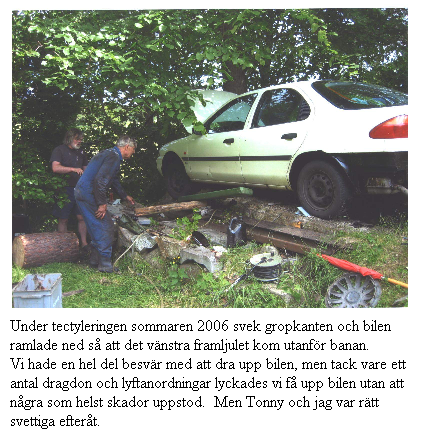
It was a bit surprising and I said I wanted to think about it. Ingegerd is so ill that she cannot drive, and then she thought it was just as well to sell it, a car that is 10 years old loses value very quickly even though it is in good condition. After a couple of days of consideration, we agreed on 45,000 kronor. We sent in all the papers; both deregistration of KEA061 Orion and registration of Mondeo PUR189. The registration went without any trouble and now Ann-Marie and I are owners of a somewhat newer car, with automatic transmission, air conditioning, and a good radio. The car has only gone 10,000 miles and is almost completely free of rust. The car has been driven by two women, a woman from Stockholm and Ingegerd. There are minor blemishes, the rear bumper which is plastic is slightly cracked, but that doesn't matter. Otherwise, the car is in very good condition, clean and well-maintained, and it shows that it has spent most of its time in the garage. I have sprayed Tectyl on the underbody and received commendations from the inspector at the Swedish Vehicle Inspection. The rear bumper, however, has taken some damage; it is of completely different strength than what the Orion had. The plastic of the bumper is very brittle and as soon as I get a bit too far when parking under the concrete roof, you can hear a rattle as some pieces of the bumper fall to the ground.
Shortly after the purchase, we were going to visit Tomas and on the way, opposite the Eriksson complex – just before the entrance to Liljeholmen, we heard a rattling noise and I suspected it must be the exhaust pipe. Luckily, it was possible to turn into a construction site (they were building an additional lane) and there we could stop and investigate why it was clattering. It turned out that the rear part of the muffler had broken off and was dragging on the ground. Fortunately, the asphalt was good on that stretch, otherwise the fallen part could have caught on an unevenness with unforeseen consequences for the fuel tank and underbody.
The muffler was hanging by its rearmost rubber link and now the task was to find a suitable repair method. I looked around and noticed that they were also laying some pipes in the ground – there was a pile of pipes by the side of the road. Upon closer inspection, it turned out that the coupling joint for connecting pipes fit exactly over the exhaust pipe. With the strap that the pile of pipes was tied with, I could twist it together reasonably well and attach the ends of the exhaust pipe, and the job was done. The only damage that occurred was that I didn't have any overalls with me, I had to take off my jacket, roll up my shirt sleeves, but since the car had been Tectyl-treated only a week earlier, there were some black spots on the clean white shirt. Ann-Marie had quite a bit of trouble saving it. Luckily, there was a small mat in the trunk and I didn't have to lie on bare ground – it was still quite cold.
After the battery, exhaust pipe, brakes, and rear "bumper" were replaced (the latter in May '05), the car has worked without any exceptions whatsoever. A couple of weeks ago (2005-08-06), I took the opportunity to Tectyl-treat the underbody so now it shouldn't rust too quickly.
Mondeo Helcombi PSB….
The interpreting that was never carried out.
PUR 189 ended its days in a ditch near Johannisdal on road 53 between Nyköping and Eskilstuna.
On October 29, I was to interpret in Eskilstuna. It was early in the morning and we started already at 7:00 AM. When we came out onto the courtyard, we saw that there had been frost during the night, but unfortunately I had not thought about changing to winter tires until the following week.
It went well until just after Oxbron. I was aware that the road could be slippery near the lake and drove quite carefully. It went well until I came up to the slight incline just before Johannisdal. Suddenly the car began to "float" and I had difficulty keeping it on the road. At the last second, however, I managed to avoid a head-on collision. The speed had in fact decreased quite significantly, but the car still continued to be uncontrollable and after a couple more swerves, the car went into a ditch on the right side of the road. There was a slope towards the field and the car slid into the ditch, the front touched the ground and the front suspension lifted the front part so that the front wheels came out of the ditch, but now the speed was so low that the rear wheels got stuck in a ditch – about 20 cm deep. Not even the airbag deployed and we only felt a slight tug in the seat belts. The car stood in the field with the rear wheels in the ditch on the right side of the road, barely a couple of meters into the field. We tried to get out by ourselves, but the ground was muddy and a 20 cm hole is enough to fail. We got out of the car and came out onto the road; it was so slippery that we had some difficulty moving.
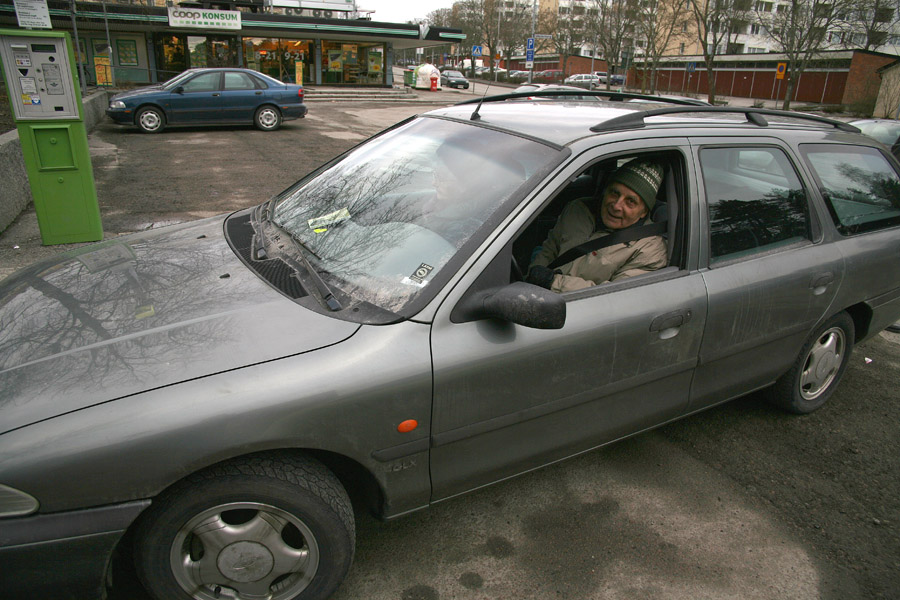
A couple of cars drove by, but then a German company car with two men in it came, they stopped and helped us out of the ditch; it only took a bit of manpower. Right next to the stretch where we ended up, there was a drive-up ramp to the field, and I could drive the car up onto the road. While we were dealing with our car, we heard a noise and when we looked up, a blue car was rolling over on the left side of the road. We were about to rush to the wrecked car, but didn't get many steps before the driver, a man, crawled out of the ruins of his car, waved to us that everything was fine, and took out his mobile phone.
After I had cut away parts of the front "bumper", which had been damaged by contact with the ground, we thanked the Germans and set off towards Eskilstuna, but after a short distance the car began to behave somewhat strangely; it only pulled at high engine revs, and I decided to go to Åke Karlsson's workshop in Sparreholm to possibly get some help. It turned out, however, that both the radiator and the oil pan of the automatic transmission had been damaged – they were leaking considerably from both, and any further journey to Eskilstuna was out of the question. We left the car for possible repair at the car dealership and Åke Karlsson drove us to the junction of roads 57 and 53 because the bus had already left. The next bus would only go after a couple of hours, so we decided to try to get a lift to Nyköping.
At first it didn't look very promising, several cars with only one person passed without taking any notice of us, but a car with an official from the County Council stopped and we could ride with him. He was a computer technician and was going to Bryngilstorp to see some elderly person to install a large-print program on their computer. His name was Mikael Eliasson and his phone number is 016-10 35 73. During the journey we discussed my special program and he gave some advice and references about programs that might be able to solve my problem with the sound for my documentation.
Now it is a problem to get another car. Åke Karlsson has a Mondeo for 10,000 kronor for sale, so I will take a closer look at it. Otherwise there is a Mondeo from a later date at Skobes in Katrineholm, but it is privately imported.
Tomorrow, Monday 081103, we are flying to Paris to meet Katarina and Pierre, then we will together with them take a trip to Werner and Felice in Zollikon, Zurich.
When we had returned from our trip, I called Åke Karlsson and Mrs. Viola answered. She said that Åke had suffered a urinary tract infection and was in the hospital, where she was on her way to, but if I wanted, she would leave the keys in the workshop's mailbox and I could pick up the car for a test drive.
Now we have driven the car for a few miles, been on a couple of interpreting jobs to Eskilstuna, visited Tomas and Anders to congratulate Anders on his 24-year-day. The car has certain smaller faults which shall be attended to, but as long as Åke is ill nothing happens – the ball is with him. He shall give a signal when he can adjust the blinking on the airbag, the lock on the left side so that it is also possible to unlock there (now one can only lock the car on that side) and some other unessential adjustments of doors. The car is somewhat larger than our previous one, has a 2-litre engine and uses about 1 litre per 10 kilometres, but at the same time has cruise control and electrically heated and electrically adjustable rear-view mirrors, as well as a radio with CD-player of very high quality. The car was probably in its time a “parade car” when it was new – about 14 years ago. A pity only that I had had to spend close to 5,000 on PUR 189 some month before the accident was at hand. I had almost imagined myself “retiring” with that car – there were no faults whatsoever on it at the last inspection.
A couple of weeks ago we were on the way from Eskilstuna, I accidentally knocked out the gear lever while the cruise control was on. The engine revved high and when I had turned off the cruise control, the car only ran in second gear. Nothing helped. I went to Åke Karlsson in Sparreholm and we did an inspection. It turned out that the windshield wipers did not work, but they had an automatic fuse and would probably come back when the fuse cooled. We did not find any other blown fuses and we set off towards Nyköping on only second gear. It runs at about 2500 rpm and the speed becomes about 60 kilometers per hour.
Last Thursday I went to Lennerstig's Car on Husarvägen to possibly get something done. The mechanic did a couple of tests and the test showed that there was no power supply to something. However, he had many other cars and asked me to leave the car at the workshop, he would take another look if he got time. I then told him that I needed the car on Friday and would pick it up whether he had fixed it or not.
The car stood where it had stood all night and nothing had happened. We took the car and set off towards Torshälla, where I had an interpretation. We had chugged past Sparreholm and I thought I might try the cruise control anyway, switched it on and … abracadabra … the gear engaged third and has not (touch wood…) since then caused any trouble. I nearly drove into the ditch out of pure surprise. It is a mystery, one might say it is the highest degree of automation.
On March 1, 2010, I was to go with Ann-Marie to the University Hospital in Örebro because in Nyköping they suspected something was wrong with her health. She had had bleeding in the lower abdomen. The weather was probably the worst of the year, snow, drifting snow, fog, and icy conditions in general. On the approach to Örebro we did not find any signs to the hospital and I desperately looked for them because time was running out. A heap of snow appeared, I thought it was a curve and did not brake enough, with the result that when I reached the snow heap it turned out to be a roundabout. My speed was much too high, braking did not help, and I collided with a box van. The box van did not get major damage, but our front shock absorber broke into pieces. Today (2010-03-04) we have left the car at Åke Karlsson in Sparreholm and got to borrow a small Ford Fiesta to be able to get back to Nyköping.
Recordings
- 1965 Familjens bilar A.mp3
- 1965 Familjens bilar B.mp3
- 1965 Familjens bilar C.mp3
- 1965 Familjens bilar D.mp3