At Olli Naukkarinen's in Joutsa, Finland.
Under the Finns' occupation of Far Karelia in the years 1941-44, the Finns started primary schools for the Karelian children, but only for the Karelian ones. No Russian children were allowed to participate in the teaching; there were quite a few of them - deported families who had suffered the same harsh fate as Estonians and Ingrians. The teachers were as a rule very enthusiastic about building Greater Finland and threw themselves wholeheartedly into their tasks.
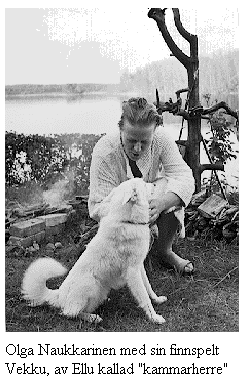
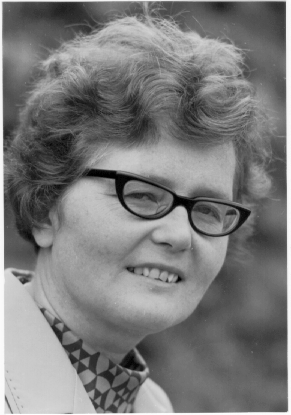
One of these enthusiasts was a teacher of Finnish and music - Olga Naukkarinen from Parainen, a community in Finnish Karelia near the "new" Russian border. Olga was a great music enthusiast and musical activity reached unprecedented heights compared to what we had enjoyed during the Soviet era. Admittedly, there was a lot of singing even during the Soviet era, but it happened more spontaneously and unorganized. In the chapter about Sheltozero 1940 I have described the time and the teaching in the Finnish school. I had graduated from the 10th grade in the Finnish school and did not know what to do next; there was no further education, nor any work either. I had been a diligent student and, because of my boy-soprano voice, had held a nearly privileged position with Olli; we had toured various front sectors and now Olli arranged a music student position for me in the 2nd Jaeger Regiment's band under the direction of music captain Onni Palomäki. With them, just before Christmas 1942, I had toured for three weeks in Finland, so we were not entirely strangers. Our paths diverged, but we kept contact by letter, especially after the Finns had to leave Far Karelia and I, together with the band, was brought back to Finland. I had no relatives on the western side, and Olli, along with the Ansas family and Erkki Inkinen, were the fixed points in my new existence. After the escape to Sweden, only sporadic letter contacts remained, but it still worked reasonably well; we at least kept track of each other's addresses.
1960, when we lived in Hägersten, I received a postcard from Olli. In it she wrote that on her way from a holiday in some warmer country she would pass through Stockholm on the way to Finland and would like to meet me and my family. We had not seen each other since autumn 1944. She had been on holiday somewhere in the south and was now returning to the cold north, where she now had her work. From the card it was evident that she was a music director and principal of the teacher-training college in Kemi in northern Finland. I drove out to Bromma, where she was to have a stopover for a visit with us. She stayed overnight with us and we talked long and well about old memories. She had been a teacher in Sheltozero (Soutjärvi in Finnish) and had imparted to me and some other children the first knowledge of the Finnish language. Before the war she had studied at the Music Conservatory in Viborg, but at the outbreak of the war her studies were interrupted and she went out to the theater of war to teach children in the areas occupied by the Finns. When the war ended and Finland had to cede both the occupied parts of Far Karelia and also parts of its own Karelia, those that the Russians had occupied during the war of 39-40, the disappointment and frustration were naturally great among most Finns. Perhaps most among the soldiers and Lottas who had closely seen the life and conditions in Far Karelia. Olli was perhaps more disappointed than most: her childhood home was in Parikkala and it lay very close to the Soviet border. To overcome her disappointment she had thrown herself into new tasks, resumed her musical studies and gradually passed her examination as music director and now had the task of imparting musical knowledge to new primary school teachers.
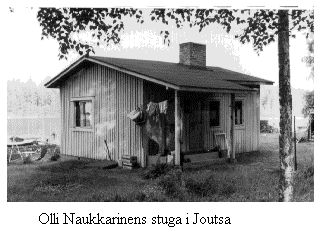
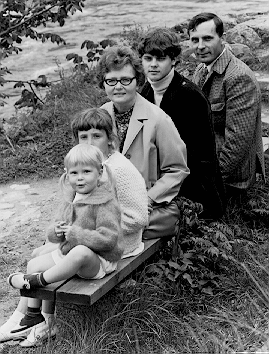
After the visit we continued to correspond. In one of the letters a couple of years later, she wrote that she had now become the owner of a summer cottage on Lake Päijänne near Joutsa and wanted us to come there to spend a few weeks with her at the new summer cottage. Olli was alone now and had only a friend, a postal worker - a "post office miss" who had served in Sheltozero during the war - Elna Liesto. We were by no means pressed for an invitation; the children were small and our finances were not anything to speak of; there could be no extravagances in Europe with expensive trips and rented cottages or hotel rooms. In 1965 we had bought a car, which would make the trip easier. Besides, I wanted to see Finland again.
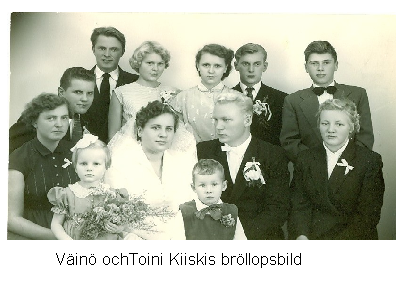
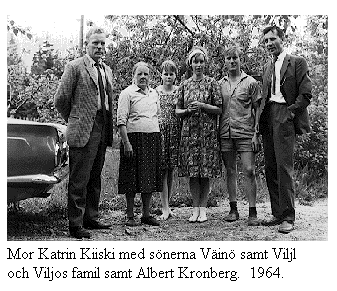
On the way to Olli we would also visit the Kiiski family: mother Katrin with the sons Väinö, Toivo, Ville and the daughter Iris. I had met Toivo in Gothenburg a few times before; the others I had not seen since the end of the war. They too were under threat of deportation after the war, but through the efforts of some Finnish teachers (who had served in Far Karelia during the war) they were hidden in the Anjala area and lived in obscurity for a few years until it became suitable to come into the "light".
In Soutjärvi there were Ingrian families who had been first deported from Ingria to Siberia, from there to Khibinogorsk on the Kola Peninsula and further to Far Karelia, to the village of Soutjärvi. The retreat from Soutjärvi in the summer of 1944 began hastily and these families were filled with great anxiety. Arvo Lehtinen, a driver for the administration based in Soutjärvi, gathered three families in his truck: the Pajunen, Kiiski, and Lemetti families. As one of the last vehicles they drove out of the village of Soutjärvi. Arvo drove the families to the train in Petrozavodsk and said they should travel to Inkeroinen station and from there to Anjala manor. So it happened, and there they remained.
The Kiiski family was from Ingria and they were deported to the Kola Peninsula, to a town called Khibinogorsk (later renamed Kirovsk). Father Kiiski was deported to Siberia in 1937 and the rest of the family to the Kola Peninsula, and after the Finnish Winter War, in the summer of 1939 to Far Karelia, to the village of Soutjärvi. Mother Kiiski became a caretaker and cleaner at the school and they all lived, 6 people, in one small room: grandmother, mother Katrin, the sons Toivo, Väinö and the daughter Irja.
The Continuation War was ongoing; the Russians retreated and the Finns arrived in Soutjärvi. The conditions for the families also improved considerably; the soldiers brought food and spoke the same language. The coexistence between the soldiers and the Ingrians as well as the local population proceeded well.
In Soutjärvi lived for the most part elderly Vepsians; the young had gone away from the war zone. The Finnish soldiers got along well with the local Vepsian population; they helped the people with both food and other things.
From the year 1943, Väinö Kiiski worked as an errand boy and helper in construction work for Arvo. He spoke the language and saw when Arvo needed help. Arvo liked to build and did not get nervous or throw the hammer or swear when something did not go as it should. Then he would turn to Väinö and say: what shall we do now?
Väinö Kiiski's schooling was interrupted; in March 1944 school ended and Väinö started working at the staff headquarters as an orderly. He met every day people at headquarters, ate with them and got to know them. He was an orderly for three months, right until the end in the summer of 1944; before Midsummer the Finns had to leave Soutjärvi.
During the retreat phase, Väinö received an order from the chief of staff that all mail should be collected and delivered directly to headquarters. The soldiers at headquarters spread out the newspapers on the table, read about the German troops' collapse and about the beginning of the retreat. The chiefs of staff said that now it would soon be our turn to retreat, and so it was. Before Midsummer was over, the Svir front was broken.
People began to flee from the Svir area and the flight went through Soutjärvi. Every evening there were people in cars, with horse-drawn carts and their belongings on the way through the village. The teacher Heimo Heikkinen said to the Kiiski, Lemetti, and Pajunen families that if they wanted to get away from here, they should leave with us Finns. The families were ready for departure and at headquarters they planned together with Arvo, Heikki, and Lauri Orispää where in Finland the families should be sent. Then Arvo said: send them to Anjala; there is plenty of space there. The families received travel permits, the soldiers helped with free tickets for the train, and the destination became Inkeroinen station in Eastern Finland.
The family had a couple of hours to gather their belongings and leave Soutjärvi. The staff, the teachers, and the Ingrians were the last to leave the village. Arvo drove fast with three families on the flatbed and grandmother Liisi in the driver's cab. The Russians had landed and made a motti (encirclement) at the village of Soksu, and everyone thought that Arvo with his load had fallen into the Russians' encirclement and ended up in the Russians' clutches, but they got out just before the motti closed.
Arvo drove the family to the railway station in Petrozavodsk. They were supposed to take a certain train, but now it happened that the train was already overcrowded, and the families could not fit into it. They spent the night at Petrozavodsk railway station, taking turns guarding their belongings. The bundles contained mostly clothes and a few small items. The next morning the families were able to board the train that took them to Kouvola in Finland. It was an ordinary passenger car and it was overcrowded. The children were stuffed under the benches and the bundles in the car's vestibule. The journey took a full day; they traveled via Pieksämäki and the journey was delayed by bombings. In Kouvola the families changed trains and arrived at Inkeroinen.
At Inkeroinen station the families wondered how they could get to the other side of the Kymi River, to Anjala manor and the family Lehtinen. The station staff for their part wondered what strange people they were and where they were heading. The station staff knew the Lehtinen family; the cars owned by Lehtinen at that time often drove goods to the station. From the station they called the Lehtinen family, and from there a car was sent to fetch them.
Some of the families stayed at the station to guard their bundles and some went to the grocery store at Kymenranta to get food; food was scarce. Then they saw the car that was to fetch them. On the sides of the car one could read "Arvo Lehtinen", and with it they could get to the Lehtinen family's farm.
They came to Lehtinen's farm and sawmill. Arvo had written to his wife Märta that she should contact the teacher Emil Honkalinna, who was then chairman of the Anjala municipal board and an acquaintance of Arvo. Honkalinna had arranged some work for Arvo's sawmill and often visited the family. He gave orders to drive the family to a guesthouse, which was located at Anjala Manor, where there was also a restaurant. As they drove through the avenue leading to the manor, Lemetti's mother remarked: now we are on our way to paradise. The Finnish summer nature was at its most beautiful at that moment.
The families spent a few days at the guesthouse, after which they moved into their new home. The Kiiski family remained at Anjala Manor and they were given a dwelling on the estate, near the rapids, and also received work there.
Väinö worked on the farm and mother Katrin became a milkmaid in the cowshed. Later they built their own house in Ruokosuo. They were called to the municipal building and asked if they wanted to stay in Finland. The Kiiski family answered yes to the question and they have never been subjected to any unpleasantness, despite the fact that all Ingrian Finns received an invitation after the war to return to Ingria in the Soviet Union. Arvo forbade them to return and they all remained in Finland.
The Pajunen family moved to Ahvio, near Ahvio Manor. Their youngest child Eeva was born in Ahvio and had Arvo and Märta Lehtinen as godparents. The family later moved to Anjala. The family's second daughter Lilja is very agile and good at gymnastics. Terttu was the founder of Anjala's Women's Gymnastics Group, its first chairperson, and also served as a gymnastics leader. Later Lilja successfully took charge of its activities and even performed at the Olympic Games in Helsinki in 1952, in its demonstration group at the opening of the Olympics.
The Lemetti family was placed in Junkkari, at Marta Manor. They moved from Junkkari when father Lemetti got a job at the Karhula glass factory. With the Lehtinen family, the Ingrian families maintained contact and friendship throughout all the years.
Arvo's letter to his wife Märta
Listen! Refugees have left from here and at least three families are coming to Anjala: the Lemettis, Pajunen and Kiiski, all Ingrian Finns. Lemetti has worked here as a foreman, Pajunen has been a helper to drivers, and they are ordinary decent people and hardworking men. Kiiski's wife has worked here at the school. I am not putting this forward as if you should provide them with work, but if necessary you can take care of them for a short time; they will surely come to visit you. But the housing issue will probably be difficult this time. Goodbye, now I have to go out driving again, even though it's already half past one at night. See you again and all the best.
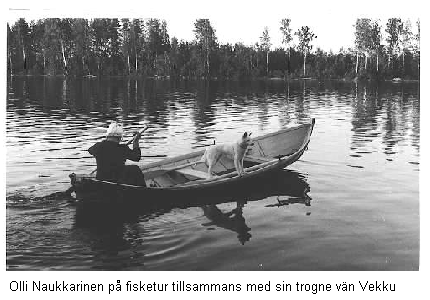
In 1964 we set off by boat and train to Joutsa in Finland and were met by Olli at Joutsa bus station. We took the bus to the boat pier where we loaded our suitcases into her rowboat and she started the outboard motor for a quarter-hour trip to her cabin. There was no road there yet and Olli did not have a car either. A couple of years later she bought a car and at the same time had a road built to the cabin, making it easier to get there. We had also acquired a car, a Ford Taunus of the 1963 model, but had some difficulties getting around with the car. In the beginning the road was not entirely smooth and the undercoating laboriously sprayed onto the car wore off.
The cabin was, of course, by a lake and it was ideal for everyone. Sometimes Ellu (friend Elna Liesto) also came to visit, but then it got quite cramped. The cabin had only one room and a small entryway, which also served as a dining room, and at night the floor space was taken up by sleeping spots. With the help of a neighbor, Olli's nephew, and me, a sleeping alcove was built after a few years, which greatly eased the bedding arrangements. The following summer we helped each other clean out and deepen her well. It consisted of five concrete rings, but Olli had said several times that it needed to be deepened. When we arrived the following summer, she had a concrete ring lying around and the plan was for a company to come and do the work. When I suggested that we could do it ourselves, she looked a bit suspicious but agreed to the proposal and we started the work. To accomplish the deepening and get better water filtration, I cleaned around the top ring, filled the hole with clean sand from the lake (it was quite a few wheelbarrow loads).
The children took advantage of the return trip to ride in the wheelbarrow and be tipped into the lake. With Olli's, Ellu's, and Ann-Marie's help, I placed the new concrete ring. Then it was just a matter of going down into the well and starting to dig. When there are no stones in the ground, it's quite easy to deepen a well made of concrete rings. You dig away the soil under the lowest ring and the concrete rings sink down by their own weight. In Olli's case, the ground consisted of soft clay; it was really cold on the feet during the digging. I had to dig for a couple of days to get the well finished and Olli satisfied. It felt satisfying to have been useful and not just "parasitized" on her goodwill.
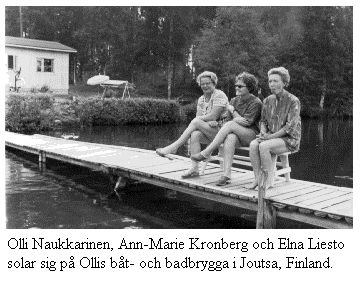
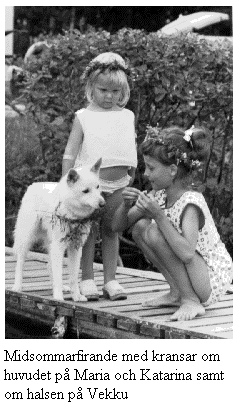
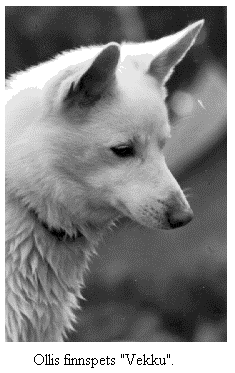
For the rest, the days at Olli's passed with sunbathing, fishing, bathing in the sauna, then jumping into the lake and grilling fish and sausages in the evenings. For the children it was an ideal existence. They enjoyed themselves and played with Olli's dog Vekku – if Vekku thought he had time, which happened now and then. Most of the time he ran along the pier or the shore barking at the small fish swimming in the lake. Sometimes he even dared to jump after the fish, but we never saw him catch any. Vekku was a fine "gentleman". He didn't eat just anything and Olli had some trouble with him. He was very elegant, his tail curled like a pretzel, and Olli probably thought he was a bit too thin. Sometimes she tried to give him extra food, but Vekku was rarely interested. When Olli tried to coax him with extra food, he looked almost condescendingly at her and you could almost see him thinking:
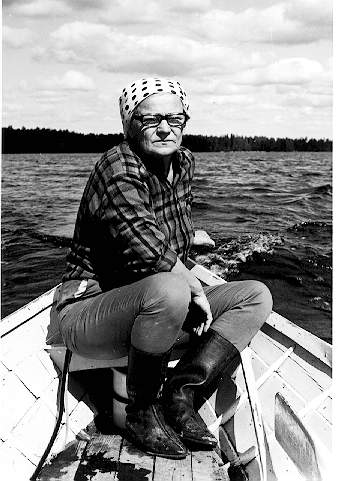
- "I suppose I'll take a bite since you're nagging!" Then he ate a little, but just to sort of show his goodwill, and glanced at Olli now and then to see if she would be satisfied. Spitz dogs are not lapdogs; Vekku was not either, except when Olli sat down in front of the fireplace, then he jumped into her lap and let himself be cared for. Olli herself was not easy to care for either. She is a spirited lady with a temper of her own and sometimes a bit touchy. By then she had spent a large part of her life as principal of the Kemijärvi Teacher Training College, and schoolmistresses do become quite headstrong over time. The Swiss say: "Der Herrn Gott weiss alles aber der Lehrer weiss noch mehr." In 1983 I, together with Ann-Marie, visited her in Savonlinna, where she had moved after finishing her teaching career far up in northern Finland. Savonlinna became Finland's music center, with opera performances in the old castle courtyard. Olli, of course, could not live without music and had several choirs going even after her retirement. Where else would the ladle be but in the pot? At the end of the 1970s, Olli and her friend Ellu spent Christmas with us and Olli tried to play on our piano. It didn't go very well and I joked:
- You play "Old Man Noak" with one finger, then maybe it'll sound like something! She had had difficulties with her joints and could barely play anything at all on the piano. Her fingers and the other joints were swollen and she was in a lot of pain. At the library in Savonlinna she had found a book about vegetable food and began experimenting with eating 1/3 of the food in vegetable form. There was a noticeable improvement and she continued with half of the food being vegetables. After a time she switched to a fully vegetarian diet and slowly but surely regained her previously rather slim shape. Often, however, the curing process goes to certain excesses, and so it was for Olli. Now she was going to cure herself further and to that end she had let herself be tempted into taking a blood analysis. It showed that she had too little copper in her blood and that was to be remedied.
During our visit to her in Savonlinna, we went to the pharmacy where she was to pick up 12 liters of health drink – copper-"something". Olli lived as a vegetarian and believed in natural medicines. On the way we made a stop at a kiosk, and while we stood there, Olli accidentally bumped into a little man with clear signs of being a down-and-out drunkard. Olli looked angrily at him, but he squinted so kindly and somewhat slyly at her and then came:
- Lovestruck? Huh...? (Rakkauskipea, vai..?)
Olli snorted and got annoyed, but the man smiled such a mild and winning smile that it was hard to be annoyed with him and remain serious.
We stayed with Olli for many summers – to our mutual enjoyment. The children had an ideal time; there were opportunities for fishing, bathing, and sauna. There were also many fishing trips in the surrounding lakes. Fishing was mostly done with a "katiska", a metal cage. Usually we got some perch that gave occasion for a sauna and grilling evening. Maria was a real "goer"; on one occasion she ran about ten times between the sauna bench and the lake. The sauna is a natural and beloved part of Finnish life, not least during the summer.
A summer cottage without access to water is unthinkable in Finland; the Swedish way of bringing water with them to the summer cottage is generally regarded by Finns as something completely incomprehensible. No water at the summer cottage? That's impossible! – thinks the Finn, and doesn't understand at all how the Swedes manage it. Not being able to take a Saturday bath makes the Finn consider it almost not worth living under such circumstances. In Finland, the sauna is culture, not just some fictitious ritual (as with some other peoples) to clean the body and relieve the soul.

Recordings
- 1966 Olli Naukkarinen A.mp3
- 1966 Olli Naukkarinen B.mp3