Soviet air visits 1967, 1975, 1981
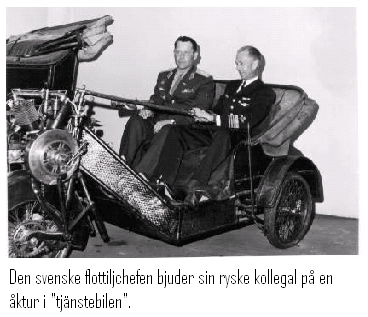
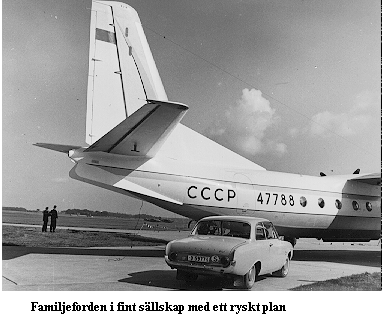
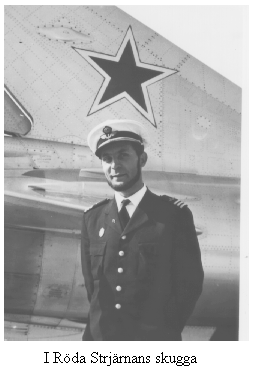
Duringmy active interpreter time, the Russians made three air visits, which I helped interpret: in 1967 came the first with 6 MiG-21s to Uppsala under Colonel Medvedev's leadership, in 1975 to F11 in Nyköping and in 1981 to F17 Kallinge in Blekinge. As always during Nils Öberg's time as interpreting officer, many interpreters were called in to get practice in the Russian language. During the first visit I was assigned as interpreter to the contingent's technical chief Col. V. Rashevskij, a very pleasant man and a great storyteller of history and anecdotes. The Russian division was from Kubinka near Moscow, from a display division. At first the atmosphere was (as usual) somewhat strained, but after a relatively short time and a few bottles of vodka, the atmosphere became really jovial. There was plenty of representation money and the Russian transport plane was not only loaded with flight equipment. The gatherings became quite wet and on one occasion the Swedes tried to drink the Russian embassy secretary G. Popov under the table, but it was a vain attempt. Popov was a hardened rogue, he is said to have held onto the walls at the cadet quarters in Uppsala, but made it to his room under his own power, which was not the case for some Swedes. During the visit the guests were treated to some cultural events, we visited Uppsala Castle, Stockholm and took a boat trip from Uppsala to Skokloster. Throughout the journey Col. V. Rashevskij told stories and we laughed heartily. Near Skokloster Castle there is a car museum, where we looked at old cars and in the castle we were guided to all the places that are not open to the public. There one could see all the goods that Baron Wrangel plundered as war booty on the continent and dragged to Sweden during the Swedish Age of Greatness. .
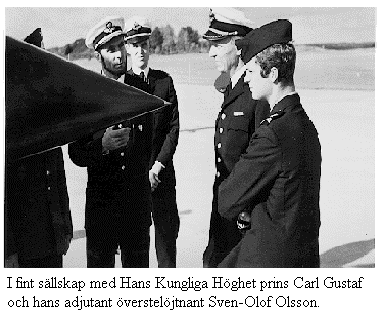
The then king, Carl XVI Gustaf, was still "the prince" and did some of his military service in the Air Force. The Russians wanted very much to meet him and so it happened at a reception on the airfield. The prince arrived in somewhat wrinkled trousers and we joked that he had probably slept in his clothes, but nobody dared make such an insinuation in the presence of his then adjutant, later Chief of the Air Force Col. Sven-Olov Olsson. The prince came and everyone wanted to crowd around him, but most were shooed away, the hosts had other things on their minds. The prince was isolated with a few carefully selected people, including the technical chief of the Russian contingent, Col. V. Rashevskij. The Russians are very authority-bound and meeting the Swedish heir apparent was considered a great honor. The prince, for his part, was apparently well prepared by the adjutant to ask appropriate questions of the Russian, and the latter answered all questions quite openly (even of a fairly secret nature). We had managed to isolate the "politruk" with some Swedish officers at a proper distance from the group with the prince and saw how he suffered because he surely suspected what was going on without him being able to do anything.
The pornography wave swept over Sweden during the same years and the Russians were naturally interested. Discreetly, man to man, they asked us to get them some porn magazines. They had seen such at the bases and wanted to take some home themselves. Their financial means were limited, each had only 75 SEK at their disposal. I had promised to take care of the request and stepped into a tobacco shop in Uppsala in full uniform to buy some rags. My interest in photography meant that I was not satisfied with the cheapest prints but bought for about 25 kronor really nice issues. It was an expense, but we got it back in the form of "literature costs" when we gathered for the final review in Uppsala after the Russians had flown home. The Swedish Air Force was to fly to Moscow for the return visit the following year, but that came to nothing.

On 21 August 1968 we were to take off with a division of Drakens and a transport plane. The participants had gathered at the Air Staff and undergone a briefing about the visit. Some of the interpreters had been to Kubinka to prepare the visit with the Russians and everything seemed ready to depart the next day. After the briefing in the afternoon we were free and went out into town awaiting the next day's departure for Moscow and Kubinka.
When we turned on the radio to hear the morning news the next day, we heard that the Russians had made an invasion of Prague during the night, taken the airport at the same time as Warsaw Pact troops had crossed the Czech border. At the Air Staff they had not yet received any new instructions regarding the situation that had arisen, and we were on standby all day before the government at the afternoon cabinet meeting the same day decided that there would be no visit to the Soviet Union. I still have the visa - issued for a visit to the Soviet Ministry of Defense. Visa K Nr 972793 never came to use.
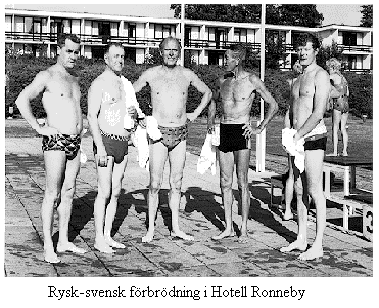
Then it was not until 1975 that the next Russian visit came. The Russians are said through diplomatic channels to have pressed for the visit to take place earlier, but custom dictates that such actions should be marked properly. The visit was to the Royal Södermanland Wing, F11 in Nyköping. Colonel Hagerström received the visit and I was his interpreter. The programs are quite monotonous from one visit to another: the crews meet the Swedish airmen, there are flight demonstrations and excursions are made to various places. One of the flight engineers was chairman of the Hånö Caravan Club and we were invited to visit the caravan camp and swim in the Baltic Sea. The swim was not announced in advance, but the beach was not occupied in any way and there were no others nearby. The Swedes took off their uniforms and ran into the water, while the Russians kept their underwear on. We tried to convince them that in Sweden one swims without clothes when there are no ladies around, but it didn't help. After the swim we sat down on the beach and enjoyed vodka with snacks.
For the most part the interpreting went well, sometimes really well according to some opinions, but a couple of times it failed. It was still not so bad that I didn't manage with a certain preserved dignity, but barely with honor.
In 1981, Sweden and the Royal Kallinge Wing were visited by 6 Russian MiG-23 aircraft and I was ordered as interpreter to Colonel Sven-Olof Olsson, later Chief of the Air Force, but then chief of Southern Milo. While waiting for the Russians to land, the colonel called me in for a review of his welcome speech to the Russian guests. The colonel read his relatively short speech sentence by sentence and I interpreted into Russian, memorized a few important points, and we parted to meet again on the tarmac when the Russians had arrived.
I still remember the formation quite clearly today. Out on the tarmac we stood in a square: the Russian An-12 crew on the left, the Russian pilots straight ahead, and the Swedish participants on the right. I stood together with Colonel Sven‑Olov Olsson at the microphones and the welcoming ceremony began. Colonel Olsson gave his speech and I interpreted, everything seemed to be in order.
Suddenly I become aware that the colonel is looking at me and I notice that I have been away, unfocused. I had no idea what he had actually said when he noticed that I was not following up and I just stood there and we looked at each other. The microphone for the loudspeaker system was on and I could not start asking the colonel what he had said. The question would have gone out over the whole airfield. Now good advice was expensive. I had a feeling that he had gone through almost the entire speech, but only a feeling, what should I do? Asking him to repeat the phrase was out of the question; on the right wing stood 10 other military interpreters and they had surely followed my actions with great interest. There was a somewhat too long pause and when the delay began to feel awkward, I made my decision. I still thought he had said most of what we had rehearsed and I constructed a closing phrase myself:
- And finally, on behalf of the Swedish Air Force, I warmly welcome our Russian friends and colleagues to Sweden and the Royal Blekinge Wing, F 17!
Now it was a matter of me having guessed right; what would I do if this was not the last phrase? I was lucky, it was the last phrase, but the comrades later asked what was really wrong with me since the phrase did not quite match what the colonel had spoken. One must have luck.
The rest of the visit I stayed more alert and everything went well for the interpreters; for the Russians, on the other hand, it was somewhat more troublesome. We had said goodbye to our newfound friends with Colonel Andreenko at the head, the MiGs had taken off and headed for Ventspils. We were about to disperse when an order came over the loudspeakers that all Swedish participants should remain on the field. The Russians would come back.
One of the aircraft had a fault, one of the fuel valves was not working and then the aircraft cannot fly normally, the tanks must be drained in a balanced order to maintain stability. The Russians landed and since the AN-12 was still on the ground, all service personnel were still there and they began their work. They knew which valve it was, but instead of opening the hatch and repairing the valve, they took a large hammer and started to work on the port side, quite far back. We suggested that they take out the valve, to which the Russian mechanics replied that it was not possible, the valve was sealed - factory guarantee. Tableau! The Swedes shook their heads when the interpreters translated what the Russians said. The mechanics continued hammering and after a while everything seemed to be in order, the planes took off and did not return this time. When the AN-12 also had taken off and disappeared eastward, we could finally, with a couple of hours' delay, leave the airfield and conclude the visit.
”We have remained Soviet people”, says General A. Lebed and adds:
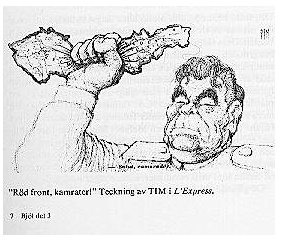
”The Russians don't care if they are ruled by fascists, communists or the military as long as they can buy six kinds of sausage and very cheap vodka in the store”
from E. Kheres' book ”Lebed” page 162.
General A. Lebed appears to have been an unusual Russian. From his biography it emerges that he was something akin to old Prussian soldiers, incorruptible and just. He put an end to the war in Moldavia, but Moscow did not seem to have liked him. He was sent as governor to Krasnoyarsk, but died in a “helicopter accident”.
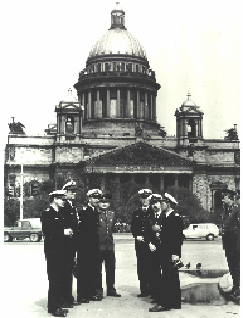
1967
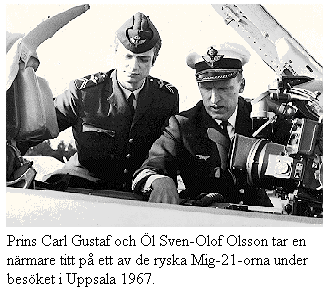
At the end of August 1967, a Soviet air unit, a division of MIG-21s, made a notable visit to the Royal Uppland Air Wing. Naturally, MT was present, and eleven members served as interpreters from the reception of the technical personnel, who arrived the day before the MIG-21s, and the Soviet flight controller's preparations for the landing of the unit until the departure took place six days later. From the extensive program can particularly be mentioned the showing of various Swedish aircraft to the Soviet pilots, a display of advanced flying by a Swedish Draken and a Russian MIG aircraft, as well as a demonstration for Swedish pilots of the MIG planes on the ground.
The latter placed no small demands on the interpreters and the Russian MIG pilots, for that matter. To the interpreters, who together with the Russian pilots stood by the planes, it probably seemed as if at least half of the Swedish Air Force (and a good deal more) surged over them and the ten MIG planes. Within seconds of the air display being over and the spectators invited to inspect the Soviet planes, the Russians and the interpreters stood in the middle of a seething blue-uniformed maelstrom asking, pointing, asking and poking at everything in and on the planes. They climbed up, in, out and down from the planes – everyone obviously had to sit in the pilot's seat and feel the sticks and controls. And ask. Interested and hyper-technically. That the Soviet pilots managed to answer – and they did so calmly, matter-of-factly, kindly and knowledgeably – and that the interpreters managed to convey at least a good many of the questions and answers, seems something of a miracle. By all accounts afterwards, the interpreters carried out their tasks with distinction.
The visits naturally also included comradely socializing between Soviet and Swedish pilots, excursions and sightseeing, among others a boat trip on the Fyris River to Skokloster and a party at the Soviet embassy. Everywhere, MT members were present and handled the linguistic contacts.
(From The Military Interpreters' 20th Anniversary Publication 1951-1971)