Mountain Hike 1967
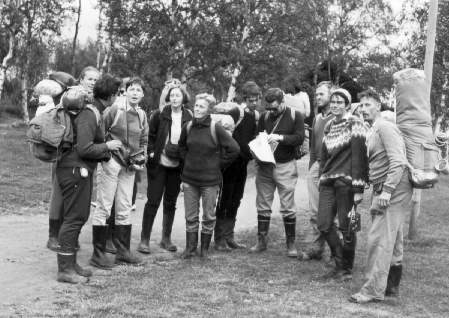
Sepp
Lisa Schellenberg
Yvette Burgat
Therese Holliger
Dominique Reinmann
Inez
Irene Thomann
Jurg Spörri
Werner Muelli
Theyear's hike with the Swiss would go on the trails Nikkaluokta - Kebnekajse - Tarfala - Kaskasavagge - Vistas – Alesjaure- Abiskojaure- Abisko and the group consisted of me with Tomas and 12 Swiss. Werner organized the group in Switzerland and we went, so to speak, "under our own steam" without involvement from Herr Kägi and Kuoni Reisebũro.
I left Falkenberg with Tomas on 12/6 to complete the preparations for this year's mountain hike. Werner had sent 1193 kronor for the purchase of provisions and we had three days to get everything in order. The difficulties began almost immediately, it turned out that the excellent freeze-dried food that Vato manufactured was not available. Blå Band, as the company was now called, had discontinued production for civilian consumption as the market wasn't large enough. Friluftsmagasinet had, however, managed to place an order in connection with the Crown and we could buy, but only three different kinds, sausage stews, pea soup with soft drink and vegetable stew.
It worked out in the end and we bought 2 x 9 x 3 packages of each kind, we had to take the same kind twice, there wasn't that much else to choose from. All other provisions we bought at Nyköp in Nyköping, got 10% off the total amount of about 300 kronor, which meant that Tomas could join the food group at no cost to me.
It was quite a lot of work with packing, but by Thursday evening we were ready and could send the bags off to Stockholm. There we filled the packages with the freeze-dried food and sent the entire supply off to Kiruna. The rest of Friday we spent with various purchases in Stockholm and in the evening we traveled to Farsta to sleep over at Harriet and Jim Beláew's. Jim was going to the summer cottage with the children, Harriet was going to be visited by her siblings so we would be quite many at Ejdervägen 46 in Farsta.
On Saturday we went out and wandered around Stockholm, looked at Hötorget and other sights that otherwise mostly pass by.
On Sunday morning we met our party, the train was on time but the departure was delayed by almost three quarters of an hour. Werner, Dominique and Yvette and Thèrese were with us from last year, from the year before also came Elisabets and Jürg, Inez, Irene, Hans, Werner and Sepp. There's not much to say about the train journey, we managed to get hold of several sleeper car tickets so almost everyone who wanted could sleep comfortably.
Kiruna- Kebnekajse.
Kiruna greeted us with cold, but otherwise relatively beautiful weather. We distributed the provisions and the Swiss handed over the bottles with various types of alcohol, which I had ordered through Werner. He had managed to break one of the bottles and thus there were only 9 "putäller" left, but with the consumption that we have, it will last quite a while. We packed the bottles in a cardboard box and left it at Kiruna Station's left-luggage office, I was not keen to send the package to Nyköping, it would probably end up as just shards.
The rest of the journey went completely as planned, we had time to buy butter and denatured alcohol in Kiruna and were at 11 o'clock in Nikkaluokta. After a quick coffee at Nikkaluokta café, the journey continued towards Kebnekajse. Some of the new participants were quite untrained and because the packs were quite heavy, the journey was somewhat strenuous. This was also contributed to by the time pressure between the boat departures. We had about 2½ hours, but the coffee drinking took so much time that there was hardly any time left for the walk down to the boat. I had to hurry some of them so we would arrive in time for the boat's departure from lower Ladjojaure. At the time there was very low water level and we had to roll the boat quite heavily to get through in some places.
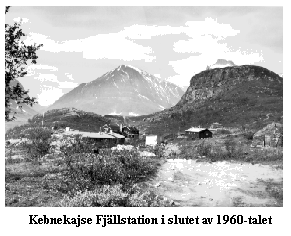
A few times the boat hit sandbanks, but everything went well. The journey further past Tarfala ....... and to Kebnekaise went under the sign of mosquitoes and good spirits. Upon arrival, the backpacks were weighed and it turned out that Sepp had the heaviest, a full 27 kg. Afterwards, when we saw everything he had in the pack, we understood why it would weigh so much. He turned out to be an experienced climber, but that he would have so much extra provisions with him that he almost carried himself to death, we had no idea. On the other hand, he needed a lot of food, he was thin and had a high metabolism.
My backpack weighed 21 kg, Tomas 16, Yvette and Dominique, who had experience of hiking in the Alps, came down to 14 kg weight and the heaviest lady's pack weighed a full 18 kg. We had to divide it into several, it would be too much for a lady. From Tarfalajokken I walked ahead to arrange sleeping places for the group and already at the entrance I met Mrs. Eyvor Fischer, the manager of Kebnekajse station. She had received my letter and the beds were reserved in the main building. We were offered juice and then it was lovely to sit down at the dinner table and eat brown beans with pork. There were generous portions and with tutti-frutti cream for dessert. We were full. We came too late for the sauna, but thanks to Mrs. Fischer's accommodation we were able to bathe after the staff's time and soon both the sauna and the Fischer couple had several new admirers. It was with great pleasure that we fell into our beds after an eventful day. Some of us (Lisa Schellenberg, Jurg, Sepp, Tomas and I) would go up to the Kebnekaise summit the next day. Actually, the Eastern route was closed due to a lot of snow and ice, but Sepp was a climber and had rope and carabiners and other equipment with him and we decided to try anyway. We started at 08.00 and were at 10 o'clock at Björling's glacier. The wind was strong, the sky was completely overcast so Lisa Schellenberg thought there was no point in going up, there would be no pictures to take anyway so she turned back and on the way down she got company with a Swede. The Swede had difficulties with his hip and didn't dare to go up in the prevailing weather.
At 11-11.30 Jürg thought we could be up at the summit hut itself, drink tea up there and go down and be back at the station in time for the sauna. It didn't quite turn out that way, it took considerably more time both up and down. We started our climb towards the "hut" and soon began to understand why Mrs. Fischer did not want us to take the Eastern route with the tourists. The glacier ridge before the "shelf" was extremely narrow, in fact no more than about 40 centimeters to step on. The winds from down in Ladjovagge and from up on Björling's glacier made it difficult to balance, especially since it was impossible to walk to the side. We reached the "shelf" and saw in the distance the three Swedes, whose comrade had gone back with Lisa. They were working their way up from Björling glacier.
Fischer had been to the Eastern route and hung out some ropes so the first part went quite well, then the ropes ran out, or they were frozen in and Sepp had to bring out his 60-meter ropes, he went first while Jürg secured the rope behind, then Sepp secured the rope up again and we could without any major risk cross the ice strands that lay in a crevice. With any great speed you don't do such a climb, you go slowly and surely, not until half past one in the afternoon were we at the summit hut.
In the summit hut there were four Swedes, they had arrived there the previous evening and visited the summit during the night, they had had beautiful weather with cloudless sky and free view over the 11th part of Sweden, which one is said to be able to see from Kebnekajse's summit. For our part, there was no point in climbing there, the clouds were all the way down to Björling glacier and we had to walk along the cairn to get to the summit hut.
The tea tastes excellent, as it always does at such occasions. After 4-5 "cooks" on the spirit stove, it was time to think about the return journey. The Swedes would go down the Western route, they had around 20 kilos in each backpack and going down the eastern route they were no longer inclined.
Now the wind had increased and when we reached the edge, the wind tore properly, it blew from Björling glacier and we got wet from below, all the water that ran down got caught in the gusts and wetted our trousers from below. My wind jacket could not withstand the strain, the right sleeve came apart at the weld seam and soon I had a plastic sheet fluttering around my arm, after a while the seam at the shoulder also broke and I had to patch the jacket together down at Kebnekajse station. Again Sepp ferried us over the ice strands and if not before, then now we knew who had climbing experience. He finally came down with a "divertissima" (a fast descent with the rope, which is doubled around the piton or carabiner, and pulled after the end of the descent) and it took not a tenth of the time we had used for the down-climbing maneuver.
We came down to Kebnekajse without any difficulties, the only trouble was the fog, we had a little trouble finding the descent to Kitteldalen. Werner "Bonatti" (an Italian who climbs with bare hands in the Matterhorn) as Tomas called him, met us in the yard and he told us that the sauna had been going for half an hour. He had slept well all morning, otherwise he used quite a lot of his vacation to sleep.
It felt wonderful to warm up in the sauna, there are few things one appreciates more after a cold day than a visit to the sauna.
Kebnekajse - Tarfala
The day began with breakfast at the station, there was no provisions intended for anything other than the evening meal. It was enough to carry the 55 kg we had gathered. In addition, came 3 kg of butter bought in Kiruna and 2 liters of T-spirit for the Trangia stove. The Trangia stove has proven to be an excellent means of momentarily lifting the mood at lunchtime, even if 1 liter of water after 10 minutes doesn't go far, it's quite fast to boil up a refill. In the first batch, each hiker gets a small splash and if the splash is hot, the spirits revive quite quickly.
After breakfast the group was to be photographed before departure, and that caused some trouble, as not everyone had produced their mosquito sticks and mosquito spray bottles to protect themselves from the small annoying insects.
We said goodbye to the Fischer couple and thanked them for Tomas and me being allowed to stay for free at the accommodation.
-
You go here every year and with so many people that it might be justified, said Eyvor Fischer at the farewell. We got underway and the journey to the Tarfala hut went without any major adventures. The path is heavily trodden and the ascent moderate. We stopped a few times to take photographs and drink from the Tarfala-jokk. Tomas and I washed ourselves; one of us had to wave his shirt while the other was bare-chested; the mosquitoes were bloodthirsty and immediately attacked every unprotected bit of skin.
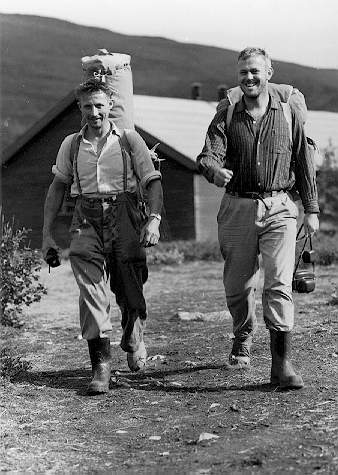
On the journey towards Tarfala we met two military men; one was a young second lieutenant from S3, he had graduated and was to do a mountain hike as the conclusion of his training as a scout. He was a remarkably fit lad and he had a very large pack with "all" equipment. When I say "all" I mean that he even had with him a personal weapon, a pistol with 9 rounds. As if that were not enough, he also had a 16 mm Paillard movie camera with all sorts of accessories. The other was more like an ordinary hiker with the equipment one normally brings.
Upon arrival at the first hut you always see who are the quickest and most diligent. Some throw themselves immediately over the cooking gear and start cooking while others, when part of a group, do nothing voluntarily. On this trip we had two "divas". I solved the problem most simply by calling "Two volunteers here" and simultaneously looking at them. The method has worked so far with a certain success. The sun had gone into clouds, we postponed the photography for the moment and started cooking. The first time everything takes a long time and before we were finished with cooking it had become nearly six in the evening and it was too late to photograph.
We continued directly with coffee and just as we were sitting there on the porch steps, we saw two hikers approaching the hut. I did not recognize the lady immediately but the man was unmistakable; he looked exactly the same as many years ago when we were students at Katrineberg Folk High School in Halland. Yes, one apparently has to come to the mountains to meet one's former folk high school classmates, I thought. It was Kjell Berglund and Alice, maiden name Johansson, from the academic years 1948-49 at Halland County Folk High School Katrineberg. We had not met since spring 1949, when I was in the second year, so it was a happy reunion. I have met several old schoolmates during mountain hikes.
With Alice I have danced many a hambo during Saturday and Sunday evenings at Katrineberg Folk High School in Vessigebro.
We had much to talk about and time was short; it became late in the evening and they had to return to Kebnekaise. Nor did we have much to offer; the provisions were tightly rationed so it had to be coffee with some Marie biscuits. They in turn offered apricot soup from a thermos they had brought. Alice and Kjell were not on a long hike; they used Kebnekaise as a base and made shorter excursions to the surroundings. Kjell had had some trouble with a girl before, and it ended up being Alice; moreover they had had something going already during the Katrineberg time if I remember correctly. From the conversation it emerged that they had a 6-year-old son together.
Tarfala - Kaskasavagge
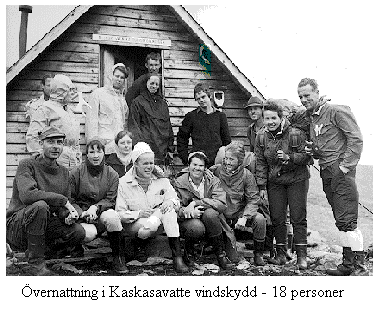
There was rain and fog in the morning at our start, and the mountainside we were to climb was hidden in clouds after a few hundred meters. The stones were slippery and we had to be careful not to slip and fall. The fog clouds were thick and we had to keep close together; it is easy to lose each other when distances become too long between hikers. When we had come a few hundred meters up we could not see anything at all; it was just to take out the compass and set the course. On Jukkasjärvi Crown Surplus Land it is mostly foggy; even during the previous hike in 1964, when we went with the whole family (Ann-Marie, Tomas and I), it was the same, fog and damp all the way from Katterjokk to Vakkottavaare, perhaps even worse than this time; the journey went entirely by compass. This year it was not quite so bad; now and then we could discern some of the sky, but only for short periods. After three hours of walking the fog lifted and we could ascertain that the navigation had gone well; we saw Kaskasavagge ahead of us at about 4 km distance.
We took a break northwest of the Tarfala glacier, ate our nuts and chocolate and raisins, then continued the journey down towards the valley. In the clear air of the mountain world, everything looks much closer than it actually is, and sometimes it felt as if we would never arrive. We walked and walked; it took a good while before we were down at the jokk and could ascertain that at the level of the Kaskasavagge hut it was impossible to cross. The ropes that had been there earlier were gone, and now we had to start looking for a place in the jokk where one could cross to the other side.
I myself walked up along the jokk to look for a place, and after a couple of kilometers I found a spot where the jokk divided and I considered that here I could take the group across. I went back along the northern bank to avoid carrying the backpack twice. At the narrowest point we transferred the backpacks using our ropes; then I went back and helped the company across the Kaskasajokk. Everything went well.
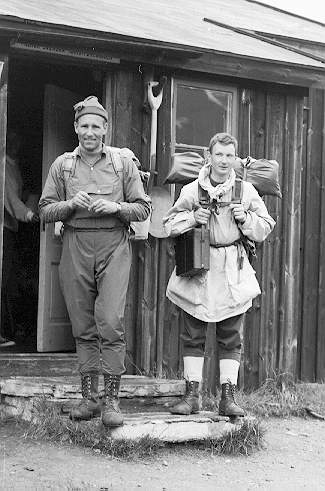
On the way towards the Kaskasavagge wind shelter it began to rain, and when we arrived the rain had increased considerably. The wind shelter consisted of two standard wind shelters with 4 bunks accommodating at best 8 people, if they could share two and two on the bunks. There were already three people before us, and with our group we became a total of 15 people in the hut. On the same route as we were traveling there were also two men, a newly graduated second lieutenant from S3 in Skövde and a Stockholmer from 4H. When they saw how many people there already were in the wind shelter, they said that since they had a tent with them they could camp outside, despite the rain. The second lieutenant was well-trained and had a very large backpack; besides that he also had a 16 mm Paillard movie camera with several lenses. We squeezed into the wind shelter and it became quite damp inside. The Kaskasavagge wind shelter is located up on the high mountain and there is no fuel to burn there, and we did not have much opportunity to dry our clothes.
In the wind shelter there were as yet no other hikers, and we thought it would go reasonably well despite the overcrowding. There were 4 double bunks to sleep on, but some would have to sleep on the floor. There wasn't much cooking; in the Kaskasavagge hut (consisting of two connected wind shelters) there was no kitchen or any other heating device; the hut is on the high mountain. We prepared some tea and blueberry soup on the spirit stove we had brought. Sepp and Werner, who were going "on their own" and were not really part of the group, began to find it too cramped and left after the meal; they would go directly to the Vistas hut, where there would be more space since it was a standard hut with a kitchen and drying facilities.
Those who did not get space on the bunks had to lie on the floor, but sleep was accompanied by certain difficulties; however we were so tired that it went fairly well anyway. The wind shelters are not really well thought out regarding sleeping arrangements; the distance from the lower edge of the bunk board to the floor is too small and you cannot turn over when you have half your body under the bed because your hips get in the way. We lay with the lower part of the body under the bunks and with our heads towards the central aisle. Whoever needed to turn over had to crawl out towards the central aisle so that the bunk edge came below the hip area; then the turning maneuver could be performed and the pressure relieved on that side which after a few hours on the hard floor began to feel numb.
Now we thought there were enough guests in the wind shelter, but at around 11 o'clock in the evening two more men arrived. It was our scout, the second lieutenant and his comrade. When they saw how many we already were in the hut, they thought it best to pitch the tent they had brought. At midnight it began to patter against the roof and we could hear that the rain was increasing. At around 1 o'clock at night a timid knock was heard on the door and two men stepped in. It was our officers, and they asked if there was no possibility of getting a roof over their heads. Their tent was about to float away; they had placed themselves in a small depression and now the depression was turning into a small pool. There wasn't much to be done about it; we had to squeeze together even more. We just had to shuffle together those already lying on the floor; there was a little space left between the stove and the water bucket, and we stuffed them in there. When morning dawned there were a total of 18 people in the hut. Jürg had gotten a spot next to one of the Gothenburg girls; she performed a little "strip-tease", put on a really nice negligee, spread out her sleeping bag next to Jürg and with an "I hope you don't mind" slipped into the sleeping bag. We heard some murmuring and in the morning we had two who were holding each other's hands and it did not seem as if they had had much sleep during the night.The rest of the night passed in sleep, except that we had to turn Irene a few times; she snored quite loudly. Irene was very talkative and held forth all day long, especially with Werner. Unlike the others who were teachers, Irene was a journalist, and Dominique said to her in the morning:
"Not enough, Irene, that you make noise during the day, you make quite a lot of noise at night as well."
With our 15 members in the wind shelter in Kaskasavagge along with officers, we have likely set the summer record for the number of overnight guests in a double wind shelter.
Kaskasavagge - Vistas.
It was still raining when we woke up in the cabin, it felt very damp and we stayed in bed until 7:00 regardless of all the disturbances that had passed during the night. After morning coffee we gathered for a photo in front of the cabin and then continued our journey toward Vistasstugan. The ensign, who had a 16 mm film camera, immortalized the departure from the wind shelter and remarked:
- Otherwise they'll never believe us at STF, but now they'll get to see the film.
As for the journey itself up to the watershed, there is really nothing to say; the weather was somewhat raw and we had to keep our rain gear on the whole time. The clothes became damp and it felt somewhat unpleasant. When it started sloping down toward Vistasdalen we got a strong headwind; at the highest point we could lean forward quite a bit without falling. The wind slowly died down, however, and down in the valley it was calm and peaceful—only the mosquitoes troubled us.
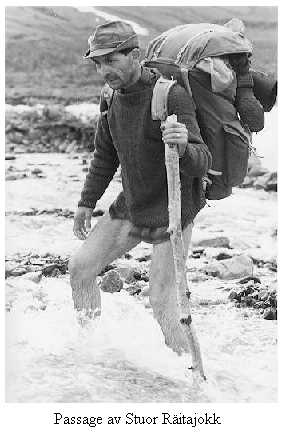
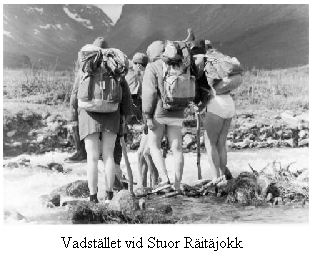
Irene dropped her backpack. After a few hours of hiking we came to Räitäjokk. We found a ford and I carried some of the ladies across. Irene dropped her backpack, but the ford was shallow and the current not particularly strong – the backpack could be saved. Jűrg wanted to throw his boots across and I was not nearby when he was about to do it. The first boot went well, while a gust of wind took the other, and the boot never reached the other shore. The wind caught it, lifted it in an arc, the boot fell in a curve into the jokk and was gone; the current is strong and there is no way to retrieve what you drop in the jokk.
Maybe the boot made it all the way to Nikkaluokta; the Sarri family often finds many articles there, everything that is lost in Unna as well as Stuor Räitäjokk and Vistasjokk.
Jürg had to continue the rest of the hike with only one boot, but he was partly to blame himself—don't throw things in the mountains; the gusts are strong and quickly blow away whatever has come loose. We continued on and toward evening we reached Vistasjokk. It looked like there was a lot of water; I "parked" my group and went across myself to reconnoiter. No one was visible at Vistasstugan, but after a while both Werner and Sepp came out. They pointed toward the ford at Vistas. When I got there, it turned out to be high water; it had rained all day and the water level was high; a ford with the whole group was out of the question.
I shouted to those standing on the other shore that Sepp should throw a rope over to us. Across Vistasjokken there was a cable, but only one, and even that lay only 30-40 cm above the water. I had thought that Sepp would throw a climbing rope, which he had with him, then we would prop up the cable and pull over blankets, axe, and saw to our side. The Swiss are bad sailors and in the strong headwind they could not hear what I shouted to them. Sepp made several attempts to throw the rope to the southern side, but it just rose in the headwind and fell back. It began to get cold, the evening was well advanced and the situation looked somewhat hopeless.
I began to feel the cold and thought that we couldn't just stand there; the blankets, axe, and saw had to get to our side to be able to make a fire and have a decent night. As a tour leader one feels a strong responsibility for one's group and does not want any of the participants to catch cold from having no warmth for the night.
I decided to cross Vistas using the cable that was over the jokk. Now I wished I had been a tightrope walker, then it would have been easy. Straight into the water, I walked as long as it was possible to stand on my feet. But before halfway, the water became too deep; I had to let go with my legs and hang from the cable by my arms only. There was quite a jerk on my arms; the water flows at 4-5 knots and I was wearing the Air Force's jacket, trousers, and boots; these filled with water and offered strong resistance. Summoning what seemed like my last strength at that moment, I swung over to the other side. There stood Werner and Sepp, along with a doctor. They had hot tea for me and said they thought my last hour had come; the crossing looked very strenuous. The return to the southern side was not quite as dramatic but more strenuous; I tied a loop around my waist and hooked one of Sepp's carabiners onto the cable. The idea was that Werner and Sepp would hold the cable up so that I could cross without having to go into the water. The beginning went quite well; I hung from the cable with arms and legs. At the middle of the jokk, the line slackened heavily and my back touched the water. Now it was just as well to let go of my legs; otherwise, I would have gotten wet all over the body. I hung by my arms with the help of the carabiner. The friction against the cable was great, and it was much harder and heavier to move along the cable than when I hung by my arms alone.
Well, everything is possible even if it sometimes seems hopeless. I made it safely across, and then the work began of passing over blankets, axe, and saw. It took three trips before we had enough equipment; then we had the heavy work of carrying the blankets to the campsite about 400 meters south of Vistasstugan. There we built a good fire, partly to keep the mosquitoes at bay and partly to be able to dry our clothes and have warmth for the night. My clothes, the Air Force work jacket and trousers, were wet up to my waist and I changed. In the meantime, my ladies had managed to prepare food and we finally got some peace. When I came with the last load of blankets, the camp had gained two new members: our acquaintances, the officers from Kaskasavaggestugan. They had also been unable to get across Vistasjokken and now set up camp with us. When they saw our situation, they offered their tents to the ladies, but not everyone fit; Dominique and Yvette had to sleep under the open sky. These two girls were ideal fellow hikers; they managed everything without complaining, both the fords across the jokks and the cooking and the other chores one has to do in a hiking group.
After everything that had happened during the day, I was quite exhausted. The military men now had no tent to sleep in and when they saw my situation, they offered to keep watch by the fire so that I could get a full night's sleep. The weather had cleared somewhat and it looked like it would be a light and rain-free night. I rolled myself up in my sleeping blanket and slept until 4:00 in the morning, but the sleep wasn't very deep. Sometimes I felt as if I had been awake the whole time; I heard the conversations during the night, but still felt sufficiently rested in the morning.
The day before had been filled with trouble and considerable exertion; now we received a rich reward as the sun rose. The sky was perfectly blue and clear, the sun rose like a great fireball and my fellow hikers awoke to a fabulously beautiful Nordic morning. After having boiled coffee, eaten breakfast, and admired the mountains for a while, it was time to carry all the "bedding" back to Vistasstugan and begin the hike toward Nikkaluokta, from where we would return to the more civilized regions. The water had receded and there was no difficulty at all with the ford.
During the journey, Werner told of his troubles after they had left us in Kaskasavagge. They were three men hiking on their own and went ahead of us. It always takes a considerable amount of time to get a group ready for departure and I had 12 people in my party, so we fell somewhat behind. The weather conditions in the morning were also such that they weren't particularly inviting for hiking. Werner, Jürg and Sepp had had some difficulties with the crossing of Stuor Räitäjokk. Sepp, who was semi-professional, did not manage the ford; you don't practice such things in Switzerland, he had fallen in with his backpack on his back and had great difficulty getting back on his feet again. The ford was done in sports shoes; the boots were strapped to the backpack, but it turned out that one boot was now missing, the backpack was wet, and all the banknotes and other papers were soaked through. Inside Vistasstugan, they had to rig up a clothesline and hang their 100-franc notes to dry over the stove. To avoid losing the boots as Sepp did, Jürg was going to put on his sports shoes and throw the boots to the other shore to avoid dealing with them during the ford. The mountain winds are, however, unpredictable, and when Jürg's boot was in the air, a gust came and pushed it down. The boot landed in the jokk and was lost. Now they had one boot each, fortunately for different feet and they could use this mismatched pair of boots one at a time. They didn't look the same, but the size was roughly the same, and for the rest of the trip they alternated wearing these boots while the other trudged along in a pair of sports shoes.