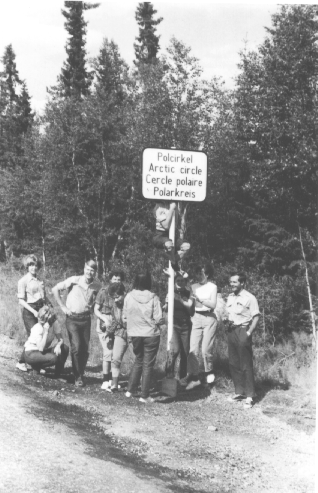
”Wandergruppe Narvik 1969”
Kvikkjokk-Porte-Aktse-Sitojaure-Saltoluokta-Ritsemjokk-Sitasjaure-Skjombotten.
Béatrice Bechir
Lucia Dall´aqua
Erika Engler
Rosmarie Frueh
Birgitte Feer
Barbara Grimmer
Marlis Meyer
Doris Mueller
Regine Schmid
Ingrid v. Schmidt
Evy Wettstein
Maria Kronberg
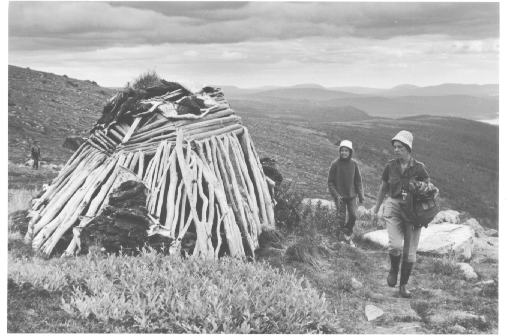
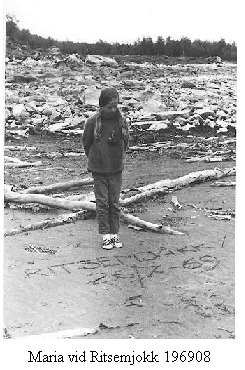
On Saturday the 19th of July we arrived at the station Murjek and continued from there by bus to Lapland's Paradise Kvikkjokk. On the way we passed the Arctic Circle, stopped at the sign and took some pictures. The next day we spent in Kvikkjokk and made a visit to the 804 m high Snejrak. Tomas, who usually came along, was to do summer work between his studies in upper secondary school and couldn't join the hike. Maria was 12 years old, a good hiker and willing to come along to Lapland. The condition was that Ludde, her stuffed animal, would also get to come. I had sewn a number of backpacks for the family, but they were all still too big for Maria. At Studsvik an aluminum frame was made (with Kent Johansson's and Lennart Ekholm's kind help), I got to sit down at Ann-Marie's sewing machine and make a backpack adapted for Maria. Ludde was to come along, "he" also wanted to see the mountains. So that Maria wouldn't carry him all the time, Ludde got his own pocket in the backpack. The pocket had a lid so that it wouldn't rain on him, but no disturbing closing strap, he was to keep watch on the path behind.
On Monday we started our regular hike that would stretch all the way into Norway, to Skjombotten on the North Sea. The section Kvikkjokk-Porte goes through lowland with lush vegetation, there are quite tangled groves one passes through As usual, most participants were female and some had not much experience with hikes. Footwear is one of the most important factors on the hike, here there could sometimes be certain problems. At the start I used to urge participants to watch their feet, at the slightest beginning of chafing they should report this. We used to stop and check the feet and take any measures to prevent foot injuries. Most participants in this group were teachers and used to speaking up, but one lady apparently did not dare to do so. When we had hiked for half a day on the way to our first overnight stop at Portestugan, one of the fellow hikers, Lucia Dall'Aqua, came and said that her friend Rosemarie Früh had gotten chafed feet. I went to her and looked at the injuries, they were noticeable, but the skin had not yet come off and there was hope. Initially we tried to prevent further spread of the chafing by wrapping her feet in a pair of foot cloths (which I myself use on hikes). It didn't help, her boots were too rough and the chafing did not diminish. Fortunately the weather was kind to us, it hadn't rained for a while and the trails were quite dry. What to do? No turning back, the group had to follow a certain schedule, the overnight stays were booked and we had to be there at a certain time. Rosemarie had to pull out her indoor shoes which turned out to be a pair of small, pretty gold sandals. Incredible as it sounds, she walked practically the entire hike in these footwear. Where there were depressions and too wet, I took her under the arm (she was small in stature) and the backpack under the other. Once on dry land she could continue again in her gold sandals. . This caused both amusement and a certain envy and one of the participants said:
- Ich bin auch blond und blauaugig.
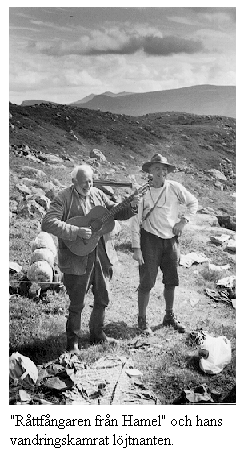
On the way to Aktse hut we stopped at the height and sat down to have lunch. A while later we saw a couple of men hiking towards us and already from a distance I got the impression that one was an officer. The other was bearded and carried a guitar. We invited them to our lunch and noted that they were Germans. One turned out indeed to be an Oberleutnant, while the other was an artist. It became a long lunch, with music, stories and discussions. The artist was from Hamel and was instantly dubbed "The Pied Piper", in accordance with the classic tale, and later I received a large thank-you card from him for the kindness shown. On such hikes it is the leader who decides who is invited to the party.
I am still in correspondence with Rosemarie. She has for many years been an editor at the newspaper Ostschweiz, we usually meet and a few times she has invited me to dinner when I am in Switzerland with or without Ann-Marie
When the extended lunch break was over we continued our hike down into Rapadal and were picked up by …. Länta with the boat over to the Aktse huts. According to information, Länta had lived there for a very long time. He was married to an Estonian lady, she had come strolling on the Kungsleden, become acquainted with Länta and stayed with him forever. It got late before I went to bed, Läntä had much to tell from his many years in Lapland.
We left Aktse and arrived in good time at Sitojaure hut, where we spent the night and had a pleasant evening by the fire. The hut is located in lowland and there is plenty of fuel. In the high mountains wood is scarce, the wood that is transported there should be used very sparingly so that it does not happen as a few years ago at Akka hut. A group of German scouts from Berlin were playing wilderness life, made a large fire outside the hut and burned up the entire supply for the following summer. The wood was transported to the hut by sledges in winter and cost the Tourist Association a lot of money.
Next day we continued and arrived at Saltoluokta Tourist Station. At the station the situation was somewhat more "modern", with opportunities for this and that that were missing in the huts. Sauna bath, a dinner, sleeping in real beds with sheets and eating at set tables and an opportunity to have a beer with the meal.
Unfortunately we do not serve any alcoholic beverages here.
This surprised Marlis greatly:
- That is just what I would so badly need something strengthening. The following day we took the boat across Akkajaure, landed in Ritsemjokk and would continue our journey further towards Sitasjaure – a distance of 25 km – one of the longer stretches on the Kungsleden.
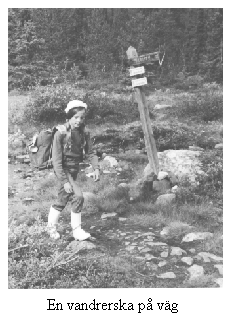
Marlis Mayer from Ebikon I remember well also for other reasons. During the hike it became clear that she was not a great hiker, this was her first venture in the "hiking business", and not entirely problem-free. Compared to the others, more experienced hikers, she had quite poor condition and mostly came a bit behind the others. One could well say that she sort of dragged herself along the trails, it looked strenuous and I sometimes felt sorry for her. When she arrived at the hut she disappeared to the washroom and was gone for a good while, but the world lady who came out of the washroom was by no means a tired hiker, no, out of the washroom came a "grand dame", spiffed up and ready to show herself in all her splendor.
Her packing was quite small, but it contained a sufficient amount of thin blouses and other female accessories to strongly impress the surroundings. The other Swiss women were usually quite "tame" creatures and had what was really needed for a mountain hike, but not Marlis. When she came out of the washroom she sat down on a chair, pulled out a cigarette and lit it with a smooth motion. During the hike it emerged that she was "Kathederin", i.e., a teacher of Christianity. At home in her normal somewhat strict environment she did not dare to blossom. She told that she would occasionally run into the toilet to take a puff (out of sight of the pastor). It was also she who upon arrival at Saltoluokta went to the counter and asked to be served coffee and brandy. The girl at the counter just stared, she had surely never heard anything like that before. I had to step in and explain to Marlis that unfortunately she could not count on any brandy at the STF station. She was as surprised as the girl at the shop, could one really not get a brandy now - when she so badly needed it? The tourist stations did not yet have any wine licenses, it was only sometime in the 1980s that the stations got the opportunity to also serve wine.
On the 1969 hike we started from Vietas, after the road had been extended there for the expansion of the Suorva dam, continued by boat to Ritsemjokk. In Ritsemjokk we stayed overnight and slept in Vattenfall's tents. Ritsemjokk had been transformed into a construction site and on the way up there were both work barracks and construction machinery. There would be a water tunnel from Sitojaure to the dammed Suorva dam. Part of the mountain-near forest had already been cut down and the shores looked anything but appealing – with half-rotten logs lying at the water's edge.
The hiking trail Ritsemjokk-Sitojaure is about 25 km and partly goes along Sitojaure's western shore, its narrow part. The shore consists of small ridges from the Ice Age, these are oriented northwest-southeast and during the hike one passes many of these. When you reach Sitojaure's southern tip you see the huts on its northern shore and think you will soon be there. In the clear air everything seems much closer, but you are sorely mistaken. It becomes several hours of hiking before you arrive. For each ridge you pass you think you can see the hut after the next height, but the heights follow one another seemingly without decreasing and it takes a long time before you arrive.
Sooner or later, however, you arrive and will settle down for the night. Before that, there is a lot to do, because during the 1960s there were no cabin hosts in every STF cabin. The hikers were divided into three groups and the cooking group started preparing dinner. As a guide, you have to make sure there is water and firewood. The weather had been rather misty and everyone felt somewhat sweaty. Maria was in the "washing age" and was constantly washing her underwear. We walked a bit along the lake and decided to take a dip to freshen up our bodies. Off with the clothes and into the water. It became one of the fastest baths. I was out quicker than quick. The water was only a few degrees and after the dip I was freezing for a whole quarter of an hour before my body temperature evened out. The same was true for Maria.
After the bath, I fetched more water and chopped wood for the next day. The food was almost ready and before I went out I told the group to start eating. When I came back with the water, the group was well seated around the table, the food was on the table, but no one had touched anything, but as soon as I sat down and took up my cutlery, the others also started eating. The Swiss are polite and wait for the "pater familias" to begin.
From the Sitojaure cabin, the journey continued by boat across Lake Sitojaure and all the way into Norway. Then one continues again on foot over the watershed and the border between Sweden and Norway. Shortly after we had debarked the boat and put on our backpacks, we passed a small lake and Maria asked what the lake was called. I had the map in my backpack and told her that she would find out at the next rest stop. This angered Maria to such an extent that she passed the entire group and walked briskly ahead along the path. I called to her that she should stick to the markings and that after a while the markings would change colour and instead of blue-yellow marks there would be red-white ones.
About an hour later we met Maria and she told us that she had accidentally run into a lemming migration and had to climb up onto a large rock to defend herself from the small angry creatures. After a few hours of hiking, we crossed the watershed and could see the North Sea in the distance. The descent to Skjombotten is a rather difficult and steep affair, but when it is dry it goes fairly well. In rainy weather, the descent turns into a slide in mud, the path becomes slippery and difficult to walk.
In Skjombotten we made our way to Nygårds Pensioneat and got food. The Norwegian food consisted largely of all kinds of brown cheese, one sweeter than the other. From Skjombotten we took a small local boat, a lake bus from Ofotens Dampskibssellskap to Narvik, and were lodged at Hotel Royal. Narvik's Hotel Royal left some impressions, unfortunately not of the best kind. For lunch they served lukewarm fried cod. That was a big criticism from the Swiss, they are quite picky and surely one might think that in a country where fishing makes up a large part of the diet, they could have done something better. Before departure, we took a tour of the town and visited the ore loading port.
On the return journey from Narvik in Norway, we stopped for a day at Hotel Lapplandia at the national border. My well-to-do Swiss women wanted to buy some Sami handicrafts to take home, and we waited for a suitable opportunity to make the purchases. It would possibly be in Kiruna at Wennbergs. While I was outside looking at the hotel surroundings, a small elderly woman of unmistakable Sami origin came walking from the station, and I noticed that she had a very beautiful leather backpack. I started a conversation with her and after a short discussion it emerged that she was on her way to the Swedish Tourist Association's kiosk inside the hotel to deliver some handicrafts for sale.
"Wait a moment," I said to her, "I may have buyers for your goods. If you can wait half an hour, I'll gather my fellow hikers and there will surely be some buyers; then you can add a little to the price, but not 100% like STF does." When I had gathered the Swiss women and we went down to Mrs. Ella Rautas from Rautavaara (as the lady was called), she sold almost the entire year's production to the group. The girls had been inside the hotel and seen what prices STF charged for the handicrafts; now they were quick to take advantage of the opportunity for good purchases. Ella's products sold out, and I received a Sami-style tie as commission.
On later hikes (when I came close enough with the group), I always wrote to her to bring the handicrafts, and for the most part she had the same luck with sales. I have five or six ties from her production; they are practically indestructible, and since then I haven't bought any more; those that have been added are gifts from interpreting assignments: Oskarshamn, Forsmark, Studsvik and the Nuclear Power School, Volvo-Bolinder, etc.