Hiking in Northern Finland 1971-07-13 to 08-03
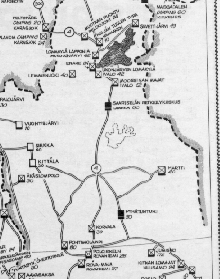
Unlike mountain hikes in northern Sweden, the Swiss would hike in Northern Finland this year, starting from Saariselkä Retkeilykeskus (Saariselkä Tourist Centre). My fellow hikers arrived at Arlanda at 09.00 and we went to Stockholm to prepare for the onward journey north. We had the whole day in Stockholm, took a bus tour to see the city, and continued at 17.00 by train to Boden.
Wednesday 07-14
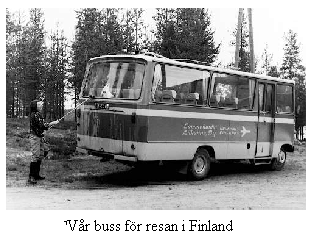
In Boden a small tourist bus was waiting for us. The driver also had his brother-in-law with him, so it was a proper reinforcement on the male side. We continued by bus towards Finland and after about 20 km we stopped to look at a large dam on the Kemijoki. It was not every day one had the privilege of seeing a construction consisting of so many logs. The next stage took us to the capital of northern Finland, Rovaniemi, where we made a somewhat longer stop and visited the hill Ounasvaara. In the afternoon we continued and within 2 hours we had arrived at the holiday village Jumisko, where we stayed until Monday the 19th of July, getting acquainted with Finnish conditions, taking saunas, and making excursions in the immediate vicinity, including Finland's highest mountain - Pyhätunturi. The weather was dry and I wasn't wearing any boots; I slipped in my shoes with leather soles and it was very close that I had broken my leg. It made such an awful crack when the shin hit the stone. I had my camera in my hand and couldn't catch the fall. Now I got away with a bruise and pain for a couple of days.
Saariselkä Tourist Centre served very good food and I asked the hotel staff if they always had such tasty dishes.
- No, perhaps not quite as high a standard every day, but the hotel manager had worked in Switzerland and knew that the Swiss were quite picky, and so she thought she would offer something extra nice.
Thursday 07-15 Jumisko holiday village south of Kemijärvi.
From Saariselkä Tourist Centre the journey continued to Jumisko Holiday Village. We were to stay in the holiday village for a few days: partly so that the Swiss would have the opportunity to get acquainted with Finland, and partly to make some minor hikes in the area. The holiday village consists of a number of picturesque cottages and we were lodged in these – the gentlemen separately and the ladies separately. On the gentlemen's side we were not so many: myself, Karl Schaffer, and the bus driver and his brother-in-law Eero.
Friday 07-16 Excursion
We set off towards Lake Jumisko, a hike of 3-4 hours, a hike that went through Jumisko church village and looked at some of the old buildings that had survived the war when the Germans retreated from Northern Finland at the end of the Second World War. Reconstruction had proceeded quite quickly; there weren't many traces left from the war, but then again the Finns are known for their diligence and perseverance. The Finnish 'sisu' has a certain significance. The journey continued towards one of Finland's fells, Suomuntunturi (408 m above sea level). The Fennoscandian mountain range drops off towards the east and the heights of the fells decrease as one moves eastward. The ascent of the fell went without any difficulties; for the Swiss such a height is almost nothing, they hardly notice it, so accustomed are they to real altitude variations and difficult climbs.
Well returned from the excursion, we took the opportunity to take a sauna; it is almost mandatory during hikes in Finland. The Finns themselves absolutely cannot live without a sauna; in summer they bathe diligently several times a week. The Finnish saunas are almost invariably located by a lake or other body of water, and that was the case also in Jumisko. The driver and Eero were proper sauna bathers; they threw plenty of water on the sauna stones and it became almost too hot for me, but in Finland one must endure even if steam comes out of one's ears. After the hot steam in the sauna it was nice to throw oneself into the cool lake water and cool down the overheated body. When it was time to go to bed, there was no difficulty falling asleep.
Saturday the 18th of July.
After breakfast we set off by bus via Jumisko - Karhujärvi - Hautajärvi towards the well-known hiking trail 'Karhunpolku' (The Bear's Path). It became a somewhat more strenuous hike than the day before; the trip was supposed to take 5-6 hours, but an incident occurred that upset the plans most considerably.
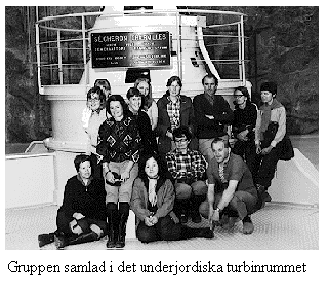
During the hike we were to see a power station located deep underground. The area is quite flat, but there are some heights and from these they take the opportunity to collect water in the lakes above during the summer. The power station was several tens of meters underground and we entered the generator room through a service tunnel with a rather steep incline. The air down there was somewhat musty; the station had not been in operation for several months and the ventilation was turned off. The driver's brother-in-law Eero was not feeling well, and both he and the driver went up to the bus ahead of us. After a few minutes the driver came running and said that something was wrong with Eero; he had had difficulty coming up along the steep tunnel and upon reaching the bus he had thrown himself onto the seat completely exhausted and was breathing with great difficulty.
We rushed up and got to feel the difficulty of running uphill in such a steep slope as the tunnel. The gradient is usually 1:7 and it felt properly in both lungs and legs before we had run the 75-100 m up to ground level. When we finally reached the bus, out of breath and with lactic acid in our legs, Eero was lying down on one of the seats and looked somewhat blue in the face. Now good advice was expensive.
There was no medically trained person nearby; the only thing I knew about first aid was that one should give artificial respiration. Images from lifesaving drills with 'sister' Tore at the Military Interpreters' Källviken camp came to mind. I tried to help Eero using the mouth-to-mouth method, but it seemed to have no effect. Since we were uncertain how the situation should be handled, we decided to head for the hospital in Kemijärvi. It was, however, nearly 30 km away – on a rather bad and bumpy road. By this time the other participants had also come up from the power station tunnel, and we started the journey. During the trip I used both mouth-to-mouth and tried to beat on Eero's heart at regular intervals, but I could not get his breathing started. We did not feel any pulse.
When we arrived at the hospital in Kemijärvi, the doctors took over our patient and gave him electric shocks, but life could not be saved. The time between the heart attack and our arrival at the hospital was too long.
It was with somewhat subdued mood that we returned to Jumisko Holiday Centre; such incidents are always sad. So far I had avoided all such incidents on my tour guide trips with the Swiss.
To overcome the sorrow caused by what had happened, we decided to take a sauna. The sauna has an extraordinary healing ability when the mental state is at low ebb. We bathed in the steam, but not as intensely as the day before, swam in the lake and threw a pilsner bottle into the water – in memory of Eero. The next day the hospital informed us that Eero had had a weak heart, and the bathing the day before had certainly not been good for him.
The driver and the bus were to wait for us during our 5-6-day hike in Northern Finland. Then he was to drive us down to Kuopio from where we would continue by boat towards Savonlinna for further travel by bus to Helsinki, but now we had to change the plans. Since my driver's license was valid for all vehicles, we agreed that the bus would be left in Northern Finland and the driver would go with the hearse down to Tampere, where the deceased belonged. I would take the hikers with the bus to Saariselkä and carry out our hike according to the original plans. Then I would drive the bus down to Kuopio, let the travel party take the boat to Savonlinna and meet them there.
Kiilonpää - Suomunruoktu, 15 km
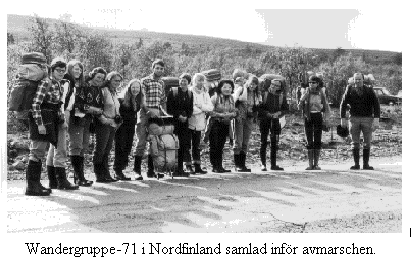
So it was time to leave the comfortable existence, put on the hiking boots and backpacks. The next overnight stay would be somewhere else, and I knew it would not be as comfortable as in the Swedish mountains. The start was from Kiilonpää and the day's stage was to extend to the wilderness cabin Suomunruoktu in a southeast direction at a distance of 15 km. It turned out to be fairly easy terrain, but there were no signposts or cairned trails as in Sweden. The hike was by map and compass and sometimes it felt a bit nerve-wracking; it would have been annoying to miss the cabin and be forced to spend the night with the whole group out in nature. We did not have resources with us for such adventures. When the staff in Saariselkä found out which route we were taking, they warned us laughing:
- Make sure you navigate correctly, it's close to the border and if you get lost, the return trip could be via Moscow. It has happened before.
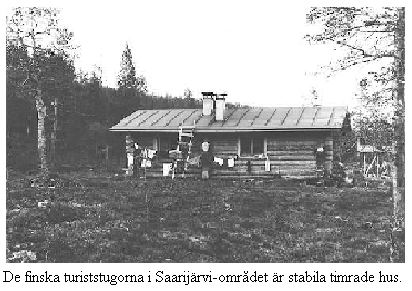
The journey went well and the compass showed correctly, at least correctly enough that we found the cabin without major difficulty and went in for night lodging there. It was always some use from the orienteering competitions I had participated in at the Källviken camp during the summer courses for military interpreters. The Finnish cabins lack all amenities; they are usually just a single room with 12-15 bunks equipped with reindeer hides instead of blankets. Cooking was done outdoors on a brick fireplace, so we did not need to use our alcohol stove.
Suomenruoktu - Tuiskuru, 12 km
The day's stage extended to the cabin at Tuiskuru and it happened without any major adventures; it was just a matter of keeping the compass heading as correct as possible. Here too, cooking had to be done outdoors, and afterwards it was quite a lot of effort to remove the soot from the food containers.
Tuiskuru - Luirojärvi, 10 km
The third hiking day began with a long ascent towards Ampupää and then the hike continued to the southern shore of Lake Luirojärvi. At its southern tip there were a number of tourist cabins with some service and opportunities for a sauna bath; by now we felt we were in need of a cleansing procedure. The day's stage was relatively short, and with experienced hikers like the Swiss, it did not take many hours to reach the day's goal. Since there was much of the day left, we did an additional hike. Nearby is the mountain peak Sokosti (717 m above sea level) and we climbed it to see the surroundings. We were told that in good weather we might be able to see into Russia with binoculars, or at least their watchtowers on the other side of the border. Now the weather was not such that we got to see any, but that was not the main point either.
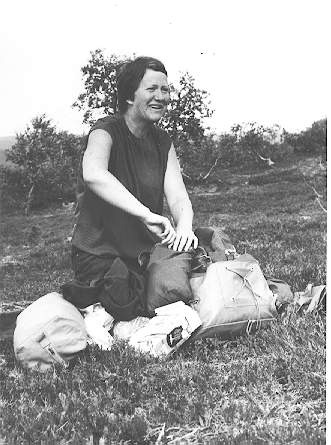
One of my "faithful" hikers was Hildegard Höhl, a German who had been living in Switzerland for many years and a very eager hiker. She was in very good shape and usually ran ahead of the others. This annoyed some of the other participants, and they decided to play a prank on her by putting a number of stones in her backpack to curb her excessive zeal. Since it was a short excursion, most of the usual contents were left in the cabins and we brought only the essentials and rain gear.
The extra weight did not seem to have any braking effect on Hildegard; she ran up most of the way, and once at the top of the fell, everyone waited with great anticipation for Hildegard to open her backpack. She was somewhat surprised and admitted that she thought something was wrong with her condition—her backpack should not have been that heavy. From then on, she always carefully checked her backpack to make sure no one had played a trick on her.
At Luirojärvi there were several cabins and quite a few people. We sat at the same table as a Finnish nurse. She had developed pain in her knees and was not going to continue; she had been forced to walk for two days with the pain and did not want to risk tormenting herself all the way to civilization. She had sent for a plane and was going to fly back to the Saariselkä Tourist Centre the next day. There were also two Germans, and one of them had caused himself a wound at the dinner table. The Finnish woman wanted him to fly as well to get the wound bandaged, but the German insisted on staying. I talked to him and found out how this "self-mutilation" had occurred.
He had been sitting at the dinner table with his provisions and was about to spread butter on his bread. Somehow, the knife, a double-edged dagger, fell, and like any man, he made a reflex motion and clamped his knees together to catch the knife. As it turned out, he thereby stabbed himself in the thigh, and according to the Finnish woman, it was a very deep wound. The Finnish woman pointed out to the German that the knife was not clean and that there was a certain risk of inflammation; she had cleaned the wound as best she could and recommended that the German come with her on the plane to the doctor the next day. Considering the cost, however, the German did not seem inclined to fly back but intended to continue his hike.
In Luirojärvi there was a sauna, and it felt natural to take a sauna; even Karl started to get used to it and gladly joined. It was not difficult to accustom the Swiss to the use of the Finnish sauna. At first it was done with reduced heat, but after just a couple of sauna baths they usually stayed almost as long as the bathing Finns.
Luirojärvi - Sudenpesä, 15 km
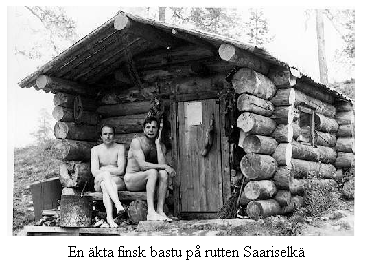
We left the Luirojärvi camp and headed straight north to the campsite Sudenpesä (Wolf's Den). The terrain is hilly but easy to walk, and our journey progressed quite quickly. Over the watershed we rounded the height Vaulopää and found our overnight cabin next to the springs of the brook Solvusoja, a small brook that flows into a larger one named Harrijoki.
Sudenpesä – Lankojärvi
Along the southern slope of the height Kaarnepää we reached on Sunday the Sotanvaaranjoki and waded across it to its western bank. The hiking route gradually curved westward, and we arrived at the lower part of the Suomujoki, where our overnight stop was located with the possibility of taking a sauna, which of course was used by most, even by those who had not previously bathed in the Nordic manner.
Lankojärvi - Taajostupa, 15 km
The day began with a river crossing of the upper part of the brook Kulasjoki, and we followed a short stretch along this river up to its source, where we took a rest in a small hut, Rumakuru. From here the journey turned north into a valley. From Taimenlampi the ascent towards Lankopää begins. We pass its height in a west-east direction and come to Kulasjoki on a slow upward journey. There we have our cabin Taajostupa.
Taajostupa - Saariselkä, 11 km
It is our last hiking day and a rather short distance at that. By now we had good practice, and the journey went without any incidents. We were back in very good time, took a sauna, and got to enjoy Saariselkä's good cuisine again.
Saariselkä - Uleåborg - Kajaani - Iisalmi - Kuopio.
After an early breakfast we got on the bus for our return journey to southern Finland, and by noon we had reached Kajaani. The journey went across the Finnish highlands through large forests on a plateau. The Swiss marveled at the number of lakes and waterways they saw in Finland, the "land of a thousand lakes." They also marveled that one could drink from all the lakes and waterways. In the Alps you cannot do that, not even at higher altitudes. In the North you can drink from every tap; in Switzerland I have seen many taps, even up in the mountains, with the sign "Non-drinkable water." The settlement in that part of Finland is not particularly dense, and most of the road wound through forests. In the afternoon we reached Kuopio, the capital of Eastern Finland, a city located within the Kallavesi lake system. We had a few hours left until dinner and took the opportunity to visit the hill Puijo. After the war, when we were quartered in the regiment's regular barracks in the Niirala district, we often skied on Puijo. It was almost immediately adjacent to the barracks and easily accessible. At the top there was a café where one could get both hot and cold cordial. The old brick observation tower was gone; instead there was a TV tower with a revolving restaurant at the very top of one of the floors.
I also took the opportunity to visit the barracks area and look at the building where the military band had its quarters. Everything seemed to have shrunk; I remembered, for example, that the arsenal building at the parade ground was a very large building, but now it did not give the same impression at all. The buildings had assumed completely normal proportions.
Friday, July 30th.
After breakfast at the hotel, I drove my passengers to the harbor where they were to take the boat to Savonlinna. The original intention was that I would travel with them, but now, due to the death that had occurred, we had to make a change in the program and send the Swiss themselves to Savonlinna, while I would drive the bus there.
Saturday, July 31st
Before we were to begin our journey towards Helsinki, we took the opportunity to visit the castle Olavinlinna (Nyslott), built by the Swedes in the 18th century. It is a mighty castle standing on a few small islets and was previously accessible only by boat. After visiting the castle, we continued along the almost 7 km long isthmus - Punkaharju, a real tourist experience. You drive for several kilometers with the lakes only a few meters from the road.
The rest of the day was spent traveling further towards Helsinki, but we made a short stop in Imatra, where we looked at Finland's largest waterfall. Finland is quite flat and there is not much hydropower. From one spot along the road we could see the Russian watchtowers, and it was said that tourists liked to photograph them. The Russians did not like this and had demanded that the Finns confiscate the photographers' film. Upon arrival in Helsinki, it was time to take possession of the rooms at Hotel Academica.
Sunday, August 1, 1971
We had the whole day at our disposal, and it included both a bus tour through the city and a visit to the Russian Orthodox church - Uspenski Cathedral - on Skatudden. I did not have to act as both tour guide and driver; the bus company provided us with a new driver as soon as we had returned to Helsinki.
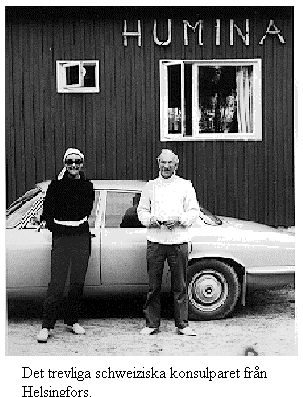
At Jumisko Tourist Centre there was a car with diplomatic plates, and while we were looking at it, a couple came up and started a conversation with us. It turned out to be the Swiss consul and his wife, and since we were to be in Helsinki on August 1, the Swiss National Day, he invited us to a cocktail party at the fortress Sveaborg (Suomenlinna) in Helsinki. After all the hikes and sightseeing tours, it was time to rest for a few hours and have some food at the hotel, then we headed to Sveaborg and the invitation. The entire Swiss colony was gathered at Sveaborg, and there the Swiss got to look at their country's flag and yodel to their heart's content. On the occasion of the national day, both kirsch drinks and other Swiss specialties were offered.
Monday, August 2, 1971
Now not much of the trip remained. At 11:00 the bus was ready to take us to Turku for embarkation on a ferry bound for Sweden. We spent the afternoon looking at Turku Castle and the Handicraft Museum. At 19:30 it was time to take our cabins on the ferry and visit some bar on board.
Tuesday, August 3.
The travel group did a tour of Stockholm, and it was time to eat a joint lunch at the Central Restaurant. Ann-Marie and the girls had come up to Stockholm, and Katarina was very interested in the participating Swiss women. Afterwards we could note that she could identify every single one of the women: some by their clothes, some by jewelry, etc. Children have a good memory before they start school; then that feeling disappears and it becomes much harder to tell who is who. At 12:00 it was time to say goodbye and ensure that the travelers got on the Arlanda bus for further transport to the Zurich-Kloten flight.