The Health Exhibition in Moscow 1974
Soviet began to open up more and more to the West as the years passed, and a faint thaw began to appear again after Nikita Khrustjov's era had receded somewhat into the background.
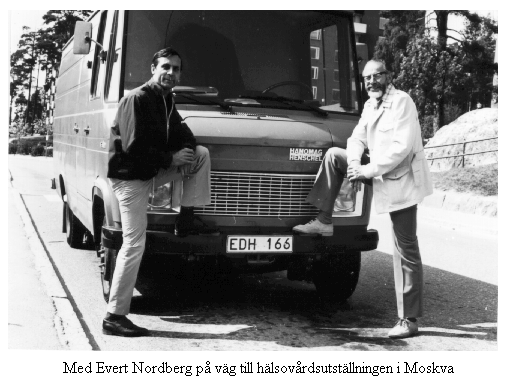
PIn the spring of 1974, an international health exhibition was to be held at the Sokolniki exhibition grounds in the heart of Moscow. Studsvik was also interested and there was a lot to show; bone density meters, Gandalf scanner, the 400-analyzer, several instruments for measuring activity and a memory oscilloscope. Sales manager Bengt Svensson asked me if I wanted to translate the brochures and then work for three weeks at the exhibition in Moscow. I worked hard on the translations and it became a really neat booklet about devices for measuring radioactivity to take to the exhibition in Moscow. Evert Norrhäll handled the organizational matters, the information secretary "Solan" handled the other threads, and after some hard work, Evert and I set off in a 7-ton box truck filled with equipment to the Soviet Union. Already in Stockholm we almost collided with a small car, one of those insect-like types with antennas and peculiar headlights shaped like eyelids. We should have sprayed DDT on it, but we didn't have any with us at the time. It pulled up to the right of our side next to us when we were about to turn, and it was more by luck than skill that Evert managed not to crush it; we might not even have noticed.
The journey went by ferry to Finland, then to the border station Vaalimaa and the first stop for an overnight stay in Russia was Leningrad, where we were to check in at the hotel "Leningrad". We found that out at the border; one could not book a named hotel in advance in the Soviet Union. In some respects, the "Soviets" haven't had much imagination. The hotels in Leningrad were usually called "Leningradskaja", "Moskovskaja" or something equally nondescript. The Moscow hotels were the same. A little later they took heart and named the newly built hotel in Viborg to "Druzhba" (friendship) – also a somewhat overused word. "Druzhba" was a hotel, chainsaws, and much else. As a hardly surprising variation, they sometimes called things "Mir" – peace (the word also symbolizes the world).
Now it was the hotel "Leningrad" that was for us. It is located on the western bank of the Neva, near the railway station and the armored cruiser "Aurora", which according to legend fired a shot from its cannon to mark the storming of the Winter Palace and the beginning of the revolution. Later research shows that most of the stories were fabrications, just like Eisensteins "famous" film. On all the fleet visits I participated in between 1960 and 1981, it was never possible to find any sailor who had been assigned to the "Aurora"; they were all shot during the second revolution, on the ice in front of the Kronstads fortress in 1922. By then soldiers and sailors had realized what the Soviet Union was about and made a renewed uprising – but too late.
We checked in at the hotel, but it turned out that we were by no means to stay overnight there; it was only a place to register to get further information about night accommodation. There they knew nothing at all about our arrival, and only after some discussion were we referred to the hotel center at the hotel "Astoria" – a venerable hotel designed by a Swedish architect at the beginning of this century. Customs and border control had taken their ample time, and it was long after midnight before we could finally go to bed after getting some food at the hotel. We parked the car in front of the hotel, in a parking lot guarded by the militia.
The next day we had 715 km ahead of us to Moscow. The Russian roads have never been classifiable; such low numbers do not exist for the European main roads, and the Leningrad-Moscow stretch was no exception. In principle it was the old village road, here and there reinforced with some asphalt, and intended mainly for transport with "telegor" - the Russian peasant carts. The roads have no foundation; the asphalt was mostly laid directly on the sand, and after a number of passing cars the road turned into a shaking table, like the one I worked with at Nordiska Instrument when we tested the durability of anti-aircraft sights. The predominantly part of the vehicles were state-owned, and one might have thought that the state would have some interest in keeping the roads in good condition to reduce wear on the means of transport, but it was not. At least varje 50th kilometer there was also a queue of militiamen, they coontrolled the traffic only from an administrative point of view.
If the roads were bad, the monuments to the revolution and its leaders were all the more massive. On the approach to Leningrad, there stand in a curve five 1x1 m concrete pillars with a 3 m high letter on each pillar: L..E..N..I..N. The pillars stood in a curve and some looked a bit scuffed; presumably several cars had gone off the road in winter conditions and been received posthumously by Comrade Lenin. They did not think of the road users' safety first. On a visit to Sweden, a Russian was surprised at the lamppost constructions on the highways (truss structures) which in his opinion were far too weak and would break on collision with a car. When it was explained to him that it was intended that they should break before the car, he looked somewhat surprised. In the Soviet Union, it was always about saving equipment; that came before the crew. I remember that in some serious accidents, they spoke of the pilot having saved a valuable aircraft at great risk to his life.
With the great corruption, which is possible only in totalitarian states, many transports took place more or less illegally.
How did it work? A naive Westerner asks. Very simple. The boss, the biggest schemer, needed to get some private errand done and turned to the company's chauffeur.
"That's fine," says "Ivan" (the Russian Sven). "Write out double the mileage, at least!" The bosses were generous with state funds; it didn't directly affect any individual since the money was the state's, and they signed a travel order that far exceeded the actual need. Now the driver had a number of kilometers in credit and could make some extra cash by transporting someone who needed to move or pick something up. For example, there were no moving companies in the Soviet Union; if a family needed to move, they would contact a driver and ask him to transport the goods or belongings. The price was usually half a liter of vodka. In the former Soviet Union, half a liter was the most used hard currency; for that you could get most services performed. On a private trip with my own car to Tallinn, I got a tire repaired for half a liter at a repair shop for city buses; that it didn't last too long was due to the usual Russian carelessness. The Russian had not seen to removing the cause of the puncture; a steel tag was still there when the tire was to be repaired a second time in Finland. For a while, even the leading Russians joked that Soviet cars were the most fuel-efficient in the world; they ran on half the fuel sold to private motorists in the Soviet Union, the other half came from state supplies.
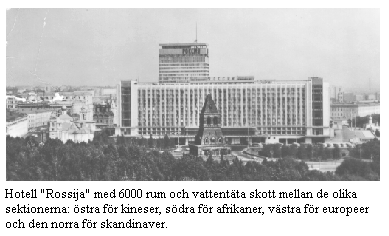
It takes time to drive 750 km, and we did not arrive until late in the evening. In Moscow we were to stay at the hotel "Rossija", not far from Red Square and the Kremlin. Finding the hotel proved not entirely problem-free. The Soviet Union was covered with various signs: "Long live the socialist revolution", "Lenin lives forever", "Peace in the World", "The Communist Party – the brain of the working class" and similar slogans, but no useful signs that would show the way to the hotel – none could be found. Nor were there any maps worth the name. The pitiful sketches that existed of the Soviet cities were often deliberately misdrawn – all to make life difficult for the potential conqueror. That it took infinitely long times even for their own citizens to find their way was of no concern. "Time theft" is something that the dictatorships are masters of; how much useful work could not be performed during the time Soviet citizens had to spend in queues. We ended up on the Sadovoe Koltso (Garden Ring) in the belief that we would get to the hotel that way, but we lost our way. There were no real road maps any more than road signs, and we wandered around for a while. Finally we stopped next to a militiaman and asked him about the hotel. He was a kind man; he told us we were heading in the wrong direction, and so that we could turn around on the Sadovoe Koltso (with a U-turn ban), he stopped traffic and we made a full turn on the main road. For some unfathomable reason we still got lost and passed the same intersection once more, and still in the wrong direction, but it felt a bit too much to ask him to stop traffic again. Eventually we found the hotel, a mammoth building with 6000 rooms occupying an entire block, but several inquiries were needed before we could reach our goal.
The following days were spent setting up the exhibition booth, and we had little time for anything else. To unload the heavier apparatus, we were to hire a Russian crew equipped with a forklift. Formally, their services were included in the participation fee, but it is never that simple in Russia. The men wanted "souvenirs". We had a lot of small items with us, and I offered them pocketknives with the Studsvik emblem, ashtrays and such, but no, that wasn't the kind of souvenirs they meant. Now I began to understand what it was all about and said that then they should get half a liter of vodka.
"Njet, not vodka, whisky!"
I pulled out a 75 cl Johnny Walker and said, "Here you get something to party with tonight." The Russians took the bottle and one of them asked:
"Njet, can we borrow the booth?"
The booth had a small space behind a curtain and four men went in there. One heard the cork being unscrewed and then four gurgling sounds and smacking. The fifth, the driver, managed to abstain from drinking this time. The fellows came out, wiped their mouths and when I went into the booth there was only an empty whisky bottle standing there.
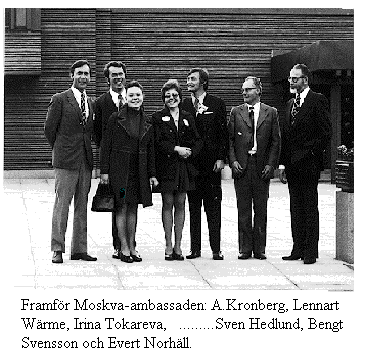
There were many different nations participating in the healthcare exhibition and Sweden had its own section under the auspices of the Export Association, a total of 11 Swedish firms took part, among them LKB, KEBO, Electrolux and others. Interest in the exhibition was very great and there was a steady stream of visitors passing the various booths. Most visitors were professionals, but ordinary Russians also showed great interest in the equipment; gamma scanners, bone densitometers, analyzers and various types of oscilloscopes for medical use.
The exhibition lasted three weeks and various salesmen from Studsvik featured in the picture; Bengt Svensson, Sven Hedlund, Per-Gunnar Sjölin and a few others while Ewert and I were there the entire exhibition period. After a few days, once we became more familiar, we began to take an interest in the surroundings. The exhibition opened at 10:00 and since both Ewert and I are early risers we couldn't stay in bed but set off on strolls. We were going to take a closer look at our hotel and thought we would walk all around the hotel on the floor we were staying on, but that was not possible. Where the corridor made a 90o degree turn, the glass doors were locked. On closer inspection it turned out that in this country, which made so much fuss and propaganda about the equality of all people, there was an extremely strong separation between the different races. We, like all other Europeans and Scandinavians, lived in the northern and western part, the Asians in the eastern and the Africans in the southern. Between them there were watertight bulkheads. It was the same with the restaurants in the different wings; you were not let into the restaurant that was in the Asian wing.
"Everything is taken," said the doorman, but one could see that the tables were quite sparse and the same was true of the restaurant guests. Mostly it was possible to get in with bribes. You pretended to leave, shook the doorman's hand in farewell (with one or a few rubles folded inside) and soon the doorman began to look interested. In the best case he went in through the door, turned in the entryway and came back beaming with joy and said:
"Quite by chance, a table has become free. Please, come right in, ladies and gentlemen!"
The menu in the northern wing covered a couple of pages with all sorts of dishes, but most were crossed out with the note – "sold out for the day", when the day had hardly begun.
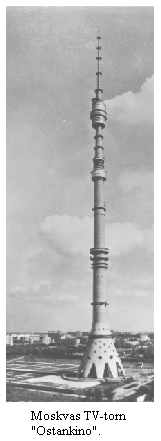
One day Evert and I decided that now we would eat properly Russian. The hotel restaurants had quite Westernized dishes on their menu. We decided that now we would go to the TV tower in Ostankino and try Russian soups and black bread, that was advertised in some brochures.
We arrived at the tower, well protected with barbed wire and guards, paid an entrance fee of 4 rubles and took the elevator to the top - together with an accompanying militiaman. 4 rubles was a considerable sum for a Russian in the 70s. I asked some Russians why it is so expensive and the answer was;
"It cost far too much to build and no Russian will ever visit the tower more than once in their lifetime!"
There was no space in the "golden hall" so we had to settle for being assigned a table in the "silver hall" - one floor further down. We were going to place an order and had planned to start with something truly Russian, some good Russian soup and black bread.
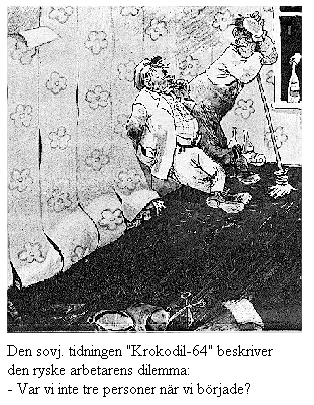
"Khleba net, sopa net" (no bread and no soup), replied the waitress. By then we were quite hungry and Evert had a very short fuse in such cases, he was about to explode with anger but the facts could not be changed.
"Then we'll take some meat dish and vodka with that," said Effekt.
"Vodki net" (no vodka), came the reply, only cognac and "heavenly drink", which turned out to be some kind of raspberry soda in Russian style.
Necessity knows no law, we were hungry and had to settle for what was available, and our perception of the socialist system took a few more knocks.
When the exhibition opened, Bengt Svensson and Sven Hedlund and PG Sjölin came and we were five men riding in a Mercedes van's three-person seat. It was a bit too many legs, so many that from the driver's seat it was impossible to reach the gear stick. With good cooperation, however, everything can be arranged and we solved the problem in our own way. I drove most of the time and the gear stick lay two knees further away. The cooperation consisted of me giving commands to the third man to my right, he got to be the gear shifter. When I had pressed the clutch the command was:
"First gear in,..... now!"
After the next press;
"Second gear in, .....now!"
In this way we climbed up and down the gears and after some practice it worked quite well to drive.
Moscow was one of the "hero cities" and for motorists there were some extra rules; among other things, you were not allowed to drive around with a dirty car, otherwise you would get the militia on you. On a trip between the hotel and the exhibition our car was stopped by a militiaman and he pointed out to us that the car needed to be washed. When I asked where I could do that because I hadn't seen any car washes, he became thoughtful, he couldn't say where one could perform such an obvious action in the West. After a moment's thought he recalled that there was supposedly a possibility to wash the car somewhere on Warshawa Road. When asked how far it might be, he replied that it was probably about 10-15 km, absolutely no more than 30 km. At the next convenient opportunity I set off to the washing place. After a lot of searching I came to a place where washing could be done. I was directed to a wall with a water tap and a hose about 4 m long. As a wash brush there was an old, almost completely worn-out broom. I put on a white Studsvik coverall and soon a few people dressed in old suits gathered and wondered if I wasn't afraid the coverall would get dirty. At my answer that the coverall could be washed, they just shook their heads in astonishment.
With a hose barely 4 meters long it is not possible to wash the whole car at once, so after washing the front part it was just a matter of turning the car around and continuing with the rear part. When it came time to pay, the following, typically Soviet situation arose. To my question what the wash cost, they answered:
"2 rubles. But we can write a bill for 4 rubles and then we split one ruble each."
"No, I said. I don't need a receipt, my company believes me when I say the wash cost two rubles. They looked a bit taken aback, they were not used to hearing anything like that and probably came to regard me as a stupid Westerner."
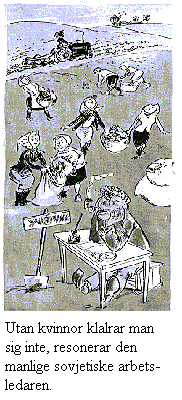
We had relatively plenty of time in the mornings and for lack of other amusements we occasionally visited the large open-air bath just below the Kremlin. The bath is a sight and well worth a visit, you could swim there summer and winter. In winter you see almost nothing, steam hangs over the water surface and you have to watch out not to collide with someone when swimming. Our group went in and we swam for a while; coming back was fraught with certain complications. Once we had swum back through a lock to the men's section, we took off our swim trunks and walked up to the changing room, where an elderly matrona resided with keys to the lockers. When we reached the lady and she saw that we were not wearing any swim trunks, she started shouting violently:
"What impertinence, rudeness! (bezobrazie) she shouted at us, you are not allowed to walk naked here!"
"Don't be afraid, we're not dangerous. She wasn't exactly young and I tried to "comfort" her."
"If you haven't seen any naked men before, it's really time now."
It didn't help. She didn't open the doors to our lockers until we had backed up a bit and put our swim trunks back on. The "Soviets" have an old-fashioned bigoted attitude towards nudity, almost like some religious groups. While we were palavering with the lady, I saw a Russian standing in the shower and occasionally loosening the waistband of his swim trunks to get some water to essential details in the crotch.
Unfortunately the pool has been demolished and on the same site they are now building an enormous church, as if there weren't enough churches in Moscow. It is said to cost 3 billion dollars, that's something to invest in, instead of building housing and other necessities. Once again the old saying is proven true that churches are built on a number of pillars of sin: pride, bad conscience, prayer for forgiveness of sins, etc.
Towards the end it became quite monotonous at the exhibition, even though there were almost always many people in the booths. Unfortunately, not all of the Studsvik instruments were completely finished and there was also poor support from the parent company, which meant that no significant deals were made. There were buyers for the 400 analyzer. A small, dry Russian was very interested in it and in conversation with him I found out where the equipment would go in case of a possible purchase. At first he didn't want to tell me, but gradually it came out that he was the head of a hormone institute and that there were no difficulties with payment. Another interested party was an Armenian doctor; his equipment would be paid for by the worldwide Armenian support fund. That the instrument would stay in the Soviet Union was of no importance.
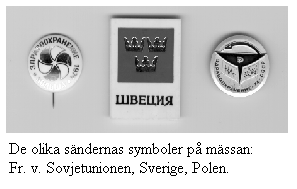
As a sort of identification badges, we had the Export Association's plastic badges with three golden crowns on a blue background surrounded by a white border. If we had had the opportunity to hand these out as souvenirs, we would have needed a considerable amount. The Russians were crazy for "znachki" (badges) and you could see grown men with their jacket lapels filled with all sorts of similar varieties. These badges were usually produced to mark some event: the inauguration of a cinema, a power plant, etc., and most were of very poor and sticky plastic quality. Even in "Star City", where the Russians trained their cosmonauts, they had nothing but cheap, nondescript plastic badges with a relief of Yuri Gagarin.
The Flight Safety Delegation, for which I served as interpreter in 1981, made a visit to "Star City" and we wanted very much to see how the Russians trained their cosmonauts in a swimming pool. Time was short and we suggested to the guiding colonel that we would rather see the training pool instead of going to the Cosmonaut Museum, but for him a visit to a small memorial hall with pictures of Gagarin, Titov and the other cosmonauts was more important than the visit to the training pool. There he also handed out to us a small plastic badge with a relief of Gagarin.
A Ukrainian female doctor became very fond of the Export Association's identification badges, and it did not help when I explained to her that it was our identification badge and "propusk", a pass. She absolutely wanted the badge; it did not help that I offered her far more valuable souvenirs in the form of nice knives, Studsvik badges, and I was even prepared to provide her with a ladies' scarf with the Studsvik emblem on it. No, she only wanted the badge, and I had to go to the Export Association's representative to request such a badge. I believe the lady would have done almost anything to become the owner of that badge.
When the exhibition ended after three weeks and we had not managed to sell very much, we were to load all our equipment back into the car for the return journey to Sweden. Considering the condition of the Russian loaders after consuming the "souvenirs", I was on site early and agreed that they would help us first thing in the morning before the departure day. The forklift with the crew came, and for our part the loading went really well; the men got another "souvenir" and consumed it in much the same way as before. It went somewhat worse for Elektrolux. The loading of a large industrial washing machine was to take place quite late in the afternoon, and given how many "souvenirs" the Russian loading crew had consumed by then, things went as they did. When the washing machine was lifted up with the forklift, the driver was no longer sober; he could no longer control the machine, with the result that the washing machine fell with its instrument side against the forklift's mast. There was a crashing sound, and then the entire ground under the washing machine was strewn with broken dials, Bakelite buttons, and glass shards. In light of the incident, I spoke with the exhibition management and expressed my amazement that they did not fire the whole lot.
- If we fire them, we might not have any at all, was their response.
On the return journey we had a bit more time. We started very early from Moscow and could make small stops along the way. We drove past small, idyllic Russian villages that looked as if taken from some Russian novel; the only things indicating the 20th century were the radio and TV masts above the roofs. Some delays were due to the Soviet GAI, the state traffic inspection. On nearly every 50 km stretch we had to stop and be inspected. The Russian inspection's task is not to examine the car's technical condition; it is mostly about checking the driving documents and possibly the load.
Because we stopped many times, we were a bit rushed towards the end of the stretch, and at the entrance to Leningrad the speed was considerably higher than permitted. Evert was driving. It had begun to get dark when a militiaman just before Leningrad tried to stop us, but since we were quite close to the city, we did not stop but rather increased speed. The militia had no radio, and we saw him run into his booth to call the next post, but by then we were already almost within the built-up area and turned off at a side street. Then we continued on a parallel road into the city center. We got away.
After the overnight stay in Leningrad, we headed towards Finland-Vaalimaa.
Shortly before Vyborg, the fuel gauge was very close to empty, and we began to look for a gas station. However, it took a while before we reached one, and suddenly we were there without fuel. We did pass a couple of stations, but they only sold gasoline, and our small truck ran on diesel. In Russia, cars up to 12 tons ran on gasoline, and not all stations had diesel. I managed to stop a truck and rode the few kilometers remaining to Vyborg. All Russian cars have very hard suspension, including this truck, and since the seats are also hard, it felt like sitting on a wooden plank. I returned with a can of diesel, and after refilling we could continue to the gas station at Vyborg Central Station. It was never easy to refuel in the Soviet Union. Sometimes only coupons were accepted, sometimes cash. I went up to the lady behind the small window and ordered a fill-up and paid (in advance) for a certain number of liters. She flipped a switch on a panel to the side, and shortly after, a sound was heard:
- Turn off! Turn off! someone shouted.
Everyone's eyes turned towards the direction from which the shout came, and we saw a stream shooting out from one of the nearby hoses, where our car was parked next to a dispensing point. In the Soviet Union, you did not decide when the filling would start; the lady at the window did, after the fuel was ordered and paid for. The usual procedure was that you put the nozzle into the car's fuel inlet, and the fuel began to flow after the lady started the pump. Now she quickly turned off the pump and began to scold me for not following the Soviet procedure and that she was now losing several liters of fuel.
- You can have a nice ballpoint pen as compensation, I said to her and handed over one of the remaining Studsvik promotional pens. She brightened up immediately and said that it really didn't matter much; we were foreigners and couldn't know everything about the Russian procedure. Evert was standing near the car, and I asked him to insert the nozzle into the car's fuel inlet. The lady activated the pump, and we filled the tank to the brim.
When I was about to thank the lady at the window for her kindness, she asked:
- If you have any spare cans, fill up! I'm treating.
We had none. The cargo area was sealed, and up front in the driver's cabin there was no space either; otherwise, we probably would have filled a few cans without too much expense.
We had cleared customs for transit in Moscow and thought the border crossing would go relatively quickly, but as always in Russia, there is room for complications. We had taken the car over the obligatory pit, where a couple of men check the car's undercarriage to see if anything unusual, and now stood in front of the customs house. A younger man came with a pair of wire cutters and was about to cut the sealing wire. I said to him that we had transit clearance and that he did not have permission to break the seal. He looked at me somewhat condescendingly, as if to say, you have nothing to say here, you damned capitalist, and cut the wire. A couple of officers walked by, and I gave a shout, calling them over to witness that the customs officer had broken the seal, and I demanded that his boss come. A dry, small, unpleasant man came and began to lecture the foolish "Ivan" that there is something called transit, and sent him to find a sealing pliers with accompanying wire. The thing was that the car was difficult to seal; there was a long distance between the attachment points for the doors, and in Moscow they had to get extra-long sealing wires to put the seals on. No matter how "Ivan" tried, the wires were not long enough, and they had to splice it with an intermediate seal. Now it was I who stood commenting on the Soviet Union in general and certain customs officers in particular.
As for the rest of the return journey, there is not much to tell. When we had been shaken all the way to the Finnish border, we came onto a "proper" road, and Evert said:
- Try now to keep the car on the road; it's tiresome driving in the ditches! Instead of a lot of people, at the Finnish border post there were only 3-4 people, but the café was open, and the people were not as sullen as on the Soviet side. The road from the border is exceptionally good; you almost think the Finns made an extra effort to mark the transition from the Soviet Union to the West.
We reached the ferry in Helsinki in good time and returned to Sweden richer by a few experiences and poorer by many illusions about the blessings of the collectivist Soviet system.
Recordings
- 1974Hälsovårdsutställningen i MoskvaA.mp3
- 1974Hälsovårdsutställningen i MoskvaB.mp3
- 1974Hälsovårdsutställningen i MoskvaC.mp3
- 1974Hälsovårdsutställningen i MoskvaD.mp3
- 1974Hälsovårdsutställningen i MoskvaE.mp3