Pakistan 1974
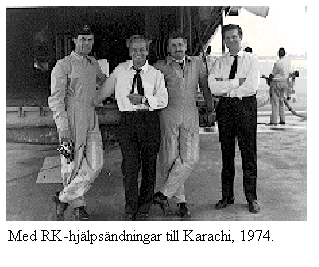
In the mid-1970s, Southeast Asia was suffering from floods, and the Scandinavian countries also took part in the relief effort to alleviate the distress of the inhabitants. In 1974, a shipment of aid to Pakistan was to be flown out from Sweden and I was invited to join, formally as a co-pilot to help with the language when crossing borders and surveillance zones. The journey started from Bromma with the Air Force Hercules "Swedish Air Force nr 7". As cargo we had about 22 tons of supplies: the Finns had donated an ambulance, the Swedes medicines, and the Norwegians had bought a large number of Russian blankets, which were now to be sent down to Pakistan. The route went via Moscow, Tashkent, Kabul, with the destination Karachi.
We made a stopover in Moscow and as soon as the plane had stopped and the flight mechanic opened the door, a Russian major was standing there and demanded to see the documents. I was in charge of certain papers required in Russia – among other things, the visa documents, where it was noted that on the return journey we would land in Tashkent. The major wanted to immediately take charge of the visa and tear off the first third, but since the return journey would also go through Russia, I could not agree to that. He insisted, however, to the very end on doing it. How we would explain that we had no visa for the return journey he had no idea about – he wanted his portion and that was that!
When no other substantial arguments helped, I resorted to a "ultima ratio", which almost always worked with Soviet people.
- OK, I said to the major. You are welcome to take the visa, but before doing so, you shall sign a paper stating that you have done so. We must have something to show your colleagues in Tashkent on the return journey.
That had its effect. If there was anything the Soviet officials were terrified of, it was signing any papers. All of a sudden, he seemed almost completely uninterested in our earlier discussion and slunk off without further troubling us.
In Moscow, we were saddled with an extra co-pilot, a Russian flight officer. My presence on the plane was justified because we would need to talk to the Soviet air surveillance stations on the ground, but that was not enough – the Russians had to have additional surveillance. Even if you knew Russian, in most cases it was almost impossible to carry on any conversation with the ground stations. The equipment was very poor, and when passing from one surveillance area to another, it could go something like this.
The navigator Lasse Mäkitalo announces that we are now entering another air surveillance area and the Russian station on the ground should be called. I take the microphone and call the Russians:
Tjernaja Grjäz, Tjernaja Grjäz. (A surveillance station on the route Moscow – Tashkent) – This is Swedish Air Force transport plane F7 Hercules en route to Karachi. We request permission to pass over your surveillance area.
In the loudspeakers we heard something that, with a good imagination, could be interpreted as a human voice, but most of the time it was impossible to tell whether permission was given or not. Nor was it anything to worry about – the main thing was that the formalities were observed.
Tjernaja Grjäz! Tjernaja Grjäz! We understand that we have permission. Spasibo! Do svidanja!
After leaving Moscow and crossing the Volga, we came out over the Russian steppe southeast of Central Russia. For several hours we flew over practically uninhabited areas – we saw only a number of small villages and some vehicle tracks on the ground – mile after mile.
A transport plane of the Hercules type is a rather noisy machine, and only the cockpit is reasonably insulated. It is not possible to have a quiet conversation, but we were military and accustomed to a kind of command voice at a fairly high volume, and we carried on certain conversations and discussions with the Russian. He was an exceptionally pleasant fellow and we had quite long conversations during the hours the flight lasted. During the talks, we touched on the Russians' relationship with the African countries, and I asked him how he viewed it. At first he said nothing, but after a moment's thought, he told the following anecdote, considering that we were out on a flight.
- A Russian transport plane crashed in darkest Africa, and the crew of four men survived the crash. After some time, the local chieftain appeared, wearing only a loincloth, and had a couple of his warriors with him. After taking a closer look at the Russians, the following conversation took place between the chieftain and his companions:
- How shall we dispose of them? asked one of the lesser chieftains.
- The fat one we roast, said the chieftain. The second we can make soup from, and the third we can freeze and keep as a reserve.
- What shall we do with the fourth?
- The fourth, said the chieftain, he shall live – we are fellow students from Lumumba University in Moscow.
On the flight eastward, the day disappears very quickly, and it was late in the afternoon that we arrived in Tashkent. Before it grew completely dark, we wanted to see the city and made use of a minibus and a guide who was at our disposal. We asked the guide to drive us to the oldest part of the city, but despite several prompts, we did not get there; instead, she showed us a multitude of typically ugly Soviet concrete monstrosities and various other completely uninteresting buildings. We asked her for the third time if we could not go to the old city, and then she had to confess that she did not have permission to show it to foreigners. She blamed it on the fact that the district had been badly damaged in an earthquake a few years earlier.
She did, however, tell us a great deal about the old "Kashban" – the Uzbek city within Tashkent. From her account, it emerged that not much had changed in certain respects. Some old women inside the enclosed area still went about with veils on and did not come out of the area except feet first – that is, when they were to be buried.
The overnight stay was at the hotel "Tashkent", a rather run-down hotel, but the food was good. At the neighboring table in the dining room sat a number of Uzbeks who looked like an illustration of the Mongol chieftain Genghis Khan – with long, somewhat sparse drooping mustaches and narrow slanted eyes. Lars Mäkitalo, who was an eager photographer, asked me if he dared to take a picture of the group. I started a conversation with the Uzbeks and expressed Lars' wish. Oh yes, that would be perfectly fine. By the way, didn't we want to move over to their table so we could, together with the board of the collective farm "The Red Uzbek", celebrate that the rice harvest had been successfully brought in and the cultivation norm had been exceeded by 25%.
We did not need to be asked twice; after a while, everyone had squeezed together around the table, and the rest of the evening passed in a very friendly atmosphere with large quantities of the local wine. No vodka here!
- It's only Russians who drink vodka here! said the Genghis Khan look-alike.
was piping hot. We started with a soup in small, rather tall earthenware pots; these had been in the oven, and we were expressly warned not to burn ourselves. After the soup, we ate a traditional Uzbek (and also other South Russian nationalities' main dish) "shashlyk" – skewer-grilled pieces of mutton.
The next day we were to cover the distance Tashkent–Karachi. The route went over the foothills of the Himalayas – the Pamir Mountains.
- Hope nothing happens, said the navigator Lasse Mäkitalo; the nearest landing strip is about two hours away.
The Hercules has four engines and can stay in the air with two, but here we were flying at an altitude of 5,500 meters and had the nearest jagged peaks barely a few hundred meters below us. The revolution in Afghanistan had been going on for a while, and we were not allowed to land there; we just had to continue toward Pakistan.
Stepping out of the plane on Karachi's airfield was like opening an oven door, humid and hot. The field also looked completely scorched and nowhere could we see anything green. Our unaccustomed bodies reacted instantly and we felt how the sweat began to stream out of all the pores in our skin. After unloading the plane, locking it and going through passport formalities, we put on our "going-out uniforms" (dark Air Force uniforms with royal blue...) and headed to "Luxury Beach Hotel" somewhere in the city. There was a throng of people on the streets, it smelled of frying oil, dust and the Orient. "Luxury Beach Hotel" perhaps didn't live up to its name from a Westerner's point of view, but that naturally depends on what you compare with. For Karachi's many beggars with a bamboo bed in one hand and the rest of their property in a bundle in the other, the hotel would surely feel like the height of luxury. On the other hand, they didn't need to go to any hotel; when they felt it was time for an afternoon nap, they set down the bed with two legs on the curb and propped up the other two with a couple of stones so the bed would lie flat, lay down and forgot their worries.
The air conditioning worked reasonably well, which could not be said about the bath. A little rusty brown water came out of the shower tap, and you might get wet but not clean. The day was far advanced and darkness fell like pulling down a roller blind – in just a few minutes it became completely black. Since there were not very many street lamps, we could not just walk anywhere. The Red Cross representative invited the entire plane crew to a welcome supper; he claimed it cost no more than about 7 kronor per person, and the beer in disposable bottles (manufactured in Lidköping) cost the same, which we were to pay ourselves. The menu choice was free and consisted to a very large extent of seafood. The lobsters were crawling around in a large basin, and each participant could choose their own victim, point out their lobster, which the staff then grilled.
Breakfast became a solemn ceremony. We sat at tables for four and essentially had one waiter each. The headwaiter – a small man with great dignity – directed the waiters with a few, very measured hand movements. He came up to the table, took out the order pad, and it seemed as if he was graciously doing us a favor. After writing down our wishes, he slowly turned toward the kitchen door (where the waiters stood) and immediately a man sprang forward to our table. The order was executed 30 seconds later. There is always a risk in eating vegetables (especially in southern countries), but we could not resist all the good salads. To some extent prevent stomach illnesses, we had, to be safe, taken a few shots from the vodka supply bought in Moscow, with the result that the entire crew got through without any major troubles.
During the two free days in Karachi we were to see the city. Together with the navigator Lasse Mäkitalo, I went to the city market hall. It was a large building with solid openings under the eaves for air circulation. That it was needed, we realized when we approached the hall. Neither of us dared go all the way into the hall, the smells of half-rotten meat were so strong that we only came near the hall – then our Western noses put a stop. Outside the market hall there was also a row of stalls, standing there in the sunshine, and the vendors offered their wares: fruit, meat and vegetables. I wanted to buy dates and we approached a stall. The vendor was quick to come over and began, as we understood from his tone, to praise his products. To show how good they were, he waved his hand over a dark pile and an armada of flies lifted from the "date field" – my desire to buy quickly vanished, and since then I have not been particularly fond of dates and figs in Sweden either.
We made another attempt to enter the market hall, but when we approached a stall where a lone sheep's head with horns and all lay on a counter, we stopped, the smell was far too strong for our unaccustomed olfactory organs. Our understanding of why Southerners spice their dishes took on another dimension.
Lasse Mäkitalo and I were the most diligent sightseeing tourists; we decided to see more of the city and its attractions, and for this purpose we had obtained some tourist brochures. When we came out of the hotel, a snake charmer sat with a cobra in front of the hotel entrance, blowing on his double-piped flute. The snake was not particularly willing to sway to the musician's rhythm, and the snake charmer periodically gave it a slap to make it move.
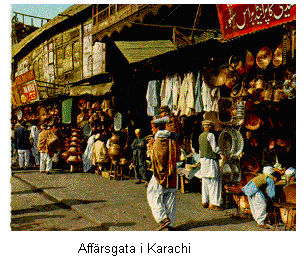
The trip to the city center was an experience, especially the shopping streets and the square. It was a real bazaar of true Oriental model. The variety of goods was very large, but perhaps somewhat monotonous. In many places it was so crowded that the craftsmen had only minimal spaces, and it was fascinating to see how a tailor sat on a table and sewed with a hand-cranked sewing machine. There was no electricity, so he occasionally gave the wheel a turn with the handle so that the sewing machine made its stitches. A carpenter stood there at his workbench and was planing a board in the midst of (as it seemed) the crowd. There were many rugs, copper and brass bowls, as well as various wooden basins. I bought a brass flower vase and a teak salad bowl.
A carpenter stood there at his workbench and was planing a board in the midst of (as it seemed) the crowd. There were many rugs, copper and brass bowls, as well as various wooden basins. I bought a brass flower vase and a teak salad bowl.
Taxi prices varied considerably, depending partly on how close to the hotel the vehicles were and partly on what type they were. There was a wide selection – from ordinary London taxis, three-wheeled scooter taxis, to rickshaws. We took a three-wheeler (for the experience, since the prices were negligible even for real taxis), showed the driver our brochure and wanted to be taken there. He stepped on the gas so we almost fell off (you don't sit very comfortably in a scooter taxi, with your knees almost at eye level) and sped off. According to navigator Lasse, we were driving far too much to the northeast, but since the driver knew only a few words of English, there wasn't much to do but go along and bide our time. After about fifteen minutes we came to something that looked like a mosque. A couple of young men in Western suits came forward and offered their services. It became a real exercise in pidgin English; we agreed to their suggestion of being guided through the mosque.
It was situated high up on a hill, and at the bottom of the stairs we had to leave our shoes (against a receipt – here they didn't trust entirely in Allah's watchful eye). In just our stocking feet we walked up the stairs, which were covered with fine dust and flower petals. Several flower sellers stood there and wanted to sell us rose petals strung on a thread. We believed no more in Allah than in our Lord and declined to buy. Once inside the mosque, it was full of people; we were each given a small straw cap to put on our heads, and were provided by the mosque attendants with some white, sticky sweets (they seemed to be something like "chewy toffees"). I had no desire to try these, and when in the crush they started to feel sticky from the heat, I let them fall to the floor. In the prevailing crowd there was no danger of discovery; otherwise it might perhaps have been regarded as an insult to the prophets. We stood for a while in the throng, and when we made it clear to our guides that we wanted to leave, we had to back out – you don't turn your back on the prophets (who lay buried there). Our eager guides dragged us through several rooms, and afterwards it felt as if we had walked the whole way backwards.
In one of the rooms they showed us their holy book – the Quran – and when I wanted to touch it, one of the guides quickly snatched the book away. A Christian dog (he didn't say that directly, of course) was not allowed to touch the holy scripture with his unclean hands; it would take about 7 days and a lot of prayers and prostrations toward Mecca to purify the Quran from this "contamination" (defilement, to speak in nuclear power terms).
On the way back we drove past something that perhaps bore a distant resemblance to an amusement park. In the shadow of the structures lay several beggars, skinny creatures with ribs visible under their skin like washboards.
We happened to be in Pakistan on National Day, but due to the flood and a national disaster, there was no parade. The prominent Pakistanis instead walked to the mausoleum of Italian marble, built in honor of the first president. The beautiful and airy building had the shape of a canopy, with four corners resting on the ground and the dome soaring toward the sky. We visited the place, took off both shoes and socks, but put our socks back on fairly quickly because the marble was scorching hot where the sun beat down. Under the dome itself, however, it was cool and pleasant; there a Pakistani guard of honor was performing English drill number 1 (according to Lasse). It looked funny when he stamped his bare feet on the marble floor; it sounded like applause.
The city was not entirely without a holiday atmosphere, however. People from the higher social classes took walks to the monument, which constituted some kind of park area, if one doesn't have too high expectations. The mausoleum stands on an elevation, and from there a water feature descends with a number of steps over which the water flows. Along the water feature stood a number of dusty palm trees; it hadn't rained for a while after the flood. On the way up to the mausoleum there was a stream of Pakistanis in holiday clothes. There it is still permitted to have multiple wives, and here we could observe the family hierarchy. First came the family father with his favorite son at his side, then followed the favorite wife and her relatives, then the other children and the remaining wives in rank and order with their respective children and relatives. Both the male and female participants in this procession were well-fed, not to say fat. In these countries, obesity is a sign of prosperity, and some were probably more than well off. The beggars, on the other hand, were so thin that you didn't dare sneeze in their vicinity. As soon as they saw a foreigner, they threw themselves at him and held out their hands. Some female beggars sat at street corners with deformed children (could the deformity have been deliberate abuse?) – the deformities usually involved misshapen arms and legs, inability to walk, heavy hair growth over the entire body, and so on.
Pakistan is a Muslim country and no alcohol is served, but this applied only in theory. Muhammad forbade Muslims to drink wine (he must have discovered alcohol's pernicious effects), but whiskey could be taken as medicine, and many did so quite liberally at the hotel bars. The effect was exactly the same as on the rest of us – they became loud and argumentative.
On the return trip we landed in Tashkent, spent the night there, and went out to the market square to buy tropical fruit. There was no sign there of the fruit and vegetable shortage that Leningrad, Moscow and other Russian cities farther north suffer from. The square was covered with all sorts of fruits and vegetables; mountains of watermelons, figs, dates and tomatoes of all kinds, many entirely unknown to us. The hygiene was also different, even if it did not reach the level of the West. I bought two kilos of large, juicy tomatoes and put them in a plastic bag (which was fortunate). Upon arrival in Nyköping, the tomatoes had turned into tomato puree. On the way home the plane was empty; only a Red Cross nurse was returning to Sweden. She had worked hard and slept almost the entire way back. We started the return journey from Karachi at 0200 (Swedish time) and after about 12–14 hours we were happily home in Sweden again, landing at Bromma airfield.
Recordings
- 1974PakistanA.mp3
- 1974PakistanB.mp3
- 1974PakistanC.mp3