Tallinn 1976
I would like to know something more about how it was with the others and what year did you move to Novoselje?
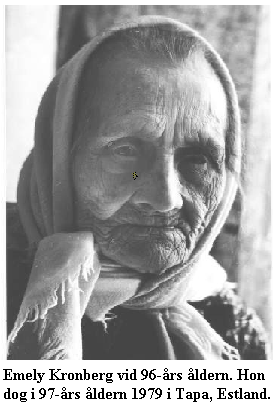
I don't remember that, answered mother Emely, my parents had moved to Russia already before my birth. When my older siblings were small, my father worked as a carpenter on the estate, and when everyone else began moving to Russia, he also decided to follow. They came to Novoselje and settled about 10 km from the village. That is where you, Albert, were at your aunt Anne's in 1939. Oh God! They came to a swampy area, but managed quite well, got it cleaned up, and could have lived quite well. My parents told that when they arrived in the area they couldn't let the cow out anywhere, it was only forest all around. My husband's parents arrived at a Russian village and lived there for three years, and they couldn't even speak with the native population, they themselves spoke only Estonian. My parents came to a place by a small stream, on whose opposite bank some Latvian families had already settled.
One of the men with a place near us was somewhat thievish, and the owner of the manor did not tolerate this; he was gradually driven away. My father was able to take over the place because it was much better than ours.
We had clear papers concerning our conduct and could trade up to the new place. Here the soil was of a completely different quality, things grew very well. Now we lived on the border of a large estate and had to let our livestock out in the manor forest. The lady of the manor had a lamb, and sometimes when they came to visit she brought the lamb with her. Later the manor was taken over by an Estonian emigrant, and he did not allow the livestock to go in the forest. We were forced to reduce the number of livestock; the family was large, the sisters were grown up and our mother was still alive. The new land was more of a sandy soil character, and millet grew well; visitors who had been with us always praised the Poltan family for their good porridge. Millet requires somewhat sandier soil to grow well.
Gradually both we and our neighbors became reasonably well-off, and when fields changed owners as new people with more capital came, a good deal of envy arose in the surroundings. When the war came, the envy reached its peak; some complained about one of these richer farmers, who was arrested, and his wife was forcibly relocated to some workplace at a peat bog. Can you imagine that our neighbors grabbed their belongings and made themselves masters, considering themselves to be poor! What kind of poverty was that? They got their "riches" at the expense of sending away all the big farmers - "kulaks".
What then became of all this? How much did they grab? I only got two wool blankets with me when we were deported to Khibinogorsk; the "poor man's committee" took care of the rest. They deprived us of almost everything. I had two sewing machines, one hand-powered and one with a foot treadle, everything disappeared. Our neighbor boy, who considered himself somewhat poorer than us, came to us to write down everything we had. Jaan was not at home. They went to our chests and noted everything that was there1. I snatched some clothing items, but didn't dare to be too assertive. What reward did these people then get? At our second deportation to the Urals, they also had to come on the deportation train and experience the same hardships as we - what it was like to be exiled from home and house.
Most people around were Russians, and nearby there was a cemetery. It was some old burial ground, and quite often people from the big cities came to look at it. The place was 23 hectares, and toward the end of the 1920s we bought an additional 15 hectares. There wasn't much forest; it had been logged a few years earlier.
I asked mother to tell about our origin and how it all began in Russia, from where our ancestors arrived and in what way, and how it came about that they settled precisely in Pustaperzha. Here follows her story.
Life in Estonia was quite poor; most people supported themselves as workers and farmhands, while my father was a carpenter on the estate. Life was difficult under the German estate owners, and a good part of the population was moving to Russia, where they could become independent farmers when the borderland between the Estonian Grand Duchy and Russia was opened for colonization. My husband's parents were still alive; his older brother was married and already had children. They supported themselves by transporting brandy to Riga from the distilleries in Southern Estonia. My husband told that he was together with his father on the road with two horses for a week with a brandy haul. Sleep was very poor, and often he thought it would have been nice to lie down for a while, if not on anything else then on a table. For food they had a ham, some bread, and plenty of brandy. They drilled a small hole in the barrel and could drink through a straw. My husband was not particularly interested in strong drinks: "Even if brandy ran like a stream, I wouldn't drink much," he used to say.
Gradually he grew up and wondered how long it would have to go on like this. In Estonia there was a rich farmer who leased out land, and the income was divided equally, but after a while father began to think that even that was a dog's work. The heavy labor of threshing grain during the winter took a toll on the mood and on the hands.
Many had already moved to Russia, and my husband's parents thought that they too should undertake something new, but what and how? Through acquaintances they learned about the conditions in Russia, and after a few months of consideration they decided to move. There was a division of the small property that existed, and grandfather Karl got a horse and a cow, a barrel of pork, and a small number of other provisions. When the provisions they had brought ran out, it was mostly milk-based food for long periods.
I don't really know how badly off they actually were in the beginning. He told that when he was to go to Russia, he didn't have a single kopeck, but they moved voluntarily. A family acquaintance had met them on the road and had given him 20 kopecks with the admonition: Have a drink so you'll dare more!
Grandfather's family arrived in Russia and settled next to a Russian village near a stream, (Paartna. Vesikova-village?). They spoke no Russian. Father Jaan was then 12 years old. Nearby there was an Estonian miller, and he had to serve as interpreter until Jaan had learned enough Russian to manage. Grandfather worked as a farmhand for the miller and got along well with his son Jaan. Later, when the farm was developed, everything was written in his name. Jaan was always a very calm and composed person; he and grandfather never argued as far as I remember, said mother.
Near us lived an Estonian family, and after a time my husband and his parents moved there. I don't remember how long they lived there before they started building on the place where you (Albert) were born. The distance there was probably about 2 kilometers, it couldn't have been much more. At first a sauna was built on the bank of a small stream, and they lived there for a few years, but during dry summers the stream dried up, and then they had 1.5 km to the nearest water source.
To my question why they didn't try to dig a well, Karl answered that the soil was clayey and water was difficult. After a time the situation became untenable; the sauna caught fire during smoking of hams, and there wasn't enough water in the stream to put out the fire. They looked for a place with better water conditions and started building anew. There the water was so close that they could get it into the kitchen through a trough. Jaan's father said that now there was nothing to do, everything worked so easily with the water. Earlier they had to harness the horse and go after water when the regular working day was over. On the previous place the soil was so clayey that if you dug a hole and poured water into the hole, the water stayed there. It was impossible to carry on any farming or animal husbandry under such conditions; moreover, the roads to transport water were of a quality that cannot be described! Oh, oh, how much trouble and difficulties people had to survive!
Jaan lived there until about age 20. In 1911 we got married, and in 1930 came the confiscation. By that time we had gotten the farm going quite well; the fields were cleared and gave good harvests. We had borrowed 300 rubles from a well-off acquaintance and, with the help of some local Russians, had the fields cleared of stumps. They were enormous stumps, as big as houses, and they served as fuel for a 4-5 year period. Stumps were also burned in the drying barn. The land was cleared, 23 hectares of field so clean that we could buy a mowing machine and use it to cut hay and grain, but could only use it for about 2 years. Everything fell into the hands of those beggars.
As for livestock, it was so-so; most was arable land, but we had to have a certain number of animals for the sake of manure, while we also leased some hayfields that we harvested and shared with the owner. Often we bought long straw from distant villages to have under the animals. Before we came to our own land we had 3 milk cows and 2 heifers, and 2-3 calves.
One of our acquaintances, Karl Sack, had a small place near us with rather poor means of livelihood. When he got an opportunity to take over a considerably better place, he took apart his old house and moved it to the new place, but did not get to enjoy the fruits of his labor for any longer time before the confiscation came.
When you, Albert, were at our former place in 1939, you remember that the only things left of my parents' place were a large stone foundation after the barn and a somewhat dilapidated root cellar with a large birch tree growing on the roof. Of the sauna, where you were born, nothing remained.
Mother tells: The Post family (with whom I stayed one summer) were our closest neighbors. Emely Post, who took you back to Kirovsk, she now lives in Pöltsamaa, her son fell in the war and her husband was exiled to the Kola Peninsula, where he died. My aunt Anna rented a room at the Posts'.
All those who had come from Estonia are gone now, only one widow remains here. She had small children and had fled to the woods when the Germans came. She is the only one left in the kolkhoz. It is now a dairy kolkhoz. No, now there is nothing but heifers there. In 1958 the kolkhoz still existed, says Karl. But the grazing lands are quite poor and almost nothing grows in the fields because there is no one to tend them. They are conscripting people from the Novosele railway settlement to bring in the hay, everything has grown over and only here and there near the road are a few small fields remaining. They have let the pastures fall into disrepair, there are no ditches left, they are overgrown with birch and willow scrub, and the land is almost always under water.
Mother continues: My own parents came to Russia before I was born, I had three sisters then, they went to school and were very bright. They had attended Estonian school before, while I and my brother Karl and my sister Alma were born in Russia. My parents came to a very poor place here in Russia, the soil was mostly white clay. It was beside a stream, and on the other side of the stream lived Latvians, they were good people. When the somewhat thievish man was driven away, the neighbor asked my parents if they wanted to come there and take over the place. The farm lay next to a hill, and there were two old burial grounds with some stone crosses, still standing there in the 1930s. There were quite a few visitors to this burial ground, people came all the way from Leningrad, because it was supposed to be something quite remarkable.
I had a neighbor woman and she had three siblings, they all came to Russia. One brother married and his wife was raised not to work. One of my siblings also married into that family. The mother was such that the women did not work. The wives stayed home and cooked, mostly for themselves, according to the rumor.
The neighbor woman said to me:
- You Emely! Don't marry into a Russian family, there you'll only become a servant in the house. I had my life in order and I had suitors too, but I didn't feel inclined to marry until Jaan's father proposed to me on Jaan's behalf. Jaan's father Karl could see how we lived, we were three people on my father Karl Poltan's farm: my father, my brother and I. My mother was dead and the last sister married.
Jaan's father had come to us to buy potatoes, and at the same time he had probably taken a closer look at how we were doing.
Jaani esa tule meie poole kevadel kartulid ostma. Jaani isa läks kodu ja oli siis nii paar kuud ja Jaan kadunud tuli minu öe pole. Jaan oli tulnud minu öe poole ja kusinud kas ma oli valmis mehele minema. Es tule minu poolegi. Mina ei teadnud temas midagi, ainult et ta niisugune pois et temale olis ega tüdruk läinud.
Jaan's father came to us in the spring to buy potatoes. He went home and after a couple of months Jaan came to my sister and asked her if I was ready to marry. He himself did not come to me. I knew nothing about him, only that he was such a man that any girl would have married him.
When he drove home he spoke with his son Jaan and the matter was settled. Jaan was good-looking, reportedly a good and sober man, and also had a reputation for being very kind and accommodating. At some point I would have to get married anyway, even if I hadn't thought it would happen so quickly. We barely knew each other. About a month passed, then came the wedding. The priest came, we were married in the combined schoolhouse and church, and I moved to Jaan's farm. I don't remember what year it was, Mother said. My eldest sister had a good memory and remembered everything, but my memory is poor now.
Well, I was content with my life, and so were Jaan and his father. The late Jaan was a good worker but had a peculiarity: he couldn't do business. He handed over a cow to a trader on credit, and it nearly ended in the loss of the money. The trader kept promising to pay, but nothing came of it. I took care of the matter, and shortly after my mother died we had another cow to sell. Jaan was ready to go and leave the cow, but I said: No, you don't! I'm not letting you go there alone with the cow. It was the same merchant, and he said:
- If you want to sell the cow, you'll have to leave her here now. At the moment I have no money to pay for either the previous cow or the new one.
I stood my ground and asked him how we should handle it. Without money I wouldn't leave the cow, but it wasn't a good idea to take the cow back either. Finally we agreed that he would leave his expensive fur coat as a pledge. I kept the coat for a couple of years. Eventually I went to the merchant and said:
- Are you going to redeem the coat from me, or should I sell it? Only then did I get paid for the cow. We got 50 rubles in gold, those are the coins I have divided between you, Karl, and Alida. If I had let Jaan go there alone, he would probably have left the cow with him on credit again, and we might never have seen the payment.
Our neighbor across the street here at Uus tänav 18 is somewhat similar. He always has to have his wife with him. The other day they were out somewhere and his wife sent him home with the money to buy food. He had three rubles with him and spent them on vodka, got drunk, and got fired from his job. Now he has a new job at the carriage depot. Karl should also have a wife to look after him, but no. He has had women, but they drank as much as he did, and that hasn't helped family life.
The late Jaan did not have such tendencies. We lived in Pustaperzha for 19 years. He often traveled to Pskov to sell our agricultural products, and it was 50 km away. He usually traveled in the evening, but he never drank large amounts. A few years after the marriage, I developed a problem with my thumb, a growth appeared on it and no medicine helped, so we had to go to Pskov for an operation. I was afraid of the operation, Mother said, and laughed somewhat strainedly. It hurt a lot and finally I couldn't stand it, and it wasn't easy to work either; the operation became necessary. It went well, and after the operation I had to stay at the hospital for a whole week.
After the operation Jaan came to fetch me. I received some medicines and was quite weak after the hospital stay, my legs were trembling. I thought: I'd rather die than undergo another operation.
It was evening, and before the return trip we visited Jaan's sister Anne, who lived in Pskov. The sister and her husband wanted us to stay overnight with them. But they were city dwellers and had no stable; Father could not stable the horse anywhere, and he was very particular about the animals. Jaan was always careful to keep the horses in good condition. We set off from Pskov at about ten in the evening. Jaan had made the trip many times without any incidents, I really didn't want to travel at night, but he could be quite stubborn at times, and I myself also longed for the farm and the animals.
After about an hour we came to a place with a bad reputation, where there had been robberies and murders. As we were driving, we saw two men come out of the woods. God, how scared I was! Jaan saw them too and let the horse go as usual. When we got closer – to a distance of about a hundred steps or less – Jaan gave the horse a good whip and then it took off. The horse was in good condition and broke into a full gallop, and we got past the men. "Live as you like, but make sure the horses get fodder!", as the Russians themselves say. So we got through. If the horse had been in poor condition, we probably would not have made it. There had been several murders at that place, we heard afterward.
We had a remarkable doctor in the area. When you were small, I suffered from some chest disease. I went to the doctor, and he put some blue paper on my chest and drew something on it with a piece of chalk. After he had done that, I returned home, and afterward I needed neither medicine nor anything else. What a doctor! This doctor also fell victim to the confiscation, but before that he was going to sell some pigs in Pskov, and during that trip he was murdered at the same place where we were threatened. After a few months, the place where he was buried was found, and the relatives retrieved the body for burial in the regular cemetery. So he lost his life. Jaan apparently did not have any such incidents, or else he never told about any similar events when he came home.
Tallinn 1976, section D
He trusted in his God and relied on his horses. I have often thought about it; it was God's providence that we saw the men in time, otherwise it would probably have been our death as well. With bad horses we would not have had the same luck.
Our life was probably like that of most peasants at that time. In the mornings when I went to the barn to milk the cows, Jaan would go out, fetch the horses, and go plowing. As he plowed, he would often sing the following song:
Ma oodan sind, ma oodan Issand (I am waiting for you, my Lord…..)
God's hand has nevertheless rested upon us, considering all the misery we have experienced, survived, and endured. I even managed recently when I went out here in Tapa.. The neighbor had been tasked with sanding, but he did not do it. Our stairs are unprotected and when it rains, ice forms on the steps. I went out in the morning and stepped on a slippery spot and began to slide, but my God was with me. I failed to keep my balance, but slid down and landed on all fours. My hip hurt a little. If I had fallen down the stairs, it surely would not have gone as well. I got back on my feet, clasped my hands and thought: God in heaven! Thank you that I came through without any major scrapes. I have had a lot of trouble with the neighbor. He has a dog and it lives in the entryway. The neighbor is also thieving and I have to guard both my potato patch and a vegetable garden. I sleep lightly and hear when he opens the door to the entryway and is about to go out and steal from me. A woman had also seen him rummaging in my garden and we filed a complaint with the militia. The militia conducted a search, I got my potatoes back, and at the same time the militia admonished the man not to steal from old people, to which the thief replied:
- She lives almost alone in the apartment while there is a great shortage of housing.
Karl was registered at my address, but he had gone to the Caucasus to convalesce and did not live with me all the time.
Thefts are Russia's scourge. Everyone steals from everyone, no one wants to work themselves as long as there is any possibility to steal from someone else.
Leo Tolstoy did not have much appreciation for the Russians. In "Anna Karenina" he writes about the discussion between Levin and another landowner as follows:
”The workers do not want to work decently and with good equipment. The worker knows only one thing – to drink himself into a stupor like a pig and destroy everything that has been entrusted to him. He waters the horses excessively, he ruins the harness, he exchanges the iron-rimmed wheel and drinks up the proceeds, he feeds something into the threshing machine so that it breaks. He is sickened by everything that is not his. For this reason the entire level of agriculture has declined. The fields are abandoned, overgrown with wormwood, or else they have been turned over to the peasants, and where they once produced for millions, today they produce only for a few hundred thousand: the common wealth has diminished".
(Karelian Edition, Petrozavodsk 1965, page 375)
PS. Here I again thought of my father who said that God punishes the Russians because they are stupid. Now in the year 2000 one almost begins to believe he was right. What else can one say about a state where thefts are legalized, and not just at the level of confiscation? A car stolen abroad and smuggled into Russia is not returned. The authorities merely make a marginal note that the car is stolen, but take no interest in dispensing justice and ensuring the car is returned to its original owner. Does such a country have any future?
The late General Alexander Lebed writes: "The jubilant boors, the same 'cook's children' and then her children and grandchildren, understood very quickly that the people consist of fools, and that they can be driven any way one pleases, and they used their power for their own interests, without in any way seeing this as shameful."
The other day I saw a Finnish report about V. Putin. There were some old women going to an exhibition of Putin's images. They stopped before his portrait, bowed and made the sign of the cross, and I was reminded of the ancient Greek saying: "One cannot remove any gods without putting new ones in their place."
The Russian author Ivan Turgenev, in "A Nest of Gentlefolk," has the chamberlain Panshin say in a discussion:
- "Russia has fallen behind Europe," and quotes one of the leaders of the Pan-Slavic movement, Khomyakov, who admits that: "we have not invented so much as a mousetrap."
Transcript from a tape recorded by mother Emely in archaic Estonian.
Vaada mis ma olen näinud omal elul. Olen ma kannata saanus……..Sinu pärast ma pagesin kaks korda. Vaada kuid siin lapset kasusid, aga kui sina kasvid….. Ku viidi sinne Uraali – kannu körval teid asja. Aga näes kas se es ollut Jumala hoidmine …………vot ku on ütte kopikad karmannis ja ku sa ni paljas oled. Kui minul es ole seta rahakopkad olnud et ma seal välja es oles jõudnud, sis oles pidanud surema.a mis ma olen näinud omal elul. Olen ma kannata saanus……..Sinu pärast ma pagesin kaks korda.Vaada kuid siin lapset kasusid, aga kui sina kasvid….. Ku viidi sinne Uraali – kannu körval teid asja. Aga näes kas se es ollut Jumala hoidmine …………vot ku on ütte kopikad karmannis ja ku sa ni paljas oled. Kui minul es ole seta rahakopkad olnud et ma seal välja es oles joudnud, sis oles pidanud surema.
Ja, seal ole kaks vanna – mees naisega mõlemad, ja nendel oli kaks last, nigu sinagi. No süüa es anda, palkka ka ei saa, mötsa tööd tema ei jouatema es joua – mis tetta?
Sis …………oles jumalast ônn. Uks tuttva mees, kadunud Jaan teadas teda Pihkvas. Tema uetles ett võtta loodik ja sõida sinne koski seal kusal saad rongi pääle istuda. Aga Jaanil nii palju pead es ole otsal, nii kaugele sõitta.
No sis tulevad önnes et ũhel perekonnal sai lehm otsa, ol kodumaalt lehm ũtte võettu, tul sai lehm otsa ja tolle lupatti lihat linna viija, kos rongit käivad. Aga Jaanil temal oli käed ………… ………..Ma sis läksi tolle mehe manu ja ũtli tälle. Nu nakkas tegema seda barschad kulla ta sais linna sõitta, ma ũtle et vot, ma tahassi väga et minu mees tule ka sulle appi, ku sa saad sinna nii võtta meid ka sinna. Aga ole ta väga valmis
See what I have experienced in my life! Indeed I have endured… For your sake I fled twice. See how the children grow up here, but how would it have been? When we were deported to the Urals – there you had to sit beside a stump and play. But everything is in God's hand… if you have a few kopecks in your pocket, you are not entirely naked. If I had not had those kopecks, we would not have been able to get out of there, we would have died there.
There were two old people there – a husband and wife, and they had two children, your age. But there was no food, no wages, your father could not keep up with forestry work – what was to be done?
So then – with God's blessing. An acquaintance, the late Jaan, met him in Pskov and said one should take a boat and set off to where one could board a train. But Jaan did not have enough sense to go that far.
Our luck came when a cow in one of the families fell ill and was slaughtered. They had brought a cow from home, but she fell ill and they were allowed to take the meat to the railway station. Jaan was not particularly eager
I went and talked to the man. He began building a raft and to go to the city (today Yekaterinburg – then Sverdlovsk) and I said, look here, we would very much like my husband to come to your aid. When you set off, you can take us along
Mother tells about the Urals, Tape Tallinn 1977-08-24
Vaata mis ma olen näinud omal elul. Olen ma kannata saanus……..Sinu pärast ma pagesin kaks korda. Vaata kuid siin lapset kasusid, aga kui sina kasvid….. Ku viidi sinne Uraali – kannu körval teid asja. Aga näes kas se es ollut Jumala hoidmine …………vot ku on utte kopikad karmanni ja ku sa ni
paljas oled. Kui minul es pöse seta rahakopkad olnud et ma seal välja es oles joudnud, sis oles pidanud surema.
Ja, seal ole kaks vanna – mees naisega molemad ja nendel oli kaks last, nigu sinagi. No suua es anda, palkka ka ei saa, mötsa tööd tema ei jouatema es joua – mis tetta?
Sis …………oles jumalast önn. Uks tuttva mees, kadunud Jaan teadas teda Pihkvas. Tema uetles ett vötta loodik ja söida sinne koski seal kusal sa rongi pele istuda. Aga Jaanil nii palju pead es ole otsal, nii kaugele söitta.
No si tulevad önnes et uehel perekonnal sai lehm otsa, ol kodumaalt lehm kätte vöettu, tul sai lehm otsa ja tolle lupatti lihat linna viija, kos rongit käivad. Aga Jaanils temal oli käed …… ………..Ma sis läksi tolle mehe manu ja uetli tälle. Nu nakkas tegema seda barschad kullal ta sais linna söitta, ma uteli et vot, ma tahassi vega et minu mees nule ka sulle appi et, ku sa saad sinna nii vötta meid ka vii sinna. A tu oll ka väega valmis. Sis kadunut Jaan läks ka appi barschad tegema ja ……………..ja muidu oles surnud.
Kommendant ……………ja mehele ka kellel ne kaks last oli utles:
- Me paneme teid vanadekodu ja lapsen viime lasteaeda. A mina utlesi sis temale niin: - Sureda siis sureda uhtel, aga las ma ei anna.
- Much we have suffered. Much we have endured.- For your sake I had to flee twice. See how the children grow here, but how you fared during your childhood? In the Urals you had to play beside a large stump and be alone in the house while we were out working, but God is merciful. And if you also have a few kopecks in your pocket, you'll get by. Had I not had any money to get away from there, we would have died there.
- There was another elderly couple with two children about the same age as you, Albert, mother Emely continues. It was the family Hillers and they had a cow that they had been allowed to bring with them into exile. When the cow began to ail, they were given permission to slaughter it. There was no permit for private sale; the cow was to go to the station town and be handed over to the state food store there, and they were allowed to take the cow to the railway station. When I heard this, I went to the Hillers, who were to build a raft to bring the cow to the station, and asked if it might not be possible for my husband to come and help him with the raft and then accompany them to the station so that we too could come along without having any permission to leave. Hillers was willing to do this, for they themselves had some thoughts of setting out on a longer journey than just to the station. My late husband went with him and was to help him with the raft; Hillers was to bring the cow to the station entirely on his own. The commandant in the place said both to us and the other couple
- You are so old that we will place you in an old people's home and the child in an orphanage, to which I replied:
- If we are to die, we will do so together, I will not give up my child!
Mother 78 aug 21 Mother tells about Siberia (in Estonian)
Recordings
- 1976TaliinnMorberättarB.mp3
- 1976TallinnMorberättarA.mp3
- 1976TallinnMorberättarC.mp3
- 1976TallinnMorberättarD.mp3
- 71 Morberättar om Pustaperzha A.mp3
- 710809 EmelyA est.mp3
- 710809 Mor EmelyB est..mp3
- 730903 Mor berättar om sitt liv A.mp3
- 730903 Mor berättar om sitt liv B.mp3
- 780820 Tallinn Mor berättar om livet efter kriget sida 1 A.mp3
- 780820 Tallinn Mor berättar om livet efter krigetB sida 1 A.mp3