Gorsjkov 1978
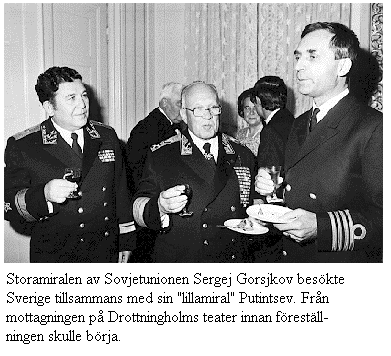
1978 Sweden had a visit from Admiral of the Fleet Sergej G. Gorsjkov. He came with his "little admiral" Putintsev, personal physician Kotikov, and his wife Natasja. To ensure he would have a "dignified" interpreter, I was appointed commander. We were three interpreters with general staff rank: Antti Nordberg, Alex Potocki, and I. It was probably thought that we had served so long that it was time to give us a few more stripes. It wouldn't look good with overly old captains; one might easily think they weren't particularly capable and therefore hadn't been promoted. During a lively evening in Karlskrona at Governor Camilla Odnoff's residence, she proposed, in view of the upcoming Olympics and the 300th anniversary of the founding of the city of Karlskrona, that the visits should be extended to the two naval cities: Karlskrona in Sweden (during the Olympics) and Kaliningrad (Königsberg) in the Soviet Union. All previous Swedish naval visits had gone to Leningrad, Tallinn, and Riga, and the corresponding Russian visits to Stockholm and Gothenburg. At first, Admiral Gorsjkov looked somewhat gloomy; now all his secrets about the old "scrap heaps" (the cruisers of the Suvorov and Kashin classes, etc.) in Kaliningrad would be revealed to the West. No, he did not seem inclined for that visit; a clear lack of enthusiasm for that kind of friendship visit was evident. However it was, he softened after a while, and the admirals agreed on a further extension of "the friendly relations," shook hands, and promised to work for the realization of these new goals. Unfortunately, neither visit came to pass, at least not officially. Admiral Gorsjkov had written a book—"The Sea Power," according to informed readers a very detailed book, but with bottom charts etc. (though no map of the Murmansk area)—and many officers had bought it and wanted the admiral's dedication. Now and then I had to step forward with the request and present the book to him. The "unofficial" visit of the Soviet submarine U-137 in the autumn of 1981 effectively put a stop to all further military interaction. The few visits by official Russian persons since then have generally gone to the Ministry for Foreign Affairs. Among these was the Soviet Supreme Commander Jazov, who participated in the failed military coup in August 1991.
Admiral of the Fleet of the Soviet Union S. Gorsjkov had an impressive set of trinkets on the left side of his chest. Only thanks to his large chest, which continued all the way down to where he must have had his waist in the past (a very long time ago), did he have room for all the finery. Sometimes I wondered if the "paunchiness" of Soviet officers with many medals was part of their "duty requirement"; otherwise, they wouldn't have room for all the decorations. The medal ribbons on the admiral occupied an area the size of an A4 sheet and covered the entire left side of his chest and stomach. However, his arms had not kept up with the growth; they had become too short relative to his belly, and he had some difficulty getting food into his mouth without spilling. When the "spills" landed on the left side of his chest, where all the ribbons were, it didn't matter much. There was already so much color there that a splash or two from some colorful sauce or lingonberry jam made little difference to the color scheme. The problem was most noticeable on the right side; it looked a bit naked compared to the left side, and anything that landed there discolored the fabric of the uniform jacket. During the visit to Sweden, the Russians were quartered at the Hotel Stockholm, in its best and most expensive suite. Nonetheless, his adjutant, Captain-Lieutenant Kotikov, came one morning and wanted hot water—in a thermos.
I conveyed the request to Admiral Bengt Rasin, the Swedish host, and he asked me to inquire whether they were not satisfied with the service at the hotel. If so, they should tell him, and he would pass it on to the hotel management.
"No, no," replied Kotikov, when I had delivered the message, and I could see from his expression that he did not want to enter into further discussions. However, I pressed on, and after a while it came out that the water was needed to clean the admiral's uniform jacket.
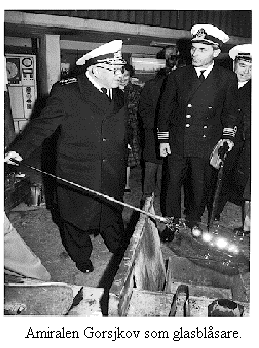
The visits to Orrefors and Svängsta were so-called "cultural visits," and the participants seemed very interested. The admiral tried to blow glass and discovered that it was much harder than it looked when he watched the professionals. The master glassblower joked with him, saying that now he had the chance to blow his own crystal vase, but it turned out as "something" indefinable—a blown glass lump. However, Orrefors presented both him and the other Russians with a proper bowl each, so they didn't have to return home with "homemade" products.
During the Svängsta visit, salmon fishing was to take place in the Mörrum River. The evening before, the Navy had hosted a party in Karlskrona, and there were quite a few demonstrations on our way to the party venue, with placards reading "No party for the admiral of war" and the like. In Svängsta, the police had taken strict measures to prevent the demonstrators from getting near the fishing spot, and all roads there were cordoned off. That did not prevent, however, that just before we arrived at the shore, two people rushed out onto the road with a burning Soviet flag. The demonstrators had had to take a long detour through the forests to bypass the police cordons. I was sitting in the front car together with Admirals Gorsjkov, his escort Admiral Putintsev, and the Swedish escort officer Admiral B. Rasin.
"How can people be allowed to demonstrate against us? We have been officially invited here by the Swedish Navy!" was the question from the Russian escort admiral.
It is surprising how poorly even persons in very high social positions were informed about Western democracy and conditions here. Gorshkov was more familiar with the rules of democracy and began, slightly embarrassed, to explain to his closest man how things stood and that an official invitation did not prevent demonstrations in the capitalist countries.
The admiral had received a "Diplomat" fishing reel as a gift from the Navy the evening before; he was wearing his sports outfit, but there was no great fishing luck. The Soviet consul general caught a small salmon, the others caught nothing.
The return journey to Stockholm was to be made by Vertol helicopter, and we arrived at Sturup to begin our flight from there. More than just Mrs. Gorsjkova were afraid of flying. The then Soviet ambassador Michail Jakovlev said he would drive back to Stockholm.
"We fly, all of us!" was Gorshkov's reply, and the ambassador had to accept the decision.
Mrs. Gorshkova was worried about the flight, and to make it easier for her, I told the joke about the lady who was also afraid to fly but had to do it.
"I don't want to sit next to the wings," the lady had said, "they flap too much; I want a seat far in the back instead."
When we had boarded the helicopter and put on our hearing protectors (the Vertol makes quite a lot of noise), Mrs. Gorsjkova looked quite worn out. I attracted her attention, and since we couldn't talk, I just waved my arms, simulating wing movements, and she soon looked somewhat relieved.
In Stockholm, there were several both professional and cultural visits. One evening, SAAB hosted an excellent event at the Drottningholm Theatre with "Cosi fan tutte" and an unforgettable return trip by a chartered boat to Stockholm, landing at the quay in front of the Hotel Stockholm. The next day, we were to visit the last still-serving major Swedish warship—the destroyer "Södermanland". Most others had already succumbed to oblivion; "Halland" was ready for scrapping.
It was quite windy out at Muskö, where we were to tour the naval base. We noticed that a new "element" had been added to the admiral's entourage, likely an expert on military fortifications. When it became known among the Swedish officers and those working at the facility that the Russians were to be allowed into Muskö and see our defense installations, there were strong protests, but the government overrode the protests and the Russians were allowed in.
We went through most of the rock caverns with their repair workshops, dry docks, and looked at the submarine lying in one of the docks. Muskö is an impressive facility, and the Russians' interest was very great. They don't have anything like it at home. After the tour, the journey continued by launch out to the destroyer "Södermanland", which was at anchor in Hårsfjärden. The weather was gray and overcast with strong gusts of wind, and the escort officer Bengt Rasin was worried about how, in this weather, we would get the rather corpulent Russian admiral on board from the launch up to the destroyer.
The sea was rough, with strong heave. The boat driver was instructed to take it very carefully and not to come alongside unless he was absolutely sure. The Russian naval attaché Konovalov was with us, and we decided that they themselves would assist the admiral's boarding. The third attempt to ride a wave at the same moment the gangway was within reach and could be grasped succeeded; Gorsjkov grabbed hold of it and showed that he was truly an old sailor. Despite his corpulence and a certain ill health (he had a doctor with him in the entourage), he climbed nimbly like a cat up to the "Södermanland's" main deck, while for some of the rest of us it was not nearly as elegant. To avoid further transfers under difficult conditions, the destroyer went in and moored at the quay when we were to leave the ship.
During the inspection of the destroyer, Gorsjkov had the honor of entering the Holy of Holies—the Combat Information Center. A number of conscripts were sitting at the radar and target screens. The admiral looked at them and then turned to the escort officer, Admiral Bengt Rasin:
"How long have they been in service?"
"Somewhere between three months and half a year," replied Rasin.
"And you already dare to let them handle all these instruments?"
- Yes, replied Admiral Rasin, most of them have a technical education from civilian life and they can perform their duties without us having to worry.
Gorsjkov shook his head a little and walked away in amazement. Just imagine! Letting in conscripts, completely ordinary people, civilian riff-raff with vocational training.
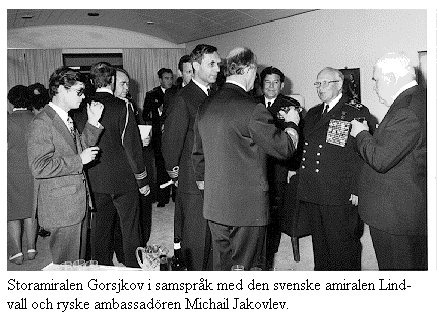
Upon returning to Stockholm, we were invited to the Soviet embassy for a party. This was to take place after a visit to SAAB-Data in Järfälla, where the admiral wanted to look at the electronic equipment for navigation and gunnery training. The time was a Friday afternoon and it was hot. We got stuck in the car queue just before Traneberg Bridge and it became a long wait. The sun blazed from a clear sky and it started to get sweaty, literally. The admiral began to mutter something about in such cases we should have used a helicopter; he was already slightly disappointed that we did not have a massive police escort for transports from one place to another. In the Soviet Union he was accustomed to the motorcade driving with a siren in front and a loudspeaker system through which at regular intervals it was announced:
- Citizens, clear the road! The car queues at Traneberg Bridge were long and it took a while before we could begin our journey to the Soviet embassy at Görwellsgatan 31 near Västerbron. Everyone was hungry by this point and looked forward to getting into the embassy and having some substantial sandwiches and hot meat pies. Judge our disappointment when it turned out that the Russians had adopted Western customs and only had cocktail sandwiches, small miserable pieces of cheese and meat on a toothpick. It wasn't very filling; instead we drank even more vodka and decided to continue our gathering at some restaurant with real food.
The Russian admirals can be quite amusing. Some of the prominent gentlemen can be mentioned here. In October 1972 Sweden was visited by a delegation from the Baltic Diving and Submarine Rescue Service led by Rear Admiral P.P. Eromenko. He was a great storyteller and we laughed heartily during the visit. We made a trip to Karlskrona Diving Center and took a trip with the submarine rescue ship "Belos". The visit took place in October and during the "Belos" excursion we thought a sauna would be appropriate. There is one on the ship and the heat was turned on. Not many could fit in the sauna at once - 5-6 people and I was there as interpreter for Lieutenant Commander Jan Sundlöf, then commander of the submarine rescue ship. In the nude, a very jovial atmosphere arises, no rank insignia and everyone is just people and one starts telling somewhat risqué stories. The Russian officers' repertoire of anecdotes can indeed be quite extensive, but monotonous. For the most part the action is set between the navel and the knees - about that and such, as Ola in school said. One of the admiral's stories that I remember was the following:
He had entered a cadet barracks where the men were competing in who had the strongest penis. The winner boasted that he could carry a water-filled bucket up to the second floor on his penis.
- That's nothing to brag about, said the admiral, even I can do that, despite my age.
The men almost wet themselves laughing, but I showed them that it was true, said the admiral.
- How did the admiral do it?
- Very simple. I tied my foreskin around the bucket handle and went up to the second floor, after that no one dared to laugh.
That business of evaluating and weighing the penis is said to be very ancient. In the excavations in Pompeii, scales for this purpose have been found in the excavated houses. The phallus cult flourished more strongly in past centuries; now we have pornography instead. Modern life with stress and new difficulties has strongly contributed to twisting sexual life in the wrong direction. The Russians, due to the catastrophic housing situation, have probably had it worse than most with their sex lives. In poorly insulated and cramped apartments, there cannot be any great experiences in that way.
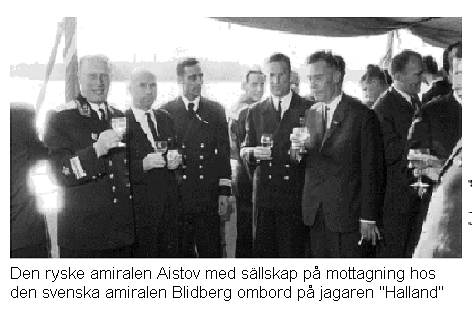
When one is talking about admirals, I remember a Tallinn trip with three destroyers: Halland, Södermanland and Uppland. Bill Belaeff was along as interpreter on the destroyer "Södermanland" and at a gathering on the deck of the destroyer "Halland", the admiral's wife Smirnova (her husband was an admiral in the supply corps) took a liking to Bill. Bill was elegance itself, reservedly polite and a good conversationalist. The admiral's wife sensed a whiff of the fine world, and during the party with alcohol's favorable contribution to the joviality, she wanted to drink a 'du' toast with Bill. In Russia one uses the formal 'you'; 'thou' is completely unthinkable in dealings with strangers. They filled their glasses, hooked
arms together and drank up, after which Bill, according to old Russian custom, threw his glass overboard, and the admiral's wife followed suit with hers. Bill should not have done that. Among those who had witnessed the event was also the ship's supply officer and he was soon at Bill's side. I was standing quite close to the 'you'-toasters and heard what the supply officer had to convey to Bill.
- I just want to point out to Captain Belaeff that the loss of the glasses will be charged to your mess bill with……. kronor.
They were not ordinary plain shot glasses; the Navy's anchor and some other insignia were engraved in the glass and there was hardly any new production.
CM secretary 1978-09-07
Preliminary plan for car transports during the visit of the Soviet Union's naval chief in Sweden 12 - 16 September 1978
Fleet Admiral Gorsjkov Mrs. Gorsjkova Rear Admiral Putintsev Commander Fedunkin Colonel Malygin Lieutenant Commander Kosjkin. Commander Konovalov Mrs. Konovalova
Captain AstakhoN,
Gor Fru G Pu
Fe ,
Mal
Adj Kon
Fru Kon Ast
V
CM
Fru L Rhe Hell Åk Kron CM adj Vice Admiral Lundvall
Mrs. Lundvall
Rear Admiral Rheborg
Captain Hellström Commander Åkerhielm
Commander Kronberg Mrs. Ginsburg
Captain Fischerström
Cars used
1
ur Fo 44/KörC vpl Sjöstedt
ur Fo 44/KörC ur Fo 44/KörC vpl Spång
ur Fo 44/KörC ur Fo 44/Körc ur Fo 44/KörC
Mercedes (7-seater)
2 Mercedes no. 17600
3 Mercedes(7-seater)
4
5 Volvo no. 40330
6 x)
7
8 Bus (10 pers)

D irectives for drivers
Car must be ready at least 10 min before departure time indicated in the plan.
In case of doubt, incident, difficulty keeping time etc - take contact with
CM secretary (Mrs. Nelson)
CM adjutant (Captain Fischerström)
Escort officer (Commander Rheborg)
tel 67 95 60home 62 72 96
tel 6795 60 home 773 31 18
tel 2210 20 (Grand Hotel)