Funerals in Tapa, December 1979, 1989, 1999.
Inearly December 1979, when I was in Skövde at the Intelligence School with Cavalry Captain Stig Åby-Eriksson to give a lecture about the Soviet Union to reserve officers on refresher training at S3, a telegram arrived from Tapa informing me that my mother Emely had passed away and that I should come to the funeral. I called the Soviet embassy, spoke with the consulate and was told that it would probably take a week before they could finish the visa. Moreover, there was another catch, they could not issue a visa to Tapa. Tapa was a forbidden area for foreigners; there was both an airfield and a missile base there, as Karl and Lida had told me.
Lida was particularly annoyed about the airfield and the missile base; earlier she had been able to pick berries and mushrooms there, but now the area was ruined and inaccessible even for those who lived in Tapa. It would take far too long, and the boat connections were still quite poor at that time.
With the delay in the visa matter and other administrative difficulties, it would take far too long – and the boat connections were quite poor at this time of year. There was no ferry traffic between Sweden and Estonia, so if you wanted to get to Tapa you first had to travel to Finland and from there take a boat to Tallinn.
Damn it! I thought, will the Russians really prevent me from attending my mother's funeral? I called one of my military acquaintances at the Russian embassy – the military attaché, Commander Konovalov. Unlike many other Russian attachés I had met over the years, Konovalov was a true sailor, born in Siberia and a good man for that matter in comparison to some other Soviet sh...-boots, who were mostly political officers and no real soldiers. Colonel of the Air Force Jan-Åke Berg and I were to have celebrated his departure from Sweden in the autumn of 1980, but our colleague Arthur Haars' funeral got in the way. Konovalov liked me and my singing, but was wary of my small provocations and often repeated: Just don't criticize!
Konovalov pulled some strings inside the embassy with the result that I could pick up the visa immediately once I got to the embassy with my passport, but the embassy could do nothing about a visa to Tapa. The Stockholm embassy was not authorized to issue visas to forbidden areas; I could possibly get that visa in Tallinn, it was said.
The consul called and said it was fine to send in the passport and visa application, but knowing the Russians and their handling of documents, I did not want to send the papers by mail. Instead, I persuaded my colleague Dahlman at Studsvik (who lived in Stockholm) to take the visa documents to the Soviet Embassy. Dahlman took the documents and went off to Stockholm, but there was no handover; the embassy was closed. I called Maria and asked her to take over the documents; she did, and the next day at half-past eight Maria called and said she could not submit the papers before ten o'clock. I called the consul and managed to get him to receive the papers. This was on Tuesday and on Friday I just had to pick up the visa, collect the tickets from my military interpreter colleague Alex Potocki at the agency Scansow, which had taken over Nyman & Schultz's travel agency tasks. Alex helped me get to Värtahamnen and then I was on board in cabin 232 on my way to Finland. I took a sauna and ate for 36.50 – guaranteed every penny. The day had been somewhat hectic and I had not had any food.
There was no ferry traffic between Sweden and Estonia; the journey to Estonia had to be made via Helsinki in Finland and from there further by a Russian boat to Tallinn, from where the journey to Tapa would continue by train or car. There was only one trip per week with an old tub "Tallinn", which meant I would not be able to return for several days and would have to spend Christmas 1979 in Tallinn, where I would stay at the Hotel "Viru".
From Helsingfort the journey continued the next day to Tallinn. The Russian vessel"Tallinn" arrived at Tallinn harbor quite precisely at 15.30 local time, but so did the cruise ship "Viking", which came two hours late and their passengers were disembarked before us. As always in the Soviet Union, nothing could be done quickly. "Viking" moored astern of us and we became spectators to the unloading of tourists. The Finns had by then built a nice terminal with automatic doors and some other Western refinements.
Most of the cruise passengers were fairly intoxicated, and since "Tallinn" also came from Helsinki, there arose some piquant "discussions" between our passengers and those who came with "Viking". They exchanged some pleasantries but also many insults. There was a man, a typical Finnish lumberjack with a somewhat stooping gait, wearing an ear-flap cap and beak boots, and soon it was heard from those on board "Tallinn":
Pekka, you forgot the saw and the axe in the forest!
The quay in Tallinn was slippery; no sanding had been done and many elderly had difficulty moving. One of the Russian porters had sand in his pockets and sprinkled a few handfuls on the worst sections. An extremely drunk Finn had come up with another method; he was so unsteady on his legs that it would have been an achievement if he had managed the slippery surface on the quay. He simply sat down on the porter's cart and was transported into the terminal – under cheerful shouts from the other passengers. I reflected that here the victors go and serve as a backdrop for the defeated. The customs formalities were quickly completed; they were preparing for the Olympic Games. The servicewoman opened my bag as quickly as possible, looked at my declaration, and then off we went to the reception committee consisting of Vera, Bella and Valdemar with little Jaan. Valdemar had borrowed a car and we drove to Sveta, my godmother Minna's one daughter..
In Tallinn they were completely dismissive; I would not get a visa; Tapa was a forbidden area for foreigners, etc....
I got angry and said:
- I will travel by train; you can arrest me, but then there will be writings in the Western newspapers that in the Soviet Union one cannot go to one's mother's funeral. That did the trick and there was a little commotion at OVIR (the passport authority). As a result, I would not be able to get a separate permit, but it was fine to rent a car – with a driver – and be able to attend the funeral.
I joked with the OVIR man that I had a professional driving license and that I could drive everything from a moped to a tank, and consequently had no need for a driver, but that joke did not go down well. It became a car with a driver. I would be allowed to use the car for 12 hours at a total cost of 290 SEK. Since there were no better offers, I had to accept the proposal. My brother Karl joked, saying they could dress me in Russian clothes and we would take the train to Tapa, but since the Russians knew of my presence in Tallinn, it could have led to certain unpleasantries if I had been caught.
The car was supposed to come at 11.00, but as always in Russia schedules are not kept, and only around 12.00 did a Volga arrive with a younger fellow at the wheel. Since there was room in the car anyway, some Tallinn residents and relatives came along. They were Elvira from Leningrad, and Svetlana, Bella and Anatoli – godmother Minna's children and Elvira's nieces and nephews.
We set off in the direction of Tapa, a distance of about 80 kilometers. About 60 km went along the Tallinn-Narva road, and then we turned onto a smaller road southwards. After a couple of kilometers on the smaller road, there was a tall radar mast, and I joked with the KGB man:
- Well, that's interesting, here is a radar mast aimed westward, so the missile base is somewhere nearby. He laughed a bit strained, what was he to answer?
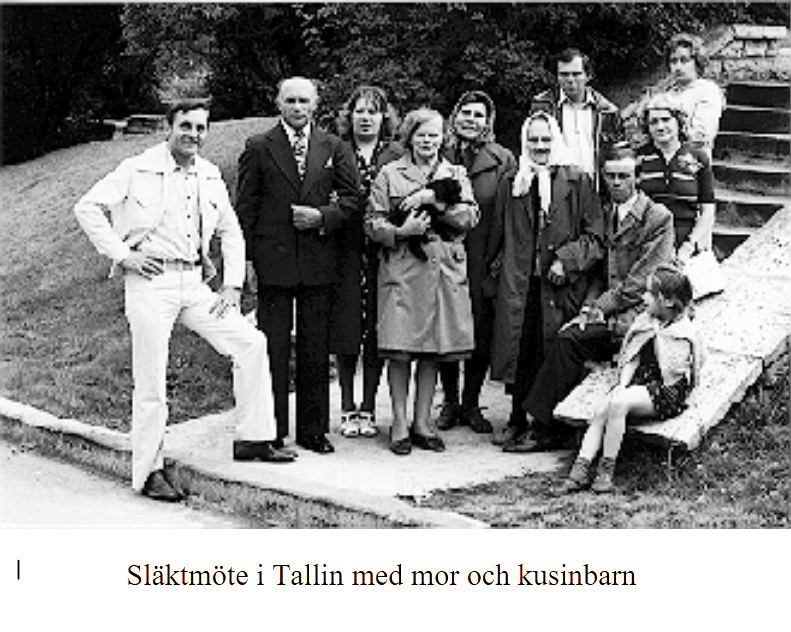
Arriving in Tapa, the other relatives had gathered at Lida's; Jürgensons, Toppers, Posts, and others.
When we arrived at the church, a service was in progress; mother's coffin stood to the left of the entrance. It was very cold in the church. After the service, I greeted the other relatives and acquaintances: among others Maria I, Karl's wife and his daughter Maja, who lives somewhere on the road to Leningrad. The funeral ceremony took place inside the church and was solemn.
In Estonia they still practice the more old-fashioned burial and church service order. For example, they do not screw the coffin lid shut, but the deceased lies there in their best clothes, so that relatives and friends may take a last farewell. In 1964, when we found each other again, the first thing she wanted was for me to send her a certain number of white cloth for a shroud. Karl told that mother had been fully conscious until the last minutes, but the fever rose quite quickly and in a few hours it was over. Now she lay in her coffin and looked almost alive. The wrinkles had to some extent smoothed out because it was cold in the church, the congregation could not afford to heat it and from the Soviet state's side no money was granted for either heating or maintenance of the church.
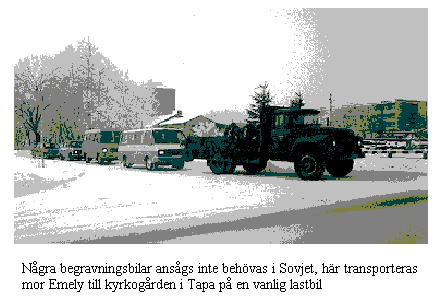
The priest gave a long funeral oration. Mother was not a fanatical believer, but people born in the 19th century naturally had a different attitude toward religion, without being directly devout. The oration was long, and between times we sang mother's favorite hymn ”Tugevad och Jesu käed…..”, (Jesus' hands are strong), and the hoarfrost from our breath settled on collars and caps. When the oration was over, the priest read ”From earth you are come……..” and placed three shovelfuls of soil on a white cloth specially intended for this purpose in the coffin beside the deceased, only then was the lid screwed on. The coffin was carried out of the church and placed on a small truck; there were no hearses in Estonia. The Soviet government did not consider that the ordinary citizen should be afforded any more dignified ceremonies at their passing. It was in the middle of winter and no great quantities of flowers were included; in Soviet times flowers were an inaccessible luxury, there were no flower shops at all. Floral decorations consisted mostly of geraniums, geraniums, and some other potted plants. One of the relatives walked with a white cross in front of the car and the funeral procession followed behind the car, the procession toward the cemetery was underway. The distance there was about a kilometer long. Right to the end there were obstacles on the road; the railway line cut straight through the town and just as we were about to cross the railway crossing, the express train Tallinn-Moscow was due to pass. Since the gates are operated manually, the train had to wait until the funeral procession had crossed. The weather was gray and gloomy, a true funeral atmosphere prevailed.
The cemetery is shared by both congregations - both the Lutheran and the Orthodox; there it does not matter what or how you have believed during your lifetime. Albert Jr, Valentin and a couple of hired men had dug the grave, which was not without exertion. The soil is very calcareous and there were large limestone blocks next to the grave opening, but Albert Jr had also made sure that there was a load of sand nearby. After the burial and more oration, the grave was filled in by me, Albert Jr and Valentin, first sand and then some limestone and more sand on top of the surface.
The cemetery lies in the western part of the town of Tapa and Karl and mother's home was only a stone's throw away. The funeral meal was laid out in Karl and mother's one-room-and-kitchen at Uus-gatan 18-1 and with all the mourners it became very crowded - and soon also very hot - both from the abundance of food and large amount of drinks, and from the crowding at the table. Mother had left behind about 700 rubles to cover funeral expenses and the vodka flowed all too abundantly. The cousin's child Sass (Alexander) Jürgenson and some others drank a bit too much, so my sister Alida put away quite a few vodka bottles. Some became heavily intoxicated and Lida, together with Vera, removed over half a dozen bottles:
- It might be good to have for tomorrow as well, she said The ceremonies had taken a long time and our chauffeur began to get anxious; the entire assignment was supposed to be finished by 20.00 for his part, but with a 10 FIM the time could be extended. Around 22.30 however he began to get seriously anxious and did not want to stay any longer - the car was to be back in the garage by 23.00. It was time to return to Tallinn. .
The winter was quite cold and when the next day I was going to go to town with Vera and Lida, I intended to treat them to coffee in the bar of Hotel ”Viru”. We tried to enter, but the somewhat swarthy South Russian, a ”kaftantjik” (Russian term for people from the Asian republics who wear a long coat) who served as a guard, would not let us in. For me it was fine, but not for Lida and Vera. According to the ”blackhead” they would need to fetch a ”propusk” (pass) somewhere from the militia. I got angry and said loudly and clearly so that others in the lobby could also hear it.
- It was in China during colonial times that one could read the signs on hotel entrances:
"For dogs and Chinese, entry is forbidden! Put up a sign 'Forbidden entry for local Soviet citizens!' "
This naturally attracted some attention (which was also the intention), the hotel guests around turned and looked at us. The guard became confused and did not really know what to do; that someone would protest was probably not part of his thinking nor in the instructions either. I took the opportunity to pull Lida and Vera with me before the guard had time to act.
After returning from Tapa to Tallinn the next day, I went to the cashier in Hotel ”Viru” to pay the stipulated sum of 290 SEK for rental of car with chauffeur. I went up to the first of the two cashiers, handed over three hundred-kronor notes and waited for change. The girl at the cashier looked long in her drawers, but apparently found no Swedish ten-kronor note and asked me:
- Can't we say 300 kronor even, and I'll write out the bill.
No, I answered. If it costs 290 kronor, I pay that and not a penny more. And who would take care of the leftover ten-kronor note anyway?
- I can go and change it, there's another cashier right next door, I said. I moved a few steps to the girl who sat at the second cashier, took out a 50-kronor note and asked to have it changed into tens, but look… it didn't work.
I may not change any foreign money for the same currency, only into
rubles.
When the state suspects everything and everyone (in the Soviet Union, admittedly on good grounds), such situations arise, which seem difficult to understand for a Westerner. I promised to return the next day and asked the girl to make sure she would have suitable change to give back.
Ten years later, in 1989, we went through the same funeral procedure with sister Alida, but then the regulations had eased and the visit went somewhat more simply. At her death Lida was younger than her mother and had a slightly larger circle of acquaintances, and therefore the funeral meal took place in the canteen of the metal company ”Vasara”. Albert Jr worked there and arranged everything. A candle had been lit at Lida's empty place. She probably died of some liver disease. When Ann-Marie, Sonja and I were there in autumn 1989, Lida looked yellow and it was only a couple of months, until December, before she passed away.
Waldemar told that she did get into hospital, but there was no cure. The Soviet hospitals were never any healing institutions and now the Soviet state was beginning to decay and the healthcare system and the school system along with it. He himself had to go to the hospital and either bribe the staff there to take care of her, or come himself to change and help her with the simplest and most necessary tasks.
- Two things I would not wish on my worst enemy, said Waldemar. One is to do military service in the Soviet defense forces as an ethnic minority and the other is to end up in a Soviet hospital.
Waldemar did his two years on the floating Soviet fish factories and had a lot to tell from there. Some relief was achieved by his playing the accordion and thus becoming a central figure at parties, but it did not compensate for all the harassment. When his fish factory was in Helsingborg, he smuggled a letter to a dock worker for forwarding to me, but the political officer saw the action and he was not allowed to go ashore in Sweden. On another occasion, when they were on their way to England and everyone was to get shore leave, he was lifted by helicopter over to a ship that was just on its way out of England to the North Atlantic.
In 1999 it was again a funeral. This time it concerned my brother Karl, born 1912. When I visited him in Tapa in the summer he was already a marked man. The change had happened in just half a year; at the February visit he seemed somewhat tired, but no worse than in previous years. He was nevertheless well enough that we could make a visit to the relatives in Dorpat, aunt Elvy and the daughters Margaretha, .......... and their children Alexander and Vitalij.
On 4 November 1999, Faina called and told me that Karl had passed away. When I asked when the funeral would take place, she said it should happen as soon as possible. I told her that I could come by Sunday. Of the family members, only Maria could (and wanted to) come along. Now there are daily ferry services between Stockholm and Tallinn, and the trip posed no difficulties.
Karl had been ill for the last two months and most things were prepared. I left on Friday evening, was met by Bella and Rein at the harbour, and went with them to their apartment. Faina had some people staying overnight, and we decided that I would stay with Bella and Rein and travel to Tapa on Sunday morning to attend the funeral. The plan was that Bella's sister Sveta Samarina would also come with us in the car, but her daughter Inna had no babysitter, and Sveta had to bring Kristina (the granddaughter's name) to the funeral, and they had to take the train.
There were quite a lot of people at the funeral; Karl and Albert with his family are well known in a small town, and many came to accompany Karl to his final rest. It was a civil funeral. The ceremony was held in the funeral chapel at Tapa cemetery. As is customary in Estonia, the coffin was open, and anyone who wished could say goodbye to the deceased. One of his former work colleagues gave a eulogy as follows.
As an irony of fate, Karl was to be buried on 'the day of the Great October Revolution' according to the new Russian calendar, November 7, but there were neither drums nor trumpets, as was otherwise customary during Soviet times.
Eulogy at Karl Kronberg's funeral in Tapa, Estonia. 1999-10-07 (у гроба)
Увавжаемые дамы и господа, уважаемый сын, брат, племянницв, внучка, внуки, правнуки и родственники, близкие и друзья покойника. От себя лично выражаю глубокое искренное соболезнование всем вам по случаю кончины дорогого человека Карла Кронберга.
Как в природе – была весна, поступило лето, затем осень и потом зима, так и жизнь человека проходит по закону природы – родился, рос, были годы игр и годы учёбы, годы упорного труда.
За всё время любой человек испытывает моменты грусти и радости, и каждому, кому раньше, кому позже приходит прощальный день с земным миром. Не смотря на то, что мы всё это знаем, знаем, что это неизбежно, очень больно, когда навсегда теряем близкого дорогого человека.
Каждый день дает миру сотни и тысячи человеческих жизней, каждый день перестает биться тысячи дердец. Когда эти события не касаются нас, то мы все смотрим на них, как обычные явления человеческой жизни.
Стоя у гроба, низко склонив головы, мы вспоминаем его пройденные годы жизни.
Карл родился 19 апреля 1912 года в селе Новоселье Псковской губенрнии, где прошли его детские годы, годы учёбы, окончил начальную школу. В 1930 году вместе с семьей были репрессированы в Приморский край город Апатиты, где работал на разных работах.
Во время войны работал на оборонительнх работах, кочегаром на паровозе, имел правительственные награды. В 1947 приехал уже с семьей в Эстонию. Работал слесарем в автобазе. В 1968 году ушел на петсию, но продолжал работать сколько было сил.
4-го ноября не стало больше битися его сердце. Он ушел навсегда от нас.
Мы собрались сегодня сюда для того, чтобы проститься с Карлом и вызказать слова искренной благодарности за его труды.
Прошай дорогой человек.
(на кладбище)
Мы прибыли на это святое место, чтобы поместить на вечный отдых дорогого нам человека Карла Кронберга. Жизненный путь Карла прошел достойно и целунстремленно. Мы всегда будем помнить его как простого, скромного человека.
Дорогой Карл. Весной и летом твою могилу будет покрывать прекрасные цветы и роскошная зелень, зимой пушистый снег. Пусть земля будет тебе пухом. Прошай дорогой отец, брат, дядя, дедушка, прадед, хороший родственник.
Recordings
- 1979Begravningar i TapaA.mp3
- 1979Begravningar i TapaB.mp3
- 1979Begravningar i TapaC.mp3