With "Flavia" in Tallinn – an Olympic adventure 1980...\Bilder\1980
Missing "Sleep on my arm and the pilot's story."
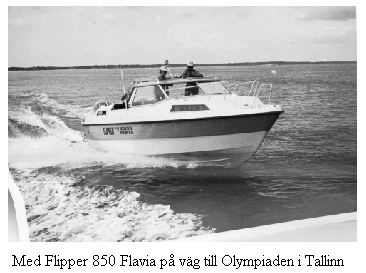
Under the early summer of 1980, Jan Åke Johnsson (a member of the Military Interpreters' Association) called and asked if I wanted to join him at the Olympics in Tallinn with his motorboat – a Flipper 850. We would serve for two weeks during the Olympic sailing events: driving around with VIPs, press people, and other guests out at the sailing courses. Jan Åke had not initially received any further details himself, only that the boat manufacturer in Finland had arranged with the Olympic Committee that 15–16 Flipper boats from Sweden and Finland would serve during the sailing events. He had signed up more or less 'sight unseen'. We were to get food and lodging, we had been told, and also some excursion coupons to see the sights. On such premises, it was buying a pig in a poke, but since the opportunity would hardly come again on this side of the century, I also said – OK, I'll come along.
The time for departure came; I had a whole seabag with children's clothes for Valdemar's boys with me, took the train to Stockholm to board the "Flavia". It was not as simple as I thought. The boat was somewhere at a dock on Lidingö, and I had great difficulty with my luggage and guitar. The weather was hot, the seabag heavy with all the children's clothes, and on top of that I got lost a couple of times because there weren't many people out and about whom I could ask for directions. I arrived at the small boat harbor and had to overcome the last obstacle in the form of a rather high fence, but he who fights wins, and on Saturday afternoon, July 12, 1980, I was at the quay where the "Flavia" was moored.
Departure was to be early the next morning together with five other boats from Sweden. We were up in good time and could enjoy fine weather, lots of sun, and barely any wind. We cast off and the journey went along the Furusundsleden, towards Söderarm and out onto the Åland Sea. After we refueled in Degerby on Åland and eventually came out onto Skiftet, the large open water between Åland and Åbo, we shut off the motors, took a swim, and enjoyed the brilliant sun and the calm.
Toward evening we arrived at Nagy, where the "Flipper" factory is located, and were met out on the bay by the owners Harry and Bjärne Öhlander. They had expected us somewhat earlier, and the delay caused certain ceremonies to be rearranged – the sauna, for example, had to come after dinner. Such a procedure is considered in Finland almost a catastrophe and can be applied only to avert an even worse catastrophe – i.e., no sauna at all. The food was getting cold and the drink warm, but everything worked out well, mostly thanks to the host couple at the seaside restaurant Las Pargas. They had to wait over two hours for the guests, but still managed to offer an exceptionally good supper with several kinds of herring, schnapps, and pike-perch. It tasted good! After dinner came the sauna, and it took a fair amount of time before everyone had bathed. Naturally, there was the opportunity to jump into the lake afterward, and everyone made ample use of that chance.
At 0800 the next morning we were to cast off for Helsinki, where the rest of the Flipper flotilla would join. Knowing our (bad) habits, Harry Öhlander stood on the dock already at 0700 making sure we at least woke up on time. Naturally, we were delayed. Now we didn't have to navigate ourselves, though; Bjarne Öhlander from Flipper took over the lead of the convoy toward Helsinki.
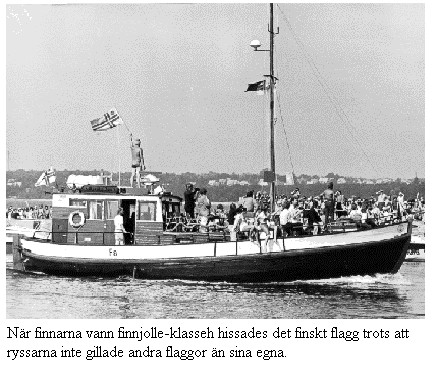
The fairways were well marked; it was joked that it was like driving between two fences. Undeniably, it gave that impression when looking along the fairway through binoculars. We arrived in Helsinki in the evening and met the others in the Flipper flotilla. During the gathering there, a discussion arose about which flag to fly during the sailing events (if we weren't allowed to fly our own). Everyone agreed that one might possibly stretch to the Olympic flag, but no further. Otherwise, it would have to be without a flag. On Tuesday morning, it was time to set off for Tallinn. The "armada" consisted of about fifteen boats of a few different makes: Flipper 850, Flipper 700, Stormskär, and a fast "board" of open type. The driver stood behind a plexiglass screen, dressed only in a suit, white shirt, and tie. The boat did about 40 knots, and since we were to arrive at the same time in Tallinn, his trip became somewhat jerky. He took off at 40 knots and then had to bob around on the Gulf of Finland waiting for us to catch up. After a relatively short sailing time, we could leave the Helsinki fortress behind us, and when it began to disappear astern and we had come out into open sea, we could count 18 vessels, more than half of which were Russian patrol boats. The Tallinn fortress began to emerge from the sea haze, along with a destroyer and a few more naval units. It would turn out that the entire Tallinn Bay was well sealed on all sides by the Russian Baltic Fleet.
Just before the entrance buoy, we got a pilot to the lead boat and could make out Tallinn's profile through the haze. The TV tower, Långe Hermann, and the other characteristic buildings appeared one after another. We chugged in through a rather narrow harbor entrance, on both sides of which stood little men in large green "furaschkor" (peaked caps) counting us in, like sheep in a pen.
The customs formalities took quite a long time; ideally, the customs officers would have liked to overturn the boats to get at the contents, but when that wasn't possible, they contented themselves with being offered a cup of tea and unscrewed the hatches over the fuel tanks. The customs officers had, as usual, help from the border soldiers and the passport-checking officers from the border troops. These are almost always career people, with the Komsomol badge on their chest and faces as if carved from stone – if they didn't look like they had been chewing on nails. A little cocker spaniel was also there as a drug dog, and it sniffed in all spaces, but when it was to jump ashore from one of our boats, it happened to slip on an oil stain on the pier and ended up in the water. The dirt and disorder were, as always, the most prominent features of all Soviet life, and cleaning up the oil stain was out of the question; one simply did not do that.
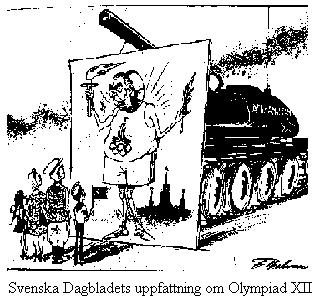
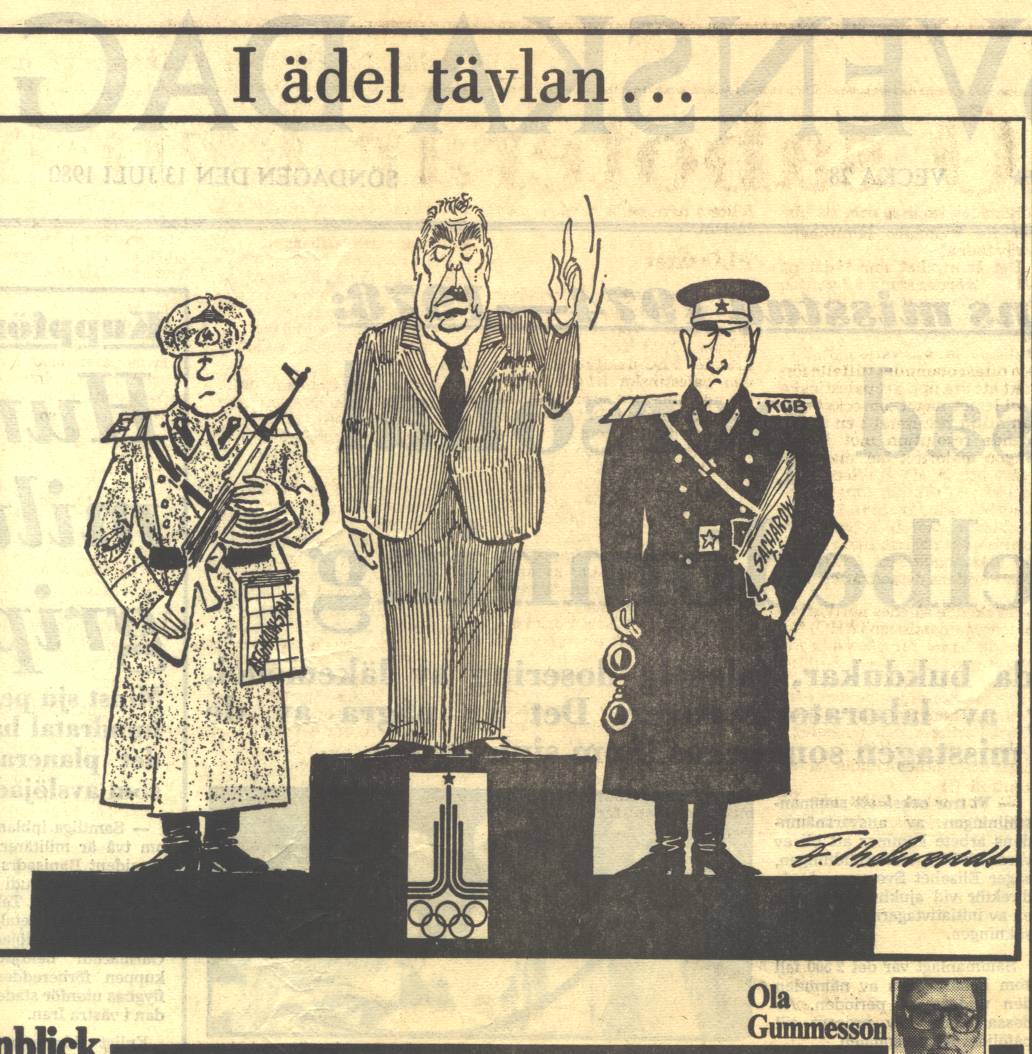
Most things were handled relatively quickly. One of the Flipper boats had been rented out and not sufficiently "cleaned": they found a copy of Fib Aktuellt with juicy nude pictures, and therefore it got an extra trip to another quay, where it was examined more closely. For my part, I had placed on the saloon table the editorial page from "Svenska Dagbladet" with Brezhnev as the "angel of peace", and the customs officer wanted to take it with him. I pointed out to him, however, that it was an official Swedish newspaper and that he had no right to confiscate it, and the customs officer had to give in. Of course, it was a provocation on my part, but one has to amuse oneself somehow. After just a couple of hours, we were ready to sail in to the "VIP quay", which would be our "home port" for two weeks ahead.
The Olympic harbor is located outside the city, in the Pirita area, which takes its name from the Birgitta monastery, whose mighty gable ruin (practically the only thing left of the former monastery) forms a landmark for sailors. We were to stay at Hotel Viru in Tallinn, and the buses were ready to take us there. The coastal road between Pirita and Tallinn, which previously was in very poor condition, had now become a splendid motorway with two lanes in each direction and lawns in between. Only service traffic was allowed on this road during the sailing events. During the journey, we could behold the other – from the sea clearly visible landmark – a peculiar concrete lump, intended to represent some kind of monument to the glory of socialism. Its shape invites imagination, and the Estonians have renamed it "Brofästet till Finland". It actually looks like the beginning of a bridge – unfinished – like most things in the Soviet Union.
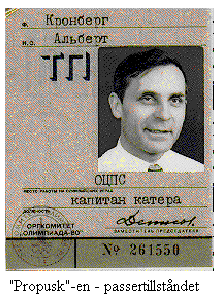
Upon entering the hotel, a very thorough inspection of the carried belongings was undertaken. They had installed a metal detector and very carefully checked the contents of every bag. This then occurred at least twice a day, both when entering the Olympic harbor and when we were to return to the hotel. It turned out to be a fortified castle with militiamen outside and inside; no unauthorized person was allowed to enter without a "propusk" – a pass. Sometimes, however, formalities are not enough. One evening, when we returned from the sailing events, there was a big commotion at the entrance. A police sergeant in uniform ran past the checkpoint without having passed the detector. Jokingly, I said to the militiamen standing there.
‑ "I wouldn't let him in like that without further ado; he could be a dangerous criminal." This had its effect; they took the militiaman and checked him as well. Most militiamen (policemen) seemed to be assigned to the regatta from other parts of the Soviet Union, mostly people from the southern border republics, and the Tallinn residents had roughly the same opinion of them as the average Swede has of foreigners. "Tjernyje", i.e., blackheads. They buy up everything we have in the shops, was the Tallinn residents' opinion of them.
There were many boat tourists who had written to Intourist and tried to book a place in Tallinn to stay during the regatta. The answer had almost always been – no vacant rooms at the hotels. Reality was, as always in the East – different. In the entire Hotel Viru – with 22 floors and about 20 rooms on each floor – there were a total of about 300 people staying during the regatta. On floor 12, besides me and Jan-Erik Jonsson, there were two other people, plus the obligatory "nyckelpigan" and a fire and safety soldier – a cadet. The active participants with their entourage were staying at Hotel Olympic, and it is said it wasn't particularly crowded there either.
To a foreigner, it might seem excessive to have a "ladybird" on every floor, but upon closer acquaintance, certain things become clear and one realizes that under the prevailing conditions, these ladies had a rather important role to fulfill.
First and foremost came naturally the surveillance function; both political and moral. However, these ladies made their greatest contribution in fire protection. I spoke with our 'ladybird', a middle-aged Estonian woman, and she told me that in the previous half-year alone she had helped extinguish 4 fires in rooms. Russian carousing often takes violent forms, they drink heavily and upon going to bed there is a papyross - the Russian cigarette. It was the guests who smoked in bed that caused the fires, she said.
We had arrived in Tallinn in good time ‑ the first few days we didn't have much to do other than familiarize ourselves with the Olympic Village, the city and its inhabitants, or rather those who were still there. I had visited Tallinn a few times before and knew where the 'leisure committees' used to gather. Now they were gone without a trace. According to reports, they had gathered up the entire 'A-team' of the city and given them a vacation in the countryside, and the same was done with the younger children. Half-grown brats, who normally run around tourists begging for gum and wanting to buy jeans, had been dressed up in traffic monitor uniforms and placed on street corners to ensure that no one used anything other than the crosswalks when crossing the street. If anyone crossed any old way, they used their whistles. I had my boatswain's pipe with me, and sometimes we had a little duet; the young lad became very confused and turned to his 'supervisor' ‑ a militiaman ‑ who always stood just a few steps away.
Tallinn has benefited from the Olympics, at least temporarily. The Old Town is spruced up beyond recognition, house facades painted and streets repaired; we felt almost as if we were in the Middle Ages when we strolled along Long Street in the evening.
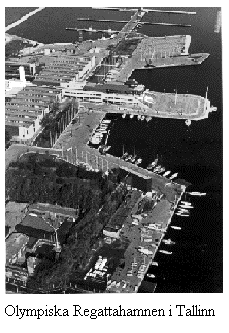
Everything was to be neat and tidy. The Kirov collective farm's boat harbor was temporarily arranged for the few foreign visitors. They had received permission to come in their own boats to the regatta. The collective farm harbor lies about fifteen kilometers from Pirita and the cost of staying there amounted to about 1,200 kronor, but if one had enough foreign currency and a famous name, one could moor one's vessel in the Olympic harbor. For a couple of nights, Krupp von Bohlen's large pleasure yacht lay there, and one could, with a certain travesty, use Emperor Vespasian of Rome's words when his son criticized him for taxing public conveniences: 'Num odore offendetur' - money does not stink.
When the pilots, which every VIP boat was required to have, were assigned, we got the chief pilot of Tallinn harbor, and our boat was to be placed at the disposal of the head of Estonian Radio, TV and Press, Aado Slutsk, i.e., to be a representation boat with certain advantages. A representation boat is to drive VIPs and other prominent persons out to the competition areas, and these should also be offered something. We had some provisions loaded on board every morning ‑ both stronger and weaker goods in solid and liquid form to entertain guests.
After a couple of days' rest we were to start working. The first outing was with a number of photographers, before the actual competitions began, to take some pictures of the Tornado class out on Tallinn Bay. That very day it was blowing 5-6 m/s, quite suitable weather for Tornado, but not for the rest of us. We tried to keep up with them, but there wasn't much chance. Despite us doing about 15 knots in the rather choppy sea, they sailed away from us without too much difficulty. It was raining and the photographers had great trouble keeping their lenses clean from water spray.
On the whole, we had good weather the whole time, both during the crossing and during our stay in Tallinn; only a couple of days during the actual regatta was the weather bad. It doesn't need to blow very much; if the wind comes from the north, Tallinn Bay soon becomes quite choppy. Waves can reach up to 80-100 cm in height, and then it's not so good to compete with small boats ‑ nor is it particularly pleasant to go by motorboat at any speed.
We experienced another such day out on the course. It might not have been as bad as it seemed at the time. The reason was that the evening before we had been invited to a soiree with variety show at Hotel Viru. We had a few snaps with dinner and later met four or five people who claimed to be history teachers but hardly knew when the Battle of Narva took place (when was that, by the way?). Presumably they were state security personnel. It was a long evening, and it was almost getting light before we got back to our room. When we were to take the boats out, the waves were still high (not only on the sea), the rain lashed down from above, and as soon as the boat picked up speed, spray came from below as well. The canopy had to be on, the windows fogged up, and everything was damp and hard to manage. It was so that one didn't feel particularly 'seaworthy'.
On the first sailing day, we had the chief, Aado Slutsk, on board with his guests, a charming French couple who later invited us for a cocktail at the Press Centre. Aado Slutsk spoke excellent German and quite good French; it turned out that in his youth he had spent several years in Paris and Berlin. That particular day happened to be perfect for excursions: hardly any wind and no sea swell. For the sailing, of course, it wasn't so good. The catamarans could make some speed, the other boats barely moved, and it was close to them having to be towed back to harbor. We made a tour around the sailing distances, but mostly it became a pleasure trip. The French guests were not particularly interested in boats; they were probably invited to the Olympics as representatives of the 'brother party'; the next day they were to travel to Kiev to watch football. Later we found out that the man was a brother of the leader of the French Communist Party.
Besides the VIPs, we had quite a lot of people from the Soviet news agency 'Novosti', and one of them turned out to be much more interested in 'Flavia' than in the sailing. He was happiest when he got to steer the boat and open up the throttle as much as the machinery, decency, and consideration for other traffic allowed. He was so interested in this that I couldn't resist putting my promotional cap with the text 'Flipper' on him. Later he came and wanted some decals with the 'Flipper' seal to put on his own boat, which he said he had somewhere on the Moscow River. His photographer had a Hasselblad copy and complained that his countrymen hadn't succeeded very well with the copying. It was a Hasselblad with a focal-plane shutter, and he told that the Soviet 'copiers' hadn't managed to get the curtain to run evenly. It rushed at the beginning and slowed down towards the end, the exposure became uneven across the image field. This was especially noticeable in color photography. He borrowed my Hasselblad with a 150 mm lens to get really good pictures.
The working hours were fairly light, but there were no difficulties in passing the days and evenings. We looked around town and sometimes tried to get into a restaurant, but despite there being relatively few people left in town, the restaurants were mostly almost always full. After a few days, however, we became acquainted with a man from the administration, and he knew (due to his profession) where all the company and association clubs and bars were. We discovered that there were quite a lot of 'semi-secret' ones, where you could get in if you knew which door led there and whom to ask for. These doors never had any signs.
One morning while we were waiting for the day's guests, I saw a group of black-clad men near the regatta office. When I picked up my binoculars to look more closely at who they were, I found it was my 'friend' the Grand Admiral of the Soviet Union Sergei Georgievich Gorshkov with his entourage. In September 1978, he had visited Sweden. Antti Nordberg, Dan Nosell and I served as interpreters during that visit. I naturally intended to greet him, I thought. The day was quite hot, and I was wearing only swim trunks and my identification badge; he and his men were in full regalia, in black uniforms bedecked with orders and decorations. I didn't have time to put on any dress uniform, just pulled on a sweater with 'Flipper' on it. When the admiral passed near us, I stepped forward and greeted:
'Good day, Herr Admiral! May I offer you a boat trip on the motorboat? It admittedly doesn't hold the whole party; it's somewhat smaller than the destroyer 'Småland', which Admiral Lundvall invited you for a trip on at Horsfjärden, but if we leave all the captains commander ashore, perhaps it will work.'
He naturally had some difficulty recognizing me; he had only seen me in uniform; a half-naked civilian slob is an extremely uninteresting person for a military man of his rank. Somewhat perplexed, he looked at my ID card, gradually recognized me, and said:
'Oh, so you're captain of your own boat now. But either everyone goes or no one - "vse ili nikto!"'
In my mind's eye, I saw Flavia sinking in the harbor basin under the weight of six or seven sturdy captains commander, so there was no outing with the admiral and his staff officers. I had hardly expected that anyway.
Fourteen days pass quite quickly even when there is little work and plenty of free time. We didn't earn any money from the stay, but we had seen the XXII Olympic Regatta from the front row, gotten tanned, and had a fairly pleasant vacation with Estonians, Finns, Swedes, and the occasional Russian.
One fact was that there were unusually few Russians involved - at least in the visible part. We experienced the 'invisible' part one of the first days, when we had moored the boat and left it in the hands of the militiamen in the harbor, which was hermetically sealed at night. During the night, 'someone or some people' had visited the boat and rummaged through its papers. Jan Åke got angry and went to the director to complain, arguing that if there is security posted, the boats should be left alone; otherwise, we would have to sleep in them. 'Well, yes,' said the Estonians, 'but we can't control "the grey ones".' We could of course go to the militia chief with a complaint, but they preferred that we didn't, as they would themselves incur some of the displeasure.
Occupying powers are seldom welcome, despite all the fine words about brotherhood between peoples. The Swedes were hardly so during the Age of Empire, nor the Germans during the Second World War, and probably least of all the Russians now. We often heard the expression: "It's pleasant to socialize with white men; one can discuss and air one's views without having to watch one's tongue." A Swedish newspaper, which I had "ordered" a militia captain to go and obtain from the forbidden press center, became hot material; everyone wanted us to translate the articles.
The language was mainly Estonian; the Finns had an advantage and could socialize with the "natives" without any major difficulties. We managed well linguistically. I knew the local "lingos" – Finnish and Russian – as well as passable German. Jan Åke spoke Russian and Italian. Most of the pilots spoke English well enough to make themselves understood with the Swedes, but there was one exception. One of the pilots, a Russian – unlike the other pilots who were Estonians – had apparently been appointed by the authorities outside the regatta and could essentially only speak his native Russian. He was a naval officer and the only one who, during the regatta, got a "taste" of the sea; during a sharp maneuver he fell overboard. The maneuver was perhaps somewhat unwarranted, but as the crew of the Finnish boat said:
- One couldn't help but see him fall into the water, standing there so unguarded at the bow.
After two weeks' stay in Tallinn, I felt I understood that the language of the authorities is not particularly popular. The majority of the native population would not pass the Interpreter School's examination, and "Sigge" Sigvard Lindkvist, the head teacher at the Interpreter School in Uppsala, would weep with despair. Whether it was a matter of local custom, or a lack of interest – one thing is certain: it works perfectly well to speak Russian without paying much attention to case, gender, gerund, perfective or imperfective verbs. The situation seems to be the same in all the Baltic states I have visited. As soon as you get outside the larger cities, there are often great difficulties in managing if you do not master the local tongue. To a strikingly high degree, for example, the female half shows no interest in Russian. At a restaurant I danced with a woman who turned out to belong to the militia corps. She was from the interior parts of Estonia, and I asked her how she could manage her work with such poor language skills.
- It works perfectly well, she replied; "the bosses" speak Russian, after all.
There is not much to say about the departure, except that the customs formalities upon leaving were truly no more than formalities – but then the deputy minister of sports herself, Maja Imelik, stood on the quay saying goodbye to us. She was one of those people who did their part so that we would not be too burdened by the regulations.
The return journey offered no major adventures; inside the Åland archipelago we ran aground on a shallow and had to change the propeller. Some other crews, who had more experience of trips to Russia, smuggled in some liquor. The Flipper boats are made of fiberglass, and the smuggling went smoothly. The reinforcement of the plating in the Flipper boats consists of a square fiberglass tube – just the right size to be filled with Russian half-liter bottles. Roughly amidships on both sides of the boat, the individuals in question had drilled holes to insert the bottles, filled the entire gunwale with half-liters, and to prevent customs from noticing, glued the holes shut so that no one could detect anything odd about that gunwale. A number of beer crates purchased in Tallinn were offloaded on a skerry before clearing customs at the Finnish border station. There were no major profits, but it added a bit of excitement to life.
Recordings
- 1980OlumpiadenC.mp3
- 1980OlympiadenA.mp3
- 1980OlympiadenB.mp3
- 1980OlympiadenD.mp3