The Croft Lilla Fredrikslund – 80
Ourgeneration still belongs to countryside dwellers - both Ann-Mari and I were born in the country and have never become completely city dwellers, there was always a certain longing for the countryside and for the somewhat primitive living conditions that prevail there. Why else would one move out to the countryside with all the trouble it entails, one could live in one's pleasant city apartment, feel good and do nothing. In earlier years we had neither the time nor the money for a summer cottage, and the thought of getting one began to sprout only after the children had left us and our financial situation came somewhat under control. In reality, the age of 50 is far too old to get a summer cottage, but we were quite healthy and had no thought of our age.
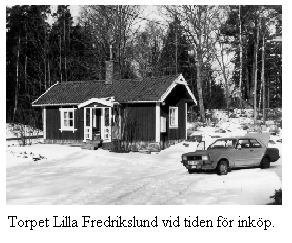
In the late 1970s we began somewhat idly to look at summer cottage ads, but for quite a long time it seemed there was nothing that would interest us. There were plenty of offers in summer cottage areas, but just a modern summer cottage with a few hundred square meters of land seemed not very interesting and we were probably not entirely eager to proceed too quickly because money was really lacking for the venture. We had a housing savings account with the maximum amount of 30,000 SEK and on that we could borrow an equal amount from the bank, but one still wouldn't get any decent cottage to speak of for that sum. A few years passed and nothing happened. We worked on as usual and I 'played' teacher at TBV, Studiefrämjandet, and some other adult education associations. No big money came from that, but the savings amount grew gradually. When you reach a certain age, the need to buy gadgets decreases and we had basically what we needed, but no summer cottage.
Some time in the autumn of 1979 I was on a Studiefrämjande course for immigrant teachers in Eskilstuna when my colleague at Studsvik, Nils Lundgren, had called and told Ann-Marie that there was a cottage for sale near Flen. Ann-Marie called me and told me about this, I got the phone number of the seller. On the way home I stopped by Helgesta, as the place was called, and met the owner: Sten Sture Alexander Hummerhielm. It turned out to be an old croft that the owner wanted to sell. He had bought Helgesta Gård a few years ago and had rented out the croft and another house (the former barn foreman's residence), since the farm had no milk cows and no extra staff was needed. The rental was probably no longer a good business, so now both the croft and the other house were for sale.
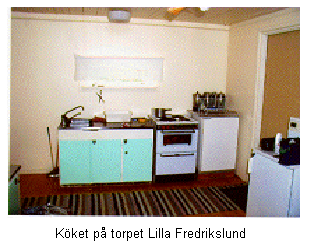
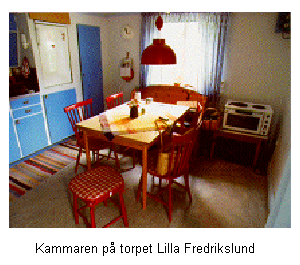
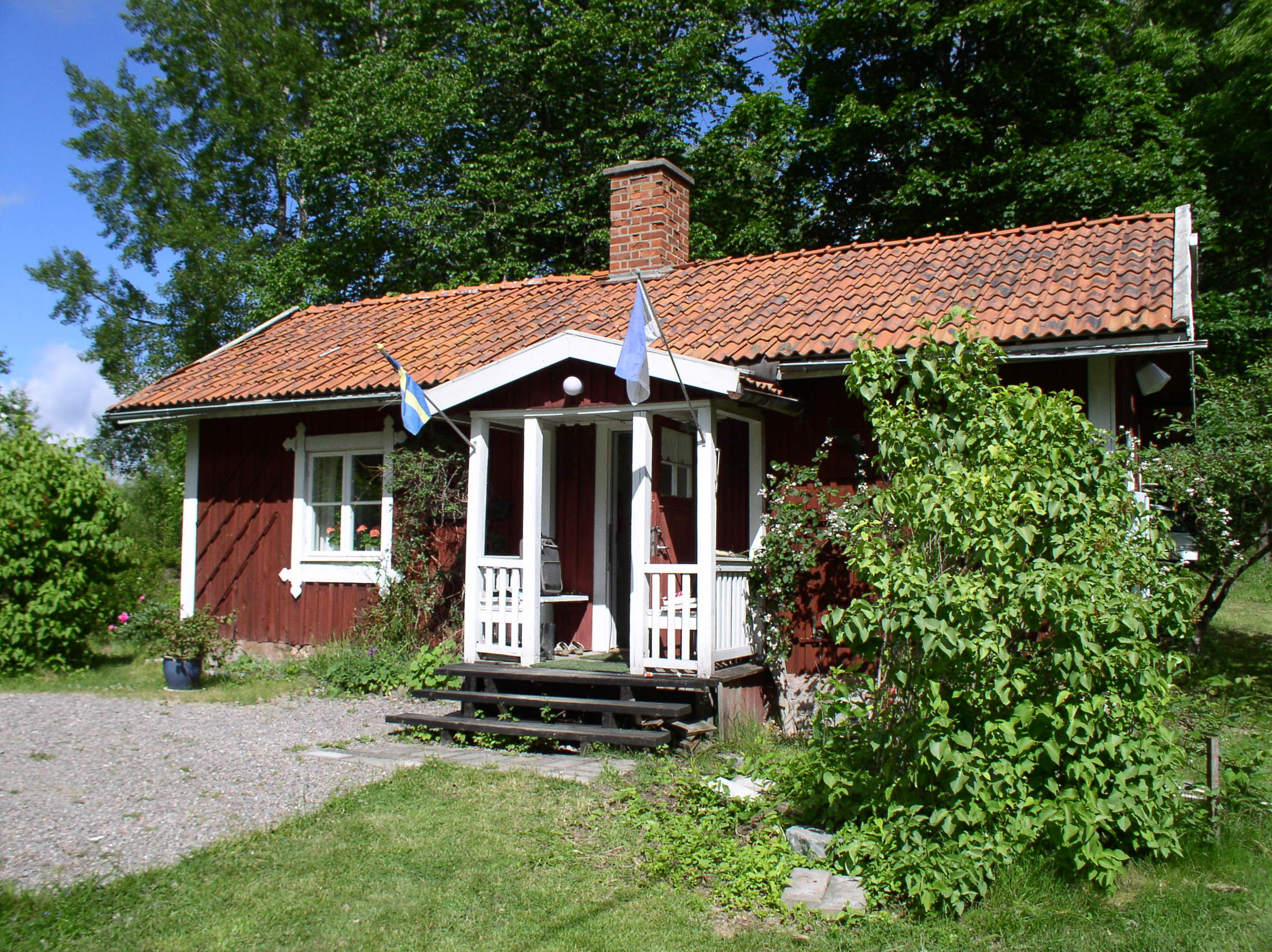
The croft turned out to be a house of the soldier-croft model, such as were built during the allotment system period, and consisted of a kitchen and a chamber as well as a small entrance hall with veranda. The total area is about 37 square meters. The plot was almost 3,000 square meters, half of it fairly usable level ground, but a very large part was strewn with large stones because the plot faced a ridge of rounded stones. Also a larger barn (about 100 square meters), which was used as a carriage hall and garage, was included in the purchase. It was more or less empty, only a few partition walls were put up. Another small shed lay in the middle of the stone heap, but it was in rather poor condition and could only be used in summer. The croft, on the other hand, had a good stove in the kitchen and a tile stove in the chamber, so one could stay there even in winter if one wished. Three-phase, 16 amperes had been drawn to the house and water was available both indoors and outdoors. The water came from Lake Båven through the farm's supply. It all seemed very tempting, here one could keep busy both until retirement - and well after, if our health held up.
I was not the only speculator. Also Vivi-Anne Englund, the telephone operator from Studsvik, had seen the ad and was there with her new partner. They thought, however, that the price was somewhat too high for them, said Vivi-Anne, 150,000 SEK, and in fact also for us. The plot was quite shabby, it lay on a ridge of rounded stones slope and half the area was covered by very large stones. It seemed very interesting though and I told the owner that I would come back with my wife and we would inspect the croft more closely. I asked Nisse Lundgren to come along and help examine the house to see if there were any major hidden defects, Nisse had very good knowledge of such things, he owned a freehold summer house from Rockelsta Manor.
A closer examination showed that most things were in order, the house appeared to have no major flaws, and the outhouse was quite newly built, the planks were still white. There one could arrange some rooms to have the children or other guests in.
The flaws that one could see were perhaps that the chimney was in poor condition and the roof needed to be replaced. According to the owner, Count Sten Sture Hummerhielm, however, the chimney sweep had been and pressure-tested the chimney, so that the fireplaces were in order and could be used for fires.
When I together with Ann-Marie had looked at the house, we both thought that this was something that would suit us well. The house lay by a public road, at first glance perhaps a bit too close to the road, but the traffic would not be disturbing, according to Hummerhielm, it was mostly in summer that an occasional car drove by. Road 604 is a smaller road that cuts off a triangle from Eskilstuna-Nyköping and Södertälje-Norrköping and the croft lay exactly halfway, 300 meters from Södermanland's largest lake Båven.
Now we had a headache with the financing. How would it happen? We really had no surplus of money. We had managed to save a few tens of thousands of kronor, had 30 thousand in the housing savings account and the bank promised to lend us an equal amount. However, 70 thousand kronor were lacking for the financing of the purchase, but it was resolved. Hummerhielm agreed to accept a promissory note for 70,000 SEK at +4% above the discount rate. We could perhaps have bargained a few tens of thousands of kronor, but we thought it was just as well to complete the purchase, otherwise the croft could slip through our fingers. We paid 20,000 kronor as a down payment and signed the deed of purchase, the croft would pass into our ownership on 1980-01-01, but we would not be able to take possession until April 1. The previous tenant had a contract until that day.
Now we were happy owners of 2750 square meters of land and I immediately started to cultivate the land. The only dug-up part was a small herb patch in front of the sleeping shed, the rest was neglected and I had a tough job digging up the patch that lay between the house and the road. The grass had grown long and it was difficult to get through with a spade. I dug, sweated, and when it became too tiring I read Singer's 'Inspirationer'. It took many hours of sweat and toil, but when spring came and we could move into the croft, there was nearly 100 square meters of land to grow vegetables on. The land had lain fallow for many years and was quite clayey, I had to fetch several loads of horse manure from a former smithy that had been used as a stable, where they had kept some ponies. No mucking out had been done for a long time and full-grown horses had had to stand on their knees in the stable to avoid hitting their heads on the ceiling. It may have been a bit too much manure, the first summer the potato plants grew so tall that no growth energy was left for the tubers. They were only slightly larger than peas.
At the deed of purchase settlement, Hummerhielm wanted us to renounce the water easement from the farm after a few years, but we could not agree to that, then there would be no purchase. There was no other water on the croft then, and if one were to have a deep well drilled (for which we had no money anyway) one still did not know how it would turn out. Södermanland has been a lake during the ice age and a lot of saltwater pockets exist under the ground. The risk of very iron-rich water was also close at hand. Our fears have proven to be well-founded, the neighbor at Stora Fredrikslund drilled a deep well a few years after they acquired the house, but have no joy from the deep well except that in dry years they can water the lawn and kitchen garden. The water is strongly iron-rich and not usable.
We got to keep the water easement and that was lucky.
There were two water outlets - one outside the cottage corner and the other in the cottage kitchen. I immediately started arranging for hot water in the kitchen, but Ann-Marie thought it was not necessary.
'We have a stove in the kitchen to heat water on,' she said, 'that works perfectly.'
I did not give in however, we would have some modernization anyway and water was the most suitable to start with. It is so nice to come into the kitchen and wash one's hands in warm water after having worked outside in chilly weather. A water heater was purchased at Friberg & Still in Nyköping and with the help of colleague Björn Grönroos the installation was completed. The device had worked excellently until some time ago. Suddenly we had no hot water and I had to leave all other tasks to fix the water heater.
I quite calmly pointed out to Ann-Marie that now she could practice her theories about heating water on the stove, as she had intended to do earlier, but now she did not want to hear of it - the hot water was necessary. There was no major problem with the water heater, the thermostat had tripped and it was just a matter of pressing the button again.
After taking possession of the croft, I started looking for where I might try to dig a well, for our own water at least for household needs. The first summer not much was done, I started digging in a small depression in the eastern part of the plot and it soon filled with water, it seemed promising. We were not at the croft much that year, other things got in the way.
1980 was an Olympic year and one of the students from the Interpreter School in Uppsala - Jan-Åke Johnsson - called and asked if I wanted to come along as crew on his Flipper 850 in Tallinn. There were about 15 boats that the Russians had hired to transport and sail around the dignitaries. In total there were 16 units, divided between Sweden and Finland - mainly Flipper 850 and Stormskär. Finland had also provided a larger, former fishing vessel, which had been converted into a floating office for a Finnish coffee wholesaler. He kept in touch with his customers through a sophisticated radio network, the former holds were converted into a salon and bedrooms - and of course there was also a sauna, otherwise it wouldn't have been Finnish.
There was some trouble when the boats were to set out. The Russians wanted us to have the Soviet red flag at the stern, but we naturally wouldn't go along with that – either the respective country's national flag or nothing. When that didn't work, the Russians wanted the boats to be flagged with Olympic pennants, but the resistance was just as strong from our side, the result was that we sailed "anonymously".
Upon returning from the Tallinn regatta, I once again took up work on the well and had some help from Waldemar - my nephew. I had sent him an invitation a few months earlier to visit us in Sweden and now he had received permission to come. I had dug some, but the digging had been interrupted due to the Olympics. Now we resumed digging, but it was accompanied by immense effort. After only half a meter we hit a stone.
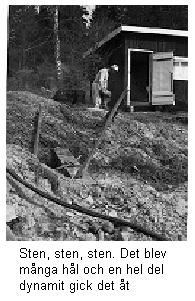
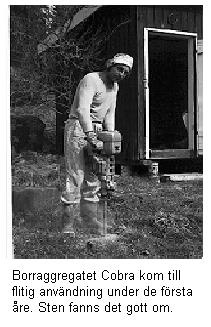
Well, I thought, I'll have to drill a hole and try to blast it. From my years working with Ann-Marie's uncle Sten Christansson I had quite good experience handling drilling equipment, fuse wire, and dynamite. My military service with the Coastal Artillery and the Navy had also contributed to increasing my knowledge of blasting techniques – each conscript cohort had the task of building some new bunkers, at that time there wasn't much talk about shoreline protection yet. Through one of the neighbors I was able to rent a Cobra from the Nyköping Street Office, and the police were kind enough to grant permission to purchase 5 kg of dynamite, some detonators, and several coils of fuse. When I had blasted away the stone and hauled off some of the rubble, it turned out there were many more stones underneath. It became a matter of blasting on weekends, and Mrs. Hummerhielm said on one occasion that they knew when we were at the cottage because the ground shook at regular intervals.
It was hard work. The property borders a glacial esker and the well site is only a couple of meters from the esker's end onto flat ground. However, water seeped in almost constantly and that spurred us on to keep toiling. Unfortunately, Nyköping still had Cobras of the old type and sometimes too much time was spent getting them to work. Now I worked with Ann-Marie as my helper in the autumn of '80, all summer '81, and part of '82. I blasted and then loaded the debris into a bucket, which Ann-Marie would haul up and empty nearby. It was strenuous work for both of us, and when the well hole gradually got to nearly 4 meters, I had to rig up a small electric hoist – Ann-Marie couldn't manage to lift a bucket of stones all the way up. We can probably say that we have lifted twice the volume of the well in stone, mostly by arm power. The blasting work went reasonably well, but it is never completely risk-free, and on one occasion it nearly went wrong.
I had drilled, loaded with a couple of "dynamite sticks" and lit. As a rule I worked with a 50 cm fuse so I had about 1 minute to climb up and pull the ladder with me. Since the well hole was farthest from the houses and I was working with relatively small charges, I considered that no covering was needed. I climbed up and walked a bit away, waiting for the explosion. A wait always feels long and now it became longer than ever. I looked at my watch, one minute had passed but nothing had happened. According to military regulations, you are supposed to wait about 10 minutes before approaching. I waited 10 minutes, but still no bang.
'You're not going there!' said Ann-Marie.
It was time for afternoon coffee and Ann-Marie called that coffee was ready. When we had been sitting at the coffee table for another ten minutes, it suddenly went off. It felt a bit eerie and I still haven't gotten any explanation as to how a "heart wire" in the fuse could keep glowing for so long and then ignite the powder again. The fuse was guaranteed not kinked – you carry the entire coil around your neck and are careful not to bend it too sharply or damage it in any way.
After many days of toil we finally had a large hole gaping next to the birch trees and water kept seeping in constantly. It had gotten to be summer 1982 and we were quite tired of the blasting. It was also expensive to rent a Cobra and since it didn't always work satisfactorily, we decided that now the depth was enough. I prepared the bottom and ordered the well rings. To get a reservoir of decent size, we decided on 120 cm rings – that would give good space in the well both for water and for work with the suction pipe and bottom valve. Enstaberga Concrete Casting came with the rings and we placed them in the hole. After making holes for pipes and casting a number of steps into the walls, it was time to start pouring sand. Despite most of the material taken out of the hole consisting of stone chips, the extracted volume was still almost double that of the well itself and now that volume was to be filled with sand to serve as a filter. It was almost as laborious to fill the hole around the well rings as it was to take it out, except that I could do this alone, without Ann-Marie needing to be there. With the top ring a few decimeters above ground level and a thick layer of sand around the rings, we could count on a certain filtering effect. When the fine-grained clay that was in the water had settled, I took a sample of the water. Ulo Teder at Radiology in Studsvik performed a water analysis and could confirm that the quality was excellent. There were only a few ppm of manganese that was too much, otherwise the water was bacteria-free and had a good composition. The well hasn't given such large quantities of water, but with a bit of thrift it has always lasted the whole summer. Admittedly, the well should have been somewhat deeper and I have sometimes considered lifting the rings and blasting a couple of meters more, but it probably won't happen. In November 1982 we could take our first sauna bath at the cottage. Cables, water hoses, and drain pipes were still hanging here and there, but the sauna worked and it felt truly wonderful to sweat it out, wash oneself clean, and become like a new person after the day's sweaty activity. One becomes that after the sauna, then let some ignorant prophets say what they will.
Stora Fredrikslund, a two-story building some 50 meters from our cottage, was also for sale. The house had stood empty for a while. It was bought in 1982 by a Stockholm civil engineer couple: Gunilla Waldemar and Tonny Svensson. The first time they stayed in Stockholm and came to the country only on weekends, but after some time they sold the Stockholm apartment and moved permanently into the former foreman's residence. They had a deep well drilled a few years later, but had bad luck with it. The water is strongly iron-bearing and it cannot be used even for washing, only for watering lawns and gardens. The deep well (40 m) has been in operation for several years now, but the water quality unfortunately has not improved. They will have to install a precipitation and purification unit before the water becomes usable as household water.
When our well started functioning, I rerouted some pipes. The old outlet at the cottage gable was dug up and with Björn Grönroos' help, the well water was connected to the kitchen and the utility water from Båven was used for the garden, sauna, and car wash.
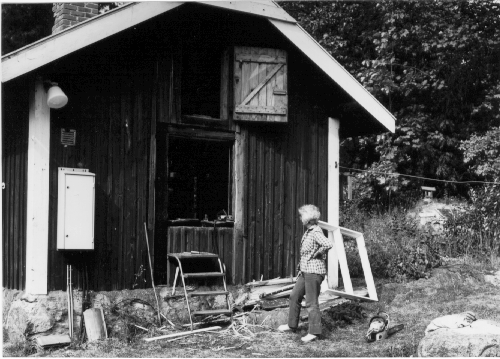
If you are born in a sauna in Russia and have lived in Finland, it entails certain obligations to the body – one cannot in the long run imagine living in the country without a sauna. Now that the well was in operation, I started eyeing the little shed – it could become a good sauna, but it would require a lot of work. The shed had a sloping roof, the floor was somewhat loose, and the spaces were minimal. Sometimes one is surprised by the behavior of builders. Here there was an infinity of stones, but the builders had damn well managed to place one shed corner on bare ground, and that corner wasn't much good now. However, it was necessary to get a somewhat functional facility going, so that corner would have to remain for the time being. We tore up the floor, lifted the hut using jacks borrowed from Studsvik, and poured new foundation pillars. After a few weekends of work, the sauna was roughly finished and we went to Adelsö – where there was a used sauna heater for sale. It cost 400 kronor plus labor, pipe installation, a new electrical line, and a drain pipe (from the dump in Studsvik). Overall, the Studsvik dump has supplied quite a lot of equipment for the cottage. The water heater is from a high-vacuum high-temperature furnace in which Allan Brown and I boiled off a uranium pellet on one occasion. The actual purpose of the experiment was to make voltage measurements during sintering, but the viewing window gradually became covered with condensation and the temperature gauge showed incorrectly. When we discovered the error, a pellet of a few grams had boiled away and the remains of it coated the furnace walls in the form of a dark blue layer. It was arduous work to clean inside the furnace. Later the furnace was handed over to the Natural Sciences Research Laboratory in Studsvik (after our exercises ended when the fuel for the Swedish reactors was finished) and they didn't want the water heater. I put it aside in the basement and just a few months later we bought the cottage and the heater came into use. It has served us for nearly ten years and heated shower water for numerous baths.
A person with a Lutheran upbringing (even if somewhat deficient) is never truly satisfied. We suffer from Luther's thesis: "Ora et labora" (pray and work) or its longer variant: "Qui orat et laborat coer levat ad Dieu con manibus" (He who prays and works lifts his heart to God with his hands). Now the well and the sauna were working, but the water pump made quite a lot of noise. It was a Perfecta pump with a ceramic impeller and since there was no pressure tank for it, it screeched every time water was drawn in the kitchen. To remedy the noise, I decided to dig a small pit under the sauna and place the pump there, and insulate it a bit to silence the racket. In the rural tranquility, one wants nothing but natural sounds: the cawing of crows and the chirping of other birds.
When I had dug enough that the pump barely fit in the pit, I realized that servicing it would be quite troublesome. Might as well dig a bit deeper so that there would be standing room. Said and done. When I had gotten down to waist height and hit my head a couple of times against the floor joists, I decided to do something truly radical and dig out a real cellar under the entire little outbuilding.
As the digging progressed, I hit my head against the floorboards a few more times and a new decision emerged. Why should I have the disturbing house above me while I dig? It would go much better if I temporarily moved the entire house away so that the ground became free. Very opportunely, the Swedish Telecom had been along our road and replaced the ordinary telephone cable with a buried fiber optic one. There were a number of poles along the road that the neighbor was supposed to take care of (he had started to think about adding some rooms). I got to borrow the poles, fetched the jacks again, lifted the shed onto the poles and, with the cable puller "Tirfort" and Ann-Marie's help, hauled the shed about 6-7 meters eastward. It was just a matter of extending the electrical and water lines; the drain temporarily had to go directly into the ground, because if you have a sauna, you should also bathe. Now there were no obstacles in the way and it was just a matter of digging. One grows with one's tasks and the tasks grow with one, the goals recede further and further and become more and more ambitious. Now that I was at it and was going to dig a cellar, it might as well be a proper, large cellar and add on to the shed. By now the plan for a cellar had matured and I already saw in my imagination a cellar several meters wide (not to mention long) with plenty of room for the pump, hot water heater, and other sanitary equipment.
The will was good, but the practical obstacles arose in the form of large boulders in front of, behind, and under the shed. The ground otherwise consisted of hard-packed gravelly sand and the spade alone was useless. Most of it had to be chopped loose with the pickaxe before the soil could be shoveled out, and sometimes I felt like a miner. Once again the Cobra and dynamite came in handy. If I remember correctly, I fired about 4-5 shots under the sauna to split the large stones. Partly I had already cleared quite a bit around the future hygiene house, but it turned out that there were quite a few large stones in the ground. As the pit became deeper and larger, it became difficult to get rid of the soil and we had to make a hoisting device in the form of a wheelbarrow that Ann-Marie had to pull up with the help of a small hoist, all while I walked holding the shafts for balance.
The ambitious plans just grew, and they grew to such an extent that we didn't finish any cellar that summer; instead, the pit stood there filled with water during the winter. Over the winter, the plans for building a proper facility matured. It was a nuisance to transport dirty laundry to Nyköping and wash it there. Why not expand the hygiene house to include also a laundry room? There was no shortage of used washing machines. With that, the plan was expanded further and when spring came, we started our digging anew. Now it turned out, however, that it was impossible to dig further in the western direction; there were some trees in the way and in the eastern direction the shed was in the way. Towards the yard level it could not be moved, so the only option was to move it up towards the ridge - 90 degrees relative to the previous direction. Once again the jacks came into use and two telephone poles were laid across the previous ones and lift the shed onto them in order to pull it away from its current location. It went well this time too.
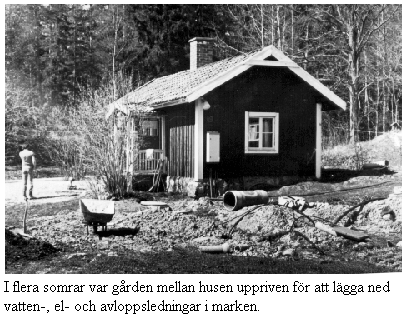
Now it was open season to start the really big digging. Here there would be a cellar both under the sauna and under the laundry room! As soon as I put the pickaxe into the ground, some obstacles appeared in the form of large stones. Dynamite was the only thing that could handle them, and throughout the summer there was a certain amount of blasting work. Of course, I should have ordered an excavator; then the work would have been done in a few hours, but since the ideas came at certain intervals (I was really only going to make a small hole for the pump), I did not realize the scope of the work and pursued the digging more like others pursue jogging or some other sport.
When the cottage was closed for the winter, there was a rather large hole next to the sauna and several large piles of earth around the hole.
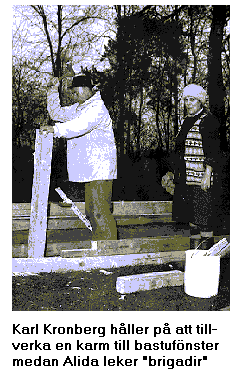
In the spring we started digging again, but the obstacles were many: hard gravelly sand, large stones, etc., and the work did not progress very quickly. However, by the end of the summer, the hole was so large that we began to think about the continuation. My Ingrian schoolmate Toivo Kiiski was a bricklayer and he promised to come and help with the brickwork, but when the agreed time arrived, he called and said that his wife had become ill and he could not come. Now good advice was expensive; we did not want to leave the hole in its current state over the winter. Our neighbor Tonny then suggested that he could help us with at least pouring the foundation. I had prepared the pouring quite well; there was about 15 cm of coarse gravel at the bottom, a lot of sand on top of it, and everything was ready to start mixing cement. One Sunday morning towards autumn, the cement mixer was started and the pouring began. Tonny had set up the bottom frame and the work got off to a good start; we were already rejoicing that we would finally reach a stage in the cellar building. But they say happiness doesn't last! Just as we were at it, a thunderstorm came and the power went out (for the first and only time so far). Several hours passed without the power returning, and Tonny suggested that we continue on Monday evening, but I thought this work should be finished, so we sat down and patiently waited for the power to come back. It took about 5-6 hours before the power came back, and by then the day was far gone. It was also quite late in the autumn. The work was resumed and the light began to disappear. I rigged up lighting and some rain protection (it was still raining), and the second half of the cellar's bottom slab was poured in semi-darkness, and we didn't finish the work until close to midnight. Not only did it rain, it also blew quite strongly, and I dared not let any tarpaulin lie as protection over the pour, for fear that it would fall down and land in the cement. The rain washed the cement off the surface and the floor became quite rough, but a floor it became nonetheless, with a drain installed.
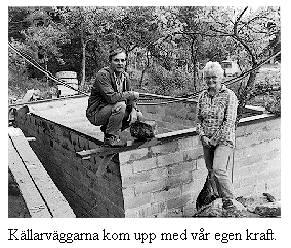
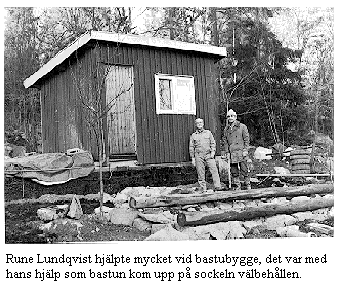
Since Toivo could not come, we had to brick up the walls as well. Once again Tonny helped us with the preparations and we got started. It was a rainy autumn and drying was poor; the 13 courses we had to lay took us a whole week. Inexperienced as we were, it didn't go very fast, but it got finished, and on the long walls the curvature was no more than about 5 mm. Not bad for a first time — at least we thought so. When the wall had dried, the sauna was to be moved up onto it, and that turned out to be quite a troublesome job. The sauna lay on its telephone poles and the wall protruded almost half a meter higher. I wanted full standing height and then some in the cellar. With the help of colleague Rune Lundqvist and Ann-Marie, we hoisted up the sauna and actually managed to get it in place without too much difficulty.
At one point the shed slipped a little and bumped against the cellar wall, but it held. After a while of new efforts and propping, we could behold the result of our labors; at last the shed sat on the intended spot and we could temporarily breathe a sigh of relief. Now winter could come, for we didn't have time for more during that building season. We covered the open part of the wall with tarpaulins and left it for the time being. When winter came and I could not work outside, it was time to tackle Tonny's drawings (he is a specialist in prefabrication and had finished the drawings for the extension). I got to borrow his garage and there I put together the roof trusses and the walls.
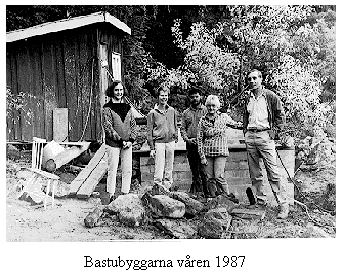
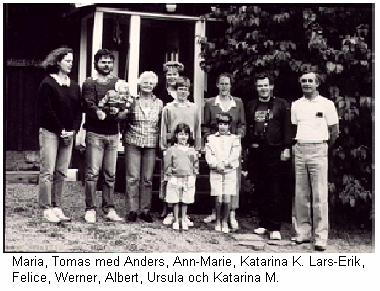
Spring came with dry and good weather for building. We managed to gather a few enthusiasts: Maria's companion Juha, Stor-Anders, and our son Tomas. It took longer than I had thought, but by Sunday afternoon the walls were up and the roof trusses as well as some roof battens were in place, and to keep the rain out we pulled a tarpaulin over the roof.
After a few weekends the roof was finished and part of the wall battens were up, but it took a few months before the whole house was complete with walls and everything. The house is well insulated and now we need only to close and drain the water that is above the basement level. The temperature in the basement has not fallen below +3°C over the past winters. At first we had some difficulties with moisture – the first year there was 5 cm of water on the basement floor, but in connection with a later re-laying of the drainage pipes, I had a channel dug between the cottage and the sauna; since then it has been completely dry in the basement and I can store moisture-sensitive tools down there without them rusting.
It took a little time before I figured out the final placements of the water pump, pressure tank, and hot water heater. Now everything is in place and has been working satisfactorily for several years. At first we used a Perfecta pump; later I got hold of an old three-ring water pump and after renovation and bearing replacement (with Kent Johansson's help at the ACL workshop in Studsvik) the pump has worked excellently.
The pressure tank was initially a 50-litre bucket from Studsvik; later I managed to get hold of a stainless steel pressure vessel with a volume of about 150 litres, which after various modifications (welding on the level indicator tube) became an excellent container.
With the sauna being installed – with a water heater – electricity became a little problematic. The 16-amp fuses just weren't enough; sometimes I had to run half-naked out to the fuse box on the pole and change a fuse while bathing. When the sauna and hot water were on, it was okay, but when Ann-Marie also turned on the oven, it was usually a bit too much and one phase would go out. After getting annoyed enough times, I took action and rewired the sauna's electrical system. Now one heating element is interlocked when the sauna is on; nor can you wash while bathing in the sauna – moreover, there is now a soft starter on the water pump, and everything is fine and dandy. With double heating elements in the hot water heater, it goes very quickly to heat up the water; it takes only a couple of minutes after switching on, you just have time to undress. When the sauna is on, one element is interlocked and it takes a little longer.
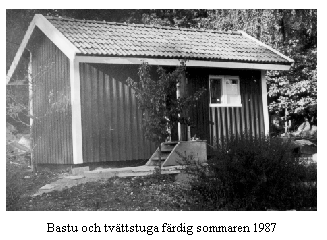
The shed, which now formed part of the sauna, had a sloping roof so that you could not sit upright in the lower part of the bench. I rebuilt that during the extension, and in the winter of 1987 I had to work to remove the slope and lift the roof to its proper height. After the sauna was finished, Rune Lundqvist suggested that I put up a sign:
"Building is great, building black is greater", alluding to the fact that this was in principle an unlicensed construction; the law was relaxed only a few years later.
The stones love me. The cottage is not exactly on sand; wherever you put a crowbar, it clinks. The northern part of the plot faces an esker and is filled with large boulders. A few poor plum trees had wedged themselves between the stones, but it was life-threatening to walk there. When the well was finished, a heavy job began to clear the plot, first with the help of a cable puller, later with a 400 kg Demag hoist, and when that wasn't enough either and the remaining stones were too large, I managed to get hold of a 2.5-ton hoist. When the O-effekt reactor in Studsvik was shut down, a lot of equipment became surplus. Two hoists lay for several years in the cold storage behind the workshop, and now the storage was to be cleared of everything that had been lying too long. I got wind of it and saved one hoist. The tractor driver Tomas Skeppare took the hoist up to ACL's (Active Central Laboratory) workshop. I washed the hoist with deionized water and then let it dry for about a week. After connecting the electricity, I did a test start – and the fuses blew. The brake on the hoist had stuck firmly during the seven years out in rain and bad weather. I had to loosen one end plate and knock the armature loose with the brake. Now it worked better, and with it I have pulled away nearly a hundred tons of stone up to the power line. There the stones lie as a barrier against the colder northern winds. Many stones, however, remain on the plot; that will have to be a second stage of the move some time later.
Rune Lundqvist is invited here to help, and then we usually pull away a few piles at a time. After a few years it should be completely clear here in the vicinity.
The cottage is old and some facilities have started to give way. In the autumn of 1989 it was time for another big job. Now a new drainage pipe had to be laid; the old one was getting alarmingly clogged and the drainage poor. Now it was such a big job that it wasn't worth digging by hand, and Roine Knutsson from Sparreholm was called in to do the work for 200 kronor per hour. The old well in the middle of the yard functioned well enough, but the drainage pipe was a cement pipe of older date and it had become quite thoroughly blocked. A large ditch was started from the drainage pit, and it soon turned out that there were some difficulties with the depth. I had bought a three-chamber septic tank consisting of two 1200 mm cement cylinders, and these were now to be dug down so that there would be a fall even from the sauna basement (which was already at 2 metres depth). It turned out that some dynamite was also needed here; there were stone sills both in front of the sauna and in front of the outbuilding's large gate. Roine Knutsson had to work for 30 hours before we could lower the septic tanks. Their bottoms lie at almost 5 metres depth. The extension pipes weren't enough; I got two pipes from Tonny to splice on. Otherwise I could not have got the future patio at a reasonable level. From the septic tanks, two 10-metre pipe lengths go out to the meadow; no infiltration line has been built yet. When laying the new drainage pipe, I also connected the outbuilding's kitchenette to it; when that is finished sometime, the descendants or other visitors can make their own coffee and watch TV without Ann-Marie and me having them underfoot in the cottage.
At the moment, Tonny and I are busy preparing a place for a car service ramp. The plot slopes steeply to the southeast, and there we have been working for a few weeks, digging down into all the rubble (which was hauled there during the blasting of Tonny's garage). Now (1992‑07‑26) we are done with the pit itself and will soon start building the walls.
Sometimes when I look at what has been accomplished so far, it doesn't seem like very much. It was probably that when we worked here only on Saturdays and Sundays, we got more done than when you stay here all the time. This past summer has been far too hot, and during the days the desire to work hasn't shown up. We've had temperatures of 30-32°C and then you don't feel like moving too much; mostly you just sit in the shade, drink cordial, and puff in the heat.
The kitchenette has lain idle for quite a long time, and last winter some ceiling boards apparently swelled so that they bulged out. Now the ceiling is propped up with a jack, and I'll have to nail the boards properly and make a couple of ventilation holes in the wall.
The car service spot is almost finished, today (1992‑09‑11). We have poured one of the footings, and within the next few days we should be able to drive the cars up onto the ramp, change oil, wash the engine, and do other service tasks without having to go to a petrol station or workshop. In 10,000 years, when archaeologists dig up our settlement, they will wonder what kind of ancient grave they have found. 5 metres long and open at one end – didn't the heroes have room for their feet?
There has been some bricklaying work. The wall in front of the western gable had deteriorated more and more; it was time to do something about it. The space between the cottage gable and the wall had been too narrow; the peonies took up a lot of room and you couldn't mow the grass in between. The idea was that Rune Lundqvist and Leif Flygare would come and help build the wall; the large stones are somewhat too big for me, even though I still have quite a bit of strength left and can do very heavy lifts, but nowadays I feel it in both my back and my head.
The second-to-last week of September 1992, however, the work on the wall began, and after a couple of days of hard labour the foundation stones were laid and aligned. There were still plenty of stones left up the slope, but they were too heavy to lift by hand into the wheelbarrow. Somehow they still had to get down to the wall, and I then hit on stretching a "Tirefort" between the linden and the ash tree; then I hung up the small hoist, and now it was very easy to lift the stones into the barrow. On site I could always tip them into a suitable position and install them into the wall. For a couple of days I then kept mixing cement and pouring the backside of the earth embankment, then came the bricklaying. By spring we can look forward to arranging a flower bed and a patch of lawn that can be mown with a machine.
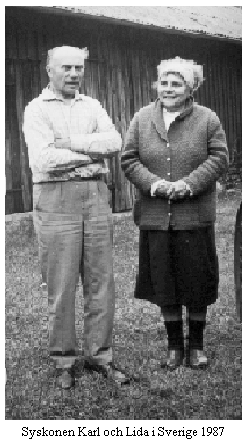
The space has been expanded and now there will be plenty of room, we will even be able to drink coffee there. Small improvements are being made all the time, but sometimes I look back and marvel at how much has been done during the past 10 years when we only worked on weekends and holidays. Admittedly, we have got another room in order, a combined bedroom and kitchenette, there is both cold and hot water - both from the well and from Båven. The work on the room lay fallow for quite a while, we poured the foundation a good while ago, it was when my siblings Lida and Karl from Estonia were here together in 1989. This last year has not seen as great an addition of improvements as in previous years. It is simply that when you have all the time at your disposal, but everything is put off until the future, even when you don't have much of a future left. We have our future largely behind us. We must realize that and be content with it. For my own part, I do not see it with regret. Despite certain initial difficulties, I find that I have had a good life with Ann-Marie. Money has been lacking at times, but money is not the only key to happiness, 'but even the other things cost money', Marilyn Monroe is said to have said.
The machines have been acting up, even the lawn mower has started to get some kind of age-related ailments and won't start. The grass got extra long before I got it temporarily working, but it lasted just barely until the grass was cut. Just before the last strip was to be mowed, the machine stopped and wouldn't start again. In late summer of 1993, the machine was definitively finished and we bought a battery-powered lawn mower of the brand Husqvarna. It works really well, but it needs to be charged between mowings, the batteries keep the machine running for about an hour, then they have to be charged for several hours. But we have time, we don't need to mow everything at once.
Now (1993-01-01) we have our pensions, they just flow in without us having to do anything other than cash them. Sometimes there have been quite good additions from the extra work that I have done for SKI, SSI and TRC. The oral interpretations at seminars and the like pay best, even if it can sometimes be quite "sweaty" in the brain when you have to interpret Russian-English nuclear power terminology, but the translations also bring in quite a bit. The positive side of interpreting is that when the day is over, the toil is also over, while with the written translations you have to struggle for a longer time. Anita Nilsson from SKI came in with a couple of translations that were very urgent and we agreed that I would take out some "machinery" in the form of a laser printer. It became a LaserJet M/4 with PostScript and a Glasnost Cyrillic Library 2 (to be able to write Cyrillic characters). Now I am quite well equipped with equipment, another question is of course if there will be enough work for these.
So gradually the former Soviet citizens are starting to know English themselves and the amount of work for my part will decrease, but I am still called upon now and then, especially when SKI or SSI invite the 'top figures' of the nuclear power industry. They are as a rule older men and have not had time to learn any foreign languages and need an interpreter.
In recent times (1995-08-30) I have again gotten a good deal of work, but mostly with the police, at the jail, and in the Nyköping and Eskilstuna district courts. Many 'refugees' are something other than what they pretend to be. Time and again there are police interrogations and trials - mostly because the foreigners get caught for shoplifting, theft, and robbery. The rules have become somewhat stricter and nowadays all documents regarding thefts, shopliftings, and fights go into the criminal register and there they take all these factors into account when the decision is made as to whether the person may stay in the country or is deported. That kind of interpreting assignment is not as well paid as the assignments for the nuclear power industry, but it still provides a fairly good inflow to the household budget.
In fact, we are very well off. Health has been nothing to complain about, a few aches and pains here and there, but that one has to put up with at our age. It is absurd to hope for any improvement in health, the main thing is that it doesn't get much worse. We enjoy life, both in town and in the country. We could even move entirely to the cottage, but Ann-Marie is a city girl and cannot imagine living year-round in the country. Relatives you get through marriage, acquaintances you make yourself, and God gives us the neighbors. We have nothing to complain about with ours. On the contrary. At first, Tonny and Gunilla were perhaps a bit reserved, they were Stockholmers for many years and suspicious of everything and everyone, but as time has gone by we have become really 'good neighbors' and there has been nothing wrong with neighborliness. We get along well and exchange both tools and services with each other.
Most of the cottage is finished, the chamber was repapered in the summer of 1998 when Ann-Marie had shingles. She sat there and directed us while we worked. During the repapering we found 7 layers of wallpaper from previous paperings.
In the 50s, smooth doors were the height of fashion, which had resulted in the cottage's beautiful paneled doors being nailed over with masonite. In 2001 it was time to do something about the kitchen and the doors. On the door between the kitchen and the hallway, the so-called 'carpenter' had cut off the panel moldings. It could not be repaired and buying new moldings would cost 2 x 300 kronor. I took down the doors, removed the old paint, but unfortunately the bottom layer was stain and it was impossible to get back the natural wood color; in that case I would have only varnished the doors. Now they are painted white, the hallway has gotten a new floor mat, the wiring has been rerouted, and it is starting to look quite neat. The kitchen has also gotten a facelift in the form of tiles by the stove, new paint both on the ceiling and walls.
This summer (2002) not much has been done. We have had sunshine and warm (hot) weather for almost 6 weeks. Moreover, I have had a lot to do with interpreting. By all accounts, Russians are flooding into Sweden and most are sent up to Norrland: Kiruna, Gällivare, Piteå, Vidsel. I have interpreted over the phone sometimes up to 9 assignments (varying between half an hour and two hours) so there hasn't been much time for anything else. When there is no rain, you don't need to mow the grass either, the lawn mower hasn't had to run many hours this summer. However, we have taken care of the kitchen garden properly, mainly by weeding and watering. The strawberries gave a good harvest, we picked almost 60 liters of berries and for almost two weeks dessert consisted of strawberries with whipped cream. It became almost too much. Also black and red currants were quite plentiful, though not as much as last year. The red and white currants were attacked by larvae and the bushes were almost bare of leaves. Even Ann-Marie's kale looks miserable, we did not notice the attack in time, now there are a few pitiful sticks and there won't be any kale dish from our own plants for Christmas this year. The potatoes look good and we have harvested two washing machine drums. The Åkerö apple tree has had some apples, but probably due to the dry weather most of the fruit has fallen off already at the beginning of September. Inger-Marie however looks to be really good. Our two pear trees also seem to have recovered from the hares' attacks and on both there is really plenty of fruit. The plum tree bought and planted by Rune Lundqvist has borne fruit for the first time this year. There were about 50 plums with very good taste.
(2003-09-01) This summer I had a heart attack and interest in the cottage has decreased considerably because I am not allowed to do heavier work. None of the children wants the cottage so now we are thinking of selling everything. Maybe it won't be this year, we will try to calm down and not act in haste, but we no longer feel the same pull to go out to the cottage as before.
Today (2003-09-25) there is great sorrow among the neighbors. Their little 'Valle', a very nice Tibetan Terrier, is no more. Last Sunday Gunilla told that Valle had to be taken to the animal hospital in Strömsund, he had been unable to poop, it must have hurt because he screamed when he tried. At the animal hospital they said that Valle had some kind of tumor, which presumably pressed on the intestine and prevented the stool from coming out. The day before yesterday morning they called Gunilla and said that Valle had died.
It is sad for us too. On her walks, Gunilla used to let Valle loose, he was a bit disobedient and didn't always obey the command 'come'. When she was near us, she let the dog loose and then Valle, like a little brown arrow, rushed towards us when we called him. After some violent greeting ceremonies with jumping and attempts to lick us in the face, he calmed down and threw himself on his back with the intention that we should scratch his belly. Then he was happy and could lie for long periods. When he got up, he wanted something, if we were sitting and eating breakfast. Usually he got a piece of cheese, but it shouldn't be too old because then he wouldn't eat it. However, even an older piece of cheese was eaten if you dipped it in tea or coffee. The same went for Marie biscuits, they had to be dipped or have butter on them.
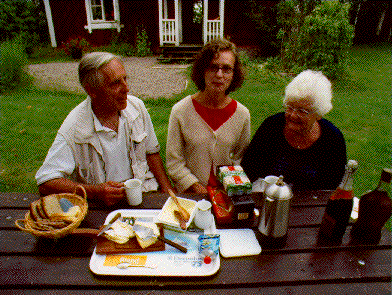
Ann-Marie tells that she still sees Valle rushing towards us, tilting his head slightly to see between his long bangs and waiting for someone to take care of him, cuddle and talk to him.
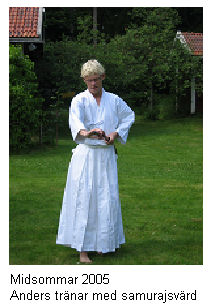
Time goes by and now (2004-05-24) we are seriously thinking of getting rid of the cottage. The children are not sufficiently interested in it and for us it is starting to become burdensome. It is quite a large area with three buildings, water systems, etc., and it is almost time to start painting the houses with red paint as well as making some adjustments to the bargeboards and other things.
During this year's Midsummer (2004-06-26) we were mostly in Nyköping. The weather has been windy and cold, right now it is only +16°C. After the weekend I will take up the matter with the bank's lawyer Curt Eriksson. He has promised to arrange all the paperwork for the transfer for 3,000:-.
This year we have found quite a lot of morello cherries. On one hand we have made several liters of cherry liqueur, on the other hand it has become jam. Yesterday (2004-08-03) I picked about 3 liters and Ann-Marie made jam. The jam is good with tea. The other jams don't leave such a strong taste. If the weather is reasonably sunny in the future, we will have a large quantity of blackberries, the bushes have taken hold and the entire long side of the outbuilding is filled with them.
The following advertisement was on the site 'Blocket' and at first nothing happened. After a week there were a couple of calls, then two couples came to look, but nothing happened for several days. Then one day a lady called and introduced herself as Mary Örnborg. She and her husband had been at the auction for the cottage Amsterdam, a large house, but without water, and Mary and Lennart (her husband's name) came to us on a Sunday afternoon and had Lennart's mother and her male acquaintance with them. They inspected the cottage and then we sat on the bench out on the lawn and drank coffee. Ann-Marie had made a pot of meat soup, the idea was to offer it to the visitors, but Lennart's mother had a whole set of sandwiches with her and they ate from their travel provisions.
In Sörmland
Cottage 37 sqm, outbuilding 100 sqm, sauna-laundry room about 20 sqm, frost-free cellar.
Freehold plot 2727 sqm nature and garden
Own well for kitchen water, easement from Båven for the rest.
Approx 10 min walk to bathing spot in Båven
Year-round access road. Access by agreement.
Inquiries and viewing
Tel 0155-33047/0155-215366 Utgångspris 600.000:--
2006-10-12 Now it seems we will soon be rid of the cottage. The family Lennart and Mary Örnberg, Nortullsgatan 20 in Stockholm, visited here and have apparently taken a liking to the cottage. They had been at the auction when the house Amsterdam was sold, but could not keep up with the bidding. Mary Örnberg had seen my ad on Blocket and called. When she had been here and looked, she called back and said:
- I would cry if we didn't buy it.
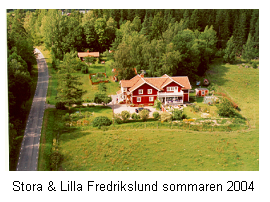
Now they have at any rate paid 30,000 kronor into my personal account and the day after tomorrow we are to meet, finalize the deal and celebrate together with Tonny and Gunilla on Saturday evening. We have picked up certain personal belongings and some tools. I have received a large reindeer antler from Ingalill Andersson and intend to transform the antler into a knife handle. It will be worse when one has no workshop – neither at Studsvik nor at Lilla Fredrikslund.
The firewood is sold to the neighbor and on Saturday we were busy moving some of it to their woodshed. Unfortunately the weather was somewhat rainy and the lawn was beginning to take considerable damage from the driving, so we decided that the move would take place at some later time, when the ground is frozen and the first snow covers the grass.
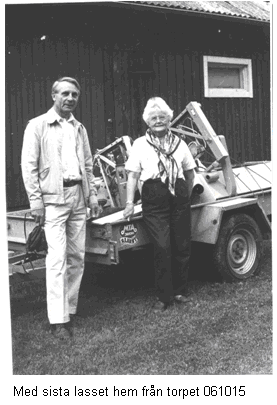
2006-10-15 We are back from the countryside and have said goodbye to Lilla Fredrikslund, that era is now definitively over. In the morning we finished writing the contract and it was witnessed by the neighbors Tonny and Gunilla. The money for the cottage is supposed to come on Wednesday, they have had problems with their computer.
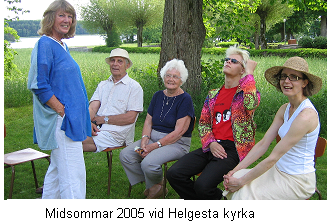
Yesterday we celebrated our farewell together with the neighbors and our successors. There was one thing and another. Maria and Gunilla had to work and bake pies, make salad etc. We started the party shortly after the buyers' arrival around 6 o'clock in the evening and the celebration with discussions went on until almost midnight. By then we had consumed whiskey, taken snaps with the pies, and beer and wine with the cheese, and Ann-Mari became so heavy-headed that she fell asleep on the sofa. We could not get her up, and then Gunilla suggested that we sleep over in their house. That became the last night with the cottage. We helped Ann-Marie to bed, the bedroom was right next to the dining room so it was not that difficult, Maria only had to fetch our bed linens.
Now in the morning we have packed up the remaining belongings that we were to take with us, and set off. The couple Örnborg with their son Philip were to return to Stockholm because Mary had to work and Philip had to play football. Maria got to ride with them.
The car became quite packed, yet I have forgotten my shoes by the stove where I put them to dry because the moisture in the grass does not dry up during the day and one gets wet feet when walking in the grass. Nor do we find Ann-Marie's medicine. There were a lot of bed linens, towels and other textiles belonging to the household. I also took some bottles of carbon tetrachloride, a little kerosene and the remaining jars of jam and juice. Luckily I have been able to make use of the shelter's space – otherwise I would have had trouble finding somewhere to put all the things. Gunilla cried a little at the farewell, I just hope that the new neighbors will live up to expectations of good neighborliness and cooperation.
A few days later Mary called and said they had decided on the cottage.
- I would cry if we couldn't buy it! We agreed to meet in Stockholm to sign the contract. However, she had only bought one copy so the matter was not completed, but they deposited 30,000 kronor as a down payment and on October 15, 2006 the cottage became theirs. A few days later the final amount of the purchase price arrived in my personal account at Nordea.
Recordings
- 1980TorpetA.mp3
- 1980TorpetB.mp3
- 1980TorpetC.mp3
- 1980TorpetD.mp3
- 1980TorpetE.mp3
- 1980TorpetF.mp3
- 1980TorpetH.mp3
- 1989TorpetG.mp3
- 800518 Torpet Sonja Bertil på besök A.mp3
- 81TorsTorp.mp3