Karl and Lida tell their story on December 1, 1982.
Karl and Lida continue their stories about life in Kirovsk in the 1930s and about the war years. (In Estonian)
Karl relates:
My first job was clearing roads. We were transported to Apatity on tractors, 13 km to km 25. The transport was done with both horses and tractors. There we were shoveling snow, that was our first occupation up north. Father took me along and went to the chief engineer Desterlo. We got to start building a barracks, a sauna, and after that I became a rodman and ran with the leveling rod. The prisoners built roads and Desterlo (a Swede) was the boss with three subordinate Russian engineers. I don't really know why Desterlo ended up there; according to some information, he was supposed to have built a power station somewhere in southern Russia and after that was sent up to the Kola Peninsula. As such, no reason was needed to be sent somewhere; the only reason for this was the state's need for labor. The one who built the White Sea Canal was the son-in-law of Nicholas I, a man with a very good education; it was said that before the revolution he had studied in France. He was born on the Crimean Peninsula, in Bachtisaraj. He was chief engineer on the White Sea Canal and it was the same with Desterlo.
The prisoners were mainly former officers and educated people. All the factories were built by German engineers, one was named Marienblatt, he built the factory in Apatity. He was assisted by Mucharovskij, who was either from Poland or from Germany; he was a city engineer. Mucharovskij was never allowed to return to Poland or Germany. There was a feverish effort to build up the factory in Apatity and the mine 25 km away.
Lida:
- The first year I was at home, I started working in 1934 and my first job was being a stoker at an electric power station, where I hauled wood and coal with a wheelbarrow. In total there were 4 or 5 boilers. After a while the power station was shut down and we were transported to km 23 - to mining work. They mined lovcherit (mineral). There I worked in the factory and the transport was tiresome. From our house a man named Ljungberg drove; his car had number 31 and when I saw his car on the bridge I had to run. When the factory whistle blew at 5 o'clock in the evening one had to run again and on one occasion I had very modern, narrow skirts, I tripped and fell into the ditch, resulting in me spraining my foot. I couldn't go to my regular work, couldn't pull on my boots, and they said:
- You'll have to become a night watchman. I didn't want to be a night watchman so I went to the doctor, but was not exempted from night work; the second time I got papers that I should not work either at the power station or on the night shift.
I took a job as a cleaner at a scientific research station, Akademija Nauk. I was there for about a year, maybe longer, and there I realized that I wasn't going to be a cleaner all my life. I needed to learn something. I quit at the research station and went to Monchegorsk to apprentice as a tailor.
At first it was quite difficult, the monthly wage was small and for food I had mainly bread, potatoes and white cabbage. I learned a great deal and earned a whole ruble a day, at the same time I started thinking how one could earn 2 rubles a day. The earnings rose steadily all the way up to the subsequent deportation in 1940. I worked all the time in Monchegorsk while Karl was in Kirovsk.
Throughout this time the family was split up, we lived apart and met again in Medvedjegorsk, the assembly point for loading onto boats. There we were loaded onto Karl Marx, a paddle steamer that was to go to the western shores of Lake Onega while a larger boat with several deportees was to go to the eastern shore, to Pudozj. There was a certain order as to where the different nationalities were to be deported: the Germans to Altai, likewise the Poles, while all Latvians, Estonians and Ingrian Finns as well as Finns were deported to Karelia. We were received royally in Sheltozero; people stood on the shores with horses and wagons, ready to transport us to the various villages; now we were all to become collective farm workers.
The first stop was the village Zalesje, 4 km from Sheltozero. Later we lived in Matveeva Selga, where father was to work, but the work was very heavy and father was no longer a young man. When Lida, who was now working at the tailor shop in Sheltozero, was allotted a house in Verhovje, the parents also moved there. There was hardly any road to Matveeva Selga, only a miserable path that could not be traveled other than on foot, on horseback or with sleighs. Karelia has many swamps and Matveeva Selga lay in the middle of one.
During the time in Matveeva Selga, Albert was very ill, probably with some childhood disease, and remembered his nightmares. There were a number of balloons that formed in the corner of the room, grew and filled the whole room.
Karl worked in the forest, mother had gotten herself goats and sheep and supported herself and father by knitting and crocheting.
I didn't want to be a driller anymore, says Karl, there was such work in Rybreka, even though the pay was good; drillers got 400-500 rubles a month. In Rybreka they had a quarry for paving stones, mainly for delivery to Leningrad. The work might have given more money, but standing out in the cold by the lake in winter with the poor clothes we had, no, that was enough; I took forest work. In Kirovsk I worked underground, there the clothes didn't matter so much; I could run to my work without outer clothing.
When I finished as a "rodman" for the engineers in Kirovsk and returned to my parents, the father was arrested (picked up as usual at night) but was released and assigned work on a factory construction. We started building, father and I. The work consisted of digging foundations; I dug for a whole week, but the work was heavy, I couldn't throw dirt up to a height of two meters for long; the food was so poor that I simply didn't have the strength. I went to the doctor and since I was only 18, I was exempted from such heavy work. We knew a certain Menskij Pridu; I was in school with his children, and he said: "Come to us! We need people skilled in carpentry." What carpentry was that? It turned out that we were to make coffins, as municipal workers. In 1930, when we started production, no new ones had come yet; people died now and then, but not more than that we managed by making one coffin every two days.
Menskij Pridu wanted us to make the coffins in the Estonian way, hexagonal, and that took two days. When we came to another workplace we had an old imperial regimental music sergeant major Jaan Niitt, he took me as an apprentice. During my entire first year of apprenticeship we only made coffins. At first we planed the boards, but later, when many new prisoners had arrived, it became more rapid production - 5-6 coffins per day and no talk of planing any boards. That was 1931-32.
- We lived then at km 16, said Lida, in a tent. I remember one time a musician came and played a tune on the accordion; we all jumped up in just our underwear. On Saturday, when we finished work, we were to clean up after ourselves and then sit on the bench before heading home. The musician was from Zapelka, on the other side of the railway, 9 km from our home region.
How did life continue after 1932-33?
Mother went with Albert to the home region; she got a (probably forged) passport from her eldest sister Sofie. Sofie, Anne, Liisa, Alma and our mother, they were five sisters. There was no real permission to come back, but Sofie had managed to get a passport and sent it to mother in Kirovsk; at that time letters and packages were not checked. Mother and Albert stayed in the home region until 1933 and father Jaan was fetched by Sass (Aleksander Jürgenson) in December. He took father with him, all the clothes and fabrics that we had also went along, and he drank them all up. Mother Emely later complained that she didn't even have a coat to put on. The main thing, however, was that father also managed to get away from there, it was thought at the time.
Father arrived at our home region and moved in with an acquaintance's family. Our own house burned down and he was called up, but several people testified that it couldn't have been him and he got off with a new deportation. In the house a cooperative had been set up with an alcoholic woman as manager. She had male visitors, there was drinking and smoking, so that is said to have been the cause of the house fire. If father Jaan had not had his good reputation, he might not have gotten off so easily.
Now came a journey to the Urals - the year was 1933, in spring.
- You came back in 1935 or 1936, I don't remember exactly, said Karl. We went to the NKVD, said Lida, to get permission for you to come back. At the NKVD they said: "Let them come, we will register them here, but a formal permit for them to come here we unfortunately cannot issue, we have no mandate for that."
Albert relates:
- I remember that we went with a barge up the river Tchusovaya. But the barge trip ended and we were to continue past the rapids. Father carried me under his arm at a couple of places where the water ran too high. When I hung there with my arms free I remember that I felt the water and got my shirt sleeve wet. Even there it was about forest work; mother liked the area because everything grew so well, huge raspberries and other forest berries. The soil was fertile, it hardly needed any fertilizer. We went into the forest to pick berries and had pot lids with us to keep wild animals at a distance.
On one occasion, I remember there was a very violent thunderstorm with lightning. The wind was so strong that it knocked down trees. My parents were at work, I was alone in the cottage and saw how the trees were knocked over. At one point, it looked as if a tree would fall on the house we lived in, so I hid behind the large stove, which always exists in Russian houses. The livelihood was poor. People said that those who came there also stayed there—in the ground. We were probably the fourth or fifth contingent of forcibly displaced people. First came Ukrainians, most of whom died, then the displacement continued from other parts of the Soviet Union.
Karl continues:
- I once worked with a young man named Klopof; his father worked in the same workshop and had brought his son with him. They had vodka at home. I knew a Petroff; he was a typographer and orchestra leader, I played the violin with him. The newspaper advertised that they were taking apprentices in typography, and I was urged to apply. Who can recommend me? I asked myself, I had no acquaintances in that field. The closest was Petroff, and I went to him. He was sitting at the table with some other men drinking vodka. I told him thus and so.
- Do you have a half-liter of vodka? (a pollitrovka) If so, you can come and start tomorrow.
I didn't have a half-liter and went with my trouble to Klopof; somehow he got me this half-liter and I changed jobs. The boy said that the father was forcibly displaced, while his uncle, a staunch communist, always talked about! "Squeeze the people!" (”Жми народ!.) He stayed there to organize the work for the new communist empire.
About thirty years ago I went to the Kola Peninsula, and found out that those who had children in the army, father or son, they could get a passport, while those who had only daughters remained slaves and were not allowed to move.
Karl tells:
- When I came home to the room on Stroitelnaja Street in Kirovsk on September 16, 1935, it smelled terribly bad in the residential barrack. When I opened the door to the room, Albert was standing in the doorway. I lived completely alone there at Stroitelnaja 13.
Albert:
- I remember part of the barrack; the front was at ground level while the back stood on fairly high stilts, and from there a staircase led down on which I often sat with a boy named Efim. At the end of that part of the barrack there was also an outhouse; the drop was considerable and it didn't need to be emptied very often.
I worked in the mine, said Karl, in Lovcheridnyj Rudnik at km 23, distances were measured in km from Apatity station. First we lived at "km 13", then at "km 16", later at "km 18", at "km 21" and at Locheridnyj "km 23".
Lida:
- I worked there next to the phosphorus factory; it was -30 degrees cold when we were building. We pushed wheelbarrows with cement and had to go to the factory chimneys at regular intervals to warm up. On one occasion I burned a hole in my sheepskin coat. To keep the cement fluid, they added salt, which meant the cement never dried; it ran out years later. In such buildings, the moisture will always remain; there are a couple like that in Tapa too, opposite the department store. It is terribly damp there, said Lida.
Lida tells that in 1939 she worked in Monchegorsk and remembers that after Poland was taken over, very large amounts of chrome leather began to arrive so that they had to start sewing leather coats. One of their cutters, named Hilda Jänes, had no practice in cutting leather. Initially they took ordinary fabric and made patterns, only then cut out the pieces.
Karl:
- Father had bought a pair of boots from a soldier, and with those boots I walked 40 km from Nila for sugar. At one place the water was up to my knees, but the boots kept the water out for the most part. I don't remember if mother sold them to someone or if they were in Lida's shed the last time.
Albert tells:
I spent the summer of 1939 with my aunt Anne; she lived on a kolkhoz with the Post family. My task during the summer was to guard the collective's sheep, cows, calves, and sheep—8 cows, 3 pigs, and 72 sheep. It was not easy to get up in the mornings, and when the kind aunt woke me at dawn, I was already dressed and had shoes on my feet. She had done that while I was still sleeping. Shoes and shoes. Such things were scarce, and I had the traditional Estonian "moccasins" on during my herding work. The "moccasins" consisted of a piece of rawhide held together with rawhide straps. Many Russians used birch-bark shoes "lapti", but Estonians mostly used these "moccasins". (Tsuuvad - in Estonian). After the meal it was off to the pastures. The cows were milked three times a day so that I was home at lunchtime; then it was time for me to eat and sleep while the milking was going on. The place where my aunt was currently living was quite close to our former home, and I went there with my aunt a few times. There was only a barn foundation of large gray stones; everything else was more or less gone. The cellar was also still there, and a birch tree was growing on the cellar roof. Aunt Anna talked with me now and then about the family; I stood by the cellar and she said: Here you can talk; here no one can listen to us in secret.
Karl continues:
- Now there is a big forest there; you cannot see the Posts' place; everything has grown over, but at Helstins and Leos' it has been somewhat maintained as pasture. Before, there was only a small house on the right side of the road; now there are only houses and villages over a stretch of 2 km. All these collective farmers harvest hay for their cows on our land. I don't remember much about the Posts, says Lida; the wife Emely was perhaps still there while August was already deported. He had worked at the station as a bookkeeper, and in 1937, when Lida worked in Monchegorsk, she met August there. They were not our relatives, just neighbors.
If the communists had not confiscated the peasants' property and deported all the peasants, destroyed the foundation for a strong economy, the Russian state today would have been very strong and rich. Because there was no economic background in the form of a strong agriculture, one could not build up industry to the extent that it could have provided the civilian population with the necessary goods and services.
I was in Arkhangelsk during the war and there was famine, said Lida; we got 5-kopeck soup; when we were to travel from Leningrad to Arkhangelsk, we lost a lot of weight and were just skin and bones upon arrival. Those who died were rolled off the train, not at the station but a bit out on the line. I was saved because I worked in a sewing workshop; we worked two shifts: in the morning from 7:00 AM and in the evening from 8:00 PM. The railway ran through the city, just like in Tapa, and I went to the forest to pick berries and got a lot of lingonberries. I picked a whole basket, but did not dare to go and sell; I only sold to the very closest for 7 rubles per drinking glass. That saved me from vitamin deficiency; my feet were quite swollen, but after eating lingonberries for a few days, the swelling in my legs went down.
In 1940, when we were expelled to Karelia, we ended up in a village named Zalesje. They unloaded us in the middle of the village and said:
- Go and find a suitable dwelling; there are plenty of empty houses and you can take whichever you want! We found a two-story house, and in the evening the house was filled with collective farmers as Lida played guitar and sang.
I was very sick there, said Lida; I had gotten used to living on bread and fish, and here in the villages there was plenty of milk. I vomited and had stomach pain. Near Zalesje there was a small lake, and the boys often went there to fish. There wasn't much fish, just an inbred sort that mostly consisted of bones and fins.
I started working in the sewing workshop in Sheltozero next to the bridge, said Lida. Admittedly, the work was intended only for invalids, but about 20% completely healthy people could be taken in. I had learned the trade, and we were part of a collective of seamstresses, shoemakers, and blind basket makers.
The situation for father and mother became quite untenable; mother thought father was still strong and moved to Matveeva Selga, but father was not strong, and the family wanted to return to the Onega shore. I worked together with Maria Lutchkina, who lived in a house with 5 rooms: 2 on the upper floor and 2 on the lower, plus one more room. I often talked with her, and she said that the landlady lived in Petrozavodsk. At one time, I remember the landlady visited Sheltozero. After we had talked, we got the house, and the family moved to the village of Verchovje. There were plenty of houses; most of the houses there were empty. There was a family of Finnish origin, they lived at the far end of the village street towards the upper course of the river. A Ukrainian blacksmith, Poletajev, had built a small cottage, and a family of Latvians named Berzins. No, said Karl, Berzins was from Tulara. The one I worked with was not Berzins; he had a daughter. A daughter indeed, said Karl, she was quite pretty and acquainted with an NKVD man. The daughter worked in the canteen and set aside certain things for herself, and when discovered she got one year. When the wars came, she was supposed to gather all the domestic animals and follow the livestock to Russia, but the departure was so quick that when the Russians had left Sheltozero, there were still quite a lot of domestic animals in the surrounding forests, both horses and young animals.
I worked 8 hours and had no desire to visit any neighbors, said Lida. In Russia, informing has become a national disease; no one really asks for it, but the militia and security men work by the sweat of their brow to justify their existence.
Karl tells:
I myself came to the forestry work in Nilo (in Far Karelia), along with Karl Korte and Karl Möiste, all Estonians. I was godfather to Karl Möiste's boy; a great many acquaintances disappeared, but Karl Möiste returned to Tapa, he stayed for a while in a sauna and worked in the forest. He drank heavily and on one occasion the sauna burned down.
Karl Moiste worked together with me in the labor company in Nilo, he didn't want to stay in forestry work. During the war he went over to the Finns, the Finns handed him over to the Germans, and when the Russians had reconquered Estonia he was a prisoner of war in Tapa. When the Russians came, he certainly got a hot reception, but got off rather easily.
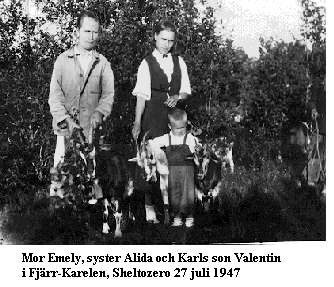
Karl:
- Once I went to visit aunt Anne Toode in Valga, about 30 km from Tallinn. Mother had scolded Lida and me for letting Anne stay there, her daughter Manja had died and mother wanted us to fetch Anne.
There was a shortage of money, but we got her with us, but mother couldn't get along with her. Anne started associating with the neighbor across the entrance, dragging laundry there, etc. Eventually she had to move back to Valga, to the old people's home. I was there a couple of times. I went there, it's on the turnoff to Tapa at the Valgejõe bridge. It was fairly clean and tidy there, the clothes were also clean, and she seemed to be doing quite well. She had frostbitten her toes sometime during the war, and her health otherwise was not the best. The last time I saw her, when I came back from the Caucasus, she was in a bad way. She had nowhere to live and slept in the stable, she smelled bad.
When the war came in 1941, we had to march first to Petrozavodsk, from there another 50 km to a barn where we were to rest. A Red Guard came and said we should be careful:
- A Finnish partisan might come and kill you with a knife, without you ever waking up. Mortars made noise all night.
After that we came to Matrosovo, now we would finally be at our destination. We tried to make ourselves at home, some started looking for unharvested potatoes while others were to write letters. After a while a man came and said:
- Within 30 seconds you must be on your way! From there we went another 30 km, what was the village now? We had put the potatoes on the stove, everything had to be left behind, the Finns had already started shelling. Everyone fled but I and a few other younger men had to stay behind to build fortifications. We built for several days in a village, the Finns kept shelling with mortars. There was a lake and next to it a small village which we reached the same morning. In the village there were some wounded Soviet soldiers and a detachment of partisans. Both the partisans and the soldiers fled with the commander running after when the shelling started, not all soldiers had even taken their rifles with them.
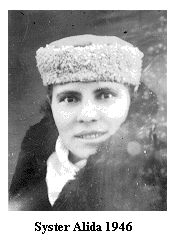
We had to start digging trenches, said Lida. I remember the planes flying over us. We were to dig deep trenches, but the ground was strewn with large stones so we got help from soldiers. In the evening we danced with the soldiers, but the next day we didn't see some of them and we learned that they had been arrested for associating with us deportees. When we fled from Matrosovo we saw the same soldiers again and I asked:
- Where is your natchalnik (commander)?
- He remained sitting in the trench, said the soldier smiling, and I understood that his own men had gotten rid of him. He was a nasty fellow, he associated with the Tatars and was harsh with his people, you couldn't even get a smoke break.
There were Finns there. We had Freide's husband Ivan as work foreman. He traded for vodka and he said: We have girls from our home regions, let's go to them and have fun! There was a shortage of bread, we passed a bread truck and a soldier took a loaf and handed it to us. It became a party.
When we returned to Petrozavodsk the Finns were retreating.
Now that you have been here for a while, what is the most striking thing about Sweden, asked Albert.
That there is plenty of everything! With us you always have to struggle, for food you have to queue, here you go in and get the goods immediately without any queuing. Overall it's richer here, but what is completely different.
Most things are different: The doors open by themselves and you get your pay by inserting a card into a slot, it's completely different, says Karl.
Lida:
- We always have to stand in line for one or two hours if we want to buy something. Here it's different, there don't seem to be so many difficulties, people interact with each other in a different way. The shop assistants don't look down on you and think: What is she doing here, couldn't she have gone to another shop? Here you come and know you'll get what you need, with us it's that if you don't have someone at home you have to go out and stand in line. It's not at all certain you'll get what you came out to get. I am quite satisfied with my life right now, there is bread, before it was often that you had to be hungry and there was nothing to buy. It's strange with this big and rich Russia, it has been managed so extraordinarily poorly.
We ended our previous conversation with you being assigned to the labor brigades in Petrozavodsk and from there to Matrosovo, a distance of 20-25 km, the last stop. It's about 50 km from Petrozavodsk, says Karl. We arrived and spread out our belongings - now we would finally be at our destination. After a while a man came running and said that within a few minutes we would be out of here. We ran out and when we reached the edge of town we shook out our sacks: I had a couple of sets of laundry in the sack, but couldn't manage to carry all this, says Karl. The next day we were back, the women couldn't manage all the running, but we had to, we were sent there to dig trenches. One day we were there, a Siberian engineer regiment was stationed there, it remained there after the Finns' envelopment.
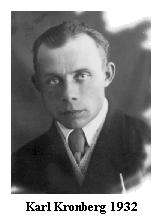
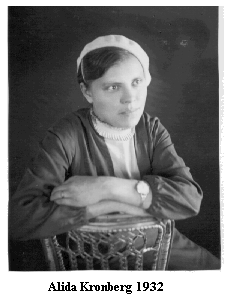
Some of the soldiers escaped to Petrozavodsk, sometimes three men came, sometimes five. They came to us when they heard Russian being spoken. The Ukrainians are used to the plains but can't cope in the forest, nor can the Germans. Now it was autumn and the sun disappeared early in the evening. Those who went out and couldn't find their way back got lost and disappeared forever.
We were not there many days. Most were loaded onto the ships and these went to Voznesenje. From there we were shipped to Aljechovshino, that's about 150 km along the Ajatj River, in the direction of Lodeinoje Pole.
Albert: I remember being there with my father sometime in 1939, at the Alexandro-Svirskij Svjato-Troitskij Monastery. We had been to our home region in Novoselje to visit Aunt Anna.
Karl:
- We came in the direction of Leningrad and were there until November 10. We were busy digging defensive positions 'zoty'. It was building alternately wood and earth. It was supposed to be a defense against the Finns, but they never came that far. Apparently it was just about concentrating people somewhere. From there we continued toward Beloozersk. How much we walked on foot and how much by vehicle I can't say, mostly it felt like we walked and the car transports were more the exception than the rule. On November 10 we left Aljechochino and on December 15 we arrived at Anjevskij-most, that's in the Marinskij water system, which passes Lake Onega and goes through Lake Beloozersk, it's a canal from the time of Peter the Great.
Lida:
- I don't remember much, but once when we came to Belomorsk, we got accommodations near a bakery and for the first time in a long time as much bread as we wanted. Yes, said Karl, that was because we knew the baker, otherwise the ration was only 200 grams. It took a long time before we got there. At the Anevskij bridge we were until March 15, we came in December and stayed until March. There we were mainly busy digging trenches. From there we were loaded onto trucks and transported to Pudosj, where we had to wait a week or two, we didn't know where we would be transported next. Finally we ended up in the forest. We were 15-17 people in total. We stayed there about a week, but since we didn't have suitable clothes we were loaded onto trucks again and transported 280 km. There we were about 5 days, I was never in the house. The area was empty, only at the station there were a few people, there was hardly any indigenous population, most had been evacuated earlier. A Jewish man came from the station and asked if there were any craftsmen here: tailors, blacksmiths, locksmiths, bakers. Two or three people volunteered and I stood next to them, I had worked as both a locksmith and carpenter.
Where do you want to go? To Belomorsk or to Archangelsk? he asked. Lida said she wanted to go to Belomorsk and then I decide to go there too. Good, he said. You will get a travel document and provisions, we got a few kilograms of rusks. Before that we were to help load some 50-kilogram sacks of ski poles for Belomorsk. They were equipment for the fighting units. Besides our rusks we were to requisition provisions from the villages, said the Jew, but when we came to the kolkhoz chairman he was gone, and for three days we didn't have much to eat.
When we arrived at Belomorsk we got 200 grams of bread and 2 bowls of soup. We were 4 people, one was a baker from Petrozavodsk and he asked upon arrival where the bakers were from. From Petrozavodsk, came the answer. He went there and sure enough, it was familiar people to him, so he returned with 4 loaves and a whole bucket of kvass (a Russian small beer).
The next day we were to go to the commandant's office to get work orders. They took us there under the pretext that we would work in a kombinat, but when we arrived at the commandant's office they told us that only invalids are to work there. Since you are not invalids, you will start on the railway. I started on the railway and was sent to Jämtsa (about 100 km from Archangelsk) to load locomotives with fuel in a 5-man team. The working hours were 12 hours a day, one bowl of soup and 700 grams of bread. It was heavy work there, I got swellings in both my face and arms.
The loading went as follows. One man, standing on a barrel, takes the wood from the pile, from there the wood is passed to the next man who stands on a platform between the pile and the locomotive. Further to the one standing on the tender and into the locomotive's wood storage. One locomotive per hour. There you really had to work hard, especially as the wood was saturated with water, heavy and slippery.
I worked on the railway until July 1942, then orders came that we were to go to the forest. We were 9 people. The weather was fine, we were to collect our rations and the girl, whom I had met earlier, said to me:
- Don't go there, Karl, it's a death camp, there you can only die, you won't come out of there alive. There is only forest and you have to have food. If you fulfill the daily norm you can get 700 grams of bread, with exceeding the daily norm maybe 900 grams. There you can only die. I went there, where else could one go, it's the same everywhere? If one ran away and got caught it would in any case result in at least 3 years. So I went there, sat down on a stump and watched the America-communists (who had arrived there around 1933-37), they were massaging their feet, but what feet, they were just skin and bone - they were not people, they were human shadows. One thought that 'here you'll probably have to give in' But as it turned out, something became different and if you are a specialist things work out. I was assigned to build barracks, both from logs and from military material. From Belomorsk they drove out some office staff and other loose people. At first they were full of enthusiasm, the men came with musical instruments, the girls with red-painted lips, but not a week passed before their enthusiasm ended. From work they went straight to the canteen and from there to the sleeping places and there was no question of even taking off their outer clothes. They didn't last long, after a couple of weeks most had fled. That was 1942.
The work consisted of hauling wood to the railway. Earlier there had been a prison camp, the prisoners had built the railway and their barracks remained. It was boggy ground all around, the wood lay practically in the water and sometimes we had water up to our knees, when we had to transport this wood to meet the norm. The wood pieces were 75 cm long and all logs thicker than 25 cm also had to be split.
I was there a couple of weeks, then I was transferred to building railways, it was a 5-man brigade and I was appointed leader. The construction went on for a few weeks and we had built a good stretch: they laid 3 logs underneath and rails on top. A few years earlier, when I worked in Kirovsk, I had studied to be a mining mechanic and now in 1943 I got use for it. There was a motor locomotive and I became wagon master. I worked as wagon master for a year and then the mechanic and party organizer Alexander Privjantsev came, a good fellow who was part of the Amur military brigade for railway construction. However, there was a drunken brawl and he was beaten to death. Now they had no mechanic. The director proposed several people and also me, I agreed to become a mechanic, but it was round-the-clock work without either days off or night rest. The main work consisted of repairing equipment, adjusting ball bearings and supervising locomotives. The food was not luxurious and since I had district chiefs and various so-called 'party types' over me, the mental strain became greater than the physical and I got inflammation of the central nervous system.
No railway embankments were built. All the tools were left in the forest and one morning we were told that we would not go there anymore. We would get new tools and start building houses, with the same brigade. When the house was finished, the railway had also reached us and a repair workshop opened, where I was again appointed leader. I worked there as a mechanic for about a year. I belonged to the mobile force and at first mainly worked on repairing wagons. Later I became assistant mechanic in the car department and at that time our workshop became some kind of experimental point and we got new Finnish saws. Until then we had mainly Leningrad saws, driven by electricity, 4 saws had a common power plant, a 4-cylinder, 12 horsepower engine. In the forest these saws did not work particularly well. The rather thin cables often broke, especially in winter and in rough terrain. The saws did not contribute to any higher efficiency. I worked there as a mechanic until 1945.
In 1947 I made a visit to Estonia and discovered that life there was more normal, both regarding existence and the food situation. In Far Karelia a sack of potatoes cost 200 rubles while you got a sack in Estonia for 15 rubles, milk 60 rubles per half liter and in Estonia 10. When I returned from Estonia I talked with the mechanic Jaan Parment, an Estonia communist or something like that, but he didn't speak Estonian. I said to him:
- Find yourself a mechanic now, I don't feel like being here any longer.
In 1945 we, formerly exiled kulak sons and daughters, also received a passport on November 7, admittedly only provisional, but nevertheless a passport in the pocket. I will disappear from here, I said to him. Eventually they found a replacement and when the war ended they wrote in a condition that we would continue working in the forest camp in Far Karelia for 3 years. Now that period was over and I went to Estonia, took a job as a locomotive fireman and after three months my wife also followed.
Lida and I knew each other's whereabouts, we corresponded and once she visited me. Unfortunately she came during a difficult period, we had not had bread for three days. Mari somehow managed to get a bread for Lida.
Lida: We were also sent to forest work from the tailoring workshop. Then I got the idea to go to Karl since he was already in the forest work.
Lida got permission to go to the 'home district' in Scheltozero quite early, already in 1944. When Sheltozero was 'liberated', she was allowed to return to her parents, who still lived there in the village of Verchovje. I sewed a pair of trousers for Karl, relates Lida, and when the leader of the forest work saw them, he asked me to sew a pair for him too. By then I had received a letter from my parents that they still lived in Sheltozero and I longed for them so I refused. He promised me the same pay as the seamstresses.
I left, but since I did not have permission to leave the locality I had to return, only when I got the permission could I leave. I wrote a 'triangle' (a letter folded into a triangular envelope) to mother. They had received the letter but could not believe that we had survived, and indeed we had suffered. I left for Sheltozero in 1944, it was sometime in the autumn. Father was still alive, but I had to go back and fetch the permission. I would have gotten work and housing in Petrozavodsk, but father was sick and asked me to stay - within a month he was dead. He died on September 9, 1944.
Karl.
- I came home three days before his death. Father had gotten some kind of paralysis, he heard and understood everything, but could not move. We took him to the sauna, the one that stood before the bridge on the road from Sheltozero, afterwards we drank vodka and anointed him, and after a couple of days he passed away. He had been sick about a month, when Lida came for the first time he could talk and sat at the table, but it took me almost a month to go back and forth for the permission collection and when I came back he was quite bad.
Karl:
- I helped bury the father and went back to Malenkaja in the Belomorsk district. It is a station on the new Obozersk-Belomorsk railway, it was built in 1941. It was a terrible road to travel, the forest on both sides of the railway was completely burned out, not a tree remained. Lida tells that she fell asleep on the way back and lost her wallet, but no one stole it, there wasn't that much to steal, only the ticket. When she was about to leave she couldn't find the ticket, she didn't notice it was stolen. Fortunately she had money left, said Karl. Everything was guarded so we passed the militia and jumped onto the train. It cost us a fine of 920 rubles, but we arrived in Petrozavodsk where everything was shot to pieces and the hotel was a single pile of stones. On the return we had to wait for a boat passage, but the boat would not dock in Sheltozero so we had to go to Rybreka, 15 km south of Sheltozero. We were three people from Sheltozero. It might have been around two or three o'clock when we came home from Rybreka. It was a rainy day. We came on foot. I also came on foot from Petrozavodsk in 1945, said Karl, it is about 85 km of road.
It is clear that it was far, after 10 km the legs start to ache so that it is hard to walk and the shoes were not always suitable for such long walks. I sometimes walked in just the soles of my stockings, said Lida, the Finns have fixed the road and laid a layer of gravel on it, but barefoot you could not walk there.
The mechanic was sent away, said Karl, only I remained in Belomorsk and stayed there for three years until 1948. No one was allowed to leave from there, mother gave me a goat and I handed it over to the chief mechanic in Belomorsk. Transporting the goat went well, they made a box and put a tight metal bottom. It took some time before I got it there. I traveled on a train that went to Murmansk, but no one helped me with the goat crates on the train, I had to stay a couple of days and herd the goat. Eventually I got help from the union chairman, we lifted the crate in Malenkoje and that way the goat Zorja got there. Mother had two goats; Rosa and Zorja.
Albert:
- I remember Zorja when she was about to have her first kids. I watched her up by the river and suddenly she wanted to go home. Usually goats don't leave the one who herds them, you don't really need to worry about them running off, but now she rushed home. We also had a pig and it couldn't run as fast as the goats. Every now and then the pig would throw itself on the ground, actually lie on its back and catch its breath.
Mor was not at home. I ran as fast as I could but Zorja was ahead and ran into the goat shed. As I stood there, Zora lay down on the ground and behaved strangely, I thought. Then all of a sudden she started to strain and a pair of tiny hooves stuck out from her back. Then I hurried, ran to a neighbor woman and she helped with the birth of the kids.
Karl continues:
- Many from the Vlasov army were exiled to northern Russia, they had to stay there for a long time, some never left. You could only leave with the director's permission, otherwise not. We had a vice-director, also a former prisoner, a real bandit. He drank a lot and lived with a female judge. When he came home, his mother-in-law had to cook and he used to say: Mother-in-law! You cook, I'll go out on the porch and throw up. A real thug, the camp life had ruined him.
When the director went on vacation, the vice-director and assistants handed out departure permits for half-liters of vodka (pollitrovka) and when the director came back he had no workers left. The problem was solved by forcibly enrolling local fishermen. They fished in the summer and worked in the forest in the winter. When spring came they had to go out fishing, there was no question of vacation. It was the same in Sheltozero - in the summer work on the kolkhoz and in the winter mostly forest work.
1948 I managed to leave Belomorsk and got to go to school in Leningrad for 6 months to obtain formal mechanic competence. I became some kind of leader and the assistants wanted me to join the party. However, my health was quite poor and I was not particularly keen on the party. After the war it would be possible even for children of the exiled and dispossessed to become party members. When everyone in a department is in the party, that department is paid better.
1948 I got a replacement from Belomorsk, an older man. Earlier in Vyborg he had made himself a diploma, supposedly there were plenty of blank forms. He had forged a builder's diploma. Together with the Vlasov people they had dismantled a locomotive and were supposed to assemble it in the spring at a cost of 25,000 rubles, which they were not capable of, but they had taken the money and spent it. The man had no mechanical talents, he broke all the parts, it's possible he might have been a train driver, but he couldn't repair a locomotive. He should never have come near a locomotive as a repairman. I went to the director to sort out my affairs and possibly get permission to go back to my parents. In the spring I had received a letter from mother, saying that she was sick and I went to Sheltozero again. The director jumped on me before the departure. Fortunately I had a file that I had been transferred to the construction department. What to do? Spring was well advanced and the snow was already melting. We drove the locomotive onto a platform, took everything down and drove the locomotive to Kemi. I managed to get away from there, but the locomotive was not repaired in Kemi either, I only went there at the director's request. One of the steam injectors worked while the other was completely broken, and I didn't want to accept it. I returned to Belomorsk and the engineer asked me how the locomotive was.
I answered truthfully, that I could not accept the locomotive because it was not in repaired condition. A man named Parning from the city of Kalinin then went there and accepted the locomotive and repairs began anew. That way, in 1948, I got away from Belomorsk and went to Estonia. Lida and mother had already moved there in 1947. The move to Estonia was not complicated. I resigned from my work, Lida told, took my few belongings and got help from Jürgensons. We lived with them the first summer after our arrival, then I lived for a while in the countryside and gradually got work in the sewing workshop.
We were two people, an older man and I, and we had to heat ourselves because we also had to sleep there. He was divorced and had no children with the first wife and two with the second. I got a place to live through the workplace, but it had been difficult and the room was nothing to boast about. The stairs were so narrow that I had some difficulty getting out with the slop bucket. The room was completely outdated, there was neither toilet nor water. The boy grew up, however, and it was mostly so cold that I had to fire the stove, behind it there was enough space for me to fit a bed. In the evenings, when I fired, at least it smelled warm, but when the firing stopped the water in the stove froze.
It was a troublesome time, one had to carry both water and firewood. Now we always have both heat and hot water and yet we are sick more often than before.
Times have naturally changed, many tourists think that we have everything in Estonia, both meat, vegetables and bread. For the Russians, Estonia is about the same as when Karl and I came to Sweden, there was everything.
The ethnic tensions, however, are still great, perhaps even greater than before. In Tallinn the situation is such that companies run by Estonians do not hire any Russians and vice versa. An Estonian pilot in Tallinn said during the 'Regatta' in 1980 that here there are only "blackheads" and it's nice to talk to a "white" man. There are of course industrious and decent Russians too, but they are certainly in the minority. Everyone has become morally "deformed", they have also been deprived of their homes and farms and are depressed and listless.
Now we shall stop, you are soon to travel back to Estonia and hopefully the weather is good so you don't get too seasick on the boat. Lida, Karl and mother Emely tell during a trip to Tallinn.
About a visit to the home region at the end of the 1980s, Lida tells the following:
There was a bus every other day from Novoselje to Molozhanje. We took it and arrived at our former place. Of our dwelling house and the farm's other buildings, nothing remained, Lida says. The lands were completely overgrown with bushes and scrub. For a stretch of 100 meters from the highway there were some fields, but up to the village of Porski there was not a grain field, only bushes and undergrowth. The bridge over our stream was also gone. Valdemar and I were there a few years ago and then the water was so high that Valdemar had to take me on his back and carry me across. I was somewhat heavier than him and it didn't go so well. Downstream, where the sauna had stood, we fell and I got my feet wet too. Where we had had our well there was a small puddle of water. The house was gone, only a few roof tiles lay there in the nettles. By the dilapidated barn foundation there grew a large bush of black currants. We went to Post's house, nothing was left there either. Lisa Post's house we couldn't find at all. Unfortunately it rained when we went to the cemetery, but there it was miserable, not a trace of care could we see.
The only thing left of the farm was a couple-three hectares of pasture. People from Novoselje come to harvest the hay every summer. Previously there were only a couple of farms between Novoselje and us, now there is a stretch of a couple of kilometers full of buildings, and since each has a cow, a lot of hay is needed. They take this from our former lands.
Mother Emely continues:
Before I could sleep, now my sleep has disappeared, I sleep so little nowadays. The hours become long, it is quite heavy, my eyesight has also become miserable, it is also difficult to get new glasses so reading is also so-so. Earlier we had some possibility to get glasses here at the hospital, now you have to go all the way to Tallinn or Rakvere and it's not certain you can get any glasses anyway. Until now I have been able to read, but now it's worse and time becomes long.
Many elderly say they sleep away most of the time, but I cannot. In summer it's okay, then I have my kitchen garden and the chickens, I'm up no later than 6 o'clock in the morning. Sometimes I lie down to rest, but there is no sleep.
The house is also bad, even though they did a repair three years ago. It was the usual Soviet measure, they just poured some sawdust between the boards and did practically nothing to the floor so it feels very cold. To stand barefoot on the floor is unthinkable. After the repair it has become a little better, they have insulated a bit more. Already from Kirovsk we have some habit of living in cold homes. There was hardly any insulation in the houses either, only boards and sawdust, the feet have suffered far too much. I remember that once I wore two pairs of large soldier boots, with several pairs of socks. In those days you could trade a couple of pieces of bread for such boots – they were good boots, light and waterproof. In the old days there was plenty of leather in Russia and people were good at making shoes, today's boots are both heavy, unwieldy and leaky. I remember I bought a pair for Minna Raie, my sister-in-law. When they were deported they had no more than 3 rubles, where can you go with so little money?
She got a pair of boots and the other pair I kept for myself. Now they are all gone, two of them died in Estonia, Elvy's mother was sick for a long time and the other (she lived about 20 km from us in the old days) lost both her son and daughter-in-law. My sister died when during the First World War they were accused of being in the Estonian partisan movement. The Russians shot them. Elvy was left alone, she had a son and a foster daughter, while my sister had several children and was herself sick. One of the children I had as a foster daughter for 7 years. When we were deported, she stayed behind in the home district. Also one of the brothers-in-law was shot. He was already married and had a wife, they would not shoot her, but when she saw that the man was about to be shot, she jumped forward to him with the child in her arms and all three were executed.
Elvy's sister was freed after spending ten years in prison and she moved to us while we lived in the Murmansk region. Later, when Karl lived in southern Russia, she stayed with Karl for a whole month, on vacation from her cold corner of Komi. Her health is also undermined. Her husband had been a merchant and when she returned she got parts of her property back. Minna said that she had received a considerable sum of money, at that time the state still cared for the people. We sought nothing, but she was a foster child from the region and these had certain benefits.
Yes, said mother, there have been a few colds, but otherwise I have been spared from hospital stays on the whole. The one who has survived Kirovsk, Ural and Far Karelia without dying there can probably count on a fairly good and stable health in the future as well. The weak were weeded out at a fairly early stage.
You Albert were quite thin in Kirovsk and I was worried about your health, mother tells. In terms of food, there was only bread and sugar, on several occasions you said you didn't want any more sugar. The sugar was cheap, I don't remember the price, but it became tiresome in the long run. Sometimes we longed for something salty.
At first we lived partly on our own meat supplies in Kirovsk, but when that ran out, there was only cod and herring. It was years of need and those who had not brought anything from home were in a bad way and a great many people died because they could not tolerate the meager and monotonous food.
Karl relates:
When after the war you left Finland and we got no news from you, we thought that you might have fallen into the hands of the Russians and been sent to the underground facilities on the Kamchatka Peninsula. There were enormous underground factories for the production of military material, all younger men were sent there. When Mannerheim and the Russians made the peace agreement, 700 men came to us in the Archangel region.
(Some of these must have been the prisoners that even Albert from the Kuopio garrison was ordered to search for in the Savolax forests. The willingness of the Finnish soldiers to find all the Russian prisoners who were sent out to farmsteads and smallholdings to help the farming population was not particularly great, but many were still taken to be sent back to Russia in accordance with the repatriation agreement)
In that forestry combine's workshop in the north, when I worked, says Karl, I had several such former soldiers. From Finland they had been stuffed into freight cars and sent across the border. In Petrozavodsk they had to sit for a few months in ordinary prisons and thereafter distributed to the various prison and forced labor camps in Far Karelia. They were housed in the ordinary prisoner-of-war camps.
We received 700 men of the younger generation, but not Ukrainians. These were sent to labor camps at the White Sea Canal. I was at the train on one occasion and heard someone call my name. It was a driller from the Kirovsk time, a Ukrainian.
- We are on our way to a camp at the White Sea Canal, he said that Finns and Germans had damaged some locks during the war and now these were to be repaired. On one occasion, when I lived alone in the Archangel area in a so-called 'shalman' – a 'fronthus', a small transportable hut, a man in a white fur coat with weapons came in and says:
We have come to repair a number of tractors that the Finns have sent
back according to the peace agreement, I need locked space for two of my men to sleep in. The officer took over my hut and I myself went to the common barrack to sleep there and the next day the tractor repairs began. The problem was that spark plugs were missing. How was it with tractors? They started them without having done any closer inspection.
The Finns had drained the oil from the engines and after a while the tractor stopped due to overheating, we eventually got it up onto the railway car with the help of another tractor and could take it to the workshop. Luckily the first tractor survived, from overheating it had only become a stop, after cooling and refilling oil the tractor worked again. One of these older men who worked with the tractors was a former collective farmer from Ukraine and the other came from a tank factory. His father had been imprisoned in 1937 and disappeared somewhere in the vast Russia.
- Lida! Weren't you in Pudozh (east shore of Lake Onega) for a while? I asked her. - No. I worked in the tailor shop in Sheltozero, the conditions there were fairly orderly, but from Pudozh many suffered further deportation to the Urals and just as many ended up in the Komi Autonomous Region east of Archangelsk. There was famine there and Eedi Rist and some other of our neighbors perished there. During a visit to Leningrad a few years ago I met a lady in her 60s named Selma, she was sister to Elvira Petrovna and consequently my cousin. I wrote to Komi a few months later, but no reply has come yet. When Karl and Albert visited Sweden in the summer of 1991, Karl said that Selma had passed away.