1991. Russian nuclear power technicians and sovkhoz farmers visit Sweden
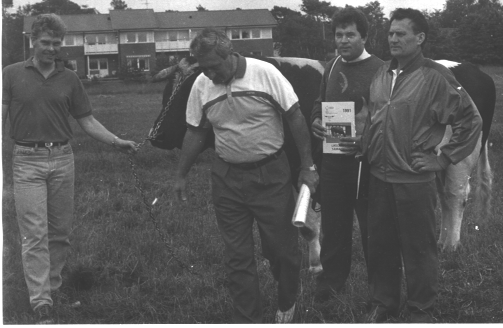
In 1990, Sweden became involved in aid activities within the nuclear power field for the disintegrating Soviet Union, and all Swedish reactors got a “godchild” somewhere in Russia or the Baltics. The Ringhals reactor took care of a pressurized water reactor in the Volgodonsk area – a few hundred kilometers southwest of Stalingrad – which in the new thinking had been conveniently renamed Volgograd. Now preparations are being made to return to the “middle name” – Stalingrad. The residents think Volgograd does not say much.
Since the exchange of knowledge and researchers between the former Soviet Union and the rest of the world was extremely modest during the past years. After the fall of the Soviet Union in the early 90s, a great need arose on both sides to visit each other and see with their own eyes how things really were. Both myths and half-truths circulated about the Soviet Union.
On 91-08-16, a delegation came from the nuclear power plant in Volgodonsk (from an unfinished PWR reactor due to the new “green” opposition in the area) with the reactor chief Mustafinof and a number of his assistants – even a lady from the local newspaper, she was to write about the visit here.
The main goal of the visit was naturally the Ringhals Nuclear Power Plant since some of the reactors here were of the same type as those of the Russians. The visit went well, the Russians got to see and hear everything they wanted and it was plenty. Apart from the chief himself, none of the Russians had been out in the Western world before, and there were many questions and many visits. Mustafinof was interested not only in nuclear power plants but also in what existed outside his actual work area – agriculture – since Halland and the area around Volgodonsk had similar branches with much agriculture and livestock.
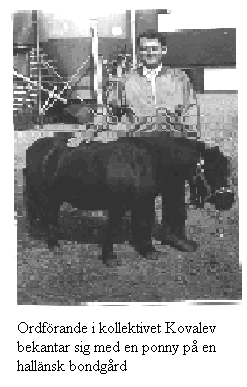
Somewhat outside the nuclear power program, we visited some Halland farms and Mustafinof thought that a number of the sovkhoz farmers in the city council of the Volgodonsk area (where he was a member) would need to see the Swedish model of farmer cooperation
We contacted the chairman of Halland’s LRF Yngvar Olsson. He was on board, and since I had often interpreted for the people at Ringhals, the information chief Torsten Bohl recommended me as interpreter to handle the communications and interpretation during the visit.
Correspondence with the Russians started and in the summer of ’91 a number of Russians came, both from the sovkhoz and from the nuclear power plant. Since the visit was to take place in Halland, it was decided that our guests would land in Copenhagen instead of Stockholm. Together with the ombudsman for LRF in Falkenberg, I drove to Kastrup with a rented Volkswagen bus and met our guests. They seemed to have a lot of quite heavy luggage. When we were to pass customs from Kastrup, the LRF man said that now they should look serious and not a word was to be uttered. The Danish customs officer looked at a number of older gentlemen and a middle-aged lady, nodded, and we passed. I dreaded what the newspapers would write if the customs had conducted a closer inspection.
The following week we visited both Ringhals and a number of farmer cooperatives: with the chairman of Arla’s dairy cooperative at the helm, potato growers, Scan slaughterhouses in Varberg, and a completely modern farm with milk production.
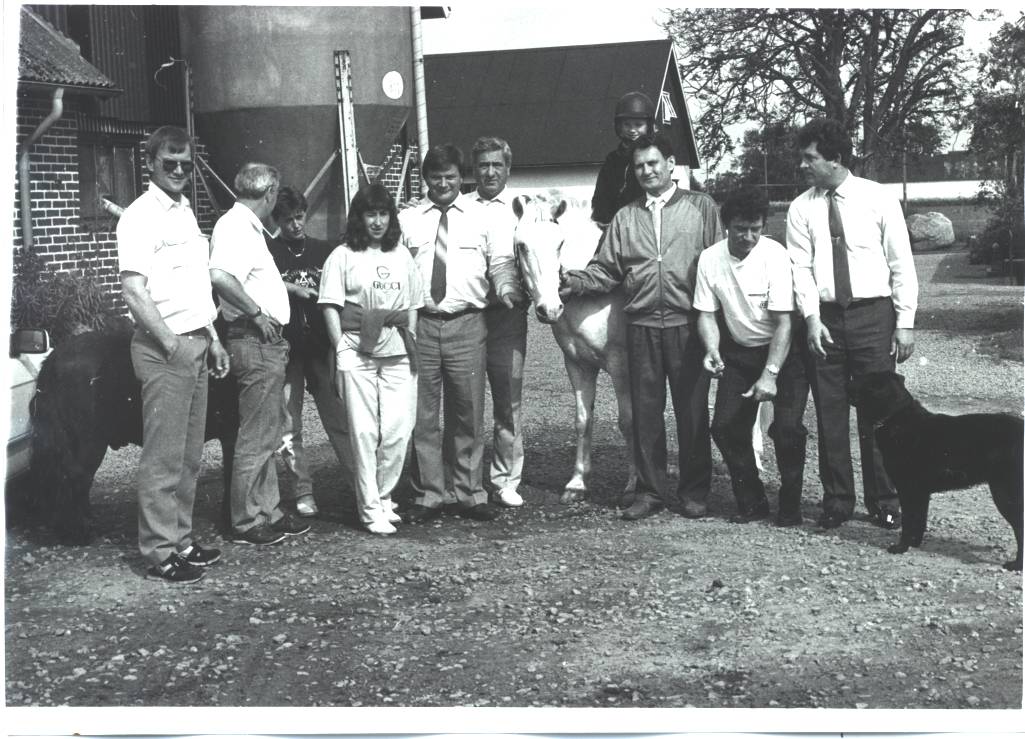
It was a smaller farm somewhere in the area of Tvååker. The farm was run by a young farmer and his wife with two children as well as the farmer’s parents. They had a herd of about 30 dairy cows, some pigs, sheep, chickens, and a border collie. The area was about 50 hectares of open land and the same amount of forest.
It was time to milk. The farmer’s wife went out into the yard, whistled, and a black-and-white border collie appeared at good speed from its kennel. The wife and the dog went to an enclosure, where we saw a number of cows, she gave orders by whistling to the dog, which set off at top speed and began driving the cows toward the farm. It all looked very elegant and professional. The cows came like on a string and went into the barn to be milked.
Among the cows there is a hierarchy – the lead cow entered first into one of the milking stalls – through the transponder the feed dispenser got a signal and 2 kg of concentrate flowed into the feed trough. The farmer said that normally each cow gets about 2 kg of feed at intervals of about 2 hours, regardless of which feeding station it goes to. At milking time there is extra allocation. Through transponders all transactions are recorded in the computer, and if an animal has not followed the program, due to illness or similar, information about that animal will be marked in red on the computer so that the farmer can immediately take action.
It was a completely modern barn, the milking station, where the farmer would handle the teat cups, was sunken so that he could work standing up. The milking went like a dance and the Russians were greatly impressed by the efficiency and comfort of the work.
The barn was for free-stall housing and we saw that in the ceiling hung a large number of black plastic pipes. At the Russians’ question, the young farmer explained that he had a heat pump and extracted heat from the barn. Each cow produces about 1 kW of heat at rest, and with the heat from the cows and the heat pump, he could heat both the main house, the parents’ house, and a number of other buildings. The Russians had never heard of heat pumps, let alone that one had them inside the barn, and their astonishment was great.
All cows were equipped with transponders and the farmer explained that in this way he could maintain very good control over both the animals’ feeding and their health status
Most of the week, however, was spent on discussions and explanations of the Swedish farmer cooperation: its activities and possibilities to help the farmers with both work and finances, which was not always so easy.
Considering the widespread corruption during the Soviet era, the low efficiency of collective farms, and the general decay, a large number of questions arose that for Westerners are obvious but almost incomprehensible for former Soviet citizens.
One such question was, for example, how the various collectives are governed. The LRF people were subjected to a great trial (and the interpreter too) when the governance system in the various dairy, meat, and grain producers’ associations was to be explained. The Russians had great difficulty understanding the cross-connections that occur between the different producer organizations - that board members from one organization sit on the boards of the others, etc. The Russians, who were used to corruption and fraud, had great difficulties understanding the reasoning. It took the Swedes almost half a morning to explain how to hire a CEO for the cooperative and how to maintain control over him.
We visited the dairy farmers’ dairy in Valberga, the meat producers’ Scan slaughterhouse in Varberg, and looked at the grain silos in Falkenberg. Almost everywhere where refreshments were served, the Russians provided the drinks, and we began to understand why they had such large and heavy luggage with them.
Some visits prompted further interest: e.g., slaughterhouse and mill operations. The Soviet state’s way of maintaining control over the collectives consisted in the collectives having no possibility to either store or process the grain themselves. Everything had to be done centrally in the cities to be supervised by the state. The chairman of the former sovkhoz said that sometimes they had such good harvests that they could not be received in the cities, and they were forced to lay the grain on asphalt roads and airfields, with the consequences that could ensue. Now they wanted to see what possibilities existed to purchase mills, build storage silos out in the countryside, and become more independent.
When it started to approach departure, two visitors wanted to stay behind and travel to Avesta and Stockholm to look more closely at the slaughterhouse and mills. The closed large slaughterhouse in Avesta was for sale, and the Juvelkronan mill in Stockholm on Kvarnholmen was selling off some units, which the Russians were very interested in. The LRF ombudsman took care of those who were to return directly from Copenhagen, and I undertook to take care of the two Russians who were to go to Avesta and fly home from Stockholm.
When the visit to the Avesta slaughterhouse was finished, we drove to our cottage Lilla Fredrikslund in Sörmland, where we would stay overnight. Ann-Marie was not in the countryside, so we had to fend for ourselves. I bought pea soup with pork, treated the Russians to a sauna, soup, and punsch, and we spent a couple of days at the cottage. Stronger drinks were provided by the Russians; there seemed to be nearly inexhaustible supplies of vodka, wine, and red champagne from the Volgodonsk area. We spent two pleasant days at the cottage; the guests got to engage in “farming” in the form of mowing grass and burning leaves and branches. Before departure to Stockholm, the Russians left the remaining supplies – two half-bottles of vodka and three bottles of wine.
On Monday morning we traveled to Stockholm, visited the Juvelkronan mill, and in the afternoon the Russians were to fly back to Moscow. No tickets were booked, and a delicate situation arose – would they be able to leave or not? Earlier in the week I had called Aeroflot, but they could not give any information about possible available seats. Most things usually work out with a little improvisation, and I took the chance hoping that it would go well this time too. At Aeroflot’s information desk at Arlanda, the girl could not give any answer but said we should wait. In the Soviet Union, where there was not too much pressure on profitability, there were usually two or three empty seats left on the plane for any delayed dignitaries, and it was important to be first in line. 10 minutes before departure, my Russians were allowed to board, and I breathed a sigh of relief. They did not have large amounts of money with them, and an overnight stay at a hotel was out of the question. If they had not gotten travel arrangements, I would have had to take them back to the cottage and try again the next day. Now everything went well, to the great satisfaction of both LRF in Falkenberg and myself.
A week or so later, Torsten Bohl invited us to an after-celebration at Ringhals.
1991-11-11 Return visit to Volgodonsk
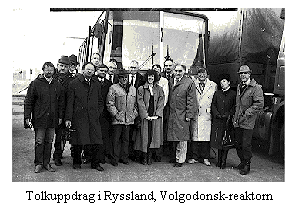
The return visit to Russia took place in mid-November, not an ideal time, dark and chilly. Under the leadership of the head of Halland’s LRF, Yngvar Ohlsson, we gathered in Stockholm at Arlanda to fly to Moscow. We were to bring “souvenirs” and what could be more fitting in Russia than good Swedish beer. Some of the members had been to the Soviet Union before and knew that one could buy Western goods in “Berjoska” shops, stores where one could purchase Western goods for foreign currency. To avoid dragging beer from Sweden, it was decided that the beer would be bought at the Intourist store in Moscow. Upon arrival there, we were lodged at the Rossiya Hotel, and after settling in we headed to the “Berjoska” shop to purchase suitable quantities of drink.
It was a surprise! In the spirit of the new era, the Russians had introduced something they called "gold ruble", worth about $2, and the price of beer under the relevant tariff even exceeded the Swedish beer prices at Systembolaget in Sweden. We regretted our convenience, but what could we do?
- How am I going to explain to the board that we bought so much beer, sighed LRF chairman Yngvar Ohlsson.
In great agony over the accounting upon returning home, a few "slabs" of strong beer were nevertheless bought, and Yngve Ohlsson was deeply worried about how he would explain these high costs for intoxicating beverages to the auditors back home. Vodka we did not worry about; it used to be both cheap and easily available everywhere in Russia.
In Moscow we were well taken care of; we were driven to the airport and boarded the Russian Nuclear Power Board's own aircraft, a 10-seat plane with all amenities. After a couple of three hours of flight we landed in Volgodonsk and were met by our friends from the nuclear power plants. We were lodged in the city's hotel and began our visit.
The nuclear power plants turned out to be a pressurized water plant, (according to reports) 95% complete. However, that was according to Russian perception; the Swedish delegates thought that 75% would be closer to the truth. The saying that: the last 10% takes 50% of the work to complete would apply here. Even the rest left something to be desired. They were not so meticulous. For example, one of the steps to the administration building was considerably higher than the others, and if you did not look carefully, there was a risk of tripping. Inside the nuclear power plant there was some disorder, but no greater than what is usually the case before the final clean-up, so the station director Mustafinof's claim about the completion level might still be somewhat accurate.
In the Volgodonsk area lies the Russians' manufacturing industry for nuclear power products. It is a mammoth facility consisting of two buildings 1 km square, plus some smaller ones with only 600 meters per side. The Russians were in the process of abandoning their RBKM reactors (Chernobyl type) and were manufacturing 1 MW pressurized water reactors. At the entrances to the factory there were long water troughs where employees had to rinse their footwear before entering the factory premises. In spring and autumn, the "black earth" formed a few centimeter thick layer of sludge, which had to be washed off, and in the summers it reportedly got quite dusty even in moderate winds.
The newly awakened nationalist and "green" sentiments were prevalent, and since Mustafinof was a Caucasian, one could see signs and placards with texts: "Russia for the Russians" and similar expressions.
Volgodonsk is not far from Novocherkassk, the central town of the Tatar people. We were going to visit the city, but the autumn fog became so thick that we refrained from the trip.
One of the evenings the "greens" held a meeting and the Swedes decided to pay a visit there. At first we met the secretary of the organization, and supported by a group of middle-aged women, they were not at all willing to let us into the meeting. After a while of persuasion they gave in. Torsten Bohl promised to give a talk on the Swedish view of nuclear power and tell a little about the Swedish reactors.
Torsten spoke for half an hour and I interpreted; afterwards there were quite a lot of questions from the audience: among other things, whether Torsten could and would dare to take over the management of the Russian nuclear power plant. To this Torsten answered yes, but the Russians looked skeptical.
The energy problem is great in the area. After the gathering at the "greens" we were invited to a "cultural meeting" – entertainment in traditional Russian style – and after about an hour the light went out. It became pitch black and we learned that this was common. They distributed electricity and disconnected some areas in turn. The locals were prepared for this and both candles, flashlights, and kerosene lamps appeared.
Nuclear power issues were at the center, but we were also informed and shown the Russian sovkhoz system. Volgodonsk lies in a large agricultural region and the dimensions were sometimes impressive, while certain details were distressing. The sovkhoz "Zhemchuzhchina"'s (the pearl) livestock consisted of a few thousand cows, staying outdoors practically all year round. There was a form of shelter, but basically only a roof, no heat remained in that barn. Length about 800 m and open passage. The herd consisted of rather small, probably quite inbred, but hardy animals. Milk production amounted, according to reports, to about 10 liters/day. The Swedish representative for the milk cooperative told that he had cows that gave up to 45 liters/day. The Russians shook their heads.
The visited area lies in the "black earth" belt and is very fertile. In some cases they could get three harvests per year, but the subsequent handling of the harvest was somewhat antiquated, and there were long discussions with the participating Swedish farmers on how the situation could be improved.
Volgodonsk lies between the rivers Volga and Don and on the canal that connects these two rivers. The cultivated fields consisted of plots of about 40 ha with irrigation. Irrigation was carried out with 800-meter wide irrigation systems on wheels, powered either by a diesel unit or by electricity through an overhead three-phase line. The irrigation operated fully automatically and started when the sensors signaled that the ground was becoming too dry.
The area is known as the northernmost wine-growing region, although the winter temperature could drop to as low as –20 degrees Celsius for a few days. To our question of how they could protect the vines from frost, we received the following explanation. After the growing season ends, they take down the vines from the supports, lay them on the ground, and plow the entire vegetation under with a large plow. The soil is so light and porous that it causes no damage or difficulty. In the spring, when the ground is sufficiently dry, they blow the soil away, tie up the vines, and continue cultivation.
Every other day we visited one of the local wine producers for tasting of wines. As a rule, we were given several bottles as gifts, and upon returning to Stockholm-Arlanda, most of us had over 10 bottles of wine in our luggage. However, there were no difficulties with customs. The inspection was almost nonexistent, and that was because the expensive Russian "gold ruble" made it unprofitable to buy alcohol in Russia at that time, and travelers from Russia came back "empty-handed", which the customs were aware of. I had 14 bottles of red Russian champagne and was a bit nervous passing through customs, but nothing happened and I had wine for many months ahead.
One of the highlights of the visit was the sauna evening in the nuclear power plant's representative sauna on the banks of the Don River. The Russians had experienced Swedish hospitality in the form of sauna bathing, beer drinking, and good food. It was not a quick sauna; no, this event lasted the entire evening with breaks now and then for food and drink. Two men from the nuclear power plant were assigned to take care of the guests' well-being. It started with a fish soup, continued with grilling, and then the party went on for several hours, alternating between sauna bathing and eating and drinking. There were both men and women; we wore thin bath towels to cover our bodies. One of the ladies present was the chairwoman of the local branch of the Communist Party. The sauna was very hot, it smelled of fresh birch (they put a piece of wood on the hot stones), and we were properly served. In Russia, as in Finland, they use birch whisks to whip themselves. We were whipped thoroughly, and those who dared could jump into the Don River to cool off; the water was somewhat chilly as it usually is in November.
Throughout the visit, a younger talent from the nuclear power plant was assigned to document the visit on video, and a few weeks later I received a copy of the tape through Torsten Bohl.
We were also invited to the sovkhoz chairman A.M. Kovalev and his wife. He, like everyone else in the collective, had some livestock, including a couple of pigs. He received pig feed from the collective, on the condition that one of these pigs should be delivered to the collective.