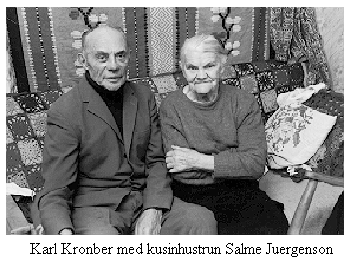
Salme Jữgenson i Tapa 950614
Cousin's wife Salme Jữrgenson tells about her life.
I was born on December 25, 1909, and was 14 when my father died. Then members of the "poor people's committee" came and took our 4 cows, and mother cried. Then collective farms were formed and our livestock were distributed to the poor, they deprived us of everything and called us "kulatskaya morda" i.e., kulak-face. The house was also taken from us and later there was much repression against everyone who had been owners of anything, but we stayed there until the year 1928.
We had already been deprived of our properties earlier, but "at first it was without government involvement, it was so‑called 'poor people'." They came after the revolution in large crowds, stepped into the barn, pointed with their fingers:
That one I want, that one I want....
Mother went to say goodbye to Waldemar, my older brother was already on the deportation list and he went to an acquaintance in the village soviet to be deported, and he left at night. He traveled to Starye Rusy where Rickard and Osvald and Emely lived together with Mali. Emely drowned there and Mali disappeared in the war. Mother came back here to us with Mali's children. From Luga Alvi traveled to Novoselje and I had to take care of one of Mali's children, Alvi took the other, and we raised them together with our mother.
Was it in Luga?
- No, it was in Ploskovo, there they stopped the factory and everyone was sent from Luga to Ploskova. It was 15 kilometers along the river.
Transport was by barges. Father was a glassworks worker. We lived together, there was a shortage of housing, and we bought a house. Bertha was barely a year old and took her first steps there. It was in 1937 when we bought the house and lived there until 1941.
I myself grew up in Ploskovo. The factory in Luga was closed and everyone who worked there was sent to Ploskovo, a distance of 15 km along the river, and the glass materials as well as the people were transported by barges along the river. Father was a glass smelter. When the war started we went to the forest, Bertha and Erich were there too, and we were in the forest until the Germans came. Father stayed with the cows in the forest while I returned home with the children. I had locked the doors and buried our few valuables in the ground in several places, but someone had discovered this and stolen everything.
When we came home, the Germans were standing behind the woodshed trying to get the door open... Erich was about 10 years old and he ran forward, I ran after with the key so they wouldn't break the door. The Germans watched us when we arrived at the house and heard me shout Erich! Erich! That is a German first name originally. They stopped trying to open the door, looked at us and shouted: Estonia! Estonia!
I answered yes, yes Estonia! Then one of the German soldiers came forward, they took Bertha in their arms and began to joke with her, but Bertha got scared and started screaming and crying. When the Germans found out we were Estonians, they moved into our house and took possession of one of the rooms. Many Germans then lived there in several shifts, one unit moved out and another moved in. When they began to retreat from the Leningrad area, they told us that we should move together with them to Estonia. They helped us with everything, with packages and chests, they were kind to us. It was a pity to have to leave the house and we cried bitter tears. They packed all our belongings, took care of the cow and two goats, to get milk for the children, it was October 3. On October 4 we arrived in Tapa, at a prisoner-of-war camp set up by the Germans. We brought all our belongings with us, including our cows and some other things and household goods, and we grazed our cows where the cemetery now is. Bertha played under the trees in the cemetery. Eventually an order came from the Germans that we were to be lodged in houses in the town and not stay in the camp barracks. They said we needed a room of at least 22 square meters no matter how many we were, and we moved into Karkus, into Ehtla's house. My sister Alvie, our mother, a nephew, and two nieces Leida and Luise, and our family of four moved there. In total we were 9 people living in the house. The landlady also lived there, she offered us a housewarming soup from a large pot. We ourselves had brought a lot of food, meat and various preserves, so the children were not hungry, and the landlady was a little annoyed:
- Spoiled refugees!
All spring we lived together in Karkus village, a bit away from the town, about 8 km. It was quite cramped in one room for 9 people. We moved in Karkus to Klamms' house, where two bachelors and a maiden lived. The maiden was considered quite lazy and I was asked if I wanted to take care of the animals on the farm. They had 3 cows, and I could also have my cow with, and I became an animal keeper. In the spring we got a piglet and we lived there until the Russians reconquered Estonia and father moved to Tapa where he got work. The houses were partly damaged, all windows were broken, and he started by glazing. The year was 1945. At that time we did not live in that house, it was at Nikuli Street 3, on the second floor, a house where soldiers lived, and when they moved, father went to the management (he spoke Russian) and got the apartment. He helped in the sovkhoz. Later the house was used as a school, I became a school cleaner and Erich started school - in 5th grade. We lived there and could keep some animals, a barn had collapsed, but not completely, so that one could build a cowshed under the roof, where we had our cow, pigs, and hay storage. We started looking for something better and said that on top of the somewhat collapsed barn they held Saturday dances and that we could not keep our animals there. I was somewhat against it and did not want to move just anywhere, but they started trying to find a new home for us. After a while we got this house, which naturally caused some envy.
I told them that I had a nervous old mother and that I worked and I couldn't take just any job. Finally we got a home here anyway, and many were envious. We came in the autumn with a large load of potatoes. We had planted potatoes in the spring and father was a diligent worker, we had a pig, a cow, and several chickens, while here there were no animals. The pig could be slaughtered and the cow gave milk. Those who lived here had no animals and they cursed us:
- Here come Russia's ........ and think they'll become rich!
We had our animals from Russia, but we had much unpleasantness because people were envious of us and didn't like that we might become well off. It was pure envy.
In 1952 we came here to Estonia. They sent me to .............. and he asked why I didn't want to move in there. I answered that I cannot live there, I must have animals. Without animals I cannot manage, my son is in military service. He is just a common soldier, said the soldier, whereupon I replied that he was not a general during his first term either. I believe my son will not remain a soldier throughout his service. Anni was 5 years old when we came here. Villes.......... his parents were deported because both had been teachers, I didn't have much myself but I helped them so much that they got started. The salary I received, I used for improvements, while the animals provided food. I have lived here since then, this is the third home I have lived in.
When Erich got married, he built a house and moved, I went to the city administration and said that I should get his housing. And so it happened. When Anni also married, I moved up here to the upper floor. As an old person, I want a little more peace and quiet. It is quite good. Now I have 6 grandchildren and I have raised them all because there was no daycare here. They all grew up with me – 6 of them. Both children and grandchildren have turned out well and I can be satisfied with life. A while ago I broke my leg and it caused some difficulties with the stairs and starting the TV. I had to use the cane to turn on the device. I live by myself and I don't interfere too much in my children's affairs.
The revolution began when the father had died, and the Russians started begging more and more. They came and wanted to borrow one thing or another, and if you gave them nothing, you got scolded:
- Kulatskaya morda! (Kulak-face). Кулацкая morda
I was tired of the Russians. Currently a Russian lives here in the house, he does not work. We have plenty of arable land. I said to him:
- Dig up the land, you can get plants from me! He shakes his head but is not interested in work at all. He probably wishes for the "old times" with confiscation, but now we are in Estonia and the Soviet regime, and the Russians are at least temporarily a closed chapter.
Salme died in mid-January 2000.
Recordings
- 19950614 Salme 0ch Karl i Tapa A.mp3
- 19950614 Salme och Karl i Tapa B.mp3