Trip to Estonia and Russia, 1998-09-19
After a successful trip to the homeland in Russia and the visit with friends and relatives in Estonia, it may be time to write down a few lines and tell about the trip and what transpired.
Already on September 10 I intended to leave by ferry from Stockholm to Tallinn, but when I called the Estline office in Stockholm I was informed that on that very day the "Neptun" ferry was carrying cargo only. Usually it also takes a number of deck passengers. When I asked what was the hindrance for passengers to come along, the girl on the phone replied that it was dangerous cargo. Wonder if it had something to do with nuclear power or if Bofors was delivering gunpowder somewhere.
Karl has read somewhere in a newspaper that the Estonia disaster would be a deliberate act because a certain amount of cobalt was dumped, but that theory is hard to believe. Such a cargo would in all likelihood have been dumped somewhere in the Atlantic and only by the Russians. In the other countries the control is so thorough that such a thing can hardly happen without the authorities and the public finding out about it. However, it still seems today (2001-03-07) something shady about the sinking of the Estonia, several commissions have not been able to give a satisfactory answer why the sinking was so rapid and why so few people (including from the crew) could be rescued.
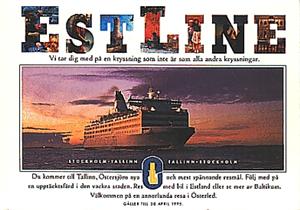
I almost became one of those possible victims. The week before the sinking I was on my way to Estonia, the departure would have been on Thursday and the return trip on the night of September 27‑28, when the Estonia disaster occurred. However, we had long planned a family cruise to Finland, the girls were most interested in that. Before my departure on the Estonia (Wednesday, September 22) Maria called and said she had obtained favorable cruise tickets to Finland and also decided on our behalf that now the trip would happen.
"Tomas can't get away anyway, he has something else to do," said Maria. I thought it was a good idea with a family cruise and decided to travel to Tallinn later.
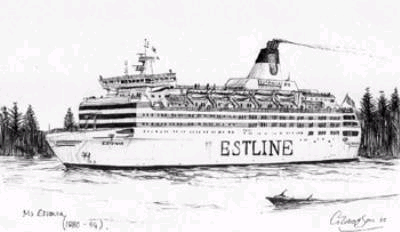
We did our cruise and the following Wednesday morning we heard in the news broadcast that Estonia had sunk. There were several who knew I intended to travel and some did not dare to call Ann-Marie for several days, afraid that I too would have been on the fateful trip. It was apparently not meant that I should die yet, I would hardly have had any chance of rescue given my age (66), the sea conditions and the cold water. The oldest rescued was the fire chief and rescue expert in Katrineholm – Sten Jolind. He who is to be hanged cannot drown, (Кто будет повешен тот не утонет) reads a Russian proverb.
It was the ferry Regina Baltica on September 9 that I crossed to Estonia and was met by Bella's husband Rein. Bella was working and to Karl and the other relatives I had informed that they did not need to come and meet me. Karl is starting to become too old to travel alone and Albert & Faina work and are also renovating their house and have no time for extra excursions.
Already early in the spring I had in a conversation with Bella agreed that I together with them would travel and visit Vera Petrovna and also pay a visit to my birthplace in Pustaperzha (under Soviet times renamed to the village of Leiner). Vera's daughter Tanja had bought a summer place near our former properties and Vera Petrovna lived there at that time. From Tallinn I traveled to Tapa to visit Karl, he was waiting for me at the station – unshaven and quite thin. Now he lives on the 5th floor and has no conversation partners. The relationship between him and his son and daughter-in-law is apparently not entirely in order. Karl is beginning to suffer from senility and suspects everyone and everything of wanting to rob him. In the apartment where he lives (and which I bought in Albert's son Alexej's name) there is really nothing to steal, but that doesn't help. Karl is of course disappointed that they don't pay enough attention to him, but on the other hand he hasn't been an exemplary father either, but he doesn't want to understand that. Albert & Faina do their best, but when Karl complains that they go into his apartment and steal things, then it naturally discourages them from visiting him. With regard to the shortened lifespan also in Estonia, it means that Karl has outlived most of his friends and is now quite lonely – disappointed and disillusioned. He listens too much to radio and watches too much TV. Both the Estonian and the Russian programs are (the little I saw) even worse than the Swedish ones – they use tinsel of the very worst (and from a production perspective) cheapest kind. Moreover, Karl's TV is not of the latest model and the picture is both blurry and flickering. Moscow radio does not have any FM band in Estonia and the sound is accordingly.
Karl is beginning to be too old to live alone. I went with him to the Social Office in Tapa, but a place in the old people's home would for his part (considering that the children live in the same country) cost close to 3,000 EEK/month and the money is not enough for either him or Albert & Faina. Karl gets something over 1,000 EEK/month and the current rent is about 300 EEK/month. The daughter Maja has been "mamma's girl" and has only sporadic contacts with Karl and Valentin is away in Russia and out of the picture. I contribute to some extent to Karl's rent, but it is not enough.
On Sunday morning we (Bella & Rein and I) set off with their Opel Berlina. After we had maneuvered out of Tallinn (where traffic is becoming Western) the journey went both fast and comfortably. The Estonian roads are relatively good, for many miles they have asphalted the roadway and done it in a (for both passengers and the car) "humane" way. We traveled the route Paide – Põltsamaa – Dorpat – Petseri and eventually got out to the Riga – St. Petersburg road. The border crossing to Russia is the same as before. Almost like in Soviet times, but even worse. On the Estonian side there were four people: a customs officer, a passport policeman, a female police officer whose job was to stamp the passport, and a border guard who operated the barrier. It took 5 minutes. Then began the traditional Russian misery. On their side there is a huge facility with a whole village and although the number of actors does not seem to be too large, they do their job irritatingly slowly. First you are met by a "barrier guard." He takes the passports and drags himself to a guard booth a few meters away. It takes at best about 15 minutes. When he returns and hands over the passports you drive a hundred meters forward to the Russian "border village." The houses are built by Yugoslavs and do not fit into the Russian picture (considering how it looked in Vaalimaa). There you are first met by a customs officer. He wants you to write a complete declaration about the import of cars into Russia, then it takes a slow procedure on their computer which seems to be from "days of yore," certainly one of the world's slowest instruments. I looked a bit at the procedure through the window, but the windows are strongly one-way and I couldn't see very well what they were doing. Despite the thoroughness, the customs officer missed our declaration about the currency owned, which caused us some trouble, though not of any major extent considering Russian conditions.
The house turned out to be a rather dilapidated shack, though not worse than most Russian houses. The stove was repaired and that meant a possibility to live there even in winter, which Vera Petrovna had done, but does not intend to do again because the roads are not plowed and she has difficulty reaching the shop. Moreover, not all the houses around her are inhabited, most are used, according to reports, as summer residences for St. Petersburg residents. The yard is fenced with a fence to prevent Joy (the dog) from setting off on any adventures. "Without Joy I could not live here," said Vera. The surroundings consist mostly of what one would call "clientele" here and when she told how she got "help" with laying new roofing felt, one understood that there was still no great hope for Russia. The drinking is if possible even worse than before.
The actual customs check of the car was about the same as in the West, so there has been some improvement after all. After the customs officer you drove forward to the border police (three car lengths) and there it continued with similar procedure. When we were done with this as well, there was yet another obstacle in the form of a barrier guard. There the same procedure was repeated as at the first barrier, although the booth was a couple of hundred meters away from the main station. In total it took a little over an hour at the border station – without there being more than two cars ahead of us.
From the border station the journey continued through Pskov, which we passed reasonably quickly, although there was practically no signage worth mentioning. It was just to follow the straightest road and the largest stream of cars. From Pskov it is a stretch of about 40 km to the village of Zapelka where Vera Petrovna lives. The entrance to the village of Gora lies just before the Zapelka sign, then it becomes more difficult. The house where she lives is on top of a hill and the road there is not always passable with an ordinary passenger car. The ground consists of sand and clay, the track is cut up by a tractor and the last stretch Bella and I had to get out and walk so that the Opel would not scrape off too much of the underbody.
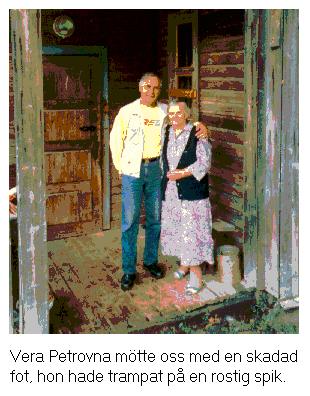
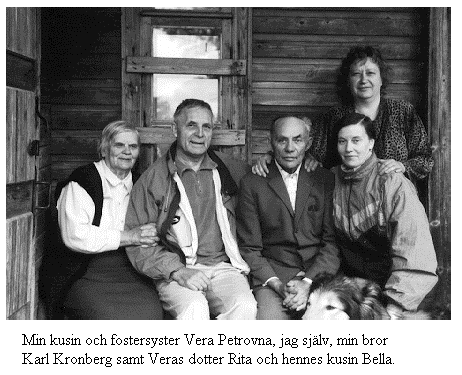
Vera Petrovna came out – limping. It turned out that she had stepped on a nail and the foot was still not healed. At the moment she was home alone with Tanja's dog (a collie of the largest kind). Soon after, however, Tanja came with her son Alexej, they had been down in the village shopping. Bella had also bought a lot of groceries when we passed Dorpat so in that respect it was well supplied. Rein is not one to forget the drinks and he pulled out several bottles from the hiding places.
After the arrival and inspection of the lot and the house, the party began. We ate and drank in the usual Russian style. At first, Tanja's son Alexej was also there, but after the third shot, which Tanja didn't want him to take, he sneaked off upstairs and after that we only saw him sporadically. He doesn't seem to be very capable; the firewood is lying out in the yard and should have been chopped and stacked before the rains came, but nothing like that has been done. His initiative does not seem to be very great, but apparently he obeys Vera Petrovna and she does after all have some help from him. Tanja, on the other hand, has risen considerably in my estimation. She has bought the house—you certainly don't get a palace for 2000 USD, but considering that she is alone taking care of her son and is very helpful towards her mother, it is still admirable. Moreover, she has gotten her driver's license and even bought a car. The car was damaged at the time, however, and she came to Zapelka by bus.
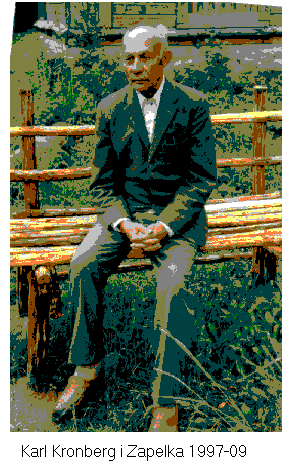
Vera was very excited and the only thing she regretted was that Karl had not come along. Karl thought it would be too troublesome for him to travel and stayed in Tapa.
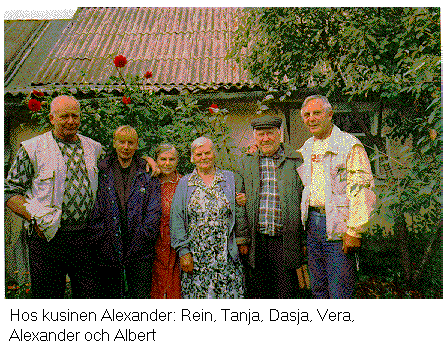
Vera has a brother still alive. He lives in the summers north of Pskov and we decided to pay him a visit. In Pskov we were going to visit the hospital to possibly get some help for Vera's injured foot, but it was a waste of time. First of all, it took a considerable time to find the city's hospital; there were no signs to go by, not even directions near the hospital itself. Vera went into the emergency room with Tanja and Bella, but there was no help to be had there. She is registered in St. Petersburg, which in itself was a small obstacle, but the main reason was still that they had no medications, only a few bandages and ointments to offer.
Cousin Alexander Topper turned out to be a gentleman in his 85s, but still quite spry and healthy. (The old peasants are a tough breed). He lives with his divorced daughter in Seredka, in a relatively good summer house (by Russian standards). There we were well received, and the letter that Bella had sent from Tallinn a week earlier announcing our arrival arrived only a couple of hours after we had arrived.
While the rest of the party inspected the house with the daughter who
as a guide I interviewed Alexander Topper—our cousin. It became almost an hour-long story about his life and adventures in the great Russia. His parents were owners of a mill, but they were not deported anywhere; they simply became workers on the mill they had owned. Alexander had voluntarily gone to Kirovsk in 1939, when conditions on the collective farms became too difficult, and had experienced a great deal during his long life. He had lived both in Komi and in Kazakhstan before, after having served in the Soviet Army's Estonian Corps during the war, settling in Leningrad.
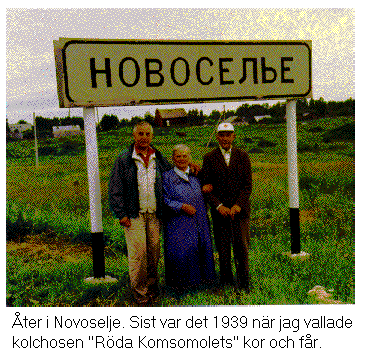
On Saturday, September 15, it was time to carry out my real errand—to visit my birthplace in Pustaperzha, a few kilometers west of Novoselje station.
I knew roughly from Karl's description where the place should be, but to be safe I asked an elderly couple about it.
– We don't know, have never heard of Pustaperzha, but in Pervenez, in the largest house opposite the bus stop, lives Maria Alexeevna Ivanova and she usually knows most about those who have lived there before.
– We stopped at the indicated house and with the help of a younger woman we found Maria Alexeevna. She was sitting on the toilet and it took considerable time before she could come out. In the meantime, Bella and I could look at a Russian collective farm dwelling, and the sight was not very encouraging. It is always a terrible mess, lots of unusable things lying here and there, and the ever-present Russian smell—it can be too much. When Maria Alexeevna came out, she truly proved to be a source of knowledge of great proportions.
She told (assisted by the younger woman) quite well where the site of our farm was and we drove there, but despite our efforts we did not find it. What were we to do? Returning with unfinished business did not feel very good. We went back to Pervenez and the younger woman was willing to come with us. We had to leave Vera and Tanja in Pervenez and drove out again to what was supposed to be my birthplace—and this time we got it right.
– Here it is, said the woman after we had trudged across a field, partly through a forest, and finally found ourselves at the cellar of the house.
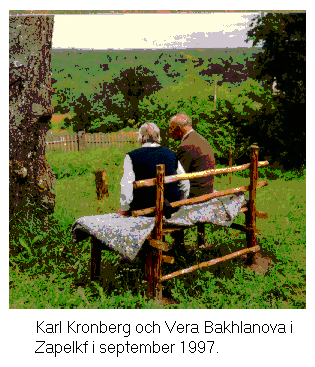
It turned out that we had been at about 50 meters' distance from the foundations, but everything was overgrown with scrub and Bella had only found some stones, which we had ignored. The place is on the road Novoselje–Molozhane, at the signpost 6 km from the village of Pervenetz. In 1939, when I last visited the place, the barn foundation and the building's lower floor of large boulders were still there. Now there were only a few scattered stones, partially overgrown with grass and scrub. The woman, however, knew where there was something more permanent and took us to the root cellar. According to Karl, the cellar was supposed to have been built in our grandfather's time sometime at the beginning of this century. It was largely in its original condition, except that the front wall of brick was gone. The vault was still intact and the hanging hooks in place. The cellar had approximate dimensions of 6 x 3 x 2 meters at the center. The strange thing was that the vault itself was completely undamaged, despite the fact that the birch tree that grew on the root cellar's roof, when I visited the place in 1939, was then the thickness of an arm, had now grown to the thickness of a man's torso. The roots had not been able to penetrate the roof and damage the structure. There was forest growing all around, and one could only spot the cellar from the opening side; otherwise it looked like any hill in the forest. We took some pictures, but I do not hold great hope that they turned out well; the weather was rainy and it was dark in the forest.
When we returned to Pervenetz, I took the opportunity to interview Maria Alexeevna and she had much to tell. It turned out that she (despite her young age in the context—born in 1924) remembered a lot from the 1930s and the years thereafter. She remembered my mother and her siblings.
– Yes, I remember the Kronbergs, Milja, Milja (Russian diminutive for Emely), she mentioned several of them by name and told that Pustaperzha at the confiscation and deportations had been renamed to the settlement 'Leiner', which had become some kind of area center.
Now we had accomplished the main errand and could return to Zapelka and celebrate the event with more food and drink. Vera told anecdotes from her life and about her stay in the Irkutsk area during the war. She had been an ardent activist in the Komsomol movement, which she now acknowledged as the great mistake of her life.
On my return, I got out of the car in Dorpat and took the train to Tapa to spend the night at Karl's. I helped him with some errands and the whole Monday was spent on that. On Tuesday I had to leave for Tallinn already at 11 o'clock; there was no later train to make it to the ferry.
Bella had been tasked with trying to reach Waldemar; I myself also called several times from Tapa some numbers from the old days, but neither Bella nor I could reach him. The old address at Kadaka tee 157 – 45 should still work and the telephone there is 009372-2-533 845. They have probably lost their townhouse in Luige just outside Tallinn forever. Lida would turn in her grave if she knew how little sense Waldemar has used. Karl used to say in the old days that the Kronbergs are ruled by their women; here it is not only a question of Olga but perhaps most of all the mother-in-law.
Waldemar unfortunately does not have a very good reputation among the relatives; he promises without keeping his word, and he disappointed me greatly a few years ago when I was supposed to visit our homeland together with him and Karl. Even though we had agreed on the trip long before my arrival in Tallinn, Waldemar took off with Olga and his mother-in-law to Kaliningrad. He was supposed to return within a couple of days so that we would have time to make the trip, but when he finally got in touch, it was too late for me to undertake the trip; I had an interpretation assignment and could not wait that long. Now I heard again about a number of broken promises on his part, and it is sad.
Estonia is beginning to emerge from the misery and a lot has improved. There are many shops and bars as well as cafes here and there, and the selection is relatively large. There is no shortage of food, but for the inhabitants with low pensions many goods are far too expensive—and prices are rising all the time. The roads are beginning to be relatively good and you roll along the road instead of being shaken, which is still the case with Russian roads. There, even the newly laid asphalt is not smooth; they have patted it a bit with a shovel, you travel shaking the whole time, and it is clear that they do not use any rollers. Most things are as usual: GAI (the State Traffic Inspectorate) stands just as densely by the roads as before and monitors traffic. Sometimes they take the car and go out to the straight stretches to catch some speeders, but the collegiality among drivers is great and you are constantly warned with flashing lights from oncoming drivers when they have passed some GAI comrades with laser pistols.
The trains in Estonia do not run as frequently as before and the railways are in miserable condition. Albert and Faina are worried; their railway depot is going to be privatized and they do not know if they will still have a job after the New Year. Just before that, they have taken a loan to renovate the house and are now very concerned about the situation. The house has been completely renovated on the outside with a new roof and new horizontal panels. Moreover, they are building a small service building with sauna, laundry room, and storage space for garden produce. Inside, the renovation consists of a new kitchen and a new toilet. They still do not have their own telephone, but can be reached through their daughter Alena. She is married and has a little son, Kiril. Upon my return to Tapa, I was together with Karl at their place for tea. The man works on the railway and seems to be a decent fellow; Alena looks to be doing well.
There is not much to say about the journey from Tallinn to Stockholm. The flow of travelers at this time of year is thin and there were not many people on board. It was blowing quite hard and the swell was noticeable. The boat shuddered a few times, but it does not seem to be any danger. It is not a traditional ferry, but a real boat, a Russian boat - Anna Karenina. The vessel is completely rebuilt and in decent condition, with proper gangways and good spaces.
Rein is some kind of harbor master in Tallinn and the city has built a new terminal for the Sweden traffic. Smart and completely Western, but located somewhat further east from the previous terminal. Bella works at Kaubamaja, a department store, and is in charge of the women's shoe department.
Recordings
- 1997 Kusinen Vera och brodern Karl berättar A.mp3