Karl recounts on 25 August 1991
Karl recounts in Estonian
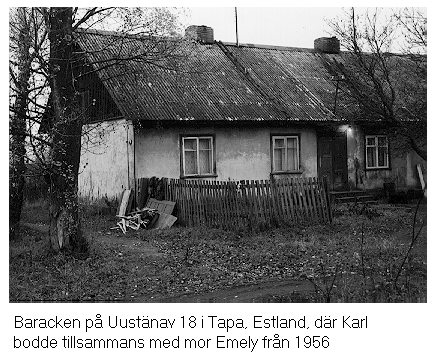
BHousing shortage was great in Tapa after the war and in such a large house I would not be allowed to live alone with my family. The depot chief called me and asked who I wanted to have with me in the house. There was a one-room apartment and also one with two rooms and a kitchen. I worked with Pavlov, we were five people and they were three, Pavlov got the small apartment and we got the large one. That is how our life in Tapa began. I was already quite exhausted, I went to Narva and had a bottle of milk with me, but could barely even drink that. I could not get any sleep, besides it was summertime and quite warm. In Tallinn they could not cure my fever, it turned out to be long-lasting and I was sent on 13 February to Dorpat. On 15 March Professor Karu came and observed that my crown bone had sunk and become completely flat. Brain fever leads to such consequences. The professor shows this to our female doctor, I myself had barely noticed it. I went to the mirror and discovered it myself, the crown was flat like an airfield. The doctor came to his room, took my hand and it was as if an electric shock had gone through me, my nerves were out of order and I could barely drink anything but all the water. He went back to the examination room and when he came out he informed me that I had been put on sick leave for 6 months. Only in August did I get out again. It was in Tallinn's Psychiatric Hospital.
At that time Beria's madness was still rampant. On 5 March Stalin died and they fired anti-aircraft guns in the middle of the night. Stalin was dead and after his death they celebrated it, whether out of joy or sorrow no one knew. The times of Beria came and at first I was in intensive care. In the ward there was a KGB major and an artist Roosileht from the Academic Theatre, he had drunk so much that he was completely paralyzed on one side. From Narva there was a 2nd 'raikom' (district committee) secretary and from Baltiski station a restaurant director. All were admitted for alcoholism. We lay in the same room, in the same company. In the morning I go to the dining hall to eat, but my other roommates got a zinc ointment and a bottle on the table until lunch. They came out only at lunch, yellow and worn out. I was together with them for several months. The KGB major was good at telling jokes. Whole evenings
he told jokes and anecdotes, the nurse admonished him to stop, otherwise she would move him to the 1st ward.
- Soon, soon, said the major. I'll stop when you have gone.
We took possession of the apartment in Tapa in 1950 together with Pavlov, it is the same house that Albert lives in now. We lived there until 1953, until I became ill and was gone for half a year. I came out of the hospital practically naked, someone had stolen my clothes. Luckily Bella could help me with some clothes. (Bella is a cousin child of ours, Minna's daughter). Everything was stolen, coat, trousers and boots. In total the theft comprised around 50 clothing items, some discharged patients had to go home in hospital clothes.
Minna came after me and I went with them, from Leningrad had come Anna Rogenbaum (daughter of Aadu Jurgenson), she had worked there all the time. We were going to celebrate and I was also going to have a drink, at night I could not sleep because my feet ached, it was a terrible feeling.
I arrived in Tapa and the registrar of the railway ambulance took care of me. I lived with him for one or a couple of years during the sick leave period, later I started working and got an apartment in a stone house. I had fallen out with Maria and half of the salary went to pay child support, I did not live with her from 1953, when I entered the hospital. During the war we each got an American coat, she took mine so that I only had a soldier's greatcoat and a pair of boots. Dressed in these I visited clubs etc., I had no other clothes.
At first I worked in a kolkhoz, I installed a heating system in a pigsty, there were about ten radiators for steam heating. After that I came to the military airfield, installed heating there. One of our relatives, Salme Jurgenson, who worked as a guard at the railway, told me that a mechanic was needed in the railway garage. I started working there and stayed working until 1956, reached the third category and my troubles began again. Things got so bad with both money and food that I relapsed into brain fever. I was again in hospital for about a month and a half, I entered in December and came out sometime in February.
I then resigned from my work and traveled to the Caucasus. It was in February and the carriages were cold, the temperature stayed below -20 degrees. I became acquainted with Leida through Sass Jurgenson, she was at a hand funeral sometime in 1964 or 1966. She is related to Jhrgenson and Leida asked me several times if I wanted to come to the Caucasus. Here in Tapa the wages were low and in the Caucasus it was even worse from that point of view. Leida, however, had a good income, she distilled vodka and I had no employment during that year in the Caucasus, I helped Leida distil vodka..
I came in February to Kubanj, it was warm there and people slept on benches in the parks. I had come from Leningrad, a journey of 10-12 hours, and was dressed in thick fufaika jacket and trousers and had a pair of thick long johns underneath. In Leningrad the station was not heated. For a whole year I did not work outside, I boiled moonshine for Leida while she worked in the Estonian fruit collective.
After some time I saw an advertisement where they needed a mechanic for refrigeration machinery. I went to the German boss at the plant and he took me without any commission examinations. I worked as an apprentice for a couple of three months, there was no automation and it took time to learn the hand movements because all regulation had to be done by hand. There I worked as a duty mechanic for about 4-5 hours daily. It was about maintaining the temperature at about -22C at cooling and -16C at the pre-warming. When the shift came they went around and checked what the cooling temperature was. I worked there until 1973, it was a good job. For a while I worked at a chicken farm, a chicken slaughterhouse but it was quite boring. You look at the eggs and feel uncomfortable. The stoker there asked how long I would work there, I came to him and I was declared fit for work in August 1974. Now I was taking care of a Skoda hatchery machine. In August I was freed from the obligation to be registered at the hospital..
By then I had had some visits during the holidays, Waldemar had been there, then Albert came with Faina and Lena. Everyone has been on holiday with me. I thought that taking care of a hatchery machine was not a real job and went back with the relatives to Estonia. An acquaintance signed me up in the construction industry and that work I was well familiar with, we built over a couple of years about 5-6 houses, we mainly did interior work and roofing. I already had a pension from the Caucasus, in 1969 I became a pensioner with 64 rubles a month and many thought that was a good pension. Here I got a job with 120 rubles a month and with the pension it became almost 200 rubles. For a while I worked in the kolkhoz, where they paid 10 rubles a month, but you were not allowed to earn more than 300 rubles so I worked no more than 18 days per month. After the kolkhoz I started building a house for Maria II, then there was no more kolkhoz work. Now I am at home and mostly busy with heating my apartment, cooking and laundry. I wash myself, there is no point in sending out the laundry, after a couple of washes the clothes are finished. Machine washing wears heavily on the clothes. I probably would have gotten another apartment in a larger house, but I have a feeling that it might be difficult to keep a large house warm now when unemployment etc. sets in, and no fuel is granted for heating.
What else would you like to hear about the old times, I asked him.
That cannot be told now, perhaps I will tell it when I get even older. Albert Jr is not free either, Faina had a child already before Albert Jr. The child lives in Lithuania and Faina had it already at the age of 13-14. Her stomach is quite damaged, wrinkled and strange. She is a victim of the Soviet system, says Karl, she was raped by a party member at the orphanage.
With Valentin it is also bad, his son Igor was visiting here this year and I tried to get him to help with potato planting, but he ran off back to Tallin. He studied for a couple of years to become a locomotive engineer, but abandoned it and moved to some other work. He lives on the street opposite Sveta and Evgeni in some wooden house on Paldiski maantee-gatan. (Evgeni fell victim to alcoholism and died at the end of the 1990s). Igor and his wife have a couple of children, I have met them at Valentin's Maria. They are doing quite poorly, one salary to support a wife and two children, it does not go far. (According to reports, Igor died at the beginning of the 2000s). First one should get a profession and then start a family. Faina is a good wife. Waldemar is in the same situation. Neither of them has taken a wife, they have been taken as husbands. Waldemar has to wash and take care of everything himself, Olga takes leave every year and goes off on vacation to her mother in Ukraine. Right now Waldemar is doing quite well, of course, there one can cheat the system.
Alida was not entirely satisfied with Waldemar's wife, (which mother-in-law isn't?) they can hardly socialize. Olga is somewhat of a Great Russian and even Ann-Mari began to think that she had certain shortcomings as a housewife, Ann-Marie rarely remarks on anyone, and never without some real reason.
Many of our wives are only half human, all of life seems to be forced labor, there is no freedom. In children's colonies the children are raped, maybe something like that has happened to Faina. If a party member rapes a woman, no one rises to her defense. In Kubanj there was a saying that if a girl wanted to get a passport from the collective, she would have to sleep with the party bigwig.
In the old days it happened that the landowner would sleep with the bride, but there were some men who bought a whore from town and sent her to the landowner, since he did not always know what the bride looked like.
Father told about a landowner in Estonia. He was going to have one of the farmhands whipped for some offense. The brother found out that this was about to happen, took a hay fork and stabbed the landowner to death. He was sent to Siberia together with his brother. In Siberia they worked their way up, became quite rich, and returned to the old country as very wealthy gentlemen.
Marxism was taken seriously. Soon the party will lose its power and it will be, as Schewarnadze has said, a new bloodbath, they will beat the communists to death. The people are so angry with the party, all this slaughter and camp internment means that those who have been camp prisoners have nothing to lose, they have been turned into savages and will not care about what happens next. Some revenge is already being taken on the communists and the Soviet government. In front of the former KGB palace in Moscow, a memorial has been erected in the form of a large stone from the prison camp Magadan to the memory of all those who were sent to the wilderness near Kamchatka. There the stone stands together with one of the Jewish "world improvers" Felix Dzherzhinsky and the former KGB men (there are surely many still in the building) will be reminded of their destructive and misanthropic communist ideas.
The small nations have taken some revenge and remind the communists of what has been. In Tapa, on the wall of the railway station, they have put up a copper plaque telling that from here an armored train went out to fight the Russian occupiers in the First World War. In Tallinn, shortly after the new independence in the early 90s, there were several signs over a cellar ruin, telling that here the Russians dropped a number of bombs just before the new occupation at the beginning of the Second World War.
Recordings
- 1991 Karsl berättelse om lok, skogsarbetea mm avsn. A.mp3
- 1991 Karsl berättelse om lok, skogsarbetea mm avsn. AA.mp3
- 1991 Karsl berättelse om lok, skogsarbetea mm avsn. AB.mp3
- 1991 Karsl berättelse om lok, skogsarbetea mm avsn. B.mp3
- 19941217 Karl om livet i Kirovsk XB.mp3
- 19941217 Karl om livet i Kirovsk XC.mp3
- 19941217 Karl om livet i Kirovsk XD.mp3
- 910825 nr 2 forts Karl om livet i Tapa efter jruget A.mp3
- 910825 nr 2 forts Karl om livet i Tapa efter jrugetB.mp3